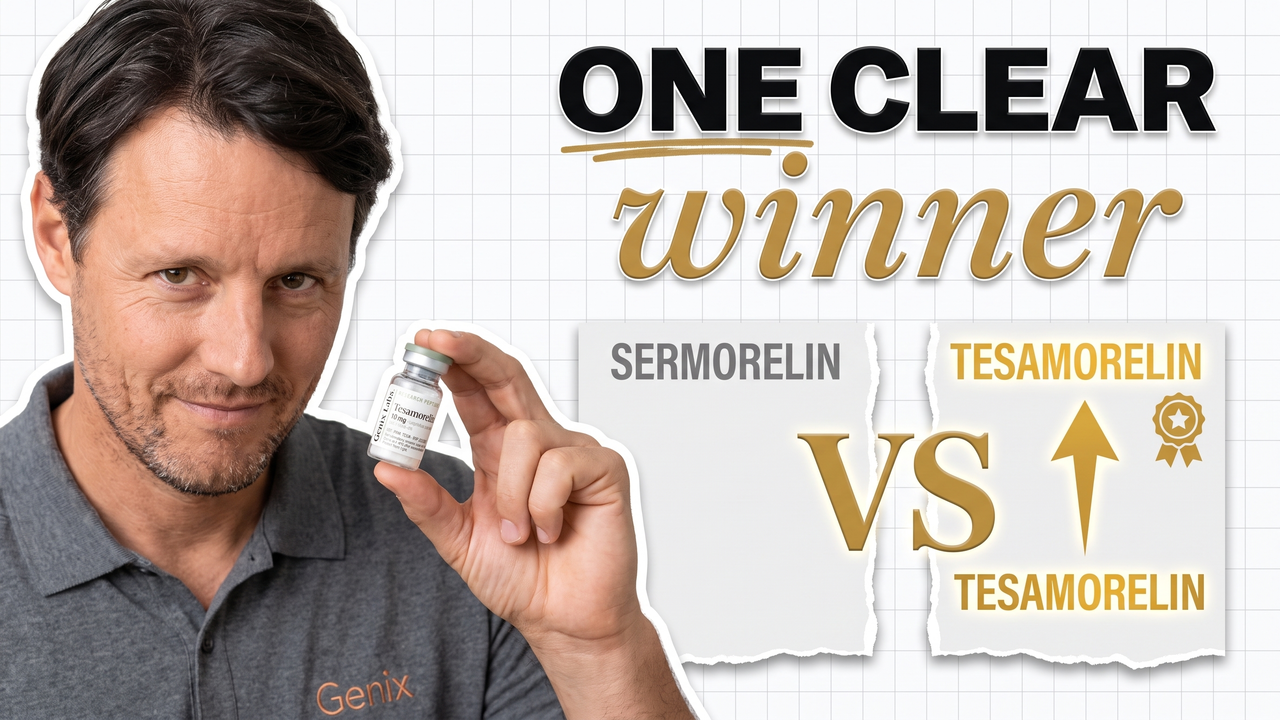
Tesamorelin and sermorelin are the two most talked-about growth-hormone peptides. They sound alike and work in the same basic way, but they are not equal. One is older and short-acting. The other is stronger, lasts longer, and is the only one with large clinical trials behind it. This guide compares them head to head, on potency, proof, side effects, and cost. Everything here is for research use only.
The quick answer
Both are GHRH analogs. That means they signal your pituitary to release your own growth hormone, rather than adding hormone from outside. Tesamorelin is the stronger of the two. It lasts longer in the blood, and it is the only one of the pair still FDA-approved today, backed by large trials where it cut deep belly fat. Sermorelin was also approved once, but it is older, shorter-acting, and now mostly used off-label as a compounded anti-aging option. Both are sold for research use only.
Tesamorelin vs sermorelin at a glance
| Feature | Sermorelin | Tesamorelin |
|---|---|---|
| Type | GHRH analog (secretagogue) | GHRH analog (secretagogue) |
| Structure | First 29 amino acids of GHRH | Full GHRH (1-44) with a stabilizing shield |
| Plasma half-life | Short (about 10 to 20 min) | Longer (about 26 to 38 min) |
| Clinical proof | Older, smaller studies | Large trials, FDA-approved (Egrifta) |
| Best-known research use | General GH support, anti-aging | Deep visceral belly fat |
| Regulatory status now | Compounded, off-label | Approved drug for HIV lipodystrophy |
| Relative potency | Milder | Stronger, longer-acting |
What is sermorelin?
Sermorelin is one of the oldest growth-hormone peptides. It is a shortened copy of your own growth-hormone-releasing hormone, GHRH. Your natural GHRH is 44 amino acids long. Sermorelin keeps only the first 29, which is the smallest piece that still does the job. Those 29 building blocks are enough to tell your pituitary gland to release growth hormone.
Because it is a short, simple copy, the body breaks it down fast. Its effect comes in a quick pulse and then fades. Sermorelin was once an approved medicine, used mainly to test how well a child's pituitary made growth hormone. It later left the market for business reasons, not safety ones. Today it is mostly made by compounding pharmacies and studied as an anti-aging or general wellness peptide.
- A 29 amino acid piece of natural GHRH.
- Short-acting. It works in a fast pulse.
- Older and milder, with smaller studies.
- Now mostly compounded and used off-label.
What is tesamorelin?
Tesamorelin is a newer, upgraded GHRH analog. Instead of trimming GHRH down, it keeps the full 44 amino acid chain and adds a small chemical group on one end. Think of that group as a shield. It stops the enzymes in your blood from chopping the peptide apart so quickly. The result is a peptide that survives longer and pushes a stronger, steadier growth-hormone signal.
That upgrade is why tesamorelin is the one with real clinical weight. It was studied in large trials and approved by the FDA under the brand name Egrifta, to reduce the deep belly fat seen in some people living with HIV. In those studies it lowered visceral fat, the fat wrapped around the organs, while raising IGF-1. That is a level of proof sermorelin never had.
How do these peptides work in your body?
Here is the key idea that trips people up. Neither peptide is growth hormone. Neither is a steroid. Both are messengers. They knock on the door of your pituitary gland and ask it to release the growth hormone you already make. Your body still controls the release, which is why these are called secretagogues.
Once growth hormone is released, your liver turns some of it into IGF-1, a second messenger that carries many of the effects people are after, like leaner body composition, better recovery, and deeper sleep. Because your own body sets the pace, the rise tends to follow your natural rhythm rather than flooding the system. We break the wider science down in our guide to tesamorelin and deep belly fat.
This is the reason researchers separate secretagogues from injected growth hormone. Straight growth hormone floods the body with a fixed amount, ready or not. A GHRH analog only asks, and your pituitary can still say no. Your natural feedback loops stay in charge, so the release tends to come in the same pulses your body already uses, mostly at night. Sermorelin and tesamorelin both work this way. The difference is how loud and how long each one asks.
That is also why neither peptide is a quick fix. The signal has to build a rhythm over weeks. In research, the earliest changes people noticed were things like deeper sleep and sharper recovery, because those track the growth-hormone pulse most directly. Waistline and body composition changes came later, once the axis had been running for a while.
How do their half-lives compare?
This is the clearest difference between them. Half-life is how long it takes your body to clear half of a dose. Sermorelin has a short one, roughly 10 to 20 minutes. Tesamorelin lasts longer, roughly 26 to 38 minutes, thanks to that stabilizing shield. It does not sound like much, but a longer half-life means a longer window of active signaling from each dose.
In practice, that extra staying power is a big part of why tesamorelin reads as the stronger peptide in research. The signal it sends is not just present, it lingers. Sermorelin fires and fades faster, which fits its role as a gentler, more subtle option.
Why does half-life matter so much here? Because a GHRH analog only works while it is intact. The moment your enzymes break it down, the signal stops. Sermorelin's short window means its pulse is brief and quickly gone. Tesamorelin's shield keeps it whole longer, so each dose keeps the conversation with the pituitary going for a longer stretch. That is the mechanical reason its effect measures larger in studies, not marketing, just chemistry.
What are they approved for?
This is where the two really split apart. Their real-world track records are not the same size.
| Peptide | Regulatory story | Studied for |
|---|---|---|
| Sermorelin | Was an approved drug (Geref), later pulled from the market for business reasons. Now compounded. | Testing pituitary function; general GH support off-label. |
| Tesamorelin | FDA-approved in 2010 as Egrifta and still marketed. | Reducing deep visceral belly fat in HIV-related lipodystrophy. |
Read that table carefully, because it is easy to misread. Sermorelin leaving the market was not a red flag on safety. It was a commercial decision. But tesamorelin holding an active approval tells you it cleared large, modern trials for both effect and safety. For research quality and depth of evidence, tesamorelin is simply the better-documented molecule.
What do the clinical studies really show?
Tesamorelin has the deeper file. In its main trials, it reduced visceral fat, the deep fat around the organs, and raised IGF-1, without the appetite crash that GLP-1 peptides can bring. The change built over roughly 8 to 12 weeks. It has even been studied in people with fatty liver, which is why it draws interest well beyond its original approval.
Sermorelin's evidence is older and lighter. Much of it comes from its diagnostic days and from smaller anti-aging studies. It clearly raises growth hormone in the short term. It just does not carry the large, waist-measuring outcome trials that tesamorelin does. If you want the peptide with the strongest published proof, that is tesamorelin.
It helps to know where each peptide's data came from. Sermorelin was first studied as a test. Doctors used it to see whether a child's pituitary could release growth hormone on command. That told researchers it worked, but it did not measure long-term body changes, because that was never the point of the test. So the sermorelin file is broad but shallow on outcomes.
Tesamorelin's file is narrow but deep. Its trials were built to measure one thing carefully, the deep visceral fat around the organs, and they measured it with scans over months. That is why it earned an approval and sermorelin, in its modern form, has not. When people say tesamorelin is better proven, this is what they mean. Not that sermorelin fails, but that no one ran the same large, outcome-measuring studies on it.
- Tesamorelin: large trials, measured visceral fat loss, raised IGF-1.
- Sermorelin: older, smaller studies, clear short-term GH bump.
- Both work through your own growth-hormone axis.
- None of this is medical advice. Results vary, and this is education only.
Will tesamorelin make you stronger?
Not directly. Tesamorelin is not a steroid and not a direct muscle builder. What it does in research is raise your own growth hormone and IGF-1, which support leaner body composition and recovery over time. Any strength gain would be indirect, coming from better recovery and a leaner frame, not from the peptide forcing muscle growth on its own.
Its headline finding in trials was fat loss, specifically deep visceral belly fat, not raw strength. So the honest answer is that it may support the conditions for getting stronger, through sleep and recovery, but it is not a strength drug. Sermorelin works the same indirect way, only more gently.
What peptide works better than sermorelin?
Tesamorelin is the most common answer, and for good reason. It lasts longer, sends a stronger signal, and carries far more clinical proof. If the goal in research is deep belly fat, nothing in this family is better documented. Other names people compare against sermorelin include CJC-1295, another GHRH analog, and ipamorelin, which works through a different receptor.
Better is not only about power, though. Sermorelin is milder and shorter-acting, which some research setups prefer for a gentler, more pulse-like signal. But on the specific measures of potency, staying power, and depth of evidence, tesamorelin is the clear step up. See our roundup of the best peptides for weight loss for how it stacks up against the wider field.
Can you use tesamorelin and sermorelin together?
In research terms, stacking the two makes little sense. They are both GHRH analogs, so they press the same button in the same place. Running them together is mostly redundant, like sending two people to knock on the same door. You would not double the effect, you would just overlap it.
The pairing researchers actually talk about is a GHRH analog plus a different type of peptide, a GHRP such as ipamorelin. Those two hit separate receptors and can add up in a way two GHRH analogs cannot. Pairing tesamorelin with sermorelin is not a common or logical combination. This is general information, not a protocol, and not medical advice.
Can you switch from sermorelin to tesamorelin?
In a research context, yes, and it is a natural step. Because both act on the same GHRH pathway, moving from sermorelin to tesamorelin is more of an upgrade than a hard reset. Many people explore tesamorelin precisely because they wanted a stronger, longer-acting signal than sermorelin gave.
The main things that change are potency and staying power, since tesamorelin lasts longer. As with any change in a research plan, the sensible approach is to move deliberately and track what happens. Our tesamorelin dosing guide covers how it is handled in studies. Nothing here is a dosing instruction or medical advice.
How do they compare to ipamorelin and CJC-1295?
This is the question that clears up a lot of confusion. The growth-hormone peptides fall into two camps. GHRH analogs copy your GHRH. GHRPs, sometimes called ghrelin mimetics, work through a separate receptor. Knowing which is which explains why some peptides stack well and others do not.
| Peptide | Family | Signature note |
|---|---|---|
| Sermorelin | GHRH analog | Short-acting, gentle, older. |
| Tesamorelin | GHRH analog | Longer-acting, potent, best-studied for visceral fat. |
| CJC-1295 | GHRH analog | Often built for a longer signal; a GHRH cousin. |
| Ipamorelin | GHRP (ghrelin mimetic) | Different receptor, so it pairs with a GHRH analog. |
Sermorelin, tesamorelin, and CJC-1295 are all cousins in the GHRH camp. Ipamorelin sits in the other camp, which is why it is the classic partner for a GHRH analog rather than a rival. When people ask about tesamorelin vs ipamorelin, they are really comparing two different tools, not two versions of the same one.
CJC-1295 comes in two forms, and the difference matters. One form, sometimes labelled with DAC, is built to hang around for days, giving a long, flat signal. The other, without DAC, acts more like a shorter pulse, closer to sermorelin. Tesamorelin sits in between, longer than sermorelin but still pulse-like, which many researchers see as a middle-ground signal. The point is simple. Within the GHRH family, the main lever is how long the signal lasts.
Which is better for anti-aging research?
This is where sermorelin has its strongest reputation. For years it has been the go-to name in anti-aging and general wellness circles, precisely because it is gentle. A short, natural pulse of your own growth hormone is exactly what those research settings tend to want, and sermorelin delivers that without a heavy hand.
Tesamorelin approaches the same goal from a different angle. Its headline effect is body composition, cutting deep visceral fat while lifting IGF-1, which are two of the markers people chase in longevity research. So the honest split is this. If the research question is a soft, natural growth-hormone nudge, sermorelin fits the classic anti-aging mold. If it is measurable change in fat and IGF-1, tesamorelin has the harder data. Neither is a fountain of youth, and both are for research use only.
- Sermorelin: the traditional, gentle, pulse-style choice.
- Tesamorelin: the harder-hitting, better-measured choice on fat and IGF-1.
- Both raise your own GH, so neither adds hormone from outside.
- This is research context, not an anti-aging treatment claim.
What are the side effects?
The side-effect profiles overlap, because the peptides act on the same pathway. In research, the most common reports were mild and centered on the injection site or the growth-hormone effect itself, like water retention or joint aches. Because both raise IGF-1 and can nudge blood sugar, lab monitoring matters in any serious research setting.
- Injection-site redness or irritation was the most common report.
- Some water retention, tingling, or joint aches, usually mild.
- Both can affect IGF-1 and blood sugar, so labs matter.
- None of this is medical advice. Talk to a professional first.
Because tesamorelin is more potent and longer-acting, its effects, wanted and unwanted, tend to show up more clearly than sermorelin's gentler pulse. Neither is a decision to take lightly, and both are strictly for research use only.
There is a fairness point worth making. A milder peptide is not automatically a safer one, and a stronger peptide is not automatically riskier. Sermorelin's short signal simply gives less of everything, good and bad. Tesamorelin gives more of both. What matters in serious research is watching the markers that these peptides move, especially IGF-1 and blood sugar, rather than assuming the gentler name is the safe one by default.
How much do they cost?
Price depends on purity, testing, and how the peptide is sourced, not just the name on the vial. A cheap vial with no certificate of analysis is not a bargain if you cannot prove what is inside it. Here is where a lab-tested Genix tesamorelin vial sits.
| Item | Details |
|---|---|
| Genix tesamorelin | 10 mg vial |
| Price | $149 USD (about IDR 2.450.000) |
| What is included | HPLC purity of at least 99%, LC-MS identity, batch COA |
| Delivery | Same-day across Bali, cold-chain, cash on delivery |
Sermorelin is usually cheaper per vial, which fits its role as the milder, older option. But the real cost question is confidence. With tesamorelin, you are paying for the peptide with the deeper evidence base, and with Genix, for a batch certificate of analysis that proves purity and identity on every order.
How do you store and handle these peptides?
Both peptides share the same weak spot. They are fragile proteins, and heat is their enemy. A vial that gets warm in transit or sits out on a counter can lose potency before it is ever used. This is true for sermorelin and tesamorelin alike, and it is the part of the process most people underestimate.
- Keep the sealed, freeze-dried vial cold, in the fridge, until the day you use it.
- Once mixed, treat it as delicate. Keep it refrigerated and use it within its short window.
- Never freeze a reconstituted vial, and never leave either peptide in the sun or a hot car.
- Mix gently. Let the liquid run down the glass rather than blasting the powder.
Because the handling rules are identical, storage is not a reason to pick one peptide over the other. It is a reason to care where your vial comes from. A peptide that was shipped warm is a gamble no matter which molecule is inside. Our guides on how to reconstitute peptides and keeping the cold chain intact walk through the details. Genix ships every order cold, so the vial that leaves the lab is the vial that reaches you.
Which peptide is right for your research?
Match the peptide to the question you are studying. If the target is deep visceral belly fat, with the strongest published proof and the longest active signal, tesamorelin is the clear pick. If the goal is a gentler, shorter, more pulse-like GHRH signal, sermorelin has a place.
- Want the strongest, best-studied option for visceral fat? Tesamorelin.
- Want a milder, short-acting, lower-cost GHRH signal? Sermorelin.
- Want to add a second, different mechanism? Pair a GHRH analog with a GHRP like ipamorelin.
- Always verify purity with a certificate of analysis first.
For most people comparing the two, tesamorelin wins on potency, staying power, and proof. Sermorelin remains a valid, gentler cousin. Neither is a shortcut, and both are for research use only.
How to check peptide quality before you buy
Whichever peptide you study, the same rule applies. The label means nothing without proof. Growth-hormone peptides are only as good as their purity and identity, and both can only be confirmed by a lab. Before you trust any vial, ask for the paperwork.
- A batch certificate of analysis, tied to the real lot number on your vial.
- HPLC purity of at least 99 percent, so you know how much is the actual peptide.
- LC-MS identity, which confirms the vial holds the peptide it claims.
- Cold-chain handling, because heat degrades peptides in transit.
Genix tests every batch to these standards and ships each order with its certificate of analysis. That is the difference between a peptide you can study with confidence and a guess in a vial. Learn what the numbers mean in our guide to peptides for fat loss.
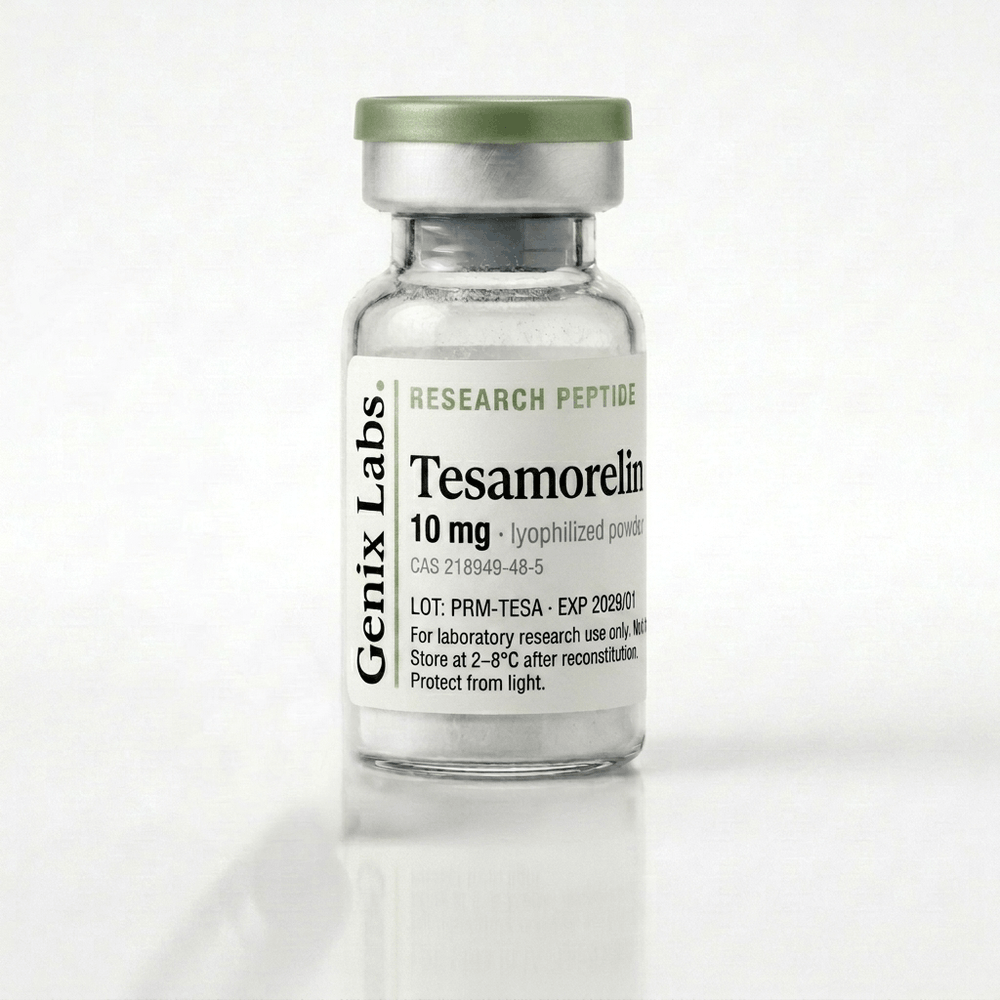
Purity of at least 99% by HPLC, LC-MS identity, and a batch certificate of analysis in every order. $149, same-day in Bali.
Buy Tesamorelin in BaliFrequently asked questions
What peptide works better than sermorelin?
Tesamorelin is the most common answer. It lasts longer in the blood, sends a stronger growth-hormone signal, and carries far more clinical proof, especially for deep belly fat. Others compared to sermorelin include CJC-1295, another GHRH analog, and ipamorelin, which works through a different receptor. This is research information only.
Will tesamorelin make you stronger?
Not directly. Tesamorelin is not a steroid and not a direct muscle builder. In research it raises your own growth hormone and IGF-1, which support leaner body composition and recovery over time. Any strength gain would be indirect, from better recovery and a leaner frame, not from the peptide forcing muscle growth.
Can I use tesamorelin with sermorelin?
It makes little sense. Both are GHRH analogs, so they press the same button in the same place, and running them together is mostly redundant. Researchers instead pair a GHRH analog with a different type, a GHRP like ipamorelin, which hits a separate receptor. This is general information, not a protocol or medical advice.
Can I switch from sermorelin to tesamorelin?
In a research context, yes, and it is a natural upgrade. Because both act on the same GHRH pathway, moving from sermorelin to tesamorelin mostly changes potency and staying power, since tesamorelin lasts longer. The sensible approach is to move deliberately and track what happens. Nothing here is a dosing instruction or medical advice.
Is tesamorelin or sermorelin better for fat loss?
Tesamorelin has the stronger case. It is the only one of the two with large trials measuring deep visceral belly fat, and it is longer-acting. Sermorelin can support the growth-hormone axis but lacks that waist-measuring proof. For fat-loss research, tesamorelin is the better-documented choice. Research use only.
Takeaway
Between the two, tesamorelin is the stronger, longer-acting, and better-proven peptide. It is the only one of the pair with large clinical trials, where it cut deep visceral belly fat. Sermorelin is older, milder, and shorter-acting, a gentler cousin in the same GHRH family. They press the same button, so stacking them makes little sense, but switching up to tesamorelin is a natural step. Both are for research use only, and this guide is education, not medical advice.