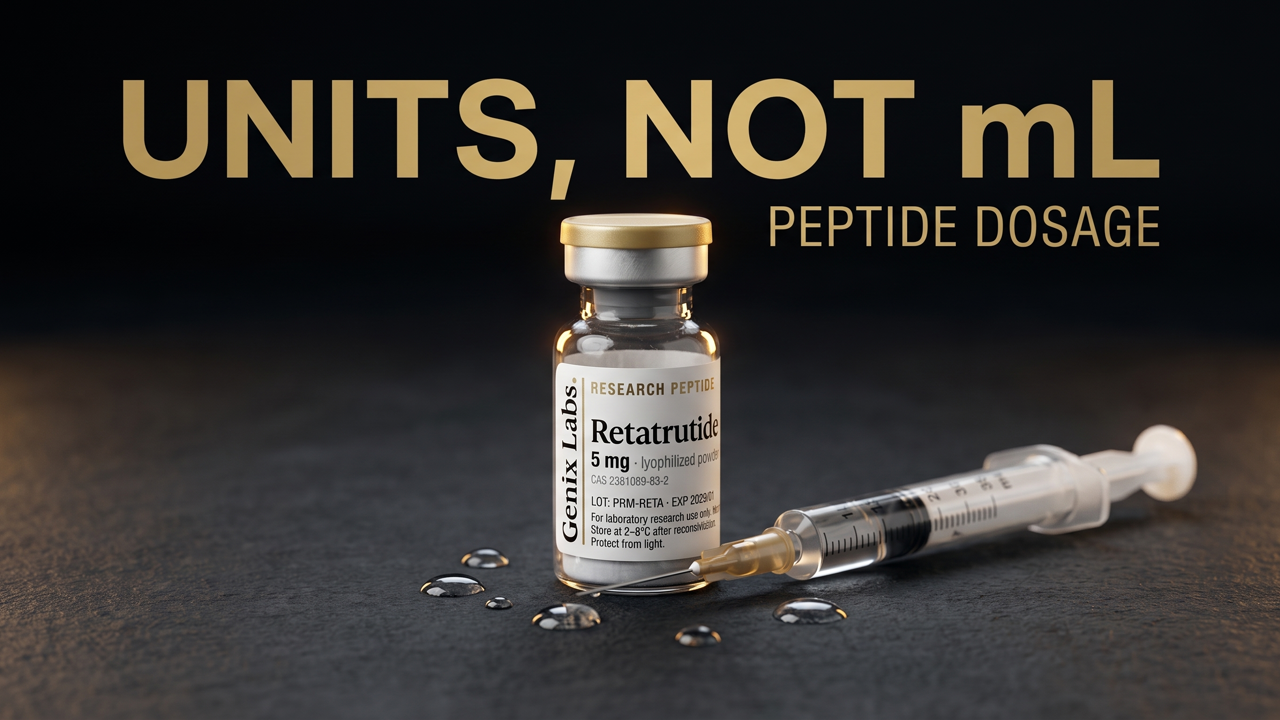
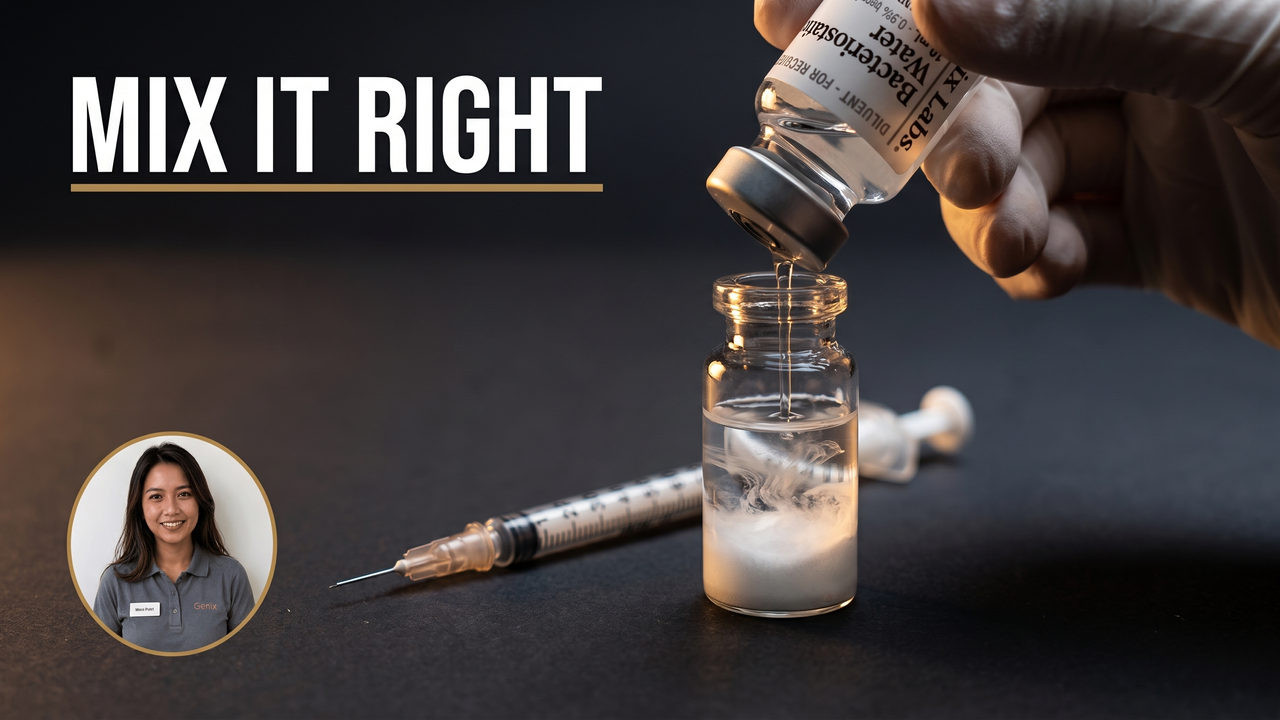
Peptides ship as a fine white powder, freeze-dried and sealed inside a small glass vial. In that form you cannot measure a dose. First you have to turn the powder back into a liquid, and that step is called reconstitution. It sounds technical, but it is really just adding water in a careful, gentle way. This guide walks through the whole thing in plain words, with the exact volumes people ask about and a free calculator at the end. Everything here is for research use only.
The quick answer
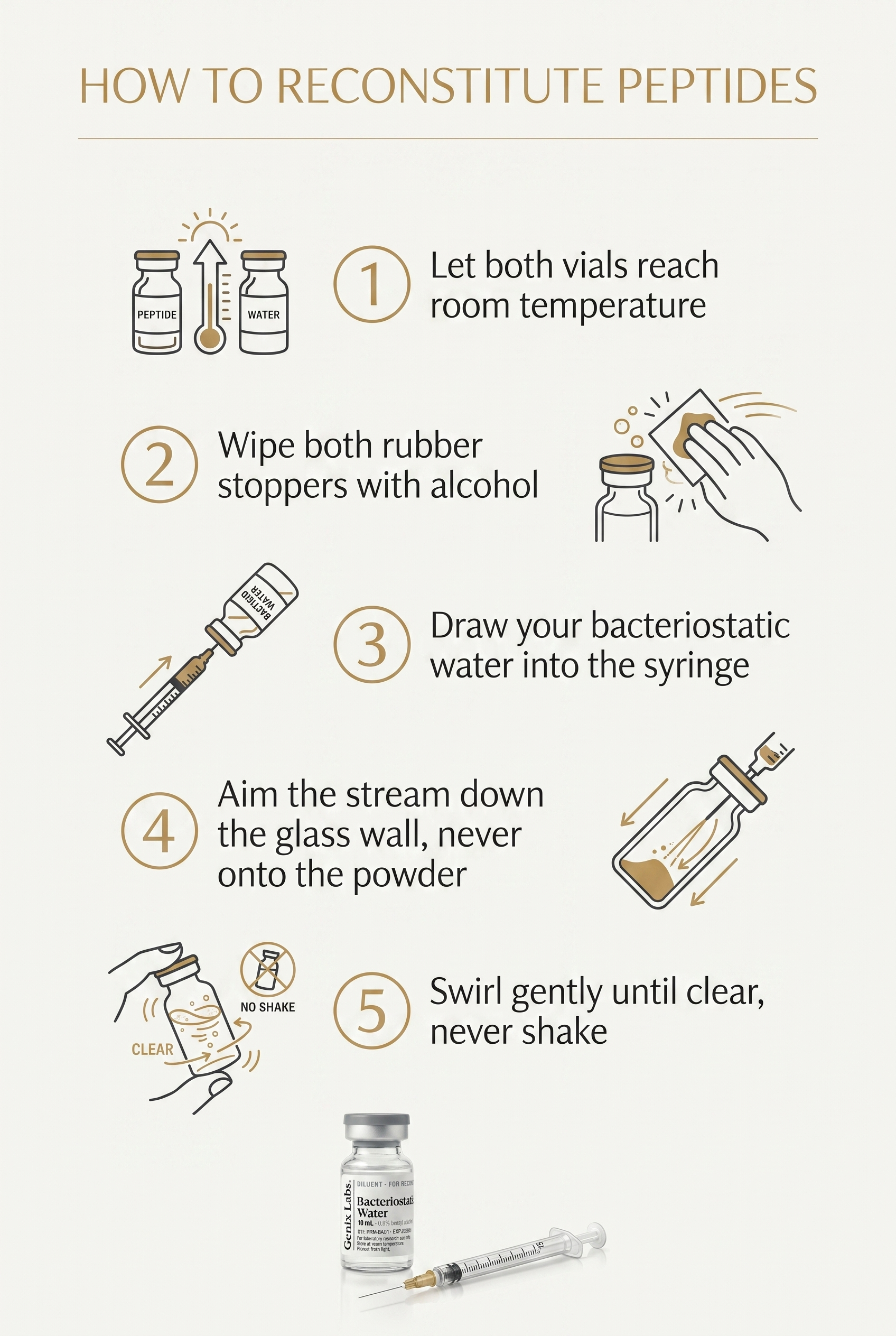
To reconstitute a peptide, let both the peptide vial and the bacteriostatic water reach room temperature. Wipe both rubber stoppers with an alcohol swab. Draw your chosen amount of bacteriostatic water into a syringe, then push it in slowly so the stream runs down the inside glass wall of the peptide vial, not straight onto the powder. Swirl the vial gently, or let it sit, until the powder fully dissolves into a clear liquid. Do not shake it.
That is the whole process. How much water you add is up to you, and it changes the concentration rather than the dose. Most research reconstitution uses 1 to 3 mL. Once the vial is clear, it is ready to draw, and you work out the exact units with the peptide dosage calculator.
What does reconstitution actually mean?
Reconstitution means adding liquid to a dried substance to return it to a usable form. Peptides are freeze-dried, a process called lyophilisation, because a dry powder is far more stable than a solution. Dry, a peptide can sit in the fridge or freezer for a long time. Once it is mixed, the clock starts and it needs to be kept cold and used within weeks.
The liquid you add is a diluent. For most peptides that diluent is bacteriostatic water. The act of mixing does not change the amount of peptide in the vial, only the volume it is spread through. A 10 mg vial holds 10 mg of peptide whether you add 1 mL or 3 mL of water. That single idea removes most of the confusion around reconstitution, so it is worth holding onto as you read the rest.
What you need before you start
Reconstitution is not fussy, but a clean, calm setup prevents almost every mistake. Lay these out on a clean surface before you open anything.
- The peptide vial. Your lyophilised powder, with the mg on the label confirmed against its Certificate of Analysis.
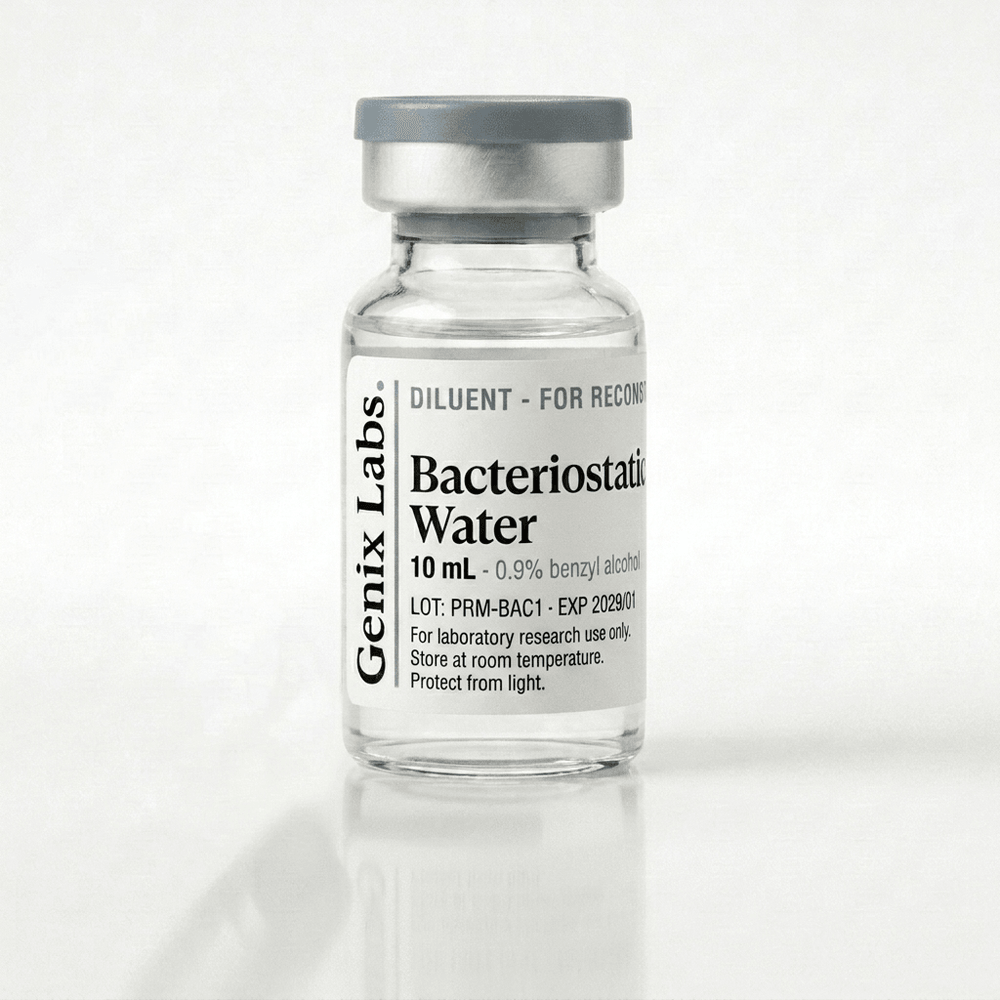
- Bacteriostatic water. The diluent that dissolves the powder and keeps a multi-dose vial usable for weeks. Genix sells bacteriostatic water in 10 mL bottles.
- Insulin syringes. A U-100 insulin syringe both adds the water and later draws your dose. A larger reconstitution syringe is fine for adding water only.
- Alcohol swabs. To wipe both rubber stoppers before the needle touches them. Cheap insurance against contamination.
- A clean, flat surface and good light. So you can see the powder dissolve and read the syringe scale clearly.
The step-by-step method
Here is the full sequence, slowed down. None of it is rushed. The gentler you are, the more of the peptide survives intact.
Step 1: Let everything reach room temperature
If the vials came from the fridge, give them 15 to 20 minutes on the counter. Cold glass and cold water make the powder dissolve slower and can fog the vial. Room temperature is kinder to the peptide and easier to work with.
Step 2: Wipe both stoppers
Swab the rubber top of the peptide vial and the rubber top of the bacteriostatic water with alcohol. Let them air-dry for a few seconds. The needle should only ever pierce a clean stopper.
Step 3: Draw your bacteriostatic water
Pull the plunger to fill the syringe with air equal to the water you want, push that air into the water vial, then invert it and draw your chosen volume of bacteriostatic water. Adding air first keeps the pressure balanced so the water flows out easily. Common volumes are 1 to 3 mL, which we break down below.
Step 4: Aim the stream down the glass wall
This is the step that matters most. Tilt the peptide vial slightly and push the water in slowly so it runs down the inside glass wall and pools under the powder. Never fire the stream straight onto the powder. A hard jet can shear the peptide and damage it. Slow and sideways is the whole trick.
Step 5: Swirl gently until clear
Once all the water is in, swirl the vial in slow circles, or simply set it down and wait. Most peptides dissolve within a minute or two into a completely clear solution. If a little powder clings on, keep swirling. Do not shake. Shaking foams the liquid and the force can break the peptide chain, leaving you with less active material than you paid for.
When the vial is clear with no floating clumps, reconstitution is done. Store it in the fridge and work out your draw with the peptide dosage guide or the calculator further down this page.
How much water do I add?
There is no single right amount, and that genuinely surprises people. The water volume does not change your total dose or how many doses the vial holds. It only sets the concentration, which decides how many syringe units you draw for a given dose. Most research reconstitution lands between 1 mL and 3 mL of bacteriostatic water per vial.
The practical rule: choose a water volume that puts your usual dose on a comfortable, readable number of units. Add too little water and a small dose lands on 2 or 3 units, which is hard to measure precisely. Add too much and the same dose runs past the top of the barrel.
- More water means a lower concentration and more units per dose. Good for small microgram doses you want to measure accurately.
- Less water means a higher concentration and fewer units per dose. Good for large milligram doses that would otherwise overflow the syringe.
- The dose count never moves. A 10 mg vial dosed at 500 mcg is always 20 draws, whether you added 1 mL or 3 mL of water.
This table shows how the same vial behaves at different water volumes. Notice the concentration changes while the peptide mass stays fixed.
| Vial | Water added | Concentration | Best when |
|---|---|---|---|
| 10 mg | 1 mL | 10 mg/mL | Large doses, fewest units |
| 10 mg | 2 mL | 5 mg/mL | A balanced everyday mix |
| 10 mg | 3 mL | 3.33 mg/mL | Small doses, easiest to read |
| 5 mg | 2 mL | 2.5 mg/mL | Finer control on a small vial |
What is the best reconstitution solution for peptides?
For most peptides, bacteriostatic water is the best reconstitution solution. It is sterile water with about 0.9 percent benzyl alcohol added. That benzyl alcohol is a mild preservative that slows bacterial growth, which is exactly what lets a mixed multi-dose vial stay usable for weeks in the fridge rather than a single sitting.
The main alternatives are worth knowing so you can see why bacteriostatic water usually wins.
| Diluent | Preservative | Best for | Notes |
|---|---|---|---|
| Bacteriostatic water | 0.9% benzyl alcohol | Multi-dose vials | The usual research choice |
| Sterile water | None | Single use | No shelf life once pierced |
| Distilled water | None | Not recommended | Not formulated for injection |
| Acetic acid (dilute) | None | A few sensitive peptides | Only if a peptide will not dissolve otherwise |
A small number of peptides are stubborn and do not dissolve cleanly in water alone. For those, a very dilute acetic acid is sometimes used to help them go into solution. That is the exception, not the rule. If your powder dissolves clear in bacteriostatic water, you do not need anything else. You can read more in our bacteriostatic water guide.
How much water do I mix with 10 mg BPC-157?
A common setup for a 10 mg BPC-157 vial is 2 to 3 mL of bacteriostatic water. Two millilitres gives 5 mg per mL. Three millilitres gives about 3.33 mg per mL, which spreads a small research draw across more syringe units so it is easier to read accurately. Either is fine. The water amount never changes the 10 mg of peptide in the vial.
Here is how a typical small draw looks at each volume, on a U-100 insulin syringe. Numbers come straight from the calculator.
| Vial | Water | Concentration | 250 mcg draw | Units | Doses per vial |
|---|---|---|---|---|---|
| 10 mg BPC-157 | 2 mL | 5 mg/mL | 0.05 mL | 5 | 40 |
| 10 mg BPC-157 | 3 mL | 3.33 mg/mL | 0.075 mL | 7.5 | 40 |
Notice the number of doses is identical at 40 either way. Only the units you draw change. For the wider picture on this peptide, see the BPC-157 dosing guide and BPC-157 benefits.
How do you reconstitute a 20 mg vial?
A 20 mg vial is reconstituted exactly like any other vial. The method does not change with the size, only the volume of water you choose. Add 2 to 4 mL of bacteriostatic water down the glass wall, then swirl until clear. The larger the water volume, the lower the concentration and the more units each dose draws.
| Vial | Water | Concentration | 1 mg draw | Units |
|---|---|---|---|---|
| 20 mg | 2 mL | 10 mg/mL | 0.10 mL | 10 |
| 20 mg | 3 mL | 6.67 mg/mL | 0.15 mL | 15 |
| 20 mg | 4 mL | 5 mg/mL | 0.20 mL | 20 |
Pick the volume that keeps your usual draw on an easy-to-read number of units. A larger vial often takes a little more water simply so the concentrated solution does not make every dose a tiny sliver on the syringe. The dosage calculation guide walks through the arithmetic if you want to see it worked out by hand.
Why vial pressure matters
A sealed vial is a closed space. Every time you add or remove liquid, you change the pressure inside. Ignore that and the plunger fights you, water spits back, or air bubbles ruin your draw. Managing pressure is simple once you know the trick.
- Before drawing water out, push an equal volume of air into the water vial first. This raises the pressure so the water flows out into your syringe smoothly.
- Before adding water in, let the peptide vial breathe. As liquid goes in, pressure rises, so add slowly and pause if you feel resistance.
- Before drawing a dose out, a small puff of air into the mixed vial again keeps the pressure balanced so the dose draws cleanly.
Common mistakes to avoid
- Shaking the vial. The single biggest error. Swirl or wait. Shaking foams the liquid and can damage the peptide.
- Firing water onto the powder. Aim down the glass wall so the stream slides under the powder gently.
- Using plain sterile water for a multi-dose vial. With no preservative, it is meant for a single use before bacteria can grow.
- Skipping the alcohol swab. An unwiped stopper is the easiest way to contaminate a vial you plan to keep for weeks.
- Freezing a mixed vial. Freeze-thaw cycles damage a reconstituted peptide. Keep it in the fridge, not the freezer, once it is liquid.
- Not verifying the mg. If you cannot confirm the mass from a Certificate of Analysis, your concentration is a guess. Start from tested material.
What if it will not dissolve or looks wrong?
Most vials go clear in under two minutes. When one does not, the fix is almost always patience or a gentler hand, not more force. Here is what the common problems mean.
| What you see | Likely cause | What to do |
|---|---|---|
| Powder still swirling after a minute | Cold vial or a large mass | Set it down and wait; warmth and time finish the job |
| Tiny bubbles or foam on top | Added water too fast, or shaken | Let it settle; the foam clears on its own |
| Cloudy or milky solution | Contamination or a struggling peptide | Do not use it; discard and start fresh |
| Floating specks or strands | Undissolved material or debris | Swirl longer; if specks remain, discard |
| A stubborn peptide that will not clear | Poor water solubility | A few peptides need dilute acetic acid to dissolve |
A clear, colourless solution is the goal every time. If a vial stays cloudy after settling, that is a signal to stop, not to push on. Starting from lab-tested material with a matching Certificate of Analysis removes most of these problems before they start, because you know the powder is pure and correctly filled.
How to store a mixed vial
Reconstitution starts a shelf-life clock. Dry powder is stable for a long time, but once it is liquid it needs cold, dark, still storage. Kept in the fridge at 2 to 8 degrees Celsius, most reconstituted peptides stay stable for several weeks, often up to about 28 days.
- Refrigerate, do not freeze. 2 to 8 degrees Celsius is the target. Freezing a mixed vial damages the peptide.
- Keep it dark. Light degrades many peptides, so store the vial in its box or a drawer.
- Watch for cloudiness. A clear solution is good. If it turns cloudy or grows particles, discard it.
In a hot climate this matters even more. Our guide to storing peptides in Bali covers cold-chain handling from delivery to fridge, and the Peptides 101 hub links the rest of the basics.
Work out your dose instantly
Once the vial is clear, the only thing left is turning your target dose into syringe units. This is the same free tool that lives on our peptide dosage calculator page. Enter the vial size, the water you added and your target dose, and it draws the syringe for you. It updates live.
Your vial
75 peptides with the protocols people commonly run, or pick custom to enter any vial by hand.
The total peptide mass printed on the vial or Certificate of Analysis.
How much solvent you reconstitute with. More water means a lower concentration.
The amount you want in each draw. 1000 mcg equals 1 mg.
Most research uses a U-100 insulin syringe (100 units = 1 mL). A 3 mL auto-injection pen dials the same units, with up to 300 in the cartridge.
What people commonly run
Reference figures for research planning, gathered from published trial protocols and widely used community conventions. They are not a recommendation to dose anyone.
Draw this
Reconstitution mathNumbers update live and are reconstitution arithmetic only. Genix peptides are for laboratory research use, not for human or veterinary use. Nothing here is medical advice or a dosing recommendation.
Frequently asked questions
How much water do I mix with my peptides?
There is no single correct amount. The water sets the concentration, not the dose. Most research reconstitution uses 1 to 3 mL of bacteriostatic water per vial. More water makes small doses easier to read on the syringe; less water concentrates a large vial. The peptide mass never changes.
What is the best reconstitution solution for peptides?
Bacteriostatic water is the usual choice. It is sterile water with about 0.9 percent benzyl alcohol, a preservative that slows bacterial growth so a multi-dose vial stays usable for weeks in the fridge. Plain sterile water has no preservative and suits single use only.
How much water do I mix with 10 mg BPC-157?
A common setup is 2 to 3 mL of bacteriostatic water in a 10 mg BPC-157 vial. Two millilitres gives 5 mg per mL; three millilitres gives about 3.33 mg per mL, which makes a small research draw land on a readable number of syringe units. The water amount never changes the total peptide.
How do you reconstitute a 20 mg peptide vial?
The method is identical to any vial, only the volume differs. Add 2 to 4 mL of bacteriostatic water down the glass wall of the 20 mg vial, then swirl until clear. Two millilitres gives 10 mg per mL; four millilitres gives 5 mg per mL. Pick the volume that keeps your usual draw easy to read.
Can you shake a peptide vial to mix it?
No. Shaking foams the solution and the shear force can break the peptide chain, lowering how much active peptide is left. Add the water slowly down the inside wall and swirl the vial gently, or let it sit, until the powder fully dissolves into a clear liquid.
How long does a reconstituted peptide last?
Mixed with bacteriostatic water and kept refrigerated at 2 to 8 degrees Celsius, most reconstituted peptides stay stable for several weeks, often up to about 28 days. Keep the vial out of light, do not freeze a mixed vial, and discard it if the solution turns cloudy or grows particles.
The takeaway
Reconstituting a peptide is calm, slow work. Bring everything to room temperature, wipe the stoppers, add your bacteriostatic water down the inside glass wall, and swirl gently until the solution is clear. Never shake it, and never fire the stream straight onto the powder. How much water you add sets the concentration, not the dose, so choose a volume that keeps your usual draw easy to read.
When the vial is ready, the peptide dosage calculator turns your dose into exact units, and every vial in the Genix catalog ships with a batch Certificate of Analysis so the mg you mix is the mg you trust. Research use only.