Before anyone in Bali or Jakarta buys a research peptide, the same question comes up: is this even legal here? It is a fair question, and the honest answer is more nuanced than a simple yes or no. This guide lays out what Indonesian law actually says, what is genuinely banned, and what the research-use label means for you. It is written to be clear and accurate, not to sell you anything. Everything here is general information, not legal advice, and every product we discuss is for research use only.
The short answer
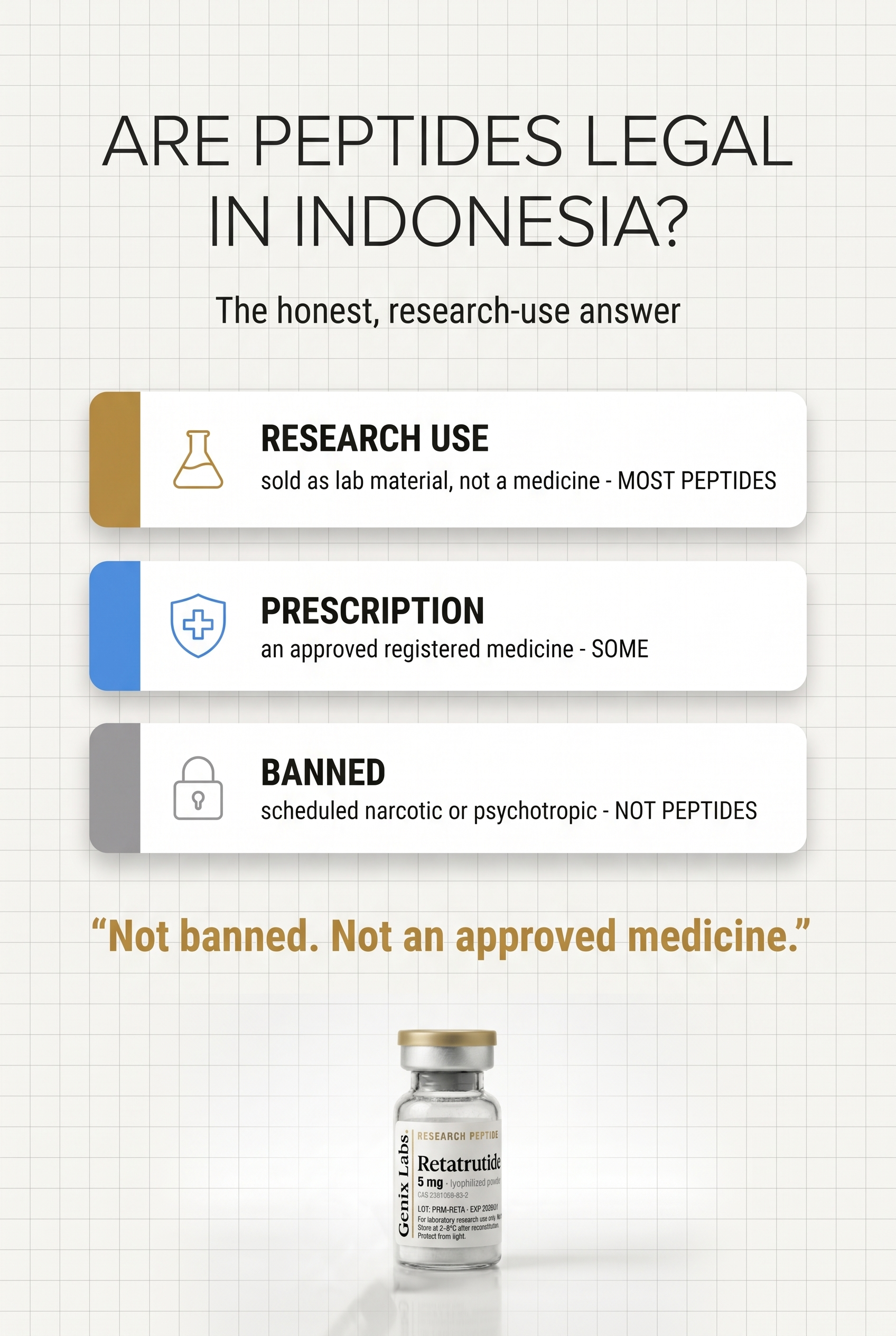
No Indonesian law names research peptides as illegal. Peptides like BPC-157, TB-500, GHK-Cu, and MOTS-C are not narcotics and not psychotropics, so they are not on Indonesia’s banned-drug schedules. At the same time, they are not BPOM-approved medicines, so they are sold as research-use-only laboratory materials rather than as treatments. In plain words: not banned, but not an approved medicine either.
That middle ground is the whole story, and it is where most of the confusion comes from. The rest of this guide unpacks it: what the law covers, how each peptide is classified, the reality of flying with them, and why sourcing locally removes the hardest part of the problem.
What Indonesian law actually says
Indonesia does not have a law called “the peptide law.” Instead, three separate frameworks decide how any substance is treated. Once you see the three buckets, the status of research peptides becomes obvious.
- The Narcotics Law (UU No. 35 / 2009). This lists scheduled narcotics, the substances with the harshest penalties. Research peptides are not on it.
- The Psychotropics Law (UU No. 5 / 1997). This covers mind-altering psychotropic drugs. Research peptides are not psychotropics and are not on it either.
- BPOM and the Health Law (UU No. 17 / 2023). BPOM, Indonesia’s food and drug authority, approves and registers medicines for human use. Most research peptides have no BPOM registration, which is exactly why they are sold as research materials, not medicines.
So a research peptide is not a banned narcotic, and it is not an approved medicine. It is a laboratory chemical sold for research. That is the legally honest way to describe it, and it is the framing every responsible supplier should use.
Legal status, peptide by peptide
People usually ask about a specific compound, not “peptides” in the abstract. Here is how the common ones map onto the buckets above. None of them are scheduled narcotics or psychotropics in Indonesia.
| Peptide | Category | Narcotic / psychotropic? | How it is sold |
|---|---|---|---|
| BPC-157 | Research peptide | No | Research use only |
| TB-500 | Research peptide | No | Research use only |
| GHK-Cu | Research peptide | No | Research use only |
| MOTS-C | Research peptide | No | Research use only |
| Semaglutide | Also an approved medicine abroad | No | Research use only (research grade) |
| Retatrutide | Investigational compound | No | Research use only |
The GLP-1 peptides are worth a quick note. Semaglutide is also sold as an approved prescription medicine in some countries. The research-grade peptide is supplied, like the others in the table, for research use only rather than as that finished, packaged medicine. Same molecule, sold in the research category. Our semaglutide vs tirzepatide and retatrutide comparison cover the compounds themselves.
Is it legal in Bali specifically?
Bali is a province of Indonesia, so it follows the exact same national law as Jakarta, Surabaya, or anywhere else. There is no special Bali rule that makes peptides more or less legal on the island. The narcotics law, the psychotropics law, and BPOM apply the same way in Canggu as they do in the capital.
What is different about Bali is the market, not the law. A large research and wellness community means demand is high and local, reputable suppliers exist. That is a practical advantage: buying from a Bali-based supplier means the material never crosses an international border, which is where the real legal friction lives. More on that next. If you are ready to compare local options, our where to buy peptides in Bali guide walks through it.
Can you fly with peptides into Indonesia?
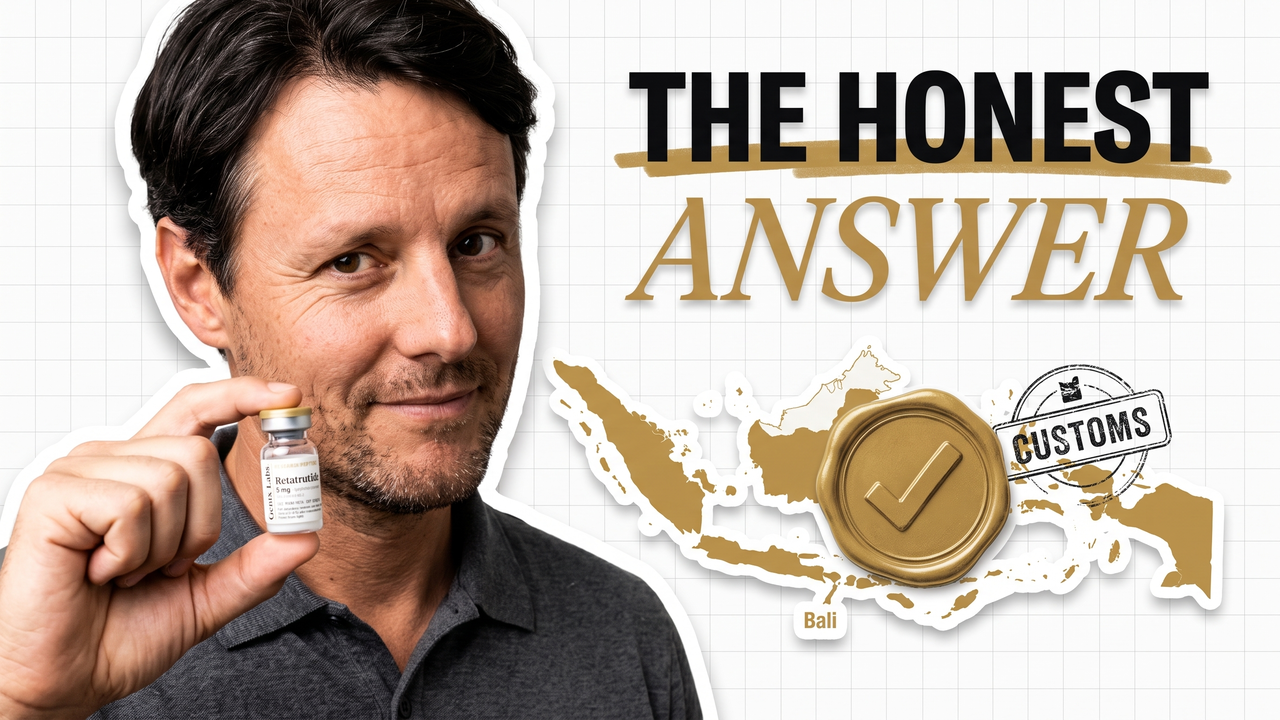
This is the one practical hurdle worth knowing about, and it is more about hassle than anything else. A research peptide is not a banned narcotic, so it is not the kind of thing that carries heavy consequences. The catch is simpler: unregistered vials, liquids, and needles can slow you down at customs, and the cold-chain can break on a long trip. It is friction, not danger, and there is an easy way around it.
- Fewer questions at the border. A vial without local registration can slow you down at customs, even though it is not a controlled substance.
- Liquids and needles get looked at. Reconstituted vials and syringes are exactly the items customs tends to open and ask about.
- The cold-chain stays intact. Peptides need to stay cold, and a long flight plus a customs wait can spoil the material. See our storage guide.
- It keeps things clearly separate. A research peptide is nothing like a controlled drug, and buying locally keeps it that way, with no border step to think about.
Which countries are peptides legal in?
Indonesia is not unusual here. In most of the world, research peptides live in the same research-use grey zone: legal to sell and possess as laboratory materials, but not approved for human use. The exact wording differs by country, but the pattern is consistent.
| Region | Typical status | What it means in practice |
|---|---|---|
| Indonesia | Research use, not BPOM-approved | Sold as lab material; import restricted |
| United States | Research chemical, not FDA-approved | Sold for research; not for human use |
| United Kingdom | Research use | Legal to buy for research; not a medicine |
| European Union | Research use, varies by state | Generally research-only; check each country |
| Australia | More tightly controlled | Several peptides are prescription-only |
The takeaway is that “is it legal?” almost never means “is it banned?” It means “is it approved for human use?” For research peptides, the answer in most places, including Indonesia, is that they are sold for research, not approved as medicine. Always confirm the current rule where you are.
What actually IS banned in Indonesia
It helps to see what real prohibition looks like, because research peptides are nowhere near it. Indonesia enforces some of the strictest drug laws in the world, with severe penalties for scheduled substances.
- Narcotics. Cannabis, cocaine, heroin, and opium-derived drugs are heavily scheduled with severe penalties.
- Stimulant and party drugs. MDMA (ecstasy) and methamphetamine are prohibited and prosecuted aggressively.
- Many psychotropics. A range of mind-altering substances are controlled under the psychotropics law.
Research peptides such as BPC-157, GHK-Cu, or MOTS-C are chemically and legally unrelated to any of these. They are not intoxicants, they are not scheduled, and they should never be mentioned in the same breath as a controlled narcotic. Conflating the two is the single biggest myth this guide exists to correct.
What “research use only” means for you
The phrase research use only is not marketing filler. It is the legal category the product sits in, and it carries a real meaning. A research-use-only material is sold for laboratory and research purposes and is not approved, tested, or labeled for human or veterinary use.
- It is not a medicine. No BPOM or equivalent approval, no human dosing on the label, no medical claims.
- Purity still matters. Research grade should still mean tested and verified, which is where a Certificate of Analysis comes in.
- The responsibility is yours. Buying a research material means you accept it is for research, and you follow the law where you are.
Understanding this keeps everyone honest. A supplier that pretends a research peptide is a proven medicine is the one to avoid. A supplier that is upfront about the research-use category, and backs it with real testing, is doing it right.
How Genix Labs stays on the right side of it
Because we operate in Bali, these rules are not abstract to us. Here is how we handle the research-use category in practice, so you can see what a compliant local supplier looks like.
- Research-use-only labeling. Every vial is labeled for research use, not for human or veterinary use. No medical claims, no human dosing on the label.
- A Certificate of Analysis in every order. Third-party HPLC for purity and LC-MS for identity, with a lot number that matches your vial, so research grade is proven, not promised. See a sample Certificate of Analysis.
- Local, same-day delivery. Cold-packed and delivered across Bali, often within a couple of hours, with cash on delivery. Nothing crosses a border, so there is no customs step.
- Honest positioning. We describe compounds using only what the research supports, and we keep the research-use framing consistent everywhere.
If you want the practical buying side rather than the legal side, the how to buy peptides in Bali guide and the Genix catalog cover pricing, delivery, and what ships with each order. New to peptides entirely? Start with the Peptides 101 hub.
Frequently asked questions
Are peptides legal in Bali?
Bali follows the same national law as the rest of Indonesia, so there is no separate Bali rule. No Indonesian law names research peptides as illegal, and they are not narcotics or psychotropics. They are also not BPOM-approved medicines, so they are sold as research-use-only materials. This is general information, not legal advice.
Can you fly with peptides into Indonesia?
It is more about hassle than danger. A research peptide is not a controlled substance, but unregistered vials, liquids, and needles can slow you down at customs, and the cold-chain can break on a long trip. Most people skip the friction by buying locally instead, so nothing has to cross a border.
Which countries are peptides legal in?
In most countries, research peptides sit in a research-use-only grey zone: legal to sell and own for laboratory research, but not approved for human use. A few countries regulate them more tightly. The status is about approval for human use, not an outright ban, so always confirm your own local law.
What drugs are banned or illegal in Indonesia?
Indonesia bans narcotics and many psychotropics, including cannabis, cocaine, heroin, MDMA (ecstasy), and methamphetamine, under strict laws that carry severe penalties. Research peptides such as BPC-157 or GHK-Cu are not in these categories at all. Never conflate a research peptide with a controlled narcotic.
Are research peptides the same as prescription drugs?
No. A prescription drug is a medicine that has been approved, registered, and regulated for treating people. A research peptide is a laboratory material sold for research use only. It is not approved as a medicine and is not meant for human or veterinary use, which is the core distinction buyers should understand.
Is it legal to buy research peptides in Indonesia?
There is no law specifically banning the sale of research-use-only peptides, and they are not scheduled narcotics or psychotropics. They are sold as laboratory materials rather than medicines. This remains general information and not legal advice, so verify the current BPOM and customs rules for your own situation.
The takeaway
Are peptides legal in Indonesia? No law names research peptides as illegal, they are not narcotics or psychotropics, and they are not on any banned schedule. They are also not BPOM-approved medicines, so they are sold as research-use-only materials. Bali follows the same national law, and the real friction is not local possession but importing across a border, which buying locally avoids.
Keep the framing simple and honest: research use only, not a medicine, not a banned drug. Verify the current rules for your own situation, insist on a Certificate of Analysis, and choose a supplier that is transparent about all of it. Every vial in the Genix catalog ships with batch testing and research-use labeling. This article is general information, not legal advice.