
Bacteriostatic water is the least glamorous item in a peptide order, and the one most likely to ruin the rest of it. Every freeze-dried vial needs a liquid before it can be measured. This is that liquid. It is sterile water with a small amount of preservative added, and that preservative is the entire point. Get it right and one vial lasts weeks. Get it wrong and you are throwing away good material. Everything here is for research use only.
What is bacteriostatic water?
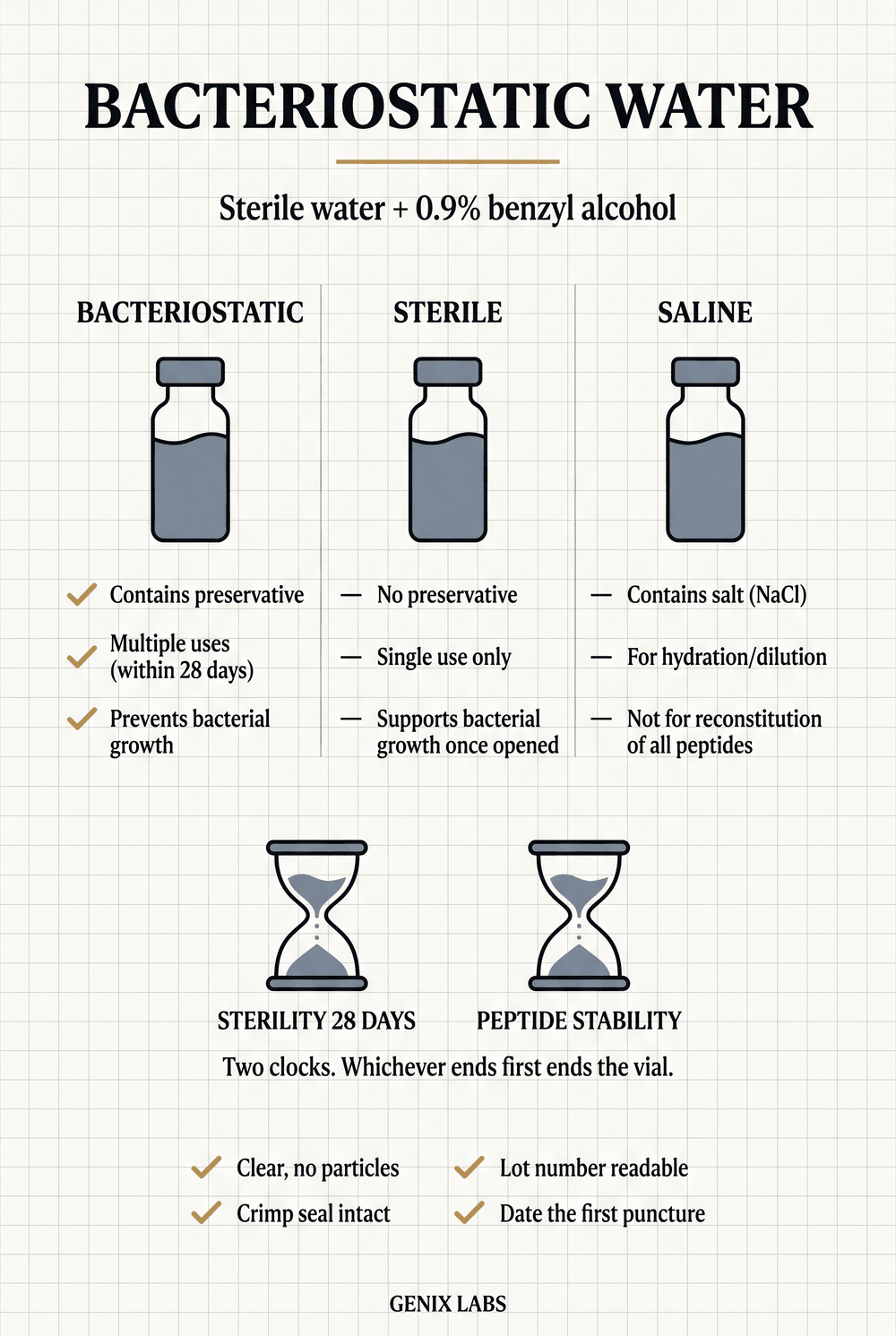
Bacteriostatic water is sterile water with about 0.9 percent benzyl alcohol added. The benzyl alcohol is a preservative. It stops bacteria from multiplying inside the bottle once the rubber stopper has been pierced. That single ingredient is what separates it from every other clear liquid on the shelf.
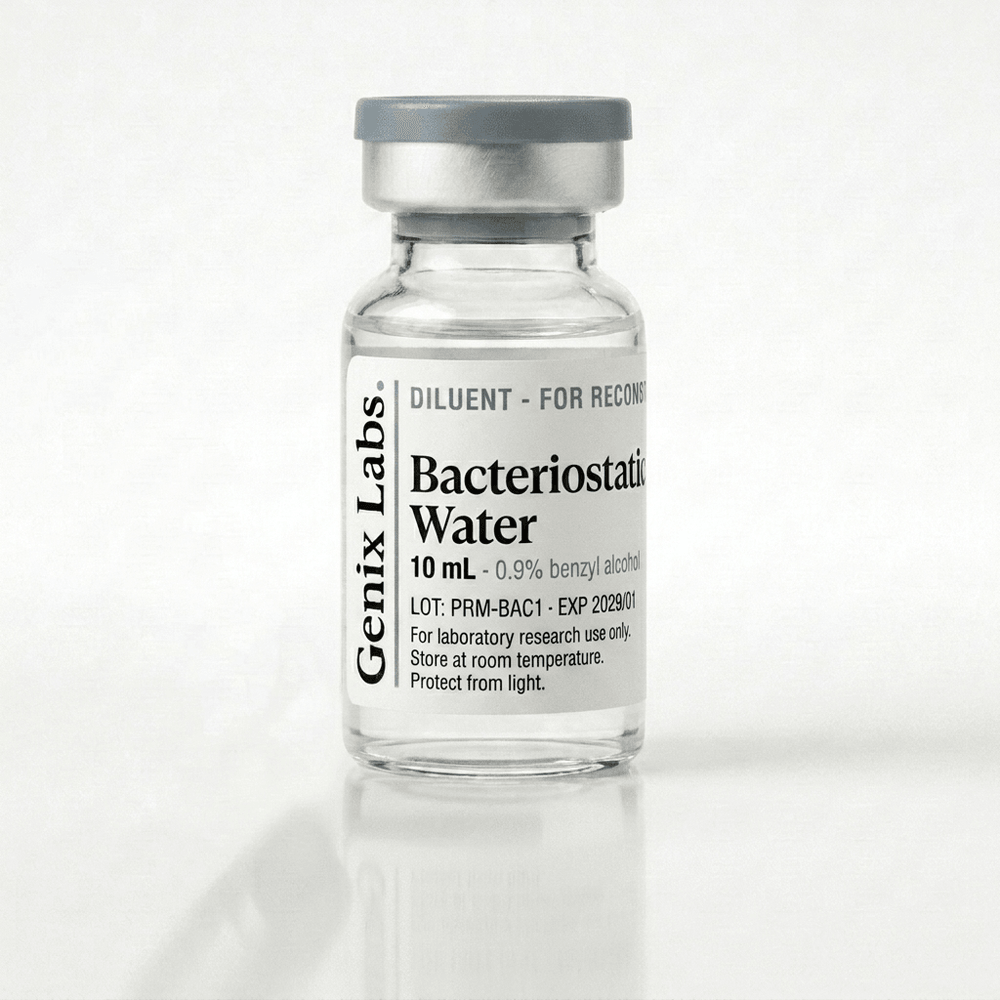
Everything else about it is deliberately boring. It is clear. It has no colour and no particles floating in it. It carries no active drug of its own. Our own bottle is a 10 mL vial, coded BAC-10, sealed under a metal crimp cap and filled sterile. You can read the full specification on the bacteriostatic water product page.
Two words in the name do a lot of work. Sterile means nothing is alive in the bottle when it is sealed. Bacteriostatic means bacteria are held in check after you open it. Those are two different promises, and the second one is the one people misread.
- Sterile water plus roughly 0.9 percent benzyl alcohol.
- The preservative lets you draw from one vial many times.
- It dissolves the powder. It does not change the peptide mass.
- It is a diluent, not a drug, and not a treatment for anything.
What is bacteriostatic water used for?
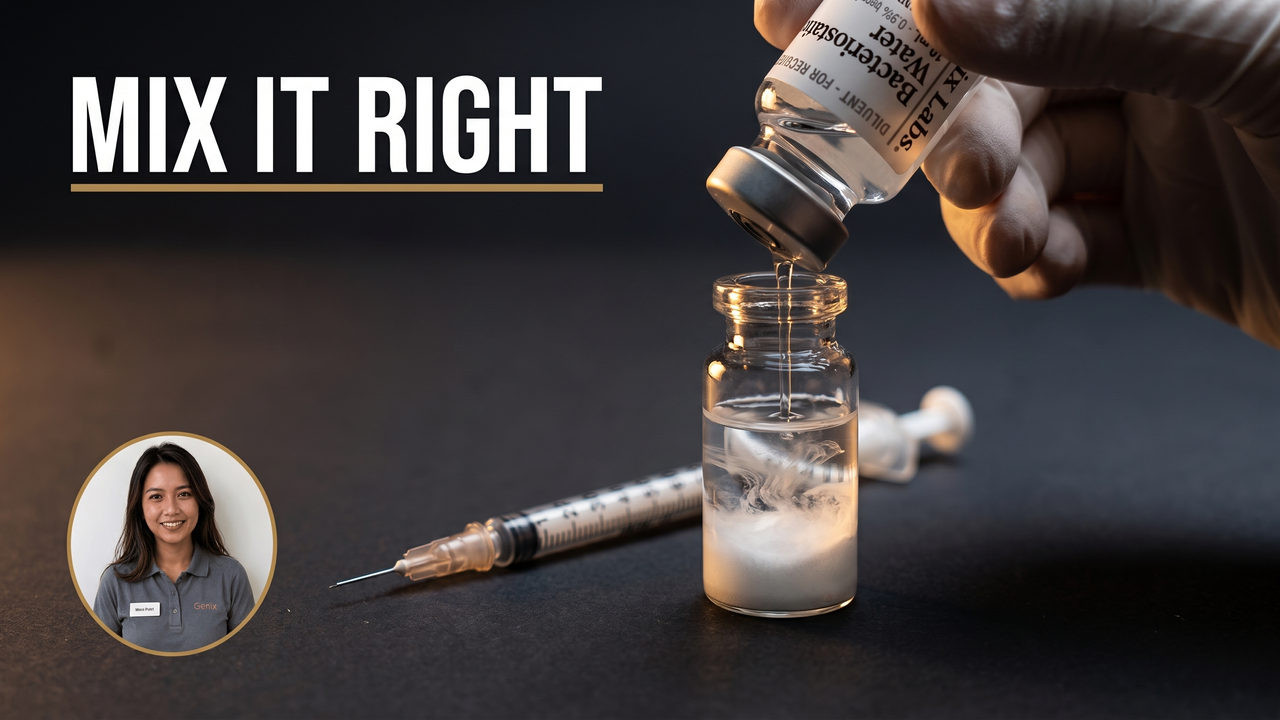
It is used to dissolve freeze-dried powders back into a measurable liquid. In peptide research that step is called reconstitution. Because the benzyl alcohol slows bacterial growth, one vial can be drawn from repeatedly over several weeks instead of being discarded after a single use.
A lyophilized peptide arrives as a small puck or dusting of white powder. You cannot measure a research dose out of a powder. You need it in solution, where a known volume holds a known mass. Bacteriostatic water is the standard way to get there. The full method is in our guide on how to reconstitute peptides.
Outside peptide work, the same preserved diluent shows up wherever a multi-dose vial needs mixing. Laboratories use it for that reason alone. It is convenience with a safety margin built in, nothing more exotic than that.
What the preservative changes
The preservative changes how many times you can safely pierce the stopper. With plain sterile water, the first puncture starts a race against bacterial growth, so the vial really suits one use. With bacteriostatic water, the benzyl alcohol keeps that growth in check, and the same vial stays usable across weeks of draws.
Think about what that means in practice. A 10 mg vial of peptide might be intended for many small research draws. Without a preservative you would need a fresh vial and a fresh mix each time. Most of the material would be wasted. The preservative is what makes a multi-draw vial sensible at all.
It does not do anything to the peptide itself. The mass in the vial is fixed before the water goes in. Adding water sets the concentration, and nothing else. If that distinction is fuzzy, the peptide dosage calculation guide works through it slowly.
How benzyl alcohol actually works
Benzyl alcohol dissolves into the fatty outer membrane of a bacterial cell. That membrane stops holding its shape properly. The cell can no longer manage what moves in and out, so it cannot divide. Growth stalls. The bacteria that are present do not multiply into a population that matters.
Here is the part almost every page skips. Bacteriostatic and bactericidal are not the same word. Bacteriostatic means growth stops. Bactericidal means the bacteria are killed. Benzyl alcohol at 0.9 percent is doing the first job, not the second.
Why does that matter to you? Because it sets the limits of what the bottle can fix. If a contaminated needle goes into a vial, the preservative slows what happens next. It does not undo it. Clean technique still does the real work, and the preservative is a margin of safety sitting behind it.
Bacteriostatic water, sterile water, and saline
All three are clear, sterile liquids, and they are not interchangeable. Bacteriostatic water has a preservative and suits multi-draw vials. Sterile water has no preservative and suits single use. Saline is sterile salt water, matched to the body's own salt level, and it is usually a flush or a carrier rather than a reconstitution diluent.
| Bacteriostatic water | Sterile water | Sodium chloride (saline) | |
|---|---|---|---|
| What is in it | Sterile water plus about 0.9% benzyl alcohol | Sterile water, nothing added | Sterile water plus 0.9% sodium chloride |
| Preservative | Yes | No | Usually no |
| Draws per vial | Many, across weeks | Effectively one | Depends on the presentation |
| Typical role | Reconstituting lyophilized peptides | Single-use mixing or dilution | Flushing and dilution |
| After first puncture | Refrigerate, about 28 days | Use straight away | Follow the label |
| Main catch | Benzyl alcohol is not suitable for every use | No margin once opened | Salt can affect some compounds |
There is a fourth liquid worth naming so you never reach for it. Distilled water from a hardware shop or a supermarket is not sterile. It is purified, which is a different thing entirely. It has no place near a peptide vial.
People often ask which one is best. For reconstituting a research peptide that will be drawn from more than once, bacteriostatic water is the usual answer. For a single mix that will be used immediately and discarded, sterile water is enough.
Can you buy bacteriostatic water over the counter?
In many places yes, because it is a simple preserved diluent rather than a controlled drug. Rules still differ by country, so local law decides. What you should check either way is the seal, the lot number, and that the liquid is completely clear before you use the bottle.
Availability is the messy part. In the United States it is treated as a pharmacy stock item, which is why searches for CVS, Walgreens, Amazon and Hospira all sit next to each other in the results. Some branches keep it on the shelf. Some order it in. Some will not supply it at all. The 10 mL bottle is the common size, with 3 mL and 30 mL turning up less often.
Buying it alongside your peptides usually removes the problem. The bottle arrives in the same cold-packed parcel, and you can mix on the day it lands instead of hunting for a diluent afterwards. That is the main reason we stock it in the Genix Labs catalog at all.
Choosing your volume
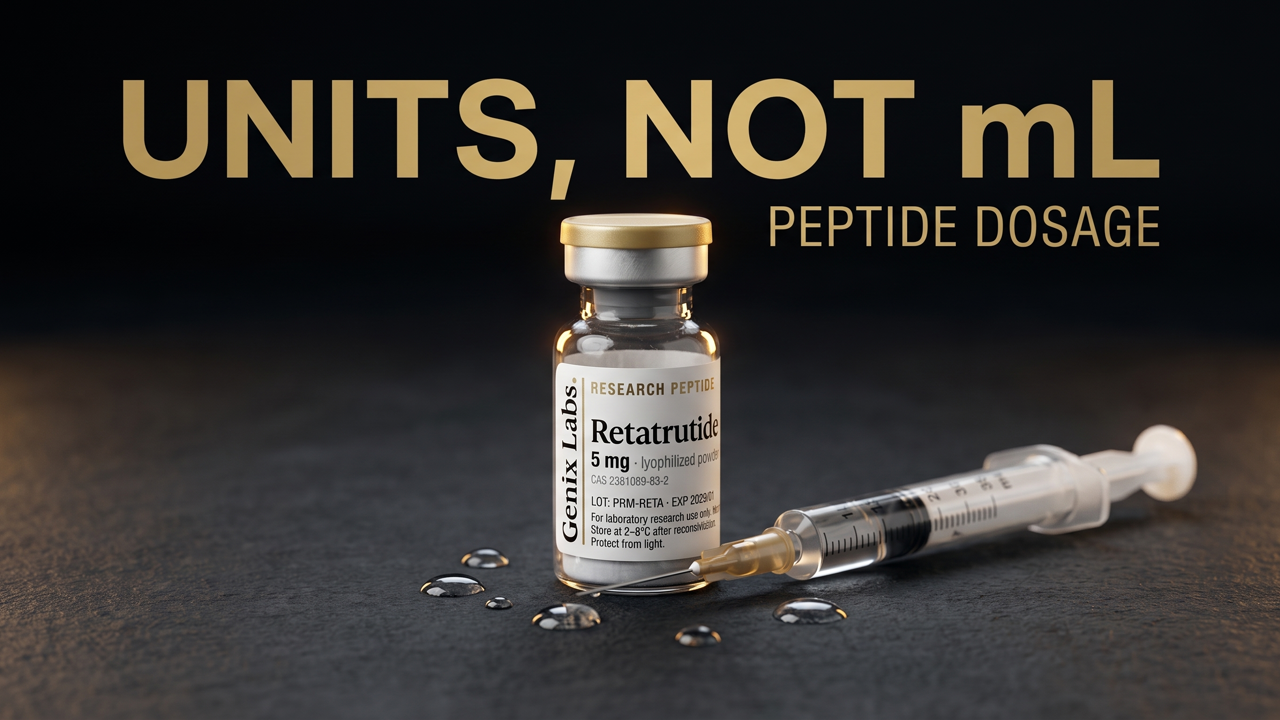
Work backwards from the concentration you want, not forwards from a habit. The peptide mass in the vial is fixed. The water you add decides how concentrated the solution is. More water means a weaker solution and larger, easier-to-read draws. Less water means a stronger solution and smaller draws.
Most research reconstitution lands between 1 mL and 3 mL per vial. A 10 mL bottle therefore covers several vials comfortably. Two common setups make the arithmetic obvious.
Notice that the peptide total never moved. Only the reading on the syringe changed. Our free peptide dosage calculator does this arithmetic for you if you would rather not do it by hand.
Storage and the first-puncture date
Store the sealed bottle at room temperature, away from direct light. Once you pierce the stopper, move it to the fridge and plan to finish it within about 28 days. Write the puncture date on the label in pen. That one habit removes all the guesswork later.
The 28 days is a working convention rather than a law of nature. It exists because a preserved multi-dose container is generally treated as good for four weeks after first entry. It is a sensible default, not a guarantee, and it assumes the bottle was handled cleanly throughout.
- Sealed bottle: room temperature, out of the light, good until the printed expiry.
- Opened bottle: refrigerate, and write the first-puncture date on the label.
- Swab the stopper with alcohol before every single entry, not just the first.
- Never decant it into another container. Draw from the original bottle.
- If you cannot read the lot number or the date, retire the bottle.
How long does a mixed vial really last?
Two separate clocks run on a mixed vial, and most people only watch one. The sterility clock is set by the preservative and runs roughly 28 days from first puncture. The stability clock is set by the peptide itself, the fridge temperature and light exposure. Whichever clock finishes first ends the vial.
This is the single most useful idea on this page. A vial can be perfectly sterile and still be worth very little, because the peptide in it has broken down. In water, peptide chains are slowly attacked in predictable ways. Warmth speeds that up. Light speeds it up. Repeated warming and cooling speeds it up most of all.
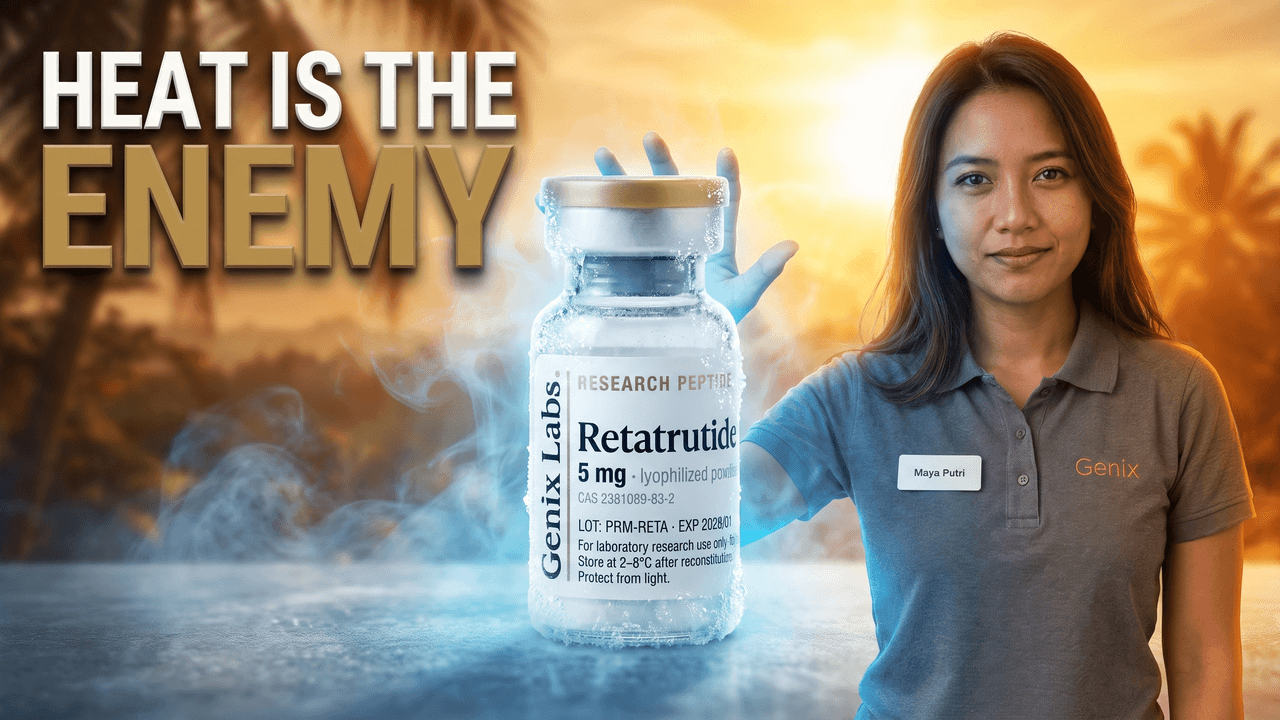
So the preservative protects against one failure mode only. Cold, dark, stable storage protects against the other. Our guide to storing peptides in Bali's heat goes deeper on the second clock, which is the one a tropical climate attacks hardest.
A simple rule of thumb
Date the vial at first puncture. Keep it cold and dark between draws. Stop at 28 days, or sooner if the solution stops looking completely clear. Clarity is a free diagnostic and it costs you nothing to check.
What bacteriostatic water cannot do
It cannot sterilise a vial that is already contaminated, cannot rescue a peptide that heat has already degraded, and cannot make a questionable compound safe. It holds bacterial growth flat. That is the whole of its job, and reading more into it is where real mistakes start.
- It does not kill bacteria. It stops them multiplying, which is a weaker claim.
- It does not reverse heat damage. A peptide cooked in transit stays damaged.
- It does not extend a peptide's stability clock. Only cold and dark storage does.
- It is not universally suitable. Benzyl alcohol is not appropriate for every application, and some compounds are formulated to avoid it.
- It is not a cleaning agent. Alcohol swabs clean the stopper, not the diluent.
The benzyl alcohol point deserves a sentence of its own. It is a preservative with a real safety profile behind it, and there are contexts in clinical practice where preserved diluents are specifically avoided. That is a decision for a qualified professional in a clinical setting, and it has nothing to do with laboratory research use.
Spotting a bottle you should not use
Check four things before the needle goes anywhere near it. The liquid should be completely clear with nothing floating in it. The crimp seal should be intact. The label should carry a readable lot number and expiry. And the bottle should have come to you cold-packed and sealed, not loose in an envelope.
Any haze, any particle, any flake of something suspended in the liquid and the bottle is finished. There is no version of that story with a good ending. The same goes for a crimp cap that spins freely or a stopper that looks pushed in.
| Check | Good | Retire the bottle |
|---|---|---|
| Clarity | Completely clear, no particles | Any haze, flake or floating speck |
| Crimp seal | Tight, does not spin | Loose, lifted or spinning freely |
| Stopper | Flat and intact | Pushed in, split or already pierced |
| Label | Lot number and expiry both readable | Missing, smudged or unreadable |
| Delivery | Sealed and cold-packed | Loose, warm or repackaged |
This is also the honest argument for buying a diluent from the same supplier as the compound. Every Genix batch ships with a per-batch certificate of analysis, HPLC purity at or above 99 percent and LC-MS identity confirmation, tested to ISO 17025 standards. The bottle is held in the same cold chain as the peptide beside it.
Bacteriostatic water in Bali's heat
Tropical heat attacks the stability clock, not the sterility clock. The preservative works just as well in Denpasar as anywhere else. What changes is how fast a reconstituted peptide degrades between draws, because the fridge door opens into a warm, humid room every time.
Three practical habits cover most of it. Keep the mixed vial at the back of the fridge, not in the door, where the temperature swings least. Keep it in its box so light never reaches it. And take the draw you need, then put it straight back rather than leaving it out on the bench.
Delivery matters for the same reason. We dispatch the same day on orders placed before 9 PM, cold-packed and tracked, with same-day delivery inside Bali and cash on delivery available. The shorter the warm window in transit, the less of the stability clock is spent before the bottle even reaches you.
FAQ
What is bacteriostatic water used for?
It is used to dissolve freeze-dried powders back into a measurable liquid. In peptide research that step is called reconstitution. Because the benzyl alcohol slows bacterial growth, one vial can be drawn from repeatedly over several weeks instead of being discarded after a single use.
Can I buy bacteriostatic water at CVS?
Stock varies by store and by country. In the United States it is a pharmacy item, so some CVS branches carry it and others order it in. Genix Labs supplies bacteriostatic water as a laboratory diluent, cold-packed, with same-day dispatch and same-day delivery inside Bali.
Can I buy bacteriostatic water over the counter?
In many places yes, because it is a simple preserved diluent rather than a controlled drug. Rules still differ by country, so local law decides. What you should check either way is the seal, the lot number, and that the liquid is completely clear before you use the bottle.
Can I buy bacteriostatic water at Walgreens?
Sometimes. Walgreens and similar chains treat it as a pharmacy stock item, so availability changes branch to branch. Buying it alongside your peptides is usually simpler, because the bottle then arrives in the same cold-chain parcel and you can mix as soon as it lands.
Is bacteriostatic water the same as sterile water?
No. Both start sterile, but only bacteriostatic water contains a preservative. Sterile water has nothing to hold bacteria back once the stopper is pierced, so it suits single use. Bacteriostatic water is the one that keeps a multi-draw vial usable across weeks in the fridge.
How long is bacteriostatic water good for after opening?
About 28 days is the working convention once the stopper is first pierced. Keep the opened bottle refrigerated and write the puncture date on the label. The sealed bottle lasts until its printed expiry, stored at room temperature and away from direct light.
Takeaway
Bacteriostatic water is sterile water with about 0.9 percent benzyl alcohol. That preservative holds bacterial growth flat, which is what turns a single-use mix into a vial you can draw from for weeks. It is not a disinfectant and it does not protect the peptide itself.
So watch both clocks. Date the vial at first puncture and stop at about 28 days for sterility. Keep it cold and dark between draws for stability. Check the bottle is clear, sealed and properly labelled before you ever pierce it. Those few habits protect everything else in the order.
Start with the pillar hub on peptides 101 if you want the whole handling sequence in order, or go straight to the bacteriostatic water 10 mL bottle if you already know what you need. Research use only, in every case.