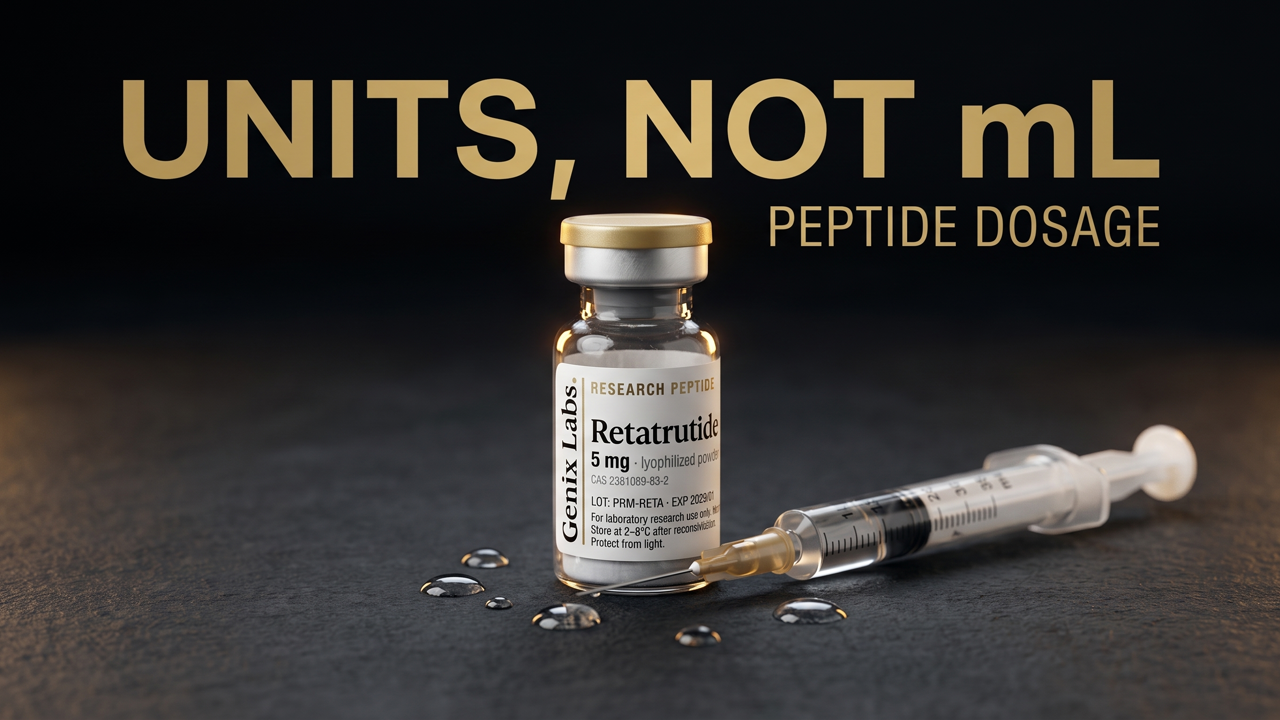
Peptides arrive as a dry powder in a sealed vial. Before you can measure a dose, you mix that powder with liquid. That step is called reconstitution, and it is where most of the confusion starts. The good news: working out a dose is not guesswork. It is one short calculation you can do the same way every time. This guide walks through it in plain words, with worked examples and a free calculator. Everything here is for research use only.
The quick answer
To calculate a peptide dose, first find the concentration. Divide the peptide mass in the vial (in mg) by the bacteriostatic water you add (in mL). That gives mg per mL. Then divide your target dose by that concentration to get the volume to draw. Multiply that volume by 100 to get the units on a U-100 insulin syringe. That is the whole thing.
Here is the fastest example. A 5 mg vial mixed with 2 mL of water is 2.5 mg per mL. A 500 mcg dose (which is 0.5 mg) needs 0.2 mL. On a U-100 syringe, that is 20 units. If you would rather skip the math, the peptide dosage calculator does it for you and draws the syringe.
The three numbers you need
You cannot calculate anything until you have three values. Every peptide calculator, ours included, asks for exactly these three. Write them down before you start.
- Peptide in the vial (mg). The total mass of peptide inside, printed on the label and confirmed on the Certificate of Analysis. A vial might say 5 mg, 10 mg or 100 mg. This number never changes, no matter how much water you add.
- Bacteriostatic water added (mL). The liquid you mix in to dissolve the powder. You choose this. It sets the concentration, so it is the one number people get wrong most often.
- Target dose per draw. How much peptide you want in a single draw, usually written in micrograms (mcg) or milligrams (mg). Remember that 1000 mcg equals 1 mg.
Notice what is not on the list: the syringe size. The syringe does not change the dose. It only changes how that dose is displayed, as a number of units. We come back to that below.
The formula, step by step
There is only one formula, and it runs in three steps. Do them in order and the answer falls out every time.
Step 1: Find the concentration
Concentration is how much peptide sits in each millilitre of liquid. Divide the vial mass by the water you added.
A 10 mg vial with 2 mL of water is 5 mg per mL. The same 10 mg vial with 5 mL of water is 2 mg per mL. Same peptide, different concentration, because you added different amounts of water.
Step 2: Find the volume
Now work out how much liquid holds your dose. Divide the dose by the concentration. Keep both in the same unit first. If your dose is in mcg, turn it into mg by dividing by 1000.
Say the concentration is 5 mg per mL and you want a 250 mcg dose. That is 0.25 mg. Divide 0.25 by 5 and you get 0.05 mL. That is the volume to draw.
Step 3: Convert to syringe units
Insulin syringes are marked in units, not millilitres. On a U-100 syringe, 100 units fill 1 mL, so one unit is 0.01 mL. To turn your volume into units, multiply by 100.
Our 0.05 mL becomes 5 units. So you pull the plunger to the 5 mark. If you are ever unsure, the calculator shows the fill point on a drawn syringe so you can check it against your own.
Use the calculator
Reading the steps is one thing. Doing them at the bench, half awake, is another. This is the same tool that lives on our peptide dosage calculator page. Pick a vial, type your water and dose, and read the units straight off the syringe. It updates live.
Your vial
75 peptides with the protocols people commonly run, or pick custom to enter any vial by hand.
The total peptide mass printed on the vial or Certificate of Analysis.
How much solvent you reconstitute with. More water means a lower concentration.
The amount you want in each draw. 1000 mcg equals 1 mg.
Most research uses a U-100 insulin syringe (100 units = 1 mL). A 3 mL auto-injection pen dials the same units, with up to 300 in the cartridge.
What people commonly run
Reference figures for research planning, gathered from published trial protocols and widely used community conventions. They are not a recommendation to dose anyone.
Draw this
Reconstitution mathNumbers update live and are reconstitution arithmetic only. Genix peptides are for laboratory research use, not for human or veterinary use. Nothing here is medical advice or a dosing recommendation.
How to read your syringe
The single most common reconstitution error is misreading the syringe scale. A unit is not a millilitre. Confirm which scale is printed on your barrel before you draw anything.
Most research uses a U-100 insulin syringe. On a U-100, 100 units equal 1 mL. So 50 units is 0.5 mL and 10 units is 0.1 mL. The barrel may hold 1 mL, 0.5 mL or 0.3 mL, but the unit spacing is the same on all of them. A smaller barrel just stops sooner.
A U-40 syringe is different. On a U-40, 40 units equal 1 mL, so one unit is 0.025 mL. If you read a U-40 syringe as though it were U-100, your volume is off by more than double. This is why the calculator asks which syringe you hold.
| Syringe | Full barrel | 1 unit | Best for |
|---|---|---|---|
| U-100 · 1 mL | 100 units | 0.01 mL | Larger draws, bigger vials |
| U-100 · 0.5 mL | 50 units | 0.01 mL | The everyday research syringe |
| U-100 · 0.3 mL | 30 units | 0.01 mL | Small, precise micro-draws |
| U-40 · 1 mL | 40 units | 0.025 mL | Only genuine U-40 scale syringes |
How much water should you add?
There is no single right answer, and that surprises people. The water volume does not change your total dose or how many doses a vial holds. It only changes the concentration, and so how many units you draw for a given dose.
The practical rule: pick a water volume that puts your usual dose at a comfortable, readable number of units. Too little water and a small dose lands on 2 or 3 units, which is hard to measure precisely. Too much water and the same dose runs past the top of the barrel. Common research volumes sit between 1 mL and 3 mL.
- More water means a lower concentration and more units per dose. Good for small doses you want to measure accurately.
- Less water means a higher concentration and fewer units per dose. Good for large doses that would otherwise overflow the syringe.
- The dose count never moves. A 10 mg vial dosed at 500 mcg is always 20 draws, whether you added 1 mL or 3 mL.
Bacteriostatic water vs sterile water
Bacteriostatic water contains a little benzyl alcohol, a preservative that slows bacterial growth. That is what lets a reconstituted vial keep for weeks in the fridge. Plain sterile water has no preservative, so it suits single use rather than a multi-dose vial. For most research reconstitution that spans several draws, bacteriostatic water is the usual choice.
Worked examples by peptide
The math is identical for every peptide. Only the vial size and the dose change. Here are the setups people ask about most, each run through the same three steps on a U-100 syringe.
BPC-157 (10 mg vial)
Mix a 10 mg vial with 3 mL of water for 3.33 mg per mL. For a 250 mcg draw, that is 0.075 mL, or about 7.5 units. The vial holds 40 of those draws. See the BPC-157 dosing guide for the wider picture.
Tirzepatide and semaglutide
These GLP-1 peptides are dosed by the milligram and stepped up slowly. Reconstitute a 10 mg tirzepatide vial with 2 mL for 5 mg per mL. A 2.5 mg draw is 0.5 mL, or 50 units. Our tirzepatide dosage chart and semaglutide vs tirzepatide pieces cover the step-up itself.
Retatrutide (5 mg or 10 mg vial)
A 5 mg vial with 2 mL is 2.5 mg per mL. A 1 mg draw is 0.4 mL, or 40 units. Because retatrutide is dosed across a range, many people mix it thinner for finer control. The retatrutide dosing overview has more.
GHK-Cu and ipamorelin
GHK-Cu vials are large, often 100 mg. Add 5 mL for 20 mg per mL, so a 2 mg draw is only 0.1 mL, or 10 units. Ipamorelin is the opposite, dosed in micrograms, so a thinner mix keeps the units readable. Same formula, very different vials.
Peptide dosage chart
This is a quick reference for the setups above. Every row is exactly what the calculator returns on a U-100 syringe. Use it to sanity-check your own numbers, then run your real vial through the tool.
| Peptide | Vial | Water | Dose | Concentration | Volume | Units | Doses |
|---|---|---|---|---|---|---|---|
| BPC-157 | 10 mg | 3 mL | 250 mcg | 3.33 mg/mL | 0.075 mL | 7.5 | 40 |
| Tirzepatide | 10 mg | 2 mL | 2.5 mg | 5 mg/mL | 0.50 mL | 50 | 4 |
| Retatrutide | 5 mg | 2 mL | 1 mg | 2.5 mg/mL | 0.40 mL | 40 | 5 |
| GHK-Cu | 100 mg | 5 mL | 2 mg | 20 mg/mL | 0.10 mL | 10 | 50 |
| Semax | 10 mg | 2 mL | 300 mcg | 5 mg/mL | 0.06 mL | 6 | 33 |
Common mistakes to avoid
- Reading units as millilitres. 20 units is 0.2 mL on a U-100, not 20 mL. Confirm the scale first.
- Mixing up mcg and mg. 500 mcg is 0.5 mg. A slipped decimal here is a tenfold error.
- Assuming more water means a bigger dose. It does not. Water only changes the units you draw, never the peptide in the vial.
- Shaking the vial hard. Add water slowly down the side and let it dissolve. Peptides are delicate. Read the peptide handling guide for the gentle method.
- Skipping the Certificate of Analysis. If you cannot verify the mg, your concentration is a guess. Start from a tested vial.
New to all of this? The Peptides 101 hub and what are peptides guide cover the basics before you reconstitute anything.
Frequently asked questions
How do you calculate peptide dosage?
First find the concentration: divide the peptide mass in the vial by the millilitres of bacteriostatic water you added, giving mg per mL. Then divide your target dose by that concentration to get the volume to draw, and multiply by 100 for the units on a U-100 insulin syringe.
How much bacteriostatic water should I add to a peptide vial?
There is no single correct amount. More water lowers the concentration, so each syringe unit holds less peptide and small doses are easier to measure. Less water concentrates it. Common research volumes are 1 to 3 mL. The amount of water never changes your dose, only the units you draw.
How do I calculate peptide dosage per day?
Work out a single dose first, then multiply by how often you draw. If one draw is 250 mcg and the protocol calls for two draws a day, that is 500 mcg daily. Divide the total peptide in the vial by the daily amount to see how many days a vial lasts.
Is there a free peptide dosage calculator?
Yes. The Genix Labs peptide dosage calculator is free and needs no signup. Enter the vial size, the bacteriostatic water you added and your target dose, and it returns the concentration, the volume to draw and the exact insulin-syringe units, updating live as you change any input.
What is a peptide reconstitution calculator?
It is a tool that turns reconstitution math into a syringe reading. Reconstitution means mixing a freeze-dried peptide powder with bacteriostatic water. The calculator takes the vial mass, the water volume and your dose, then tells you how many units to draw so you do not have to do the arithmetic by hand.
What is the difference between bacteriostatic water and sterile water?
Bacteriostatic water contains a small amount of benzyl alcohol that slows bacterial growth, so a reconstituted vial keeps for weeks in the fridge. Plain sterile water has no preservative and is better suited to single use. Most multi-dose research reconstitution uses bacteriostatic water for that shelf life.
The takeaway
Calculating a peptide dose is not hard once you see it as one formula. Find the concentration, find the volume, convert to units. The water you add only changes the units on the syringe, not the dose itself or how many doses a vial holds. Confirm the mg against a Certificate of Analysis, pick a water volume that keeps your dose readable, and read the correct syringe scale.
When you want it done instantly, the peptide dosage calculator handles the arithmetic and draws the syringe for you. And when you are ready to start from verified material, every vial in the Genix catalog ships with a batch Certificate of Analysis. Research use only.