

People search "MOTS-C dosing" because the vial ships as a dry powder, with no chart inside. This guide explains what dosing means, how the research handled the amount, and the simple reconstitution math, all in plain words. It is a research overview, not medical advice or a protocol for human use.
The quick answer
MOTS-C dosing has two parts: how much, and how often. In research it is studied in small amounts scaled to body weight, usually a few times a week rather than daily. There is no official human chart. The vial holds a set amount, and water only decides how that amount is measured out.
How MOTS-C dosing works
Think of dosing as a recipe with two numbers: the amount of peptide, and how often it is given. MOTS-C is a mitochondrial-derived peptide, tied to how cells make energy, so research often studies it a few times a week. New to it? Start with Peptides for Weight Loss and the Weight & Metabolism hub.
How to reconstitute a 10mg vial of MOTS-C
MOTS-C ships as a dry powder. In a lab it is mixed with bacteriostatic water. The water sets the concentration: add 1 mL for 10 mg per mL, or 2 mL for 5 mg per mL. The vial always holds 10 mg either way. This is lab technique for research use only, not human use.
Once mixed, keep the vial cold and use it within a few weeks. See How to Store Peptides in Bali for the full storage guide.
MOTS-C in units and mL
People get confused by "units" because insulin syringes are marked in units, not mL. The rule is simple: on a standard insulin syringe, 100 units equals 1 mL. So units are just a fine ruler for a small volume of liquid.
| Concentration | 10 units | 20 units | 50 units |
|---|---|---|---|
| 5 mg per mL | 0.5 mg | 1 mg | 2.5 mg |
| 10 mg per mL | 1 mg | 2 mg | 5 mg |
To turn units into an amount, you need the concentration you mixed. This is measurement math for research use only, not a protocol for human use.
When is the best time of day to take MOTS-C?
Research has looked at MOTS-C around exercise, since it is tied to how cells use energy, so some studies use it before activity. There is no proven best time for a person. Timing questions in humans are not settled. MOTS-C is for research use only.
Per day or per week?
Unlike a daily peptide, MOTS-C is often studied a few times a week, not every day. The idea is that it works upstream on cellular energy, so research routines space it out. There is no fixed human schedule, and programs vary. This is reported research shape, not a personal protocol.
- Small amounts scaled to body weight, not a fixed human number.
- Given a few times a week in many research routines.
- Often studied around exercise and activity.
- No official chart, because human trials are still early.
What are the downsides of MOTS-C?
The honest downside is thin human evidence, since most MOTS-C research is early or animal work. Reported effects are mild, like injection-site soreness or a light head, but long-term safety in people is unknown. Quality also varies a lot between suppliers. This is not medical advice.
What peptide should you stack with MOTS-C?
In research discussion, MOTS-C is often paired with other metabolic or repair peptides, since it works on cellular energy rather than appetite. Any stack is a research design, not a personal protocol, and combining materials raises unknowns. See how the metabolic options compare in our tesamorelin guide. Talk to a doctor before combining anything.
MOTS-C dosing notes for women
People ask whether MOTS-C dosing differs for women. In the research, amounts are scaled to body weight, not split by sex, so a smaller person uses a smaller amount. There is no separate proven female protocol. This is reported research framing for education only, and MOTS-C is for research use only.
How long is a MOTS-C cycle?
In research, MOTS-C is often studied across a set number of weeks, then stopped, rather than run forever. There is no single official cycle, and programs differ. This is reported research shape for education only, not a protocol for human use.
Why purity beats any dose chart
A perfect schedule means nothing if the vial is wrong. An under-dosed or dirty vial makes any chart useless and can be unsafe. That is why a certificate of analysis matters more than any number. It shows the batch was tested for purity by HPLC and identity by LC-MS.
Quick checks on arrival
- A certificate of analysis with a lot number that matches the vial.
- A dry, even cake of powder, not a yellowed or oily clump.
- A vial that arrived cold, with the seal and crimp intact.
- HPLC purity of at least 99% and LC-MS identity on the report.
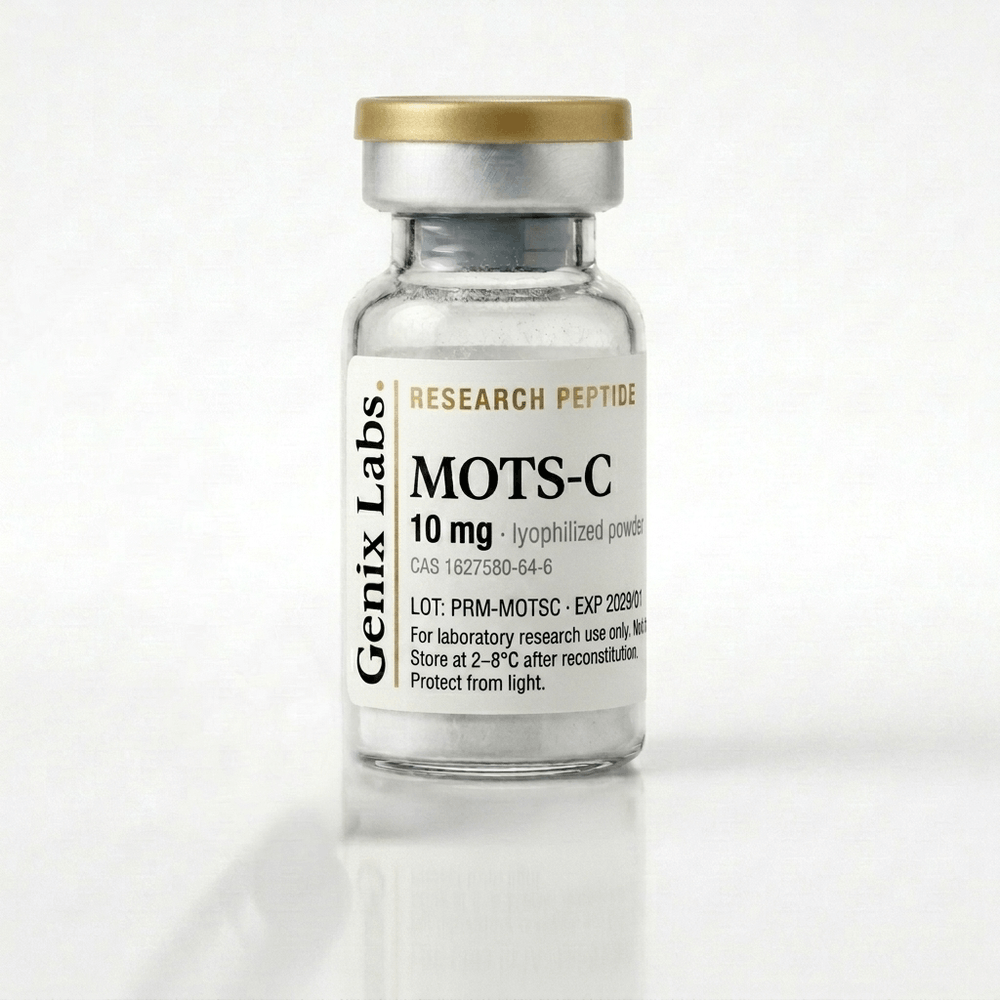
Purity of at least 99% by HPLC, LC-MS identity, and a batch COA in every order. Cold-chain shipping and same-day delivery in Bali. From $79 (Rp 1.290.000). Research use only.
Shop lab-tested MOTS-CFrequently asked questions
How do you reconstitute a 10mg vial of MOTS-C?
In a lab, a 10 mg vial is mixed with bacteriostatic water. The water sets the concentration: add 1 mL for 10 mg per mL, or 2 mL for 5 mg per mL. The vial always holds 10 mg either way. This is lab technique for research use only, not human use.
What are the downsides of taking MOTS-C?
The honest downside is thin human evidence, since most MOTS-C research is early or animal work. Reported effects are mild, like injection-site soreness or a light head, but long-term safety in people is unknown. Quality also varies a lot between suppliers. This is not medical advice.
When is the best time of day to take MOTS-C?
Research has looked at MOTS-C around exercise, since it is tied to how cells use energy, so some studies use it before activity. There is no proven best time for a person. Timing questions in humans are not settled. MOTS-C is for research use only.
What peptide should I stack with MOTS-C?
In research discussion, MOTS-C is often paired with other metabolic or repair peptides, since it works on cellular energy rather than appetite. Any stack is a research design, not a personal protocol, and combining materials raises unknowns. Talk to a doctor before combining anything. Research use only.
How much MOTS-C per week is studied?
Research reports amounts scaled to body weight, given a few times a week rather than daily, but there is no fixed human number. The powder ships without a chart because it is a research material. Any specific weekly amount for a person is a medical question, not a blog answer.
Takeaway
MOTS-C dosing comes down to two numbers, how much and how often, and most of what we know is early research, not a human chart. Reconstitution is simple math, where water sets the concentration, not the amount. The single most useful thing you can check is the certificate of analysis. Above all, this is a research overview, and MOTS-C is for research use only.