
Retatrutide is the first weight compound to agonize three receptors at once. For two years its benefit list was a single phase 2 trial that everybody quoted. That changed this autumn. Three phase 3 trials have now finished, two of them were published in the New England Journal of Medicine and the Lancet within the last four weeks, and the benefit list is suddenly much wider than weight. It also now contains one clear miss.
What are the benefits of retatrutide?
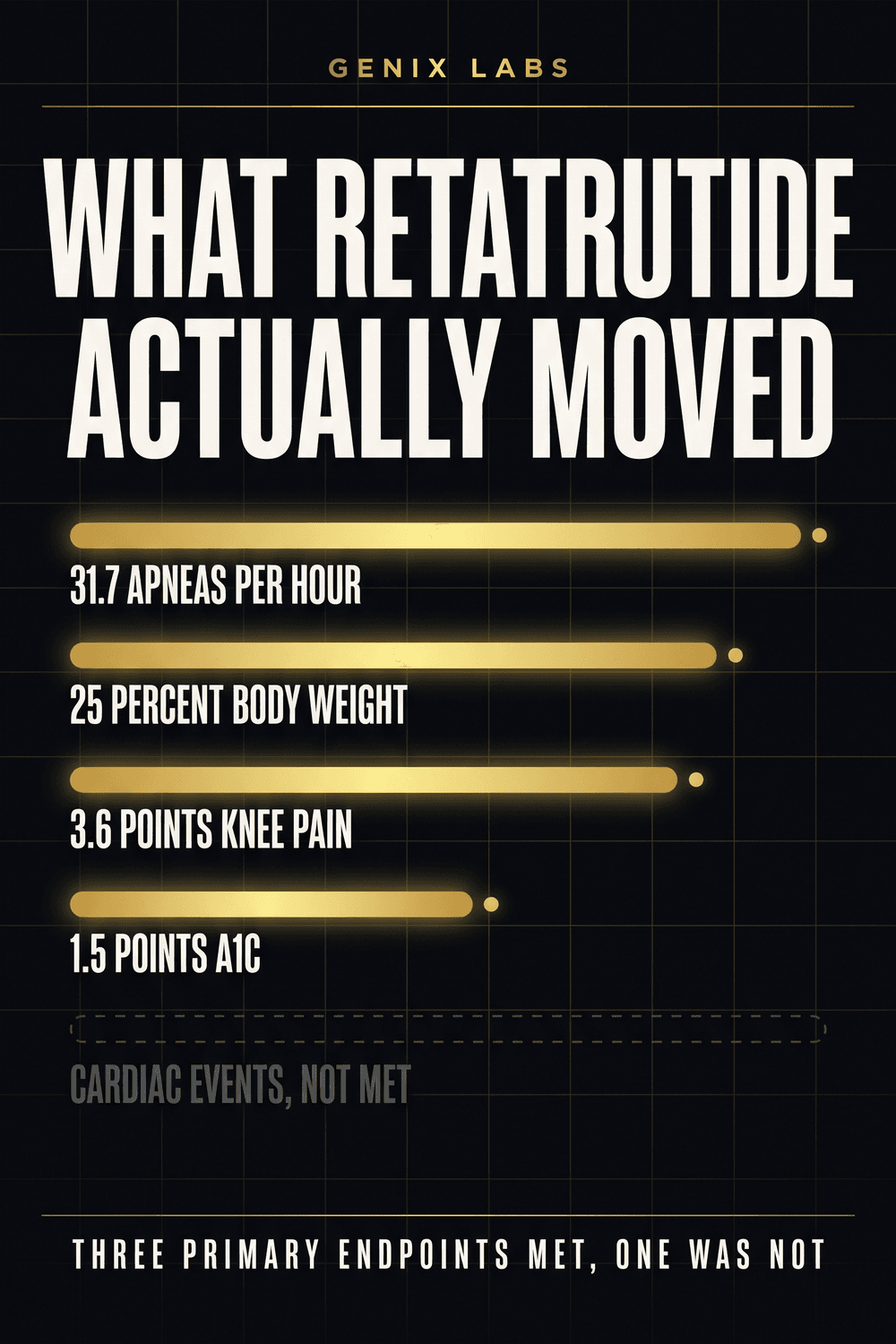
In published trials, retatrutide lowered body weight by up to 25.0% at 80 weeks, cut knee osteoarthritis pain by 3.6 points on a 10 point scale, reduced sleep apnea by up to 34.3 breathing events an hour, lowered A1C by 1.6 points in type 2 diabetes, and cut liver fat by up to 86%. It did not reduce cardiac events.
Those six results are not equal. Three of them were pre-registered primary endpoints in phase 3 trials. One was a secondary endpoint. One comes from a 98 person phase 2 substudy. And one is a miss that most summaries report as a win. The rest of this article sorts them properly.
How every benefit on this page was graded
A benefit is only as strong as the question it answered. A pre-registered primary endpoint is the strongest kind. The trial was designed to test it, the statistics were set in advance, and the result counts. A secondary endpoint is weaker. An exploratory finding in a substudy is weaker still.
So every number here carries three labels. Which trial produced it. Which kind of endpoint it was. And how many people it came from. If a claim about retatrutide cannot carry those three labels, it is not a result. It is a rumour wearing a decimal point.
The retatrutide benefit ledger, in one table
Here is the whole published record in one place. The last column is the one that matters most, and it is the column nobody else prints.
| Benefit | Best published figure | Trial | Strength of evidence |
|---|---|---|---|
| Body weight | 25.0% at 80 weeks, 12mg | TRIUMPH-1, 2,339 adults | Phase 3 primary endpoint, met |
| Body weight, longer | 29.9% at 104 weeks | TRIUMPH-1 extension, 532 adults | Pre-specified extension, smaller group |
| Knee osteoarthritis pain | 3.6 point fall on WOMAC | TRIUMPH-1 subgroup, 574 adults | Phase 3 primary endpoint, met |
| Obstructive sleep apnea | 34.3 fewer events an hour | TRIUMPH-1-OSA, 243 adults | Phase 3 primary endpoint, met |
| A1C in type 2 diabetes | 1.6 point fall from 7.7% | TRIUMPH-2, 1,152 adults | Phase 3 secondary endpoint |
| Waist circumference | 24.1cm, or 9.5 inches | TRIUMPH-1, 2,339 adults | Phase 3 secondary endpoint |
| Triglycerides | 37.0% lower | TRIUMPH-3, highest dose | Phase 3 secondary endpoint |
| Systolic blood pressure | 9.3 mmHg lower | TRIUMPH-3, highest dose | Phase 3 secondary endpoint |
| hsCRP, an inflammation marker | 51.2% lower | TRIUMPH-3, highest dose | Phase 3 secondary endpoint |
| Liver fat | 86.0% lower at 48 weeks | Phase 2a substudy, 98 adults | Phase 2 only, never repeated |
| Cardiac events | No separation from placebo | TRIUMPH-3, 1,949 adults | Measured and not met |
| Lean mass | Not reported | None | No published figure |
Read the right hand column downward and the picture changes. Four rows are as solid as drug evidence gets. Five are real but secondary. One is thin. One is a miss. And the last one is a blank that matters more than it looks.
What is retatrutide?
Retatrutide is an investigational once weekly injection made by Eli Lilly. Its lab name is LY3437943. It is a single engineered peptide that switches on three different hormone receptors at the same time: GIP, GLP-1 and glucagon. That is why it is called a triple agonist.
Agonist just means a key that fits a lock and turns it on. Most weight compounds turn one lock. Tirzepatide turns two. Retatrutide turns three. Whether the third lock is worth turning is the entire scientific argument, and the TRIUMPH trials were built to answer it.
Is retatrutide a drug, and is it natural?
It is a drug, and it is not natural. Retatrutide is a synthetic peptide designed in a laboratory. Nothing in the human body produces it. It borrows the shape of natural gut hormones, then changes them so they survive for a week instead of a few minutes.
It is also an unapproved drug, which is a different legal thing again. No regulator anywhere has cleared it for sale or for human use. That is why Genix Labs supplies it strictly as a lab-tested retatrutide research compound, for in-vitro laboratory work only.
Does retatrutide have a brand name?
Not yet. Brand names are assigned around the time a drug is approved. Semaglutide became Ozempic and Wegovy. Tirzepatide became Mounjaro and Zepbound. Retatrutide has no marketing name because it has not reached that stage.
If you see a retatrutide product sold under a brand name today, that name was invented by the seller. It carries no regulatory meaning at all.
How does retatrutide help with weight loss?
It switches on three receptors at once. GLP-1 and GIP signalling lower appetite and slow the stomach, so less food is eaten. The glucagon receptor is the third, and it raises energy expenditure and moves fat out of the liver. Trials measure the combined result, not each part separately.
That last point is important and usually skipped. No human trial has ever isolated the glucagon contribution in retatrutide. Every published benefit is the sum of all three signals working together. The mechanism split is inferred from animal work and from what each receptor does on its own.
What each of the three receptors adds
| Receptor | What switching it on does | Which approved drug already uses it |
|---|---|---|
| GLP-1 | Cuts appetite, slows stomach emptying, improves insulin release | Semaglutide, Ozempic and Wegovy |
| GIP | Adds further appetite and metabolic effects alongside GLP-1 | Tirzepatide, Mounjaro and Zepbound |
| Glucagon | Raises energy burned at rest, mobilizes fat from the liver | None approved for weight |
Read that third row again. The glucagon receptor is the only one of the three with no approved weight drug behind it. Retatrutide is the first serious test of whether adding it is worth the trouble.
Why the third receptor is the whole argument
Glucagon has a reputation problem. It is the hormone that raises blood sugar. Deliberately switching it on in someone with diabetes sounds backwards, and for decades that is exactly why nobody tried.
The counter argument is that glucagon also burns energy and empties fat out of the liver. If the GLP-1 and GIP signals control the blood sugar side, the glucagon side can be used for what it is good at. The liver fat results are the clearest sign that this reasoning holds up.
TRIUMPH-2 gives the safety read on that gamble. In adults with type 2 diabetes, A1C fell by 1.4 to 1.6 points across every retatrutide arm. Blood sugar went down, not up. The gamble paid off.
What is the average weight loss on retatrutide?
In TRIUMPH-1, the mean change at 80 weeks was 17.6% on 4mg, 23.7% on 9mg and 25.0% on 12mg, against 3.9% on placebo, counting everyone randomized. A smaller extension group carried on to 104 weeks and averaged 29.9% on 12mg. These are trial means, not individual promises.
Those are the numbers worth memorising, because they count every person who was given the drug. That includes the people who stopped early, the people who struggled with side effects, and the people it simply did not suit.
What is the TRIUMPH trial programme?
TRIUMPH is the phase 3 programme for retatrutide. It has enrolled more than 5,800 people across its trials. Each trial takes a different population, so the same molecule can be tested in different circumstances rather than one flattering one.
| Trial | Who it enrolled | How many | Length |
|---|---|---|---|
| TRIUMPH-1 | Obesity without diabetes | 2,339 | 80 weeks, with a 104 week extension |
| TRIUMPH-2 | Obesity or overweight with type 2 diabetes | 1,152 | 80 weeks |
| TRIUMPH-3 | Severe obesity with established heart disease | 1,949 | 80 weeks |
| TRIUMPH-1-OSA and TRIUMPH-2-OSA | Moderate to severe sleep apnea, nested in the above | 243 and 448 | 80 weeks |
| TRIUMPH-5 | Head to head against tirzepatide | Not yet reported | Not yet reported |
The last row is the one to watch. TRIUMPH-5 is the only direct comparison against tirzepatide, and until it reads out, every retatrutide against tirzepatide claim is a comparison across separate trials.
What did TRIUMPH-1 find at 80 weeks?
TRIUMPH-1 randomized 2,339 adults with obesity and no diabetes to 4mg, 9mg, 12mg or placebo for 80 weeks. The average participant weighed 112.7kg, about 248 pounds, with a body mass index of 40.0. Weight fell 17.6%, 23.7% and 25.0% across the three doses against 3.9% on placebo.
It carried two more primary endpoints alongside weight, which is unusual and ambitious. One was knee osteoarthritis pain in the 574 participants who had it. The other was sleep apnea severity in the 243 who had that. All three primary endpoints were met.
- 2,339 adults, 80 weeks, three doses against placebo.
- Weight down 25.0% on 12mg against 3.9% on placebo.
- Knee pain down 3.6 points against 1.9 on placebo.
- Sleep apnea down 31.7 events an hour against 9.9 on placebo.
- Published in the New England Journal of Medicine in September 2026.
Why one trial reports two different numbers
TRIUMPH-1 reports 25.0% in one place and 28.3% in another, for the same dose in the same trial. Neither is wrong. They answer different questions, and the difference between them is where most exaggerated claims live.
| Which number | What question it answers | 12mg at 80 weeks |
|---|---|---|
| Treatment regimen estimand | What happened to everyone who was randomized, including people who stopped | 25.0% |
| Efficacy estimand | What happened to people who actually stayed on the drug as planned | 28.3% |
The first is the honest headline. The second is the best case. Marketing quotes the second and calls it the average. This page uses the first everywhere unless it says otherwise, because a benefit that only appears if you never stop is a conditional benefit.
What happened in the 104 week extension?
532 participants who started with a body mass index of 35 or above carried on for another 24 weeks, to 104 weeks in total. They were moved up to the highest dose they could tolerate. On the treatment regimen estimand, the 12mg group reached 29.9%. On the efficacy estimand it was 30.3%.
That group started heavier than the main trial, at 121.7kg with a body mass index of 42.8. So the extension is a different population, not simply a longer version of the same one. The 30% figure is real, and it is not the average for everybody.
One more detail deserves attention. Participants who had been on placebo and then moved to the real drug reached 19.2% in those 24 weeks. That is a fast change, and it is the cleanest within trial evidence that the effect belongs to the molecule.
How many people lost a quarter of their body weight?
62.5% of the 12mg group lost 25% or more of their body weight by 80 weeks, against 2.2% on placebo. That is the single most striking number in the whole file, because it describes people rather than averages.
| Weight lost | 4mg | 9mg | 12mg | Placebo |
|---|---|---|---|---|
| 25% or more | 27.8% | 52.9% | 62.5% | 2.2% |
| 30% or more | 15.3% | 37.9% | 45.3% | 0.5% |
| 35% or more | 5.9% | 20.8% | 27.2% | 0.3% |
These proportions come from the efficacy estimand, so they describe people who stayed on treatment. The 5%, 10%, 15% and 20% thresholds were not reported, which is itself telling. At these doses almost everyone cleared them.
The benefit that gets the least attention
65.3% of the 12mg group ended the trial with a body mass index below 30. They started the trial in the obesity category and finished outside it. That is a category change, not a percentage, and it is easier to understand than any of the figures above.
More striking still, 37.5% of people who began with class 3 obesity, a body mass index of 40 or more, also finished below 30. Crossing two whole categories was previously something only surgery produced reliably.
This result almost never appears in summaries. It should, because it answers the question people are actually asking far better than a decimal percentage does.
Did the weight loss plateau?
Not within the trials. The phase 2 curve was still falling at 48 weeks. TRIUMPH-1 was still falling at 80 weeks. The extension group was still falling at 104 weeks. Every published retatrutide curve ends before it flattens.
That is unusual, and it is also a limitation rather than a benefit. Nobody knows where the curve ends, because no trial has run long enough to find out. Anyone quoting a final ceiling for retatrutide is quoting a number that has not been measured.
What did the phase 2 obesity trial find?
The phase 2 trial enrolled 338 adults for 48 weeks and tested four doses. Weight fell 8.7%, 17.1%, 22.8% and 24.2% at 1mg, 4mg, 8mg and 12mg, against 2.1% on placebo. It was published in the New England Journal of Medicine in 2023 and it is why the phase 3 doses were chosen as they were.
Notice that 24.2% at 48 weeks is close to the 25.0% that TRIUMPH-1 reached at 80 weeks. The phase 2 figure looks faster because phase 2 trials report the efficacy estimand more often, and because smaller trials lose fewer people. Our breakdown of every retatrutide result goes through that comparison timepoint by timepoint.
Which benefits keep climbing with dose, and which flatten
Weight keeps climbing. Every trial shows 12mg beating 9mg beating 4mg, with no sign of a ceiling. If the goal is weight, more dose reliably means more result across the tested range.
Other benefits flatten early, and this is the most useful thing on this page. A1C in TRIUMPH-2 fell 1.4 points on 4mg and 1.5 points on 12mg. Tripling the dose added almost nothing. Knee pain fell 3.2 points on 4mg and 3.6 on 12mg. Sleep apnea in TRIUMPH-1-OSA actually did slightly better on 9mg than on 12mg.
| Benefit | 4mg | 9mg | 12mg | Does more dose help? |
|---|---|---|---|---|
| Body weight, TRIUMPH-1 | 17.6% | 23.7% | 25.0% | Yes, steadily |
| A1C, TRIUMPH-2 | 1.4 pts | 1.6 pts | 1.5 pts | No, flat after 4mg |
| Knee pain, TRIUMPH-1 | 3.2 pts | 3.5 pts | 3.6 pts | Barely |
| Sleep apnea, TRIUMPH-1-OSA | 22.9 events | 34.3 events | 31.7 events | No, 9mg did best |
| Nausea rate, TRIUMPH-1 | 28.6% | 38.4% | 42.4% | Yes, and that is the cost |
Read the bottom row alongside the others. Side effects climb with dose on every single benefit. For weight that trade may be worth it. For A1C, knee pain and sleep apnea the data say the extra dose buys side effects and not much else.
What happened to waist circumference?
Waist fell 24.1cm, which is 9.5 inches, on 12mg at 80 weeks. Placebo fell 3.6cm. The average participant started at 118.3cm, or 46.6 inches, so the waist shrank by about a fifth.
Waist matters more than total weight for metabolic risk, because it tracks the fat around the organs rather than under the skin. TRIUMPH-3 saw a similar 19.0cm fall on its highest dose in a group with heart disease.
Does retatrutide reduce liver fat?
In a phase 2a substudy, yes, and by a lot. Relative liver fat fell 82.4% at 24 weeks on 12mg, and 86.0% by 48 weeks. On placebo it rose 0.3%. 86% of the 12mg group reached a normal liver fat level, below 5%, by week 24, against nobody on placebo.
Now the caveat that almost nobody prints. That substudy had 98 participants. It was phase 2a, not phase 3. And MRI data were available for 78.6% of participants at week 24 but only 43.9% at week 48. The 48 week figure rests on fewer than half the group.
So liver fat is a real and large effect sitting on thin evidence. It is the strongest candidate for the next approval after obesity, and it is not yet in the same class as the weight data.
The liver fat ladder, dose by dose
| Dose | Liver fat at 24 weeks | Liver fat at 48 weeks | Reached normal liver fat by week 24 |
|---|---|---|---|
| 1mg | 42.9% lower | 51.3% lower | 27% |
| 4mg | 57.0% lower | 59.0% lower | 52% |
| 8mg | 81.4% lower | 81.7% lower | 79% |
| 12mg | 82.4% lower | 86.0% lower | 86% |
| Placebo | 0.3% higher | 4.6% lower | 0% |
This table shows a pattern worth noticing. The jump from 4mg to 8mg is enormous. The jump from 8mg to 12mg is small. For liver fat specifically, the useful part of the dose range appears to end around 8mg.
Does retatrutide lower A1C?
Yes. In TRIUMPH-2, A1C fell 1.4, 1.6 and 1.5 points across 4mg, 9mg and 12mg, from a starting average of 7.7%. Placebo fell 0.2 points. A1C is a three month average of blood sugar, so that is a substantial change.
The phase 2 diabetes trial went further, with A1C falling as much as 2.16 points over 36 weeks. That trial is unusually informative because it used an active comparator, dulaglutide, rather than placebo alone. Beating an active drug is a much harder test.
What did TRIUMPH-2 find in type 2 diabetes?
TRIUMPH-2 enrolled 1,152 adults with obesity and type 2 diabetes across 92 centres in eight countries. Weight fell 11.9%, 16.8% and 18.8% against 5.1% on placebo. Every dose beat placebo with a p value below 0.0001.
Compare those numbers to TRIUMPH-1 and a clear pattern appears. Every dose lost less weight in people with diabetes. 12mg reached 25.0% without diabetes and 18.8% with it. That gap is consistent with every other drug in this class and it is worth knowing before quoting a single figure.
The population also explains part of it. The median participant had lived with obesity for 21 years and with diabetes for 5.6 years, and 92% were already taking oral glucose lowering medication.
Does retatrutide reduce knee osteoarthritis pain?
Yes, and this was a pre-registered primary endpoint rather than an afterthought. Among 574 TRIUMPH-1 participants with knee osteoarthritis, pain scores fell 3.2, 3.5 and 3.6 points on a 10 point scale, against 1.9 points on placebo. The difference from placebo was significant at every dose.
Placebo falling 1.9 points on its own is the part to sit with. Pain scores move a long way on expectation alone. That is exactly why a placebo controlled trial was needed, and why the extra 1.8 points is the real result rather than the full 3.6.
Does retatrutide help obstructive sleep apnea?
Yes. Two phase 3 trials nested inside the TRIUMPH programme tested it, and both met their primary endpoint. The apnea hypopnea index, which counts breathing interruptions per hour of sleep, fell by up to 34.3 events an hour against 9.9 on placebo in people without diabetes.
These results were published in the New England Journal of Medicine on 21 October 2026. They are the newest entry in the whole retatrutide record, and most pages about retatrutide benefits were written before they existed.
The sleep apnea numbers, trial by trial
| Trial | Who | Starting events per hour | 4mg | 9mg | 12mg | Placebo |
|---|---|---|---|---|---|---|
| TRIUMPH-1-OSA | 243 adults, no diabetes | 58.6 | 22.9 fewer | 34.3 fewer | 31.7 fewer | 9.9 fewer |
| TRIUMPH-2-OSA | 448 adults, with diabetes | 55.9 | 19.2 fewer | 24.7 fewer | 25.4 fewer | 10.3 fewer |
A starting index near 58 is severe sleep apnea. Removing 34 events an hour moves a person from severe toward mild. That is a category change in the same way the body mass index result was, and it is the benefit most likely to be felt day to day.
Note again that the diabetes group did less well, just as it did on weight. The same molecule, the same doses, a different population, a smaller benefit.
Which cardiovascular risk factors moved?
In TRIUMPH-3, at the highest dose, triglycerides fell 37.0%, non-HDL cholesterol fell 16.5%, systolic blood pressure fell 9.3 mmHg and hsCRP, a marker of inflammation, fell 51.2%. TRIUMPH-1 reported improvements in the same four without publishing figures.
A 9.3 mmHg fall in systolic pressure is roughly what a blood pressure medicine delivers. These are meaningful numbers. They are also secondary endpoints, which means they describe the drug rather than prove an outcome.
What did TRIUMPH-3 find in people with heart disease?
TRIUMPH-3 enrolled 1,949 adults with severe obesity and established cardiovascular disease. Weight fell 21.6% on 9mg and 22.6% on 12mg against 3.2% on placebo over 80 weeks. The risk factors above all improved.
One side effect result in this trial runs the other way and is easy to miss. Hyperglycemia, meaning high blood sugar, occurred in 3.9% and 3.1% of the retatrutide groups against 13.4% on placebo. The drug protected against it.
Did TRIUMPH-3 show fewer cardiac events?
No. This is the miss, and it is reported as a win almost everywhere. For the five part cardiac endpoint, there were 44 events on retatrutide against 52 on placebo, a hazard ratio of 0.82. The confidence interval ran from 0.55 to 1.22, which crosses 1.0.
Crossing 1.0 means the result is compatible with no benefit at all. For the three part endpoint it was worse, with 27 events on retatrutide against 23 on placebo and a hazard ratio of 1.12. Lilly itself stated the trial is not proof of fewer cardiovascular events.
The trial was not designed as an outcomes trial, and 80 weeks is short for counting heart attacks. So this is an absence of evidence rather than evidence of absence. It is still the most important honest line on this page, because semaglutide does have a positive outcomes trial and retatrutide does not.
Are there retatrutide benefits specific to men?
No published trial has reported a benefit that applies only to men. TRIUMPH-2 enrolled 52% men and 48% women and did not report separate results by sex. The other trials did not either.
What is true is that visceral fat, the fat around the organs that the waist measurement tracks, is more common in men. A compound that shrinks waists by 24cm will therefore change that pattern more visibly. That is a reasonable inference, not a published finding.
Retatrutide vs Mounjaro vs Wegovy: how do they compare?
| Retatrutide | Tirzepatide (Mounjaro, Zepbound) | Semaglutide (Ozempic, Wegovy) | |
|---|---|---|---|
| Receptors | Three: GIP, GLP-1, glucagon | Two: GIP and GLP-1 | One: GLP-1 |
| Best published weight result | 25.0% at 80 weeks | 20.9% at 72 weeks | 14.9% at 68 weeks |
| Trial behind it | TRIUMPH-1, 2,339 adults | SURMOUNT-1, 2,539 adults | STEP 1, 1,961 adults |
| Cardiac outcomes trial | None, and TRIUMPH-3 did not separate | Ongoing | SELECT, positive |
| Approved | No | Yes | Yes |
| Oral form | No | No | Yes |
| Sleep apnea evidence | Two phase 3 trials, both positive | Approved indication | No |
| Knee osteoarthritis evidence | Phase 3 primary endpoint, met | No | No |
Read across the rows rather than down the columns. Retatrutide leads on weight and on breadth of new indications. Semaglutide leads on proven hard outcomes and on being something a doctor can actually prescribe. Our three way comparison of retatrutide, semaglutide and tirzepatide goes deeper on the trade.
Is retatrutide the same as tirzepatide?
No. They are different molecules from the same company. Tirzepatide agonizes two receptors, GIP and GLP-1. Retatrutide adds a third, the glucagon receptor. They are not interchangeable and the doses are not comparable.
A 12mg retatrutide dose and a 15mg tirzepatide dose are not equivalent amounts of anything. Different molecules, different potencies, different schedules. The only thing they share is a manufacturer and a once weekly rhythm.
Is retatrutide the same as Ozempic?
No. Ozempic is a brand name for semaglutide, which agonizes one receptor. Retatrutide agonizes three and is made by a different company. Ozempic is approved for type 2 diabetes. Retatrutide is approved for nothing.
They sit in the same family in the loose sense that both use GLP-1 signalling. That is where the similarity ends. See our semaglutide and tirzepatide comparison for how even those two differ.
Is retatrutide better than semaglutide or tirzepatide?
For weight, the published numbers favour retatrutide: 25.0% against 20.9% and 14.9%. For proven cardiovascular protection, semaglutide is the only one with a positive outcomes trial. For being legally available, both others win and retatrutide loses outright.
There is also a measurement problem that is rarely acknowledged. Those three figures come from three separate trials in three separate populations at three different lengths. TRIUMPH-1 ran 80 weeks. SURMOUNT-1 ran 72. STEP 1 ran 68. Longer trials produce larger numbers in this drug class.
TRIUMPH-5, the direct head to head against tirzepatide, has not reported. Until it does, the honest answer is that retatrutide looks stronger on weight and that no trial has yet proved it.
What are the advantages of semaglutide?
It is approved, prescribable and has the longest safety record of the three. It is the only one with a completed cardiovascular outcomes trial, SELECT, which cut major cardiac events by about 20% in 17,604 adults. It also comes in an oral form. Its weight effect is the smallest of the three.
Two more advantages are practical rather than scientific. Side effect rates are lower, because the dose is milder and only one receptor is involved. And because it has been in wide use for years, the long term picture is far better understood than for anything newer.
How long does it take to lose 20 lbs on tirzepatide?
SURMOUNT-1 enrolled people averaging 231 lb and reached 20.9% at 72 weeks on 15mg. Twenty pounds is roughly 9% of that starting weight, and the published mean curve passes that point somewhere around weeks 20 to 24, as dose escalation finishes. Individual results varied widely around that mean.
That timing is not a schedule. It is where an average line crosses a threshold in one trial. Half the participants were slower than the mean by definition. Starting weight matters too, because 20 lb is a smaller percentage for a heavier person and arrives sooner.
Retatrutide side effects and safety signals
The common side effects are gastrointestinal and they scale with dose. In TRIUMPH-1, nausea reached 42.4% on 12mg against 14.8% on placebo. Diarrhea, constipation and vomiting followed the same pattern.
| Side effect | 4mg | 9mg | 12mg | Placebo |
|---|---|---|---|---|
| Nausea | 28.6% | 38.4% | 42.4% | 14.8% |
| Diarrhea | 25.2% | 34.1% | 32.0% | 13.5% |
| Constipation | 23.8% | 25.9% | 26.1% | 10.9% |
| Vomiting | 10.6% | 22.8% | 25.3% | 4.8% |
| Dysesthesia, unusual skin sensation | 5.1% | 12.3% | 12.5% | 0.9% |
| Urinary tract infection | 7.5% | 8.8% | 8.4% | 5.3% |
Our full breakdown of retatrutide side effects works through each of these rate by rate and across all three trials.
The side effect that is specific to this molecule
Dysesthesia is an unusual skin sensation, often described as tingling, prickling or burning. It appeared in 12.5% of the 12mg group against 0.9% on placebo. That is a fourteen fold difference, and it does not show up with semaglutide or tirzepatide in the same way.
It is widely thought to be a glucagon receptor effect, which would make it the price of the third receptor. The trials reported it as generally mild to moderate, mostly resolving during treatment, with most participants carrying on. TRIUMPH-3 also found hypotension more often on retatrutide than placebo.
Who stopped, and at which dose
| Trial | 4mg | 9mg | 12mg | Placebo |
|---|---|---|---|---|
| TRIUMPH-1 | 4.1% | 6.9% | 11.3% | 4.9% |
| TRIUMPH-2 | 3.8% | 11.6% | 7.7% | 4.9% |
| TRIUMPH-3 | Not tested | 9.8% | 13.5% | 4.8% |
These are the people who stopped because of a side effect. At 4mg the rate is no higher than placebo. At 12mg roughly one person in eight to nine stopped. That is the real cost of climbing the dose, and it is why the treatment regimen estimand gives a lower number than the efficacy one.
Does your body become dependent on semaglutide?
Not in the addiction sense. There is no craving, no withdrawal syndrome and no escalating requirement. What happens is rebound. In the STEP 4 trial, people switched to placebo regained about 6.9% of body weight over 48 weeks while those who continued lost a further 7.9%.
The honest way to put it is that the benefit is rented rather than owned. These compounds work by holding a hormone signal switched on. Remove the signal and the body returns to the setting it had before. That is physiology, not dependence.
What happens to the benefits when the drug stops
No published trial has stopped retatrutide and followed people afterwards. The question has not been asked, so it has not been answered. Everything known about rebound in this class comes from semaglutide and tirzepatide trials.
Those trials point one way consistently. Weight returns. There is no reason to expect retatrutide to behave differently, and a larger loss plausibly means a larger return. That is an inference, and it should be labelled as one.
What the benefit list does not include
Body composition. None of the three phase 3 releases reported how much of the lost weight was fat and how much was lean tissue. For a drug that removes a quarter of body weight, that is the most important missing number in the entire file.
It matters because muscle loss is the known cost of rapid weight loss in this whole drug class. A 25% fall in weight that is mostly fat is a different result from a 25% fall that takes significant lean mass with it. Without the split, the benefit cannot be fully graded.
- Lean mass and fat mass split: not reported in any phase 3 release.
- Anything beyond 104 weeks: no data exists.
- What happens after stopping: never studied for retatrutide.
- Mortality: no trial has been designed to measure it.
- Head to head against tirzepatide: TRIUMPH-5 has not reported.
Known risks and open questions
- Cardiac protection is unproven. TRIUMPH-3 measured it and the confidence interval crossed 1.0.
- Dysesthesia appears at roughly fourteen times the placebo rate at the top dose, and its long term course is unknown.
- Discontinuation reaches 13.5% at 12mg in people with heart disease, against 4.8% on placebo.
- Liver fat results rest on 98 people, with under half of them contributing the 48 week MRI data.
- The weight curve never plateaued in any trial, so the real ceiling has not been measured.
- The counterfeit and grey market problem is now documented in the medical literature itself.
What the published record says about buying it online
This is now a documented medical topic rather than a rumour. In October 2026, JAMA Network Open published a cross sectional study of adverse effects self reported by social media users taking nonapproved retatrutide. JAMA itself ran a piece on the online market the same month.
The crucial limitation in that study is also its lesson. It is self reported data, so nobody can verify what was actually in the vial. People reported effects from a substance they believed was retatrutide. Identity, purity and amount were all unknown.
That is precisely the gap a lot document is meant to close, and precisely why no certificate can turn an unapproved compound into a medicine. Verification of identity is a different question from legality or safety, and only the first is answerable by testing.
Is retatrutide approved, and when will it be available?
No. Retatrutide is investigational and is not approved by any regulator anywhere in the world. Lilly has said it plans to submit a Biologics License Application to the FDA in the first quarter of 2027. Legal human access today is limited to enrolled clinical trial participants.
Submission is not approval. A filing in early 2027 means a regulatory review that typically runs the better part of a year. Lilly has also said it is still completing the manufacturing and controls package that has to accompany the filing.
Lilly has stated it intends to pursue submissions for three uses: obesity, knee osteoarthritis pain, and obstructive sleep apnea. That tells you which benefits the sponsor itself grades highest.
Can you get retatrutide through a regular prescription?
No. A prescription requires an approved medicine, and retatrutide is not one. No doctor in any country can lawfully prescribe it for weight loss today. Compounding pharmacies cannot legally supply it either, because compounding rules apply to approved ingredients.
This is the single most common misunderstanding about retatrutide. The trial results are genuinely impressive and the drug is genuinely unavailable. Both statements are true at the same time.
Can you sign up for a retatrutide trial?
The main TRIUMPH trials have finished enrolling. TRIUMPH-1 completed, TRIUMPH-2 is registered as completed, and TRIUMPH-3 has reported. Other trials in the programme continue, and new ones are added as the sponsor expands into further uses.
Trial registries are the only reliable place to check which studies are recruiting. Any website offering to enrol you in a retatrutide trial in exchange for payment is not a trial.
What does retatrutide cost per month?
There is no retail price, because there is no retail product. No regulator has approved it, so no pharmacy stocks it and no insurer prices it. Any monthly cost quoted online is for an unapproved research compound, not for a medicine.
For reference, the Genix Labs lab-tested retatrutide research vial is 109 USD, about Rp 1.700.000, for 5mg, and 189 USD, about Rp 3.000.000, for 10mg. That is a laboratory reagent price for a research material, and it is not a treatment cost. Our guide to retatrutide pricing breaks down what drives the figure.
What a research vial is, and what it is not
A research vial holds lyophilized powder, which means freeze dried. It is supplied for in-vitro laboratory work by qualified personnel. It is not a dose, not a treatment, and not a medicine, and it carries no human use instructions of any kind.
A vial size is also not a dose. 5mg and 10mg are convenient amounts to freeze dry into a single glass vial. They are package sizes chosen by manufacturing, and they have no relationship to any figure in any trial on this page.
What a lot report rules out, and what it does not
Every Genix Labs lot carries a Certificate of Analysis from an independent ISO 17025 accredited laboratory. HPLC measures area purity, and the retatrutide 10mg lot 205817 returned 99.96%. LC-MS confirms the molecule is the one named on the label.
Here is the part most suppliers leave out. Purity is a lot specific HPLC area result. It is not a statement of content, sterility, safety or efficacy. It confirms identity and it rules out a counterfeit. It does not establish a benefit and it does not make an unapproved compound into an approved one.
Our lots ship cold chain from Bali, same day, with cash on delivery available locally. The Weight and Metabolism hub collects every guide in this pillar in one place.
Grade any retatrutide benefit claim in 30 seconds
- Name the trial. If the claim cannot name TRIUMPH-1, TRIUMPH-2, TRIUMPH-3, or a specific phase 2 paper, stop there.
- Ask which endpoint. Primary endpoints were designed to be tested. Secondary ones were watched. Substudy findings were noticed.
- Ask which estimand. 25.0% counts everyone. 28.3% counts people who stayed on. The same trial produced both.
- Check the population. Every dose did less in type 2 diabetes than without it. A figure without a population is incomplete.
- Check the group size. 2,339 is a phase 3 trial. 98 is a substudy. Both are real, and they are not the same weight of evidence.
- Watch for cardiac protection claims. TRIUMPH-3 measured it and did not show it. Any claim otherwise is wrong.
Run those six checks and most retatrutide content on the internet falls apart within a sentence. The ones that survive are worth reading.
Frequently asked questions
How does retatrutide help with weight loss?
It switches on three receptors at once. GLP-1 and GIP signalling lower appetite and slow the stomach, so less food is eaten. The glucagon receptor is the third, and it raises energy expenditure and moves fat out of the liver. Trials measure the combined result, not each part separately.
What is the average weight loss on retatrutide?
In TRIUMPH-1, the mean change at 80 weeks was 17.6% on 4mg, 23.7% on 9mg and 25.0% on 12mg, against 3.9% on placebo, counting everyone randomized. A smaller extension group carried on to 104 weeks and averaged 29.9% on 12mg. These are trial means, not individual promises.
How long does it take to lose 20 lbs on tirzepatide?
SURMOUNT-1 enrolled people averaging 231 lb and reached 20.9% at 72 weeks on 15mg. Twenty pounds is roughly 9% of that starting weight, and the published mean curve passes that point somewhere around weeks 20 to 24, as dose escalation finishes. Individual results varied widely around that mean.
What are the advantages of semaglutide?
It is approved, prescribable and has the longest safety record of the three. It is the only one with a completed cardiovascular outcomes trial, SELECT, which cut major cardiac events by about 20% in 17,604 adults. It also comes in an oral form. Its weight effect is the smallest of the three.
Does your body become dependent on semaglutide?
Not in the addiction sense. There is no craving, no withdrawal syndrome and no escalating requirement. What happens is rebound. In the STEP 4 trial, people switched to placebo regained about 6.9% of body weight over 48 weeks while those who continued lost a further 7.9%.
Is retatrutide approved?
No. Retatrutide is investigational and is not approved by any regulator anywhere in the world. Lilly has said it plans to submit a Biologics License Application to the FDA in the first quarter of 2027. Legal human access today is limited to enrolled clinical trial participants.
Takeaway
Retatrutide has the strongest published weight result of any compound in its class, and it now has three phase 3 primary endpoints met rather than one. Weight fell 25.0% at 80 weeks and 29.9% in the group followed to 104 weeks. Knee pain and sleep apnea both improved as pre-registered primary endpoints.
It also has a real gap. Cardiac events did not separate from placebo in the one trial that counted them. Body composition was never reported. Nothing beyond 104 weeks exists, and nobody has studied what happens after stopping.
Both halves are the honest answer. The benefits are larger than anything before them and the evidence behind them is younger than anything before them. Genix Labs supplies retatrutide strictly for in-vitro laboratory research, not for human or veterinary use, and nothing on this page is medical advice.