
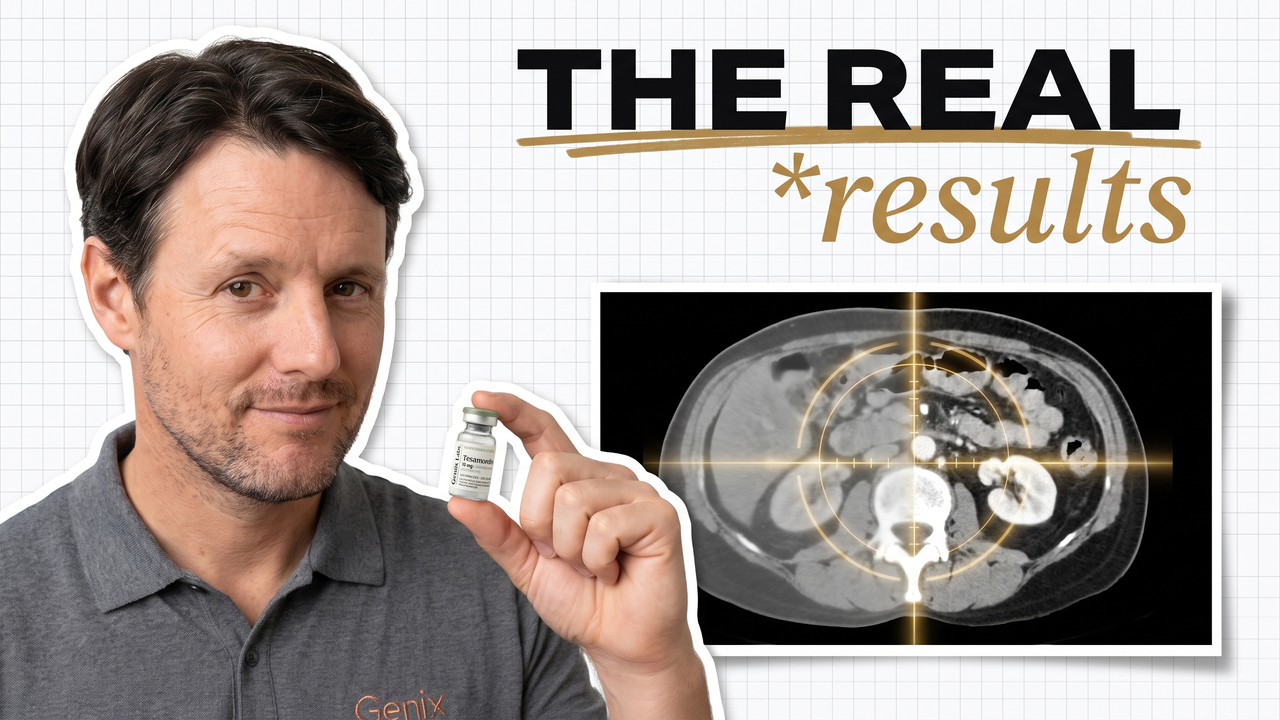
Search tesamorelin before and after and you get a wall of dramatic photos and bold claims. Most of them skip the one thing that matters: the fat tesamorelin actually targets is deep inside you, wrapped around your organs, where no mirror can show it. This guide gives you the honest picture, built from the real clinical trials, not the hype. What changed, when it changed, and why the scale can barely move while your waist quietly shrinks. Everything here is for research use only.
The quick answer
In its main trial, tesamorelin cut deep visceral belly fat, the fat around your organs, by about 15% over 26 weeks. Your own growth hormone rose, and a marker called IGF-1 jumped about 81%. But here is the honest part. The change is internal. A body scan showed it clearly, yet the bathroom scale often barely moved, because fat shifted rather than vanished from the whole body. The first thing people noticed in research was deeper sleep, then a slowly tightening waist over three to six months. It is a slow, quiet build, not a two-week transformation, and it is sold for research use only.
What does a tesamorelin before and after actually show?
The real before-and-after in the studies was a picture you cannot take with a phone. It was a CT scan of the belly, measuring the deep fat that sits behind the muscle wall and packs around the liver, gut, and other organs. That is visceral fat. In the pivotal trial of 412 adults, a daily 2 mg dose of tesamorelin lowered that deep fat by 15.2% in 26 weeks, while the placebo group actually gained 5%.
Notice what is not on that chart: total body weight. Tesamorelin did not melt pounds off the scale the way a crash diet does. It moved fat out of the dangerous deep compartment. That is why a proper before-and-after is a scan and a tape measure, not just a number on the scale. The waist can narrow while the scale holds steady, because the loss is concentrated where it counts most.
What is the week-by-week timeline?
Tesamorelin does not work like a switch. It works like a slow dial. The hormone signal turns up within days, but the body composition change is measured over months. Here is the arc researchers actually saw, laid out in plain order.
The pattern is consistent across the research. Early wins are things you feel, like sleep and recovery, because those track the growth-hormone pulse most directly. The fat change is something you measure later, once the axis has been running for weeks. Anyone promising a dramatic visible change in the first two weeks is not describing what the trials found.
Tesamorelin before and after at 2 weeks
At two weeks, do not expect a mirror change. In research, this is the window where the internal signal is ramping up. IGF-1 climbs, and the most common early reports were better sleep quality and a sense of faster recovery. The waistline has usually not moved in any visible way yet.
This early stretch trips people up. Because they do not see a change on day fourteen, they assume it is not working, when the studies say the opposite is happening under the surface. The engine is warming up. Judging tesamorelin by a two-week photo is like judging a garden by the day after you plant it.
Tesamorelin before and after at 1 month
By one month, the growth-hormone signal is well established, and some people begin to notice the first hints of a change. Clothes can feel slightly different around the middle. But in the trial data, one month is still early for the headline visceral-fat drop. The big 15% figure was measured at 26 weeks, not at four.
Think of the one-month mark as the point where the trend starts, not where it finishes. In research, the direction was clear by then, deeper sleep, a subtle waist shift, steadier recovery, but the measurable fat loss kept building well past this point. A realistic one-month before-and- after is small and mostly felt, not a dramatic reveal.
- Deeper sleep and quicker recovery, often the first clear signs.
- A subtle change around the waistband, not a dramatic drop.
- Little movement on the scale, because fat shifts more than it vanishes.
- The bigger visceral-fat change is still building past this point.
Tesamorelin before and after at 3 months
Three months is where a before-and-after starts to look real. By this point in the studies, the visceral fat had been dropping steadily, and the waist change was becoming visible rather than just felt. Three months, roughly twelve weeks, is about halfway through the 26-week arc where the full 15% reduction was measured.
This matches what people report in research settings: the midsection looks flatter and firmer, clothes fit differently, and the change reads as a tighter core rather than a big weight drop. The fat leaving is the deep kind, so the effect is a leaner shape more than a smaller number on the scale. If you want a milestone to judge tesamorelin by, three months is far more honest than two weeks.
Will tesamorelin get rid of belly fat?
Yes, but a specific kind of belly fat. This is the most important thing to understand. Tesamorelin targets visceral fat, the deep fat wrapped around your organs that pushes the belly out from the inside and drives many health risks. In the trial, that deep fat fell about 15% in 26 weeks. That is the belly fat it was built to reduce.
What it does far less for is subcutaneous fat, the soft, pinchable layer just under the skin. So if your goal is losing the surface fat you can grab with your fingers, tesamorelin is a weaker tool than you might hope. It works on the fat you cannot pinch, the fat behind the muscle wall. For most people that is a good thing, because deep visceral fat is the more harmful type, but it does change what the mirror shows.
Why is the change often hidden at first?
To make sense of a tesamorelin before-and-after, you have to know the two kinds of belly fat. They sit in different places and behave differently, and tesamorelin treats them very differently.
| Fat type | Where it sits | What tesamorelin did |
|---|---|---|
| Visceral fat | Deep, around your organs, behind the muscle | Fell about 15% in the trial, the main target |
| Subcutaneous fat | The soft, pinchable layer under the skin | Changed far less, not its focus |
This is why the scan moves before the mirror. A person can shed a real amount of visceral fat, which flattens the belly from the inside, while the pinchable surface layer looks much the same early on. Over time, as the deep fat keeps dropping, the outline of the waist tightens and the change becomes visible. But the sequence is inside first, surface second. Understanding that saves you from quitting too early because the two-week photo looked flat.
How long does tesamorelin take to actually work?
It depends on which effect you mean, because they arrive on different clocks. The growth-hormone signal works within days. IGF-1, the marker of that signal, rose fast in research, and the early subjective changes, deeper sleep and better recovery, often showed up in the first couple of weeks. That part is quick.
The visible, body-shape change is slow. The headline 15% visceral-fat drop was measured over 26 weeks, and most of it built across the three-to-six-month window. So the honest answer to how long tesamorelin takes to work is: the hormone effect is nearly immediate, but the waistline result is a three-to-six-month project. We cover the mechanism in more depth in our guide to tesamorelin and deep belly fat. Results vary, and this is not medical advice.
Will I gain muscle on tesamorelin?
Not directly, and not much. This is a common misunderstanding. Tesamorelin is not a steroid and not a muscle-building drug. It raises your own growth hormone and IGF-1, which can gently support lean body mass and recovery, but its trials were designed to measure fat, not muscle growth. The headline result was visceral-fat loss, full stop.
Any leaner, more defined look from tesamorelin comes mostly from losing fat, not from adding new muscle. Better sleep and recovery may help you train and hold the muscle you have, but that is an indirect effect. If a bigger, more muscular before-and-after is your goal, tesamorelin is the wrong tool for that specific job. It reshapes where fat sits far more than it builds mass.
What does a tesamorelin before and after look like for women?
The big trials were mostly men, but only because they studied a condition, HIV-related belly fat, that was more common in the men enrolled. The way tesamorelin works, raising your own growth hormone to target deep visceral fat, is not specific to one sex. Women in research settings look at the same markers: visceral fat on a scan and IGF-1 in the blood.
So a realistic before-and-after for women follows the same rules as for men. The change is a tighter, flatter midsection from losing deep fat, built over months, with little movement on the scale. It is not a dramatic overall weight drop, and it is not a spot-reduction miracle for surface fat. The same slow, inside-first pattern applies. This is general education, not a treatment claim, and everything here is for research use only.
Do you take tesamorelin 5 or 7 days a week?
In the registered clinical trials, tesamorelin was given once daily, meaning seven days a week, at a fixed 2 mg dose. That daily, steady signal is how the studies produced the visceral-fat results you have read about here. When people ask about a five-days-on, two-days-off pattern, they are describing community discussion, not the studied protocol.
We do not give dosing instructions, so treat this as a description of how the research was run, not a plan to copy. What matters for understanding a before-and-after is that the trial results came from a consistent daily schedule over months. Our tesamorelin dosing guide explains how the peptide was handled in studies. Nothing here is a protocol or medical advice.
Why can before-and-after pictures mislead you?
Photos are the least reliable way to judge tesamorelin, for a simple reason. Its main effect is on fat you cannot see. A dramatic before-and-after picture is usually driven by surface fat, lighting, posture, and water, none of which is what this peptide mainly changes. So the most eye-catching images may not reflect the peptide at all.
- The real effect, deep visceral fat, does not show up cleanly in a photo.
- Lighting, angle, posture, and a flexed core can fake a bigger change than any peptide.
- Many online before-and-after shots also involve diet, training, or other compounds.
- A scan or a tape measure over months tells a truer story than a single dramatic pair of photos.
None of this means results are not real. It means the honest measure of tesamorelin is a slow, internal one. If you want to track a before-and-after properly, a tape around the waist every few weeks and how your clothes fit will tell you more than a staged photo ever could.
What does Reddit say versus what the studies show?
Community threads on tesamorelin are a mix of the useful and the misleading. The useful part is that many people echo the trial pattern: sleep improves early, and the waist change is slow and modest, not explosive. That lines up well with the research. The misleading part is the occasional claim of huge, fast transformations, which usually involve diet, training, or stacking other compounds on top.
The gap between anecdote and evidence is the whole point. A single glowing post is one person's story, with no scan, no control group, and no way to separate the peptide from everything else they did. The trial is 412 people measured against placebo with imaging. When they disagree, trust the measured data. Read community reports for texture, not for proof.
- Where Reddit and the studies agree: slow, modest, waist-focused change.
- Where they clash: dramatic fast results, usually from diet or stacking.
- Anecdotes have no scan and no control, so they cannot prove cause.
- The measured 15% visceral-fat drop is the number worth anchoring to.
How does the before and after compare to Ozempic?
This is where the two look nothing alike, and knowing the difference sets your expectations right. A GLP-1 peptide like semaglutide, the drug in Ozempic, works by cutting appetite, so it drops total body weight, often a lot, and that shows clearly on the scale and in photos. But it can pull muscle down with the fat, and it does not specifically target deep visceral fat.
| Question | Tesamorelin | GLP-1 (Ozempic) |
|---|---|---|
| How it works | Raises your own growth hormone | Cuts appetite |
| Scale change | Small, weight often holds | Large, clear weight drop |
| Main target | Deep visceral belly fat | Overall body weight |
| Muscle | Tends to preserve it | Can be lost along with fat |
| Best before-and-after | A tighter waist on a scan | A smaller number on the scale |
So the before-and-after tells two different stories. Ozempic's is a dramatic scale drop. Tesamorelin's is a quieter reshaping of where fat sits, focused on the harmful deep kind, with muscle largely spared. Neither is better in the abstract, they answer different questions. Our comparison of semaglutide and tirzepatide covers the appetite-based side in detail.
What mistakes flatten your results?
If a before-and-after underwhelms, the peptide itself is often not the problem. In research, a few avoidable issues blunt the outcome, and most of them come down to expectations and handling rather than the molecule.
- Quitting at two weeks because the mirror has not changed, before the fat clock even starts.
- Expecting a big scale drop, when the change is a shift in fat, not a whole-body weight loss.
- Judging only by pinchable surface fat, which is not what tesamorelin mainly targets.
- Using a warm or mishandled vial, since heat degrades peptides and quietly cuts potency.
- Ignoring sleep, diet, and training, which shape body composition alongside any peptide.
The fixable ones are expectations and quality. Give the fat clock its three-to-six months, judge by a tape and a scan rather than a photo, and make sure the vial you study was pure and kept cold from the start. A degraded peptide produces a flat before-and-after no matter how patient you are.
How do you make sure the results are real?
A before-and-after is only as trustworthy as the vial behind it. If you cannot prove what was inside the vial, you cannot know whether a flat result was the peptide or the product. That is why purity and identity testing matter as much as patience. Before trusting any tesamorelin, ask for the paperwork.
- A batch certificate of analysis, tied to the real lot number on your vial.
- HPLC purity of at least 99%, so you know how much is the actual peptide.
- LC-MS identity, which confirms the vial holds tesamorelin and not a look-alike.
- Cold-chain handling, because a peptide shipped warm can lose potency before you use it.
Genix tests every batch to these standards and ships each order with its certificate of analysis. That is the difference between a before-and-after you can trust and a guess in a vial. If the peptide is proven and kept cold, the only variable left is time.
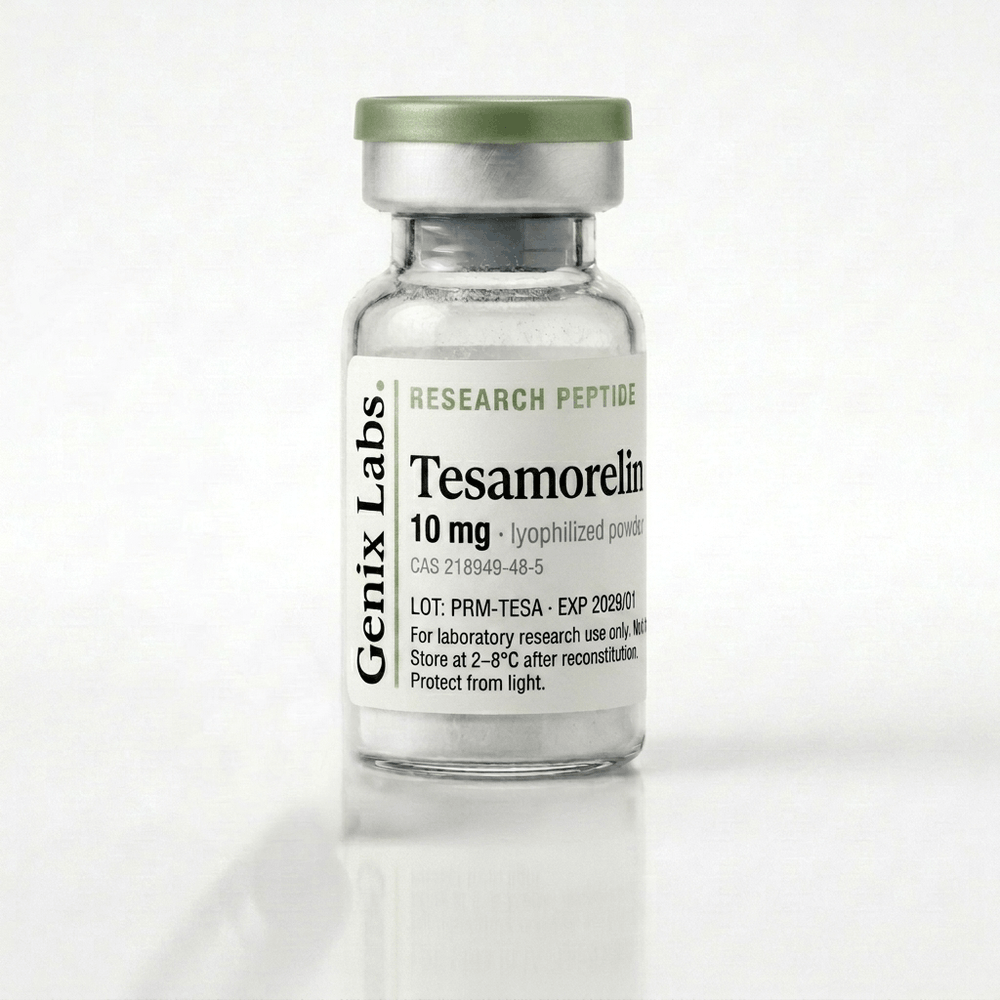
Purity of at least 99% by HPLC, LC-MS identity, and a batch certificate of analysis in every order. 10 mg vial, $149, same-day in Bali.
Buy Tesamorelin in BaliWhere can you buy tesamorelin in Bali?
Genix Labs stocks tesamorelin as a 10 mg vial for $149, about IDR 2.450.000, with same-day delivery across Bali and cash on delivery. Every vial is third-party tested, HPLC purity of at least 99% and LC-MS identity, and ships cold-packed so the peptide that leaves the lab is the one that reaches you.
Because a before-and-after depends on a real, potent peptide, sourcing is not a detail to skip. A cheap vial with no certificate of analysis is not a saving if you cannot prove what is inside. See our tesamorelin vs sermorelin comparison for where it sits against its closest cousin, and the pillar hub on weight and metabolism peptides for the wider field.
Frequently asked questions
How long does tesamorelin take to actually work?
In research, the growth-hormone signal rose within days, and deeper sleep or sharper recovery often came first. But the visible change, deep belly fat, was measured over 26 weeks. Most of the visceral-fat drop built across 3 to 6 months, not in the first week. Results vary, and this is research use only.
Will I gain muscle on tesamorelin?
Not much, and not directly. Tesamorelin is not a steroid or a muscle builder. It raises your own growth hormone and IGF-1, which can support lean mass and recovery, but its trials measured fat loss, not muscle growth. Expect a leaner look from losing fat, not big new muscle. This is not medical advice.
Will tesamorelin get rid of belly fat?
In its main trial it cut deep visceral belly fat, the fat wrapped around your organs, by about 15% over 26 weeks. That is the fat it targets. It does far less for the soft, pinchable fat just under the skin. So the waist can shrink from the inside while the surface layer stays. Research use only.
Do you take tesamorelin 5 or 7 days a week?
The registered clinical trials used a once-daily schedule, meaning 7 days a week, at a fixed 2 mg dose. Some research discussions mention five-days-on, two-days-off patterns, but that was not the studied protocol. We do not give dosing instructions. Everything here is general information for research use only, not medical advice.
Does tesamorelin work for women?
The large trials were mostly men, because they studied HIV-related belly fat, but the mechanism, raising your own growth hormone to target visceral fat, is not sex-specific. Women in research settings look at the same visceral-fat and IGF-1 markers. Individual results vary, and this is education, not a treatment claim.
Takeaway
A real tesamorelin before-and-after is quieter and slower than the internet suggests. In its main trial it cut deep visceral belly fat by about 15% over 26 weeks and raised IGF-1 sharply, but the scale barely moved, because fat shifted rather than vanished. Sleep and recovery improved first, the waist tightened over three to six months, and the surface pinchable fat changed least. It is not a muscle builder and not a crash-diet scale drop. Judge it by a tape measure and months of patience, not a two-week photo, and always with a proven, cold-shipped vial. Everything here is for research use only and is not medical advice.