Epithalon is the peptide people reach for when aging stops feeling abstract. It is tiny, only four amino acids long. It is also the only peptide widely studied for switching telomerase back on inside human cells. This guide covers what it does, what the human data truly proves, what it does not, and what one honest cycle costs. Everything here is for research use only.
The quick answer
Epithalon is a four-amino-acid peptide, Ala-Glu-Asp-Gly. It is modeled on a natural pineal compound. In cell studies it switched telomerase back on and lengthened telomeres by about 33%. In older adults, a related pineal preparation restored the melatonin rhythm. People notice sleep first. It is sold for research use only.
What is epithalon?
Epithalon is a synthetic tetrapeptide. Tetra means four. So it is a chain of four amino acids, Ala-Glu-Asp-Gly, often shortened to AEDG. It is one of the smallest peptides in the research world. New to this? Start with the hub, Longevity and Anti-Aging Peptides.
It came out of Russian gerontology. Professor Vladimir Khavinson built it in St. Petersburg. He copied the active part of epithalamin, an extract taken from the pineal gland of cattle. The pineal gland is a pea-sized organ in your brain. It sets your sleep clock.
So epithalon is a lab-made copy of a signal your own brain used to send more strongly. As the pineal gland hardens with age, that signal fades. Epithalon is studied as a way to send it again.
- Sequence: Ala-Glu-Asp-Gly, also written AEDG.
- Molecular weight: about 390 daltons, very small.
- Modeled on epithalamin, a pineal gland extract.
- Studied for telomeres, melatonin rhythm, and oxidative defense.
- Sold as a lyophilized powder for research use only.
Is it epitalon or epithalon?
Both spellings mean the same peptide. Epithalon, epitalon, and AEDG all point to Ala-Glu-Asp-Gly. The split happened when Russian papers were translated into English. Epithalamin is the one word that means something different. That is the older bovine extract, not the clean synthetic tetrapeptide.
How does epithalon work?
Epithalon is studied to act on three pathways at once. It switches on telomerase, the enzyme that rebuilds the caps on your DNA. It supports the pineal gland, which sets your melatonin rhythm. And it lifts antioxidant defense, which lowers everyday cell damage. Three switches, one very small peptide.
Switch one: telomerase
Most adult cells keep the telomerase gene switched off. In the 2003 study, epithalon turned that gene back on. It raised hTERT, which is the working part of the enzyme. Telomere length then grew. That result is why this peptide has a reputation at all.
Switch two: the sleep clock
Your pineal gland makes melatonin on a daily rhythm. That rhythm flattens with age. In research on older adults, the pineal preparation pushed the rhythm back toward a normal shape. Sleep depth followed. This is the effect people actually feel.
Switch three: oxidative defense
Cells rust, in a sense. Reactive molecules chip away at proteins and DNA every day. Epithalon is studied for supporting the body's own antioxidant response. It is the quietest of the three switches, and the one with the least human data behind it.
What are telomeres, and why do they matter?
Telomeres are protective caps at the ends of your chromosomes. Think of the plastic tips on a shoelace. Every time a cell divides, the tips get a little shorter. When they run out, the cell stops dividing. It goes quiet and starts leaking inflammatory signals. That state is called senescence.
Short telomeres track with immune aging and slower tissue repair. Telomerase is the one enzyme that can rebuild them. Most of your cells keep it off by default. That is a safety feature, because cancer cells rely on telomerase to divide forever. Hold that thought, because it comes back in the risk section.
What are the benefits of epithalon?
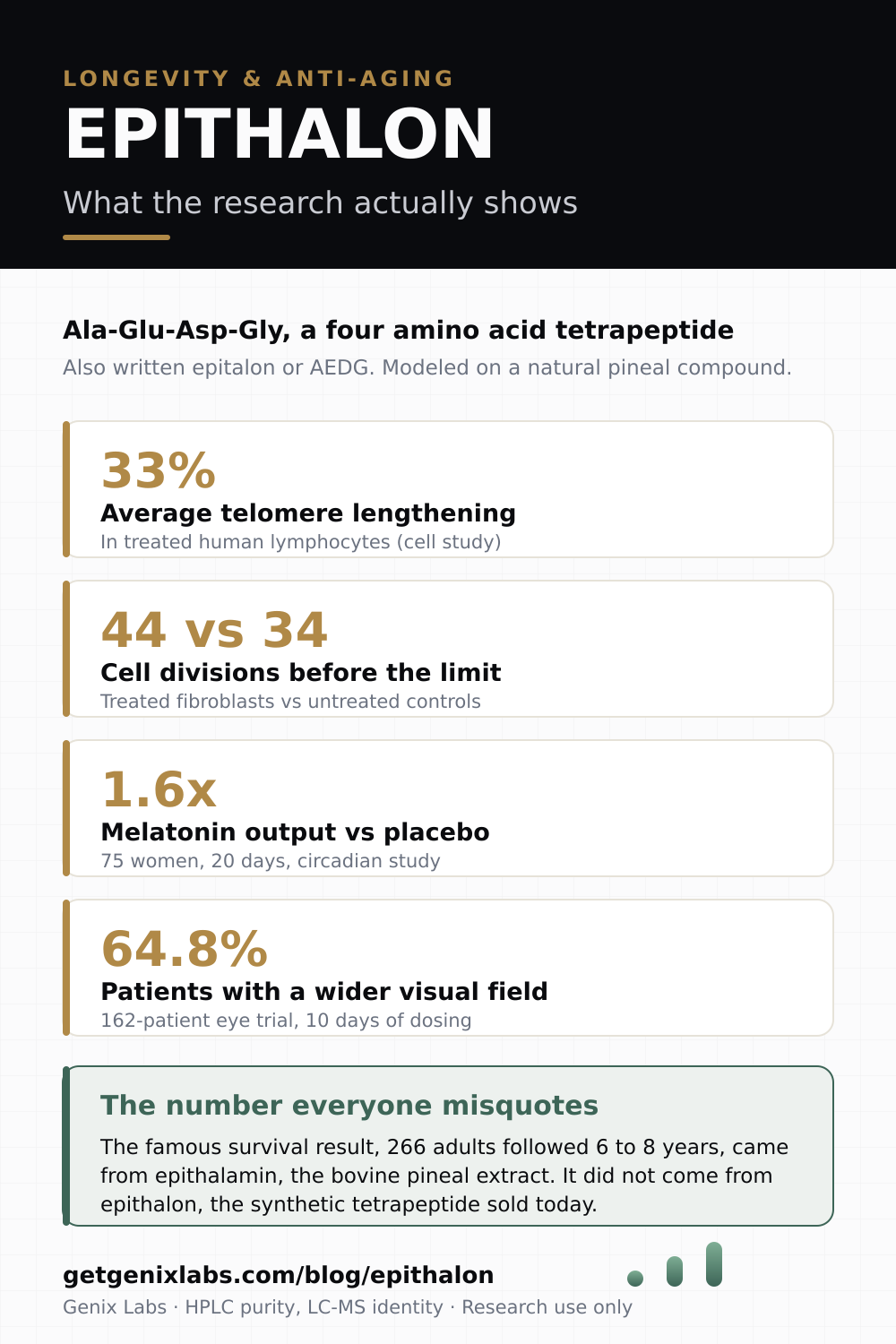
Research points to three benefits. Telomerase came back on and telomeres lengthened by about 33% in treated human cells. Melatonin rhythm normalized in older adults, which shows up as deeper sleep. And antioxidant defense improved. These are study findings, not promises, and it is research use only.
| Studied benefit | What was measured | Strength of evidence |
|---|---|---|
| Telomere lengthening | About 33% longer telomeres in treated human lymphocytes | Cell studies, repeated |
| More cell divisions | Fibroblasts reached passage 44, controls stopped at 34 | Cell studies |
| Deeper sleep | Melatonin output up about 1.6 times against placebo | Small human studies |
| Circadian reset | Clock gene expression shifted, Cry2 doubled | Small human study, 75 women |
| Eye function | Visual field widened in 64.8% of 162 patients | One human trial |
| Antioxidant support | Lower oxidative damage markers | Mostly animal work |
Notice the pattern. The strongest numbers come from cells in a dish. The human work is small and mostly from one research group. That is not nothing. It is also not the same as a large trial.
Does epithalon really fix sleep?
Sleep is the effect with the most human support. In a study of 75 women, melatonin output rose about 1.6 times against placebo over 20 days. Clock gene expression shifted too. In older adults given the pineal preparation, the flattened melatonin rhythm moved back toward a normal daily curve.
The feel is different from a sleeping pill. It does not knock you out. It works on when your body decides night has started. People who track sleep on a ring or a watch tend to see deep sleep minutes move before they notice anything else. Vivid dreams are a common report during a cycle.
Does epitalon make you look younger?
No study measured wrinkles, skin thickness, or facial appearance. The research measured telomere length, cell division capacity, and melatonin rhythm. Better sleep and lower oxidative load can change how rested a face looks. That is indirect. Anyone promising visible anti-aging from epithalon has gone past the evidence.
If skin is the actual goal, the copper peptide research is a closer match. GHK-Cu was studied for collagen and skin repair directly. We cover it in copper peptides for hair and skin. Epithalon works far deeper down, where you cannot see it.
Who is epithalon actually for?
In the research, epithalon was studied in older adults, not in healthy young people. The pineal gland calcifies with age, so the signal it replaces is one that fades over decades. That makes it a maintenance compound for people already past the point where sleep quality has slipped.
| Profile | Fit | Why |
|---|---|---|
| Over 40, sleep has quietly got worse | Strong fit in research terms | Matches the population the melatonin work studied |
| Tracking sleep on a ring or watch | Good fit | You will have a baseline to judge the cycle against |
| Already running NAD+ or similar | Complementary | Different pathway, different cadence |
| Under 30 and sleeping well | Weak fit | Little to correct, and no study support |
| Any history of cancer | Excluded in the literature | Telomerase concern, treated as a hard stop |
There is a second group worth naming. People chasing a visible result will be disappointed. This peptide has one fast, felt effect and one slow, invisible one. If you need to see something in the mirror, this is the wrong shelf.
What does the human data actually show?
Three human datasets matter. A 162-patient eye study used 10 days of dosing and widened the visual field in 64.8% of patients. A 75-woman study raised melatonin about 1.6 times over 20 days. And a 266-person survival study followed older adults for 6 to 8 years.
| Study | Size | Length | Key result |
|---|---|---|---|
| Retinitis pigmentosa trial | 162 patients | 10 days of dosing | Visual field widened in 64.8%, no side effects reported |
| Circadian rhythm study | 75 women | 20 days | Melatonin output up about 1.6x against placebo |
| Survival cohort (epithalamin) | 266 adults | 6 to 8 years | Mortality 1.6x to 1.8x lower in the treated arm |
| Telomerase in fibroblasts | Cell culture | 44 passages | Telomeres lengthened, division limit passed |
The survival cohort is the one everyone quotes. Adults were treated for the first 2 to 3 years, then followed. The treated arm died at a lower rate. When a thymus peptide was added, the gap grew further. That is a striking result for a peptide field.
What the data does not show
Here is the part most articles skip. The 266-person survival study used epithalamin, the bovine pineal extract, at 10mg per day. It did not use epithalon, the synthetic tetrapeptide. The two are related, not identical. Treating that mortality number as an epithalon result is the single biggest error in this topic.
- No large randomized trial of epithalon itself exists in humans.
- Most published work comes from one research group in St. Petersburg.
- Long-term toxicity data is missing, and the 2025 review says so directly.
- Telomere effects are measured in cell culture, not in living people.
- No study has tracked lifespan in humans taking the synthetic peptide.
We publish this because the gap is real. A 2025 review in the International Journal of Molecular Sciences called for proper toxicity work before epithalon could be treated as an approved active ingredient. That review is linked in our sources. Read it before you decide anything.
How long does epithalon take to work?
Sleep is the fastest signal. In the melatonin research, rhythm changes appeared inside the 10 to 20 day dosing window. Telomere and cell-aging effects were measured in cell cultures over weeks, not felt in a body. So expect sleep feedback within one cycle, and treat everything deeper as slow, invisible biology.
| Window | What research points to | What you can notice |
|---|---|---|
| Days 1 to 3 | Melatonin signaling begins shifting | Vivid dreams, mild tiredness |
| Days 4 to 10 | Circadian rhythm moves toward normal | Falling asleep faster, deeper sleep scores |
| Weeks 2 to 4 | Antioxidant and repair markers respond | Steadier energy, better recovery |
| Months 3 to 6 | Cell-level changes, if any, accumulate | Nothing visible, by design |
This is a slow peptide with one fast tell. If nothing changes about your sleep during a cycle, that is useful information about the material in your vial.
How are epithalon cycles run in research?
Published work uses short cycles, not daily use for months. The common research pattern is 10 consecutive days, repeated twice a year. Dosing in the human studies was low, from 0.5mg per day sublingually up to 10mg per day for the extract. Evening timing was preferred, to match the natural melatonin release.
The short-cycle logic is worth understanding. Telomerase is not something you want switched on permanently. Pulsing it, then stopping, is the pattern the literature settled into. That is a safety idea, not a marketing one.
Why do people search for epithalon 100mg?
Because of cycle math, not vial size. A common research pattern models 10mg per day across 10 days. Ten times ten is 100mg total for the cycle. People then search for a 100mg vial that does not really exist in that form. Epithalon is sold in small vials, usually 10mg each.
So a 100mg cycle is not one vial. It is a run of vials across ten days. A Genix epithalon 10mg vial is one unit of that. If a seller offers you a single 100mg vial cheaply, be careful. Loading that much peptide into one vial raises real questions about what is actually inside it.
Reconstitution also gets harder at high mass. More powder needs more water and more careful handling. Our guide on how to reconstitute peptides walks through the arithmetic step by step.
What are the side effects and the real risks?
Reported side effects are mild. In the 162-patient eye trial, no patients reported side effects at all. Research literature lists injection site irritation, short tiredness in the first days, vivid dreams, and rare mild nausea. The serious concern is theoretical, and it is about telomerase, not about tolerance.
- Cancer cells depend on telomerase to keep dividing without limit.
- Any telomerase activator therefore carries a theoretical concern.
- No study has shown epithalon causes or spreads cancer.
- In the literature, active or suspected cancer is treated as a hard stop.
- Screening before and during a research protocol is standard practice.
Other groups flagged in the literature include pregnancy, breastfeeding, autoimmune conditions, and recent transplant patients on immune suppressants. None of that is a treatment claim. It is the risk framing the published work uses, and it belongs in any honest article about this peptide.
Epithalon vs NAD+, NMN, and GHK-Cu
These four get grouped as longevity compounds, but they do different jobs. Epithalon works on telomeres and sleep timing. NAD+ fuels cellular energy and repair enzymes. NMN is a precursor your body converts into NAD+. GHK-Cu works on skin, collagen, and hair. Different layers of the same problem.
| Compound | Main studied target | What people notice | Speed |
|---|---|---|---|
| Epithalon | Telomerase and melatonin rhythm | Deeper sleep, vivid dreams | Sleep in days, rest invisible |
| NAD+ | Cellular energy and repair enzymes | Steadier energy, clearer head | Days to weeks |
| NMN | Raising NAD+ as a precursor | Similar to NAD+, gentler | Weeks |
| GHK-Cu | Collagen, skin, hair follicles | Skin texture, hair density | 6 to 12 weeks |
They are not rivals. Epithalon runs in short pulses twice a year. NAD+ runs as ongoing support. If you want the energy side explained properly, read NAD+ benefits for energy and aging and the comparison in NAD+ vs NMN.
How does epithalon fit into a longevity stack?
Epithalon runs on a different clock from most compounds. It pulses for 10 days, twice a year. Everything else in a longevity stack tends to run continuously. That difference is the whole logic of stacking it. You are adding a periodic reset, not another daily habit.
- Epithalon: short pulse, twice a year, aimed at telomeres and sleep timing.
- NAD+: ongoing support for cellular energy and repair enzymes.
- GHK-Cu: continuous, aimed at skin, collagen, and hair.
- Antioxidant support: daily, to lower the oxidative load underneath all of it.
- Sleep hygiene: free, and it moves the same markers epithalon targets.
That last line is not filler. The melatonin studies changed the same rhythm that a consistent wake time changes. A peptide cannot outrun a 1 AM phone habit. Fix the free inputs first, then judge what the cycle adds on top.
What bloodwork tracks an epithalon protocol?
Research protocols track two things. First, safety markers, because of the telomerase concern. Second, the aging markers the peptide is meant to touch. Baseline first, then a repeat after the cycle. Without a baseline, you cannot tell a real change from a normal day.
- A full blood count, as a general baseline.
- Tumor markers, used as a screening step in published protocols.
- Inflammatory markers such as high-sensitivity CRP.
- Fasting glucose and HbA1c, for general metabolic context.
- Leukocyte telomere length, if you want the direct measure.
- Overnight 6-sulfatoxymelatonin, the marker the melatonin studies used.
Telomere length testing is the interesting one. It is also noisy. Small changes between two tests can be measurement error rather than biology. Treat a single result carefully, and talk to a doctor about your own health.
How much does epitalon peptide cost?
A Genix Labs 10mg epithalon vial is USD 49, or Rp 850.000, with a batch certificate of analysis included. Published research cycles used 5 to 10mg per day across 10 days. So one modeled cycle draws on roughly five to ten vials of material. Prices elsewhere swing widely, and cheap usually means untested.
| What you are buying | Genix price | Notes |
|---|---|---|
| Epithalon 10mg vial | USD 49 / Rp 850.000 | Batch COA included, ships cold |
| A 10 day cycle at the lower research dose | About USD 245 | Five vials of material |
| A 10 day cycle at the upper research dose | About USD 490 | Ten vials of material |
| Bacteriostatic water | Sold separately | Needed for reconstitution |
Two cycles a year is the pattern in the literature. That makes epithalon one of the cheaper longevity compounds per year, because you are not running it daily. The cost sits in the cycle, not in a subscription.
Watch for prices far under this. Epithalon is cheap to fake. A vial of plain mannitol looks exactly like a vial of tetrapeptide, and it costs almost nothing to produce. The lab report is the only thing separating them.
How do you know your epithalon is real?
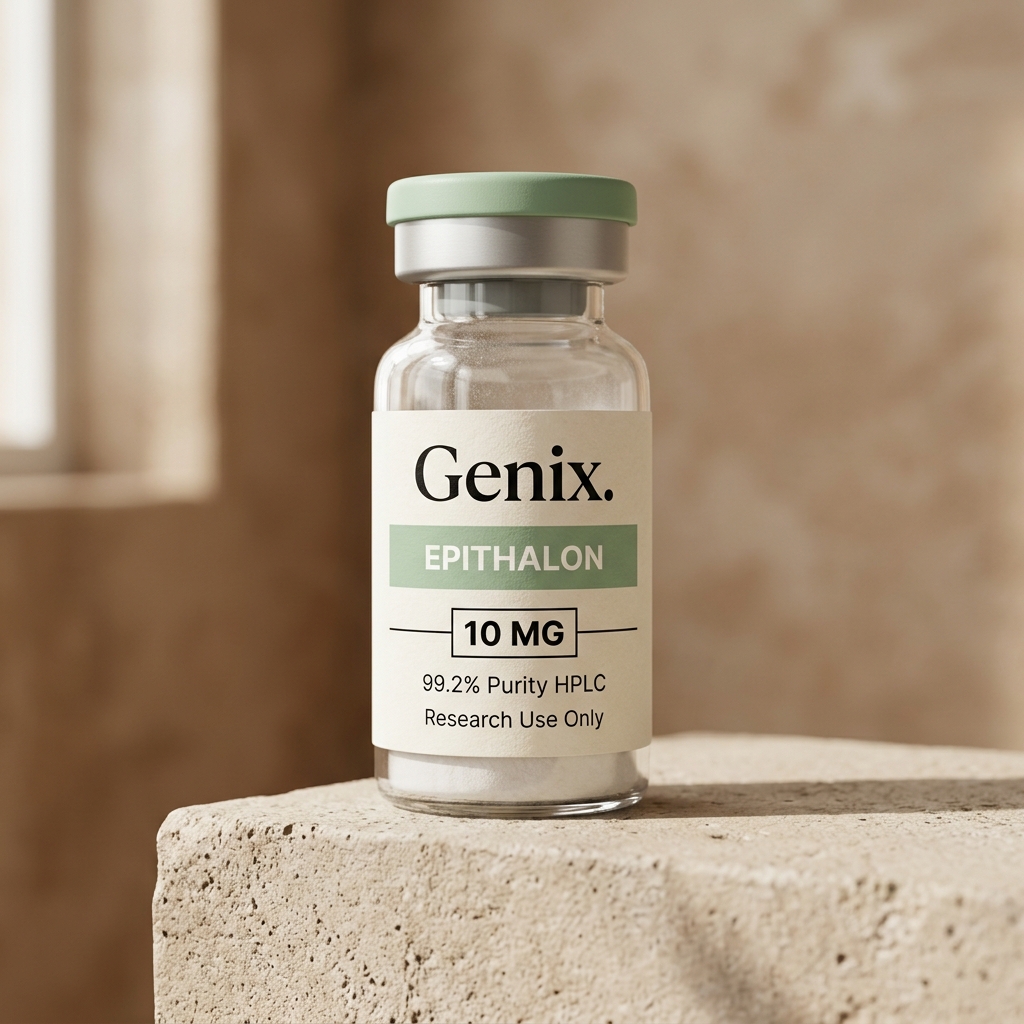
You read the certificate of analysis. HPLC shows purity, meaning how much of the powder is the peptide. LC-MS shows identity, meaning the mass matches Ala-Glu-Asp-Gly at about 390 daltons. The lot number on the report must match the label on your vial. No report means no proof.
What to check on the report
- HPLC purity of at least 99%, so it is not cut with filler.
- LC-MS identity confirming the tetrapeptide mass, about 390 Da.
- A lot number that matches the label on your vial.
- Testing by an independent, ISO 17025 accredited lab.
- A recent test date, not a report recycled from an old batch.
Mistakes that waste an epithalon cycle
Most disappointing cycles fail on handling, not on biology. Epithalon is a small peptide and it is fragile once mixed. Four mistakes account for almost all of it. Each one is avoidable in about thirty seconds of care.
Mistake 1: shaking the vial
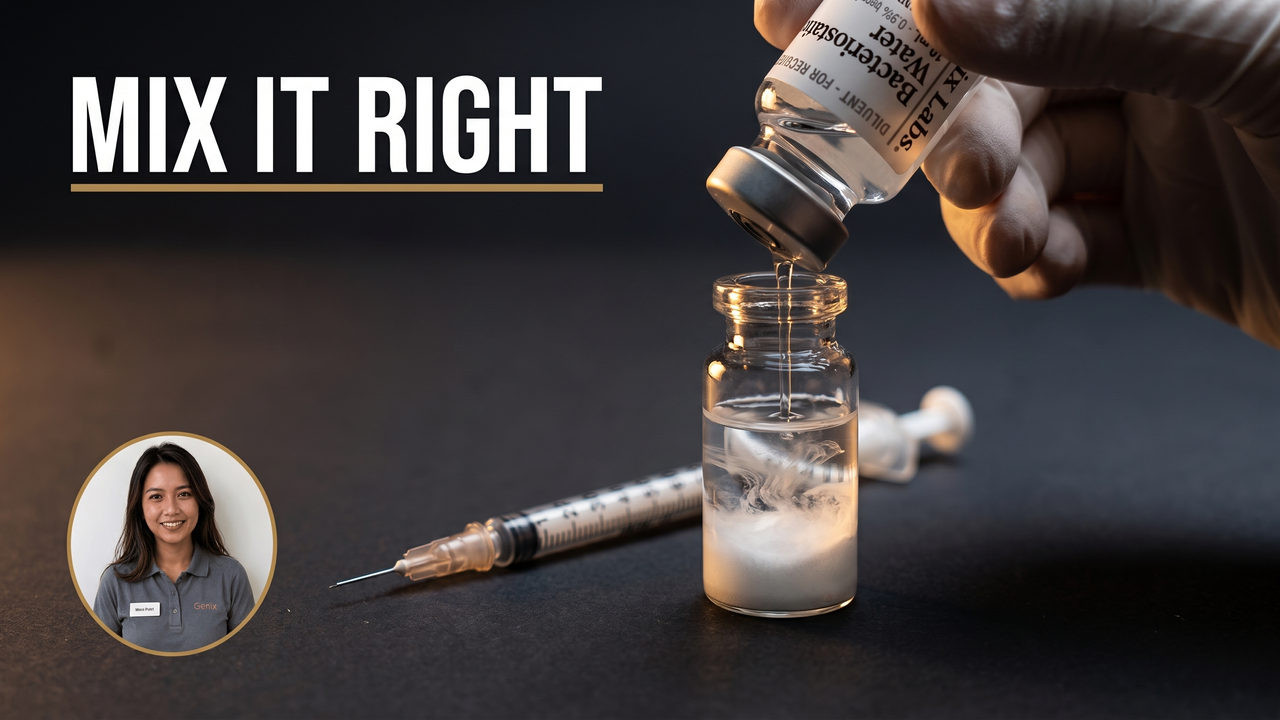
Shaking breaks peptide chains. Add the water slowly, down the side of the glass. Then let it sit and swirl gently. It dissolves on its own within a minute or two.
Mistake 2: letting it get warm
Heat and light both degrade peptides. Sealed vials belong cold and dark. Once mixed, back in the fridge every time. Our guide on storing peptides in a hot climate covers this properly, which matters in Bali.
Mistake 3: the wrong water
Bacteriostatic water contains a preservative that keeps a mixed vial stable for weeks. Sterile water does not. Using the wrong one shortens the life of everything in the vial.
Mistake 4: no baseline
Running a cycle with no sleep data and no bloodwork means you cannot judge the result. Track one week before you start. Then you have something real to compare against.
Buying epithalon in Bali
Genix Labs delivers lab-tested epithalon across Bali, often within 2 hours in Canggu, Seminyak, Ubud, Sanur, and Denpasar. Every order ships cold with a batch certificate of analysis. Order before 9 PM to ship the same day, with cash on delivery.
Purity of at least 99% by HPLC, LC-MS identity, and a batch certificate of analysis in every order. USD 49 for 10mg, same-day in Bali.
Buy epithalon in BaliFrequently asked questions
What are the benefits of epithalon?
In research, epithalon is studied for three things. It switched telomerase back on and lengthened telomeres in human cells. It helped restore the natural melatonin rhythm in older adults, which shows up as deeper sleep. And it supported antioxidant defense. These are research findings, not promised outcomes, and it is sold for research use only.
Does epitalon make you look younger?
No study has measured wrinkles or facial appearance. What the research measured was telomere length, cell division capacity, and melatonin rhythm. Better sleep and lower oxidative load can change how rested a face looks, but that is an indirect effect. Anyone promising visible anti-aging from epithalon is going past the evidence.
How long does epithalon take to work?
Sleep is the fastest signal. In the melatonin research, rhythm changes showed up within the 10 to 20 day dosing window. The telomere and cell-aging effects are measured in cell cultures over weeks, not felt in a body. So expect sleep feedback inside one cycle and treat everything deeper as slow, invisible biology.
How much does epitalon peptide cost?
A Genix Labs 10mg epithalon vial is USD 49, or Rp 850.000, with a batch certificate of analysis included. Published research cycles used 5 to 10mg per day across 10 days, so one cycle draws on roughly five to ten vials of material depending on the protocol modeled. Prices elsewhere range widely, and cheap vials usually mean untested ones.
Is epithalon the same as epitalon?
Yes. Epithalon, epitalon, and AEDG are three names for the same four-amino-acid peptide, Ala-Glu-Asp-Gly. The spelling split happened in translation from the original Russian research. Epithalamin is different. That is the older bovine pineal extract the tetrapeptide was modeled on, and most of the famous human survival data belongs to it.
Is epithalon safe?
In the published human eye study, none of the 162 patients reported side effects. But long-term toxicity work is still missing, and the 2025 review in the International Journal of Molecular Sciences says so plainly. Because telomerase also supports cancer cell growth, active or suspected cancer is treated as a hard stop in the literature. Research use only, not medical advice.
Takeaway
Epithalon is the most interesting longevity peptide with the thinnest human evidence. The cell data is genuinely striking. Telomerase switched back on, telomeres grew about 33%, and treated cells pushed past their division limit. The sleep research in older adults is real too. But the famous mortality numbers belong to epithalamin, the extract, not to this peptide. Run short cycles, read the certificate of analysis, and keep your expectations tied to what was actually measured. This is research use only, and it is education, not medical advice.