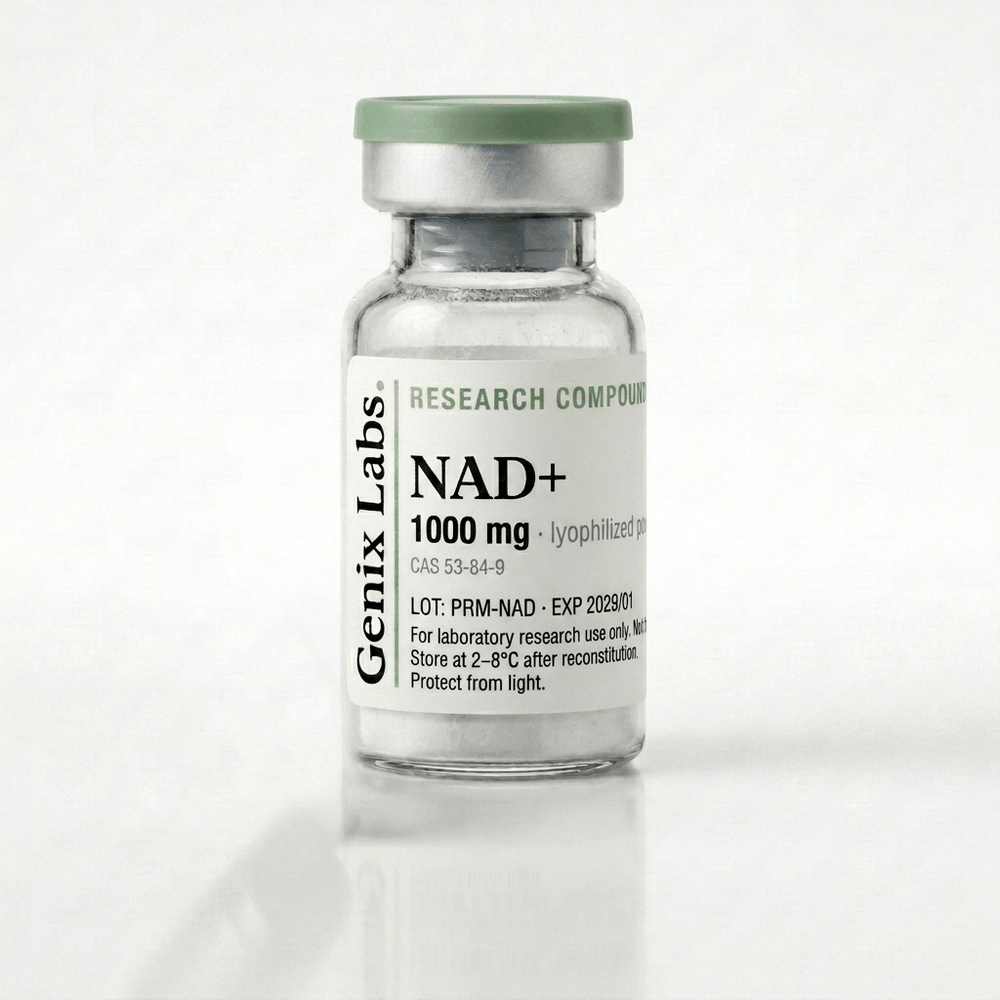
NAD+ and NMN sit at the center of almost every longevity conversation. Their names look alike, and the shops that sell them make big promises. But they are not the same thing, and they do not work the same way. One is the finished molecule your cells burn for energy. The other is a building block your body turns into it. This guide breaks down the real difference between NAD+ and NMN, which one your cells actually use, which survives your gut, the side effects of each, and whether it is worth taking both. Everything here is for research use only.
NAD vs NMN: the quick answer
NAD+ is the coenzyme your cells run on. NMN is the raw material your body uses to make NAD+. NMN is just one small step away from NAD+ inside the cell. So NMN is a precursor, and NAD+ is the finished product. Swallowed as a pill, NMN tends to survive digestion better than whole NAD+, which is a large, fragile molecule. But research-grade NAD+ that skips the gut delivers the finished coenzyme directly. Neither is a cure. Both are studied for the same goal: keeping cellular NAD+ from falling with age.
What is NAD+ and what does it do?
NAD+ stands for nicotinamide adenine dinucleotide. It is a coenzyme found in every living cell. Think of it as a shuttle that carries energy inside the cell. It helps turn the food you eat into the fuel your cells burn. It also helps run the repair crews that fix damaged DNA and keep cells tidy.
NAD+ is not optional. Without it, the tiny power plants in your cells, called mitochondria, cannot make energy. That is why NAD+ shows up in so much aging research. Studies report that NAD+ levels drop as people get older. Lower NAD+ is linked in research to tired cells, slower repair, and the general wear of aging. Restoring it is the whole point of both NAD+ and NMN products.
- The finished coenzyme your cells use, not a precursor.
- Central to turning food into cellular energy.
- Helps run DNA repair and cell cleanup pathways.
- Levels fall with age, which is the problem people try to fix.
For a fuller look at what NAD+ is studied for, see our guide to NAD+ benefits for energy and aging.
What is NMN and how does it work?
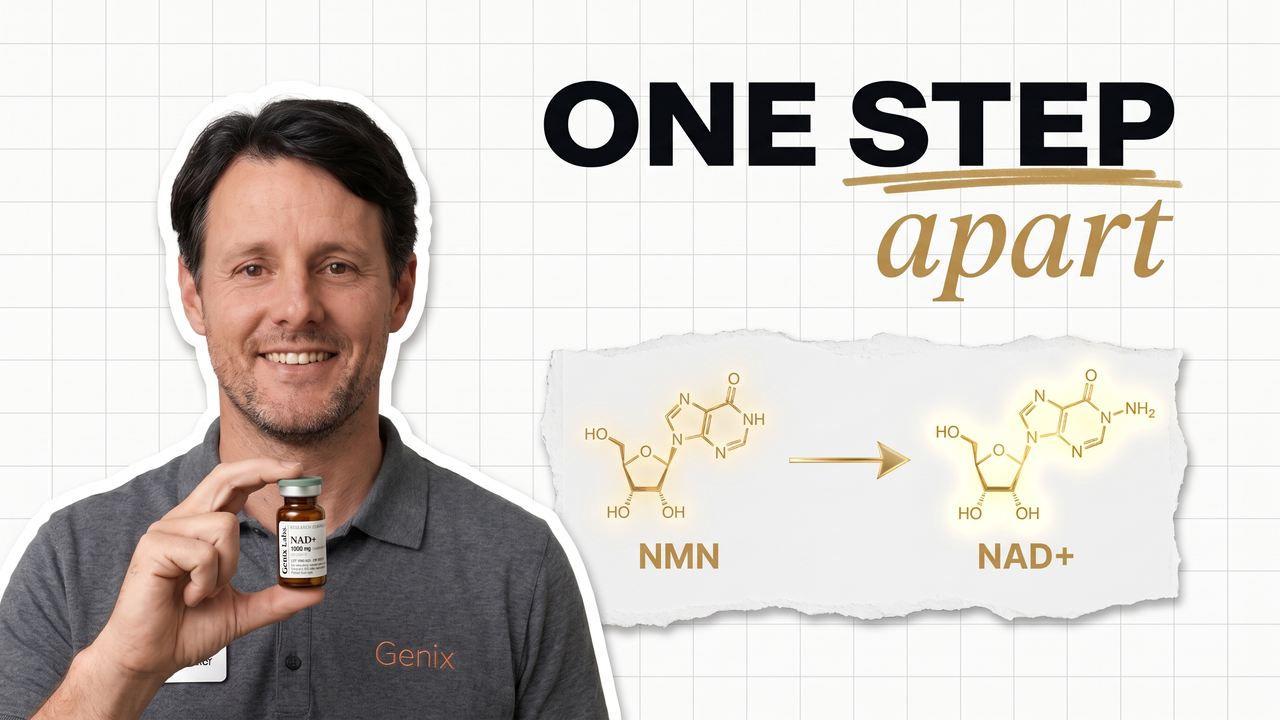
NMN stands for nicotinamide mononucleotide. It is a precursor, which means it is a raw material. Your body takes NMN and, in a single enzyme step, turns it into NAD+. That last step is handled by a family of enzymes called NMNAT. Because NMN is only one step away, it is a fast and direct way to feed the NAD+ pool.
NMN does not do the coenzyme work itself. It has to become NAD+ first. So when you read that NMN boosts energy or supports repair, that is really NAD+ doing the job after your body converts the NMN. In animal studies, NMN raised NAD+ levels in blood and tissue. In one human trial, NMN increased NAD+ inside blood cells and was well tolerated over several weeks.
Are NAD+ and NMN the same thing?
No. NAD+ and NMN are not the same thing, though they are closely related. NMN is a smaller molecule that your body converts into NAD+ in one step. NAD+ is the larger, finished coenzyme that actually does the work. The simplest way to picture it: NMN is the flour, and NAD+ is the bread. You cannot swap one for the other, but one becomes the other. That single fact explains most of the differences below.
How NMN turns into NAD+ (the pathway)
Your body has a recycling route called the salvage pathway. It builds NAD+ from smaller parts, over and over, all day long. NMN is the last part in that chain before NAD+. One enzyme step converts NMN straight into NAD+. There is another precursor, NR, that sits one rung further out. NR first becomes NMN, then NMN becomes NAD+.
This is why the order matters. NAD+ is the destination. NMN is one stop away. NR is two stops away. The closer a molecule sits to NAD+, the fewer steps your body has to run to use it. That does not automatically make one better, because each step also depends on how well the molecule is absorbed first. Absorption is the next big piece of the puzzle.
NAD+ vs NMN at a glance
Here is the head-to-head in one place. Read it as a map, not a scoreboard, because the right pick depends on your research goal and your delivery method.
| Feature | NAD+ | NMN |
|---|---|---|
| What it is | The finished coenzyme | A precursor, one step before NAD+ |
| Does the work itself? | Yes, directly | No, must convert to NAD+ first |
| Molecule size | Large and fragile | Smaller and sturdier |
| Oral pill survival | Low, breaks down in the gut | Better, but still partly lost |
| Steps to NAD+ | Zero, it is NAD+ | One enzyme step |
| Common forms | Reconstituted vial, IV, pill | Capsule, powder, sublingual |
| Best studied angle | Energy and cellular repair | Metabolism and insulin sensitivity |
Which is better absorbed, NAD+ or NMN?
This is where the two split apart. NAD+ is a large molecule. When swallowed as a pill, most of it breaks down in the gut before it ever reaches your blood. Research estimates put oral NAD+ survival at a low single-digit to low-double-digit share. NMN is smaller and survives better, though gut bacteria and enzymes still take a cut of it too.
There is a twist, and it favors NAD+ in the right form. The gut problem only applies to pills. When NAD+ is research-grade and reconstituted rather than swallowed, it can skip the digestive tract entirely. That means the finished coenzyme is delivered without the gut tax that wrecks oral NAD+. Scientists even found a special gut transporter, called Slc12a8, that helps carry NMN across the intestinal wall in mice, which is part of why NMN pills fare better than NAD+ pills.
Comparing benefits for energy and longevity
Both NAD+ and NMN aim at the same target: raising cellular NAD+. So their studied benefits overlap heavily. In research, higher NAD+ is linked to steadier cellular energy, better DNA repair signaling, and healthier mitochondria. Because NMN becomes NAD+, its benefits flow through the same door.
The research emphasis differs a little. NMN has a notable human trial in metabolism. In a 2021 study in the journal Science, NMN improved muscle insulin sensitivity in prediabetic women over ten weeks. NAD+ research leans more toward energy, repair, and the broad idea of slowing cellular aging. Neither line of research proves an anti-aging cure. They map pathways, not miracles.
- Shared goal: lift cellular NAD+ that falls with age.
- NMN: a standout human trial on muscle insulin sensitivity.
- NAD+: energy, DNA repair, and mitochondrial support.
- Both: promising signals, not proven cures. Research use only.
Do you need NAD+ if you take NMN?
Not strictly, because NMN already becomes NAD+ in your body. Taking NMN is one way to feed the NAD+ pool. Adding whole NAD+ on top does not unlock a separate pathway, since both end at the same place. Some researchers still explore stacking the two, on the idea that a direct NAD+ source plus a steady precursor might keep levels topped up. That is a research question, not a settled answer.
If your goal is simply to raise NAD+, one well-absorbed source can be enough. The choice often comes down to form and practicality, not a need to run both. We cover the practical side further down.
Is it worth taking NMN and NAD together?
It can be, but it is not required, and more is not always better. Since NMN converts into NAD+, the two are not additive in a simple way. Running both mostly makes sense in a research setting that wants both a fast finished-coenzyme source and a slower-release precursor. For most goals, a single quality source, dosed sensibly, does the job. Doubling up raises cost and side-effect odds without a proven extra payoff. This is general research context, not a protocol.
What is the downside of taking NAD+?
The main downside of NAD+ is delivery. As a swallowed pill, it is poorly absorbed, so you may pay for a molecule your gut mostly destroys. Delivered another way, such as a fast IV push, NAD+ is linked in reports to flushing, nausea, cramping, or a tight chest feeling when it goes in too quickly. Slower delivery tends to be gentler. Cost is another downside, since clinic drips add up fast.
- Oral NAD+ pills are largely wasted in digestion.
- Fast IV NAD+ can cause flushing, nausea, or chest tightness.
- Clinic drips are expensive and mean repeat visits.
- Quality varies widely, so a certificate of analysis matters.
None of this means NAD+ is unsafe in research. It means the form you choose changes the experience. Research-grade NAD+ that is reconstituted at home and run on a gentle schedule avoids both the gut waste of pills and the sting of a rushed drip.
What are the negative side effects of NMN?
In human trials so far, NMN has been well tolerated at the doses studied. Reported side effects tend to be mild and dose-related. The most common ones are stomach upset, nausea, flushing, headache, or trouble sleeping if taken late in the day. Higher doses raise the odds of these. Long-term human safety data is still limited, which is a fair reason for caution.
- Mild stomach upset, nausea, or bloating at higher doses.
- Flushing or a warm skin feeling in some users.
- Headache, or restless sleep if taken late in the day.
- Limited long-term human data, so caution is reasonable.
NMN vs NR: where does nicotinamide riboside fit?
NR, or nicotinamide riboside, is a third player people ask about. NR is also a precursor, but it sits one step further from NAD+ than NMN does. Your body turns NR into NMN, then NMN into NAD+. So NR takes two steps, while NMN takes one. NR has more approved commercial history in some markets, while NMN has the well-known muscle insulin study.
| Molecule | Steps to NAD+ | Best known for |
|---|---|---|
| NAD+ | Zero, it is NAD+ | The finished coenzyme itself |
| NMN | One step | Metabolism and insulin research |
| NR | Two steps | Longer commercial track record |
The three are members of the same family, all aimed at the same NAD+ pool. Picking between them is less about which is magic and more about absorption, purity, and how you plan to use the material.
NAD+ vs NMN: injection versus oral
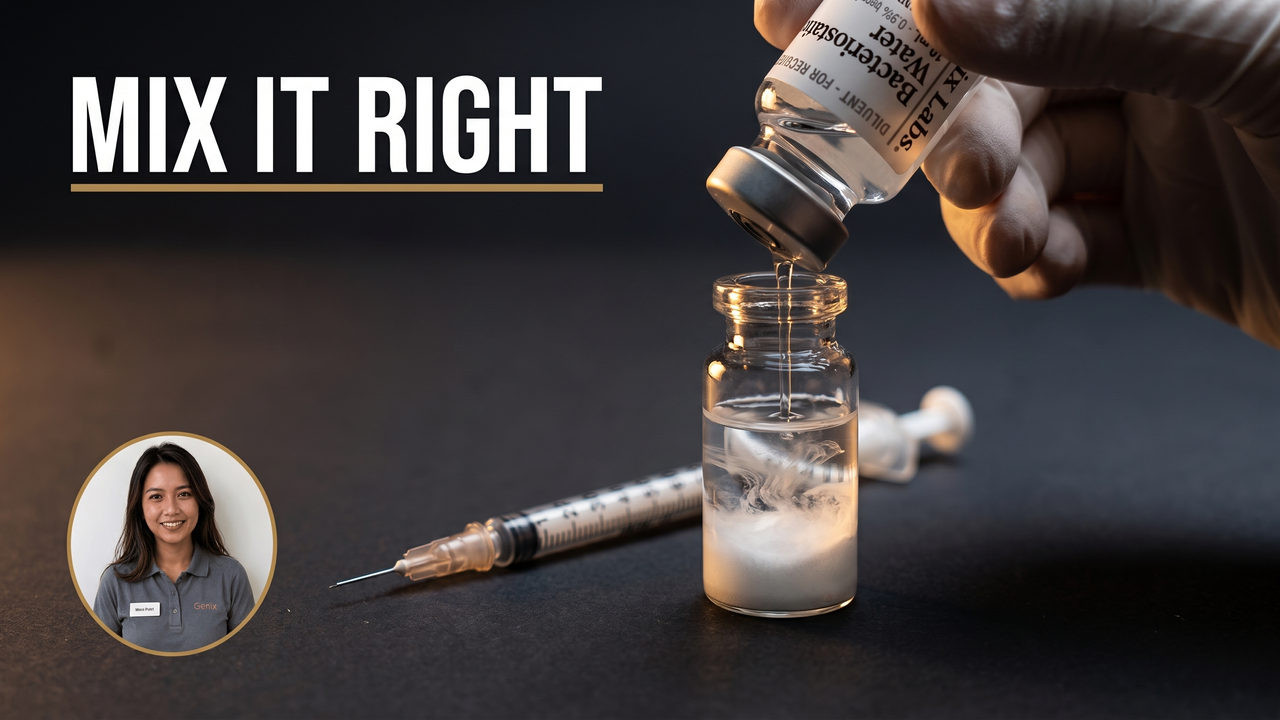
Delivery is a big reason people compare these two. Oral pills are easy but lose a lot to the gut, especially with whole NAD+. Reconstituted research-grade material, prepared with bacteriostatic water, skips the gut and delivers far more of the molecule. That is why so much serious NAD+ research uses a reconstituted form rather than a capsule.
NMN is common as a capsule or a sublingual tablet that dissolves under the tongue. Reconstituted NMN exists too. The pattern is simple: skipping the gut protects the molecule. For a whole, fragile molecule like NAD+, that protection matters more. To understand how reconstitution works, read our guide on how to reconstitute peptides.
NMN vs NAD+ for anti-aging
For the anti-aging question, both point the same way, because both raise NAD+, and falling NAD+ is one of the patterns tied to aging in the lab. The honest summary is that this science is still young. Studies show NAD+ boosting can improve markers in cells and animals. Strong, long-term human proof of a longer life is not there yet.
So treat anti-aging claims with a cool head. NMN and NAD+ are among the most studied NAD+ boosters, which is a real point in their favor. But research context is not a promise of youth. The most useful anti-aging habits, like sleep, movement, and not smoking, still do the heavy lifting. Peptides and coenzymes are studied additions, not replacements.
Which is more practical for daily use?
Practicality often decides the real-world winner. NMN capsules are the easiest to handle, since you just take a capsule. But you accept that some is lost, and that oral NMN quality varies a lot. NAD+ in a reconstituted form takes a little setup, mixing and cold storage, but it delivers the finished coenzyme without the gut tax.
Genix ships research-grade NAD+ cold-chain, so the molecule stays intact from our fridge to yours. That handling is a bigger deal for fragile NAD+ than for sturdier precursors.
Which one should you choose?
Match the molecule to your research goal and your delivery plan. If you want the finished coenzyme delivered directly, and you are set up to reconstitute and cold-store, NAD+ is the direct route. If you want the simplest oral option and accept some loss, a precursor like NMN is the easy path. If your interest is specifically metabolism and insulin signaling, NMN has the standout human trial.
- Want the finished coenzyme, no conversion needed? NAD+.
- Want the easiest oral option, and accept some loss? NMN.
- Focused on metabolism and insulin research? NMN has the trial.
- Worried about the gut destroying a pill? Reconstituted NAD+ skips it.
Whichever you pick, the same rule holds: the paperwork behind the vial matters more than the label on the front.
Why do some people stop taking NMN?
A common search is why people quit NMN. The reasons are usually practical, not scary. Some feel no clear change and decide the cost is not worth it. Some react to a low-quality product with stomach upset and blame the molecule. Some read about the shaky regulatory status of NMN in certain markets and get nervous.
- No obvious felt effect, so the cost feels wasted.
- Stomach upset that often traces back to impure product.
- Confusion over changing rules for NMN in some countries.
- Switching to a direct NAD+ source instead of a precursor.
The lesson is not that NMN fails. It is that quality and expectations drive satisfaction. A clean, tested product used with realistic goals avoids most of the disappointment.
Common mistakes when comparing NAD+ and NMN
A few errors show up again and again. Avoiding them will save you money and confusion. The biggest is treating NAD+ and NMN as interchangeable when the form is different. A whole NAD+ pill and a reconstituted NAD+ vial behave nothing alike, even though both say NAD+ on the box.
- Comparing an oral NAD+ pill to reconstituted NAD+ as if they are the same.
- Buying any NAD+ or NMN with no certificate of analysis.
- Chasing higher doses instead of better absorption.
- Expecting a felt buzz, when the work happens quietly at the cell level.
- Ignoring cold storage, which protects fragile NAD+.
What to look for in a quality product
The market for NAD+ and NMN is crowded, and quality is all over the map. The single best filter is a third-party certificate of analysis, or COA. It should show purity by HPLC and identity by LC-MS, and its lot number should match the label on your vial. No paperwork means no trust, no matter how good the marketing looks.
- A batch COA with HPLC purity and LC-MS identity.
- A lot number on the COA that matches your vial.
- Purity at or above 99 percent.
- Cold-chain handling, which protects fragile NAD+.
- A real named author and reviewer behind the science, not an anonymous shop.
Every Genix NAD+ vial ships with a batch COA you can read before you pay, plus cold-chain delivery and same-day dispatch in Bali. For related longevity research, see our guides on copper peptides for hair and MOTS-c dosing, or start at the longevity and anti-aging hub.
NAD vs NMN: frequently asked questions
Do I need to take NAD if I'm taking NMN?
Not strictly. NMN already becomes NAD+ in your body through a single enzyme step, so taking NMN is one way to feed the NAD+ pool. Adding whole NAD+ on top does not open a separate pathway, since both end at the same molecule. One well-absorbed source can be enough. Research use only.
What is the downside of taking NAD?
The main downside is delivery. As a swallowed pill, NAD+ is poorly absorbed and mostly wasted in the gut. Given fast by IV, it is reported to cause flushing, nausea, or chest tightness. Clinic drips are also costly. Reconstituted NAD+ run on a gentle schedule avoids both problems. Research use only.
Is it worth taking NMN and NAD?
It can be in a research setting, but it is not required, and more is not always better. Because NMN converts into NAD+, the two are not simply additive. Running both mainly suits research that wants a direct coenzyme source plus a slower precursor. For most goals, one quality source is enough. Research use only.
What are the negative side effects of NMN?
In human trials, NMN has been well tolerated at studied doses. Reported side effects are usually mild and dose-related: stomach upset, nausea, flushing, headache, or restless sleep if taken late. Higher doses raise the odds. Long-term human data is still limited, so caution is reasonable. Research use only.
Is NAD and NMN the same thing?
No. NMN is a smaller precursor molecule that your body converts into NAD+ in one step. NAD+ is the larger, finished coenzyme that does the actual work of energy and repair. NMN is like the flour, and NAD+ is the bread. One becomes the other, but they are not interchangeable. Research use only.
Which is better, NAD+ or NMN?
It depends on the form. For pills, NMN usually absorbs better than large, fragile NAD+. For the finished coenzyme delivered outside the gut, reconstituted NAD+ wins because it needs zero conversion. Match the molecule to your goal and delivery method, and let a certificate of analysis guide quality. Research use only.
The takeaway
NAD+ is the finished coenzyme your cells run on. NMN is the building block one step before it. NMN pills tend to survive the gut better than whole NAD+ pills, but reconstituted research-grade NAD+ skips the gut and delivers the finished molecule directly. Both aim at the same target: keeping cellular NAD+ from falling with age. Neither is a proven cure. Choose by your goal and your delivery method, and let the certificate of analysis, not the marketing, be your guide. Everything here is for research use only, and is not medical advice.