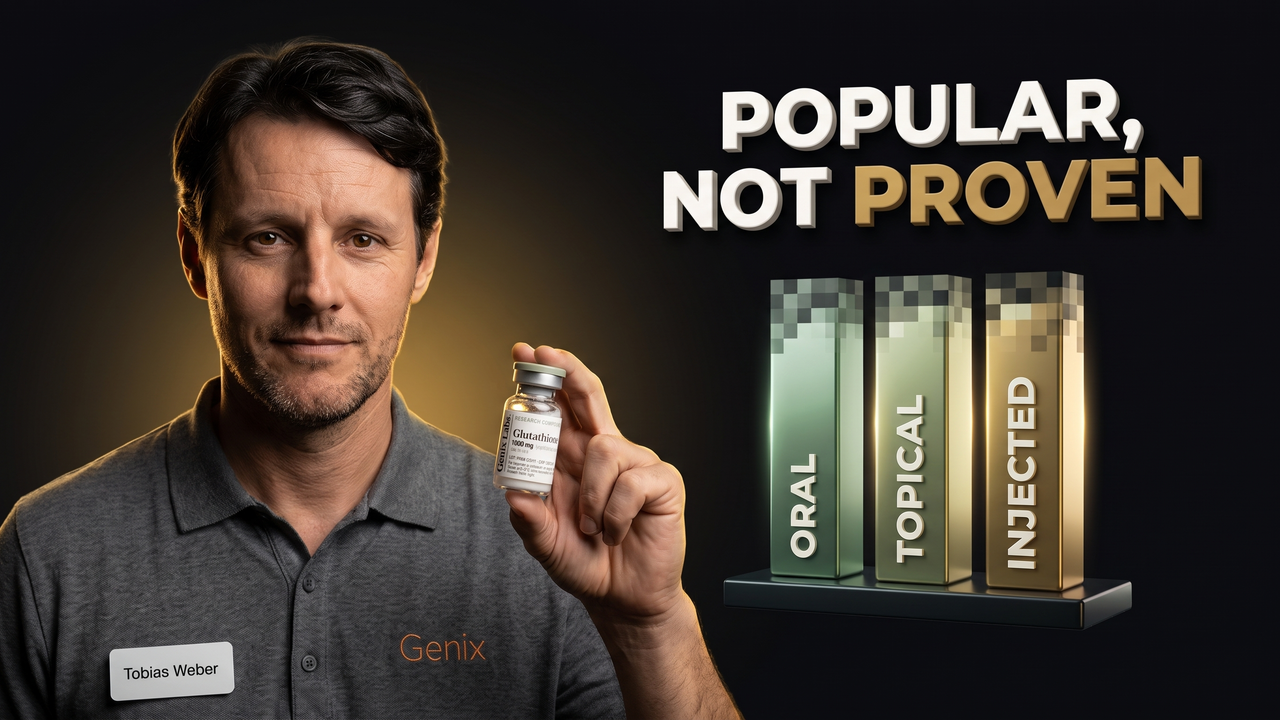
Glutathione is the most injected antioxidant in the world. It is also, in that exact form, one of the least studied. Clinics sell drips. Forums swap protocols. Meanwhile the controlled trials that actually exist tested a pill and a cream. This guide separates what the research proves from what the market sells. Everything here is for research use only.
The quick answer
A glutathione injection puts GSH, a three amino acid antioxidant, straight into blood or muscle. Research studies it for oxidative stress, skin pigment and liver detox pathways. But the controlled human trials tested oral and topical glutathione, not the injected form. Regulators have warned about unregulated intravenous use. Research use only.
What is glutathione?
Glutathione is a tiny peptide your own cells build. It is three amino acids long. The chain is gamma-Glu-Cys-Gly, and it is written GSH for short. Every cell in your body makes it. That is why it is nicknamed the master antioxidant.
Its job is simple. Reactive molecules chip away at proteins and DNA all day. Glutathione hands over an electron and neutralises them. It is the cell version of rust protection. New to this area? Start with the hub, Longevity and Anti-Aging Peptides.
Levels fall with age. They also fall with alcohol, poor sleep, illness and heavy training. That drop is the reason people go looking for a way to top it back up.
- Sequence: gamma-Glu-Cys-Gly, usually written GSH.
- Molecular weight: about 307 daltons, very small.
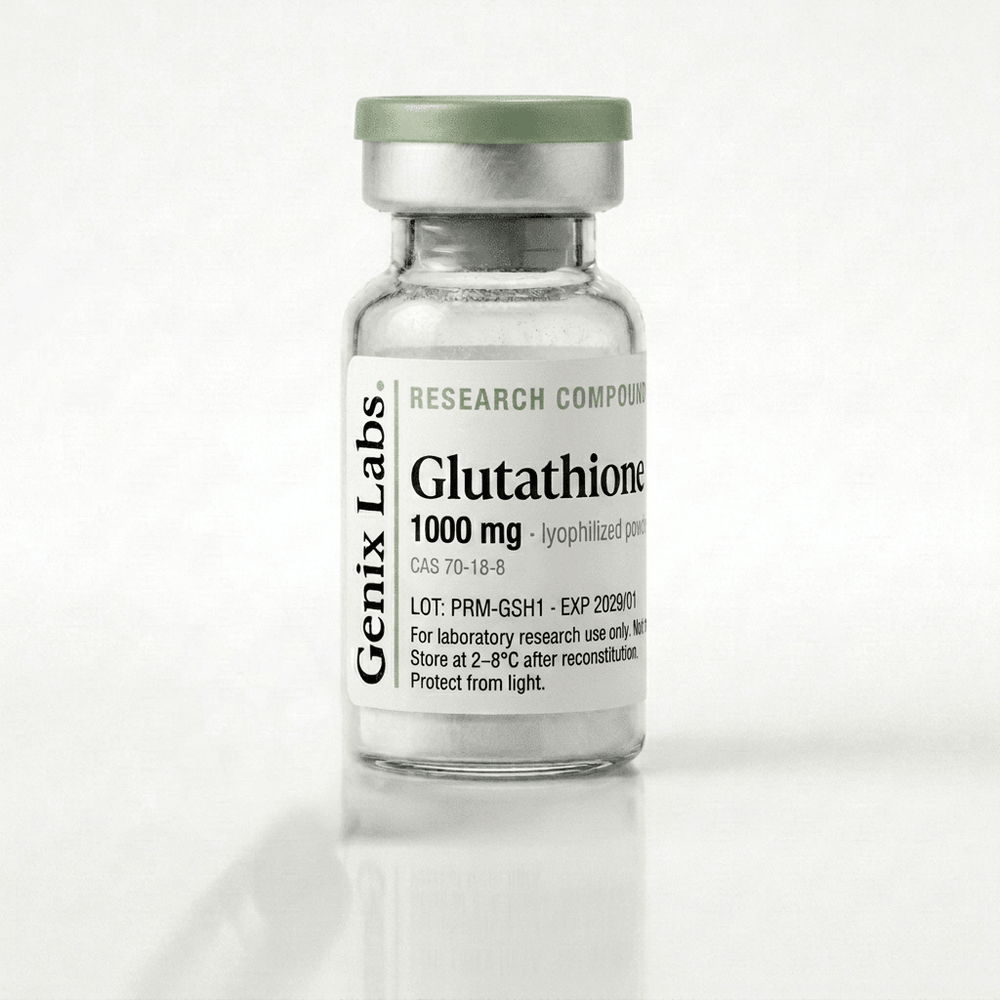
- CAS number: 70-18-8.
- Made by every cell, and depleted by age, alcohol and stress.
- Supplied as a lyophilised powder for research use only.
What is oxidative stress, in plain words?
Oxidative stress is damage caused by unstable molecules. They are missing an electron, so they take one from whatever is nearby. That target is often a protein, a fat or a strand of DNA. The theft leaves a new unstable molecule behind, and the damage spreads.
An antioxidant stops the chain. It hands over an electron without becoming a problem itself. Glutathione is the one your cells lean on most, because it is present in large amounts inside almost every cell.
The ratio that actually matters
Total glutathione is only half the story. Researchers watch the balance between the reduced form and the oxidised form. A high share of reduced glutathione means the system has capacity left. A high share of oxidised glutathione means it is struggling.
That ratio is why the 2015 trial is more interesting than it first looks. Six months of oral dosing did not just raise the total. It lowered the oxidised share in whole blood. The buffer got deeper, not just bigger.
Why do glutathione levels fall?
Your cells make glutathione from three amino acids. Building it takes energy and raw material. When either runs short, or when demand spikes, the pool drains faster than it refills. Several everyday things do exactly that.
- Age. Production slows, and the oxidised share of the pool tends to rise.
- Alcohol. The liver spends glutathione neutralising acetaldehyde, so a heavy night drains it.
- Smoking. It loads the system with oxidants, which is why the 2015 trial recruited non smokers only.
- Illness and infection, which raise oxidative demand sharply for as long as they last.
- Hard training and poor sleep, which both raise the daily oxidative load.
One detail is worth pulling out. Cysteine, the middle amino acid, is usually the limiting ingredient. It is the rarest of the three in the diet. That is why the body cannot simply build more glutathione on demand.
How does your body make glutathione?
Glutathione is built inside the cell, in two steps, and both cost energy. Knowing the steps explains why you cannot simply order the body to make more.
Step one joins glutamate to cysteine. The enzyme that does it is the bottleneck for the whole process. Step two adds glycine on the end, and the finished tripeptide is ready to work.
Cysteine is the ingredient that usually runs out first. It is the scarcest of the three in a normal diet, and it carries the sulphur atom that becomes the working thiol group. No cysteine, no glutathione, however much glutamate and glycine are sitting around.
What is a glutathione injection?
A glutathione injection is any route that bypasses the gut. In practice the phrase covers three different things. There is a slow intravenous drip. There is a faster intravenous push. And there is an intramuscular shot. They are not interchangeable, and the research does not treat them as one thing.
The material itself is usually a white lyophilised powder in a sealed vial. It is mixed with sterile or bacteriostatic water before use. The powder is stable. The moment it meets water and air, a clock starts. We come back to that below.
How does glutathione work on pigment?
Skin colour comes from melanin. Melanin is built by an enzyme called tyrosinase. Glutathione is studied for slowing that enzyme in two ways. It blocks tyrosinase directly. It also shifts production from eumelanin, the dark pigment, toward phaeomelanin, the lighter one.
That mechanism is well described in the 2016 review in the Indian Journal of Dermatology, Venereology and Leprology. The mechanism is not the argument. Whether an injection delivers enough of it to matter is the argument.
Why the mechanism is not the whole story
Plenty of molecules slow tyrosinase in a dish. Far fewer change a measured melanin index in a person. The gap between those two facts is where most of the marketing lives.
How is melanin actually made?
Melanin starts as tyrosine, an ordinary amino acid. Tyrosinase converts it through a short chain of steps into a reactive molecule called dopaquinone. What happens next decides your skin tone, and it is a genuine fork in the road.
If a sulphur carrying molecule is present at that moment, the pathway branches toward phaeomelanin. That is the lighter, red and yellow pigment. If none is available, the pathway continues to eumelanin, the dark brown and black pigment.
Glutathione carries sulphur. So it does two jobs at once. It slows tyrosinase at the start, and it pushes the branch point toward the lighter pigment further down. That double action is the mechanism the 2016 review describes.
Why the effect is gradual, not instant
This mechanism only affects pigment that has not been made yet. Melanin already sitting in your skin is untouched. It leaves at the speed skin cells turn over, which takes weeks. That is why the trials measured at four and twelve weeks, and why nothing here happens overnight.
What are glutathione injections good for?
In research, glutathione is studied for three things. It neutralises reactive molecules inside cells. It lowers pigment by damping the tyrosinase enzyme. And it supports the liver pathway that clears certain toxins, including the byproduct of alcohol. Those are research findings, not promised outcomes, and the injected form is the least tested of the lot.
The antioxidant role
This is the best established job. Glutathione is the main redox buffer inside a cell. In the 2015 trial, six months of oral dosing lowered the ratio of oxidised to reduced glutathione in whole blood. That is a direct read on oxidative load falling.
The pigment role
This is the reason most people search for it. Two controlled trials measured melanin index and found it fell. Both used capsules, not needles. The size of the change was modest and gradual.
The detox role
Your liver uses glutathione to neutralise acetaldehyde, the toxic byproduct of alcohol. Running low on glutathione is part of why a heavy night hits hard. Topping the system back up is studied for supporting that clearance.
The immune signal
One finding gets overlooked. In the 2015 trial, natural killer cell activity more than doubled in the high dose group at three months, against placebo. Natural killer cells are part of your first line immune response. It is a single result, so treat it as a lead, not a conclusion.
Glutathione, alcohol and the heavy morning after
Alcohol is processed in two steps. First it becomes acetaldehyde, which is considerably more toxic than the alcohol was. Then acetaldehyde becomes acetate, which is harmless. The misery of a hangover tracks the middle molecule.
Clearing acetaldehyde and the oxidative mess it creates draws on glutathione. A long night spends the pool down. That is a well described mechanism, and it is the reason glutathione has a reputation in this area at all.
What does not exist is a controlled trial showing an injection fixes a hangover. The mechanism is real. The clinical proof is absent, which is the same pattern that runs through this whole topic.
What else is glutathione studied for?
Skin tone is the loudest use, but it is not the only one in the literature. Because glutathione sits at the centre of cellular defence, researchers have looked at it anywhere oxidative stress is part of the picture.
- Neurology. The 2009 Parkinson's trial is the best known injected study, and it was neutral.
- Liver research, because the liver holds the largest glutathione store in the body.
- Immune function, following the natural killer cell finding in the 2015 trial.
- Skin aging beyond pigment, after the wrinkle and elasticity signals in the 2017 trial.
- Exercise and oxidative load, where the GSH to GSSG ratio is used as a readout.
Be careful reading that list. It describes where research has looked, not where it has landed. A study existing is not a result, and none of this makes glutathione a treatment for anything.
What does the human evidence actually show?
Four studies carry most of the weight in this topic. Three tested capsules. One tested a drip. Here they are side by side, with what each actually measured.
| Study | Form and protocol | People | What it found |
|---|---|---|---|
| Arjinpathana, 2012 | Oral, 500mg a day, 4 weeks | 60 | Melanin index fell at all six sites measured. The fall reached significance at two of them. |
| Weschawalit, 2017 | Oral GSH and GSSG, 250mg a day, 12 weeks | Three arms | Melanin index and UV spots trended below placebo. Wrinkles fell significantly at some sites. No serious adverse effects. |
| Richie, 2015 | Oral, 250mg or 1000mg a day, 6 months | 54 | Body stores rose 30 to 35%. Buccal cells rose 260%. Levels returned to baseline after one month off. |
| Hauser, 2009 | Intravenous, 1400mg, three times a week, 4 weeks | 21 | Well tolerated, no withdrawals for adverse events. No significant difference on the primary rating scale. |
Read that table again and notice the pattern. Every positive skin result came from a capsule. The one properly controlled injected study was in Parkinson's disease, and it missed its endpoint.
The four studies, in detail
Summaries hide the things that matter. Here is what each trial actually did, and where each one is weak. Reading the limitations is how you avoid repeating a marketing claim by accident.
Arjinpathana 2012: the first oral whitening trial
Sixty healthy medical students in Bangkok took 500mg a day, split into two doses, or a placebo, for four weeks. It was randomised and double blind. Melanin index was measured at six sites.
Melanin fell at all six sites in the glutathione group. It reached statistical significance at two of them, the right side of the face and the sun exposed left forearm. Both groups tolerated it well. The authors closed by stating plainly that long term safety had not been established.
The weakness is the size and the length. Sixty people over four weeks is a signal, not a settlement.
Weschawalit 2017: testing both forms at a lower dose
This one asked a smarter question. It ran three arms, giving reduced glutathione at 250mg a day, oxidised glutathione at 250mg a day, or placebo, for twelve weeks in healthy women.
Melanin index and UV spots trended below placebo in both active arms. Wrinkles fell significantly against placebo at some sites in the reduced group. Skin elasticity showed a tendency to rise. No serious adverse effects appeared across the study.
Two things stand out. The dose was half the earlier trial and still moved the needle. And the oxidised form was not inert, which matters for the vial chemistry we cover below.
Richie 2015: the six month store trial
This is the study that changed the argument. Fifty four non smoking adults took 250mg or 1000mg a day, or placebo, for six months. Researchers measured glutathione in blood, red cells, plasma, lymphocytes and cheek cells.
Levels rose at one, three and six months at both doses. At six months the high dose group was up 30 to 35% in red cells, plasma and lymphocytes, and up 260% in cheek cells. The low dose group rose 17% in blood and 29% in red cells. Natural killer cell activity more than doubled at three months.
Then came the part most people skip. After one month off, every level returned to baseline. That single sentence is the most honest thing in the literature about how long any of this lasts.
Hauser 2009: the one controlled injected trial
Twenty one people with Parkinson's disease received 1400mg intravenously, three times a week, for four weeks, or placebo. It was randomised and double blind.
Glutathione was well tolerated. Nobody withdrew because of adverse events, and reported events looked similar in both groups. But there was no significant difference on the primary rating scale. The small numerical edge during dosing faded afterwards.
This is a different disease and a different goal from skin research. It is included because it is the only decent controlled evidence on injecting glutathione into people, and it is neutral.
Why is the injected route the least proven?
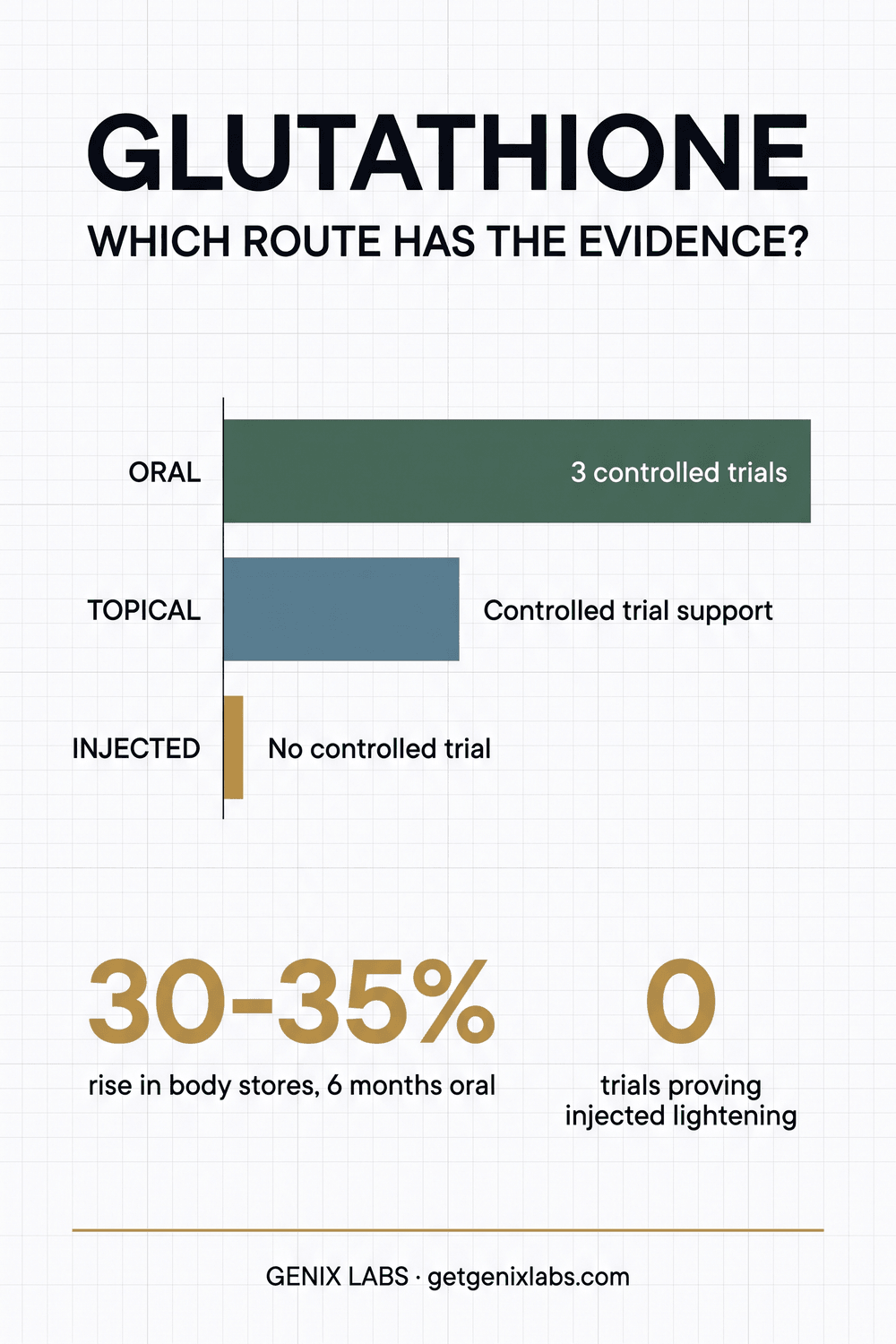
Because nobody has run the trial. The 2016 review states it plainly. Intravenous glutathione injections are popular, and there is no evidence proving they work for skin lightening. The three randomised controlled trials that do support glutathione tested the oral and topical forms instead.
This is not a claim that injections do nothing. It is a claim that nobody measured. Those are different statements, and the difference matters when money and a needle are involved.
Oral, topical, intravenous or intramuscular?
The whole case for injecting rests on one claim. The claim is that swallowed glutathione gets broken apart in the gut and never reaches the blood. For years that sounded obvious. Then it was tested.
The 2015 trial ran for six months in 54 adults. Oral glutathione raised stores in red blood cells, plasma and lymphocytes by 30 to 35% at the higher dose. In cheek cells it rose 260%. So the foundation of the injection argument is weaker than it looks.
| Route | Human evidence | Main caveat |
|---|---|---|
| Oral capsule | Three controlled trials, including a six month store study | Change is gradual, and it fades after stopping |
| Topical | Controlled trial support for measured skin lightening | Acts locally, not systemically |
| Intravenous | No controlled trial for pigment. One neutral trial in Parkinson's | Carries the reported harms, and needs sterile technique |
| Intramuscular | No controlled trial at all | Popular in clinics, absent from the literature |
Does an injection work faster?
Into the blood, yes, and immediately. Into the cell, that is a different question, and it is the one that actually matters. An injection puts glutathione in plasma. Almost all the useful work happens inside cells instead.
Most cells do not simply absorb whole glutathione from outside. An enzyme on the cell surface takes the molecule apart first. The amino acids go in separately, and the cell rebuilds glutathione internally using the two step process above.
So the plasma spike an injection produces is real, and it is not the same thing as a deeper intracellular store. That gap is the strongest technical reason the injected route may be less impressive than it sounds, and it is why the six month oral trial measuring cells rather than plasma is so much more useful.
What does a glutathione injection session involve?
Clinic sessions follow a fairly standard shape. A vial of powder is reconstituted, drawn up, and given either as a slow drip over roughly twenty to forty minutes or as a quicker push. Vitamin C is often added to the same bag. Sessions are usually sold in packages.
The parts that carry real risk are the least visible ones. Was the vial sterile. Was the concentration known. Was the water appropriate. Was the line handled properly. Those questions decide safety far more than the molecule does.
This is a description of common practice, not a recommendation. We supply material for laboratory research and do not provide or endorse human administration.
Why is vitamin C given with glutathione?
There is an actual reason, and it is better than most of the marketing around it. Vitamin C can hand an electron back to oxidised glutathione and return it to the working form. The two antioxidants recycle each other.
So pairing them is chemically sensible. A cell with plenty of vitamin C keeps a larger share of its glutathione in the reduced, useful state. Vitamin C also slows tyrosinase on its own, so the two overlap on pigment as well.
What the pairing does not do is convert an unproven route into a proven one. No controlled trial has tested the combination given by injection for skin tone either.
How many glutathione injections are used in research?
We do not give human dosing guidance, and no controlled trial has ever set an injected schedule for skin. What exists are study protocols. The oral trials used 250mg to 1000mg a day, run from four weeks to six months. The Parkinson's trial gave 1400mg intravenously, three times a week, for four weeks.
Those are descriptions of published research, not instructions. If you are working out how material converts to a concentration in a lab setting, our guide on calculating peptide dosage covers the arithmetic.
The honest answer to the question is that the number quoted in a clinic is a commercial decision, not a finding. Ten sessions is a package, not a protocol.
How long does a glutathione injection work?
Effects track the supply, not the injection. In the six month oral trial, glutathione stores rose steadily and then fell all the way back to baseline within one month of stopping. Pigment studies measured change across four to twelve weeks. Nothing in the literature supports a lasting effect once the supply ends.
That washout result is one of the most useful numbers in this whole topic. It means glutathione behaves like a tap, not a switch. Turn it off and the level drains back to where it started.
It also explains a common forum complaint. People report that their tone drifts back a month or two after they stop. That is exactly what the washout data predicts.
What markers does the research track?
Glutathione research does not rely on how someone feels. It relies on measurements. Knowing which ones exist makes it much easier to spot a claim that was never measured at all.
| Marker | What it reads | Where it was used |
|---|---|---|
| Erythrocyte glutathione | The store held inside red blood cells | Richie, 2015 |
| Whole blood GSH to GSSG ratio | How much spare antioxidant capacity is left | Richie, 2015 |
| Lymphocyte glutathione | The store inside immune cells | Richie, 2015 |
| Buccal cell glutathione | Tissue level uptake, measured in cheek cells | Richie, 2015 |
| Melanin index | Pigment density, read by an instrument on the skin | Arjinpathana, 2012 |
| UV spots | Sun damage marks, counted by standardised imaging | Weschawalit, 2017 |
Notice what is missing from that list. There is no marker for an injected skin lightening result, because no controlled trial ever set one up to measure.
Can the effect be maintained?
Only while the supply continues, according to the data we have. The six month trial is unusually clear on this. Levels climbed at one, three and six months, then fell back to baseline within a month of stopping. No residual benefit was measured.
For pigment, the logic follows the same line. Glutathione acts on melanin that has not been made yet. Stop, and normal production resumes, and skin turns over back toward its baseline tone.
- Nothing in the literature supports a course that produces a permanent change.
- Nothing supports loading a high dose early and then coasting.
- The 250mg arm of the 2017 trial moved skin measures, so higher is not automatically better.
- Sun exposure drives pigment production directly, which no antioxidant protocol overrides.
The honest framing is maintenance, not cure. That is much less exciting than a package of ten sessions sounds, and it is what the measurements actually say.
What are the bad side effects of glutathione?
Oral and topical glutathione were well tolerated across the published trials, with no serious adverse effects reported. The injected route is where the reports sit. The 2016 review lists severe skin reactions, thyroid disruption, kidney injury and air embolism, all linked to unregulated intravenous use.
- Severe cutaneous reactions, including the blistering type that requires hospital care.
- Thyroid dysfunction reported after repeated high dose intravenous use.
- Kidney injury, reported with high dose unregulated administration.
- Air embolism and infection, which come from the procedure rather than the molecule.
- Paradoxical darkening of skin in some reported cases.
Notice how many of those are delivery problems, not molecule problems. Non sterile compounding, unknown concentration and untrained injection carry risk whatever is in the syringe. That is the core safety argument, and it is an argument about supply chains.
What regulators actually said
The adverse effects from intravenous glutathione led the Food and Drug Administration of the Philippines to issue a public warning. That warning condemned its use for off label indications such as skin lightening. It is documented in the 2016 review, and it is the clearest regulatory statement in this field.
More broadly, no regulator anywhere has approved a glutathione injection for skin lightening. Every clinic offering one is working off label. That is worth knowing before a first session, and it is rarely mentioned on a price list.
What the research does not show
An honest guide has to list the gaps as clearly as the findings. Here is what glutathione research has not established, despite how confidently it is often sold.
- That injected glutathione lightens skin. No controlled trial has tested it for that purpose.
- That the effect lasts after stopping. The washout data shows the opposite.
- Long term safety. The 2012 authors said so directly, and the position has not changed much.
- A dose response curve for skin. The 250mg arm worked, so the useful floor is simply unknown.
- That more milligrams means more effect. Nothing in the data supports scaling up indefinitely.
- Any effect on a disease. Glutathione is not a treatment for anything, and it is not sold as one.
None of that makes glutathione uninteresting. It makes it a compound with a specific, modest, measurable effect, sold in a market that describes it very differently.
How does glutathione compare to other brightening agents?
| Agent | What it targets | Human evidence | Main caveat |
|---|---|---|---|
| Glutathione, oral | Tyrosinase, plus eumelanin to phaeomelanin switch | Controlled trials, modest measured effect | Fades after stopping |
| Glutathione, injected | Same mechanism, different route | None for pigment | Carries the reported harms |
| Vitamin C | Tyrosinase and oxidation of existing pigment | Widely studied topically | Unstable in formulation |
| Tranexamic acid | The pathway that drives melasma | Well studied for melasma | Targets a condition, not general tone |
| GHK-Cu | Collagen and repair signalling, not pigment | Studied for skin quality | Different goal entirely |
Glutathione is not the strongest option for any single pigment problem. Its appeal is breadth, because it works on general oxidative load at the same time. If your interest is skin structure rather than tone, read our guide to copper peptides instead.
Where glutathione sits beside NAD+ and GHK-Cu
Glutathione is a defensive compound. It stops damage. The other longevity compounds people study do different jobs, which is why they get grouped together rather than compared head to head.
| Compound | The job it is studied for | How it differs |
|---|---|---|
| Glutathione | Neutralising oxidants, plus pigment and liver pathways | Defence. It prevents damage rather than repairing it |
| NAD+ | Cellular energy production and repair signalling | Fuel and repair, not defence |
| GHK-Cu | Collagen signalling and skin structure | Rebuilds tissue quality rather than tone |
| Epithalon | Telomerase and the melatonin rhythm | Acts on the aging clock and on sleep |
If your interest is energy rather than skin, our guide to NAD+ for energy and aging covers the other half of this picture.
GSH or GSSG: is your vial still reduced?
This is the part almost nobody checks, and it is the part we care most about. Glutathione has a free thiol group, written SH. That group is what does the antioxidant work. It is also chemically eager. Air, light and heat will take it.
When it oxidises, two glutathione molecules join into one linked pair called GSSG. Both forms are sold under the same single word. A vial labelled glutathione can be largely GSSG, and the label will not tell you.
To be fair to GSSG, it is not useless. The 2017 trial tested both forms at 250mg a day and both influenced skin properties. But you should get what you paid for. If a vial is sold as reduced glutathione, it should test as reduced glutathione.
Why only a lab can tell
GSH and GSSG look identical as a white powder. Mass differs, and retention time on a column differs. That is why high performance liquid chromatography is the test that matters here, and why a mass check on identity sits beside it.
How to read a glutathione certificate of analysis
A certificate of analysis is the only document that turns a claim into a fact. Most grey market vials arrive without one. Here is what a real one should let you check in under a minute.
- A lot number on the certificate that matches the number printed on your vial label.
- HPLC purity, stated as a percentage. Our spec is 99% or higher.
- LC-MS identity, confirming the mass lands where glutathione should, near 307 daltons.
- The name of the third party lab, and an accreditation such as ISO 17025.
- A test date recent enough to mean something for a molecule that oxidises.
Every batch we ship has one. You can read the certificate for our lab tested glutathione before you pay a rupiah, which is the order those two events should happen in.
A buyer checklist
Run this before money changes hands, with any supplier, including us. Five questions is enough to separate a tested vial from a hopeful one.
- Can I see the certificate of analysis for this lot, before I pay?
- Does the lot number on the certificate match the number printed on the vial label?
- Which third party lab ran it, and are they accredited?
- Does the certificate report HPLC purity as a percentage, rather than a vague pass?
- Does it confirm identity by mass, and does the mass land near 307 daltons?
A supplier who answers all five without hesitation is dealing in tested material. A supplier who deflects on any of them is selling a white powder and a story.
How should glutathione be stored?
Cold, dark and sealed. The enemy here is not bacteria first, it is oxidation. Every hour the powder spends warm, lit or exposed to air pushes more GSH toward GSSG. Sealed and refrigerated, the lyophilised powder holds for months.
Once it is in solution the window shortens considerably. Keep it chilled, keep it dark, and use it inside a few weeks. Our full guide on storing peptides in a hot climate covers the tropical version of this problem, which is a harder one.
What happens to a vial over time
Glutathione is not a fragile molecule in the way some peptides are. It is a reactive one. The change it undergoes is chemical rather than microbial, and it is driven by exposure.
| Condition | What is happening | Practical result |
|---|---|---|
| Sealed powder, refrigerated, dark | Almost nothing. Very little oxygen contact | Holds for months |
| Sealed powder, room temperature | Slow oxidation of the thiol group | Degrades over weeks to months |
| Powder left open to air | Direct oxygen contact with the thiol | Conversion toward the oxidised form begins |
| Reconstituted, chilled and dark | Slow oxidation in solution | Use within a few weeks |
| Reconstituted, warm or lit | Faster oxidation, and microbial risk too | Assume the working form is going |
The lesson is consistent. Whatever raises air, heat or light exposure moves the vial from the working form toward the spent one, and no amount of careful handling later reverses it.
How glutathione is reconstituted
The technique is the same as any lyophilised peptide, with one extra reason to be gentle. Run the water slowly down the inside wall of the vial. Let it dissolve on its own. Do not shake it.
Shaking matters more here than with most compounds. Shaking whips air through the solution, and air is exactly what converts the working form into the spent one. A swirl is enough. Our step by step on reconstituting peptides walks through the full method.
How much does a glutathione injection cost?
A Genix Labs 1000mg glutathione vial is USD 63, or Rp 1.000.000, with a batch certificate of analysis included. Clinic drips across Southeast Asia are commonly advertised between USD 80 and USD 250 per session, usually with no purity paperwork attached at all.
The gap is not the molecule. Glutathione is not an expensive compound to make. The gap is testing, cold chain and the room you sat in. Only one of those three changes what is in the vial.
What about those before and after photos?
Treat them as marketing until proven otherwise. Lighting, white balance, camera angle and a fading tan will move apparent skin tone further than any measured trial result did. None of those variables are controlled in a clinic photo.
The trials did not use photographs for their primary outcome. They used an instrument that reports a melanin index, and a standardised imaging system for UV spots. The changes those instruments found were real, and they were modest.
If a result looks dramatic in a photo and modest in a trial, the photo is usually the thing that is wrong.
What Reddit gets right, and wrong
What the forums get right
The scepticism about clinic drips is well founded. So is the widely repeated observation that tone drifts back after stopping. That matches the washout data almost exactly, and it is one of the few places where anecdote and evidence line up neatly.
What the forums get wrong
- That oral glutathione is destroyed in the gut and does nothing. The six month store trial contradicts this directly.
- That intravenous is obviously stronger. It may be. Nobody has run the trial that would show it.
- That a high milligram number on a label proves potency. It proves nothing without a purity test.
- That side effects are a myth. The reported harms are real, and they concentrate in unregulated intravenous use.
Mistakes that waste a vial
- Shaking the vial to speed up mixing, which drives air through the solution and oxidises it.
- Storing it on a counter in a tropical climate, where heat and light do the same job slowly.
- Buying on price alone, with no certificate of analysis to check the lot against.
- Assuming a vial sold as glutathione is the reduced form, when only a purity test can say.
- Expecting a permanent change from a compound the washout data shows drains back to baseline.
Sourcing tested glutathione in Bali
Ask for the certificate before you pay, not after. Check the lot number on it against the vial you receive. Confirm the material shipped cold, because a tropical courier run undoes careful lab work quickly.
We ship glutathione with a batch certificate the same day in Bali, cold packed, with cash on delivery available. For the wider picture on sourcing locally, read where to buy peptides in Bali.
Is glutathione legal in Indonesia?
Research compounds sit in a different category from consumer supplements and from registered medicines. Genix Labs supplies glutathione strictly for in vitro laboratory research, labelled and documented as such. It is not for human or veterinary use.
The wider rules, and how research material is classified locally, are covered in our guide to whether peptides are legal in Indonesia. Read it before ordering anything, from anyone.
Who is this research actually for?
Glutathione material is bought by laboratories studying oxidative stress, by dermatology research groups measuring pigment pathways, and by teams working on liver clearance. Those are the settings the evidence was generated in, and the settings the material is supplied for.
It is not supplied as a cosmetic treatment, and this guide is not an argument for using it as one. The purpose here is to describe what has been measured, by whom, and how well.
Frequently asked questions
What are glutathione injections good for?
In research, glutathione is studied for three things. It is the antioxidant that neutralises reactive molecules inside cells. It lowers pigment by damping the tyrosinase enzyme. And it supports the liver pathway that clears certain toxins. Those are research findings, not promised outcomes, and the injected form is the least tested of all. Research use only.
What are the bad side effects of glutathione?
Oral and topical glutathione were well tolerated across the published trials. The injected route is where the reports sit. The 2016 review in the Indian Journal of Dermatology lists severe skin reactions, thyroid disruption, kidney injury and air embolism, all linked to unregulated intravenous use. That is why the Philippine FDA warned against it.
How many glutathione injections should I take?
We do not give human dosing guidance, and no controlled trial has ever set an injected schedule. The published oral trials used 250mg to 1000mg a day for four weeks to six months. The Parkinson's trial gave 1400mg intravenously three times a week for four weeks. Those are study protocols, not instructions.
How long does glutathione injection work?
Effects track the supply, not the injection. In the six month oral trial, glutathione stores rose steadily and then fell all the way back to baseline within one month of stopping. Pigment studies measured change over four to twelve weeks. Nothing in the literature supports a lasting effect after the supply ends.
Do glutathione injections really lighten skin?
The pigment effect is real but modest, and it was measured with oral and topical glutathione, not injections. The 2012 trial found melanin index fell at all six sites, reaching significance at two. The 2016 review is blunt about the injected form: there is no evidence proving it works.
How much does glutathione cost?
A Genix Labs 1000mg glutathione vial is USD 63, or Rp 1.000.000, with a batch certificate of analysis included. Clinic drips across Southeast Asia commonly run USD 80 to USD 250 per session with no purity paperwork attached. The gap is testing, not the molecule itself.
Takeaway
Glutathione is a real molecule with real evidence behind it. The evidence sits almost entirely with the oral and topical forms. The injected route is the most popular and the least measured, and it carries the harms regulators actually wrote warnings about.
If you work with it, work with material you can verify. Check the purity, check the lot, keep it cold and keep it dark. And hold the expectation the washout data supports, which is that the effect lasts as long as the supply does.
Genix Labs supplies glutathione strictly for in vitro laboratory research. It is not for human or veterinary use, and nothing here is medical advice.