Search semax benefits and you get the same list everywhere. Focus. Memory. Mood. Brain fog. Neuroprotection. The lists match because they share a source. Almost none of them tell you what kind of study each item came from. That is the part that decides whether a benefit is real or just repeated.
Semax is unusual among research peptides. It has a genuine human record, including a trial in 110 stroke patients. It also has a mechanism file with real numbers in it. What it does not have is controlled evidence that it sharpens a healthy brain. This guide separates the two, claim by claim, and shows you the grade behind each one.
Everything here is written for laboratory research context. Genix Labs supplies semax for in vitro research only. Nothing below is medical advice, and no part of it is a protocol for people.
What are the benefits of semax?
Research on semax explores effects on brain recovery after injury, on levels of a growth protein called BDNF, and on attention and memory. The strongest evidence is in stroke recovery, where human trials exist. Claims about focus in healthy people rest on small, old studies that are hard to read and have not been repeated elsewhere.
- One benefit area reaches controlled human trials. That is neurological recovery after stroke.
- Two human studies measured brain signals or blood markers. Those are suggestive, not proof.
- Most of the rest is animal work. Useful for mechanism, weak for predicting a human result.
- The famous focus study used 11 people, ran in 1996, and is not indexed in PubMed.
- A lot report is the one benefit you can verify before anything else happens.
What is semax?
Semax is a short chain of seven amino acids. Amino acids are the building blocks that make up proteins. Its sequence is Met-Glu-His-Phe-Pro-Gly-Pro. It weighs about 813 daltons, which is tiny next to a full protein.
It was built in Russia at the Russian Academy of Sciences. Doctors there use it for stroke and for several nerve conditions. It is not approved anywhere else. In the rest of the world it is a research chemical, and that is how we supply it.
Where does semax come from?
Semax is a copy of a small piece of a hormone called ACTH. ACTH is the signal your body sends to make the stress hormone cortisol. In the 1950s researchers noticed that ACTH also seemed to change learning and memory.
That raised an obvious question. Could you keep the brain part and drop the hormone part? Chemists took the fragment numbered 4 to 10 and started trimming. Semax is what came out of that work.
One change matters most. They added a short tail, Pro-Gly-Pro, to the end. Natural peptide fragments break down in minutes. In animal work, that tail stretched the effect out to roughly 20 to 24 hours. Without it there would be nothing to study.
How does semax work?
No single mechanism explains semax. The research points at three things at once. It raises growth proteins in the brain. It touches the serotonin and dopamine systems. And in injury models it calms some of the damage that follows a lack of blood flow.
- Growth proteins. It raises BDNF and NGF, two signals that help nerve cells survive and connect.
- Messenger systems. It engages serotonin and dopamine pathways in rodents.
- Injury response. In ischemia models it lowers a damaging burst of nitric oxide.
- Gene activity. It shifts the expression of genes tied to inflammation and blood vessels.
Read that list carefully. Every item is a mechanism, not an outcome. A mechanism tells you what might happen. An outcome tells you what did happen, in a body, measured against a control group. The two get mixed together constantly in semax writing.
What the BDNF studies measured
BDNF stands for brain derived neurotrophic factor. Think of it as fertiliser for nerve cells. More of it generally means better survival and better connection between neurons. It is the single most studied effect of semax.
The clearest paper is Dolotov 2006 in Brain Research. One 50 microgram per kilogram dose in rats produced measurable jumps.
| What was measured | Change after one dose | What it suggests |
|---|---|---|
| BDNF protein in hippocampus | 1.4 times higher | More of the growth signal present |
| trkB phosphorylation | 1.6 times higher | The receptor for BDNF is switched on |
| BDNF exon III mRNA | 3 times higher | The gene is being read more |
| trkB mRNA | 2 times higher | More receptor being built |
| Conditioned avoidance | More reactions | A behaviour change followed |
A second paper found semax binds in the basal forebrain and lifts BDNF there at 3 hours. By 24 hours it was back to baseline. A third followed BDNF and NGF in the frontal cortex, hippocampus and retina, and found the timing differed by region.
What it does to serotonin and dopamine
Serotonin and dopamine are chemical messengers. They shape mood, drive and attention. A 2005 paper in Neurochemical Research reported that semax activates both systems in rodents.
The detail is more mixed than the title suggests. Independent summaries of that work note that semax raised serotonin levels but not dopamine levels directly. It did strengthen the effect of a drug that pushes dopamine. So the dopamine link looks indirect.
This is a good example of how a benefit grows in transit. The paper says rodent systems were engaged. A vendor page turns that into clean mental energy. Nothing in between measured a person.
How much semax reaches the brain?
Very little, and not for long. Shevchenko 2006 tracked a labelled intranasal dose in rats. At 2 minutes, about 0.093 percent of the total signal per gram was in brain tissue. Roughly 80 percent of that was still intact semax. The rest had already broken down.
The main breakdown product is Pro-Gly-Pro, the tail they added. That fragment has its own activity in the literature. So part of what semax does may not be semax at all by the time it acts.
Keep this number in mind for the rest of the page. A small amount arrives and it clears quickly. Any benefit claim has to fit inside that window.
How should a benefit claim be graded?
A benefit claim is only as good as the study under it. Four rungs cover almost everything written about semax. Put any claim on a rung before you believe it.
- Tier 1. A controlled human trial, with a comparison group and a measured outcome.
- Tier 2. A human study that measured a signal or a marker, but not a real world result.
- Tier 3. An animal study. Strong for mechanism, weak for predicting people.
- Tier 4. A review, a blog, or a shop page. It carries no new evidence of its own.
The trap is that tier 4 is the loudest. Shop pages repeat each other until a claim feels settled. Volume is not evidence. The same sentence on fifty sites is still one source.
The nine benefits, graded
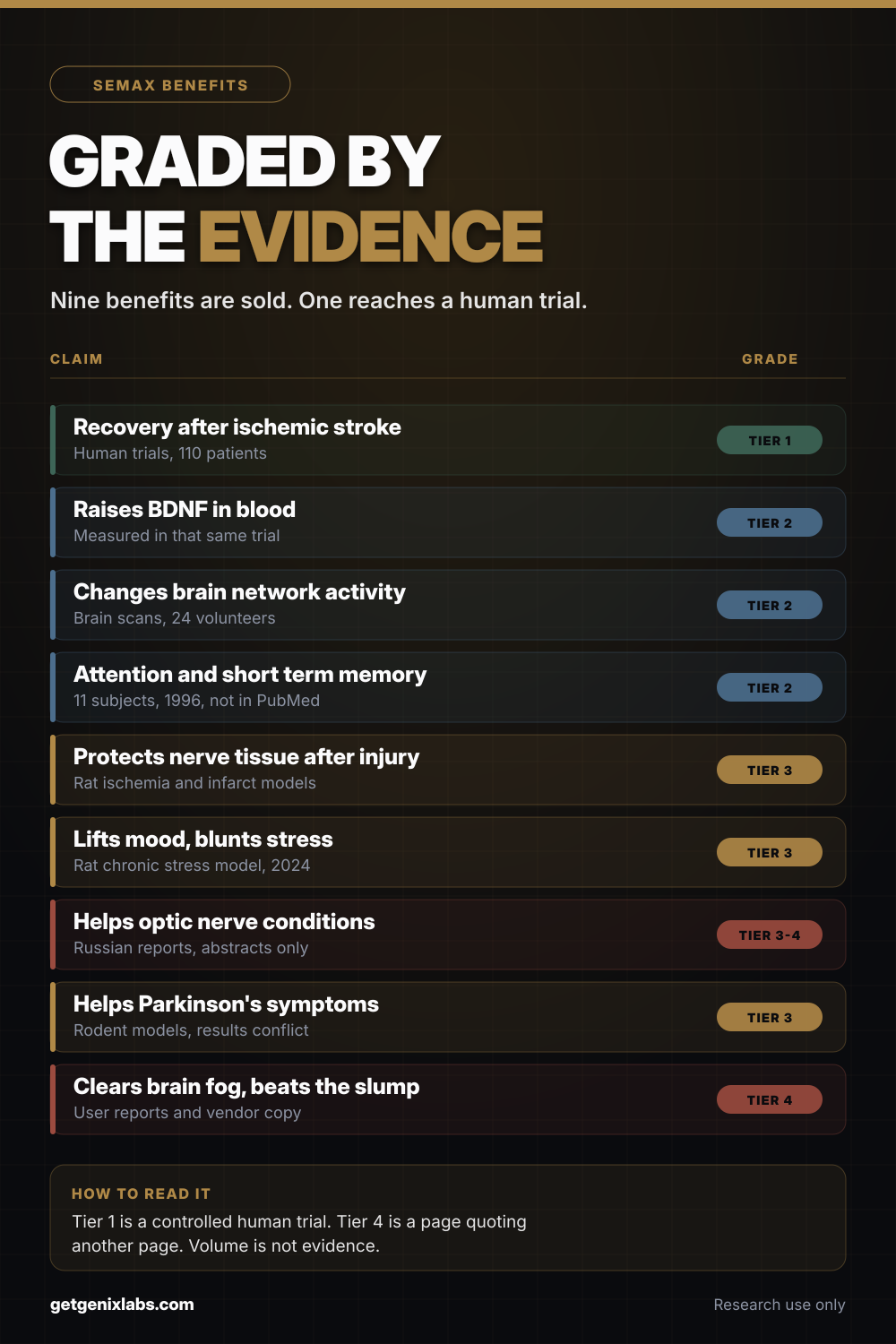
Here is the list semax is usually sold on, with the best grade each one can honestly claim. One reaches tier 1. The rest do not.
| Claimed benefit | Best evidence available | Tier |
|---|---|---|
| Recovery after ischemic stroke | Human trials, including 110 patients | Tier 1 |
| Raises BDNF in blood | Measured in the 110 patient trial | Tier 2 |
| Changes brain network activity | Resting brain scans in 24 volunteers | Tier 2 |
| Attention and short term memory | 11 healthy subjects, 1996, not in PubMed | Tier 2, barely |
| Protects nerve tissue after injury | Rat ischemia and infarct models | Tier 3 |
| Lifts mood and blunts stress | Rat chronic stress model, 2024 | Tier 3 |
| Helps optic nerve conditions | Russian clinical use, abstracts only | Tier 3 to 4 |
| Helps Parkinson's symptoms | Rodent models, results conflict | Tier 3 |
| Clears brain fog, beats the slump | User reports and vendor copy | Tier 4 |
What does the human record hold?
More than most research peptides, and less than the marketing implies. There are two stroke studies, two small studies in healthy volunteers, and decades of routine clinical use in Russia that was never written up in a form the rest of the world can audit.
Almost all of it is published in Russian. Several of the most quoted papers are available only as an English abstract. That is not a conspiracy. It is a language and indexing problem. But it means you often cannot check the claim yourself.
The 110 patient stroke trial
This is the largest human dataset in the file. Gusev and colleagues treated 110 patients after ischemic stroke, mean age 58. The schedule was 6000 micrograms a day for 10 days, then a 20 day gap, then a second 10 day course.
- It measured plasma BDNF, the growth protein, in people rather than rats.
- It measured the Barthel index, a score for everyday self care after stroke.
- It reported motor scores alongside those outcomes.
- Patients with higher BDNF had better rehabilitation timing.
- It published no table of side effects at all.
Two things follow. First, this is genuine tier 1 evidence for one narrow use. Second, it tells you nothing about a healthy brain. Stroke recovery and daily focus are different questions with different biology.
The earlier stroke papers
A 1997 study looked at semax in the acute phase of hemispheric ischemic stroke. It combined clinical scoring with electrical brain recordings. It reported improved neurological function when semax was added to standard care.
The limits are the same as everywhere else here. Small numbers, one country, abstract only in English, and no independent group has repeated it. Russian hospitals adopted it anyway, which is a fact about practice, not about proof.
Does semax help healthy people?
The honest answer is that nobody has shown it properly. Two small studies in healthy volunteers exist. One measured brain scans. One measured attention and memory in 11 people in 1996. Neither is the kind of trial that would settle it, and neither has been repeated outside Russia.
This is the single biggest gap between what semax is sold for and what semax has been shown to do. Nearly all the consumer demand is about focus. Nearly all the strong evidence is about recovery after injury.
The study behind every focus claim
Trace any focus claim far enough and you land in the same place. A 1996 study of 11 healthy subjects working 8 hour shifts. Doses ran from 250 to 1000 micrograms per kilogram. The effect looked strongest after the shift finished.
The number people quote is a memory test the next morning. The treated group scored around 71 percent correct. Controls scored around 41 percent. That is a large gap, which is exactly why it gets repeated.
What brain imaging showed
In 2018 a group ran resting brain scans on 24 healthy volunteers, 11 men and 13 women, average age about 44. Fourteen got intranasal 1 percent semax, a total of 1.2 milligrams. Ten got placebo. Scans ran before dosing, then at 5 and 20 minutes.
The semax group showed a larger volume in the front part of the default mode network. The default mode network is the set of regions that stays busy when you are resting rather than working on a task.
A 2020 follow up looked at semax and selank in 52 participants, focusing on connections involving the amygdala and the prefrontal cortex. Both studies show the molecule changes something measurable in a human brain. Neither shows that the change helps you.
Semax for focus and brain fog
Focus is the reason most people look semax up. The research case is a chain of three links. BDNF rises in rats. Brain networks shift in humans. A 1996 pilot reported better attention. No controlled trial closes the loop.
We cover the mechanism side in more depth in our guide to semax for focus and brain fog. The short version is that the biology is plausible and the proof is missing.
Semax vs stimulants
Caffeine and prescription stimulants push the system harder. They raise alertness directly and they come with a cost, such as a racing heart and a crash afterwards.
| Stimulants | Semax in research | |
|---|---|---|
| Main action | Pushes alertness up directly | Raises growth signals over time |
| Speed | Minutes | Studied over days and weeks |
| Human evidence | Extensive and controlled | Thin outside stroke recovery |
| Typical complaint | Jitter, then a crash | Nasal irritation, headache reports |
| Regulatory status | Approved medicines | Research use only outside Russia |
The comparison people want is which one works better. Research cannot answer that. No study has put semax against a stimulant in a controlled trial.
Semax, mood and stress
The best paper here is from 2024 in the European Journal of Pharmacology. Rats went through chronic unpredictable stress, a standard way to model low mood. Semax was given at 60 nanomoles per kilogram.
- It reduced anhedonia, the loss of interest in things that are normally rewarding.
- It blunted the body weight suppression that chronic stress causes.
- It reduced adrenal gland enlargement, a physical marker of stress load.
- It restored BDNF in the hippocampus.
- The authors call semax noncorticotropic, meaning it does not drive cortisol release.
That last point answers a common worry. Semax comes from a stress hormone fragment, so people assume it must raise cortisol. The 2024 work says the opposite. It lowered a marker of stress load rather than raising it.
Semax and neurological recovery
This is where the animal work and the human work finally agree. In a rat photothrombosis model, which creates a small clot driven brain injury, six daily doses at 250 micrograms per kilogram reduced the size of the damaged area and improved a memory task.
A separate paper found semax prevented a surge in nitric oxide in the cortex of rats after blood flow was cut. That surge is part of what makes the damage spread. Another compared semax against a reference drug across brain ischemia models.
Line those up next to the stroke trials and you get a consistent story in one domain. Injury first, then semax, then less damage and better recovery. That is the benefit with the most support behind it.
What about the eye research?
Semax is used in Russia for optic nerve atrophy, which is damage to the nerve that carries sight to the brain. The retina is brain tissue, so the idea is not strange. One gene expression study tracked BDNF and NGF in the retina after semax.
The clinical side is weak as published evidence. The reports are Russian, small and mostly abstract only. Treat it as an area under study, not a demonstrated use.
Semax and Parkinson's models
Results here actually conflict, which is worth knowing. In one MPTP rodent model, a chemical way of damaging dopamine neurons, four daily intranasal doses improved some behaviours and not others. Another MPTP study reported increased anxiety and no change in movement. A 2017 paper tested semax and selank in a different Parkinson's style model.
Conflicting animal results are normal science. They are also a reason to be careful. When the same model gives different answers, a human claim built on it is not ready.
Why does every benefits list match?
Because they are copying each other, and under that, copying a small number of reviews. The reviews cite Russian papers. Many of those papers are not indexed in PubMed and are not available in English. The chain ends before you can check anything.
This is the real reason the lists look identical. It is not that the evidence converged. It is that everyone drew from the same few buckets. Once you see the chain, a long benefits list stops feeling impressive.
What an independent review concluded
The Alzheimer's Drug Discovery Foundation runs a programme where neuroscientists grade compounds for brain health. They reviewed semax. It is the closest thing to a neutral verdict that exists in English.
- Semax may help stroke patients, and Russia uses it that way.
- Published literature of well conducted studies is lacking.
- There is little evidence it improves thinking in healthy people.
- There is no evidence for Alzheimer's disease.
- Little human safety data exists either way.
That is a long way from the vendor list. It is also the most useful sentence on this page. An independent group with no product to sell looked at the same file and found one plausible use and a lot of gaps.
Is semax FDA approved?
No. Semax is not approved by the FDA or by European regulators. It is a registered medicine in Russia and some neighbouring countries. Everywhere else it is a research compound.
That status is not a judgement on the molecule. It reflects that no sponsor has run the trials a Western regulator requires. Until that happens, research use only is the correct frame, and it is the only frame we use.
Does semax have lasting effects?
It depends on which effect you mean. The molecule itself clears in minutes to hours. The added Pro-Gly-Pro tail stretched activity to roughly 20 to 24 hours in animal models. The BDNF rise in one study was present at 3 hours and gone by 24.
So there are two clocks. There is how long the peptide lingers, which is short. And there is whether repeated exposure leaves a lasting structural change, which is the interesting question. The stroke trials used courses of 10 days precisely because a single exposure was not the point.
No study has followed healthy people after stopping. So whether anything persists in a healthy brain is unknown, not settled in either direction.
What is a good nasal spray for peptides?
In the published research the intranasal route was delivered as drops of a dilute solution, not as a consumer spray product. The studies describe concentrations such as 0.1 percent and 1 percent, prepared in a clinical setting. There is no validated consumer device behind any of that work.
The useful question is not which spray. It is what is in the vial. A device cannot fix wrong identity, low purity, the wrong diluent or a broken cold chain. We supply semax as a lyophilized powder, which is freeze dried, for laboratory handling. Our guide to semax dosage and why charts disagree covers why the numbers you see online rarely match the papers.
Is there a subcutaneous semax protocol?
Not a validated one. This surprises people, because subcutaneous injection is how most research peptides get discussed. The human semax literature is intranasal. The stroke trials were intranasal. The brain imaging studies were intranasal.
Animal work used intranasal and intraperitoneal routes, with doses in the range of 50 to 250 micrograms per kilogram depending on the model. Those are animal figures from published papers. They are not a human schedule and they do not convert into one.
So anyone publishing a confident subcutaneous semax protocol is filling a gap the literature left empty. Treat that as a red flag about the source.
Who should not take semax?
Everyone, in the sense the question is usually asked. Semax is supplied for laboratory research, not for people. There is no consumer population for which a benefit has been established and a safety profile published.
In the published clinical work, the populations were hospital patients after ischemic stroke and patients with optic nerve disease, treated under supervision in Russia. That is a clinical setting with monitoring, not a protocol anyone can lift.
What the safety record holds
Thin, and that cuts both ways. The 110 patient trial published no adverse event table. Nor did the others. One Russian review reports the most common complaints as discoloration inside the nose in roughly 10 percent of patients, and raised blood sugar in roughly 7.4 percent of diabetic patients.
There is one signal that does reproduce. Four papers from one Moscow laboratory found semax shifts blood toward anticoagulation and faster clot breakdown. Almost no benefit list prints it. We cover it in full in our guide to semax side effects graded by evidence.
Semax vs selank
They get studied together and they are often confused. The simple split is direction. Semax research points at attention and recovery. Selank research points at anxiety and calm.
| Semax | Selank | |
|---|---|---|
| Parent molecule | ACTH fragment | Tuftsin fragment |
| Research direction | Attention, recovery, BDNF | Anxiety, calm, stress |
| Human trials | Stroke recovery | Anxiety, Russian studies |
| Shared limit | Mostly Russian literature | Mostly Russian literature |
The full comparison, including what each one was built for, is in our semax vs selank guide.
Which benefits can you verify today?
Here is the part nobody writes about. Every benefit discussed above is uncertain. The properties of the vial in front of you are not. They can be measured, and they decide more about what happens in an experiment than the sequence ever will.
| What you can check | How it is checked | Why it matters |
|---|---|---|
| Purity | HPLC area percent on a lot report | Tells you what fraction is the target peak |
| Identity | LC-MS mass confirmation | Tells you it is semax and not something else |
| Lot match | Number printed on the vial | A report for another lot proves nothing |
| Cold chain | Packed cold, tracked in transit | Peptides degrade with heat and light |
| Diluent | Correct water for reconstitution | The wrong fluid ruins the sample |
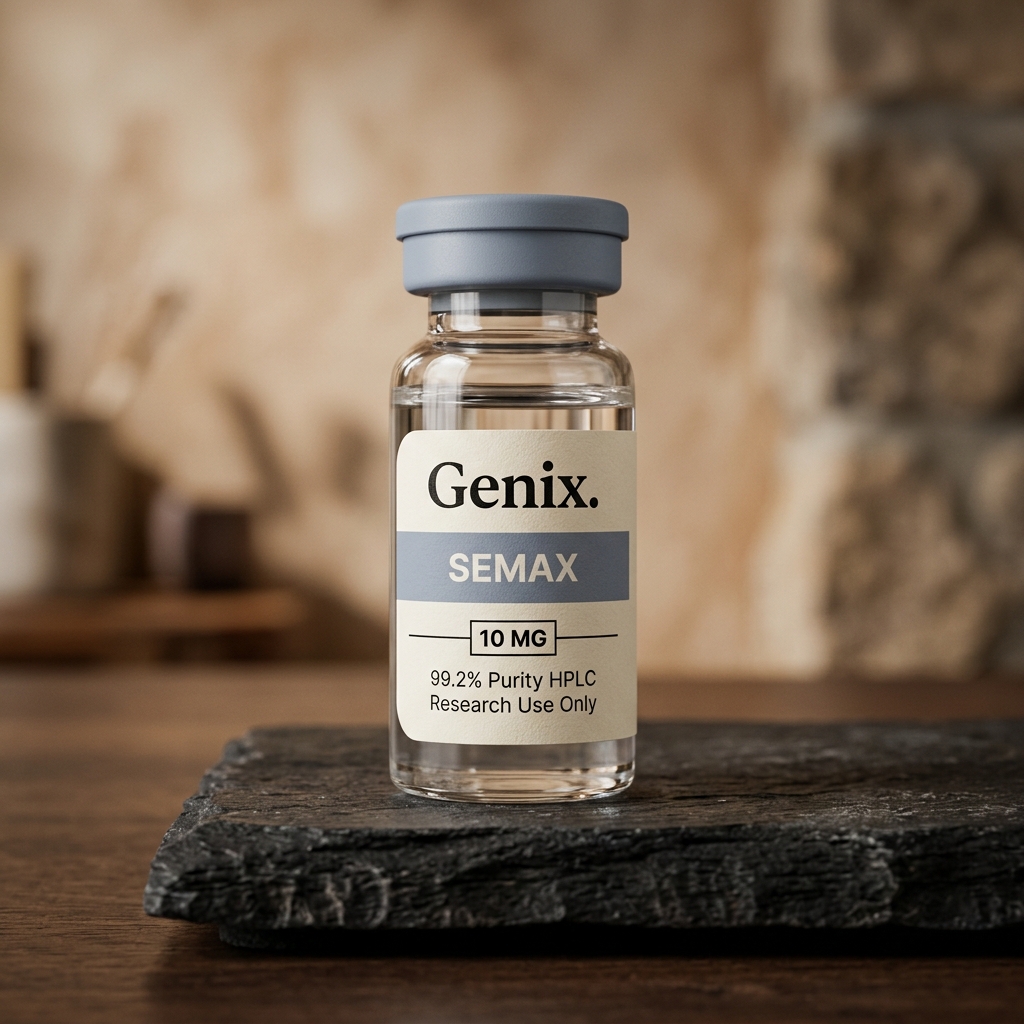
Our published semax lot shows 99.45 percent HPLC area purity at the 10 milligram size, with LC-MS identity confirmation, under lot 371924. That figure is a lot specific area result. It is not a statement of content, sterility, safety or efficacy. Confirm the lot printed on the vial against the report.
You can read the full lot document on the lab tested semax product page, and the wider cluster of focus research sits on our nootropic peptides hub.
How much does semax cost?
A Genix Labs semax vial is 10 milligrams at USD 63, or Rp 1.000.000, with the batch certificate of analysis included. Orders placed before 9 PM ship the same day, cold packed and tracked. In Bali we deliver same day, often within 2 hours, with cash on delivery.
Price is a weak quality signal on its own. A cheap vial with no lot report is not a bargain, because you cannot tell what is in it. A costly vial with no lot report is worse.
What would actually settle this?
One study design would close most of the argument. A randomised, placebo controlled trial in healthy adults, run outside Russia, with pre registered cognitive outcomes and enough participants to detect a modest effect.
- Pre registered outcomes, so the measure cannot be chosen after the data arrives.
- A placebo group, because attention tests improve with practice alone.
- A published adverse event table, which the existing trials never provided.
- Independent replication, ideally by a group with no connection to the original work.
None of that exists today. Until it does, the honest position is that semax has one supported clinical use and a large, interesting, unproven mechanism file.
Read any semax claim in 30 seconds
- Was it a human or an animal? Most semax claims are rats presented as people.
- Was there a control group? Without one, improvement may just be practice or time.
- Can you open the study? If the trail ends at a Russian abstract, you cannot verify it.
- Does the claim match the route? Human data is intranasal, not subcutaneous.
Run those four on any benefits list. Most items will fall to tier 3 or tier 4 in under a minute. The ones that survive are worth your attention.
Frequently asked questions
Does Semax have lasting effects?
Two clocks run here. The peptide itself clears in minutes to hours, though the added Pro-Gly-Pro tail stretched activity to roughly 20 to 24 hours in animal models. The BDNF rise in one rat study was present at 3 hours and gone by 24. No study has followed healthy people after stopping.
What is a good nasal spray for peptides?
The published research used drops of a dilute solution prepared in a clinical setting, not a consumer spray device. No device is validated for this. The question that matters is what is in the vial, because identity, purity, the right diluent and an unbroken cold chain decide the result.
What is the Semax injection protocol for subcutaneous administration?
There is no validated one. The entire human literature is intranasal, including both stroke trials and the brain imaging studies. Animal work used intranasal and intraperitoneal routes at 50 to 250 micrograms per kilogram. Those are animal figures from papers and they do not convert into a human schedule.
Who should not take Semax?
Nobody, in the sense the question means. Semax is supplied for laboratory research only, not for people. In the published clinical work the populations were hospital patients after ischemic stroke and patients with optic nerve disease, treated under supervision in Russia. That is a clinical setting, not a consumer protocol.
Does Semax actually improve focus?
Research has not shown it properly. The focus case rests on 11 healthy subjects in 1996, a paper not indexed in PubMed, plus two small brain imaging studies. An independent neuroscience review found little evidence that semax improves thinking in healthy people. The biology is plausible and the proof is missing.
How much does Semax cost?
A Genix Labs 10mg semax vial is USD 63, or Rp 1.000.000, with the batch certificate of analysis included. The published lot shows 99.45% HPLC area purity and LC-MS identity confirmation. Purity is a lot-specific area result and is not a statement of content, sterility, safety or efficacy. Supplied for laboratory research only.
Takeaway
Semax has a better evidence file than most research peptides and a worse one than its marketing suggests. The strong part is narrow. Human trials support neurological recovery after stroke, and the mechanism work behind that is consistent across labs.
The focus claim, which is why most people search for it, rests on 11 subjects in 1996, two small brain imaging studies, and a long chain of pages quoting each other. That is not nothing. It is also not proof, and no amount of repetition will turn it into proof.
So grade before you believe. Ask which tier a claim sits on. Then put your attention on the one thing you can actually confirm, which is the vial. Identity, purity, the right water and an unbroken cold chain decide more about your result than seven amino acids ever will. That part you can check, on a lot report, before anything else happens. Research use only.