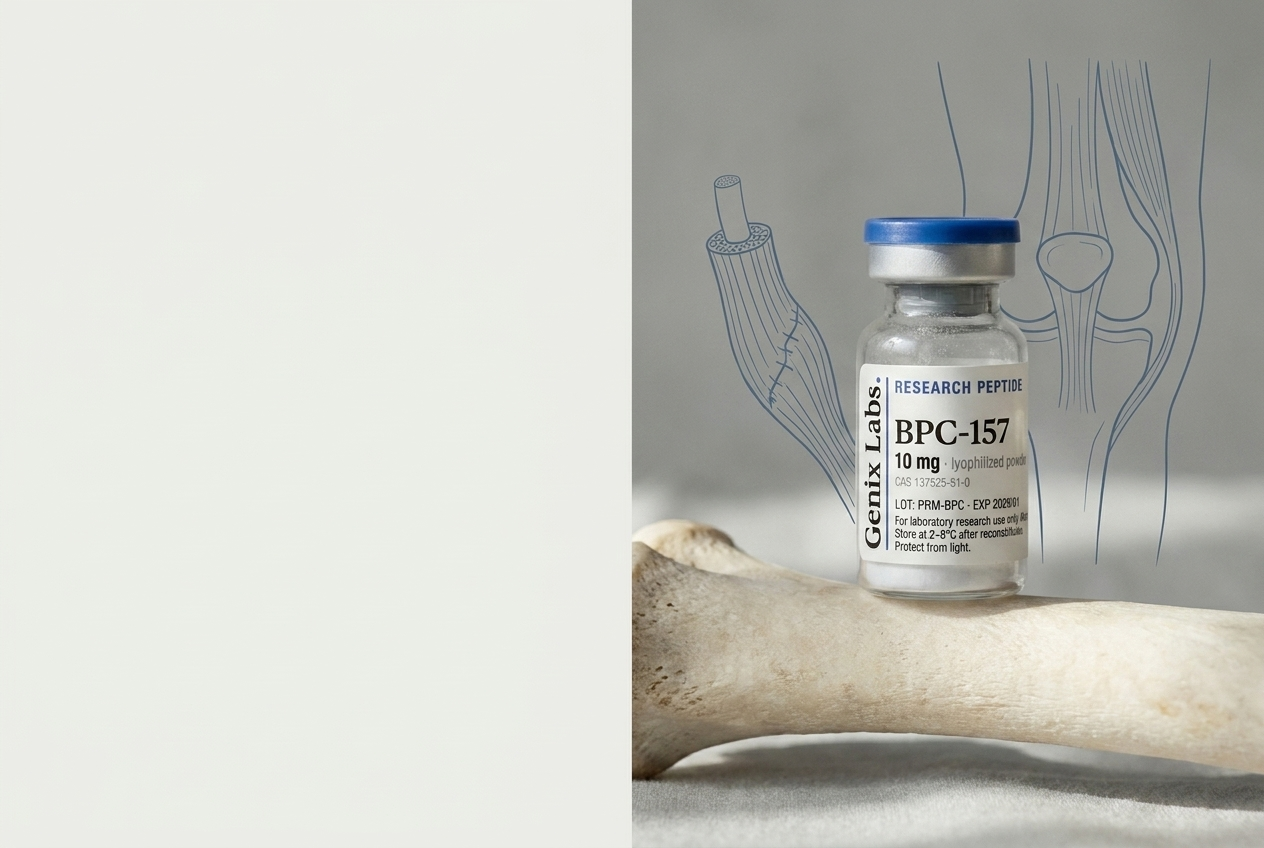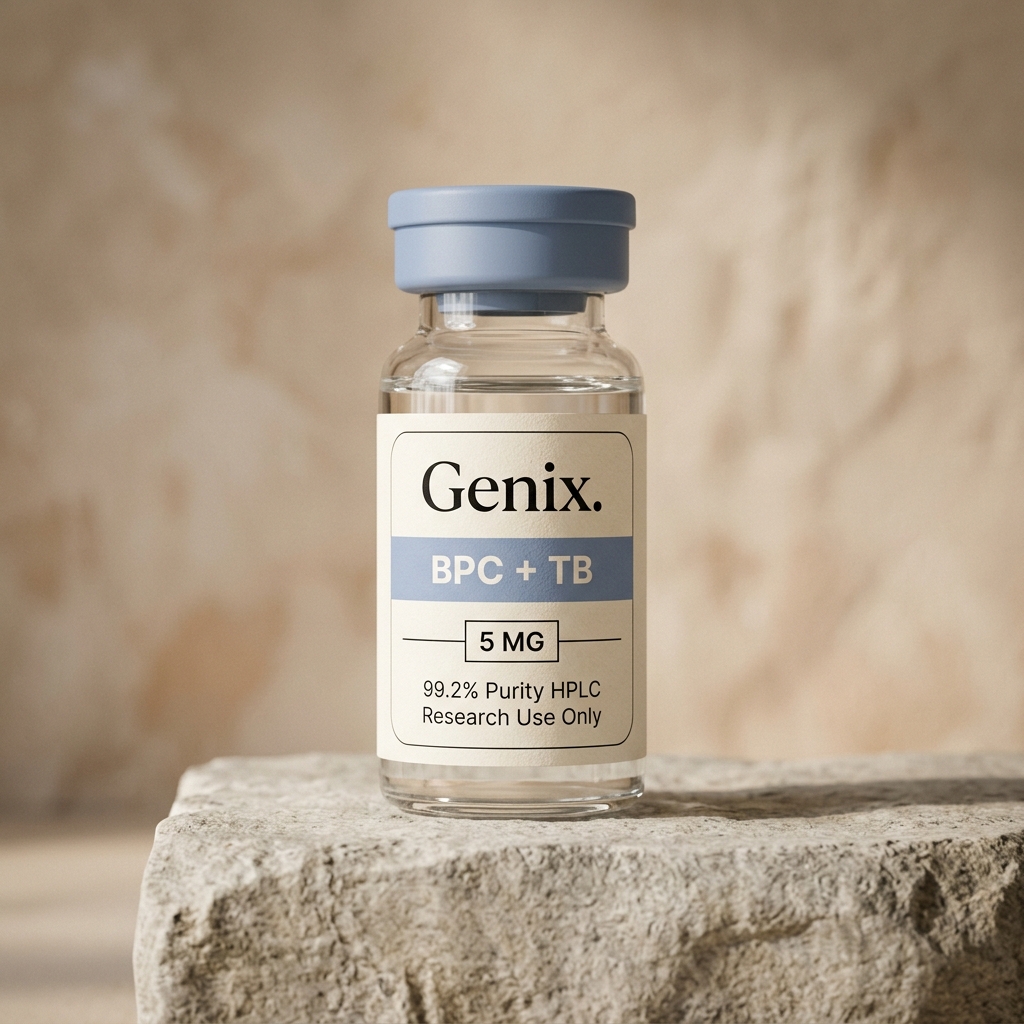

Search the BPC-157 TB-500 stack and you land on forum threads. Reddit posts. Old bodybuilding boards. Almost none of it cites a study. This guide does the opposite: what each peptide actually does, why researchers pair them, where a blend vial differs from two vials, and which popular claims the literature does not support. Everything here is for laboratory research use only.
What is the BPC-157 TB-500 stack?
The BPC-157 TB-500 stack is the pairing of two tissue-repair research peptides in one study cycle. BPC-157 is studied where it is placed, at a single site such as a tendon or the gut lining. TB-500 is studied for systemic reach, spreading through the body. Together they cover local repair and whole-body repair at once.
Read that last figure carefully, because it shapes every other answer on this page. There is no completed, controlled human trial of either compound for tissue repair, and none at all of the two combined. What exists is rodent work, cell work, and a very large amount of anecdote. The honest version of this topic keeps those three categories apart.
What is the BPC-157 TB-500 blend used for?
In laboratory research the blend is used to study tissue repair from two angles at once. BPC-157 is studied at a local site, such as a tendon, a ligament, or the gut lining. TB-500 is studied for systemic reach, travelling through the body. The blend puts both into a single research cycle instead of two.
The research questions that draw people to the pairing fall into three groups. Connective tissue models, meaning tendon, ligament, and muscle. Gut lining models, which is BPC-157 territory specifically. And general recovery models, where the interest is whether repair markers move faster when both compounds are present than when either is present alone.
That last question is the one the literature has not answered. Study the two separately and you find published rodent work for each. Study them together and you find forum logs. We go into why that gap matters in the section on forum threads further down.
Why are these two peptides paired?
Because they do different jobs, and the jobs do not overlap much. That is the short reason. Stacking compounds that work the same way adds risk without adding information. Stacking compounds that work differently is the case researchers actually make.
- BPC-157 is studied for local repair signalling at the site it is placed.
- TB-500 is a fragment modelled on Thymosin Beta-4, a protein that circulates.
- One is a spot treatment in research terms. One reaches tissue broadly.
- Different mechanisms means the effects are at least separable in principle.
- The pairing is popular partly because it is cheap to run as one blend vial.
There is a less flattering reason too, and it is worth naming. The pairing became standard because suppliers started selling it as one product, not because a study group designed it. Convenience shaped the convention. That does not make the pairing wrong, but it does mean the popularity is not evidence.
How are BPC-157 and TB-500 different?
They differ in origin, in size, in reach, and in how much data sits behind them. The table below sets the two side by side. It is the clearest way to see why the stack is a division of labour rather than a doubling up.
| BPC-157 | TB-500 | |
|---|---|---|
| Origin | A fragment of a protein found in gastric juice | A fragment modelled on Thymosin Beta-4 |
| Size | 15 amino acids, about 1.4 kDa | 7 amino acids, about 0.9 kDa |
| Reach in research | Local, at the site it is placed | Systemic, distributes through the body |
| Most studied tissue | Tendon, ligament, gut lining | Muscle, heart, skin, cornea |
| Main studied mechanism | New blood vessel formation and growth-factor signalling | Actin binding and cell migration |
| Human trial data | Early-phase work only, none completed for repair | None completed |
| Genix lot purity | 99.32 percent HPLC area, lot 613480 | 98.60 percent HPLC area, lot 726591 |
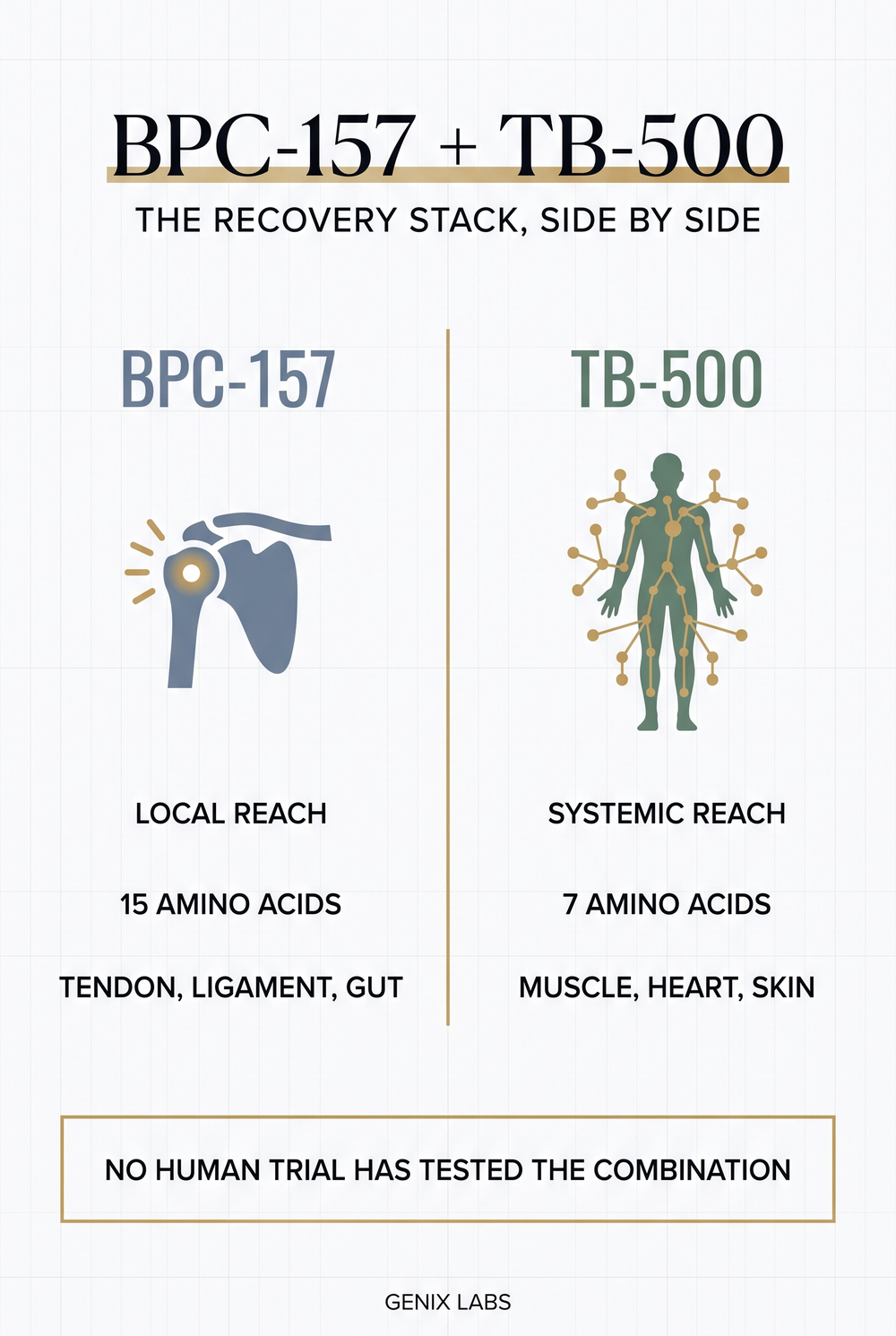
Two details in that table do real work. The reach row is the reason the pairing exists at all. The human trial row is the reason nobody can honestly promise you an outcome. For a deeper read on each compound on its own, see BPC-157: what it is and how it works and TB-500: the systemic recovery peptide.
Blend vial or two separate vials?
A 5+5 mg blend vial holds both peptides in a fixed ratio inside one container. Two separate vials hold them apart. The blend is simpler and cheaper. Separate vials cost more but let a researcher change the ratio. Neither is better in the abstract. The study design decides.
What the blend vial gives you
- One reconstitution instead of two, so fewer chances to make a handling error.
- One stability clock to track instead of two running in parallel.
- A lower total cost per milligram than buying the two compounds separately.
- A fixed, documented ratio, which makes a study easier to describe and repeat.
What separate vials give you
- Freedom to vary one compound while holding the other constant.
- The ability to stop one compound mid-cycle without stopping both.
- Cleaner attribution, because an observed effect can be traced to one variable.
- A separate lot document for each compound rather than one covering both.
On price, the Genix figures are public. The BPC-157 10 mg vial is 89 US dollars, or Rp 1.450.000. The BPC-157 and TB-500 5+5 mg blend is 99 US dollars, or Rp 1.650.000. Both ship cold-packed, same day from Bali, with cash on delivery available on the island.
How is the stack dosed in research?
There is no human dosing chart for the stack, because no human trial has produced one. In animal studies each compound was given in small amounts scaled to body weight, usually once a day. Those figures belong to rodents in a controlled setting. They do not convert to a human protocol.
What a researcher can control is the arithmetic of the vial. The vial holds a fixed dry amount. The water added only changes the concentration, never the total. Our guide on BPC-157 dosing walks through that calculation properly, and the same maths applies to each half of a blend.
One point specific to blends catches people out. In a 5+5 mg vial, every unit drawn contains both compounds in that 1:1 ratio. You cannot draw more of one. If a study design calls for a different ratio, the blend is simply the wrong product, and two vials are the right one.
How long does a research cycle run?
Published animal work on tissue repair typically runs over weeks rather than days, because collagen remodelling is slow. Rodent tendon studies commonly report outcomes across two to six weeks. That timescale is the one useful thing the animal literature transfers: repair is not a fast process in any species.
| Window | What the animal literature looks at | What it does not tell you |
|---|---|---|
| Week 1 | Early inflammatory and blood-vessel markers | Nothing about human sensation or symptoms |
| Weeks 2 to 3 | Collagen deposition and early tensile strength | Whether the same timing holds outside rodents |
| Weeks 4 to 6 | Remodelling and functional recovery measures | Durability past the end of the study |
| Beyond 6 weeks | Very little published data at all | Long-term safety, in any species |
Notice the last row. The evidence thins out exactly where most people want it thickest. Any source that describes a confident multi-month stack protocol is describing a convention, not a finding.
Is BPC-157 hard on your liver?
Published animal work points the other way. In rodent models of liver injury, BPC-157 was studied as protective rather than damaging, and no liver toxicity signal has been reported at studied amounts. There are still no controlled human trials, so long-term human liver safety is genuinely unknown.
The origin story explains the direction of the research. BPC-157 is derived from a protein sequence found in gastric juice, and the early work was gastrointestinal. Liver models entered the picture as an extension of that, testing whether the same cytoprotective pattern held. Several rodent papers report that it did.
Two caveats keep this honest. Protective in a rodent injury model is not the same as safe in a healthy human over years. And the absence of a reported toxicity signal is weaker evidence than a study designed specifically to look for one, which does not exist. Our full breakdown lives in BPC-157 side effects.
What side effects show up in the literature?
For both compounds the published animal record is quiet, and the human record is anecdotal. The most consistent reports in user accounts are local: irritation at the site of injection. Those accounts are self-reported, uncontrolled, and frequently confounded by whatever else the person was taking.
- Animal studies at studied amounts report few adverse findings for either compound.
- No controlled human safety study has been completed for either compound.
- Most reported irritation is local and tied to handling, not to the molecule.
- Unverified material is its own risk, separate from the peptide itself.
- Combining two compounds makes any side effect harder to attribute to either.
That last line is the underrated one. Run the stack and something happens, and you have no way to know which half caused it. This is precisely why controlled studies change one variable at a time, and why a blend vial is a blunt research instrument.
What peptides should not be stacked together?
The honest answer is that no published study set defines safe human peptide combinations. Researchers avoid stacking compounds with overlapping mechanisms, because it becomes impossible to attribute an effect to either one. Combining a research peptide with prescription medicine is a separate question for a licensed clinician.
Within research design rather than safety, three patterns are treated as poor practice. They are worth knowing because they explain why the BPC-157 and TB-500 pairing is considered a reasonable combination and others are not.
- Two compounds acting on the same receptor or pathway, because neither result is interpretable.
- Two compounds with the same studied outcome measure, for the same reason.
- More than two new variables at once, which makes a cycle uninterpretable from the start.
- Any combination where one compound has no lot document, because the input itself is unknown.
The stack passes the first three tests and fails none of them. It passes the fourth only if both halves carry a real lot document, which is the subject of the purity section below.
Which peptide does Joe Rogan take?
Joe Rogan has talked about BPC-157 on his podcast, usually in the context of recovery from injury. A podcast mention is anecdote, not evidence. It does not establish safety, efficacy, or any human dose, and Genix Labs supplies these compounds strictly for laboratory research.
It is worth being direct about why this question ranks so highly. A large share of current interest in BPC-157 traces back to that podcast, not to a paper. The search demand is real, the scientific weight behind it is zero, and conflating the two is how bad information spreads in this category.
What the forum threads get right and wrong
The top search results for this stack are Reddit and old bodybuilding boards. That is unusual, and it tells you something: no authoritative source has covered the topic properly. Those threads are not worthless, but they need reading with a filter.
| Common forum claim | What holds up | What does not |
|---|---|---|
| BPC-157 works locally, TB-500 works systemically | Broadly consistent with the animal literature | The distinction is sharper in forum posts than in the data |
| The two are synergistic | Plausible on mechanism, since the pathways differ | No published study has tested the combination |
| Specific milligram protocols, confidently stated | Nothing. These are conventions copied between threads | No human trial has produced any dosing figure |
| Results appear in week one | Early markers do move early in rodent models | Self-reported human timelines are uncontrolled anecdote |
| Brand X is the same as brand Y | Sometimes true, if both publish matching lot documents | Untestable without HPLC and LC-MS results per lot |
A practical filter for reading any thread on this topic: ask whether the claim is about a mechanism, an animal result, or a human outcome. Mechanism claims are often reasonable. Animal results are checkable. Human outcome claims are, without exception on this topic, anecdote.
How do you prove a blend vial holds both peptides?
By reading the lot document. HPLC gives an area purity figure for each component, and LC-MS confirms the molecular identity of each one against its expected mass. Genix lot 726591 reports BPC-157 at 99.30 percent and TB-500 at 98.60 percent HPLC area.
A blend raises a verification problem a single compound does not. With one peptide, one peak is the answer. With a blend, the document has to resolve two peaks, identify each, and report each separately. A lot document that gives one combined purity number for a blend has not actually shown you that both compounds are present.
- A separate HPLC area figure for each of the two compounds, not one merged number.
- LC-MS identity for each, matched against its own expected molecular mass.
- A lot number printed on the document that matches the number on the vial.
- An ISO 17025 accredited laboratory named on the report.
- A date, so you know the result is for the batch you are holding.
Genix publishes the lot document for each batch and ships every vial cold-packed. HPLC area percent is a purity measure, not a statement of content, sterility, safety, or efficacy, and the result applies only to the printed lot. That distinction matters more than the number itself.
Where to get a verified stack
The compound is the easy part. The verification is the hard part. When you buy a BPC-157 and TB-500 research compound, the question worth asking a supplier is not what it does. It is which laboratory tested this lot, and can I read the document.
- Blend vial, BPC-157 and TB-500 at 5+5 mg: 99 US dollars, or Rp 1.650.000.
- BPC-157 alone at 10 mg: 89 US dollars, or Rp 1.450.000.
- Per-lot HPLC purity and LC-MS identity, tested by an ISO 17025 accredited laboratory.
- Cold-chain packing on every order, with same-day dispatch.
- Same-day delivery inside Bali, with cash on delivery available.
If the pairing is not what your work needs, the wider picture is in our Recovery and Repair pillar, and the joint-specific research is collected in peptides for joint pain.
FAQ
What is BPC-157 TB-500 blend used for?
In laboratory research the blend is used to study tissue repair from two angles at once. BPC-157 is studied at a local site, such as a tendon or the gut lining. TB-500 is studied for systemic reach, travelling through the body. The blend puts both into one research cycle.
Is BPC-157 hard on your liver?
Published animal work points the other way. In rodent models of liver injury, BPC-157 was studied as protective rather than damaging, and no liver toxicity signal has been reported at studied amounts. There are still no controlled human trials, so long-term human liver safety is genuinely unknown.
What peptides should not be stacked together?
The honest answer is that no published study set defines safe human peptide combinations. Researchers avoid stacking compounds with overlapping mechanisms, because it becomes impossible to attribute an effect to either one. Combining a research peptide with prescription medicine is a separate question for a licensed clinician.
Which peptide does Joe Rogan take?
Joe Rogan has talked about BPC-157 on his podcast, usually in the context of recovery from injury. A podcast mention is anecdote, not evidence. It does not establish safety, efficacy, or any human dose, and Genix Labs supplies these compounds strictly for laboratory research.
Is the blend vial the same as buying two vials?
No. A 5+5 mg blend holds both peptides in a fixed ratio inside one vial, so the ratio cannot be changed once it is mixed. Two separate vials cost more but let a researcher vary each compound independently. The blend is simpler, separate vials are more flexible.
How do you know a blend vial really holds both peptides?
By reading the lot document. HPLC gives an area purity figure for each component, and LC-MS confirms the molecular identity of each one against its expected mass. Genix lot 726591 reports BPC-157 at 99.30 percent and TB-500 at 98.60 percent HPLC area.
Takeaway
The BPC-157 TB-500 stack is a sensible pairing built on thin evidence. The mechanism logic is real: one peptide stays local, one travels, and the two do not compete. The combination itself has never been studied. Everything beyond that split, especially confident protocols and timelines, comes from forum convention rather than published work.
If you are sourcing the stack for research, the decision that actually matters is the one you can verify. Blend or separate vials, chosen to fit the study design. A lot document that resolves both compounds separately. A cold chain that holds from the laboratory to your bench. Those are checkable. The rest, for now, is not.