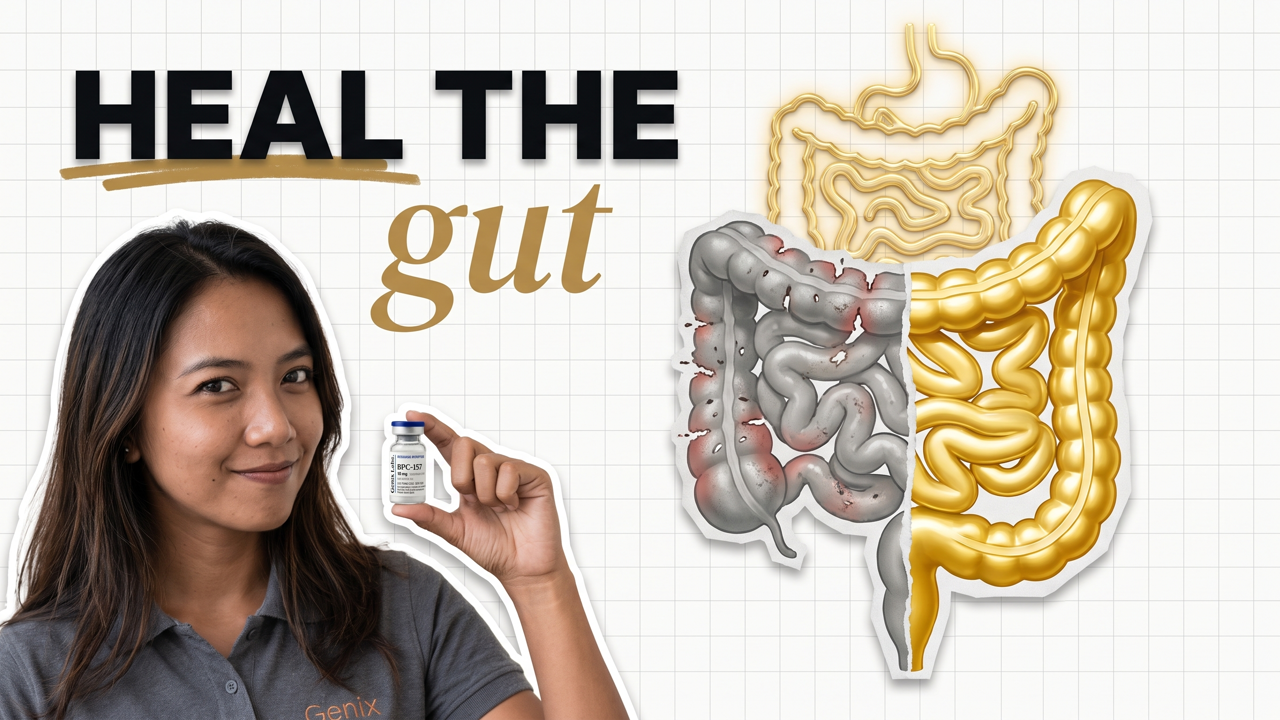
Your gut does more than digest food. It houses most of your immune system, talks to your brain, and its lining has to seal tight while letting nutrients through. When that lining gets irritated or leaky, everything downstream feels it. Peptides have become one of the most talked-about tools for gut repair, led by BPC-157. This guide sorts the real research from the hype: which peptides are studied for the gut, how they work, what to expect, and where the honest limits are. It is a research overview, not medical advice.
The quick answer
For the gut, the peptide with the most research behind it is BPC-157, a stable peptide first found in a sequence of human gastric juice. It is studied for repairing the stomach and intestinal lining, calming irritation, and supporting blood flow to the gut. KPV is studied for gut inflammation, and larazotide has been trialed for a leaky barrier. None of them is a proven cure, and every one here is sold for research use only.
What are peptides for gut health?
Peptides are short chains of amino acids, the same building blocks that make up proteins. Because they are small, they can carry signals to cells. In gut research, a handful of peptides are studied for one job: telling the gut lining to repair itself, seal its barrier, and calm down when it is inflamed. That is a very different thing from a probiotic or a fiber supplement, which feed the microbes living in your gut rather than rebuilding the wall those microbes sit on.
The word “peptide” covers a wide range here. Some, like BPC-157 and KPV, are research peptides studied on their own at high purity. Others are gut hormones your body already makes, and a few are bioactive peptides released when you digest food. This guide focuses on the research peptides people actually reach for, with an honest look at the hormones and food peptides too.
- Peptides send repair and calming signals to the gut lining.
- BPC-157 is the research peptide with the strongest gut story.
- KPV is studied for gut inflammation; larazotide for a leaky barrier.
- They rebuild the wall; probiotics feed the microbes on it. Different jobs.
Can peptides improve gut health?
Research suggests some peptides, mainly BPC-157, can support a healthier gut lining by helping it repair and by calming inflammation. The effect in the lab and animal studies is clear and often striking. Human data is thinner and earlier, so real-world results are gentler and build over weeks. Peptides are a support for gut repair, not an instant fix, and this is research use only.
The honest picture is promising but unfinished. The strongest evidence comes from animal models of ulcers, colitis, and injured intestine, where peptides like BPC-157 speed healing in ways that look remarkable. What is missing is large, long human trials confirming the same effect at the same strength. So the fair statement is this: peptides are studied for gut health with encouraging results, and they are not a proven medical treatment for any gut disease.
How do peptides help the gut heal?
The leading idea has three parts. First, peptides are studied for sealing the gut barrier, tightening the junctions between cells so the wall is less “leaky.” Second, they are studied for calming inflammation, so an irritated gut settles. Third, they support blood flow and tissue repair, which is how a damaged lining actually rebuilds. Together, that points to a stronger, quieter gut over time.
BPC-157 is the clearest example. Researchers describe it as a cytoprotective agent, meaning it helps protect and rebuild tissue. A big part of its story is angiogenesis, the growth of new small blood vessels, which brings oxygen and nutrients to a healing wound. That vascular effect is why it is studied for everything from stomach ulcers to injured intestine, and why the gut is its home turf.
Which peptides are best for gut healing?
The best-studied peptide for gut healing is BPC-157. For gut inflammation specifically, KPV comes up most. For a leaky barrier, larazotide is the peptide that reached human trials. TB-500 plays a wider, less gut-specific repair role. Here is how they stack up, and why BPC-157 sits at the top.
| Peptide | Studied mainly for | Strength of gut evidence |
|---|---|---|
| BPC-157 | Repairing the stomach and intestinal lining | Deepest research base for the gut |
| KPV | Calming gut inflammation | Solid animal colitis models |
| Larazotide | Sealing a leaky gut barrier | Reached late human trials |
| TB-500 | Systemic tissue repair | Broad, not gut-specific |
Notice what is not the same as “best.” The right peptide depends on the goal. For all-round gut repair, BPC-157 leads. For an inflamed, angry gut, KPV is the one to read up on. Many research setups combine BPC-157 with TB-500 for wider reach, which is why the two are so often stocked as a pair.
Is BPC-157 good for your gut?
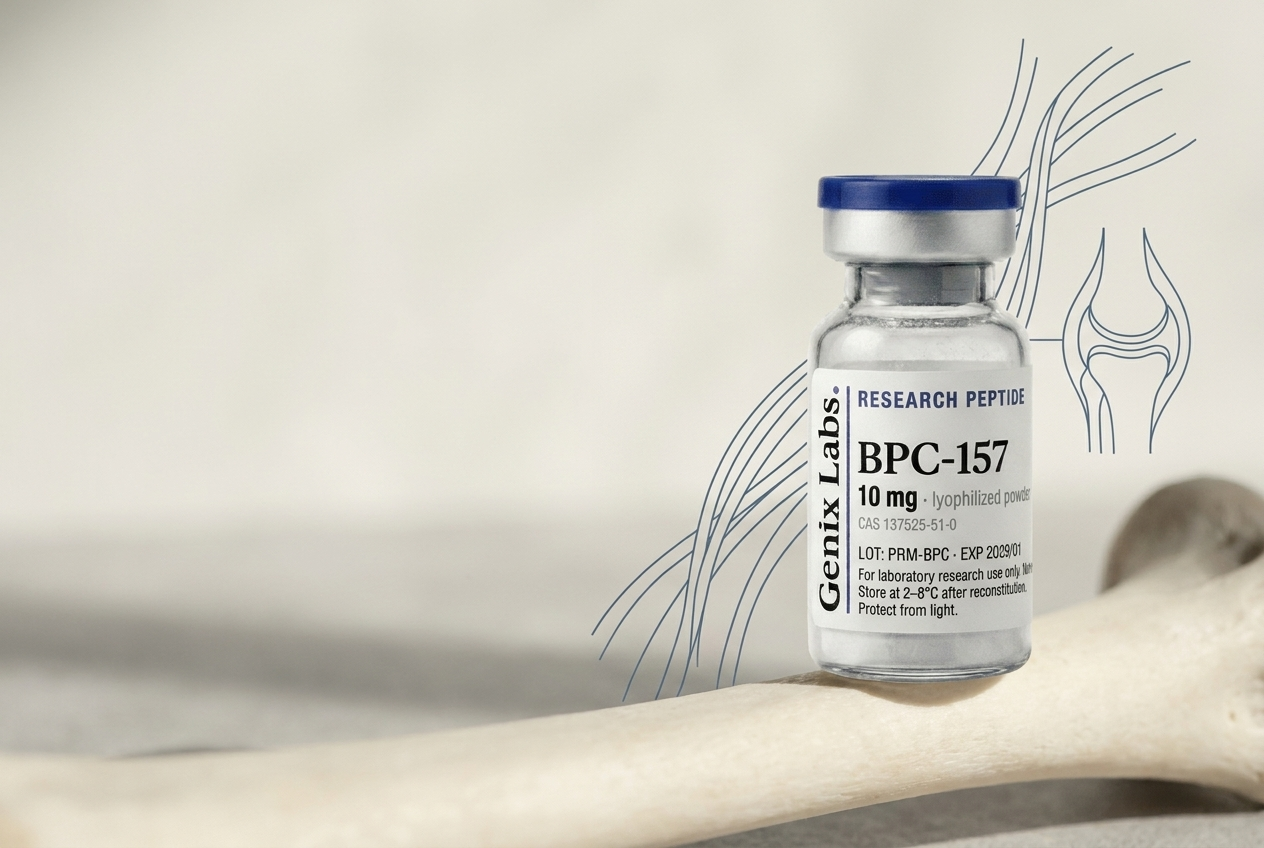
Yes, BPC-157 is the peptide most studied for the gut. It is a stable peptide first identified in a protein found in human gastric juice, and it survives stomach acid better than most peptides. In animal research it speeds the healing of ulcers and injured intestine, protects the gut lining, and supports blood flow. That is why, of every peptide here, it has the strongest gut story.
BPC-157 was first studied by a research group at the University of Zagreb, led by Predrag Sikiric, starting in the 1990s. Over thirty years, dozens of animal studies have looked at its effect on the stomach, intestine, and even damage from anti-inflammatory drugs. The catch is the same one that runs through this whole field: the human trials are small and few, so the dramatic animal results are not yet confirmed at the same scale in people.
KPV: the peptide for gut inflammation
KPV is a tiny tripeptide, just three amino acids (lysine, proline, valine), and it is the tail end of a natural hormone called alpha-MSH. It is studied for one thing above all: calming inflammation. In the gut, that makes it interesting for an irritated, inflamed lining, the kind seen in colitis models.
A key 2008 study in Gastroenterology showed KPV is carried into gut cells by a transporter called PepT1, which is switched on more strongly during gut inflammation. Once inside, KPV reduced the inflammatory signals in two mouse models of colitis. In plain terms: the more inflamed the gut, the more KPV it may take up, which is an elegant fit. It shows up in our KPV peptide guide and is one of the four peptides blended into the KLOW stack.
Where does TB-500 fit for the gut?
TB-500 is a fragment linked to thymosin beta-4, a natural repair peptide that helps cells move and rebuild tissue. It is a systemic healer, studied for muscle, tendon, and general recovery more than the gut specifically. Its role in gut health is supporting: it is often paired with BPC-157 so that repair reaches tissue throughout the body, not just the gut lining.
That pairing is the reason the two are stocked together. BPC-157 is the gut and connective-tissue specialist; TB-500 widens the repair signal across the body. For the full picture on the second peptide, our TB-500 guide covers what it is studied for and how it differs from BPC-157.
Larazotide and the leaky gut question
Larazotide acetate is worth knowing because it is the peptide that took the “leaky gut” idea furthest into real medicine. It is an eight-amino-acid peptide that acts as a zonulin antagonist, which is a technical way of saying it helps tighten the junctions between gut cells to reduce a leaky barrier. It was developed as a drug for celiac disease.
Here is the honest part the sales pages skip: larazotide reached a large phase 3 trial for celiac disease and did not meet its main goal, and the program was discontinued in 2022. That does not erase the science of tight-junction repair, but it is a fair reminder that a promising mechanism in the lab does not always win in humans. We do not sell larazotide; we include it so the picture is complete, not cherry-picked.
What about gut hormone peptides?
Your gut makes its own peptide hormones, and a couple have become real medicines. GLP-2 is a gut hormone that grows the intestinal lining; a version of it (teduglutide) is an approved drug for short bowel syndrome, a serious condition where the intestine cannot absorb enough. Its cousin GLP-1 is the family behind the well-known weight and blood-sugar peptides.
These hormone peptides are prescription medicines for specific diagnoses, not research supplements for a general “healthier gut.” They matter here because they prove the principle: the right peptide signal really can reshape the gut lining. That is the same principle research peptides like BPC-157 are studied on, at a gentler, non-prescription scale.
Peptides, food, and the microbiome
Not every gut peptide comes in a vial. When you digest protein from milk, eggs, soy, or fish, your body releases short bioactive peptides. Research suggests some of these can influence the gut microbiome, the trillions of microbes in your gut, either by feeding helpful bacteria or by acting against harmful ones. This is a young, active field.
It is worth separating two ideas that often get blurred. Research peptides like BPC-157 mainly work on the gut wall, your own tissue. Food-derived bioactive peptides mainly work on the microbes living inside that wall. A truly healthy gut needs both a strong lining and a balanced microbiome, which is why peptides and everyday gut basics (fiber, fermented foods, sleep) are not rivals.
Peptides for leaky gut and IBS
“Leaky gut” describes a barrier that has become too permeable, letting through things it should keep out. It is why BPC-157 and larazotide draw so much interest: both are studied for sealing that barrier, one by repairing tissue and one by tightening junctions. For irritable bowel syndrome (IBS), the research is more indirect, focused on calming inflammation and supporting the lining rather than treating IBS itself.
The important caveat: leaky gut is still a debated concept in mainstream medicine, and IBS has many drivers. Peptides are studied for the barrier and the inflammation, not for diagnosing why a particular gut is struggling. If symptoms are ongoing, that is a conversation for a doctor, not a vial. This section is education, not medical advice.
Peptides for gut health and weight loss
The gut and weight are linked, so people search for peptides that do both. The honest split is this: gut-repair peptides like BPC-157 are not weight-loss tools, and weight-loss peptides like the GLP-1 family are not gut-repair tools, even though both act in and around the gut. Better gut health can support metabolism indirectly, but do not expect a repair peptide to move the scale.
If weight is the actual goal, the research points to a different family entirely. Our peptides for weight loss guide covers the GLP-1 and dual-agonist peptides studied for that job. Using a gut-repair peptide and hoping for weight loss is one of the more common mix-ups in this space.
Oral or injectable peptides for the gut?
Peptides for the gut come as oral capsules and as injectable solutions, and the gut is the one place where the oral question gets genuinely interesting. Most peptides are destroyed by stomach acid, but BPC-157 is unusually stable in gastric juice, which is exactly why some research uses the oral route to reach the gut lining directly. Injectable delivery aims for systemic reach across the body.
| Form | How it is used | Notes for the gut |
|---|---|---|
| Oral capsule | Swallowed | Targets the gut lining directly; BPC-157 is unusually stable |
| Injectable (subcutaneous) | Reconstituted and injected | Aims for wider, systemic repair |
| Blended vial | One mix, several peptides | How KLOW packs gut, skin, and joint support together |
Whatever the form, storage and mixing decide whether a peptide works as the research describes. A degraded peptide will not do the job. Our guides on reconstituting peptides and storing them in a hot climate cover how to keep a vial stable.
What is the downside of taking peptides?
The biggest downside is unfinished evidence. Most gut-peptide research is animal work, so long-term human safety data is limited. On top of that come practical risks: research peptides are not approved medicines, quality varies wildly between sellers, and injectable use carries the usual risks of any injection. That is a real list, not a scare, and it is why sourcing matters so much.
- Human evidence is thinner than the animal results suggest.
- These are research compounds, not approved medicines.
- Purity and dosing vary hugely without a certificate of analysis.
- Injections carry soreness, redness, or infection risk if done carelessly.
- Results are gradual, which tests patience more than anything.
None of that means peptides are useless; it means they deserve the same caution as any research tool. The single best way to shrink the risk is to buy only lab-tested product with a batch certificate of analysis, so at least you know what is really in the vial.
Signs of an unhealthy gut
Before reaching for any peptide, it helps to know what a struggling gut looks like. These are general signs people notice, not a diagnosis, and several have causes far outside the gut.
- Ongoing bloating, gas, or stomach discomfort after meals.
- Irregular digestion that swings between constipation and looseness.
- Food sensitivities that seem to be growing over time.
- Low energy or brain fog that tracks with digestive flare-ups.
- Skin issues, since gut and skin health are often linked.
Any of these that is persistent or severe is a reason to see a doctor, not to self-treat with a research peptide. Peptides are studied for supporting a healing gut; they are not a way to skip a proper diagnosis.
Results: what to expect and when
Gut-peptide research plays out over weeks, not days. Early on, the goal is a calmer, less irritated gut. Over a full cycle, the aim is a lining that is better repaired and a barrier that holds tighter. It is a slow, cumulative process, which is exactly why the flashy overnight claims are the ones to distrust.
| Time | What research setups tend to track |
|---|---|
| Weeks 1 to 2 | Early settling; less irritation for some |
| Weeks 2 to 4 | Digestion feels steadier day to day |
| Weeks 4 to 8 | The lining has more time to repair and seal |
| Beyond 8 weeks | Gains hold with steady use, not a sudden jump |
Common mistakes people make
Most disappointment with gut peptides comes down to a few avoidable errors. Getting these right is often the difference between “nothing happened” and a real, if gradual, result.
- Skipping the basics. No peptide replaces fiber, fermented foods, sleep, and less alcohol.
- Expecting a cure. Peptides support repair; they do not fix a diagnosed gut disease.
- Quitting at week 2. The lining rebuilds over a full cycle, not in the first fortnight.
- Using a gut-repair peptide and hoping for weight loss, which is the wrong family.
- Buying an untested vial. Without a certificate of analysis, you do not know what is inside.
Why purity and a COA matter most
A peptide is only as good as the vial it comes in. An under-dosed or contaminated product will not do what the research describes, no matter the claims on the label, and for something you may inject, that is a safety issue, not just a value one. That is why a certificate of analysis matters most. It shows the batch was tested for purity by HPLC and identity by LC-MS, with a real lot number you can match to your vial.
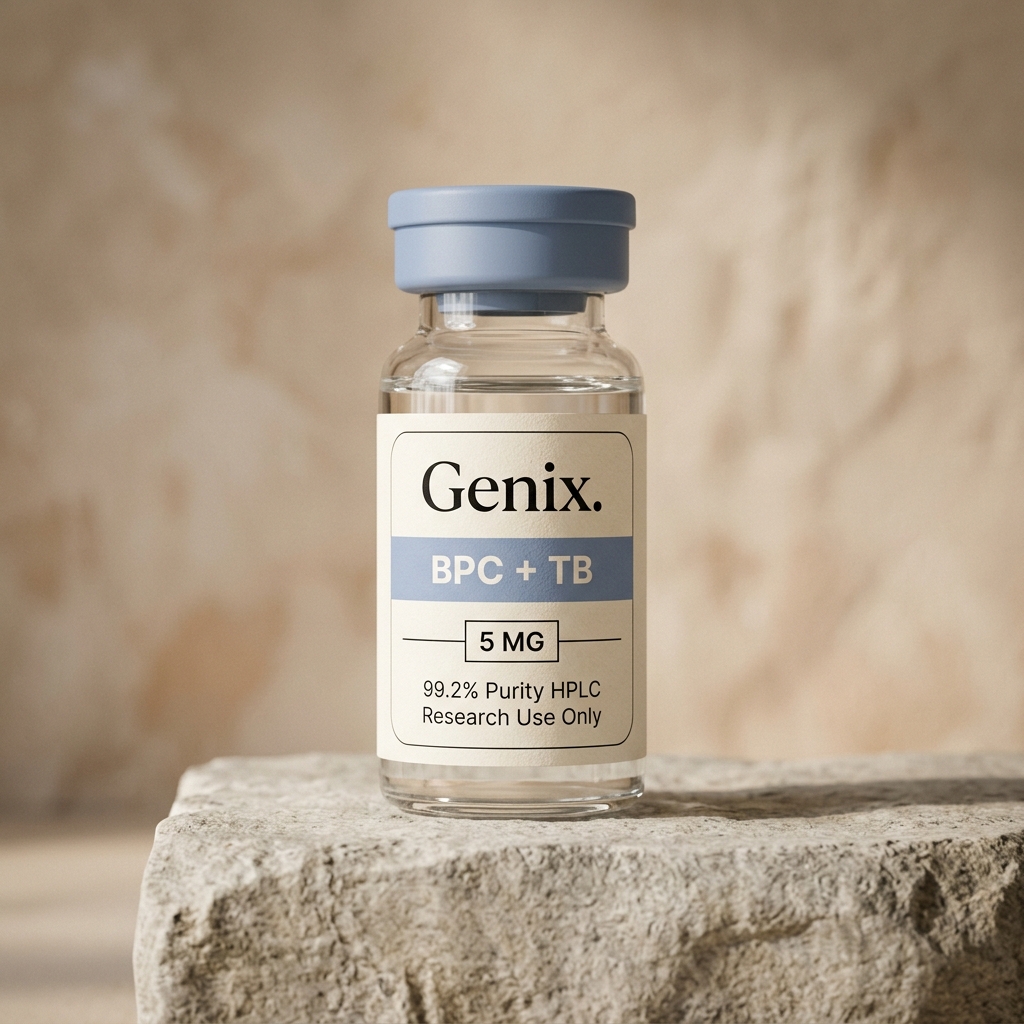
Purity of at least 99% by HPLC, LC-MS identity, and a batch COA in every order. Cold-chain shipping and same-day delivery in Bali. From $89 (Rp 1.450.000). Research use only.
Shop lab-tested BPC-157 + TB-500For the wider picture on repair peptides, the Recovery & Repair hub connects BPC-157 to the rest of the family, and the BPC-157 dosing guide covers how research setups handle it.
Frequently asked questions
Which peptides are best for gut healing?
BPC-157 is the most-studied peptide for gut healing, researched for repairing the stomach and intestinal lining. KPV is studied for calming gut inflammation, and larazotide reached human trials for a leaky barrier. TB-500 adds wider, systemic repair. BPC-157 sits at the top for all-round gut support. Research use only.
What's the downside of taking peptides?
The main downside is unfinished evidence. Most gut-peptide data is animal work, so long-term human safety is limited. They are research compounds, not approved medicines, quality varies between sellers, and injections carry the usual risks. Buying only lab-tested product with a certificate of analysis shrinks the risk. Research use only.
Is BPC-157 good for your gut?
BPC-157 is the peptide most studied for the gut. It is a stable peptide first found in a sequence of human gastric juice, and it survives stomach acid unusually well. In animal research it speeds healing of ulcers and injured intestine and supports blood flow to the lining. Human trials are still small. Research use only.
Can peptides improve gut health?
Research suggests some peptides, mainly BPC-157, can support a healthier gut lining by helping it repair and by calming inflammation. The animal evidence is clear; human data is thinner, so real-world results are gentle and build over weeks. Peptides support gut repair, they are not a proven cure. Research use only.
Can peptides help gut inflammation?
KPV is the peptide most studied for gut inflammation. It is a small tripeptide carried into gut cells by a transporter called PepT1, which is more active when the gut is inflamed. In colitis models it reduced inflammatory signals. BPC-157 is also studied for calming an irritated lining. Research use only.
Where can you buy peptides for gut health?
Buy only from a source that publishes a batch certificate of analysis showing purity by HPLC and identity by LC-MS with a real lot number. Genix Labs stocks BPC-157 with TB-500 at 99% or higher purity, cold-chain shipped, with same-day delivery in Bali. Research use only.
Takeaway
Peptides for gut health are real research tools, not magic. BPC-157 leads the field, studied for repairing the gut lining, calming irritation, and supporting blood flow, thanks to its rare stability in gastric juice. KPV is the one for gut inflammation, larazotide reached and failed a big leaky-gut trial, and TB-500 widens the repair signal. None of them replaces the basics or a proper diagnosis, and human evidence is still catching up to the striking animal data. Judge any product on its testing, not its promises. Every peptide here is for research use only, and this guide is education, not medical advice.