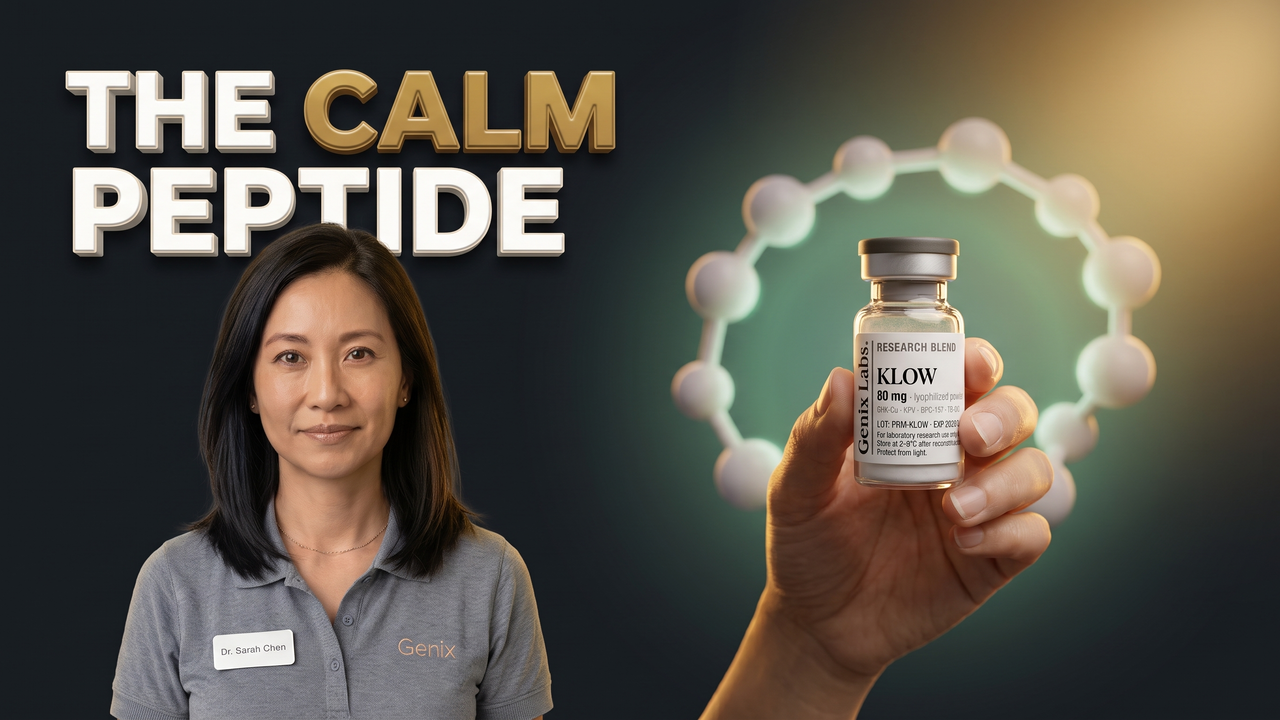
People search "KLOW peptide dosing" because the vial arrives as a plain powder with four peptides packed inside and no chart on the label. This guide explains what is in the 80 mg blend, how to reconstitute it, the concentration math, how the amounts are calculated, and how long a vial lasts. It is a research overview, not medical advice or a protocol for human use.
The quick answer
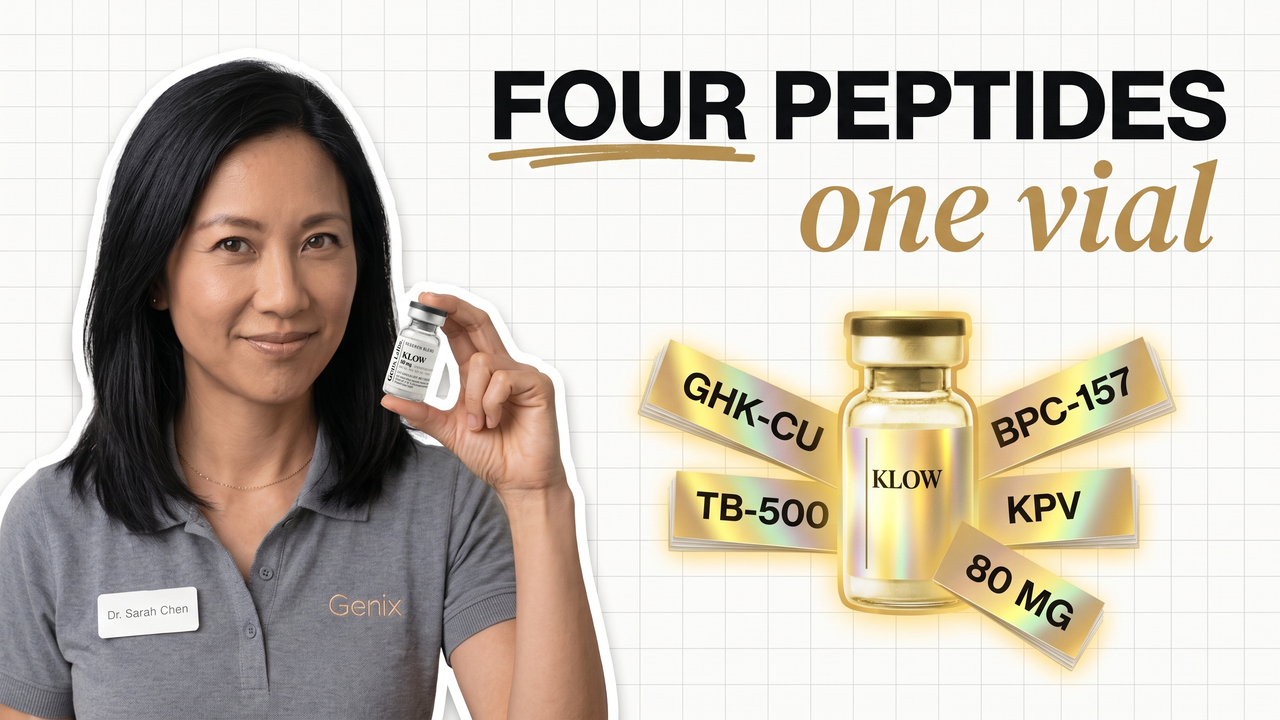
KLOW is a four-peptide blend in one vial. A standard vial holds 80 mg of total peptide: 50 mg GHK-Cu, 10 mg BPC-157, 10 mg TB-500, and 10 mg KPV. Because it is a blend, you reconstitute the whole vial once, and every measured amount carries all four peptides at their built-in ratio. Dosing KLOW is really two simple steps: set your concentration with water, then measure the volume you want.
KLOW sits inside our Recovery & Repair guides. If you want the product view, purity data, and price, see the lab-tested KLOW blend.
What is KLOW and why does dosing get confusing?
KLOW is a premium repair blend that puts four peptides in a single vial. GHK-Cu is the skin and collagen peptide. BPC-157 and TB-500 are the tissue-repair pair, studied for tendons, muscle, and the gut lining. KPV is studied for calming inflammation. Bundled together, they cover skin, gut, joints, and recovery in one protocol.
Dosing gets confusing for one reason: people try to dose each peptide separately, the way they would if they bought four vials. With a blend, you do not. The blend already fixes the ratio between the four peptides. You never measure GHK-Cu apart from KPV. You measure the mixed liquid, and all four ride along together in the same drop.
- You reconstitute the whole 80 mg vial one time.
- The four peptides are already mixed at a fixed ratio.
- You measure volume, not four separate peptide amounts.
- Every measured drop carries all four peptides at once.
What is inside the 80 mg vial?
Before any math, it helps to see how the 80 mg splits. The standard KLOW blend is weighted toward GHK-Cu, which makes up more than half of the vial, with equal 10 mg shares of the other three. This is why KLOW feels skin-forward while still carrying real repair and anti-inflammatory support.
| Peptide | Amount in vial | What it is studied for |
|---|---|---|
| GHK-Cu | 50 mg | Skin, collagen, hair follicle support |
| BPC-157 | 10 mg | Tendon, muscle, and gut-lining repair |
| TB-500 | 10 mg | Muscle, tendon, and tissue recovery |
| KPV | 10 mg | Calming inflammation, gut signaling |
If you want the deeper story on any single peptide in the blend, we cover the pieces on their own pages: copper peptides (GHK-Cu), BPC-157 dosing, TB-500, and the KPV peptide. Reading them makes the blend make sense.
Why does a blend change the dosing math?
Buying GHK-Cu, BPC-157, TB-500, and KPV on their own means four vials, four reconstitutions, and four amounts to track. A blend pre-measures all four into one vial, so you mix once and run a single, consistent protocol. That is the whole appeal: less guesswork and less handling.
The trade-off is that the ratio is fixed. You cannot dial GHK-Cu up without also raising the other three, because they share the same liquid. For most people using a repair blend, the fixed ratio is the point. It is a balanced, ready-made stack rather than a build-your-own kit. If you need a custom ratio, single vials are the tool. If you want one clean protocol, the blend is.
How do you reconstitute KLOW with BAC water?
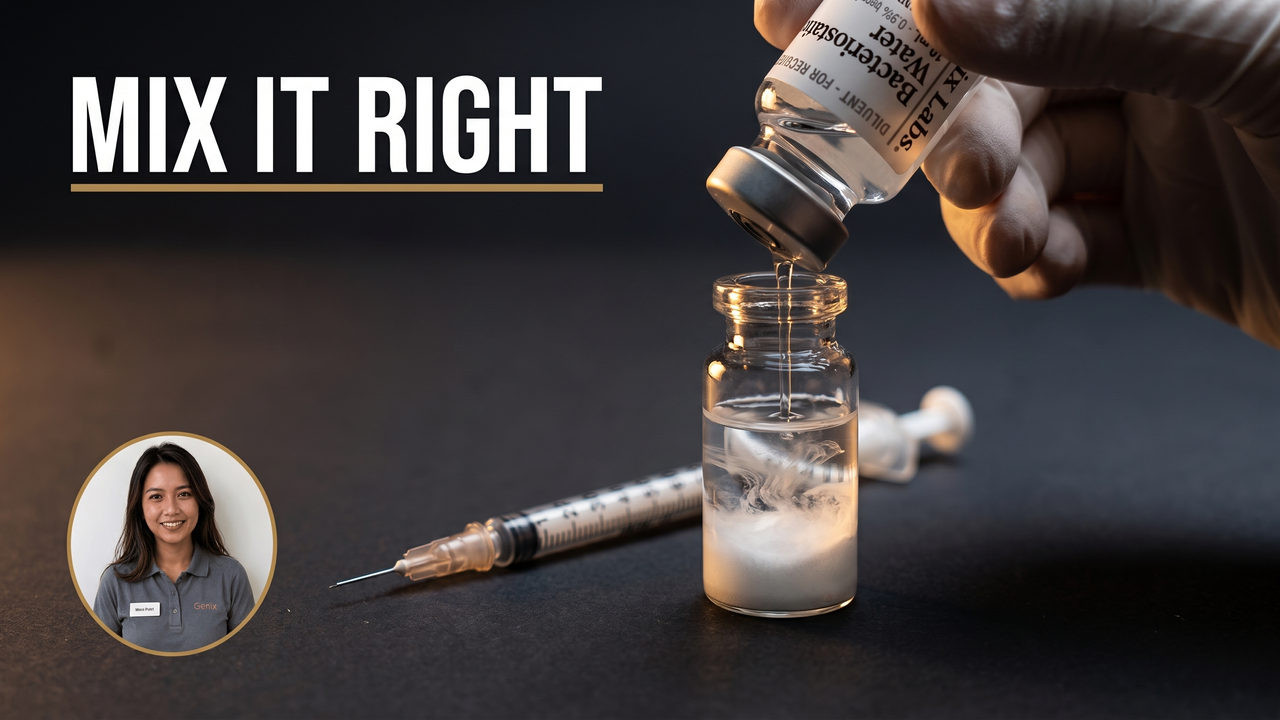
KLOW ships as a dry, freeze-dried cake. In a lab, it is mixed with bacteriostatic water, or BAC water, before any study. This step is called reconstitution. The key idea is simple: the water you add sets the concentration, but it never changes how much peptide is in the vial. An 80 mg vial always holds 80 mg.
- Wipe the KLOW vial stopper and the BAC water vial with an alcohol swab.
- Draw your chosen volume of BAC water into a clean syringe.
- Pour the water slowly down the inside wall of the vial, not onto the powder.
- Swirl gently to dissolve. Do not shake, which can damage peptides.
- Let it settle until the liquid is clear, then store it cold.
Pour the water slowly and let it work. Peptides are delicate, so gentle swirling beats hard shaking every time. For the full clean method, see How to Reconstitute Peptides, and for the numbers walk-through, see How to Calculate Peptide Dosage.
How much water should you add to KLOW?
There is no single correct amount of water. The water only sets the concentration. More water makes a weaker, easier-to-measure liquid. Less water makes a stronger, more concentrated one. The 80 mg of peptide stays the same either way. Here is how common volumes play out for an 80 mg vial.
| 80 mg vial | BAC water added | Total blend concentration |
|---|---|---|
| 80 mg | 2 mL | 40 mg per mL |
| 80 mg | 3 mL | ~26.7 mg per mL |
| 80 mg | 4 mL | 20 mg per mL |
A common lab choice is 3 mL of BAC water, which spreads the 80 mg into roughly 26.7 mg per mL of total blend. That volume is easy to measure and makes the vial last a predictable number of study days. Whatever you pick, write it on the vial so you never have to guess later.
How is peptide dosing calculated?
This is the People Also Ask question, and the answer is one formula. To find the volume for a target amount, divide the amount you want by the concentration you mixed. Volume equals amount divided by concentration. That single line covers every peptide, blend or single.
Say you mixed the 80 mg vial with 3 mL of water, giving about 26.7 mg per mL of total blend. If a research protocol calls for a 2 mg total-blend amount, you divide 2 by 26.7, which is about 0.075 mL. That tiny volume carries all four peptides in their fixed ratio. The math never changes, only the numbers you plug in.
| Mixed at ~26.7 mg/mL | Total-blend amount | Volume to draw |
|---|---|---|
| Small research amount | 1 mg | ~0.037 mL |
| Mid research amount | 2 mg | ~0.075 mL |
| Larger research amount | 4 mg | ~0.15 mL |
How do you read KLOW dosing in units and mL?
People get tangled up by "units" because lab syringes are marked in units, not mL. The rule is simple: on a standard insulin syringe, 100 units equals 1 mL. Units are just a fine ruler for measuring a small volume of liquid. They are not a separate amount of peptide.
To turn a volume into units, multiply the mL by 100. Using the 26.7 mg per mL mix, a 2 mg total-blend amount is about 0.075 mL, which is roughly 7 to 8 units on the syringe. A 4 mg amount is about 0.15 mL, or roughly 15 units. Reading units keeps small volumes easy to see.
| At ~26.7 mg/mL | Volume | Units on syringe |
|---|---|---|
| 1 mg total blend | ~0.037 mL | ~4 units |
| 2 mg total blend | ~0.075 mL | ~7-8 units |
| 4 mg total blend | ~0.15 mL | ~15 units |
How do researchers structure a KLOW titration?
Titration means starting low and easing up. With a repair blend, a gradual approach is common in research settings for one reason: it lets you watch how the sample and the subject respond before moving to a fuller amount. There is no official KLOW protocol, so this is reported practice, not a prescription.
| Phase | Rough total-blend amount | Idea |
|---|---|---|
| Opening days | Lower end | Observe tolerance and response |
| Build phase | Step toward the middle | Hold steady, watch the trend |
| Maintenance | Steady amount | Keep it consistent through the cycle |
Notice that the four peptides all move together during titration, because the ratio is fixed. You are only turning one dial: the total volume. That is the quiet advantage of a blend. One number to raise or lower, not four. This is research framing, not a protocol for human use.
Where is KLOW injected in research settings?
In research use, blends like KLOW are typically given subcutaneously, which means into the fat layer just under the skin rather than into muscle. Common study sites are the soft areas of the abdomen, away from the navel, and the outer thigh. Sites are usually rotated so the same spot is not used over and over.
This is reported research technique, shared so you understand how the studies were run. It is not an instruction to inject anything into a person. KLOW is for research use only, and any question about human use belongs with a licensed medical professional.
- Subcutaneous placement, into the fat layer under the skin.
- Soft abdominal areas away from the navel, or the outer thigh.
- Sites rotated to avoid using one spot repeatedly.
- Clean technique with a fresh, swabbed site each time.
How often is KLOW dosed?
Repair peptides like BPC-157 and TB-500 are commonly dosed daily or several times a week in research settings, because tissue repair is a steady, ongoing process rather than a one-time event. Since KLOW carries those peptides, blend protocols usually follow a similar daily-ish rhythm during the active phase.
The exact frequency in any study depends on the goal and the concentration mixed. What stays constant is the idea: a repair blend is used consistently over weeks, not taken once and forgotten. Consistency is what most research designs are built around. This is reported practice, not a schedule for you to follow.
How long is a KLOW cycle?
Repair-peptide research programs commonly run in blocks of several weeks, often in the range of four to eight weeks, followed by a break. The logic is that tissue repair builds over time, then the protocol pauses so the effect can settle. There is no single official KLOW cycle length.
- Active blocks often run roughly four to eight weeks.
- A rest period usually follows the active block.
- Skin and recovery effects tend to build across the block.
- This is reported research framing, not a protocol for human use.
Because KLOW is skin-forward through its large GHK-Cu share, some of what people watch for, like skin tone and texture, tends to build gradually across a cycle. Compare KLOW with the wider recovery toolkit in Peptides for Recovery & Repair.
How long does an 80 mg KLOW vial last?
This comes down to division. Take the vial size, 80 mg, and divide by the total-blend amount used per study day. The smaller the daily amount, the more days one vial covers. Here is the rough math at a few common research amounts.
| 80 mg vial | Per study day | Roughly lasts |
|---|---|---|
| 80 mg | 2 mg total blend | ~40 study days |
| 80 mg | 3 mg total blend | ~26 study days |
| 80 mg | 4 mg total blend | ~20 study days |
One more thing sets the real shelf life. Once mixed, a reconstituted vial should stay cold and be used within a few weeks. So a vial lasts as long as the math says, but only if it is kept cold and clean the whole time. See How to Store Peptides in Bali for the full storage guide.
How long does KLOW take to work?
In research settings, change with a repair blend is gradual, not overnight. People tend to describe subtle shifts first, like calmer skin or better recovery, with fuller effects building over roughly eight to twelve weeks. The large GHK-Cu share means skin and appearance are often the first thing people watch.
The honest version is that timelines vary a lot. A blend supports several tissues at once, so what someone notices first depends on what they are watching. This is reported research experience, not a promise for any one person, and KLOW is for research use only.
How should you store reconstituted KLOW?
Before mixing, the dry KLOW powder is stable and can sit in a cool, dark place. Once you add BAC water, the clock starts. A reconstituted vial belongs in the refrigerator, not the freezer, and should be used within a few weeks. Cold and dark keeps the peptides intact.
- Dry powder: cool, dark, and dry until you mix it.
- Mixed vial: refrigerated, roughly 2 to 8 degrees Celsius.
- Do not freeze a reconstituted vial, and keep it out of sunlight.
- Use a mixed vial within a few weeks, and keep the stopper clean.
Bali heat is the enemy here. If your vial spends hours warm in transit, its numbers stop meaning much. That is why cold-chain shipping is not a luxury for peptides, it is the whole game. Our Bali storage guide covers the heat problem in detail.
What side effects should you know about?
In research reports, the peptides in KLOW are generally described as well tolerated. The most common notes are mild and at the injection site, like brief redness, itching, or a small bump. Because GHK-Cu carries copper, blends with a large GHK-Cu share are sometimes watched for the signs of too much copper over long, heavy use.
- Most notes are mild and at the injection site.
- Some report brief tiredness or a flush early on.
- Very heavy, long GHK-Cu use is watched for copper build-up.
- This is trial-adjacent reporting, not a prediction for any one person.
Anyone weighing human use of any peptide should speak with a doctor first. Nothing here is medical advice. We report what the research literature describes so the numbers have context.
KLOW versus GLOW: what is the difference?
This trips people up constantly, and the answer is short. GLOW is a three-peptide blend: GHK-Cu, BPC-157, and TB-500. KLOW is GLOW plus one more peptide, KPV. That extra KPV is why the K sits at the front of the name, and it is what adds the anti-inflammatory and gut-signaling angle.
| GLOW | KLOW | |
|---|---|---|
| Peptides | GHK-Cu, BPC-157, TB-500 | GHK-Cu, BPC-157, TB-500, KPV |
| Extra piece | None | Adds KPV |
| Lean | Skin and repair | Skin, repair, plus inflammation |
| Vial in this range | ~70 mg total | 80 mg total |
In one line: if you want the skin-and-repair core, GLOW covers it. If you also want the inflammation and gut angle that KPV brings, KLOW is the fuller blend. The dosing math is identical, because both are reconstituted and measured the exact same way.
What are the most common KLOW dosing mistakes?
Most dosing errors are not exotic. They are small, avoidable slips that throw off every number after them. Here are the ones that show up again and again with blends, and how to sidestep each.
- Dosing each peptide separately. It is a blend. Measure the mixed liquid, not four amounts.
- Forgetting the concentration. Always work out mg per mL before you draw anything.
- Shaking the vial. Swirl gently. Shaking can damage the peptides.
- Not labeling the vial. Write the water volume and date so you never guess later.
- Leaving a mixed vial warm. Cold-chain and refrigeration keep the numbers honest.
The single biggest one is treating a blend like four separate peptides. Once you accept that you are only measuring volume, everything else gets simple. One mix, one number, all four peptides along for the ride.
How do you spot a bad or fake KLOW vial?
No dosing math helps if the vial is wrong. Under-dosed, mislabeled, or dirty product is common in this market, and a blend is even harder to eyeball because four peptides are involved. The best defense is a certificate of analysis, plus a few quick checks when your order arrives.
- No certificate of analysis, or a lot number that does not match the vial. Walk away.
- The powder looks off: yellowed, oily, or a wet clump instead of a dry cake.
- The vial arrived warm when it should have shipped cold.
- The seal or crimp is loose, broken, or looks tampered with.
A blend is only as good as the weakest peptide in it. If one of the four is under-dosed or degraded, your ratio is quietly broken and no chart can fix it. That is why third-party testing matters more for a blend than for a single peptide.
Why does purity matter more than any dose?
A perfect number means nothing if the vial is wrong. An under-dosed or dirty blend makes any chart useless and can be unsafe. That is why a certificate of analysis matters more than any dosing table. It shows the batch was tested for purity by HPLC and identity by LC-MS, with a lot number you can match to your vial.
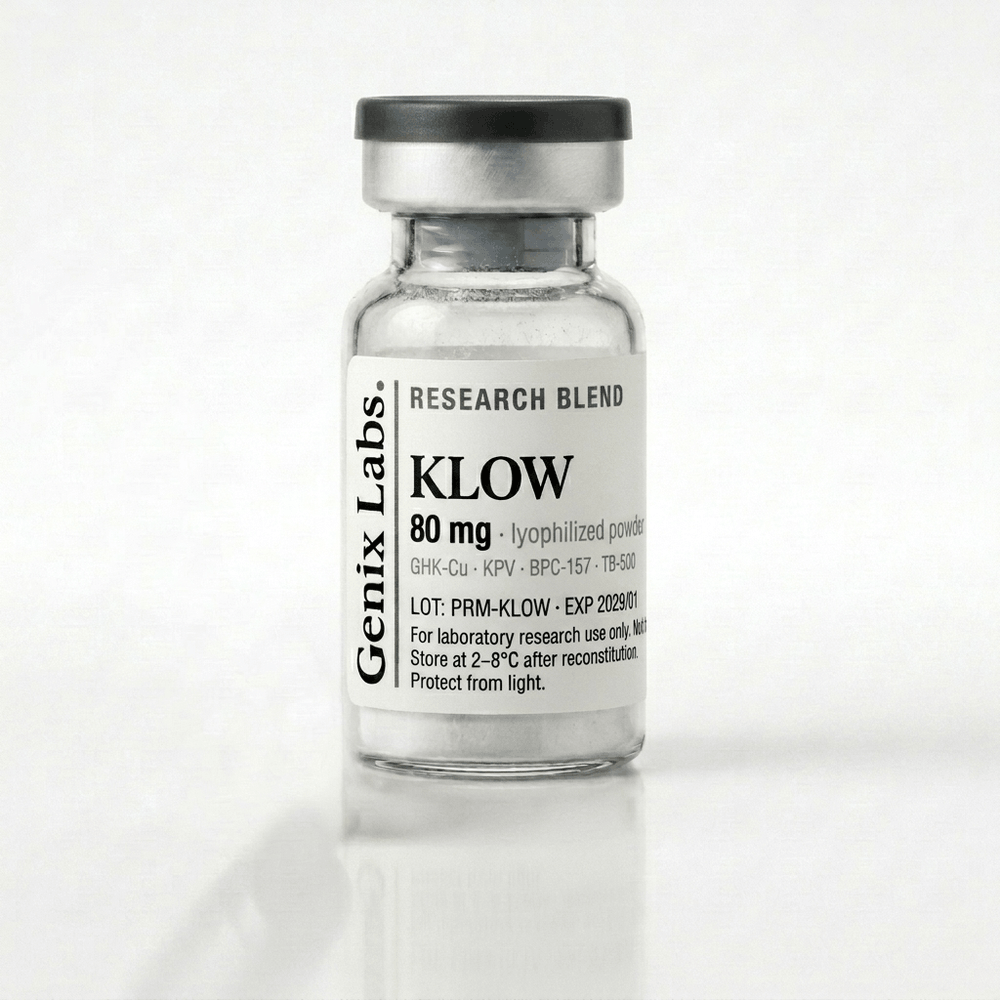
The four-peptide repair blend, 80 mg per vial. Purity of at least 99% by HPLC, LC-MS identity, and a batch COA in every order. Cold-chain shipping and same-day delivery in Bali. From $179 (Rp 2.900.000). Research use only.
Shop the lab-tested KLOW blendKLOW lives in our Recovery & Repair guides, next to the single peptides it is built from. If you are choosing between a blend and singles, reading BPC-157 dosing and the KPV peptide first will make the decision clear.
Frequently asked questions
How do you figure out dosing for peptides?
Use one formula: volume equals amount divided by concentration. First work out mg per mL from how much water you added, then divide your target amount by that number to get the volume to draw. For a blend like KLOW, you measure the mixed liquid once. This is reconstitution math for research use only.
Where do you inject KLOW peptide?
In research settings, blends like KLOW are typically given subcutaneously, into the fat layer just under the skin. Common study sites are the soft abdomen away from the navel, and the outer thigh, with sites rotated. This is reported research technique, not an instruction for human use. Research use only.
How long does KLOW take to work?
In research reports, change is gradual. People often describe subtle skin or recovery shifts first, with fuller effects building over roughly eight to twelve weeks. The large GHK-Cu share means skin is often watched first. Timelines vary a lot, and this is reported experience, not a promise.
How do you mix KLOW peptides with BAC water?
Swab both stoppers, draw your chosen volume of bacteriostatic water, and pour it slowly down the inside wall of the KLOW vial, not onto the powder. Swirl gently, do not shake, and let it turn clear. Adding 3 mL to an 80 mg vial gives about 26.7 mg per mL. Research use only.
What is inside a KLOW vial?
A standard KLOW vial holds 80 mg of total peptide across four peptides: 50 mg GHK-Cu, 10 mg BPC-157, 10 mg TB-500, and 10 mg KPV. The blend is weighted toward GHK-Cu, so it leans skin-forward while still carrying repair and anti-inflammatory support. This is research composition, not a protocol.
What is the difference between KLOW and GLOW?
GLOW is a three-peptide blend: GHK-Cu, BPC-157, and TB-500. KLOW is GLOW plus KPV, which adds an anti-inflammatory and gut-signaling angle. The dosing math is identical because both are reconstituted and measured the same way. KLOW is simply the fuller four-peptide blend. Research use only.
Takeaway
KLOW dosing is simpler than it looks once you see the blend for what it is: 80 mg of total peptide, four peptides mixed at a fixed ratio, reconstituted once and measured as a single liquid. Set your concentration with water, then divide to find your volume. You are only ever turning one dial, the total amount, and all four peptides move with it. Above all, this is a research overview, not medical advice, and KLOW is for research use only.