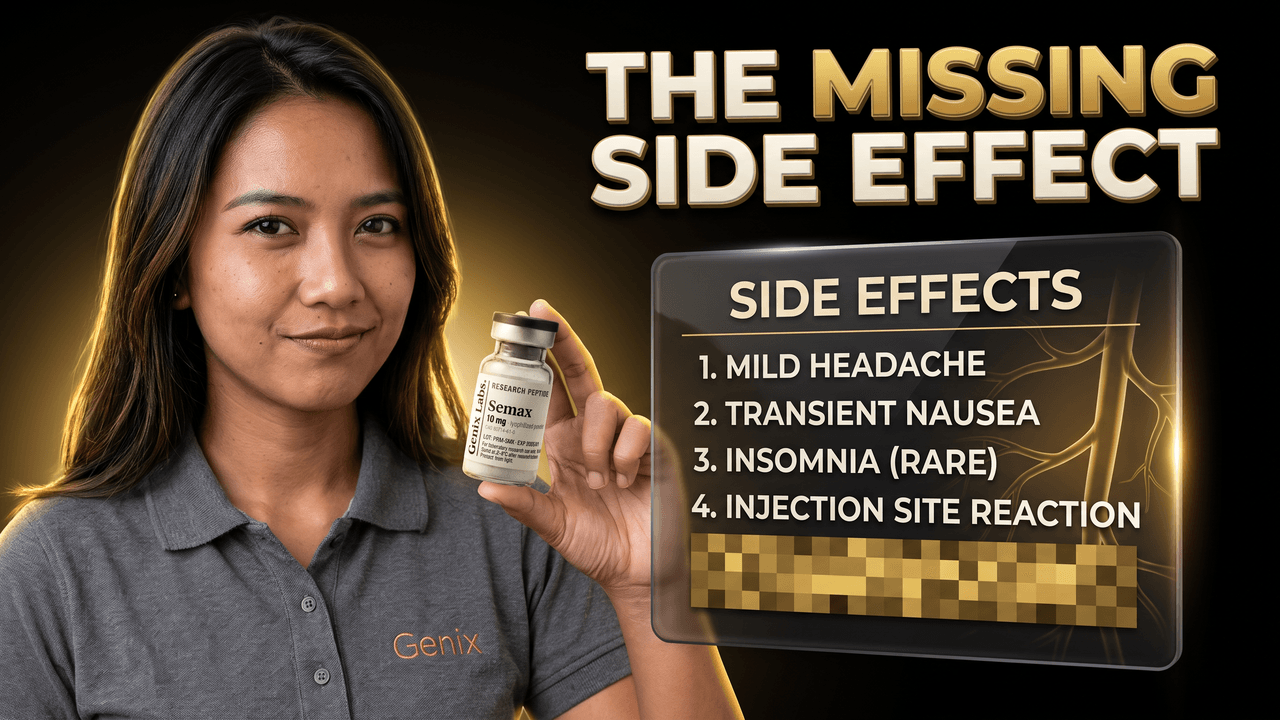
Search semax side effects and you get the same four words on every page. Headache. Tiredness. Irritability. Flushing. They are copied from each other, not from a study. Semax is actually the rare research peptide with a real human file, including a 110 patient trial. That trial still never counted a single harm. And the one effect that reproduces across four separate papers is on almost none of those lists.
What are the side effects of semax?
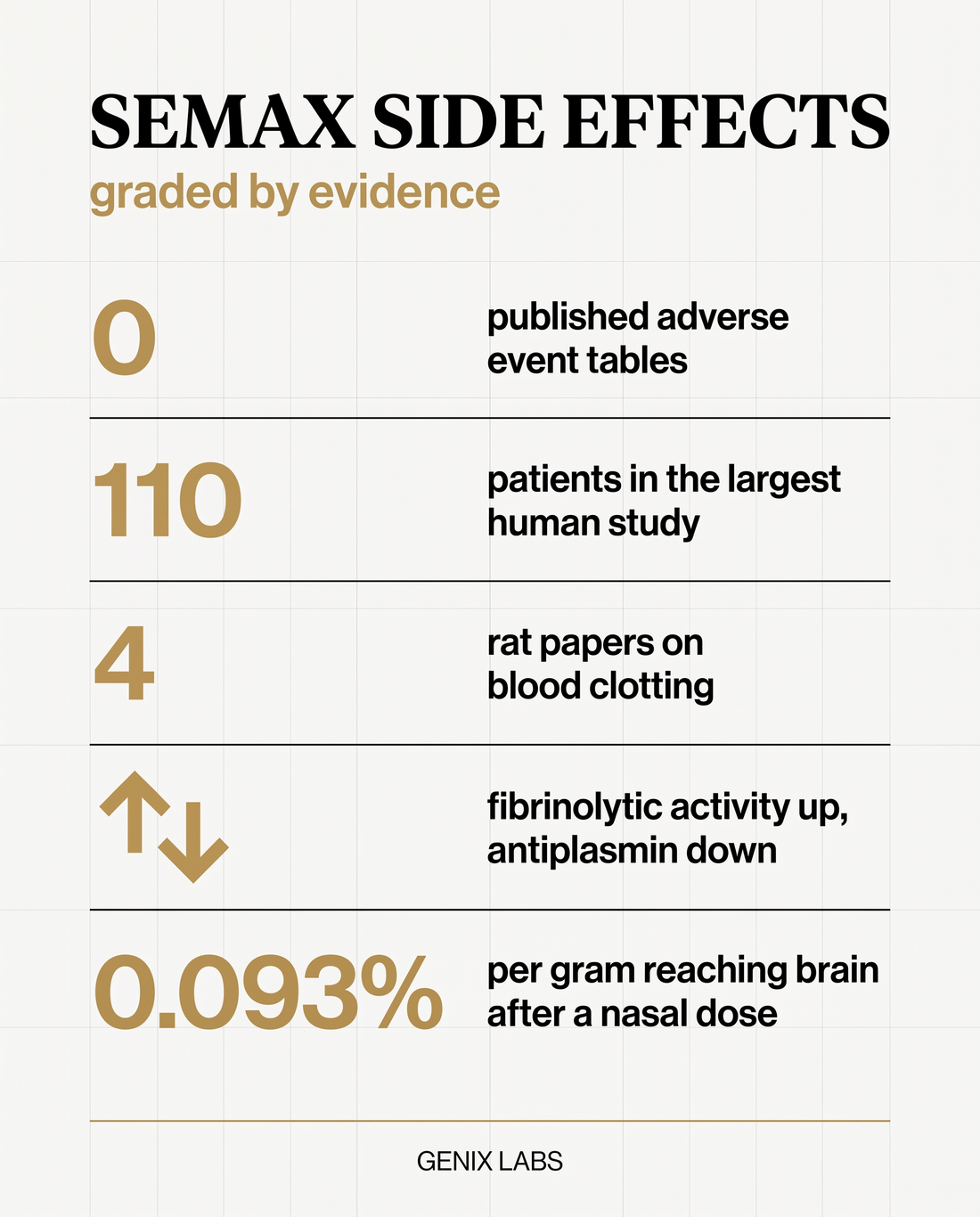
No clinical trial of semax has ever published an adverse event table, so no graded list exists. The effects printed online are uncontrolled self reports. The one finding that does repeat in the literature is a shift in blood toward anticoagulation, measured in rats across four papers, and no consumer list prints it.
That is the whole answer, and the rest of this page is the evidence behind it. It matters because semax is not like most research peptides. It has been studied in people. So the usual excuse, that nobody has looked yet, does not apply here. People looked, measured what they wanted, and left the harm column empty.
- Human studies exist. Published adverse event tables do not.
- The largest human study used 6000mcg a day in 110 stroke patients.
- Four rat papers found semax shifts blood toward thinner and faster clot breakdown.
- Semax was engineered to be noncorticotropic, so it should not drive cortisol.
- The measurable risk is the vial: identity, endotoxin, water, cold chain.
What is semax?
Semax is a seven amino acid peptide. Its sequence is Met-Glu-His-Phe-Pro-Gly-Pro. A peptide is just a short chain of amino acids, the same building blocks proteins are made of. Seven is very short. For comparison, insulin has 51. That shortness matters later, because short peptides break apart quickly in the body.
It is sold as a nootropic, meaning a compound studied for focus and thinking. Our guide to semax for focus and brain fog covers that side. This page is only about what can go wrong, and how much of it is actually known.
Where does it come from?
Semax is built from a piece of a human hormone. The hormone is ACTH, which tells the adrenal glands to release cortisol, the main stress hormone. Scientists took amino acids 4 to 7 of ACTH and bolted a short tail onto the end. The tail is Pro-Gly-Pro.
That tail does two jobs. It makes the peptide last longer before enzymes chew it up. And it removes the hormone job. The fragment on its own does not tell the adrenal glands anything. This is the single most important design fact about semax, and we come back to it in the hormone section below.
Semax was developed in Russia and is registered there as a medicine. It has been used in Russian hospitals for stroke recovery and optic nerve problems. Outside Russia it has no approval anywhere. It is sold as a research chemical, which is how Genix Labs supplies it.
How does semax work?
The clearest mechanism is growth factors. Semax raises BDNF, which stands for brain derived neurotrophic factor. Think of BDNF as fertiliser for brain cells. It helps them survive, connect and adapt. Low BDNF shows up in depression and in dementia. Raising it is the headline effect in most semax papers.
What the BDNF studies measured
One 2006 paper in Brain Res gives the clean numbers. A single dose of 50mcg per kilogram of body weight raised BDNF protein in the rat hippocampus 1.4 fold. It raised trkB phosphorylation 1.6 fold. The trkB receptor is the lock BDNF fits. The messenger RNA numbers were larger: 3 fold for BDNF, 2 fold for trkB.
The same animals performed better on a learning task. So the mechanism and the behaviour line up. This is good science. Notice what it is not. It is not a safety study. Nothing in that paper counted a harm, because that was not the question.
What benefits does research explore?
Research explores three things. Attention and learning, where animal studies show better performance on conditioned tasks. Recovery after brain injury, where the human stroke work sits. And mood under chronic stress, which is the newest line. All three trace back to the same growth factor mechanism.
This matters for a safety page, because benefit and harm share a mechanism. If semax works by raising BDNF and trkB signalling, then the places it could cause trouble are the places that system reaches. That is a far more useful way to predict a side effect than copying a list.
It also sets a limit. A mechanism that works through growth factor signalling acts over days and weeks, not minutes. So a dramatic effect reported within an hour of a dose, good or bad, probably is not the mechanism these papers describe. It is more likely the route, the expectation, or something else entirely.
Why does every list match?
Because they share a parent, not a study. Someone wrote a plausible list years ago. The next page copied it. Search engines rewarded the agreement. Now a dozen pages print headache, tiredness, irritability and flushing in roughly that order, and the agreement looks like evidence. It is not. It is an echo.
You can test this yourself in a minute. Open any semax side effect page and look for a citation next to the list. Not a citation somewhere on the page. One attached to the list. You will almost never find one. That absence is the finding.
How should a claim be graded?
Grade by what produced the claim, not by how confident it sounds. A number from a controlled human trial is the strongest thing available. A number from a rat study is real evidence about rats. A forum post is a hypothesis. Treating all three as the same is how this topic went wrong.
| Tier | What it means | What semax has here |
|---|---|---|
| A. Controlled human harm data | Trial counted and published adverse events | Nothing. Zero published tables |
| B. Human efficacy data | Trial measured outcomes in people | Several, including 110 patients |
| C. Animal findings | Measured in rats or mice, specific doses | Large. Including four clotting papers |
| D. Mechanism reasoning | Plausible from how the molecule works | Strong for BDNF, weak for most claimed harms |
| E. Uncontrolled self report | Someone online said it happened | Every list you have read |
Hold that table in mind for the rest of this page. Every claim below gets a tier. When something sits at tier E, we say so instead of dressing it up.
What does the human record hold?
More than most people expect. Semax has been through clinical work in Russian hospitals since the 1990s. The studies cover acute ischemic stroke, stroke rehabilitation, and optic nerve disease. They were published in Russian journals, which is part of why Western pages ignore them.
This puts semax in a different class from most research peptides. For something like selank, or for most of the longevity compounds, the human file is thin or empty. For semax it genuinely exists. Which makes the missing harm column harder to excuse, not easier.
The 110 patient stroke trial
The largest dataset is a 2018 study of 110 patients after ischemic stroke. Mean age was 58. Patients were split by how early rehabilitation started, then split again by whether they got semax. The amount was 6000mcg a day, given as two 10 day courses with a 20 day gap between them.
The results were positive. Semax raised plasma BDNF and kept it raised. Barthel index scores, which measure daily function, improved faster. Motor performance improved. The authors concluded that semax plus early rehabilitation sped up recovery.
The earlier stroke papers
The 2018 study was not the first. Two earlier papers in the same Russian neurology journal studied semax during the acute period of ischemic stroke. One, from 1997, is described as a clinical and electrophysiological study of hemispheric stroke. The other, from 1999, investigated the mechanism behind the neuroprotective effect.
So the human work spans roughly twenty years, in the acute phase and in rehabilitation. That is a longer run than most compounds sold as research peptides can claim. It also means the missing harm column is not a gap left by one rushed study. It is a consistent feature of the whole body of work.
What protocol did the studies use?
The clinical protocol in the 2018 study was specific and short. 6000mcg a day. Ten days on. Twenty days off. Then a second ten day course. That structure, two pulses with a gap, is the only published human schedule in the semax literature.
Compare that with what circulates online. Daily use for weeks or months, at amounts roughly ten times smaller, with no gap. That is not a variation on the published protocol. It is a different thing entirely, and no study has looked at it. Any side effect claim attached to long daily use is describing an untested pattern.
One more point about the gap. Because the clinical courses were short, there is no published human data on continuous use beyond ten days at a stretch. Questions about what happens at three months have no answer in this literature, in either direction.
Why there is still no table
Because the studies were designed to answer a different question. A trial that asks does this speed up stroke recovery will measure stroke recovery. Counting and grading every adverse event is extra work, extra cost and a separate reporting standard. Older Russian journal practice often did not require it.
So the silence is not evidence of safety. It is evidence that nobody wrote it down. Those are very different things, and most pages quietly turn the first into the second. If 110 patients took 6mg a day for 10 days and something common had happened, we might expect a mention. But might expect is not a finding either.
Does semax thin the blood?
In rats, yes, and this is the most reproducible safety finding in the entire semax literature. Four papers from one Moscow laboratory report that intranasal semax raises anticoagulant and fibrinolytic activity, lowers antiplasmin and reduces clot weight. It is tier C evidence. It is also absent from nearly every side effect list online.
The four papers, in detail
The clearest numbers come from a 2001 paper in Bull Exp Biol Med. Rats got intranasal semax for five days. Total fibrinolytic activity rose. Fibrinolysis is the process that dissolves clots. Plasmin activity rose, and plasmin is the enzyme that does the dissolving. Plasminogen activator activity rose, which is the switch that makes plasmin.
Antiplasmin fell. Antiplasmin is the brake on that whole system. And in an experimental thrombosis model, the clots weighed less. Five separate markers, all pointing the same direction. That internal agreement is what makes this finding different from a forum report.
A 2010 paper in the same journal extended it. Rats were put under acute and chronic immobilization stress, which pushes blood toward excess clotting. Repeated intranasal semax pushed back, stimulating the anticoagulation system. Two more papers from the same group, from 1996 and 2006, report the same family of effects.
What the clotting signal means
Read it carefully, because it cuts both ways. In a stroke context, thinner blood may be part of why semax helped. The researchers themselves framed it as protective. So this is not a scare finding. It is a real pharmacological action with a direction.
But any compound that shifts clotting is a compound that can interact. Blood thinners, antiplatelet agents, surgery, bleeding disorders. Those are the situations where a clotting shift stops being neutral. This is exactly the kind of thing a side effect list is for, and it is the one thing those lists leave out.
Two honest limits. Every one of those papers used rats. And every one used the intranasal route at microgram amounts. No human study has measured clotting markers on semax at all. So the finding is solid about rats and formally unknown in people.
Does semax mess with hormones?
It was built specifically not to. Semax is an ACTH fragment, and ACTH drives cortisol. But the Pro-Gly-Pro tail removes that activity. The 2024 literature calls semax noncorticotropic, which means it does not trigger cortisol release. In a chronic stress model it lowered a marker of stress load rather than raising it.
The word noncorticotropic
This word is the answer to the hormone worry, so it is worth unpacking. Corticotropic means acting on the adrenal cortex to release cortisol. That is ACTH's day job. Noncorticotropic means the molecule keeps some of ACTH's shape but has lost that job.
Semax is the ACTH 4 to 7 piece plus a tail. The parts of ACTH that bind the adrenal receptor are not in that piece. So the worry that semax will push your cortisol around, or suppress your own ACTH, does not follow from its structure. Melanotan II is the other well known noncorticotropic ACTH analog, and it is in the same 2024 paper.
What the 2024 stress paper found
This is the strongest evidence on the hormone question, and it is recent. The study ran a chronic unpredictable stress model in rats, which is a standard depression model. Chronic stress enlarges the adrenal glands, because they are being overworked. That enlargement is a physical marker of a strained stress axis.
Semax at 60 nmol per kilogram attenuated that adrenal enlargement. It also reversed the loss of interest in sugar water, which is the model's depression readout, and restored hippocampal BDNF. So in the one place where the stress axis was directly measured, semax moved it toward normal.
How much reaches the brain?
Very little, and this number keeps the whole page honest. Researchers made semax with radioactive tritium so they could track it. After an intranasal dose in rats, the brain held 0.093% of the total radioactivity per gram of tissue at two minutes. Of that, 80% was still intact semax.
So roughly a thousandth of the dose, per gram, gets where it is going. That is normal for nasal peptide delivery and it is not a criticism. But it shapes which side effects are even plausible. A molecule present in tiny amounts, briefly, in one tissue, has a small window to do systemic harm.
What it breaks down into
Semax falls apart fast. In those same samples, the tripeptide Pro-Gly-Pro became the dominant molecule, outweighing intact semax and its other fragments. Pro-Gly-Pro is the tail that was added for stability, and it has its own biological activity.
That is a genuinely important wrinkle. In the clotting papers, Pro-Gly-Pro produced effects similar to semax. So part of what semax does may be what it turns into. For a side effect question this means you are rarely dealing with one molecule. You are dealing with a short cascade.
Semax nasal spray and the nose
Most semax research used the intranasal route, and most reported discomfort is local. A solution dripped into the nose can sting, cause a runny nose, a scratchy throat as it drains, or a brief sneeze. These are route effects, not molecule effects. Saline alone can do the same thing.
This matters because it explains the lists. The complaints people actually report are mostly what you would expect from putting any liquid up your nose repeatedly. Attributing them to the peptide, rather than the delivery, inflates the molecule's risk profile.
Worth saying plainly: Genix Labs supplies semax as a lyophilized powder for laboratory research, not as a nasal spray product. The route discussion here is about reading the literature correctly, not a method to copy.
Does the route change the risk?
Yes, in two directions. Injection skips the nose, so it removes the local nasal complaints. But it adds the injection site itself: redness, a small lump, tenderness, and the real risk of contamination if sterile technique fails.
It also changes exposure. The 2024 stress study used intraperitoneal injection, not the nose. Different route means different amount reaching tissue, so animal findings do not transfer cleanly between routes. When a page quotes a nasal study to warn about an injected amount, it is mixing two experiments.
| Route | Effects that belong to the route | What the literature used it for |
|---|---|---|
| Intranasal | Stinging, runny nose, throat drip, sneezing | Most semax work, including all clotting papers |
| Injected | Site redness, lump, tenderness, contamination risk | The 2024 chronic stress study |
| Oral | Broken down before absorption | Not a studied route for semax |
What users actually report
Here is the standard list, graded honestly. Every item below is tier E, uncontrolled self report, unless noted. We are not dismissing them. People experience what they experience. We are refusing to print them as if a study produced them.
Semax, sleep and overstimulation
The most common report is trouble sleeping after a late dose. This one has a mechanism behind it, which raises it above pure noise. Semax is studied for alertness and attention. A compound that increases alertness can plausibly push bedtime later. Tier E with a tier D mechanism.
The related report is a wired or overstimulated feeling. Interestingly, the product positioning claims the opposite, that there is no jitter because semax is not a stimulant. Both can be true for different people. Neither has been measured in a trial.
Headache and head pressure
Headache leads almost every list. There is no study behind it. There is a weak mechanism story, since semax affects blood vessel and growth factor signalling, and headaches are sensitive to vascular change. But that story would predict a headache from dozens of compounds. Tier E.
One practical note. A headache after a nasal dose can come from the solution itself, from sinus irritation, or from the dehydration and screen time that often accompany a long focus session. Attribution is genuinely hard here, and the lists pretend it is easy.
Irritability and flat mood
Both appear on lists, and they contradict each other. They also contradict the research direction, since the 2024 paper found antidepressant like effects and reduced anhedonia. When reports point three ways at once, the most likely explanation is that they are reports about people's lives, not about the molecule. Tier E.
Does the effect fade?
Nobody has measured it. The question comes up because the clinical protocol itself was cycled: two 10 day courses with a 20 day gap. People read that gap as evidence of tolerance. It is not. A gap in a trial protocol is a design choice, and the paper does not say why.
Mechanistically, BDNF changes are adaptive, so some shift over weeks is plausible. That is a tier D guess. If someone tells you semax tolerance builds after two weeks, ask them which study measured it. There is not one.
Negative side effects of peptides
This question gets asked as if peptides were one category. They are not. The honest answer splits in two. Molecule effects depend on which peptide and which system it touches, so they do not transfer. Vial effects are shared by every peptide, and they are the ones you can actually check.
Molecule effects are specific. GLP-1 peptides act on gut and appetite signalling, so nausea is expected. Growth hormone secretagogues act on an endocrine axis, so fluid retention and joint aching show up. Semax acts on growth factor signalling in the brain and on clotting. None of those three groups shares a side effect profile.
Vial effects are universal. Endotoxin from careless manufacturing causes fever and chills. A wrong or impure compound causes whatever that compound causes. The wrong diluent causes stinging and degradation. A broken cold chain causes a vial that no longer contains what the label says. Our focus and cognition pillar covers this ground across compounds.
Why dose talk breaks down
The numbers in this literature do not line up with the numbers people trade online. The clinical study used 6000mcg a day in people. The BDNF paper used 50mcg per kilogram in rats. The stress paper used 60 nmol per kilogram, a different unit entirely. Online charts cluster around 300 to 600mcg.
Three different units, three species, three routes. Converting between them is not arithmetic. It requires assumptions about absorption and metabolism that nobody has established for this peptide. So when a page tells you a side effect appears above a certain amount, it is inventing a threshold.
What is known about interactions
Formally, nothing. No interaction study on semax exists. But the clotting papers point at one plausible class, and that pointer is more than any list offers. A compound that raises fibrinolytic activity and lowers antiplasmin sits in the same territory as anticoagulants and antiplatelet agents.
One clinic page in the search results claims semax is compatible with other medications. That claim has nothing behind it. There is no interaction data to support compatibility either. Absence of evidence runs in both directions, and a vendor should not get to use it only in the reassuring direction.
Who should take semax?
Nobody, in the sense the question means. Semax is supplied for laboratory research only, not for people. The published clinical work studied patients after ischemic stroke and patients with optic nerve disease, in Russian hospitals, under medical supervision. That is a clinical setting, not a consumer protocol.
The literature also offers no exclusion list, because no trial published inclusion and exclusion criteria in a form that transfers. Pages that print a confident list of who must avoid semax are writing fiction. The one evidence based flag is the clotting direction, and even that is a rat finding.
Semax and Alzheimer's disease
Research has not shown semax treats Alzheimer's disease. There is no published trial of semax in Alzheimer's. The question appears in search results because of an indirect link, and the link is worth understanding rather than dismissing.
BDNF signalling in the hippocampus weakens in Alzheimer's disease. Semax raises BDNF and trkB in the rat hippocampus. So the mechanism is in the right neighbourhood. That makes it a reasonable thing to study. It does not make it a treatment, and no page should imply it does.
What about the eye research?
This is the part of the record almost no English page mentions. Alongside the stroke work, semax has been studied in Russian ophthalmology for optic nerve disease. A 2004 paper in a Russian eye journal set out the experimental case for using it as a neuroprotector there.
The optic nerve is brain tissue, not eye tissue, which is why a brain growth factor mechanism is a reasonable thing to test on it. One of the BDNF papers measured gene expression in the retina as well as the brain, and found the same pattern. So the mechanism follows the tissue.
For side effects, the useful read is what is absent. If semax caused visual problems, the group most likely to notice would be an ophthalmology team dosing optic nerve patients with it. No such report appears. That is weak evidence, since nobody counted. It is still worth more than a forum post.
Compared with selank
Selank comes up constantly beside semax, and the safety files look similar: real Russian clinical use, no published adverse event tables. The difference is direction. Semax is studied for attention. Selank is studied for anxiety. Our semax vs selank comparison covers how they differ in detail.
For a side effect question, the useful point is that you cannot borrow one file for the other. They share a country of origin and a research culture. They do not share a mechanism, so they should not share a risk list.
The risks nobody lists
Here is where the real, checkable risk lives. Not in the peptide. In the vial holding it. Four things decide more about what happens than the seven amino acids ever will, and all four can be verified before anything else happens.
What if the vial is wrong?
Then every other question on this page is irrelevant. If the powder is not semax, you are studying something else. If it is semax at 70% purity, 30% of the mass is unidentified material. Impurities in peptide synthesis include truncated chains and reagent residue, and nobody has characterised what those do.
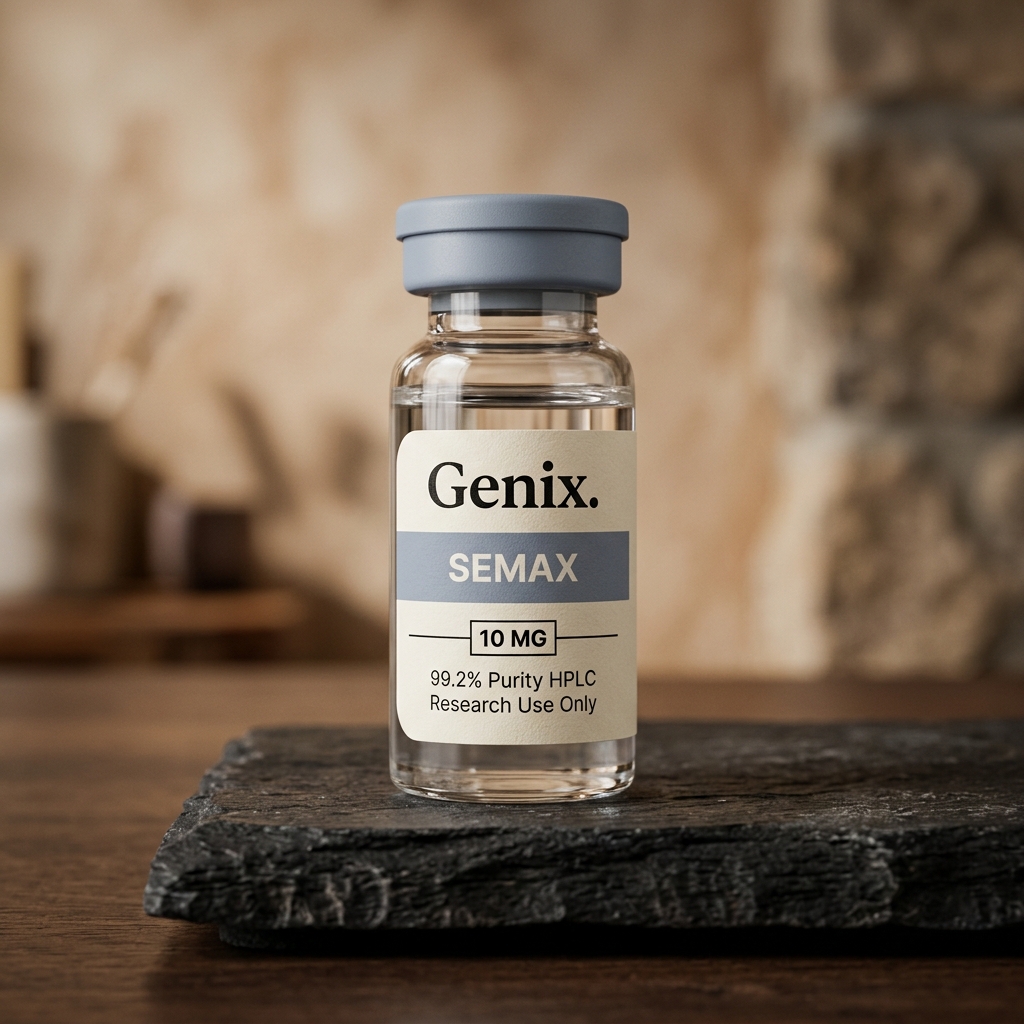
This is what LC-MS identity testing is for. Mass spectrometry weighs the molecule and confirms it is the one on the label. HPLC then measures how much of the sample is that peak. Our published semax lot, 371924, shows 99.45% HPLC area purity at 10mg with LC-MS identity confirmed.
Water, storage and handling
Three mundane failures cause more trouble than the molecule. The wrong water is the first. Bacteriostatic water contains a preservative that keeps a reconstituted vial usable. Plain sterile water does not. Tap water is not a candidate.
Heat is the second. A seven amino acid chain is not fragile in the way a large protein is, but a lyophilized powder that has been warm and damp degrades. Light is the third. Genix ships cold packed and tracked, with same day dispatch in Bali, because the cold chain is the part a customer cannot inspect after the fact.
What a lot report rules out
A certificate of analysis is a specific document about a specific batch. Ours carries the lot number, the HPLC area purity, the LC-MS identity confirmation, and the tested size. Testing runs through ISO 17025 accredited methods. That is what accreditation means: the testing method itself has been audited.
Be precise about its limits. HPLC area percent is not content. It is not sterility. It is not safety and it is not efficacy. And it applies only to the printed lot. Check that the number on your vial matches the number on the document.
Which vendor claims are red flags?
- A side effect list with no citation attached to the list itself.
- A confident frequency, such as headache in 5% of users. No study produced that.
- A claim that semax is compatible with other medications. No interaction data exists.
- A side effect page that never mentions the clotting findings. It means they did not read the literature.
- A purity number with no lot number. Purity without a lot is decoration.
- Any suggestion that semax treats stroke, dementia or depression in people.
How much does semax cost?
A Genix Labs 10mg semax vial is USD 63, or Rp 1.000.000, with the batch certificate of analysis included. For scale, the clinical study used 6mg a day for 10 days, so a single 10mg vial holds less than two days of that clinical amount. The online charts that use 300 to 600mcg would stretch one vial much further.
Price is also a signal. Semax synthesis is seven residues of solid phase work plus purification and testing. A vial priced far below the market usually saved money somewhere, and the usual places are purity, identity testing and the cold chain. You can buy lab tested semax with the lot report published, or browse the full research peptide catalog.
What would actually settle this?
One study design would close most of this page. Take the existing clinical protocol, 6mg a day in two 10 day courses, and add a published adverse event table with frequencies against placebo. Add a coagulation panel, because the rat data says to look there. Add a basic endocrine panel to confirm the noncorticotropic claim in people.
None of that is exotic. It is standard trial reporting. Semax has been in clinical use in one country for roughly three decades without it. Until someone does it, the honest position is the one on this page: known mechanism, real human efficacy signal, unmeasured harms, and one clotting finding everybody skipped.
Read any claim in 30 seconds
- Is there a citation attached to the side effect list itself, not just somewhere on the page?
- Does the page mention the anticoagulant and fibrinolytic findings? If not, it did not read the file.
- Does it separate route effects, like nasal stinging, from molecule effects?
- Does it give a lot number with its purity claim, or just a percentage?
Run those four on the next page you open. Most fail at question one, and nearly all fail at question two. That failure rate is the real state of this topic, and it is why the honest answer here is narrower than the confident answer everywhere else.
Frequently asked questions
Who should take Semax?
Nobody, in the sense the question means. Semax is supplied for laboratory research only, not for people. In the published clinical work the populations were patients after ischemic stroke and patients with optic nerve disease, treated in Russian hospitals. Those studies describe a clinical setting, not a consumer protocol.
Does Semax mess with hormones?
It was specifically built not to. Semax is an ACTH fragment with a Pro-Gly-Pro tail added, and the 2024 literature calls it noncorticotropic, meaning it does not drive cortisol release. In a chronic stress rat model it reduced adrenal hypertrophy, so it lowered a marker of stress load rather than raising it.
What are the negative side effects of peptides?
The honest answer splits in two. Molecule effects depend entirely on which peptide and which axis it touches, so they do not transfer between peptides. Vial effects are shared by all of them: endotoxin, wrong identity, the wrong diluent, a broken cold chain. The second group is the one you can actually check.
Is Semax effective in treating Alzheimer's disease?
Research has not shown that. There is no published trial of semax in Alzheimer's disease. The interest comes indirectly, from animal work where it raises BDNF and trkB in the hippocampus, a system that weakens in dementia. That is a mechanism worth studying, not a demonstrated treatment.
Does Semax thin the blood?
In rats it does, and this is the most reproducible finding in the whole safety file. Four papers from the same Moscow laboratory report that intranasal semax raises anticoagulant and fibrinolytic activity, lowers antiplasmin and reduces thrombus weight. No human study has measured it, and no side effect list online prints it.
How much does Semax cost?
A Genix Labs 10mg semax vial is USD 63, or Rp 1.000.000, with the batch certificate of analysis included. The published lot shows 99.45% HPLC area purity and LC-MS identity confirmation. Purity is a lot-specific result and is not a statement of content, sterility, safety or efficacy. Supplied for laboratory research only.
Takeaway
The semax side effect list you keep reading is not a finding. No trial of this peptide ever published an adverse event table, so there is no frequency to print and nothing to grade. Headache, tiredness and irritability are uncontrolled self reports, and a good share of them belong to the nose rather than the molecule.
What does exist is more interesting than the list. Semax has a real human efficacy record, including 110 stroke patients at 6mg a day. It was engineered to strip the hormone activity out of ACTH, and a 2024 paper supports that. And four papers found it shifts blood toward anticoagulation, which is the one reproducible safety signal in the file and the one almost nobody prints.
So put your attention in two places. The clotting direction, because it is the only evidence based flag here. And the vial, because identity, purity, the right water and an unbroken cold chain decide more about what happens than the seven amino acids ever will. That part you can verify, on a lot report, before anything else happens. Research use only.