Search Semax dosage and you get a wall of numbers. One page says 300 micrograms. Another says 600. A third prints a milligram figure ten times bigger. They cannot all be right, and in a sense none of them are. The published studies do contain real numbers. They just do not answer the question the charts pretend to answer.
This guide walks the actual record. What the rat studies measured, what the human studies measured, which route carried every one of those numbers, and why the acetylated version on sale is a different molecule with a different answer. Semax is supplied for laboratory research only. Nothing here is a protocol or medical advice.
What is the Semax dosage?
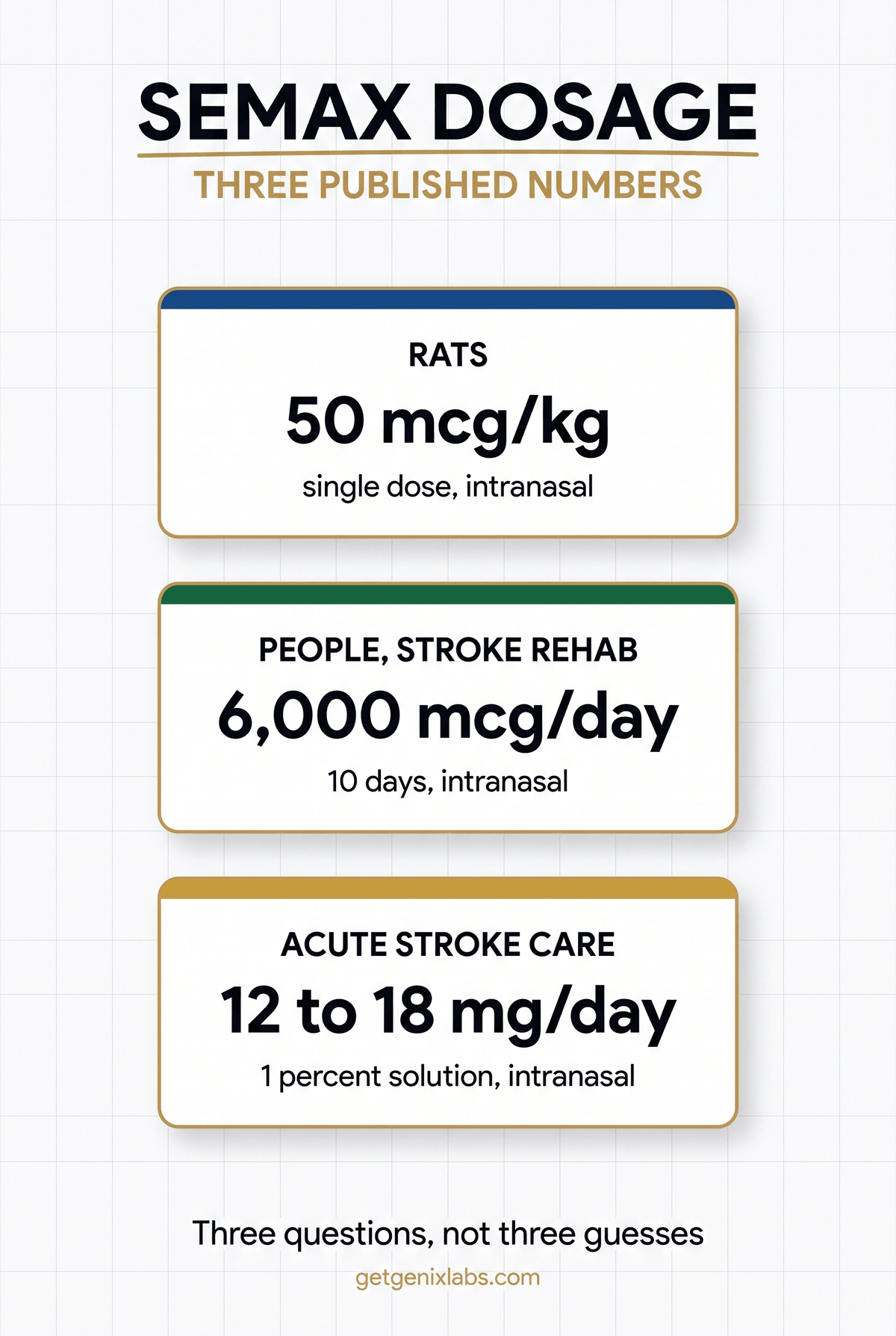
There is no single Semax dosage. The rat studies measured 50 micrograms per kilogram of body weight. One human rehabilitation study used 6,000 micrograms per day for ten days. Acute stroke summaries report 12 to 18 milligrams per day. All three came through the nose, and all three answer different questions.
- A rat number, per kilogram of body weight, from a single dose study of brain growth factors.
- A human number, per day, from a stroke rehabilitation study that measured recovery scores.
- A second human range, roughly a thousand times larger per day, from acute stroke care.
- No injected number at all. The entire human record is intranasal, meaning drops in the nose.
Why does every Semax dosage chart disagree?
Because the charts flatten three unrelated measurements into one row. A rat dose per kilogram, a daily human total, and an acute care range are not three attempts at the same answer. They are answers to different questions, in different species, at different stages of care.
Put them on one axis and the numbers look like a disagreement. They are not. The 50 microgram per kilogram figure comes from a study asking whether the peptide moves brain growth factors at all. The 6,000 microgram per day figure comes from a study asking whether people recovering from a stroke regained function faster. Neither study was trying to set a dose for a vial of powder.
So when two vendor pages print different numbers, usually neither is lying. They have each picked a different study, dropped the units, dropped the species, dropped the route, and printed what was left. The same thing happens with peptide dosage arithmetic generally, where a clean calculation gets attached to an input nobody measured.
How does Semax work?
Semax is a seven amino acid peptide. It is built from a short piece of a natural hormone called ACTH, the part numbered four to seven, with a three piece tail called Pro-Gly-Pro bolted on the end. That tail is the point. It slows the enzymes that would otherwise chew the peptide apart.
The full sequence is Met-Glu-His-Phe-Pro-Gly-Pro. Its formula is C37H51N9O10S and it weighs about 813.9 daltons, which is a unit for the mass of a single molecule. Unlike the full hormone it came from, Semax is reported to carry none of the hormonal activity, which is why it gets studied as a brain peptide rather than a hormone.
The best mapped effect is on growth factors in the brain. In rat hippocampus, a single intranasal dose raised BDNF protein about 1.4 fold. BDNF stands for brain derived neurotrophic factor, a protein that helps brain cells form and keep connections. The same study saw trkB activation rise 1.6 fold. TrkB is the receptor BDNF plugs into.
Those are the numbers behind the focus claims. They are real, they are measured, and they are from rats given 50 micrograms per kilogram. For a plain language walk through of what people reach for it for, see Semax for focus and brain fog.
What did the rat studies actually use?
The headline rat figure is 50 micrograms per kilogram of body weight, given once, in the nose. That single dose produced the growth factor changes above in the hippocampus. A companion study found the same direction of effect in another brain region, the basal forebrain.
Read that unit carefully. It is micrograms per kilogram, not micrograms. A 300 gram rat at 50 micrograms per kilogram receives about 15 micrograms in total. That is a very small amount of peptide, and it is tied to the animal's body weight by design.
Later rodent work went wider than growth factors. Studies looked at immune and blood vessel gene activity after a stroke was induced, and at behaviour after early life drug exposure. The pattern across them is consistent. The peptide changes gene activity in brain tissue after an injury. The pattern is not a dose chart.
What did the human studies actually use?
The clearest human figure comes from a 2018 stroke rehabilitation study of 110 patients. The regimen was 6,000 micrograms per day, run as two ten day courses with a twenty day gap between them. Plasma BDNF rose and stayed raised, and Barthel index scores, a measure of daily functional independence, improved faster.
Separately, review summaries of Russian acute stroke work report 12 to 18 milligrams per day of a 1 percent intranasal solution across the first ten to fourteen days. The convention described is roughly 12 milligrams per day for moderate strokes and 18 for severe ones. Those are acute hospital figures, not wellness figures.
| Study setting | Amount | Route | Duration | What it measured |
|---|---|---|---|---|
| Rat hippocampus | 50 mcg/kg | Intranasal | Single dose | BDNF and trkB levels |
| Post stroke rehabilitation, 110 patients | 6,000 mcg/day | Intranasal | 2 courses of 10 days | Plasma BDNF, Barthel index, motor scores |
| Acute ischemic stroke, review summaries | 12 to 18 mg/day | Intranasal, 1% solution | 10 to 14 days | Neurological impairment scores |
| Healthy adults seeking focus | No published figure | n/a | n/a | Never run as a dose finding study |
Look at the last row, because it is the one that matters for most people searching this term. The human record sits in stroke medicine. Nobody ran a dose finding study in healthy adults who wanted sharper focus. Every focus figure online is an extrapolation from stroke numbers, and the extrapolation step is never shown.
Why do mcg and mg cause so much trouble?
Because they differ by a thousand, and the published Semax numbers sit on both sides of that line. 6,000 micrograms is 6 milligrams. Written as mcg it looks enormous. Written as mg it looks modest. It is the same amount, and a single misread moves it by a factor of a thousand.
This is not a theoretical risk. The acute figure of 12 to 18 milligrams is 12,000 to 18,000 micrograms. If a chart prints 12 and leaves off the unit, a reader with a 10 milligram vial can reach a very different conclusion depending on which unit they assume.
- 1 mg equals 1,000 mcg. Always. There is no context where this changes.
- 6,000 mcg equals 6 mg. That is the human rehabilitation daily total.
- 12 mg equals 12,000 mcg. That is the lower acute care figure.
- A 1 percent solution holds 10 mg of peptide in each millilitre, because 1 percent means 1 gram per 100 millilitres.
That last line is worth sitting with. The acute stroke studies describe a 1 percent solution, which is a concentration, not an amount. Concentration plus volume gives the amount. A chart that copies the percentage but drops the volume has copied half of a calculation.
Does the route change the number?
Yes, completely. Every published Semax number went in through the nose. No study established an injected amount for people. Rodent work that compared routes found intranasal dosing produced larger nootropic effects than injection into the abdomen, so the two are not interchangeable in either direction.
This matters because much of the search traffic is for injection figures. Those figures exist online. They do not exist in the literature. Somebody converted a nasal number into an injected one, and that conversion is a modelling step with its own assumptions, none of which were tested for this peptide.
There is a second wrinkle. A peptide put in the nose faces enzymes in the nasal lining before it goes anywhere. Estimates of how much reaches the brain vary widely between sources, and the ones circulating online do not trace back to a measurement in people. So even the nasal numbers describe what was administered, not what arrived.
| Route | What the record holds | Status |
|---|---|---|
| Intranasal | Every rat and human figure cited above | The entire evidence base |
| Injection | Rodent comparisons only, weaker than nasal | No human amount established |
| Oral | Degraded by gut enzymes, no study figure | Not a studied route |
Is acetylated Semax dosed the same as Semax?
No. N-acetyl Semax amidate is a different molecule. It carries an acetyl cap on one end and an amide cap on the other. Both caps slow the enzymes that trim peptides from the ends. That changes how long it survives, so one milligram of it is not one milligram of plain Semax.
Here is where honesty matters more than a tidy answer. The stability logic is sound chemistry. The potency multiplier quoted everywhere, usually three to four times, is not a measured result. It comes from user comparison, not from a head to head study. No controlled trial has compared the two at matched amounts.
One recent paper is worth noting here. A 2025 study in an Alzheimer's mouse model tested Semax and a derivative side by side. Both improved performance on memory tasks and both reduced amyloid deposits in cortex and hippocampus. That is a genuine comparison, and it still does not produce an exchange rate between the two.
So the practical position is simple. Name the molecule before quoting a number. If a page cannot tell you which one it means, it cannot tell you anything useful about an amount.
How long does Semax last?
Reported clearance from blood is fast, described in minutes rather than hours across the sources that discuss it. The downstream change lasts much longer. The growth factor rise the rat studies measured plays out over hours. So the peptide is gone well before the effect it triggered has finished.
That gap is the reason half-life is a poor guide to spacing for this peptide. With many drugs you can reason from clearance to a dosing interval. Here the thing being measured is not the peptide. It is a change in gene and protein activity that outlives it.
There is a further detail that most pages miss. When Semax breaks down it does not vanish into nothing. It forms a fairly stable intermediate that retains neurotrophic activity, and eventually the Pro-Gly-Pro tail itself, which has been studied as an active peptide in its own right. One 2010 study found both Semax and Pro-Gly-Pro switched on neurotrophin genes after induced brain ischemia.
Be careful with specific half-life figures you find quoted. The numbers in circulation range from two minutes to two hours depending on the page, and none of them trace to a published human pharmacokinetic study. Treat the direction as solid and the exact figure as unsettled.
Can you scale a rat dose to a person?
Not by multiplying body weight. The 50 microgram per kilogram rat figure does not become a human figure by scaling up to 70 kilograms. Species scaling uses allometric methods that account for metabolic rate, not straight weight ratios, and no published work has done that step for Semax.
It is easy to see why people try. The arithmetic is inviting. Fifty micrograms per kilogram times 70 kilograms gives 3,500 micrograms, which lands suspiciously close to the 6,000 microgram human figure. That closeness is a coincidence, not a validation. The human number came from a clinical regimen, not from scaling a rat.
The honest summary is that two independent numbers happen to sit in the same order of magnitude. That is mildly reassuring about the general range being plausible. It is not evidence that the scaling method works, and it should not be presented as a calculation.
How do you do the reconstitution math?
A 10mg vial holds 10mg whether you add one millilitre of water or three. Water only sets the concentration. Add 2mL and every millilitre holds 5mg. Add 3mL and every millilitre holds about 3.33mg. The amount inside the vial never changes.
This is the part of every dosage calculator that genuinely works. It is division. Vial mass divided by water volume gives concentration. If you want the mechanics in full, our guide on how to reconstitute peptides walks through it with the handling steps.
What the arithmetic cannot supply is the input. A calculator will happily turn any amount you type into a volume. It has no opinion on whether that amount has ever been studied. The clean output hides the fact that the input was a guess.
- Which molecule is in the vial. An LC-MS identity line settles this.
- How concentrated the solution is. Mass divided by volume, plain arithmetic.
- How pure the powder is. A batch document reports it for the named lot.
How strong is the Semax evidence really?
Weaker than the confident charts suggest. The rodent mechanism work is solid and repeated across labs. The human work is thinner. Most of it is Russian, much of it predates modern trial standards, and the critical reviews point at the same problems each time.
The specific issues are worth naming. Several stroke studies compared Semax against conventional therapy rather than placebo, and were not randomized. One commonly cited study set 30 Semax patients against 80 on conventional care alone. The meta-analytic summaries that pool this work call for a proper multicentre double blind trial, which is a polite way of saying the current base will not carry the weight.
- Strong: rodent evidence that the peptide changes BDNF, trkB and immune gene activity in brain tissue.
- Moderate: human stroke data showing BDNF rises and recovery scores improve, from trials with design limits.
- Weak: any figure for healthy adults, any injected figure, any potency ratio between variants.
- Absent: a dose finding study in people without a neurological injury.
None of that makes the peptide uninteresting. It makes the confident numbers unearned. A page that prints a single figure without this context is selling certainty the literature does not have.
What did 2025 add?
Two papers worth knowing, neither of which appears on the vendor charts. The first is a 2025 paper in the British Journal of Pharmacology, a mainstream peer reviewed journal rather than a regional one. It studied Semax in a mouse spinal cord injury model.
That study reported something new about mechanism. It identified the mu opioid receptor as a target, and traced the effect through an enzyme called USP18 and a process called deubiquitination, which is how cells remove a disposal tag from proteins. Functional recovery improved and a form of inflammatory cell death was reduced.
The second is the Alzheimer's model study mentioned earlier, published in Acta Naturae in late 2025. Semax and a derivative both improved memory task performance and both cut amyloid inclusions in brain tissue.
What does the safety record show?
The published human work reports it as well tolerated, and the peptide has been in Russian clinical use for years. That is a genuine signal. It is also a limited one, because tolerability inside a monitored stroke protocol is not the same question as safety in unsupervised use.
Two gaps are worth stating plainly. There is no long term safety data in healthy adults, because those studies were not run. And the acetylated variant has far less human exposure behind it than plain Semax, so its record is thinner still.
A separate point, and the one we see cause the most trouble in practice. An untested vial has an unknown peptide mass and unknown related substances. Safety discussion assumes the vial holds what the label says. That assumption is what a batch document exists to replace.
Is Semax legal?
It depends entirely on where you are and what it is sold for. Semax is a registered medicine in Russia. In most other countries it is not an approved drug, and it is supplied as a research chemical for laboratory work, not for human use.
That distinction is the whole legal position. Research use only is not a disclaimer bolted on for decoration. It describes the category the product is actually sold in. For how this works in our own market, see are peptides legal in Indonesia.
What about stacking questions?
No published study established a Semax combination amount. The pairing people ask about most is Semax with Selank, because the two pull in opposite directions. Semax is studied for focus, Selank for calm. That logic is sound as a rationale and it is not a dose.
If you want the mechanism comparison rather than a chart, our head to head on Semax vs Selank covers how the two differ and why researchers study them together. The combination figures circulating online are personal routines, not measured results.
Why purity beats any chart
Because an amount is only as real as the mass behind it. If a vial labelled 10mg holds less peptide than the label says, then every careful calculation downstream is wrong by the same margin. Precision in the arithmetic cannot fix an unknown input.
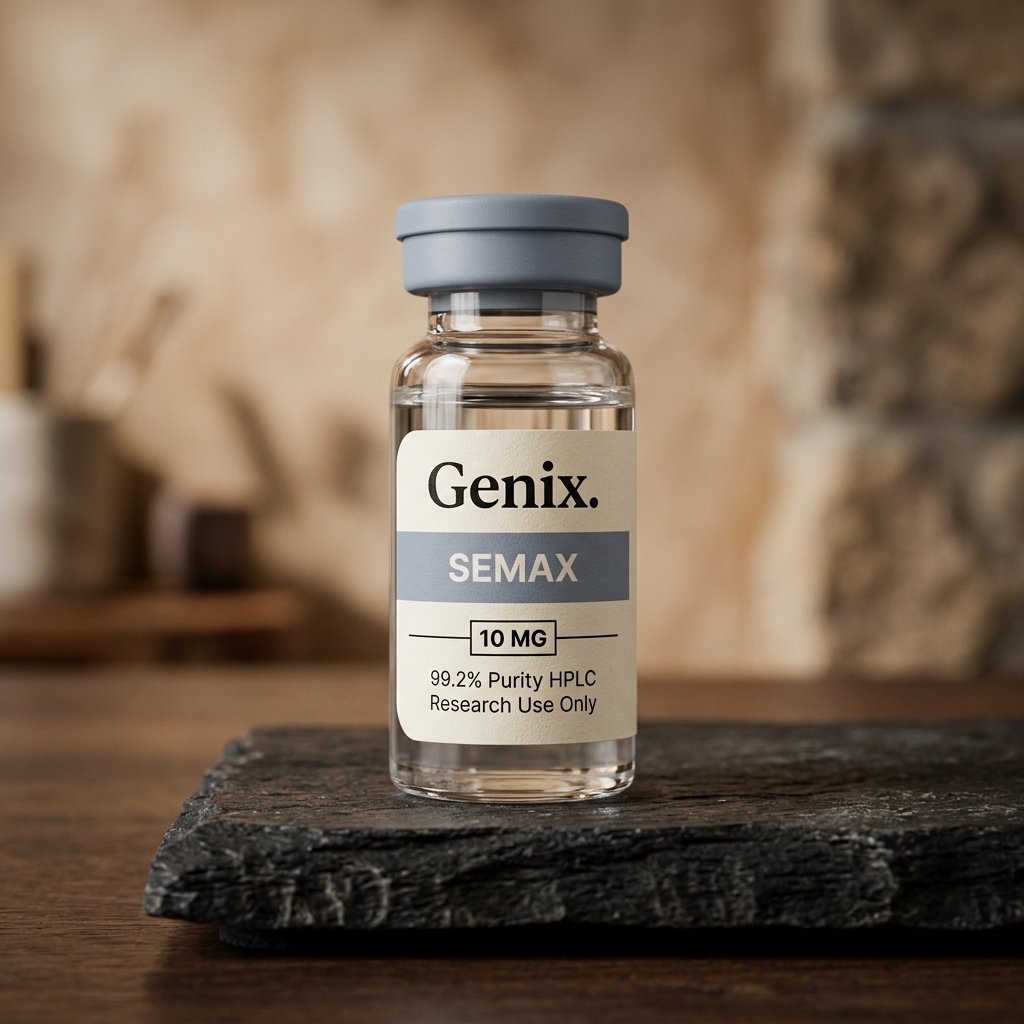
Our Semax is tested per batch. The published lot 371924 reports 99.45 percent HPLC area purity at the 10mg size, with LC-MS confirming identity. HPLC separates what is in the vial and measures the relative size of each peak. LC-MS confirms the molecule weighs what Semax should weigh, which is how you rule out a similar looking peptide.
Two cautions on reading that figure, and they apply to any vendor. HPLC area percent is not the same as content, sterility, safety or efficacy. And the result applies only to the printed lot, so the lot on the vial should match the lot on the document.
Every Semax 10mg research vial ships with its batch document, cold packed and tracked, at 63 USD or Rp 1.000.000. Testing runs in an ISO 17025 accredited facility. Inside Bali we deliver same day, often within two hours, with cash on delivery.
What are the most common Semax dosage mistakes?
They cluster, and almost all of them happen before any arithmetic starts. Here are the ones we see most often, in rough order of how badly they distort an amount.
- Reading mcg as mg. A thousandfold slip. The 6,000 mcg human figure becomes 6,000 mg, which is absurd, or 6 mcg, which is nothing.
- Not naming the molecule. Plain Semax and the acetylated version are different compounds. The research was run on the first one.
- Treating a nasal figure as an injected one. Every published number came through the nose. The conversion was never measured.
- Copying a percentage without a volume. A 1 percent solution is a concentration. On its own it is half a calculation.
- Scaling the rat mg/kg straight to body weight. Species scaling has its own rules and nobody applied them here.
- Reasoning a dosing gap from half-life. The peptide clears in minutes. The effect runs for hours.
- Quoting the three to four times potency ratio as fact. It is a community estimate with no head to head study behind it.
- Trusting an untested vial. Unknown mass in means unknown amount out, however neat the maths looks.
Semax dosage questions, answered
These are the searches that bring people to this page. Every answer stays inside the published record.
What is the Semax dosage?
There is no single Semax dosage. The rat studies measured 50 micrograms per kilogram of body weight. One human rehabilitation study used 6,000 micrograms per day for ten days. Acute stroke summaries report 12 to 18 milligrams per day. All three came through the nose. Research use only.
Is there a Semax dosage calculator?
Calculators online only do reconstitution math. They turn a vial size and a water volume into a concentration, which is simple arithmetic and genuinely useful. What no calculator can supply is the amount to put in, because that depends on a question the studies never answered for a vial of powder.
What is the Semax dosage for injection?
No published Semax study established an injected amount for people. The human record is intranasal, meaning drops in the nose. Rodent work compared routes and found intranasal dosing produced larger effects than injection into the abdomen. Injected figures on charts are conversions nobody measured.
How do you reconstitute a 10mg Semax vial?
A 10mg vial holds 10mg whether you add one millilitre of water or three. Water only sets the concentration. Add 2mL and every millilitre holds 5mg of peptide. Vial size is arithmetic. The research amount is a separate question, and only the first one has a clean answer.
Is N-acetyl Semax amidate dosed the same as Semax?
No. It is a different molecule with caps on both ends that slow enzyme breakdown. That changes how long it lasts, so a milligram of one is not a milligram of the other. The three to four times potency figure quoted online comes from user comparison, not head-to-head studies.
What does Semax dosage on Reddit refer to?
Forum figures are self-reported routines, usually in sprays or units rather than measured amounts. They are not study results and no lab verified the concentration behind them. They are useful for seeing what people try, and not useful as evidence of a dose. This is not medical advice.
The takeaway
Semax dosage is not a hidden answer that charts have cracked. It is three real measurements, in two species, by one route, answering three different questions. Flatten them into a single number and you have destroyed the only information they contained.
The rodent mechanism work is genuinely good. The human work is real but limited, and it lives in stroke medicine rather than in focus. Nobody ran a dose finding study in healthy adults, so every focus figure online is an undisclosed extrapolation.
Three things stay knowable. Which molecule the vial holds, which LC-MS settles. How concentrated the solution is, which is division. How pure the powder is, which a batch document reports for a named lot. Our Semax research vial ships with that document so the first three have real answers, and the fourth question stays with a literature that has not closed it yet.
For the wider picture on this family of compounds, start at the focus and cognition peptide hub. Semax is supplied strictly for in vitro laboratory research. It is not for human or veterinary use, and nothing here is medical advice.