
People search for a MOTS-C dosage chart hoping for one clean number. There is not one, and any honest page will tell you why. MOTS-C ships as a dry powder with no chart, because it is a research material, not a licensed medicine. This guide gives you the part that is real and useful: the reconstitution math, laid out as clear tables, plus what the research actually studied. It reports information for research and education only. It is not a dose plan, and it is not medical advice.
The quick answer
A MOTS-C dosage chart has two halves. The first half is reconstitution: how much bacteriostatic water to add to the dry powder, which sets the concentration in milligrams per milliliter. That part is simple math and does not change. The second half is the research amount: how much the studies used and how often. That part is not settled in humans, because MOTS-C has almost no human dosing trials. So the trustworthy chart is the mixing chart. The dosing amount is a research question, not a fixed number.
In plain words: the mixing chart is trustworthy because it is arithmetic. The dosing chart you see copied around the internet is not a medical protocol. It is guesswork scaled from animal studies. We will give you both, clearly labeled, so you know which is which.
What a MOTS-C dosage chart really shows
The vials you can buy hold a fixed amount, usually 10 mg of freeze-dried powder. Nothing is dissolved yet. Before it can be measured, it has to be mixed with a sterile liquid, almost always bacteriostatic water. The amount of water you add is the single most important choice, because it decides how concentrated the solution is. It does not change how much peptide is in the vial. The vial holds 10 mg either way.
This is why a chart matters at all. Two researchers can both hold a 10 mg vial, add different amounts of water, and end up drawing very different volumes to measure the same amount of peptide. The chart turns that into arithmetic you can check. It is the same math used in our broader guide to how to reconstitute peptides, applied to a 10 mg vial.
How to reconstitute a 10 mg MOTS-C vial
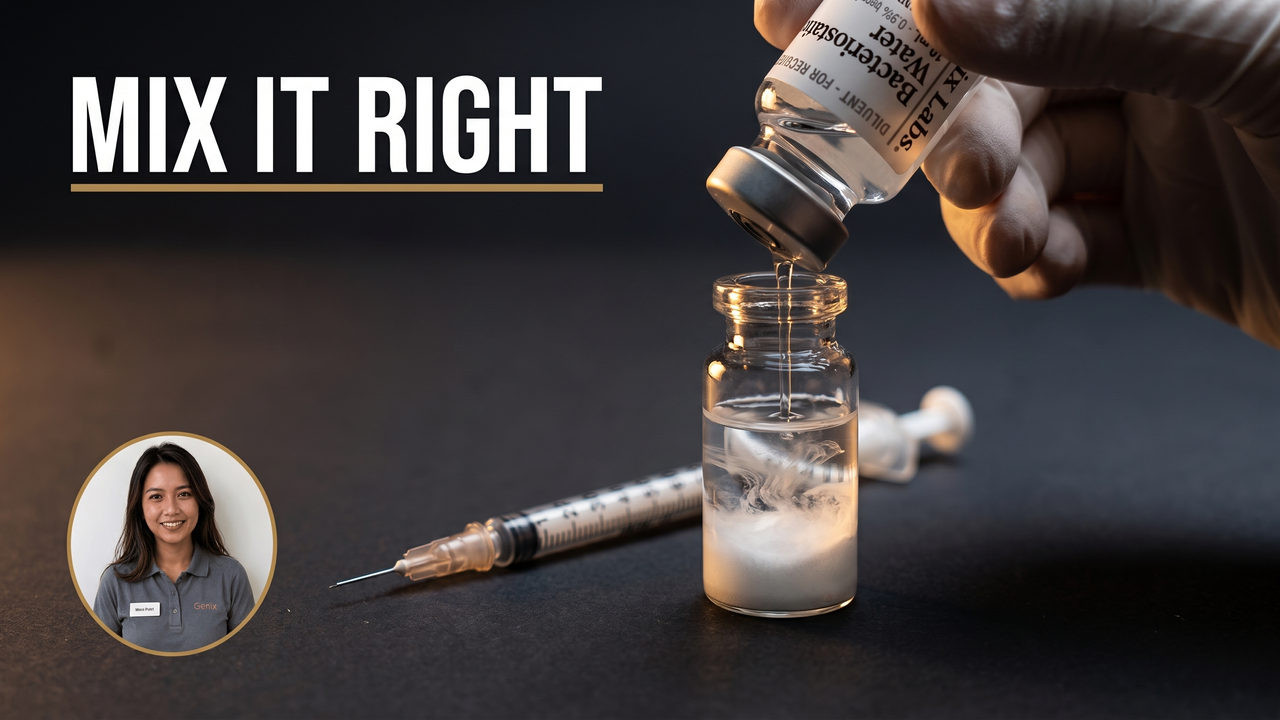
Reconstitution is a two-step idea. First, you pick a water volume. Second, that volume sets the concentration. More water means a weaker solution, so each unit on the syringe holds less peptide. Less water means a stronger solution, so each unit holds more. The peptide amount in the vial never moves. Only the concentration does.
Here is the same idea as a table. This is the core MOTS-C reconstitution chart for a 10 mg vial, and it is the part you can trust, because it is pure division. It says nothing about how much a person should use. It only tells you what is in each mark on the syringe.
| Water added | Concentration | 1 unit (U-100) | 10 units | 25 units | 50 units |
|---|---|---|---|---|---|
| 1 mL | 10 mg/mL | 0.10 mg | 1.0 mg | 2.5 mg | 5.0 mg |
| 2 mL | 5 mg/mL | 0.05 mg | 0.5 mg | 1.25 mg | 2.5 mg |
| 3 mL | 3.33 mg/mL | 0.033 mg | 0.33 mg | 0.83 mg | 1.67 mg |
| 5 mL | 2 mg/mL | 0.02 mg | 0.2 mg | 0.5 mg | 1.0 mg |
Units, mL, and mg made simple
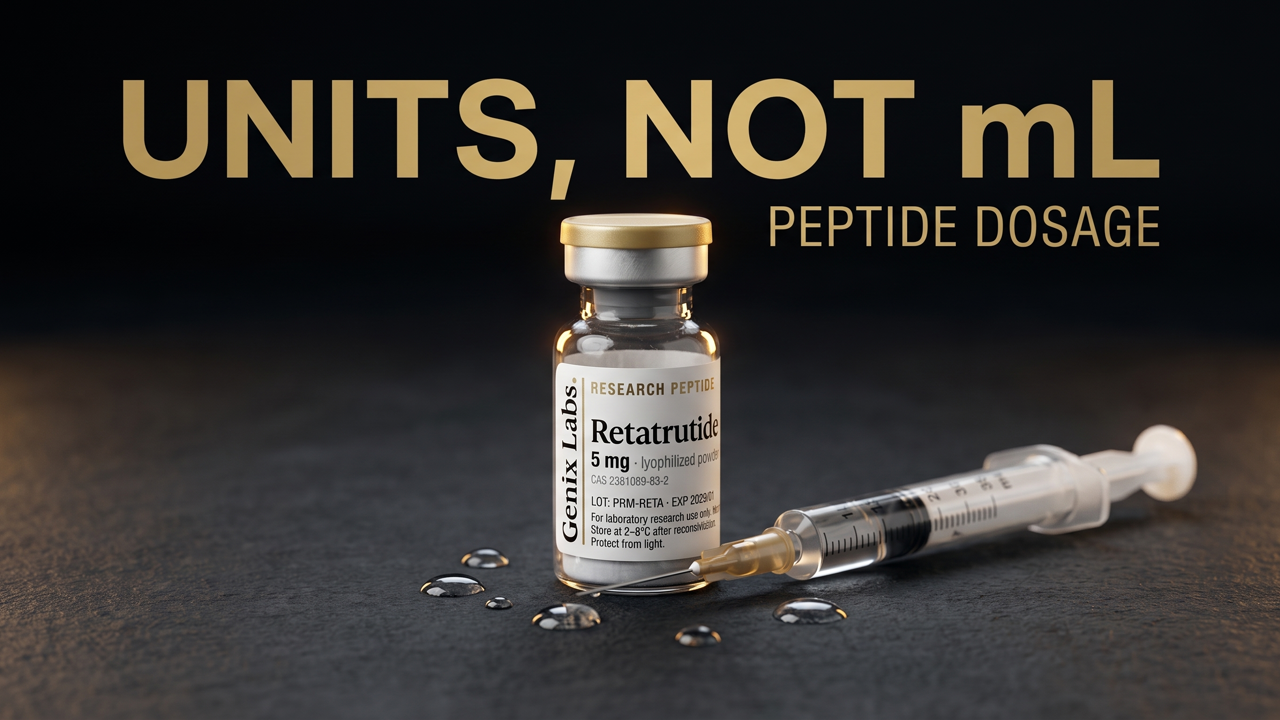
The confusion in almost every dosage-chart question comes from mixing three different measures. Milligrams (mg) are the amount of peptide. Milliliters (mL) are the amount of liquid. Units are the tiny marks on an insulin syringe. They are not the same thing, and a chart only makes sense once you keep them apart.
- Milligrams (mg) measure the peptide itself. A 10 mg vial always holds 10 mg.
- Milliliters (mL) measure the liquid. This is the water you add.
- Units are the syringe marks. A U-100 syringe has 100 units per 1 mL.
- Concentration (mg/mL) is the bridge between them: amount of peptide divided by amount of liquid.
Once concentration is fixed, everything else is arithmetic. If you want to convert a research amount in mg into syringe units, our peptide dosage calculator guide walks through the exact formula, and it works for MOTS-C the same way it works for any peptide.
A worked example
Say you have a 10 mg vial and you add 2 mL of water. That makes 5 mg per mL. Now suppose a study design calls for measuring 2 mg. You divide 2 mg by 5 mg per mL, which is 0.4 mL. On a U-100 syringe, 0.4 mL is 40 units. So the answer is 40 units. Change the water and the units change, but the method never does. That is why the math beats a memorized number.
| The question | The math | The answer |
|---|---|---|
| 10 mg vial, 2 mL water | 10 mg / 2 mL | 5 mg per mL |
| Measure 2 mg | 2 mg / 5 mg per mL | 0.4 mL |
| Convert to units | 0.4 mL x 100 | 40 units |
This is reported here to show the arithmetic, not to tell any person what to measure. The 2 mg figure is an example number, chosen to make the math clear.
How many research portions in a vial?
A common practical question is how far a single 10 mg vial goes. That answer does not depend on the water at all. It depends only on the portion size you measure out. A 10 mg vial split into 2 mg portions gives five portions. Split into 1 mg portions, it gives ten. The water changes how many units each portion is, not how many portions the vial contains.
MOTS-C dosage per day or per week?
This is the question behind most searches, and it is where honesty matters most. In the animal research where MOTS-C has been studied the most, it was usually given a few times a week, not every day, and often around the time of exercise. There is no established human schedule, because the human trials that would set one have not been done. So per day versus per week is not a settled fact. It is a research design choice that varies from study to study.
| Pattern | What it means | What the research suggests |
|---|---|---|
| Daily | A small amount every day | Less common in the studies; not established in people |
| A few times a week | Spaced out across the week | The more common pattern in animal work |
| Around exercise | Timed to training days | Fits the biology, since MOTS-C is tied to exercise |
| Cycled | On for a period, then off | Often described, but not from human trials |
Notice that none of these rows gives you a number to copy. That is on purpose. A weekly amount for a person is a medical question, and no honest chart can answer it for you. What is real is the pattern: research tends to space it out rather than dose it every single day.
What is a MOTS-C starting dose in research?
Search results love the phrase starting dose, but it comes from medicine, where a drug has an approved label. MOTS-C has no approved label. In the research literature, amounts are usually scaled to body weight in animals, then guessed at for humans by people writing online, which is why the numbers you see vary so widely. A low, conservative research amount is often described as a way to observe a material before any wider work, but that is a research habit, not a recommendation for you.
- MOTS-C is a research material, not an approved medicine with a label.
- Most dosing data comes from animals, scaled by body weight.
- Human trials that would set a starting dose have not been completed.
- Any specific number online is someone's guess, not a clinical standard.
Why there is no official protocol PDF
A lot of people search for a MOTS-C dosage protocol PDF, hoping for an official document. There is not one, and it helps to understand why. Official dosing PDFs come from drug regulators and drug makers, after large human trials. MOTS-C has not gone through that process. The PDFs floating around are made by sellers and forums, not regulators. The only document that ships with a real research vial is a certificate of analysis, which tells you what is in the vial, not how a person should use it.
How MOTS-C works
MOTS-C is a mitochondrial-derived peptide, a short chain of 16 amino acids that your own mitochondria produce. Mitochondria are the tiny engines inside your cells that turn food and oxygen into usable energy. MOTS-C is studied as a signal these engines send out to help the body manage energy and metabolism, especially under stress like exercise or fasting.
In the research, MOTS-C appears to work through a cellular energy sensor called AMPK, which the body switches on when energy runs low. When MOTS-C activates this pathway, cells lean toward burning fuel and staying metabolically flexible. Reynolds and colleagues, writing in Nature Communications in 2021, described MOTS-C as an exercise-induced peptide that can move into the cell nucleus and influence genes tied to metabolism. This is early science, mostly in cells and animals, but it is why the interest in MOTS-C sits in the energy and metabolism space.
What the research suggests MOTS-C does
Because MOTS-C works upstream at the mitochondria, the studied effects cluster around energy, metabolism, and exercise capacity rather than appetite. It is important to keep the tense honest: these are research findings, largely preclinical, not proven human outcomes.
- Metabolic balance: in early work, MOTS-C supported insulin sensitivity and steadier fuel use.
- Exercise capacity: in animal studies, it was linked to better physical performance, including in older animals.
- Cellular energy: it acts on the mitochondria, the part of the cell that actually makes energy.
- Longevity interest: because it protects metabolic flexibility, it is studied in the aging field.
For the fuller picture of what MOTS-C is and why people in the metabolism space reach for it, see our MOTS-C dosing and reconstitution overview, which sits alongside this chart in the same cluster.
How MOTS-C compares to other energy peptides
MOTS-C is often lumped in with other research peptides in the energy and metabolism space, but they are not the same. Knowing the difference helps you read any chart with the right frame. MOTS-C works at the mitochondria. The GLP-1 style compounds work on appetite. NAD-related materials work on a different energy coenzyme. None is a swap for another.
| Material | Main angle | How it is studied | Genix sells it? |
|---|---|---|---|
| MOTS-C | Mitochondrial energy, metabolism | A few times a week, often around exercise | Yes, 10 mg vial |
| NAD+ | Cellular energy coenzyme | Larger amounts, energy and aging focus | Yes |
| Retatrutide | Appetite and weight | Weekly, slow step-up | Yes |
| Tesamorelin | Growth hormone, deep belly fat | Daily in the trials | Yes |
The point is that a MOTS-C chart tells you nothing about a retatrutide chart, and the reverse is true too. Each material has its own math and its own research. If your interest is the metabolic side, our guide to peptides for weight loss maps out where each one fits.
When did the research use it?
Timing is one area where the biology gives a hint. Because MOTS-C is released by the body during exercise, several studies looked at it around physical activity. That has led many research designs to time it near training rather than at random. There is still no proven best time for a person, and timing questions in humans are not settled. But if you are reading a chart, the pattern to notice is exercise-adjacent, not fixed to a clock.
How long are MOTS-C cycles?
Research materials are often studied in cycles, a period of use followed by a break, so observers can watch what happens and then what settles back. Online write-ups describe MOTS-C cycles of a few weeks, but those come from user reports, not controlled trials. The honest summary is that no human study has established an ideal cycle length. A cycle in a research context is a study design, not a personal schedule.
What is MOTS-C stacked with?
In research discussion, MOTS-C is often paired with other metabolic or longevity peptides, because it works on cellular energy rather than appetite, so it does not overlap with the GLP-1 style compounds. People describe pairing it with NAD-related materials for the energy angle, or with recovery peptides. Every combination raises new unknowns, though. Two materials studied separately do not automatically behave well together.
MOTS-C dosage for women
People search specifically for MOTS-C dosage for women, and the honest answer is that the research does not split cleanly by sex. Most of the studied work is in animals, and the human data that would let anyone give a woman-specific number does not exist yet. The reconstitution math is identical regardless of who is doing the research. The dosing amount is a medical question that should be answered by a clinician, not by a blog and not by a gendered chart copied from a forum.
Side effects and safety
The most honest thing to say about MOTS-C safety is that the long-term human picture is unknown, because the trials have not been done. Reported effects from user accounts tend to be mild, like soreness where an injection was given in a research setting, or a brief flushed or light-headed feeling. But user reports are not the same as safety data. This is exactly why the material is sold for research use only.
- Reported effects are usually mild in user accounts, but this is not trial data.
- Long-term safety in humans is unknown, since the studies do not exist yet.
- Quality varies a lot between suppliers, which is its own safety issue.
- Impurity, not the peptide itself, is often the real risk with cheap vials.
Legal status and sport
MOTS-C is not a scheduled narcotic, and no law names it as a banned substance. It is widely sold as a research chemical for laboratory use, which is the framing to keep in mind: research use only, not a consumer supplement and not an approved medicine. That is a grey area rather than a clearly illegal one, and rules differ by country, so it is worth checking your own situation.
Sport is the one place with a firm rule. Because MOTS-C acts on metabolism and is a peptide of interest for performance, competitive athletes should treat it as prohibited in tested sport and check the current World Anti-Doping Agency list before going near it. For a general reader, the practical point is simple: this is a research material, handle it as one.
Beginner mistakes to avoid
Most reconstitution mistakes are math mistakes, not peptide mistakes. They come from mixing up units, mL, and mg, or from trusting a random chart instead of doing the division. A few show up again and again.
- Confusing units with mL. Units are syringe marks; mL is liquid. They are not equal.
- Copying a number from a forum without checking the concentration it assumed.
- Adding water fast or shaking the vial hard instead of letting it dissolve gently.
- Trusting a vendor dosing PDF over the batch certificate of analysis.
- Assuming a stronger concentration means a stronger result. It only changes the units drawn.
Storing MOTS-C the right way
Storage is where a good vial gets ruined. As a dry powder, MOTS-C is stable in a cold fridge, and it can be kept frozen for longer periods before mixing. Once it is reconstituted with water, it belongs in the fridge and is best used within a few weeks. Heat and light are the enemies. Our full guide on how to store peptides in a hot climate covers this in detail, which matters in a place like Bali.
| State | Where it belongs | Rough window |
|---|---|---|
| Dry powder, sealed | Cold fridge or freezer | Longest, before mixing |
| Reconstituted | Fridge, kept cold | A few weeks |
| Left warm or in light | Nowhere; this degrades it | Avoid entirely |
Why a calculator beats a copied PDF
The reason a PDF chart fails is that it locks in one concentration. The moment you add a different amount of water, every number on that PDF is wrong. A calculator, or the plain division in the table above, never goes stale, because it starts from the concentration you actually made. That is why we point people to the math rather than a downloadable sheet. Work from the calculation, not the chart, and you will always be right for your own vial.
Why purity matters more than any chart
A dosage chart only means something if the vial holds what the label says. If a 10 mg vial is really 7 mg, or is capped with a different peptide, the cleanest math in the world gives you the wrong answer. This is why a certificate of analysis matters more than any dosing sheet. A Genix batch COA shows HPLC purity of at least 99%, LC-MS identity confirming the peptide really is MOTS-C, and a lot number that matches your vial.
Buying MOTS-C in Bali
Genix Labs delivers lab-tested MOTS-C across Bali, often within about 2 hours in Canggu, Seminyak, Ubud, Sanur, and Denpasar. Every 10 mg vial ships cold with a batch certificate of analysis you can read before you pay, with cash on delivery. That is the trust layer the copied charts online cannot offer.
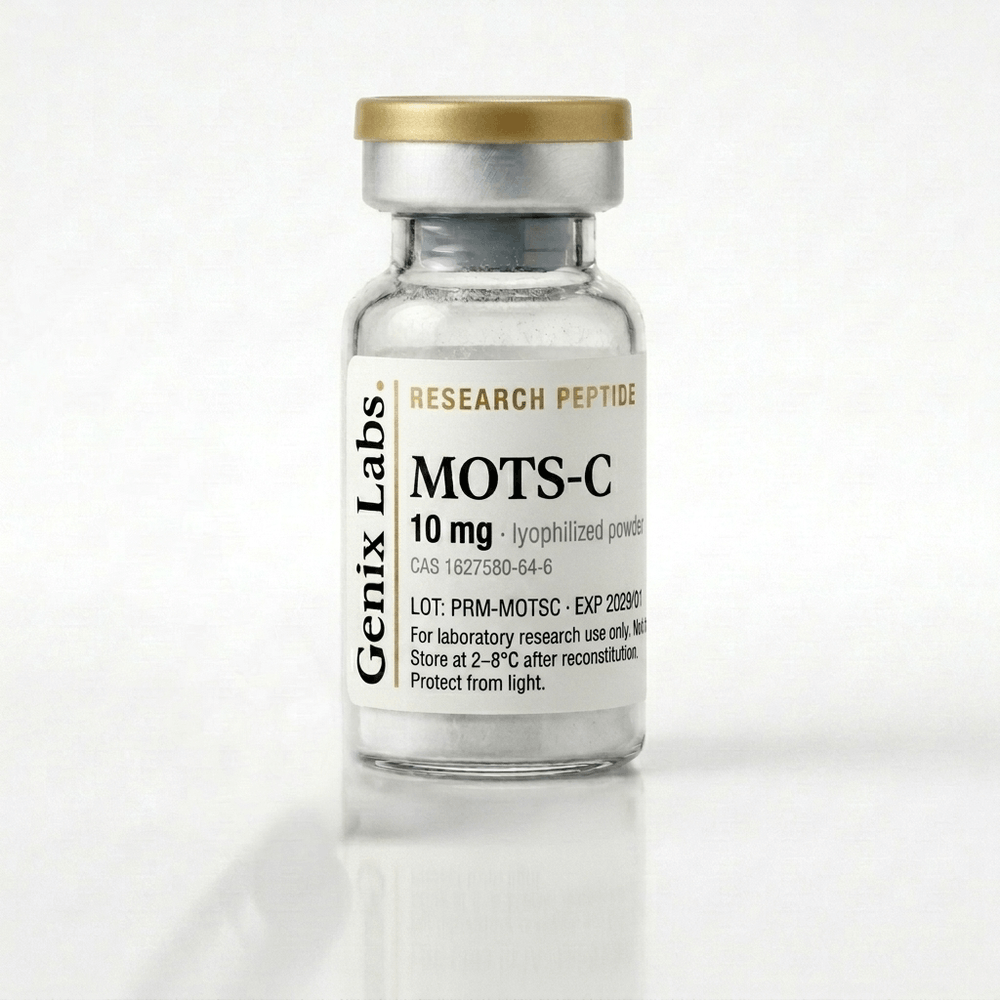
A 10 mg vial at purity of at least 99% by HPLC, LC-MS identity, and a batch certificate of analysis in every order. From $79, same-day in Bali.
Buy MOTS-C in BaliFrequently asked questions
What is the MOTS-C dosage per week?
There is no established weekly number for people, because the human trials have not been done. In animal research, MOTS-C was usually given a few times a week rather than daily. Any specific weekly amount you see online is a guess scaled from animal work, not a clinical standard. Research use only.
How do you reconstitute a 10mg MOTS-C vial?
In a lab, a 10mg vial is mixed with bacteriostatic water. The water sets the concentration: add 1 mL for 10 mg per mL, or 2 mL for 5 mg per mL. The vial always holds 10mg either way. This is reconstitution math for research use only, not human use.
Is there a MOTS-C dosage protocol PDF?
There is no official protocol PDF. Real dosing documents come from drug regulators after human trials, and MOTS-C has not gone through that process. The PDFs online are made by sellers and forums. The only document that ships with a real vial is a certificate of analysis. Research use only.
What is the MOTS-C dosage for women?
The research does not split dosing by sex, because most data is from animals and the human trials do not exist. The reconstitution math is identical for anyone. A woman-specific dose is a medical question for a clinician, not a chart copied from a forum. This is not medical advice.
What is a MOTS-C starting dose?
Starting dose is a medical term for a drug with an approved label, and MOTS-C has none. In research, amounts are scaled to body weight in animals, then guessed for humans, which is why online numbers vary so widely. Any specific starting number is someone's guess, not a standard. Research use only.
Do you take MOTS-C every day?
Daily use is less common in the research. The animal studies more often spaced MOTS-C a few times a week, and some timed it around exercise, since MOTS-C is released during activity. There is no proven human schedule. Per day versus per week is a research design choice, not a settled fact.
Takeaway
A MOTS-C dosage chart is really two charts. The mixing chart is trustworthy, because it is arithmetic: a 10 mg vial plus a chosen amount of water gives a known concentration, and the rest is division. The dosing chart is not trustworthy, because the human trials that would set one do not exist, so any specific number online is a guess. Work from the concentration you actually made, read the certificate of analysis, and remember the frame: MOTS-C is for research use only, and this guide is education, not medical advice.