
What is a peptide injection pen?
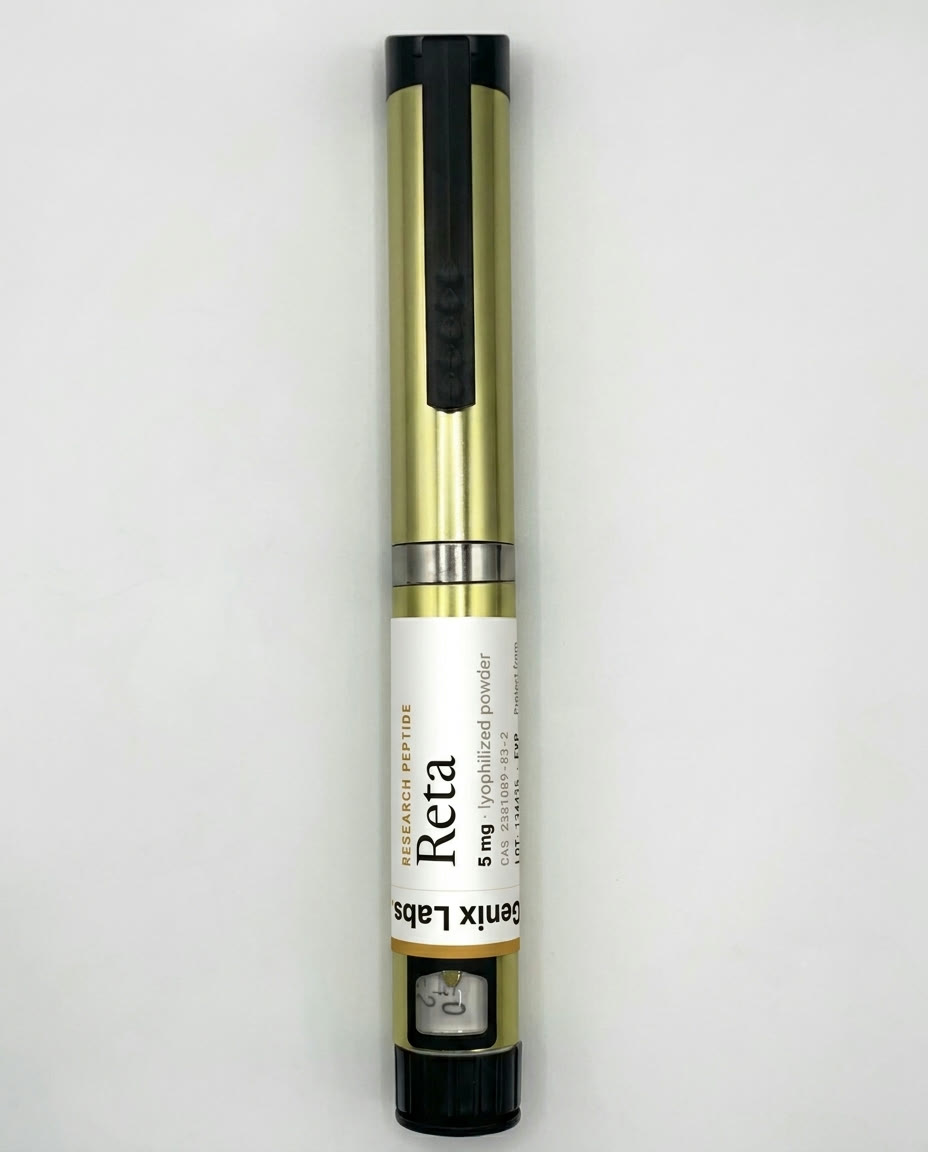
A peptide injection pen is a reusable handheld device that holds a cartridge of reconstituted peptide solution and delivers a set volume at the click of a dial. It does not mix the peptide and it does not change the peptide. It is a measuring and delivery tool, nothing more.
Search the term and you get shopping listings. Amazon, eBay, a handful of vendor storefronts, and one forum thread full of people asking why their pen leaked. Almost nobody explains the device. That is a strange gap, because the pen is the part of a peptide workflow most likely to go wrong.
So this guide does the explaining. How the mechanism works, what a click actually equals, how much liquid the pen keeps and never gives back, when a plain syringe is the smarter choice, and how to read a listing well enough to avoid a bad one. We sell a pen. We will also tell you when you do not need one.
What comes in a peptide pen kit?
A complete kit has three things: the pen body, at least one cartridge, and a strip of needles. If a listing shows only the pen, you cannot use it on arrival. That is the single most common complaint in marketplace reviews, and it is a packaging problem rather than a product fault.
- The pen body. Dose dial, plunger rod, cartridge holder, and a threaded or snap needle hub. This is the durable part. It should last months.
- At least one cartridge. The glass or plastic reservoir your solution goes into. Cartridges are consumable and are matched to the pen. They are not interchangeable across brands.
- A strip of needles. Ten is the usual count. Each one is single use, which is exactly why they ship in tens rather than ones.
- A loading guide. Often missing. Without it, people guess at the click increment, and guessing is where accuracy dies.
The Genix reusable auto-inject pen ships as pen, cartridge, and ten pre-sterilised fine-gauge needles, with the increment printed on the guide. We bundle it that way because a pen with no needles is an ornament.
How does a peptide pen actually work?
The mechanism is older than peptides and comes straight from insulin pens. Turning the dial winds a plunger rod back by a fixed number of steps. Pressing the button releases it. The rod pushes the cartridge stopper forward by exactly that distance, and the stopper displaces liquid out through the needle.
That is the whole trick, and it explains both strengths and limits. The pen is accurate because the distance is mechanical rather than visual. You are not squinting at a line on a barrel. You are counting clicks, and clicks do not drift with the light or your eyesight.
It is limited for the same reason. The step size is fixed by the gearing. A pen cannot deliver half a click. If your work needs a volume that falls between two clicks, the pen will round it, and it will round it the same wrong way every single time.
Are peptide pens worth it?
A pen is worth it when you repeat the same measured volume often and want every draw identical. The click mechanism removes eyeballing, and the hidden needle removes most of the dread. A pen is not worth it for very small volumes or occasional one-off work, where a syringe wastes less liquid and costs nothing extra.
That is the honest answer, and it splits by how you actually work rather than by budget. Three questions settle it faster than any review.
- Do you repeat the same volume? If yes, a pen pays for itself in consistency. If every draw is a different amount, the dial becomes a nuisance and a syringe is faster.
- Is the volume above the click floor? Pens have a smallest meaningful step. Below it you are rounding, and rounding defeats the point of buying a precision device.
- Is your vial small and expensive? Then residual loss matters more than comfort. See the dead-space section for what that costs in real terms.
Mapped onto the way people actually work, the answer stops being a matter of taste and becomes fairly clear.
| Your situation | Better tool | Why |
|---|---|---|
| One fixed volume, used several times a week | Pen | Repeatability compounds. The dial removes the one step where human error lives. |
| Volumes that change every time | Syringe | Re-dialling for every draw is slower than simply reading a line, and the pen adds no accuracy. |
| Very small volumes near the click floor | Syringe | A pen rounds anything below its smallest step, and it rounds the same way every time. |
| Small, costly vials | Syringe | Residual loss is proportional. On an expensive vial it outweighs the comfort gain. |
| You dislike the needle enough to skip work | Pen | A hidden needle and a spring-driven push solve a real problem that no amount of technique fixes. |
| A single one-off evaluation | Syringe | Nothing to amortise. The pen, cartridge, and learning curve are all overhead. |
Peptide pen or insulin syringe?
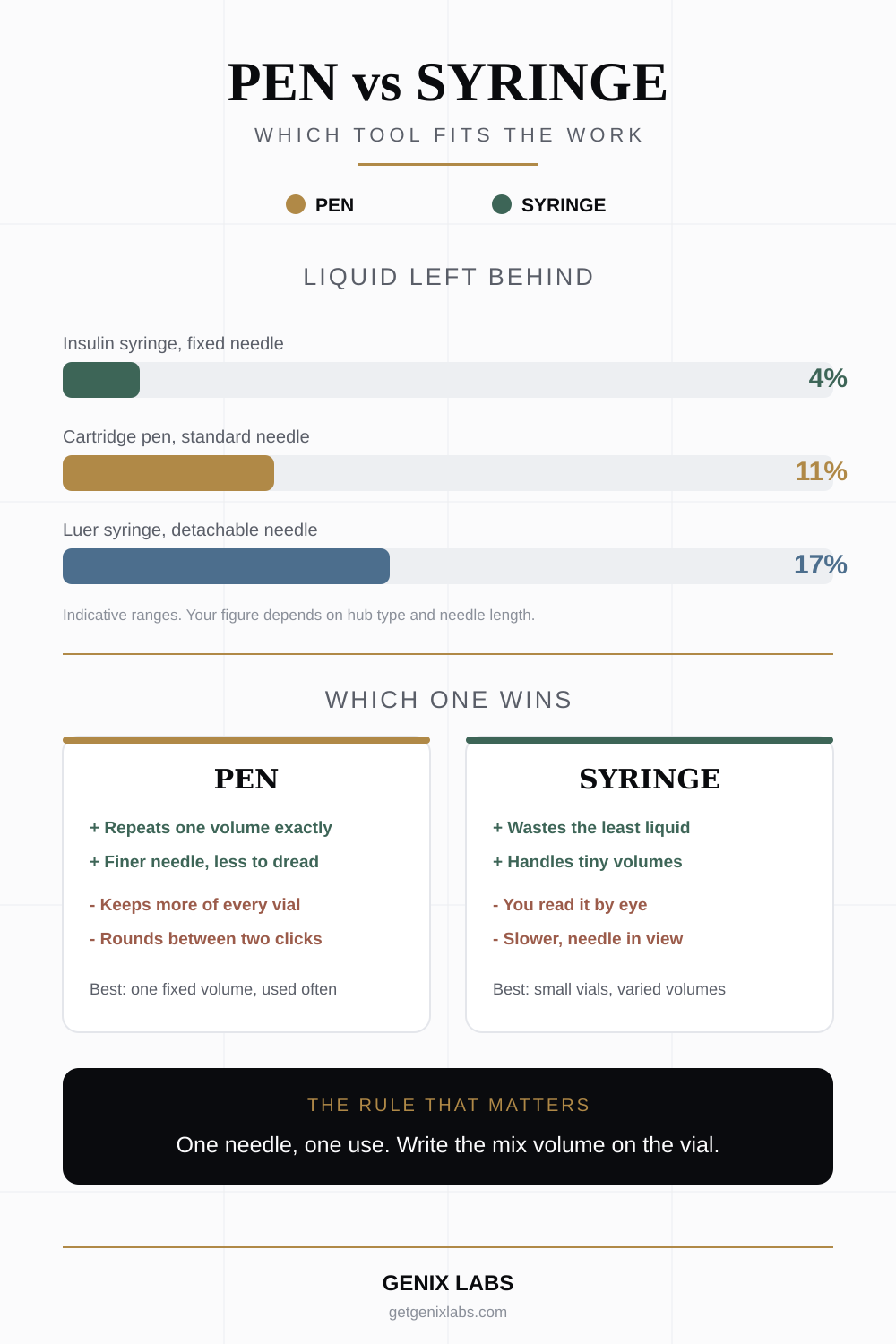
This is the real decision, and neither tool wins outright. A syringe is a ruler. A pen is a counter. Pick based on which error you would rather make.
| Cartridge pen | Insulin syringe | |
|---|---|---|
| Repeatability | High. Clicks do not drift. | Depends on your eyes and your hand. |
| Smallest usable volume | Limited by the click step. | Down to the finest graduation on the barrel. |
| Liquid left behind | Moderate. Cartridge and hub both hold some. | Lowest with a fixed needle. |
| Comfort | Finer needle, spring-driven, needle hidden. | Visible needle, manual push, slower. |
| Cost to start | Pen plus cartridges plus needles. | Cents per unit, nothing else needed. |
| Best suited to | One repeated volume, used often. | Variable or very small volumes. |
| Failure mode | Silent rounding on every dose. | A visibly misread line, once. |
Note the last row, because it is the one nobody mentions in a product listing. A syringe error is usually loud and obvious. You see that you drew to the wrong line. A pen error is quiet. If the concentration in the cartridge is wrong, the pen keeps delivering the wrong amount with perfect confidence, and nothing on the device tells you.
That is an argument for doing the arithmetic carefully before the pen ever gets involved. Our guide to calculating peptide concentration walks the same math a cartridge needs.
Can you use an insulin pen for peptides?
Mechanically, often yes. An insulin pen is the same device with a different label, and a refillable insulin pen will drive a cartridge of any clear solution. Practically there are three catches, and the first one is the reason this question comes up at all.
Insulin pens are calibrated in insulin units, not in millilitres. On a standard U-100 pen, one unit equals 0.01 mL. That conversion is fixed and it is the only reason an insulin pen can be used sensibly here. If a pen is U-200 or U-300, the printed units no longer map to 0.01 mL, and every number on the dial becomes a trap.
- Check the concentration rating first. U-100 means one unit is 0.01 mL. Anything else means the dial lies about volume, and you cannot correct for it by dialling differently.
- Disposable pens are sealed. A prefilled disposable is not designed to be opened or refilled. Only a refillable pen with a removable cartridge holder is a candidate.
- Cartridges are not universal. A 3 mL cartridge from one system frequently will not seat in another body. Seating is the leak point, so a nearly-fitting cartridge is worse than no cartridge.
- Never reuse a pen that held something else. Residual solution sits in the hub and the stopper gap. Cross-contaminating a research compound ruins the result and you cannot flush it out.
So the answer is that a refillable U-100 pen with a matching empty cartridge will work, and anything outside that description is a false economy. A purpose-built research pen costs less than the vial you would waste discovering otherwise.
What do you use to inject peptides?
Research workflows use either a graduated insulin syringe or a cartridge-fed auto-inject pen, plus bacteriostatic water to reconstitute the lyophilised powder first. The syringe suits tiny or variable volumes. The pen suits a repeated fixed volume where click-set repeatability matters more than saving residual liquid.
The full equipment list is short, and two items on it get skipped more often than they should.
- Bacteriostatic water. Not sterile water, not saline. The benzyl alcohol is what lets a mixed vial hold for weeks instead of days. Our bacteriostatic water guide covers the difference properly.
- A delivery device. Pen or syringe, per the table above.
- Fresh needles. One per use. Non-negotiable, for reasons covered below.
- Alcohol swabs. For the vial septum and the cartridge port. The septum is the entry point for contamination, and it gets punctured repeatedly.
- A sharps container. Boring, and the item most often absent from a marketplace bundle.
How do pen units translate to milligrams?
A pen reads in units or clicks, never in milligrams. The conversion depends entirely on how much water you used to reconstitute. The same pen set to the same number delivers a different mass of peptide from a thin solution than from a concentrated one. This is where most pen errors are born.
Work it in one direction only. Start from the vial, not from the pen. You know the mass of powder in the vial because the label says so. You choose the volume of bacteriostatic water. Those two numbers give you a concentration, and only then does the pen dial mean anything.
| Powder in vial | Water added | Concentration | What one 0.01 mL step carries |
|---|---|---|---|
| 10 mg | 1 mL | 10 mg per mL | 0.1 mg |
| 10 mg | 2 mL | 5 mg per mL | 0.05 mg |
| 5 mg | 1 mL | 5 mg per mL | 0.05 mg |
| 5 mg | 2 mL | 2.5 mg per mL | 0.025 mg |
Read that table twice, because it contains the trap. Rows two and three show identical concentrations from different vials. Rows one and two show the same vial giving two completely different answers depending on one choice you made at the sink. The pen knows none of this. It only counts clicks.
Which leads to a rule worth writing on the cartridge itself: record the reconstitution volume the moment you add the water. Not later. A cartridge with no note on it is a cartridge of unknown strength, and the only safe thing to do with one is discard it.
- Write the volume on the vial. Date it too. Mixed solution has a shelf life.
- Standardise one volume. If you always use the same water volume, the conversion becomes one number you memorise rather than arithmetic you redo under time pressure.
- Check the click increment, not the click count. Two pens can both say twelve and deliver different volumes. The increment is the spec that matters.
How much peptide does a pen waste?
Every injection device keeps a little liquid you never get back. It sits in the needle bore, the hub, and the gap above the cartridge stopper. This is called dead space. A cartridge pen typically loses more than a fixed-needle insulin syringe and less than a detachable-needle Luer syringe.
Nobody selling pens talks about this, so let us put a number on it. Take a 10 mg vial reconstituted into 2 mL. If the pen and needle hold back roughly a tenth of what you load, you lose about a tenth of that vial across the cartridge life. On a vial that costs real money, that is a recurring line item, not a rounding error.
Two practical consequences follow. First, on small or costly vials the syringe is the economical tool, and no amount of comfort changes that arithmetic. Second, the last portion of a cartridge is the least trustworthy part. As the stopper reaches the end of its travel, the relationship between clicks and delivered volume gets less reliable. Plan to finish a cartridge rather than scrape it.
Does a cartridge change how the peptide holds?
Yes, and this is the part of the pen question that genuinely has nothing to do with convenience. A peptide in solution is fragile in specific ways, and a cartridge exposes it to two of them more than a sealed vial does: surface area and air.
Peptides adsorb onto surfaces. Some of what you load sticks to the cartridge wall and the stopper rather than staying in solution, and the thinner the solution the larger that fraction is proportionally. This is also why froth matters. An air and liquid interface is a surface, and whipping air into a solution multiplies the area a peptide can stick to and denature on.
Air gets a second mention because a cartridge sits part-empty for most of its life. As the stopper advances, headspace grows. That headspace holds oxygen, and oxidation is the slow failure mode for a mixed peptide. A vial has the same issue, but a vial is usually drawn down faster and kept colder between uses.
- Shorter cartridge life than vial life. Treat a loaded cartridge as having less working time than the same solution left in its vial, not more.
- Do not load more than you will use. A large cartridge filled once and used slowly is the worst case for both adsorption and oxidation.
- Draw slowly, always. Froth is not cosmetic. It is surface area, and surface area is where peptide is lost.
- Keep it cold between uses. Two to eight degrees Celsius for the solution. Temperature is the single biggest lever you control.
None of this makes a pen a bad choice. It does mean the pen is not a storage container. It is a delivery device, and the solution should be treated on the vial's clock rather than the pen's convenience.
What needle gauge and length does a pen use?
Pen needles are described by two numbers, and both are printed on the box rather than the pen. Gauge is thickness and length is depth. Getting either wrong is the most common reason a pen feels worse than the syringe it replaced.
Gauge runs backwards, which trips people up constantly. A higher gauge number means a thinner needle. A 32 gauge needle is finer than a 29 gauge one. Pen needles typically sit in the 31 to 33 gauge range, and that thinness is most of why a pen is more comfortable than a standard syringe needle.
| Spec | What the number means | What to watch |
|---|---|---|
| Gauge, e.g. 32G | Thickness. Higher number means thinner needle. | Thinner is more comfortable but delivers more slowly. Very thin needles can clog on a thick solution. |
| Length, e.g. 4mm | How deep the needle reaches. | Shorter needles hold less liquid in the bore, so dead space drops. Longer needles waste more. |
| Hub type | How the needle attaches to the pen. | Screw-on is the common standard. A proprietary hub locks you to one supplier. |
| Wall type | Standard or thin-wall bore. | Thin-wall gives a wider channel at the same gauge, so flow improves without a thicker needle. |
Two consequences are worth holding on to. First, needle length feeds straight back into the dead-space arithmetic above. A shorter needle holds less liquid in its bore, so switching from a long needle to a short one measurably reduces what you lose per use. It is the cheapest waste reduction available.
Second, there is a floor on thinness. A very fine needle on a viscous or incompletely dissolved solution will either clog or deliver so slowly that you lift off before the dose finishes. If a dose feels like it is taking unusually long, the needle is too fine for that solution rather than the pen being faulty.
How many times can you use a peptide pen needle?
Once. A pen needle is ground to a single-use edge and begins to dull on the first pass, and the silicone coating that helps it glide strips away with it. Reuse also leaves the channel open to contamination between uses. Needles ship in tens for exactly this reason. Fit a fresh one each time.
This gets argued about online, so it is worth saying why it is not a matter of opinion. Electron microscopy of used pen needle tips shows visible deformation after a single pass. The point bends, and on reuse that bent point tears rather than slices. Tearing is what makes a second use hurt more than the first.
- It blunts immediately. The whole reason to use a pen is comfort. A reused needle throws that away and leaves you with the cost.
- The coating goes. Silicone lubricant is a one-pass feature. Without it, drag increases.
- It is an open channel. A needle left on the pen connects the cartridge to room air through a bore you cannot clean.
- Liquid can move. A needle left in place lets solution seep out or air seep in, which quietly changes what the next click delivers.
The last point is the one people miss. Leaving the needle on is not just a hygiene question. It is an accuracy question, because a cartridge that has lost liquid or gained an air bubble no longer matches the math you wrote on it.
What is the best peptide injection pen?
The best pen is the one whose smallest click matches the volume your work actually uses, takes standard pen needles you can resupply locally, and holds a dose without drift. Ignore brand noise. Check the click increment, the cartridge size, and whether replacement needles are easy to buy where you are.
Marketplace listings are built to hide exactly those three specs, so here is the checklist in the order it matters.
| Spec to check | Why it decides the purchase |
|---|---|
| Click increment | The smallest volume the pen can deliver. If your working volume is below it, the pen is the wrong tool at any price. |
| Cartridge capacity | Sets how many uses per load and how often you re-expose the solution to air. Larger is not automatically better. |
| Needle standard | A pen that takes common pen needles can be resupplied anywhere. A proprietary thread ties you to one seller. |
| Dose hold | A good pen keeps a set dose when you put it down. A pen that drifts off its setting is unusable for repeat work. |
| Reusability | A reusable body plus cheap cartridges beats a disposable pen on cost within a couple of cycles. |
| What ships in the box | Pen plus cartridge plus needles means you can work on arrival. Pen only means another order and another wait. |
Notice what is not on the list. Not the brand, not the colour, not the review count. A pen is a simple mechanical device, and the specs above fully describe whether it fits your work. Anything else is marketing.
What to watch when buying a pen online
Most people find a pen on a marketplace, because that is what ranks. Marketplace listings are fine for the device and bad for the information. Four patterns are worth recognising before you buy.
- No click increment anywhere. If the single most important spec is missing from the listing and the questions, assume it was left out on purpose.
- Photos of a pen, bundle of none. Read the contents line, not the hero image. The image almost always shows needles that the bundle does not include.
- Proprietary cartridges with no resupply. A cheap pen that only takes one seller's cartridge is an expensive pen with a delay built in.
- Reviews about leaking. Leaks are usually a cartridge seating fault, and seating faults do not get fixed by technique. Sort reviews by recent and read the one-star ones first.
The deeper issue is that a marketplace sells you a device and tells you nothing about the compound going into it. The pen is the easy half. A verified peptide with a per-batch certificate of analysis is the half that actually determines whether your work means anything.
How do you load a reconstituted peptide?
Loading is where a careful workflow pays off. The sequence below is the one we walk clients through, and the order is deliberate. Every step exists because skipping it causes a specific, common failure.
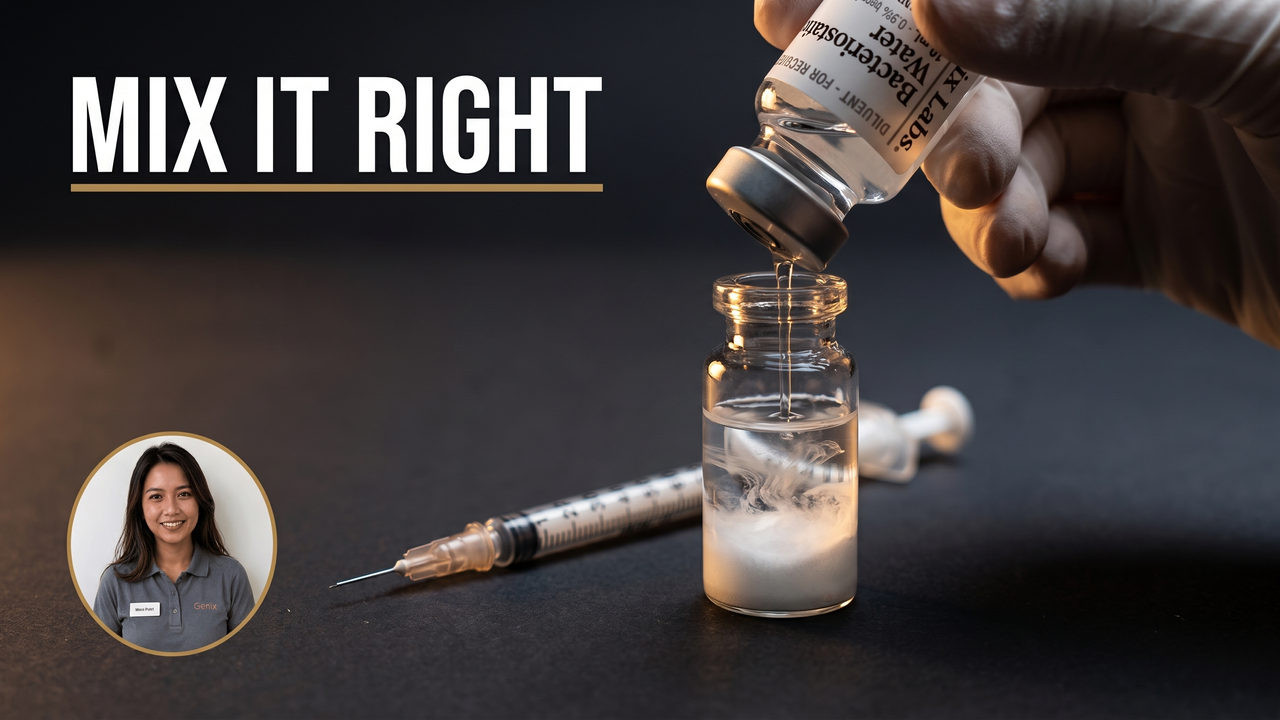
- Reconstitute, and write it down. Add bacteriostatic water slowly down the vial wall. Note the volume and the date on the label before you do anything else. Our no-clump reconstitution method covers this step on its own.
- Inspect in good light. The solution should be clear with no clumps, no haze, and no floaters. A pen cannot filter. Whatever is in the cartridge reaches the needle.
- Swab both ports. The vial septum and the cartridge port. Let the alcohol dry rather than wiping it off.
- Draw without froth. Pull slowly. Fast draws whip air into the solution, and peptides are surface-sensitive. Froth is also what makes a cartridge read full when it is not.
- Seat the cartridge fully. This is the leak step. A cartridge that is nearly seated will weep at the hub under spring pressure.
- Fit a fresh needle, then prime. Prime until liquid appears, so the first click delivers liquid rather than the air sitting in the bore.
- Set the dose and check the window. Confirm the number matches the math you wrote on the vial. This is the last point where a quiet error is still catchable.
How do you clean and store a pen?
A pen body is a dry mechanism and should stay that way. It does not go in the fridge, it does not get rinsed, and it does not get submerged. The solution needs cold. The device does not.
- Wipe, do not wash. A dry cloth on the outside, an alcohol swab on the hub. Water inside the plunger mechanism is how a pen starts skipping clicks.
- Store at room temperature, needle off. Room temperature, out of sunlight, with no needle attached.
- Keep the solution cold, not the pen. A reconstituted vial lives at 2 to 8 degrees Celsius. In Bali's heat that matters more than most places, which is why we wrote a local storage guide.
- Never freeze a mixed solution. Freezing and thawing damages peptides in solution. A cartridge that has been frozen should not be loaded.
- Retire a drifting pen. If it will not hold a set dose, the gearing is worn. Replace the body rather than working around it.
What does a peptide pen cost?
A reusable pen kit is a one-off purchase in the tens of dollars, and then cartridges and needles are small recurring costs. Compared against the vials it delivers, the device is the cheap part of the workflow. The honest comparison is not pen versus syringe on sticker price. It is pen plus residual loss versus syringe plus your tolerance for eyeballing.
For context on the compounds themselves, a BPC-157 10mg vial runs 89 USD, about 1,450,000 IDR, and a Epithalon 10mg vial runs 49 USD, about 850,000 IDR. Against those figures, a pen that loses a tenth of every vial to dead space costs more over a year than the pen itself did.
- The compound. By far the largest line. Everything else is noise beside it.
- Residual loss. Invisible, recurring, and proportional to how much you use. Usually the second largest cost and almost never counted.
- Consumables. Cartridges and needles. Small, predictable, and the wrong place to economise.
- The pen body. A one-off. Spread across months of use it rounds to nothing.
The mistakes that ruin a pen
Across the support messages we get, pen problems cluster into a short list. None of them are exotic. All of them are preventable.
| What happens | Why | The fix |
|---|---|---|
| Pen leaks at the hub | Cartridge not fully seated. | Unload and reseat until it stops with no gap. |
| First dose comes up short | Air in the needle bore, no prime. | Prime until liquid shows, every new needle. |
| Second use hurts more | Needle was reused and is blunt. | One needle, one use. No exceptions. |
| Dose drifts off setting | Worn gearing in the pen body. | Retire the body. It cannot be adjusted back. |
| Cartridge reads full but runs out early | Froth from a fast draw. | Draw slowly. Let bubbles settle before loading. |
| Delivered amount is wrong but consistent | Reconstitution volume not recorded. | Discard. Unknown strength is not a guess to make. |
The last row is the one that should worry you most, because it is the only failure on the list that the device hides completely. Everything else announces itself. A wrong concentration just works, quietly, forever.
Where to get a verified pen
A pen is simple enough that the device is rarely the risk. The compound going into it is. That is where a certificate of analysis stops being paperwork and starts being the only evidence you have.
- Per-batch HPLC purity at 99 percent or higher, with the lot number on the report rather than a generic sample page.
- LC-MS identity confirmation, so the molecule in the vial is the molecule on the label.
- ISO 17025 accredited third-party testing. Independent of us, which is the entire point.
- Cold-chain handling end to end, with same-day delivery in Bali and cash on delivery available.
- A complete kit. The auto-inject pen ships with a cartridge and ten pre-sterilised needles, so nothing blocks you on arrival.
If you are still deciding whether a pen suits your work at all, the Peptides 101 hub collects the handling guides in order, from reconstitution through storage to delivery.
FAQ
Are peptide pens worth it?
They are worth it when you repeat the same measured volume often and want every draw identical. The pen removes eyeballing and the hidden needle removes the dread. They are not worth it for very small volumes or one-off work, where a syringe wastes less liquid and costs nothing extra.
What is the best peptide injection pen?
The best pen is the one whose smallest click matches the volume your work actually uses, takes standard pen needles you can resupply locally, and holds a dose without drift. Ignore brand noise. Check the click increment, the cartridge size, and whether replacement needles are easy to buy.
How many times can you use a peptide pen needle?
Once. A pen needle is ground to a single-use edge and dulls on first pass, and the silicone coating strips with it. Reuse also leaves the channel open to contamination between uses. Needles ship in tens for exactly this reason, so fit a fresh one each time.
What do you use to inject peptides?
Research workflows use either a graduated insulin syringe or a cartridge-fed auto-inject pen, plus bacteriostatic water to reconstitute the lyophilised powder first. The syringe suits tiny or variable volumes. The pen suits a repeated, fixed volume where click-set repeatability matters more than saving residual liquid.
Can you put any peptide in a pen?
Only a fully reconstituted, clear solution. Lyophilised powder has to be dissolved in bacteriostatic water before it goes anywhere near a cartridge. Cloudy liquid, visible clumps, or anything that has been frozen after mixing should not be loaded, because the pen cannot filter what you feed it.
Does a peptide pen hurt less than a syringe?
Usually yes, for two reasons that have nothing to do with the peptide. Pen needles run a finer gauge than most syringe needles, and the spring delivers in one motion rather than a slow hand push. The needle also stays hidden, which removes most of the anticipation.
Takeaway
A peptide injection pen is a good tool with a narrow job. It repeats one volume exactly, it hurts less, and it removes the eyeballing. In exchange it rounds anything between two clicks, it keeps roughly a tenth of what you load, and it will repeat a bad concentration with total confidence.
So check three specs before you buy: the click increment, the cartridge size, and whether you can get needles locally. Write the reconstitution volume on the vial the moment you add the water. Fit a fresh needle every time. Do those three things and the device will not be the weak link in your work.