Tesamorelin has an unusually clean evidence file. Two phase 3 trials, 806 patients, a pooled analysis, two separate randomised liver trials and a withdrawal arm that shows what happens when the injections stop. It also has a benefit list that gets copied badly. The most quoted number is real. The second number, the one that makes it interesting, almost never gets printed beside it. This page walks the whole file, benefit by benefit, with the trial that produced each one.
What are the benefits of tesamorelin?
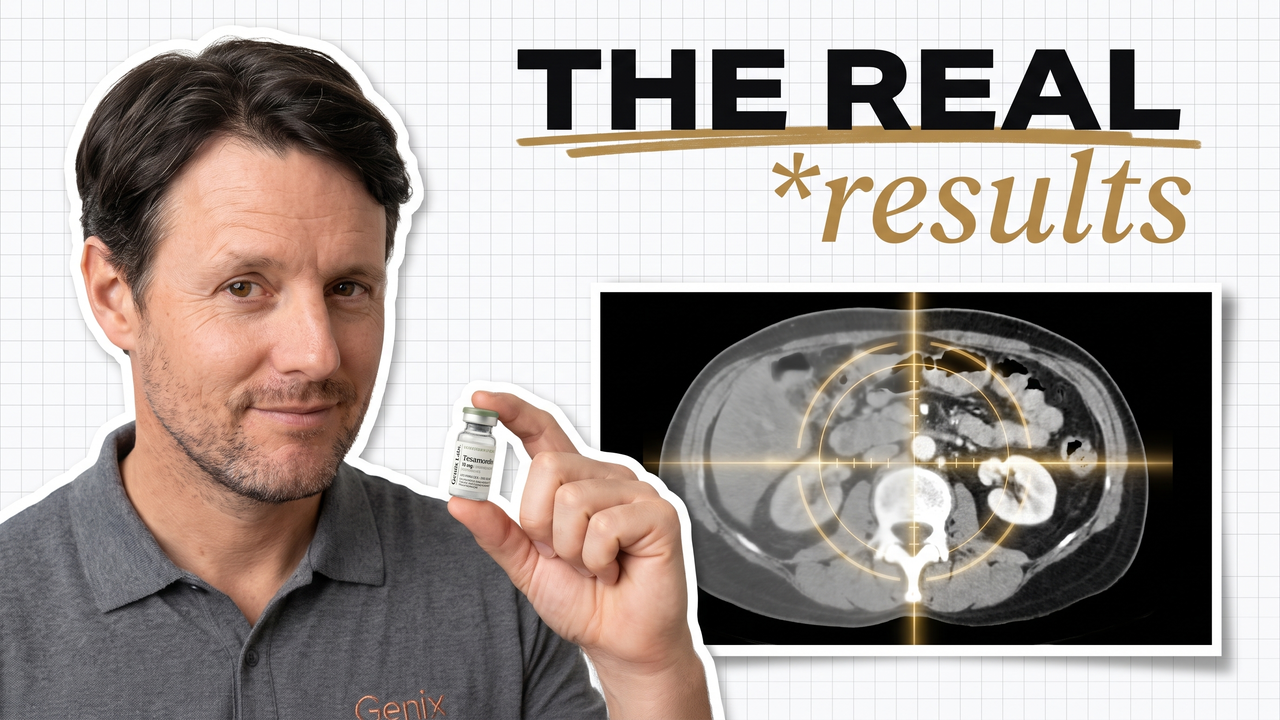
In trials, tesamorelin cut deep belly fat by about 15% against placebo over 26 weeks. It left the fat under the skin alone. Triglycerides fell by roughly 50 mg/dL. Liver fat fell in two separate randomised trials. Muscle area and density improved. Blood sugar did not meaningfully change.
How every benefit on this page was graded
Not all of these numbers are worth the same. A result from 806 patients across two phase 3 trials is not the same as a result from a 50 person study. So every benefit below carries the trial that produced it and how strong that trial is. Three grades are used, and they are simple.
- Strong. A pre-registered endpoint in a phase 3 trial, or the pooled result of two of them.
- Moderate. A primary endpoint in a smaller randomised trial with a placebo group.
- Weak. A secondary look, a subgroup, or an analysis done after the trial finished.
The tesamorelin benefit ledger, in one table
Here is the whole list in one place. Each row names the best published number, the trial it came from, and the grade. Everything after this table is the detail behind a row.
| Benefit | Best published number | Where it came from | Grade |
|---|---|---|---|
| Deep belly fat | -15.4% against placebo at 26 weeks | Pooled phase 3, 806 patients | Strong |
| Fat under the skin preserved | -0.6%, not significant | Same pooled dataset | Strong |
| Waist circumference | -3.4 cm at 52 weeks | Phase 3 extension | Strong |
| Triglycerides | -50 mg/dL against placebo | Phase 3, 412 patients | Strong |
| Cholesterol to HDL ratio | -0.31 against +0.21 on placebo | Phase 3, 412 patients | Strong |
| IGF-1 | +81%, or +108 ng/mL pooled | Phase 3 and pooled | Strong |
| Liver fat | -37% relative at 12 months | Lancet HIV, 61 patients | Moderate |
| Clearing the fatty liver line | 35% against 4% on placebo | Lancet HIV, 61 patients | Moderate |
| Liver fat, second trial | net -2.9% lipid to water | JAMA, 50 patients | Moderate |
| Muscle area and density | +0.64 to 1.08 cm2 lean area | Secondary analysis, responders only | Weak |
| Fat quality | +6.2 Hounsfield units density | Secondary analysis, responders only | Weak |
| Blood sugar held steady | no meaningful change to 52 weeks | Phase 3 and pooled | Strong |
| Body image distress | improved against placebo | Phase 3, patient and physician rated | Strong |
| Total body weight | no benefit shown | Not an endpoint in any trial | None |
What is tesamorelin?
Tesamorelin is a stabilised copy of growth hormone releasing hormone. That is a signal your own body already makes. The chain is 44 amino acids long and weighs about 5.1 kDa. A small chemical cap on one end stops the body breaking it down as fast as the natural signal.
Our companion page on what tesamorelin is and how it works covers the chemistry. This page is only about what it has been shown to do.
What does tesamorelin do to the human body?
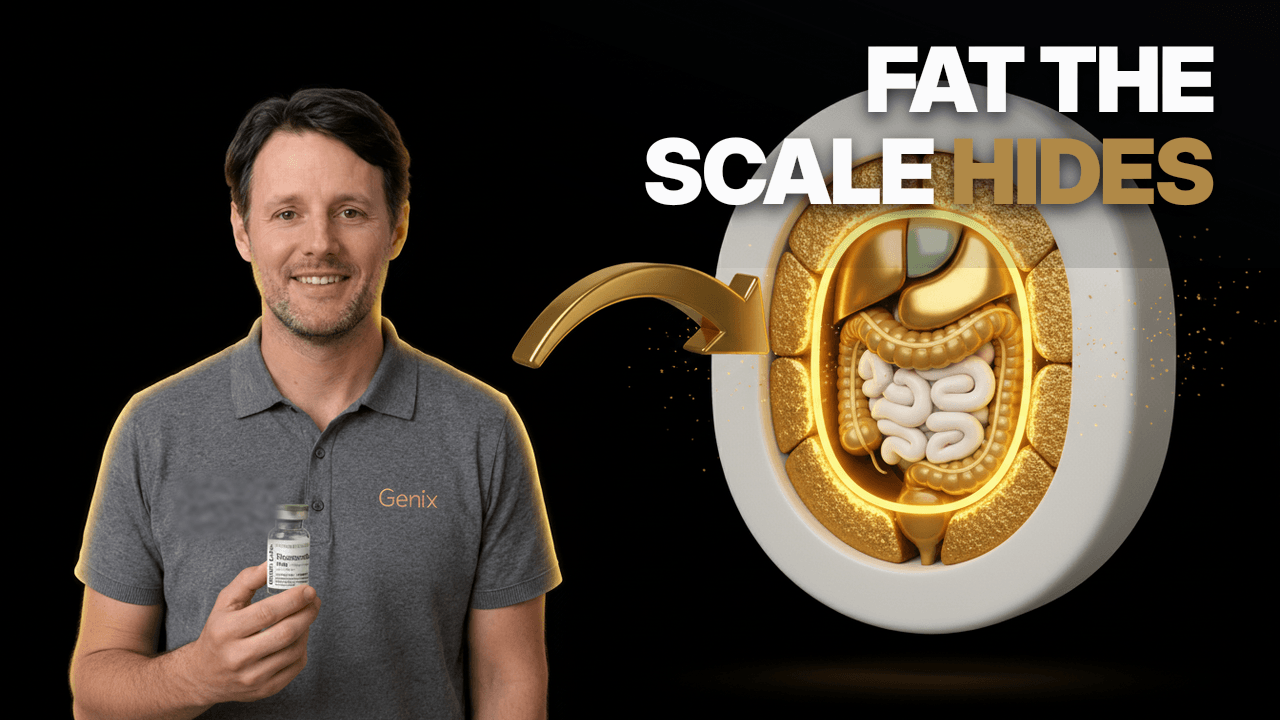
It asks the pituitary gland to release more of your own growth hormone. That lifts IGF-1, the messenger growth hormone works through. In the phase 3 trials IGF-1 rose by 81%. The effect measured most often downstream of that was a loss of visceral fat, the fat packed around the organs. Blood fats improved alongside it.
- The injection delivers a copy of the body's own releasing signal.
- The pituitary gland responds by releasing more growth hormone, in its normal pulsing pattern.
- IGF-1 rises. In trials it rose 81%, or about 108 ng/mL.
- Deep abdominal fat falls. The fat just under the skin does not.
- Triglycerides fall and the cholesterol to HDL ratio improves.
The pulsing matters. Tesamorelin does not replace growth hormone with a flat dose of it. It prompts the gland to work, so the body keeps its own feedback control. That is the design argument for the whole class.
Does tesamorelin reduce visceral belly fat?
Yes, and this is the best supported benefit it has. Three separate reads agree. In the first phase 3 trial of 412 patients, visceral fat fell 15.2% while rising 5.0% on placebo. In the second, it fell 10.9%. Pooling both trials and 806 patients gives a treatment effect of 15.4% at 26 weeks.
| Trial | Patients | Length | Visceral fat result |
|---|---|---|---|
| Phase 3, first trial | 412 | 26 weeks | -15.2% on drug against +5.0% on placebo |
| Phase 3, second trial | 404 | 26 weeks | -10.9% on drug against -0.6% on placebo |
| Both pooled | 806 | 26 weeks | -24 cm2 against +2 cm2, effect -15.4% |
| Pooled, continued on drug | 246 | 52 weeks | -35 cm2, or -17.5% |
Four numbers, four different patient groups, one direction. That consistency is why this row is graded strong and the rest are not.
Why the fat under the skin does not change
This is the fact that makes tesamorelin different, and the one most pages drop. In the pooled phase 3 data the fat just under the skin fell by 2 square centimetres on the drug and rose by 2 on placebo. The treatment effect was 0.6% and it was not statistically significant.
Read the two bars together and the claim changes shape. This is not a drug that makes you smaller everywhere. It empties one specific compartment. For a face and limbs that already lost fat, leaving the surface layer alone is the point, not a shortfall.
The benefit tesamorelin does not have
Total body weight. No tesamorelin trial set out to lower it, and none reported it as a win. Waist circumference fell 3.4 cm at 52 weeks, which is real. But fat moving out of one compartment while the rest stays put does not move the number on the scale much.
Do the benefits last past 26 weeks?
Yes, while treatment continues. Patients who stayed on the drug through week 52 held a 17.5% cut in visceral fat. Waist circumference was 3.4 cm down. Triglycerides were 48 mg/dL down. Total cholesterol was 8 mg/dL down. All of those held against the original baseline.
What happens to the benefits when you stop?
They go. The trials built this test in on purpose. At week 26 some patients on the drug were switched to placebo. Their visceral fat came back. The published wording is blunt: upon discontinuation, visceral fat reaccumulated, and the gains were rapidly lost.
No trial has shown a benefit that outlasts the treatment. That is a finding in its own right, not a gap in the data, and it belongs next to every number above.
Does tesamorelin reduce liver fat?
Two separate randomised trials say yes. In a 50 patient trial published in JAMA, liver fat fell a median 2.0% against a 0.9% rise on placebo, a net effect of 2.9% in lipid to water percentage. In a 61 patient trial published in Lancet HIV, liver fat fell 4.1% in absolute terms over 12 months.
That second figure works out to a 37% relative drop from where each patient started. Both trials were small, which is why this row is graded moderate rather than strong. Two independent trials agreeing is still a much better position than most peptide claims occupy.
How many people cleared the fatty liver line?
A liver is called fatty at a fat fraction of 5% or more. In the Lancet HIV trial every patient started above that line. After 12 months, 35% of the tesamorelin group had dropped below 5%. On placebo it was 4%. That gap had a p value of 0.0069.
Crossing a threshold is easier to picture than a percentage change, and it is the number worth remembering from the liver file.
Does tesamorelin improve cholesterol and triglycerides?
Yes, modestly and consistently. In the first phase 3 trial triglycerides fell 50 mg/dL while rising 9 mg/dL on placebo. The ratio of total cholesterol to HDL fell 0.31 while rising 0.21 on placebo. Both differences had p values below 0.001.
- Triglycerides: -50 mg/dL against +9 mg/dL on placebo in the first phase 3 trial.
- Triglycerides, pooled: -37 mg/dL against +6 mg/dL, a treatment effect of -12.3%.
- Cholesterol to HDL ratio, pooled: a treatment effect of -7.2%.
- At 52 weeks on continued drug: triglycerides -48 mg/dL and total cholesterol -8 mg/dL against baseline.
- HDL itself fell slightly over 52 weeks, which is the one lipid line that moved the wrong way.
Does tesamorelin raise blood sugar?
Not meaningfully, across 52 weeks of phase 3 data. This matters because growth hormone normally pushes blood sugar up, so it is the first thing a reviewer checks. The pooled analysis found no clinically meaningful difference between groups at week 26 or week 52.
One honest wrinkle sits inside that. In the JAMA liver trial, fasting glucose rose 7 mg/dL more than placebo at the two week mark. By six months the difference was gone and was not significant. The 12 month Lancet HIV trial found no difference in fasting glucose or HbA1c either.
The safety picture is not all clean, though, and the detail lives in our tesamorelin side effects breakdown. That page covers the one glucose signal in the approved label worth watching.
Does tesamorelin build muscle?
A little, in one secondary analysis, and only in people whose fat actually moved. Researchers went back to the phase 3 scans and measured four trunk muscle groups. Lean muscle area rose between 0.64 and 1.08 square centimetres. Muscle density rose between 1.56 and 4.86 Hounsfield units.
Two things keep this row graded weak. It was a look back at scans taken for another purpose. And it only included the 193 people who had already responded on fat, compared with 148 on placebo. The changes are small in absolute terms.
The benefit that is not about fat quantity
Fat can be measured two ways: how much there is, and what it looks like. Denser fat on a scan means smaller, healthier fat cells. In a secondary analysis of the phase 3 scans, deep fat density rose 6.2 Hounsfield units on tesamorelin against 0.3 on placebo. Surface fat density rose too.
The useful part is what the researchers did next. They controlled for how much the fat area had changed. The density effect was still there. So the quality change was not simply a side effect of the quantity change. Like the muscle row, this came from responders only, so it is graded weak.
What happens to IGF-1 and growth hormone?
IGF-1 rose 81% in the first phase 3 trial while falling 5% on placebo. In the pooled data the average rise was 108 ng/mL against a 7 ng/mL fall on placebo. This is the mechanism working as designed. It is also the number that drives the main open safety question, covered below.
Why about 3 in 10 people got no benefit at all
The trials set a bar in advance. A fall of 8% or more in visceral fat counted as a response. Roughly 70% of treated participants cleared it. That leaves roughly 30% who took a daily injection for 26 weeks and did not get the fat benefit at all.
The second finding is the more interesting one. When researchers split the 402 treated patients into responders and non responders, the blood work split too. Responders ended 52 weeks with fasting glucose 1 mg/dL lower and no change in HbA1c. Non responders ended with fasting glucose 8 mg/dL higher and HbA1c 0.2% higher.
Who responded best in the trials?
An analysis of both phase 3 trials looked for predictors. Three things were linked to a better chance of response at six months: having metabolic syndrome at the start, triglycerides above 1.7 mmol/L, and white race. Nothing predicted response at the three month mark.
The same analysis found that the odds of getting visceral fat below 140 square centimetres, a level tied to lower risk, were 3.9 times greater on tesamorelin than on placebo. That held after adjusting for study, sex, starting BMI and starting visceral fat.
How long until tesamorelin works?
The trials read their main result at 26 weeks. IGF-1 moved within the first weeks. Fat changes were measured at three and six months, and the analysis found nothing at three months that predicted the six month outcome. So the honest answer is that the measured benefit is a six month result, not a six week one.
- Within 2 weeks: IGF-1 is already up, and one trial saw a brief glucose bump that later resolved.
- At 3 months: fat changes are under way but did not predict where a patient would land.
- At 6 months: this is where every primary endpoint was measured.
- At 12 months: the benefit holds in people who stayed on treatment.
- After stopping: visceral fat reaccumulates.
Are the benefits the same for women?
Nobody can say with confidence, and that is the honest answer. The first phase 3 trial was 86% men. The scan analysis was 87% men. Women were enrolled and included, but not in numbers large enough to measure the benefit separately in them with any precision.
There is one older signal worth knowing. A 1997 trial of a related releasing hormone analogue in 19 older adults found lean body mass rose in men only, with no equivalent change in women. That is a different molecule and a tiny study, so it is a question raised rather than answered.
Are there tesamorelin benefits specific to men?
Not specific ones, but the evidence base is overwhelmingly male, so every number on this page is effectively a male result. Men made up 86 to 87% of the trial populations. If you are reading these figures as a man, they apply to you more directly than the usual trial caveat implies.
Do the benefits still hold on modern treatment?
This is a fair challenge, because the phase 3 trials ran before a now standard class of HIV medicine existed. A 2024 analysis tested it directly in 38 participants taking those newer medicines. Visceral fat fell a median 25 square centimetres against a 14 rise on placebo.
Liver fat fell 4.2% against 0.5%. The ratio of trunk fat to limb fat improved. Hyperglycaemia was no more common on the drug than on placebo. It is a small analysis, but it is the only direct answer to the most reasonable objection anyone can raise about the older data.
Which injectable peptide is most effective for weight loss?
Not tesamorelin. On published trial results the triple agonist retatrutide leads, at 25.0% of body weight at 80 weeks. Tirzepatide reached 20.9% at 72 weeks. Semaglutide reached 14.9% at 68 weeks. Tesamorelin does not appear on that list because it was never trying to.
| Compound | Best published weight result | What it is actually for |
|---|---|---|
| Retatrutide | 25.0% of body weight at 80 weeks | Total body weight |
| Tirzepatide | 20.9% of body weight at 72 weeks | Total body weight |
| Semaglutide | 14.9% of body weight at 68 weeks | Total body weight |
| Tesamorelin | not measured as an endpoint | One fat compartment, around the organs |
If total weight is the question, our comparison of the weight loss peptides ranks them properly. Putting tesamorelin in that race is the single most common mistake made about it.
Tesamorelin against the GLP-1 peptides
They do different jobs through different machinery. GLP-1 peptides work mostly on appetite. Less food goes in, so total weight falls, and some of what is lost is muscle. Tesamorelin does not touch appetite. It works through the growth hormone axis and moves one fat compartment.
Our Weight and Metabolism hub lays out every compound in this category and what each one has actually been shown to do.
Does sermorelin reduce belly fat?
There is no placebo controlled trial showing that it does. Sermorelin is a shorter fragment of the same releasing hormone. Searching the published trial record for sermorelin and abdominal or visceral fat returns no randomised trial with that endpoint. Tesamorelin has four.
The closest evidence is a 1997 trial of a 29 amino acid version in 19 adults aged 55 to 71, over 16 weeks. Body weight was unaffected. Lean body mass rose in men only. No other body composition change was found. Our head to head on tesamorelin and sermorelin goes through both files side by side.
Tesamorelin benefits and side effects, side by side
No benefit list is useful on its own. The most common reactions in trials were injection site reactions, joint ache, muscle ache and mild swelling. Injection site reactions hit 25% of treated patients against 14% on placebo. Glucose is the signal worth watching.
Put the two lists together and the trade is clear enough to judge. The full reaction table, with the placebo column beside every row, is in our tesamorelin side effects guide.
Does tesamorelin cause diarrhea?
It is not on the list. The approved reaction table includes every reaction that appeared in 1% or more of treated patients and more often than placebo. Diarrhea is not among them. Vomiting appears at 3% against 0%, and indigestion at 2% against 1%.
Gut effects are mostly a GLP-1 story, not a growth hormone axis story. That is another place where the two classes get confused.
What about the cancer question?
It is a real theoretical question and the trials cannot answer it. IGF-1 rises by 81% on tesamorelin, and IGF-1 is involved in cell growth. The trials ran 26 to 52 weeks and excluded people with active malignancy. That is far too short and too selective to measure cancer risk either way.
No trial has shown an increase. No trial was built to detect one. Both halves of that sentence are needed, and anyone who gives you only one half is selling something.
What dose produced these benefits?
Every number on this page came from the same regimen: 2 mg given once a day by subcutaneous injection. Not one trial tested a weekly schedule, and none of the phase 3 work compared different amounts. The published benefit belongs to that one regimen.
That is a statement about what the trials did, not guidance for anyone. Our research overview of tesamorelin dosing covers how the published protocols were structured.
The limit on every number here
Every trial enrolled adults living with HIV who had gained abdominal fat on antiretroviral therapy. There is no phase 3 trial of tesamorelin in anyone else. No large randomised trial has tested it in people without HIV who simply carry deep belly fat.
That does not make the biology irrelevant elsewhere. It does mean every figure above is borrowed when applied outside that group, and borrowed numbers should be quoted more carefully than earned ones.
Before and after claims run into the same wall, which is why we built a separate page on what tesamorelin before and after really shows.
What does tesamorelin cost?
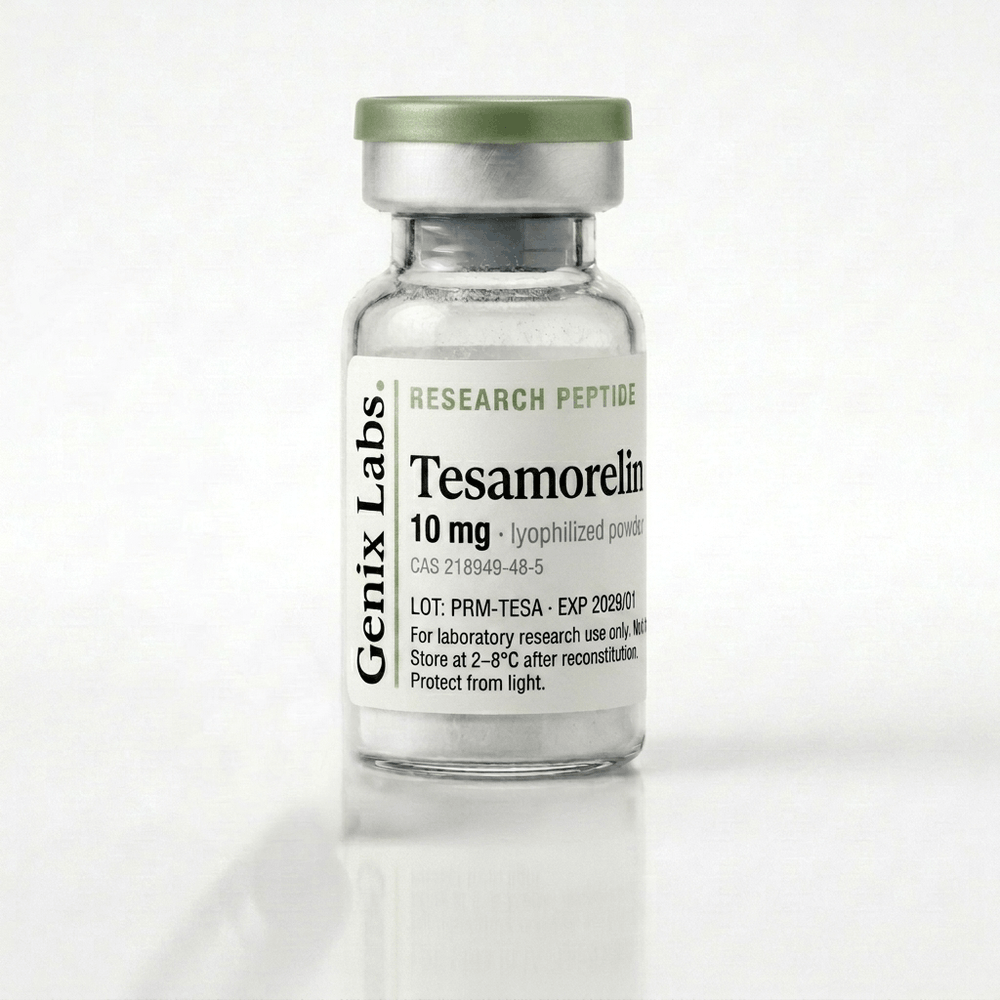
A Genix Labs 10 mg vial is USD 149, or Rp 2.450.000. It ships cold packed and fully tracked, with same day delivery inside Bali and cash on delivery available. Orders placed before 9 PM ship the same day.
You can see the current lot, the published purity figure and the full specification on our tesamorelin research vial page.
What a lot report rules out, and what it does not
Our current tesamorelin lot, 447106, carries a published HPLC area purity of 98.20% for the tested size, plus LC-MS identity confirmation. That answers one narrow question: is the material in the vial the peptide the label names, and how clean is that lot by area.
- It is not a statement of content, sterility, safety or efficacy.
- It applies only to the printed lot. Check that the number on the vial matches.
- HPLC area percent is not the same thing as how much peptide is in the vial.
- No certificate turns a research compound into an approved medicine.
- No certificate establishes any benefit on this page. Only the trials do that.
Grade any tesamorelin benefit claim in 30 seconds
You can check most claims yourself with four questions. They take longer to read than to use.
- Which trial? A claim with no trial behind it is a marketing line, not a result.
- How many people? 806 pooled is strong. 50 is worth knowing. 19 is a question, not an answer.
- What did placebo do? Visceral fat rose 5% on placebo in the first trial. Without that column the drug number means little.
- Who was in it? Every tesamorelin trial ran in adults with HIV. Numbers quoted outside that group are borrowed.
Run those four on any page about this molecule, including this one, and most of the noise drops away.
FAQ
What does tesamorelin do to the human body?
It asks the pituitary gland to release more of the body's own growth hormone, which lifts IGF-1. In trials IGF-1 rose 81%. The effect measured most often downstream was a loss of visceral fat, the fat packed around the organs, alongside lower triglycerides. It does not replace growth hormone.
Which injectable peptide is most effective for weight loss?
Not tesamorelin. On published trial results retatrutide leads at 25.0% of body weight at 80 weeks, tirzepatide reached 20.9% at 72 weeks and semaglutide 14.9% at 68 weeks. Tesamorelin never measured total body weight as an endpoint. It moves one fat compartment instead.
Does sermorelin reduce belly fat?
No placebo controlled trial shows that it does. Sermorelin is a shorter fragment of the same releasing hormone, and the published record holds no randomised trial with abdominal fat as an endpoint. Tesamorelin has four. The closest sermorelin evidence is a 19 person study from 1997.
How long until tesamorelin works?
Every primary endpoint in the trials was measured at 26 weeks. IGF-1 moves within the first weeks. An analysis of both phase 3 trials found nothing at three months that predicted the six month result, so the measured benefit is a six month result rather than a six week one.
Are tesamorelin benefits different for men?
The trials were 86 to 87% men, so every published figure is effectively a male result. No benefit is specific to men, but the female data is too thin to measure separately with precision. One older study of a related analogue found lean mass rose in men only.
Does tesamorelin cause diarrhea?
Diarrhea does not appear in the approved reaction table, which lists every reaction seen in 1% or more of treated patients and more often than placebo. Vomiting appears at 3% against 0%, and indigestion at 2% against 1%. Gut effects are mostly a GLP-1 story instead.
Takeaway
Tesamorelin has a narrow benefit and an unusually solid file behind it. Deep belly fat falls about 15% against placebo, the fat under the skin does not move, triglycerides improve and liver fat falls in two separate randomised trials. Blood sugar holds steady across 52 weeks.
Three things keep it honest. About 3 in 10 people got no fat benefit at all. The benefit stops when the injections stop. And every number was earned in adults living with HIV, which is a real limit on quoting them anywhere else. Everything Genix Labs supplies is for in vitro laboratory research only. It is not for human or veterinary use, and nothing here is medical advice.