
The approved tesamorelin label lists twenty side effects in one table. Nineteen of them barely move once you put the placebo column beside them. The one that does move is worth real attention, and the most useful fact about it almost never gets printed: it landed mostly on the patients the drug was not working for. This page walks the whole file, number by number.
What are the side effects of tesamorelin?
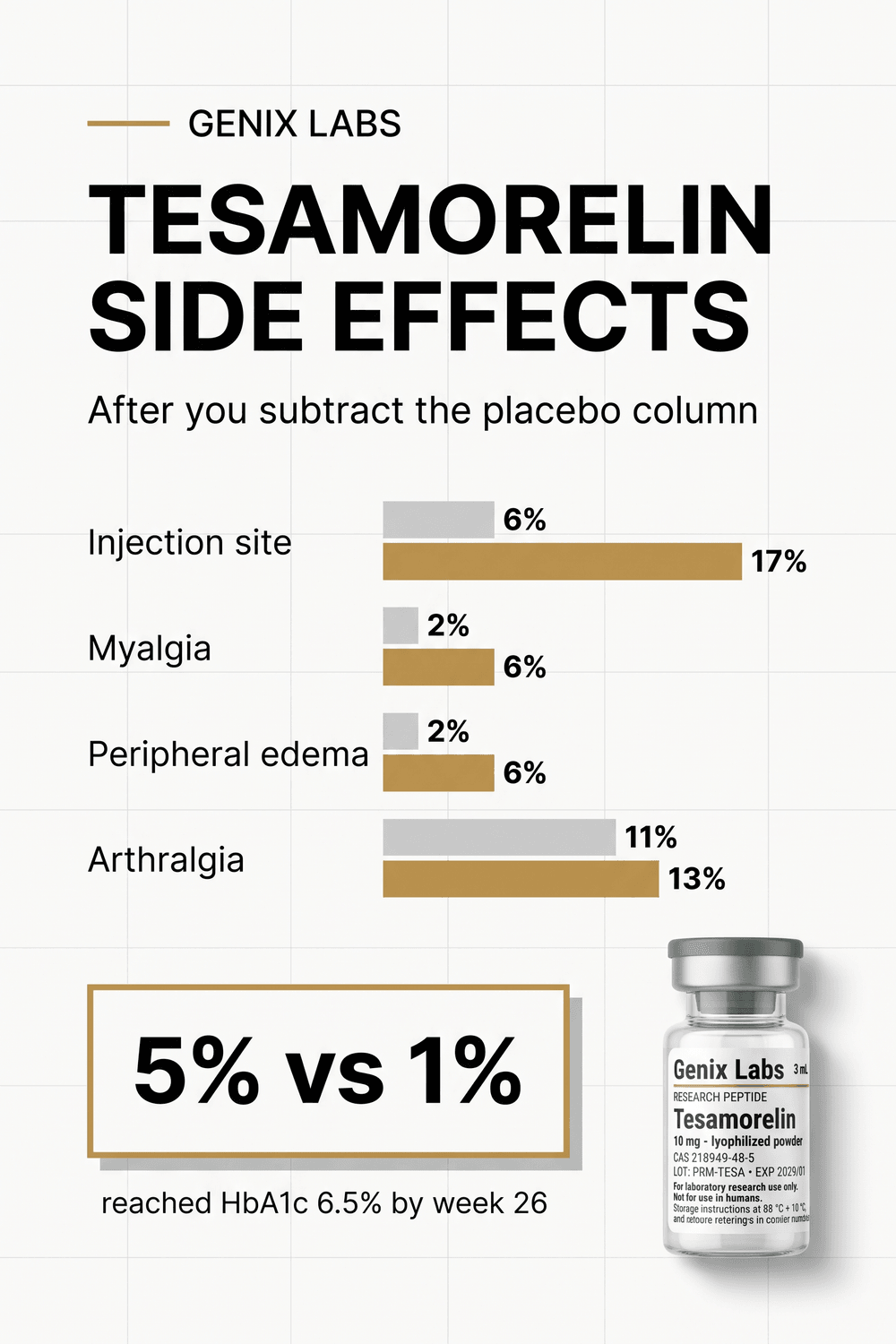
The most common side effects in trials were injection site reactions, joint ache, muscle ache and mild swelling. Injection site reactions hit 25% of treated patients against 14% on placebo. Glucose is the one signal that matters: 5% of treated patients reached an HbA1c of 6.5% by week 26, against 1% on placebo. Everything else sat within a few points of placebo.
What does the trial table actually say?
One table carries almost the entire tesamorelin side effect record. It pools both phase 3 trials. 263 patients took placebo and 543 took the drug, for 26 weeks. The table lists every reaction that showed up in at least 1% of treated patients and was more frequent than placebo. That last condition is doing a lot of quiet work, and we will come back to it.
| Reaction | Placebo (263) | Tesamorelin (543) | Gap |
|---|---|---|---|
| Injection site reaction | 6% | 17% | +11 |
| Arthralgia (joint ache) | 11% | 13% | +2 |
| Pain in extremity | 5% | 6% | +1 |
| Myalgia (muscle ache) | 2% | 6% | +4 |
| Edema peripheral (swelling) | 2% | 6% | +4 |
| Paresthesia (tingling) | 2% | 5% | +3 |
| Hypoesthesia (numbness) | 2% | 4% | +2 |
| Rash | 2% | 4% | +2 |
| Dyspepsia (indigestion) | 1% | 2% | +1 |
| Musculoskeletal pain | 1% | 2% | +1 |
| Pain | 1% | 2% | +1 |
| Pruritus (itch) | 1% | 2% | +1 |
| Vomiting | 0% | 3% | +3 |
| Musculoskeletal stiffness | 0% | 2% | +2 |
| Blood creatine phosphokinase increased | 0% | 1% | +1 |
| Carpal tunnel syndrome | 0% | 1% | +1 |
| Joint swelling | 0% | 1% | +1 |
| Muscle strain | 0% | 1% | +1 |
| Night sweats | 0% | 1% | +1 |
| Palpitations | 0% | 1% | +1 |
That is the full list. Twenty rows. Nothing in it is hidden or hard to find. What goes wrong is how it gets copied.
Why does the placebo column change the list?
Because people in the placebo group had side effects too. 11% of them reported joint ache while taking a daily injection of nothing. On the drug it was 13%. A page that prints only the drug column tells you tesamorelin causes joint ache in 13% of users. The trial says it causes joint ache in about 2% of users. Those are very different claims.
Subtract placebo from every row and one thing stands out. Injection site reactions move 11 points. Nothing else moves more than 4. The reaction people search for most, joint ache, moves 2 points. This is the single most useful rearrangement of the tesamorelin safety file, and it takes ten seconds.
What are the effects of tesamorelin?
Tesamorelin is a stabilised copy of growth hormone releasing hormone, the signal your pituitary gland already uses. It does not replace growth hormone. It asks the gland to release more of its own. In trials that raised IGF-1 by 81% and cut deep abdominal fat by about 15% over 26 weeks, while leaving the fat just under the skin alone.
- Visceral fat, the fat around the organs, fell 15.4% against placebo at 26 weeks in the pooled phase 3 data.
- Subcutaneous fat, the layer under the skin, did not change. The difference against placebo was 0.6% and not significant.
- Triglycerides fell by about 50 mg/dL and the cholesterol to HDL ratio improved.
- IGF-1 rose by 108 ng/mL on average, which is the mechanism and also the main safety question.
- Liver fat fell in two separate randomised trials, by a relative 37% over 12 months in the larger one.
Our companion guide on what tesamorelin is and how it works covers the mechanism in detail. This page is only about what it costs you.
Who were the 740 patients?
This is the limit that governs every number on this page. The entire tesamorelin safety file comes from one population: adults living with HIV, on antiretroviral therapy, who had gained excess abdominal fat as a result. 86% of them were men. 83% were white. Nobody over 65 was studied in any detail, and no children were studied at all.
- Every percentage here describes HIV patients on antiretroviral drugs. Those drugs interact with fat and glucose metabolism on their own.
- Women were 14% of the phase 3 programme. Sex specific side effect rates were never powered to be reliable.
- The label states plainly that there is no information in patients over 65.
- In children with open growth plates the label warns of growth acceleration, and the drug is not indicated for them.
None of this makes the data bad. It makes it narrow. A side effect page that quotes these numbers as if they described the general population is overreaching, and almost all of them do.
Why do injection site reactions top the list?
Because the trial regimen was a subcutaneous injection into the abdomen every single day. Over 26 weeks, 25% of treated patients had some reaction at the site, against 14% on placebo. The label groups several things under one term: redness, itch, pain, rash, hives, swelling, irritation and small bleeds. The official advice is simply to rotate the site.
This also tells you something about the rest of the list. A daily needle for half a year is a lot of needles. Rotating sites and clean technique are the only two levers, and our guide on reconstituting peptides correctly covers the sterile handling side of that in a laboratory setting.
Where do the joint and nerve complaints come from?
One mechanism explains most of the middle of the table. Growth hormone makes tissues hold more fluid. That shows up as swelling, stiff joints, aching muscles, tingling, numbness and in rare cases carpal tunnel syndrome, which is a pinched nerve at the wrist. The label is unusually clear that these are either temporary or resolve when treatment stops.
| Complaint | Net rate over placebo | Mechanism | Reversible? |
|---|---|---|---|
| Peripheral swelling | +4 points | Fluid retention from growth hormone | Yes, per label |
| Muscle ache | +4 points | Fluid retention and tissue turgor | Yes, per label |
| Tingling or numbness | +3 and +2 points | Pressure on small nerves | Yes, per label |
| Joint ache | +2 points | Fluid retention in joint tissue | Yes, per label |
| Carpal tunnel syndrome | +1 point | Nerve compression at the wrist | Yes, per label |
| Raised creatine kinase | +1 point | Muscle enzyme leak, usually mild | Not characterised |
Grouping them this way is more useful than reading them as six unrelated problems. They are one problem wearing six names.
Does tesamorelin raise blood sugar?
Yes, in a minority, and this is the one side effect worth real monitoring. Growth hormone opposes insulin. Average HbA1c at baseline was 5.3% in both groups. By week 26, 5% of treated patients had crossed an HbA1c of 6.5% against 1% on placebo. The hazard odds ratio was 3.3, with a confidence interval of 1.4 to 9.6.
Read that interval carefully, because it is doing more work than the headline number. A lower bound of 1.4 means the effect is real. An upper bound of 9.6 means the size of it is poorly pinned down. The absolute difference is 4 patients in 100 over half a year.
Who actually got the glucose problem?
This is the most useful finding in the entire tesamorelin literature and it is almost never quoted. Both phase 3 trials defined a responder in advance as anyone whose visceral fat fell 8% or more. Researchers then split 402 treated patients on that line and looked at glucose. The two halves did not behave the same way at all.
At 52 weeks, responders had fasting glucose 1 mg/dL lower than baseline and HbA1c unchanged. Non-responders had glucose 8 mg/dL higher and HbA1c up 0.2%. The gap was statistically solid, at p below 0.001 for glucose. Triglycerides split the same way.
- The glucose cost was concentrated in the group getting no fat loss benefit.
- Losing visceral fat appears to protect glucose control, which offsets the growth hormone effect pushing the other way.
- It explains the gap between the papers and the label. Averaging the two groups together hides both halves.
- It also tells you what a response check is for: the label advises considering stopping in patients who develop glucose intolerance without a clear efficacy response.
This is an analysis of subgroups after the fact, so it shows association rather than proof of cause. But it was a pre-specified split, not a fishing trip, and it was consistent across two trials and two time points.
Is there an early glucose spike?
There is, and it does not last. A separate randomised trial at Massachusetts General Hospital measured glucose closely in 48 patients. At two weeks, fasting glucose had risen 9 mg/dL on drug against 2 mg/dL on placebo, a treatment effect of 7 mg/dL that reached significance. At six months the same measurement showed a treatment effect of 2 mg/dL and was not significant.
Two hour glucose after a sugar load told the same story. No significant difference across time points. So the shape of the glucose effect is a bump early that mostly resolves, plus a small tail of patients who cross a threshold and stay there. Those are two different findings and they often get mashed into one sentence.
What happens to IGF-1?
IGF-1 is the growth factor your liver makes in response to growth hormone. It is how you know the drug is working, and it is the main open safety question. In the first trial it rose 81%. In the pooled data the average rise was 108 ng/mL. The label reports how many patients went above normal, and most pages stop at the 26 week figure.
At 26 weeks, 47% of treated patients were more than 2 standard deviations above the normal range for their age, and 36% were more than 3. In patients who stayed on treatment for a full year, those figures were 34% and 23%. The elevation is highest early and partly settles. The label notes the effect is visible by week 13, and states that the consequences of a prolonged elevation are unknown.
That last sentence is the honest centre of the whole safety question. Nothing published in this programme ran past 12 months, so the long term meaning of a sustained IGF-1 rise has not been measured in anyone.
Is the cancer concern real?
It is a real mechanistic concern that has not been answered by data. IGF-1 promotes cell growth and survival, which is useful in healthy tissue and unhelpful in a tumour. The label responds the way regulators do when a mechanism is plausible and the evidence is thin: it rules out the highest risk groups rather than claiming the risk is zero.
- Active malignancy is an outright contraindication. The label says not to treat those patients.
- A history of treated and stable cancer requires a careful benefit assessment first.
- Treatment should be discontinued at any evidence of a cancer returning.
- The label asks prescribers to weigh the raised background cancer rate in HIV patients specifically.
- IGF-1 should be monitored, with discontinuation considered above 3 standard deviations, especially when the fat loss response is weak.
No trial in this programme was designed or long enough to detect a change in cancer rates. Anyone who tells you the cancer question has been settled in either direction is going beyond the record.
Do patients make antibodies to it?
Half of them do, and this is the most interesting fact on the label that nobody reproduces. Anti-tesamorelin IgG antibodies were found in 50% of patients at 26 weeks and 47% at 52 weeks. Among patients who had a hypersensitivity reaction, 85% were antibody positive. Around 60% of antibody positive patients also had antibodies that cross reacted with their own natural growth hormone releasing hormone.
| Finding | Rate | Did it matter? |
|---|---|---|
| Anti-tesamorelin IgG at 26 weeks | 50% | No effect on fat loss or IGF-1 |
| Anti-tesamorelin IgG at 52 weeks | 47% | No effect on fat loss or IGF-1 |
| Cross reaction with the body's own GHRH | about 60% of antibody positive patients | Not characterised further |
| Neutralising antibodies at 52 weeks | 10% on tesamorelin | Fat loss was still maintained |
| Antibody positive among hypersensitivity cases | 85% | Likely the mechanism of those reactions |
The reassuring part is that the antibody response did not blunt the result. The unresolved part is the cross reactivity with your own hormone. The label reports it and does not interpret it.
How common are allergic reactions?
Hypersensitivity reactions occurred in 4% of treated patients in the trial programme. The reported forms were itch, redness, flushing, hives and rash. A known allergy to tesamorelin or its excipients is a contraindication, and the label tells patients to stop and seek care promptly if a reaction is suspected.
Who should not use tesamorelin at all?
Four groups are ruled out on the label rather than warned. These are not cautions. They are exclusions.
- Anyone whose hypothalamic pituitary axis is disrupted, including pituitary tumour or surgery, hypophysectomy, hypopituitarism, or head irradiation or trauma. The drug works by asking a pituitary gland to respond, so a damaged one cannot.
- Anyone with active malignancy.
- Anyone with a known hypersensitivity to tesamorelin or the product excipients.
- Pregnancy. Reducing visceral fat offers no benefit in pregnancy, and rat studies produced hydrocephaly in offspring at roughly two to four times the clinical exposure, plus delayed skull hardening at lower exposures.
One further warning sits outside that list. Pharmacologic growth hormone has been linked to increased mortality in patients who are acutely critically ill after major surgery, trauma or respiratory failure. The label asks prescribers to consider stopping in those patients.
What not to take with tesamorelin?
Two interaction categories are on the label, and both come from growth hormone rather than from tesamorelin itself. Growth hormone changes how the liver handles certain drugs, and it changes how your body activates cortisone. There is no long banned list, but there is a short monitoring list.
| What | Why it interacts | What the label asks |
|---|---|---|
| Drugs cleared by liver CYP450 enzymes | Growth hormone can alter their clearance | Monitor for interactions |
| Corticosteroids, sex steroids, anticonvulsants, cyclosporine | Named examples of CYP450 handled drugs | Monitor for interactions |
| Glucocorticoid replacement for low adrenal function | Growth hormone blocks the enzyme that activates cortisone | Maintenance or stress doses may need raising |
| Cortisone acetate and prednisone specifically | Both need that same enzyme to become active | Affected more than other steroids |
| Simvastatin | Tested directly in healthy subjects | No significant effect found |
| Diabetes treatment and eye checks | Raised IGF-1 plus glucose drift | Monitor diabetic retinopathy at regular intervals |
The enzyme in the cortisone row is 11 beta hydroxysteroid dehydrogenase type 1. It converts inactive cortisone into active cortisol. Growth hormone inhibits it, so a person relying on cortisone acetate or prednisone may get less active steroid than their dose implies.
How long does tesamorelin take to reduce belly fat?
The published answer is 26 weeks, because that is when the phase 3 trials measured it. Visceral fat fell 15.4% against placebo at week 26 and reached 17.5% below baseline at week 52 in patients who stayed on treatment. IGF-1 was already elevated by week 13, so the hormone signal moves well before the fat measurement does.
There is no published CT measurement earlier than week 26 in the phase 3 programme, so claims about visible changes at four or eight weeks are not coming from these trials. Our before and after guide goes through what the imaging actually showed and at what scale.
What happens when it stops?
The fat comes back. Both phase 3 trials re-randomised patients at the halfway point, and the ones switched from drug to placebo lost their gains rapidly. One paper put it bluntly: effects on visceral fat do not last beyond the duration of treatment. That is not a side effect. It is the shape of the result, and it belongs in any honest risk conversation.
What did the liver trials add?
Two later randomised trials looked at liver fat and found a benefit, plus the same narrow safety picture. The 2014 trial in 48 patients cut liver fat by a median 2.0% of lipid to water, a net effect of 2.9% against placebo. The 2019 trial ran 12 months in 60 patients with fatty liver disease.
- Liver fat fraction fell 4.1 percentage points more than placebo, a relative reduction of 37%.
- 35% of treated patients ended below the 5% liver fat threshold, against 4% on placebo.
- Fasting glucose and HbA1c changes were no different between groups at 12 months.
- The treated group had more local injection site complaints, and none were judged serious.
- A 2024 analysis of the subgroup on modern integrase inhibitor HIV therapy found the same benefits with no worsening of blood sugar control.
Does it cost you muscle?
The available data points the other way. A secondary analysis of both phase 3 trials ran CT scans through muscle segmentation software on 193 responders and 148 placebo patients. Treated responders gained muscle density across four trunk muscle groups and gained lean muscle area in all four. The effect sizes were small and measured only in responders, so this is a signal rather than a headline.
What are the downsides of Ipamorelin?
The main downside is the size of the file. Ipamorelin is a five amino acid growth hormone secretagogue developed by Novo Nordisk in the 1990s. Its published human record is one dose escalation study in 40 healthy men, with a single 15 minute infusion at each of five rates. Half life was about 2 hours and growth hormone peaked at 40 minutes.
After that the trail goes cold. The later work on postoperative gut recovery was done in rodents. No published multi week randomised safety trial exists. So the comparison with tesamorelin is not close.
| Tesamorelin | Ipamorelin | |
|---|---|---|
| Published human safety file | 740 patients treated | 40 healthy men, single doses |
| Longest human exposure measured | 52 weeks | One 15 minute infusion |
| Randomised placebo controlled trials | Two phase 3, plus three later trials | None published |
| Adverse reaction table with placebo arm | Yes, 20 rows | No |
| Regulatory review | Approved with a full label | None |
| What its side effect lists are built from | Trial data | Mechanism and anecdote |
An ipamorelin side effect list is mostly inference. It borrows from the growth hormone class and from user reports. That does not make it wrong. It makes it a different kind of claim, and the difference should be visible when you read it.
How does its evidence compare to sermorelin and CJC-1295?
All three act on the same pathway, and their evidence bases are not in the same league. Tesamorelin has a full regulatory file. Sermorelin was approved long ago in a different indication and has an older, thinner record. CJC-1295 has no approved human file at all. Our tesamorelin versus sermorelin comparison goes through both molecules side by side.
The practical point is simple. When a side effect list for one of these peptides looks suspiciously like the list for another, that is usually because it was copied across the class rather than measured.
How should a side effect claim be graded?
Four tiers cover almost everything you will read about this molecule. Knowing which tier a sentence belongs to is more useful than knowing the sentence.
| Tier | What it means | Example from this page |
|---|---|---|
| A. Randomised and quantified | Measured against a placebo arm with a rate attached | Injection site reactions 25% against 14% |
| B. Label level | Regulator reviewed and published, sometimes without a placebo comparison | IGF-1 above 3 SDS in 36% of patients |
| C. Mechanistic | A real pathway with no outcome data attached | The IGF-1 and cancer question |
| D. Borrowed or anecdotal | Carried over from a related drug or from user reports | Most ipamorelin side effect lists |
Every claimed effect, graded
This is the whole file in one table, with a tier against each line. A claim that is not in here is not in the published record.
| Claim | Evidence | Tier |
|---|---|---|
| Injection site reactions | 25% against 14% on placebo over 26 weeks | A |
| Joint ache | 13% against 11% on placebo. Net 2 points | A |
| Muscle ache and swelling | 6% against 2% on placebo each | A |
| Tingling and numbness | 5% and 4% against 2% each | A |
| Carpal tunnel syndrome | 1% against 0%, tied to fluid retention | A |
| Crossing an HbA1c of 6.5% | 5% against 1%. Hazard odds ratio 3.3, CI 1.4 to 9.6 | A |
| Early glucose rise at two weeks | 7 mg/dL treatment effect, resolved by six months | A |
| Glucose drift concentrated in non-responders | Pre-specified split of 402 patients, p<0.001 at 52 weeks | A |
| Hypersensitivity reactions | 4% of treated patients | B |
| Antibody formation | 50% at 26 weeks, no effect on outcomes | B |
| IGF-1 elevation above normal | 47% above 2 SDS and 36% above 3 SDS at 26 weeks | B |
| Fetal harm | Rat hydrocephaly at two to four times clinical exposure | B |
| Growth acceleration in children | Label warning for open growth plates | B |
| Cancer risk from sustained IGF-1 | Mechanism only. No trial was designed to detect it | C |
| Long term effects past 12 months | Nothing published. The label says unknown | C |
| Risk in people without HIV | Not studied in the phase 3 programme | C |
| Interactions with CYP450 drugs | Class level growth hormone effect, monitoring advised | C |
| Hair loss, mood change, gynecomastia | Not in the label table at 1% or above | D |
| Permanent pituitary suppression | No published evidence in this programme | D |
The risks nobody puts on a side effect list
Every number above assumes the vial contains what the label says. In a research setting that assumption is the biggest variable of all, and it is not a pharmacology question.
- Identity. A 44 amino acid peptide is easy to mislabel and hard to tell apart by eye. Mass spectrometry is the only way to confirm which molecule is in the vial.
- Purity. Related peptide fragments carry their own biology. An HPLC chromatogram shows how much of the peak is the intended compound.
- Endotoxin. Bacterial residue from manufacturing can cause fever and inflammation that gets mistaken for a drug effect.
- Cold chain. A lyophilised peptide that warmed in transit can lose potency without changing appearance.
- Reconstitution and storage. Once in solution, the clock starts. Our storage guide covers the 2 to 8 degree window.
What does a lot report actually rule out?
It rules out the identity and purity questions for one specific batch, and nothing else. The published Genix Labs lot for tesamorelin 10 mg is 447106, with an HPLC area purity of 98.20% and LC-MS identity confirmation from an independent ISO 17025 accredited US laboratory.
Do tesamorelin pills or tablets exist?
No. Tesamorelin is a 44 amino acid peptide, and digestive enzymes break peptides that long into fragments before they can reach the bloodstream. Every published trial used a daily subcutaneous injection. A product sold as a tesamorelin pill or tablet is not the molecule studied in any of the research on this page.
What is known about women specifically?
Less than most pages imply. Women were about 14% of the phase 3 programme, which is enough to include them and not enough to produce reliable sex specific side effect rates. The trials reported results for the whole group. Anyone quoting a different side effect profile for women is extrapolating, and should say so.
Which vendor claims are red flags?
- A side effect list printed without the placebo column. That is the single most common way these numbers get inflated.
- A promise of belly fat loss on a timeline shorter than 26 weeks. No published CT measurement supports it.
- Any claim that the cancer question is settled, in either direction.
- A safety claim for people without HIV. That population was not in the trials.
- A purity number with no lot number, no method and no laboratory named.
- Tesamorelin offered as a pill, tablet, nasal spray or cream.
- Human dosing advice from a supplier. A research supplier that tells you how to dose yourself is telling you something about itself.
How much does tesamorelin cost?
A Genix Labs tesamorelin 10 mg vial is USD 149, or Rp 2.450.000, with the batch certificate of analysis included and cold chain shipping. Delivery is same-day within Bali, with cash on delivery available. Supplied for laboratory research only.
For how this sits against the other metabolic research compounds, see the Weight and Metabolism peptide hub or compare the side effect file with retatrutide, which works on an entirely different pathway.
Read any tesamorelin claim in 30 seconds
- Is there a placebo number next to the drug number? If not, the claim is inflated by default.
- Which population? Every published rate describes HIV patients on antiretroviral therapy, 86% of them men.
- How long? Nothing in the record runs past 12 months.
- Is the glucose claim split by response? The drift sat on the patients whose visceral fat did not fall.
- Is it tier A, B, C or D? Randomised, label level, mechanistic, or borrowed.
- Is there a lot number, a method and a laboratory behind the purity figure?
Run those six against any tesamorelin page, including this one. Most side effect lists fail at the first question.
Frequently asked questions
What are the effects of tesamorelin?
It asks your pituitary gland to release more of its own growth hormone. In the pooled phase 3 data that cut visceral fat by 15.4% against placebo at 26 weeks while leaving fat under the skin unchanged. Triglycerides fell about 50 mg/dL, and IGF-1 rose by an average of 108 ng/mL.
What are the downsides of Ipamorelin?
Mostly that almost nothing has been published about it in people. The human record is one dose escalation study in 40 healthy men, with a single 15 minute infusion each. No multi week randomised safety trial exists. Tesamorelin has 740 treated patients and a 20 row adverse reaction table with a placebo arm.
How long does tesamorelin take to reduce belly fat?
Twenty six weeks is the first published measurement. Visceral fat fell 15.4% against placebo at that point and reached 17.5% below baseline at 52 weeks on continued treatment. IGF-1 was already raised by week 13. When treatment stopped, the visceral fat reaccumulated.
What not to take with tesamorelin?
The label flags drugs cleared by liver CYP450 enzymes, naming corticosteroids, sex steroids, anticonvulsants and cyclosporine, and asks for monitoring. It also warns that glucocorticoid replacement may need raising, because growth hormone blocks the enzyme that activates cortisone. Simvastatin was tested directly and showed no significant interaction.
Does tesamorelin cause diabetes?
In a small minority. Mean HbA1c at baseline was 5.3% in both arms. By week 26, 5% of treated patients had crossed an HbA1c of 6.5% against 1% on placebo, a hazard odds ratio of 3.3 with a wide confidence interval of 1.4 to 9.6. That is 4 extra patients per 100 over half a year.
Are the joint aches permanent?
The label describes them as either transient or resolving when treatment stops. They come from fluid retention driven by growth hormone, which also explains the swelling, muscle ache, tingling, numbness and rare carpal tunnel syndrome in the same table. Joint ache itself sat 2 points above placebo, at 13% against 11%.
How much does tesamorelin cost?
A Genix Labs tesamorelin 10 mg vial is USD 149, or Rp 2.450.000, with the batch certificate of analysis included and cold chain shipping. The published lot, 447106, shows 98.20% HPLC area purity with LC-MS identity confirmation. Purity is a lot specific result and is not a statement of content, sterility, safety or efficacy. Supplied for laboratory research only.
The takeaway
Tesamorelin has one of the better documented safety files among research peptides, which is exactly why it gets misread. Twenty reactions in a table look alarming until the placebo column goes next to them, after which one row survives at any scale: a reaction where the needle goes. Glucose is the real watch item, it is small in absolute terms, and the pre-specified responder split suggests it concentrates in people getting no benefit.
What is genuinely unknown is what a year of raised IGF-1 does, and what any of this looks like in people who are not HIV patients on antiretroviral therapy. Those are the two honest gaps. Everything else on this page has a number behind it.