Ipamorelin is a five amino acid peptide that makes the pituitary gland release a pulse of growth hormone. That much is measured, in rats, in pigs and in people. Almost everything else sold with its name attached is an extrapolation from that single pulse.
What is ipamorelin?
Ipamorelin is a synthetic pentapeptide, meaning a chain of five amino acids, that binds the ghrelin receptor in the pituitary gland and triggers growth hormone release. Novo Nordisk developed it in the 1990s under the code NNC 26-0161. It reached human trials, was never approved as a medicine anywhere, and is now sold only as a research chemical.
That paragraph is the honest answer, and it is already more than most pages for this keyword will tell you. The rest of this guide takes every benefit attached to the name and puts it next to the study it supposedly rests on.
- Chemical name: Aib-His-D-2-Nal-D-Phe-Lys-NH2. Five residues, a little over 700 daltons.
- Receptor: the growth hormone secretagogue receptor, GHS-R1a, the same one ghrelin uses.
- Developer: Novo Nordisk, code NNC 26-0161.
- Status: not approved in any country, for any indication.
- Human efficacy trials: one, and it missed its primary endpoint.
How much evidence is there, really?
Four papers do almost all the work. Two are animal studies from the original Novo Nordisk programme, one is a human pharmacology study in healthy men, and one is a randomised controlled trial in surgical patients. Everything else is review articles citing those four, or vendor pages citing the review articles.
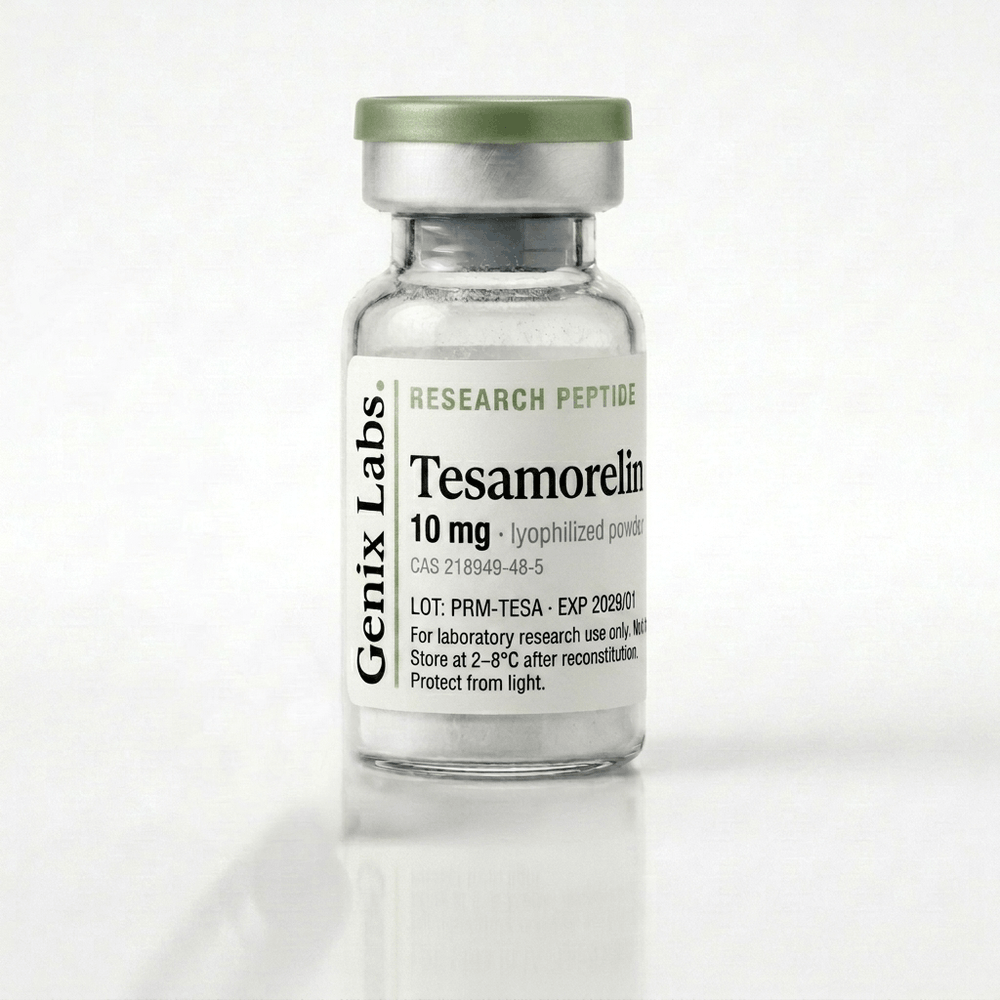
Compare that to the compound this site actually stocks in the same class. Tesamorelin has phase 3 trials, an FDA approval, and published imaging outcomes. The gap is not a detail. It is the whole difference between a drug and a research chemical.
Who actually made ipamorelin?
Novo Nordisk, the Danish company best known for insulin and later for semaglutide. The 1998 paper that introduced ipamorelin lists a Novo Nordisk address and describes the compound as the outcome of a major chemistry programme. The team was hunting for a growth hormone releasing molecule that did not drag other hormones up with it.
This matters for a practical reason. The compound was not invented in a grey market lab. It was designed, characterised and taken into people by a company with the resources to do it properly. So when the trail goes cold, the interesting question is why a company that could have developed it chose not to.
Why was ipamorelin abandoned?
No company publishes a press release explaining a quiet discontinuation, so the honest answer is that the public record does not say. What the public record does show is the sequence. Novo Nordisk characterised it in 1998 and 1999. It changed hands and resurfaced years later in a phase 2 trial for a surgical indication. That trial, published in 2014, reported no significant difference against placebo on its key endpoint. There is no later trial.
Read in order, that is a compound which was given a fair test in people and did not clear the bar. It is a section none of the pages ranking for this keyword include, and it changes how every later claim should read.
How does ipamorelin work?
It imitates ghrelin. Ghrelin is a hormone made mostly in the stomach, best known for signalling hunger, but it also binds a receptor in the pituitary gland called GHS-R1a. When that receptor is activated, the pituitary releases stored growth hormone into the blood.
Ipamorelin binds the same receptor and produces the same release. The 1998 paper measured this in isolated rat pituitary cells, in anaesthetised rats and in conscious pigs, and found potency close to GHRP-6, an older peptide in the same family.
- The peptide reaches the pituitary through the bloodstream.
- It binds GHS-R1a, the ghrelin receptor, on growth hormone producing cells.
- Those cells release growth hormone that was already made and stored.
- Growth hormone acts on the liver and other tissues, some of it through IGF-1.
- Somatostatin, the body's own brake on growth hormone, still applies.
Step five is the one vendor pages leave out. The pituitary is not a tap that a secretagogue opens at will. It sits inside a feedback system, and that system pushes back.
Why does the receptor matter so much?
Because the whole comparison shelf splits on it. Sermorelin, CJC-1295 and tesamorelin copy growth hormone releasing hormone and act on the GHRH receptor. Ipamorelin, GHRP-2, GHRP-6 and ibutamoren act on the ghrelin receptor. Two different doors into the same room.
This is why vendors sell a GHRH peptide and a ghrelin peptide together. The theory is that pulling both levers produces a bigger release than either alone. The theory is reasonable and the underlying receptor biology is real. What is missing is a controlled trial showing that the combination changes anything a person would notice.
What does selective actually mean here?
It means one specific thing, and it is narrower than the marketing suggests. Older peptides in this family, GHRP-6 and GHRP-2, raised growth hormone but also raised ACTH and cortisol. ACTH is the pituitary signal that tells the adrenal glands to make cortisol, the main stress hormone. That extra effect was seen as a problem.
In the 1998 study, ipamorelin released growth hormone with similar potency to GHRP-6 but did not raise ACTH or cortisol to a degree that differed from a plain GHRH stimulus. That held at doses more than two hundred times the dose needed for half maximal growth hormone release. The authors called it the first growth hormone secretagogue with GHRH-like selectivity.
Where was that selectivity measured?
In pigs. This is the detail that goes missing every time the selectivity claim is repeated, and it is the second section no competing page includes. The paper states plainly that the specificity for growth hormone release was studied in swine. The hormones measured were FSH, LH, prolactin, TSH, ACTH and cortisol, in conscious pigs.
Pig endocrinology is a reasonable model and the finding is a real finding. It is still not a human finding. A sentence like "ipamorelin does not raise your cortisol" converts a swine result into a personal promise, and nothing published supports that conversion.
- Supported: in pigs, ipamorelin released growth hormone without raising ACTH or cortisol.
- Supported: the same study found no change in FSH, LH, prolactin or TSH in pigs.
- Not supported: the same hormone panel has been run in people.
- Not supported: selectivity persists across repeated dosing over weeks.
What happens to ipamorelin in a human body?
This is the one question with a direct human answer. In 1999 a team modelled the pharmacokinetics and pharmacodynamics of ipamorelin in healthy male volunteers. Five infusion rates were tested, with eight men at each level, giving forty subjects in total. Each infusion ran over fifteen minutes.
| What was measured | Result | Why it matters |
|---|---|---|
| Terminal half-life | about 2 hours | Short. The peptide is cleared the same day. |
| Clearance | 0.078 L/h/kg | Steady and predictable across doses. |
| Volume of distribution | 0.22 L/kg | Stays largely in the blood and nearby fluid. |
| Dose proportionality | Yes | Double the dose, roughly double the exposure. |
| Shape of the GH response | A single pulse | Not a sustained elevation. |
| Time to peak GH | about 0.67 hours | Roughly forty minutes after dosing. |
Dose proportional kinetics is a genuinely useful finding. It means the compound behaves predictably across the range tested, which makes it easier to study properly. It says nothing at all about whether it does anything useful.
Why one pulse is not the same as high growth hormone
The paper describes the growth hormone response as a single episode of release, peaking around forty minutes and then declining exponentially to negligible concentrations at every dose tested. That is the sentence the whole category tends to skip.
Natural growth hormone release already works in pulses, mostly at night. A secretagogue adds a pulse. It does not convert the body to a steady high level, and the paper found that the variation between individuals in the growth hormone response was larger than the variation in blood levels of the peptide itself.
That last point is worth sitting with. Two people given the same amount can end up with meaningfully different growth hormone responses. Any claim built on a fixed effect per dose is arguing against the only human dataset there is.
What did the rat bone study find?
It found faster bone lengthening. Adult female rats were given ipamorelin under the skin three times a day for fifteen days, at 0, 18, 90 and 450 micrograms per day. Growth at the top of the shin bone was measured using tetracycline, an antibiotic that deposits in growing bone and glows under a microscope, marking exactly where the bone was on a given day.
A rise from 42 to 52 micrometres a day is a real, dose dependent effect, and body weight gain rose with it. This is the strongest positive finding in the ipamorelin literature. It is also a finding about growing rat bone, in a species whose growth plates behave differently from an adult human's.
The IGF-1 result nobody quotes
In the same study, total IGF-1 did not change. Neither did the IGF binding proteins, nor the blood markers of bone formation and breakdown. That is a striking result and it almost never appears on pages selling this peptide.
IGF-1 is the main messenger through which growth hormone produces most of its longer term effects on tissue. It is the marker a clinic would check to see whether a growth hormone axis treatment is doing anything systemic. Fifteen days of dosing moved bone growth without moving it.
- Pulses of growth hormone can act locally without shifting the average IGF-1 level.
- An unchanged IGF-1 is the opposite of what a sustained growth hormone elevation looks like.
- The same paper found the pituitary response to a provocative dose was slightly reduced after fifteen days, which hints at adaptation.
- No study has run the same panel in people for the same duration.
For the compound in this class that does have published human IGF-1 and imaging data, the tesamorelin guide walks through what a properly powered trial programme looks like.
What did the only human efficacy trial measure?
Time to a tolerated meal after bowel surgery. The trial, published in 2014, was a multicentre, double blind, placebo controlled phase 2 study in adults having small or large bowel resection. It tested whether ipamorelin could shorten postoperative ileus, the period after abdominal surgery when the gut stops moving normally.
That indication is not arbitrary. The ghrelin receptor drives gut motility as well as growth hormone release, so a ghrelin mimic is a sensible candidate. One hundred and seventeen patients were enrolled and one hundred and fourteen were analysed. Dosing was intravenous, twice daily, for up to seven days.
| Trial detail | Ipamorelin arm | Placebo arm |
|---|---|---|
| Patients analysed | 114 across both arms | 114 across both arms |
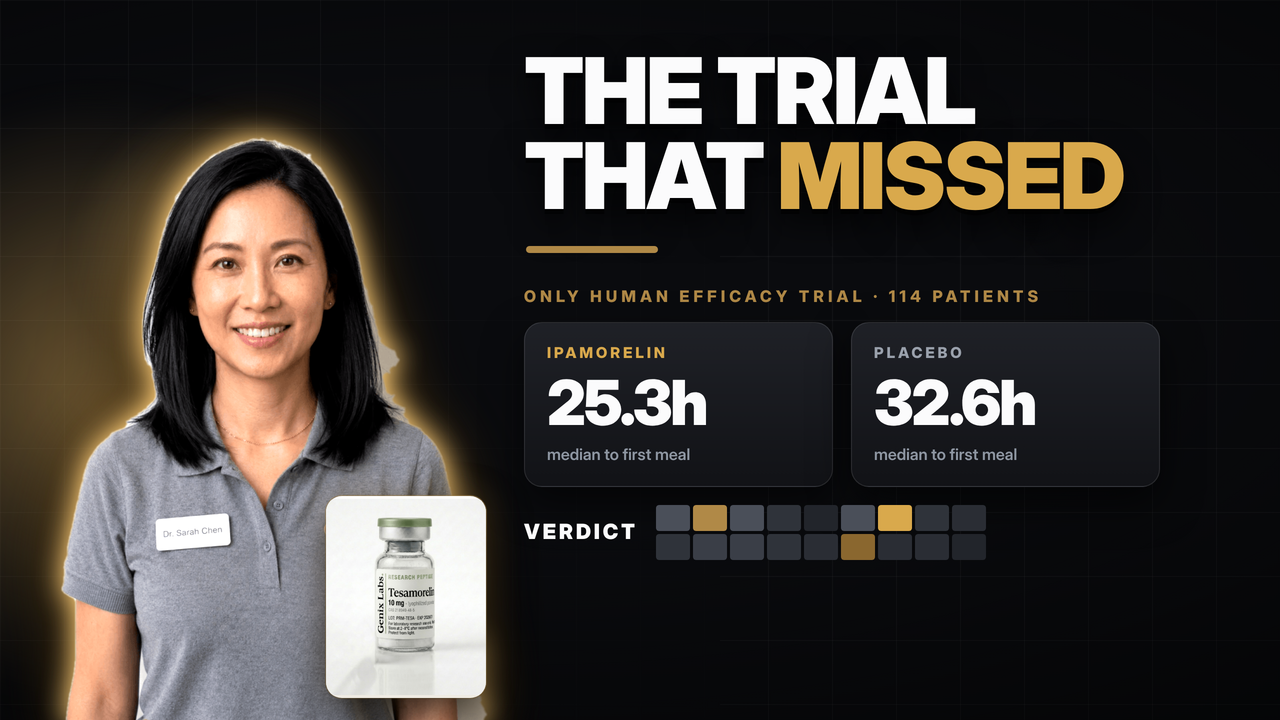
| Median time to first tolerated meal | 25.3 hours | 32.6 hours |
| Statistical significance | p = 0.15, not significant | same comparison |
| Any treatment emergent adverse event | 87.5% | 94.8% |
| Secondary endpoints | No significant difference | same comparison |
| Conclusion as published | Well tolerated, no efficacy difference | same comparison |
How should that result be read?
Carefully, in both directions. The numbers look promising at a glance. Twenty five hours against thirty three hours is a seven hour difference, and seven hours matters to someone recovering from surgery. But p = 0.15 means a difference that size could easily have come from chance in a trial this small. The study did not establish an effect.
Fairness cuts the other way too. A proof of concept trial with 114 patients is not powered to detect a modest benefit, and the authors said so, noting the study was small and enrolled a broad mix of underlying conditions. A missed endpoint in a small trial is not proof that nothing is there.
- Settles: at that dose and schedule, ipamorelin was tolerated over seven days in sick patients.
- Settles: it did not beat placebo on the endpoint the trial was designed around.
- Does not settle: whether a larger trial would have found a real effect.
- Does not settle: anything about body composition, sleep or recovery, none of which were measured.
- Worth noting: no larger trial followed. That silence is information.
Every marketed claim, graded
This is the table the top ranking pages do not print. Each row takes a claim you will find on vendor and clinic pages and puts it next to the evidence it actually has.
| Marketed claim | What was measured | In what | Grade |
|---|---|---|---|
| Releases growth hormone | A single GH pulse after dosing | Rats, pigs, healthy men | Supported |
| Selective, no cortisol spike | ACTH and cortisol flat at 200x the GH dose | Pigs only | Partly supported |
| Increases bone growth | Shin bone growth 42 to 52 micrometres a day | Adult female rats | Animal only |
| Improves body composition | Body weight gain rose with dose | Rats | Animal only, and the direction is weight gain |
| Burns fat | Nothing | No study | Unsupported |
| Builds lean muscle | Nothing | No study | Unsupported |
| Improves sleep quality | Nothing | No study | Unsupported |
| Anti-aging effects | Nothing | No study | Unsupported |
| Speeds injury recovery | Nothing | No study | Unsupported |
| Raises IGF-1 | IGF-1 did not change over 15 days | Rats | Contradicted |
| Helps gut motility | Endpoint missed at p = 0.15 | 114 surgical patients | Tested and not shown |
Six of eleven rows have nothing behind them. One is contradicted by the study most often cited in its favour. That is the real state of the literature, and no amount of confident copywriting changes it.
Is ipamorelin a fat loss peptide?
No published study has measured fat loss with ipamorelin, in any species. The claim is built on a chain of inference: growth hormone influences fat metabolism, ipamorelin releases growth hormone, therefore ipamorelin should reduce fat. Each link is plausible. The chain has never been tested end to end.
The closest measured result points the other way. In the rat study, body weight gain increased with dose. That is consistent with growth, which was the point of the experiment, but it is not what someone reading a fat loss page expects to find.
For the compounds in this category that do have measured fat outcomes, the weight loss peptides ranked by evidence guide sorts them by what the trials actually reported.
What is the most powerful peptide for fat loss?
Judged by published trial results rather than marketing, the incretin compounds are not close to the growth hormone peptides. Retatrutide, tirzepatide and semaglutide have large randomised trials with measured body weight change as the primary endpoint. Ipamorelin has none.
Inside the growth hormone family specifically, tesamorelin is the only compound with a regulatory approval and published imaging of a fat depot. That approval is narrow, covering excess visceral abdominal fat in people with HIV associated lipodystrophy, and the research vials sold here are not that medicine. But it is the only one in this class with a trial programme behind it.
- Largest measured weight change in trials: the incretin compounds, by a wide margin.
- Only growth hormone peptide with an approved indication: tesamorelin.
- Only growth hormone peptide with published fat imaging: tesamorelin.
- Ipamorelin: no fat outcome measured in any species.
Does ipamorelin build muscle?
No study has measured lean mass after ipamorelin. Not in rats, not in pigs, not in people. The rat study measured bone growth and body weight, and reported that markers of bone turnover did not shift. Muscle was not an endpoint.
The inference again runs through growth hormone and IGF-1. The difficulty is that the one study which measured IGF-1 across fifteen days of dosing found no change in it. If the main anabolic messenger does not move, the mechanism the muscle claim depends on is missing its middle step.
Does ipamorelin improve sleep?
There is no sleep study. No polysomnography, no sleep diaries, no sleep endpoint in either human trial. The claim exists because growth hormone release is associated with deep sleep, which is a real physiological relationship, read backwards.
Growth hormone rises during deep sleep. That does not mean causing a growth hormone pulse creates deep sleep. The arrow in the published physiology points from sleep to the hormone, not the other way. Our peptides for sleep guide grades this whole category by what was actually measured.
Is ipamorelin an anti-aging peptide?
Not on any published evidence. There is no longevity study, no lifespan study, no study of aging markers, and no study longer than fifteen days in any species. The anti-aging framing comes from the general observation that growth hormone declines with age.
That observation is true and uninteresting on its own. Many things decline with age, and pushing one of them back up is a hypothesis, not a result. Our anti-aging peptide guides sort that shelf by what each compound can actually show, and ipamorelin does not appear on it.
Does ipamorelin cause hunger or appetite changes?
It is the most reasonable side effect question in the whole set, because ipamorelin targets the ghrelin receptor and ghrelin is the hunger hormone. If a compound copies the hunger signal, appetite is the obvious thing to check.
Neither human study reported it. The pharmacology study measured peptide and growth hormone concentrations. The surgical trial measured time to a tolerated meal, which is a measure of gut recovery after an operation, not of appetite. The rat study measured body weight gain, which rose, but did not separate intake from growth.
Will ipamorelin increase testosterone?
The published evidence points the other way. The 1998 swine study measured luteinising hormone alongside growth hormone and found no change. Luteinising hormone is the pituitary signal that tells the testes to produce testosterone, so leaving it flat is exactly what a compound with no effect on testosterone would do.
That is a pig result, with the same species caveat as every other selectivity finding here. But it is the only relevant measurement that exists, and it does not support the claim. No study has measured testosterone directly after ipamorelin in any species.
How does ipamorelin compare to CJC-1295?
They work on different receptors, which is the entire basis of the stack. CJC-1295 is a GHRH analogue. Ipamorelin is a ghrelin receptor agonist. Pulling both levers at once produces a larger release in principle, and that is what every clinic page selling the combination says.
What neither compound has is an approval or a controlled trial showing a body composition outcome. CJC-1295 has human data on hormone markers. Ipamorelin has the pulse study and the failed efficacy trial. There is no published head to head of the stack against either compound alone, and no trial of the stack against placebo on any outcome a person would notice.
- True: the two compounds act on different receptors, so combining them is mechanistically coherent.
- True: neither compound is approved in any country.
- Unsupported: that the combination produces more fat loss, more muscle or better sleep than either alone.
- Unsupported: any specific ratio or schedule, none of which has been trialled.
The growth hormone peptides, line by line
| Compound | Receptor | Approved anywhere | Strongest published evidence |
|---|---|---|---|
| Ipamorelin | Ghrelin (GHS-R1a) | No | A GH pulse in healthy men; one failed phase 2 |
| CJC-1295 | GHRH | No | Human hormone marker data, no outcome trial |
| Sermorelin | GHRH | Previously, now withdrawn | Historic use in growth hormone deficiency testing |
| Tesamorelin | GHRH | Yes, one narrow indication | Phase 3 trials with imaged fat outcomes |
| GHRP-6 | Ghrelin (GHS-R1a) | No | Releases GH, also raises cortisol and prolactin |
| GHRP-2 | Ghrelin (GHS-R1a) | No | Higher potency, same cortisol problem |
Read down the approval column. One row has a yes, and it is narrow. Read down the evidence column and the same row is the only one with imaged outcomes. For the two closest comparisons in that table, see tesamorelin vs sermorelin.
What tesamorelin has that ipamorelin lacks
A trial programme, a regulator's review, and published imaging of the tissue it was meant to change. Tesamorelin went through phase 3 trials and holds an FDA approval for excess visceral abdominal fat in HIV associated lipodystrophy. That is a narrow indication, and it is still infinitely more than a research chemical with one missed endpoint.
It also helps that tesamorelin is a GHRH analogue. It works through the body's own releasing hormone pathway rather than the hunger receptor, which sidesteps the appetite question entirely.
Genix supplies lab-tested tesamorelin research vials at 10mg, currently 149 US dollars or 2,450,000 rupiah, each with a lot matched certificate of analysis showing HPLC area purity at or above 99 percent and LC-MS identity confirmation from an ISO 17025 laboratory. For how that compound is studied, see the tesamorelin dosing overview.
Why did the FDA ban ipamorelin?
It did not ban it. The question is phrased that way everywhere because of a real regulatory action that is routinely described wrongly. In September 2023 the FDA placed ipamorelin acetate in Category 2 of its interim policy on bulk drug substances used in compounding, alongside several other peptides including BPC-157 and CJC-1295.
Category 2 is a list of substances the agency considers to raise significant safety risks, or for which the nomination did not establish safety to its satisfaction. The practical effect is that a compounding pharmacy using one of them risks enforcement action. That is a meaningful restriction. It is not a ban, not a scheduling decision, and not a finding that the compound is dangerous.
- Not scheduled as a controlled substance anywhere.
- Not approved as a medicine anywhere, which is the more important fact.
- Placed in Category 2 of the interim 503A bulks policy in September 2023.
- Compounding pharmacies using it risk enforcement, which is why clinic access narrowed.
- Sold legally as a research chemical, for laboratory use, not for people.
What Category 2 actually means
The FDA keeps interim lists of bulk substances that compounding pharmacies may use. Category 1 substances may be used while the agency finishes evaluating them. Category 2 substances are the ones it has flagged. The compounding industry has argued that a Category 2 placement can reflect a weak nomination file rather than an identified hazard, and that argument has some force.
Either way, the reasoning that matters for a researcher is simpler. The agency looked at the file and did not see enough to be comfortable. Given that the file contains one human efficacy trial which missed its endpoint, that is not a surprising conclusion.
Is ipamorelin banned in sport?
Yes. Growth hormone secretagogues, including the growth hormone releasing peptides, are prohibited at all times under the peptide hormones and growth factors class of the World Anti-Doping Agency list. That covers both in competition and out of competition testing.
This is one of the few unambiguous answers in this guide. Any tested athlete should treat this compound as prohibited, and the fact that it is not an approved medicine makes no difference to that status.
What side effects were actually recorded?
Only the surgical trial collected safety data systematically, and it did so in people recovering from bowel surgery, which makes the figures hard to read. Treatment emergent adverse events occurred in 87.5 percent of the ipamorelin group and 94.8 percent of the placebo group.
Both numbers are near ninety percent because the patients had just had an operation. The useful comparison is between the arms, not against zero, and on that comparison the ipamorelin group did not fare worse. The authors concluded the dosing schedule was well tolerated for up to seven days.
- Seven days is the longest systematically monitored human exposure in the record.
- The population was surgical patients, not healthy adults.
- Dosing was intravenous and supervised in hospital.
- No published study has monitored repeated dosing over weeks or months in people.
- Reported effects elsewhere, such as flushing or a head rush, come from user accounts rather than trials.
So what is the real downside?
It is not a dramatic side effect profile. It is the thinness of the record. A compound studied this lightly carries unknowns rather than known harms, and unknowns are harder to plan around than a documented risk.
- No trial has followed ipamorelin past seven days in people.
- No human hormone panel has checked whether the selectivity seen in pigs holds in people.
- The rat study hinted at a reduced pituitary response after fifteen days, and nobody followed it up.
- The ghrelin receptor sits in the gut and the brain as well as the pituitary, and those tissues were not studied.
- Because it is unapproved, nothing sold under the name is made to a medicine's manufacturing standard.
What doses were used in the studies?
Reported here as study design, not as instruction. No human dosing guidance exists for this compound because no regulator has ever approved one, and nothing in this guide should be read as a protocol for a person.
| Study | Subjects | Route and schedule | Amounts tested |
|---|---|---|---|
| Raun 1998 | Rats, swine | Intravenous, single | ED50 near 80 nmol/kg in rats |
| Johansen 1999 | Adult female rats | Subcutaneous, three times daily, 15 days | 0, 18, 90 and 450 micrograms per day |
| Gobburu 1999 | 40 healthy men | 15 minute infusion, single | 4.21 to 140.45 nmol/kg |
| Beck 2014 | 114 surgical patients | Intravenous, twice daily, up to 7 days | 0.03 mg/kg per dose |
Two things stand out. Every human dose in the record was given intravenously under supervision, and the longest exposure was seven days. The weekly subcutaneous schedules quoted on vendor pages match nothing in this table.
How is a research peptide like this handled?
The same way any lyophilized peptide is handled, which is to say carefully. Lyophilized means freeze dried into a powder, which is the stable form. Once reconstituted with bacteriostatic water, a peptide is in solution and the clock starts.
- Keep the sealed vial cold and out of light until it is used.
- Reconstitute slowly down the side of the vial, never squirted onto the powder.
- Never shake a reconstituted vial. Swirl it.
- Refrigerate after reconstitution and protect from light.
- Label the vial with the date it was reconstituted.
Our peptide reconstitution method covers the technique in detail, including the clumping problem that ruins a vial.
Why purity decides the result
Because an unapproved compound has no manufacturing standard attached to it. There is no pharmacopoeia monograph for ipamorelin, no approved specification, and no regulator checking what goes into a vial labelled with its name. Whatever quality exists is whatever the supplier chose to pay for.
Two tests settle the basic questions. HPLC, high performance liquid chromatography, separates everything in the vial and tells you what share of it is the peptide you wanted. LC-MS, liquid chromatography mass spectrometry, weighs the molecule and confirms it is the right one. Purity without identity is a half answer.
A certificate of analysis only means something if its lot number matches the label on the vial in front of you. A generic PDF for a batch nobody can tie to your vial is marketing.
What is actually sold as ipamorelin?
Research vials of lyophilized powder, usually in 2mg, 5mg or 10mg presentations, from suppliers that vary enormously in what they verify. Because nothing about this compound is regulated as a medicine, the vial is only as good as the paperwork behind it.
We have tested it. Lot 905362, a 10mg ipamorelin lot, was analysed by HPLC-UV-MS at 220 nanometres and the full report is published on this site. Area purity came back at 99.30 percent against a 98.00 percent specification, peptide content at 98.80 percent, and the deconvoluted mass at 711.9 atomic mass units against an expected 711.85, which confirms the molecule is the pentapeptide it claims to be. Lead, arsenic, cadmium and mercury were all measured and all passed. You can read the whole thing on the ipamorelin lot 905362 certificate of analysis.
That report is a statement about one lot of material, not an endorsement of the compound. Ipamorelin is not a listed product in our catalog. The growth hormone axis compound we stock is tesamorelin, because it is the one in this class with a trial programme and a regulatory review behind it, and a lot report cannot substitute for either. If you are sourcing ipamorelin elsewhere, the checklist below is the one we would apply.
What breaks an ipamorelin claim?
- Reading a swine selectivity result as a human one.
- Treating a single growth hormone pulse as a sustained elevation.
- Quoting the bone study as proof of muscle growth, when IGF-1 did not move in it.
- Citing the 2014 trial as evidence it works, when the endpoint was missed.
- Saying the FDA banned it, when the action was a Category 2 compounding placement.
- Repeating a weekly dosing schedule that appears in no published study.
- Comparing it to CJC-1295 as though both act on the same receptor.
What to ask before sourcing any of this class
Six questions. A supplier who can answer all six is unusual, and the ones who cannot tend to answer with adjectives.
- Can you send the lot report for the specific vial, with the lot number printed on the label?
- Was purity measured by HPLC, and is the chromatogram included rather than a summary line?
- Was identity confirmed by mass spectrometry, so it is the right molecule and not just a pure one?
- Which laboratory ran the tests, and is it independently accredited?
- How was the vial stored and shipped, and at what temperature did it arrive?
- What else is in the vial besides the peptide, and is that published anywhere?
Which compound suits which research question?
| If the research question is about | The better supported compound is | Because |
|---|---|---|
| Visceral fat in a studied population | Tesamorelin | Phase 3 trials with imaged fat outcomes |
| Growth hormone pulse pharmacology | Ipamorelin | It has a published human PK and PD model |
| Ghrelin receptor effects on gut motility | Ipamorelin | It is the only one tested for that endpoint in people |
| Body weight change | The incretin compounds | Large randomised trials with weight as the endpoint |
| Cortisol sparing GH release | Ipamorelin, with a species caveat | The selectivity finding is real but was measured in pigs |
| Anything with a regulator's review behind it | Tesamorelin | It is the only approved compound in the class |
For the wider map of this category, the weight and metabolism peptides hub collects every guide in this cluster in one place.
FAQ
What does ipamorelin do for you?
In published work it does one measured thing. It binds the ghrelin receptor in the pituitary and triggers a single pulse of growth hormone that peaks near 40 minutes and fades. Everything else attributed to it, sleep, fat loss, recovery, is extrapolated from that pulse rather than measured.
Why did the FDA ban ipamorelin?
There is no ban. In September 2023 the FDA placed ipamorelin acetate in Category 2 of its interim policy on bulk substances for compounding, which signals significant safety risks or an incomplete nomination. It means pharmacies risk enforcement if they compound it. It is not a scheduling action.
What is the downside of ipamorelin?
The evidence base, not a dramatic side effect profile. Four papers carry almost every claim made for it, the one human efficacy trial missed its endpoint, and no study has followed it past seven days of dosing. A compound tested that lightly has unknowns rather than known harms.
Will ipamorelin increase testosterone?
No published study reports that. The swine selectivity work measured FSH, LH, prolactin and TSH alongside growth hormone and found no change in any of them. Luteinising hormone is the pituitary signal that drives testosterone, so an unchanged LH is evidence against the idea, not for it.
Does ipamorelin cause hunger or appetite changes?
It acts on the ghrelin receptor, the same receptor the hunger hormone uses, so the question is reasonable. The human trials did not report appetite as an outcome. The one efficacy trial measured time to a tolerated meal after bowel surgery, which is not an appetite measure.
How does ipamorelin compare to CJC-1295?
They hit different receptors. CJC-1295 is a GHRH analogue, ipamorelin a ghrelin receptor agonist, which is why vendors sell them stacked. Neither is approved anywhere and neither has a controlled trial showing a body composition outcome. The stack has no published head to head behind it.
The takeaway
Ipamorelin does one measured thing well. It makes the pituitary release a pulse of growth hormone, with predictable kinetics and, in pigs at least, without dragging cortisol up with it. That is a genuine piece of pharmacology and it is why the compound is still interesting to study.
What it does not have is an outcome. The one human efficacy trial missed its endpoint, no trial has followed it past seven days, the marker that carries growth hormone's longer term effects did not move in the only study that checked, and no study has measured fat, muscle or sleep in any species. The benefit list sold with the name is inference presented as result.
If you are designing research in this area, match the compound to the question, read the four papers rather than the summaries of them, and work with material whose purity and identity you can verify from a lot report. Every Genix Labs compound is supplied strictly for in vitro laboratory research. It is not for human or veterinary use, and nothing here is medical advice.