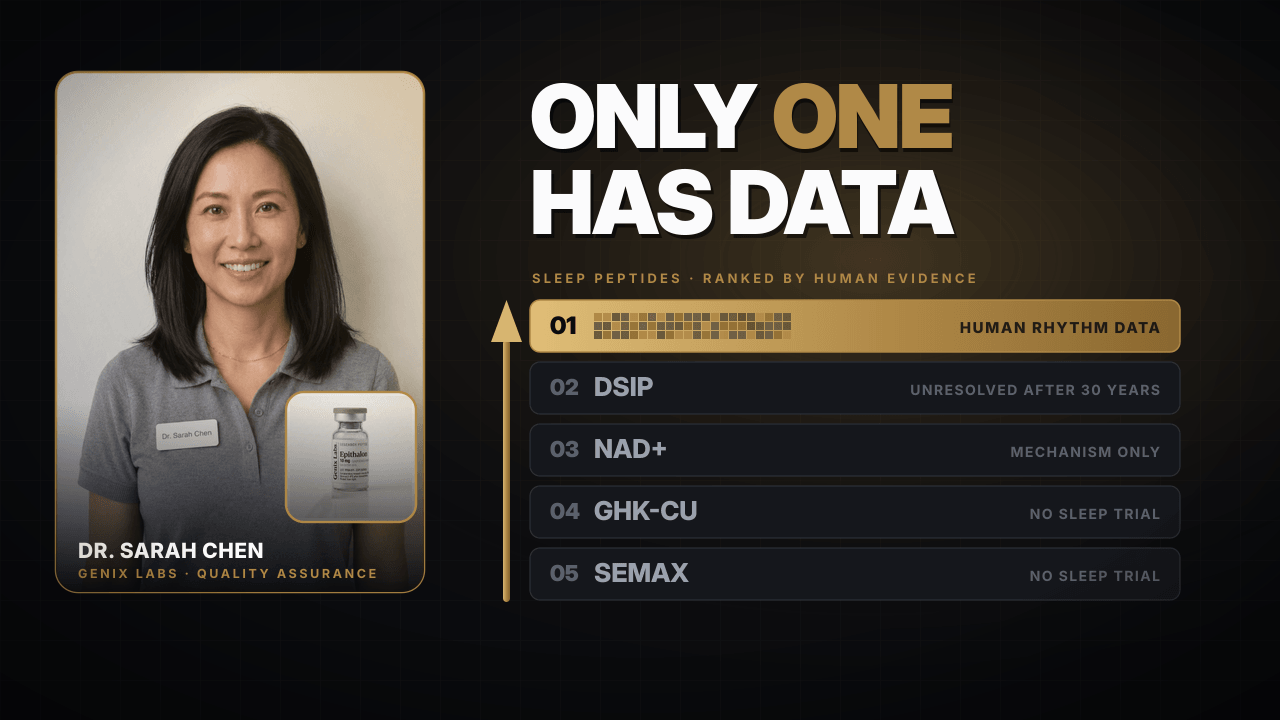
Search peptides for sleep and you get the same five names in the same order on every page. Almost none of those pages tell you which name has a human study behind it. That is the only question that matters here. This guide ranks sleep peptides by evidence, names the famous one the research keeps failing, and shows you how to judge a sleep result honestly. Everything here is research use only.
The quick answer
One peptide family has real human sleep-rhythm data: the pineal peptides behind epithalon. In older adults, the related preparation restored the night-time melatonin peak toward a younger pattern. DSIP is the famous sleep peptide and its own review called the effect unresolved. NAD+, GHK-Cu, and Semax have no human sleep trial at all. Research use only.
New to this category? Start at the hub, Longevity and Anti-Aging Peptides, then come back.
What are sleep peptides?
A sleep peptide is a short chain of amino acids studied for its effect on sleep or the body clock. Amino acids are the small building blocks your body already uses. A peptide is just a few of them joined in order. These are signals, not sedatives. None of them is a sleeping pill, and all of them are supplied for laboratory research only.
That last point changes how you should read every claim. A sleeping pill is tested against a placebo in people who cannot sleep. A research peptide is usually tested in cells, in rodents, or in a small group with a blood marker as the outcome. Those are different kinds of proof. Most sleep peptide pages blur the two on purpose.
- Epithalon, also written epitalon, a four-amino-acid pineal peptide.
- DSIP, delta sleep-inducing peptide, nine amino acids, discovered in rabbits.
- NAD+, a coenzyme rather than a peptide, sold alongside them.
- GHK-Cu, a copper peptide, studied for skin and hair, not sleep.
- Semax, a focus peptide that some people find alerting, not calming.
How could a peptide change sleep?
Through the clock, not through sedation. Your sleep runs on a daily rhythm set by light and by melatonin, the hormone your pineal gland releases at night. A peptide can only help sleep if it nudges that rhythm, raises the night-time melatonin signal, or lowers something that keeps breaking sleep, like disordered breathing.
That gives you three honest mechanisms, and a test for any claim. Ask which of the three a supplier is claiming. Then ask what they measured. If the answer is neither, the claim is a story.
- Rhythm. Restore the melatonin peak that flattens with age. This is the epithalon route.
- Direct sleep signal. Act on sleep-promoting circuits in the brain. This is the DSIP claim, and it is the weakest.
- Remove an obstacle. Reduce the breathing interruptions that fragment the night. This is where the biggest measured effect in peptide research lives.
Which sleep peptides have real evidence?
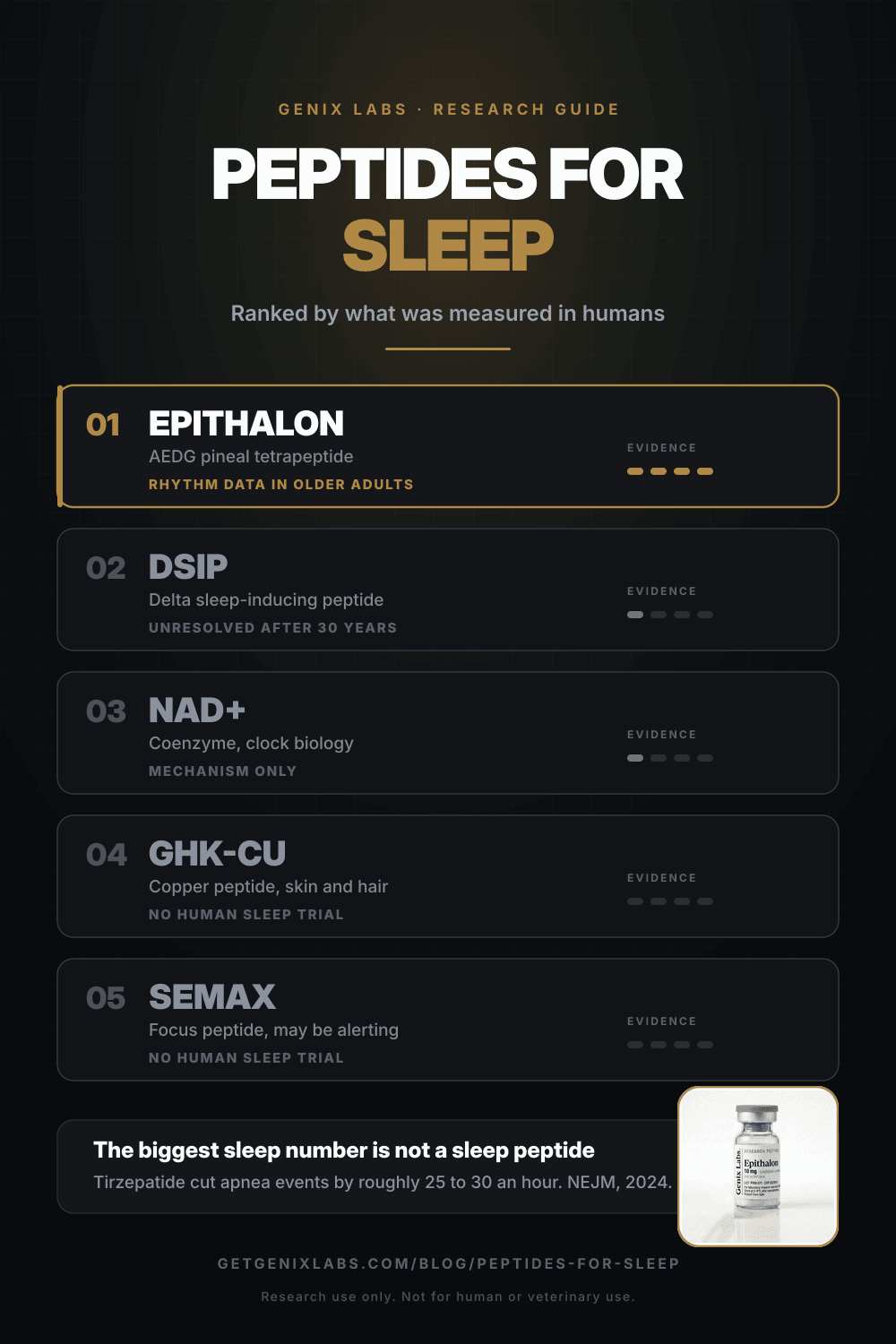
Ranked by human evidence, the order is short. Epithalon and its parent pineal preparation sit first, because the melatonin rhythm was measured in older adults and published. DSIP sits second on fame and last on proof. NAD+ sits third on mechanism alone. GHK-Cu and Semax do not belong on a sleep list at all.
| Peptide | What was measured in humans | Evidence grade | Honest use |
|---|---|---|---|
| Epithalon (AEDG) | Night-time melatonin rhythm in older adults, published in Bull Exp Biol Med | Strongest of the group, small studies | The only rhythm candidate |
| DSIP | Nothing reproducible. Named from 1970s rabbit brain work | Unresolved after 30 years | Popular, not proven |
| NAD+ | No sleep trial. Clock biology only | Mechanism only | Energy research, not sleep |
| GHK-Cu | No sleep trial of any kind | None | Skin and hair research |
| Semax | No sleep trial. Studied for attention | None, may be alerting | Focus research |
Why does epithalon lead the list?
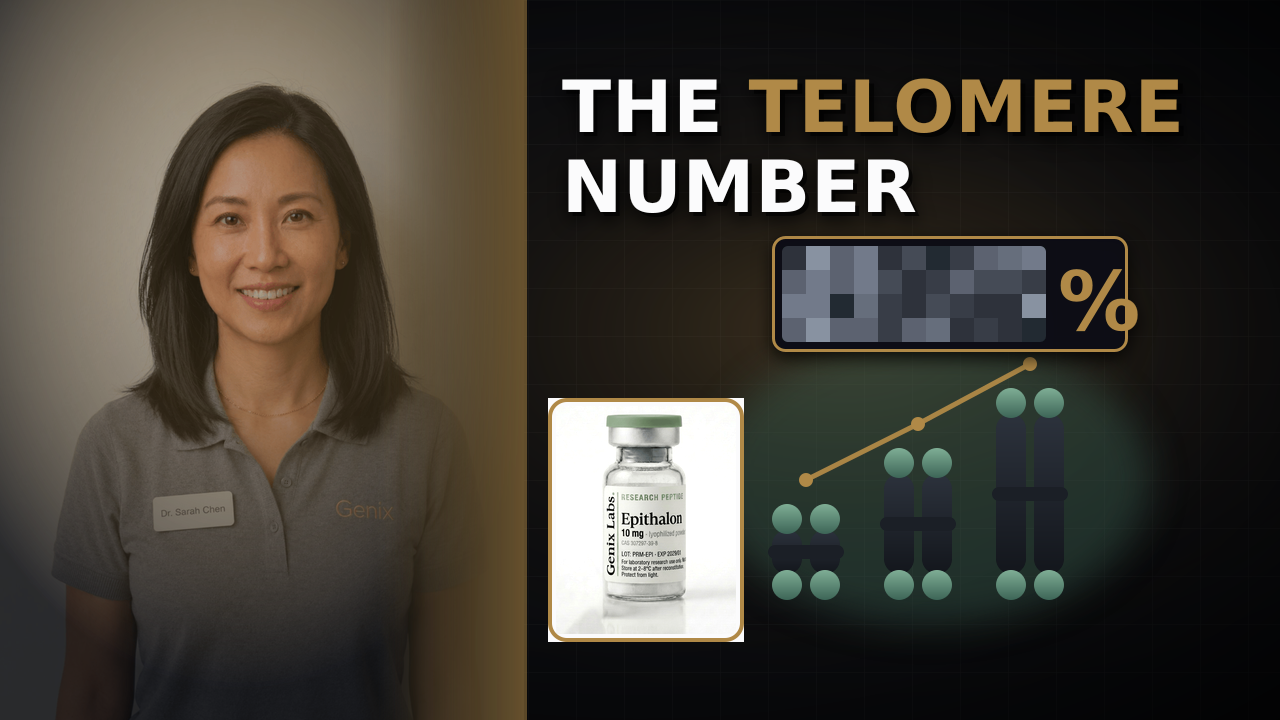
Because the rhythm was measured. In older adults, the pineal preparation epithalamin lifted the night-time melatonin peak back toward a younger pattern, and the finding was repeated across older primates and older people. That is the only published human rhythm data in this whole category. It is rhythm data, not a sleep-quality promise.
Epithalon is the clean synthetic version of that extract. It is four amino acids, Ala-Glu-Asp-Gly, built in St. Petersburg to copy the active part of epithalamin. Our full write up is here: Epithalon, the telomere peptide, honestly explained.
One caution matters more than any other in this topic. Most of the famous survival numbers online belong to epithalamin, the bovine extract, not to the tetrapeptide. The rhythm data is the part that carries over cleanly. Treat anything bigger than that as hype borrowed from the extract era.
- The outcome measured was melatonin output across the night, not hours slept.
- The groups were small and older, which is where the melatonin peak is already flat.
- The direction of change was consistent across two published groups and a primate group.
- Sleep is what people report noticing first, which is feedback, not trial data.
- Long-term safety work is still missing, and the 2025 review says so plainly.
Does DSIP actually make you sleep?
Not reliably. DSIP stands for delta sleep-inducing peptide, which is a name, not a finding. It came from 1970s work where blood from sleeping rabbits seemed to make other rabbits sleep. Human research never reproduced that cleanly. The 2006 review in the Journal of Neurochemistry called its sleep role a still unresolved riddle.
That review is the single most useful document in this topic. It gathered thirty years of DSIP work and could not land on a sleep effect. Since then nothing has changed the picture. DSIP is still sold as the sleep peptide because the word sleep is in its name.
Does NAD+ help you sleep?
There is no human sleep trial for NAD+. What exists is clock biology. NAD+ is a coenzyme that every cell uses to make energy, and the same machinery that burns it runs on a daily cycle. So NAD+ and your body clock are genuinely linked. Linked is not the same as helpful for sleep.
In practice people report the opposite of sedation. NAD+ is studied for daytime energy and mental clarity, which is why late dosing shows up in complaint threads. Our evidence review is here: NAD+ for energy and aging.
What is the biggest sleep number in peptide research?
It does not come from a sleep peptide. In the 2024 SURMOUNT-OSA trial, published in the New England Journal of Medicine, tirzepatide cut breathing interruptions in obstructive sleep apnea by roughly 25 to 30 events an hour, against about 5 on placebo. That is the largest measured sleep effect anywhere in this literature.
It also shows what a real sleep result looks like. A named trial, a hard outcome counted by a machine, a placebo group, and a journal. Hold every sleep peptide claim against that bar and the category thins out fast. Tirzepatide is a metabolic compound, not a sleep aid, and it is research use only here too. See the tirzepatide research dosing chart for how that compound is studied.
Which sleep peptides have no data at all?
GHK-Cu and Semax. Neither has a human sleep trial, and neither is studied for sleep. GHK-Cu is a copper peptide researched for collagen, skin, and hair. Semax is researched for attention and mental clarity, and some people find it alerting rather than calming. They appear on sleep lists because they sell.
- GHK-Cu. Skin and hair research. No sleep endpoint has been published.
- Semax. Focus research. Alerting for some people, which is the opposite of the goal. See the honest review of Semax side effects.
- Peptide blends marketed for rest. The blend inherits the evidence of its parts, which here is close to none.
- Anything sold with a celebrity name instead of a citation.
If you want the Semax picture before you judge it, read Semax side effects, honestly. It is a good peptide for the wrong job here.
What vitamins should I take for deep sleep?
No vitamin is proven to deepen sleep in healthy adults. The three with the most research are magnesium, vitamin D, and B6, and the signal is strongest in people who were low to begin with. So the useful step is a blood test, not a new bottle. Fixing a real shortfall beats stacking supplements you do not need.
This question matters here because it is the cheapest thing to rule out first. A peptide cycle costs more than a blood panel. If a deficiency is what is flattening your nights, you will never see the peptide work, because the peptide was never the problem.
- Magnesium. Most studied of the three. Best signal in older adults and in people who are low.
- Vitamin D. Low levels track with poor sleep. Correcting a real shortfall is the only tested move.
- B6. Involved in making melatonin from serotonin. Supplementing past a normal level is not proven to help.
- Melatonin itself. A hormone, not a vitamin. Tested mostly for shifting a clock, not for deepening sleep.
What is the downside of taking peptides?
Three real downsides. Most sleep peptides have no human trial, so you are paying for a mechanism rather than a result. Purity varies widely between suppliers, so some vials contain less peptide than the label says. And injected material carries handling and sterility risk. These compounds are supplied for laboratory research only.
The cost of a mechanism
A mechanism is a reasonable bet, not a purchase. The honest way to run one is a short cycle with a measurement at both ends, so you learn something either way. Running an unmeasured cycle for months is how people spend a year and know nothing.
The cost of bad material
This is the fixable one. A batch certificate of analysis shows HPLC purity and LC-MS identity, with a lot number that matches your vial. No certificate means no idea what is in the glass. See epithalon side effects for what the published safety record does and does not cover.
What are the top 5 most popular peptides?
By search demand, the five most popular peptides are retatrutide, semaglutide, BPC-157, tirzepatide, and tesamorelin. Not one of them is a sleep peptide. The popular sleep names are a separate and much smaller group: epithalon, DSIP, and increasingly NAD+. Popularity and evidence are not the same thing.
| Rank | Peptide | What it is researched for | Sleep relevance |
|---|---|---|---|
| 1 | Retatrutide | Weight and metabolism | None directly |
| 2 | Semaglutide | Weight and blood sugar | Indirect, through breathing |
| 3 | BPC-157 | Tissue repair | None |
| 4 | Tirzepatide | Weight and metabolism | Largest measured apnea effect |
| 5 | Tesamorelin | Visceral fat | None measured for sleep |
That table is the real shape of this market. Sleep is a small corner of peptide research, and the corner is thin. Browse the whole lab-tested catalog if you want to see where the evidence is actually concentrated.
What peptide does Jennifer Aniston use?
She has never named a peptide. Published interviews mention collagen powder, which is a hydrolysed protein supplement, not a research peptide. Every page attaching a celebrity to a sleep peptide is marketing. Treat a named celebrity as a signal that the page had no study to show you, and move on.
Collagen and research peptides are also built differently. Collagen powder is a long protein broken into fragments and swallowed as food. A research peptide is one exact sequence, made to spec, tested by HPLC and LC-MS. Comparing them is like comparing flour to a measured reagent.
How fast does sleep change?
In the published pineal peptide work, rhythm changes showed up inside the short dosing windows the studies used, which were measured in days rather than months. Sleep feedback is the fastest signal in this category. Anything deeper, like cell aging, is slow invisible biology you will never feel.
That gives you a clean decision point. If a rhythm cycle does nothing to your nights inside a few weeks, it is not going to start at month four. Stop, and look for the obstacle instead. Broken breathing, light at night, alcohol, and shift work all beat any peptide for sheer effect size.
How do you measure a sleep result honestly?
Pick two or three numbers before you start, and write them down. The useful ones are how long you take to fall asleep, how many times you wake, and how you rate the night out of ten. Record them for a week before and a week after. Without a baseline, you will credit the vial for a good week you would have had anyway.
- Sleep latency. Minutes from lights out to asleep. The single most sensitive number.
- Wake count. How many times you surface. Breathing problems show up here first.
- Morning rating, one to ten, written before coffee. Crude, but honest and consistent.
- Total time in bed. If this drifts, your result is schedule, not chemistry.
- One confounder log line. Alcohol, late screens, late training, travel.
What mistakes waste a sleep cycle?
Four, and they are all avoidable. Starting without a baseline. Changing two things at once. Running a compound that is alerting late in the day. And skipping the certificate of analysis, so a null result tells you nothing about the peptide and everything about the supplier.
- No baseline week. You cannot grade a result you never defined.
- Two changes at once. A new peptide plus a new bedtime teaches you nothing about either.
- Ignoring the obstacle. Snoring, reflux, and alcohol outweigh every peptide on this page.
- Bad reconstitution. Mixing roughly or storing warm degrades the material. Follow the steps in our reconstitution guide.
- No certificate of analysis. Then a null result is unreadable.
The handling piece is the one people underrate. Lyophilized powder is fragile once it is in water. Our step by step is here: how to reconstitute peptides.
Is your sleep peptide real?
Read the batch document, not the website. A real certificate of analysis names the lot, shows HPLC area purity, confirms identity by LC-MS, and comes from an accredited lab. The lot number on the paper has to match the number on your vial. If a supplier cannot produce that, the purity claim is decoration.
- HPLC area purity, with the chromatogram, not just a number in a sentence.
- LC-MS identity, confirming the mass matches the sequence you ordered.
- An ISO 17025 accredited testing lab named on the document.
- A lot number that matches the label on the vial in your hand.
Genix tests every batch to at least 99% HPLC purity, confirms identity by LC-MS through an ISO 17025 lab, ships cold-chain, and includes the lot document in the order. In Bali that is same-day delivery with cash on delivery, so you can read the certificate before you pay.
What do sleep peptides cost?
A tested 10mg epithalon vial from Genix is USD 49, or Rp 850.000, with the batch certificate included. That is the whole honest cost of running the one rhythm candidate with real human data behind it. Compare that against what an unmeasured year of guessing costs, and the arithmetic makes itself.
| Option | Genix price | Human sleep evidence | Worth the money for sleep? |
|---|---|---|---|
| Epithalon 10mg | USD 49 / Rp 850.000 | Rhythm data in older adults | The one defensible pick |
| NAD+ 500mg | USD 125 / Rp 2.000.000 | None for sleep | Buy it for energy research instead |
| GHK-Cu 100mg | USD 69 / Rp 1.090.000 | None | Buy it for skin research instead |
| Semax 30mg | USD 63 / Rp 1.000.000 | None, may be alerting | Wrong tool for this job |
Research amounts in the published rhythm work were small, which is why a single vial covers a short cycle. The much larger daily figures circulating online trace back to the old extract era. Our dosing write up explains the gap: epitalon dosage, what the studies used.
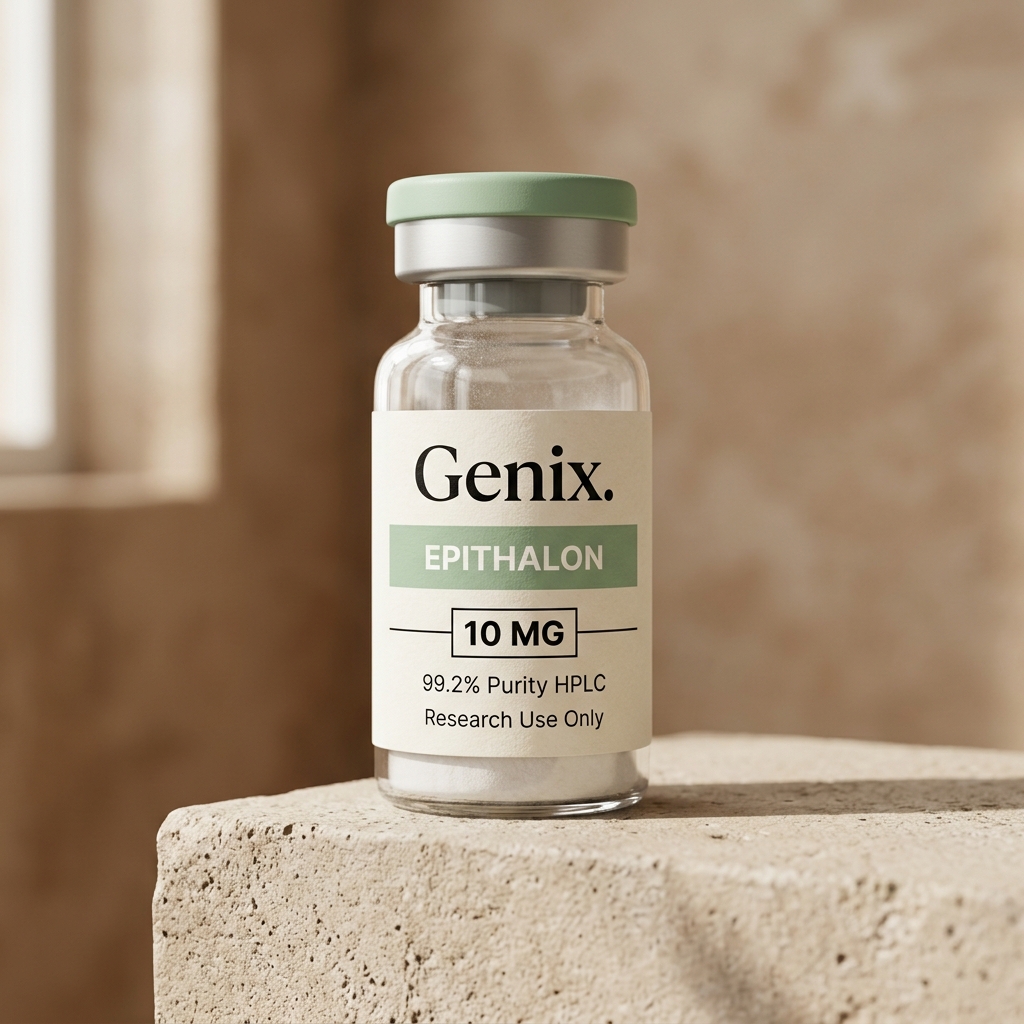
At least 99% purity by HPLC, LC-MS identity, ISO 17025 testing, and a batch certificate of analysis in every order. USD 49 for 10mg, same-day in Bali, cash on delivery.
Buy epithalon for sleep researchFrequently asked questions
What vitamins should I take for deep sleep?
No vitamin is proven to deepen sleep in healthy adults. The nutrients with the most sleep research are magnesium, vitamin D, and B6, and the signal is strongest in people who were low to begin with. A blood test tells you more than a supplement aisle does. Peptides are a separate category and are research use only.
What is the downside of taking peptides?
Three real ones. Most sleep peptides have no human trial, so you are paying for a mechanism, not a result. Purity varies wildly between suppliers, which is why a batch certificate of analysis matters. And injected material carries handling and sterility risk. These compounds are supplied for laboratory research only, not human use.
What are the top 5 most popular peptides?
By search demand the five most popular are retatrutide, semaglutide, BPC-157, tirzepatide, and tesamorelin. None of them is a sleep peptide. The popular sleep names are a different and much smaller group: epithalon, DSIP, and increasingly NAD+. Popularity and evidence are not the same thing.
What peptide does Jennifer Aniston use?
She has never named a peptide. Published interviews mention collagen powder, which is a hydrolysed protein supplement, not a research peptide. Every list that attaches a celebrity to a sleep peptide is marketing. Treat a named celebrity as a signal that the page has no study to show you.
Does DSIP actually make you sleep?
Not reliably. DSIP was named for an effect seen in rabbit brain studies in the 1970s. Human work never reproduced it consistently. The 2006 review in the Journal of Neurochemistry summarised decades of research and still called its sleep role unresolved. It stays popular because of the name, not the data.
Which peptide has the best human sleep evidence?
The pineal peptide family behind epithalon. In older adults, the related preparation epithalamin restored the night-time melatonin peak toward a younger pattern in published Bull Exp Biol Med work. That is rhythm data, not a sleep-quality promise, and it is research use only, not medical advice.
Takeaway
Peptides for sleep is a category with one real candidate and a lot of noise. The pineal peptide family behind epithalon has published human rhythm data, and that is where the money belongs if you are going to spend it. DSIP has the name and not the result. NAD+, GHK-Cu, and Semax are good compounds doing other jobs. Before any of it, rule out the obstacles that outweigh every peptide on this page. Set a baseline, read the certificate of analysis, and judge the cycle on numbers you wrote down first. Research use only, and this is education, not medical advice.