Search epithalon side effects and you get the same short list on every page. Headache. Tiredness. Mild nausea. Redness where the needle went in. It reads like a drug label. It is not one. No trial of this peptide ever counted those events. Meanwhile a real safety file does exist, in animals, and almost nobody quotes it. This guide separates the two.
What are the side effects of epithalon?
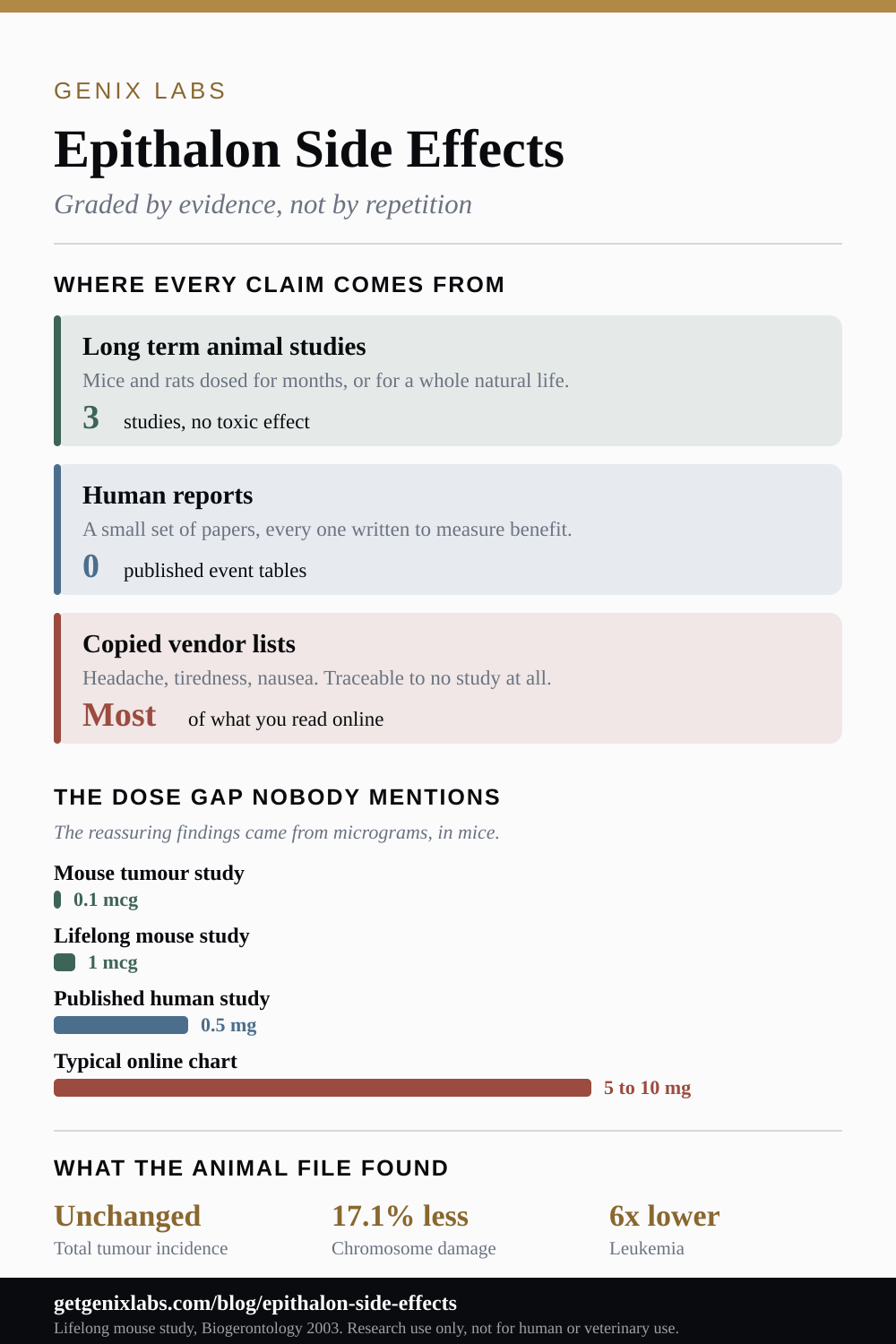
No human trial of epithalon has published a side effect table. Three long term animal studies reported no toxic effect, at microgram amounts. So the printed lists of headache, tiredness and nausea are self reports, not findings. The measurable risk sits in the vial: contamination, wrong identity and broken cold chain.
- Zero published adverse event tables in humans. Not a small number. Zero.
- Three animal studies dosed for months or for a whole life and reported no toxic effect.
- Those studies used micrograms in mice. Charts for people print milligrams.
- The cancer worry is theoretical. The animal record points the other way.
- The risks you can actually measure are endotoxin, identity, water and temperature.
What does epithalon do?
Epithalon is a four amino acid peptide, Ala-Glu-Asp-Gly. It was built to copy a natural pineal gland compound. Research studies it for two jobs. It switches telomerase back on in human cells, which maintains the caps on DNA. And it helps restore the natural melatonin rhythm, which shows up as sleep.
That matters here for one reason. What a compound does tells you where to look for side effects. A peptide that touches telomerase raises a cancer question. A peptide that touches melatonin raises a sleep and alertness question. Those are the two places a real safety signal would show up first. Our full epithalon explainer covers the mechanism in plain words.
Epitalon or epithalon, and does it matter here?
Epithalon, epitalon, epithalone and AEDG are all the same tetrapeptide. The split came out of translation from the original Russian research. For a safety page the spelling matters for one practical reason. Searching only one spelling hides half the literature, including most of the animal toxicity work.
One name is genuinely different, and confusing it causes most of the bad claims on this topic. Epithalamin is the older bovine pineal extract the tetrapeptide was modelled on. It is a mixture, not a defined four amino acid sequence. The next section explains why that one letter changes everything.
Why does every side effect list look the same?
Because they copy each other. One early vendor page wrote a plausible list. The next page borrowed it. Within a few years the list looked like consensus. Nothing new was measured at any step. A claim repeated a thousand times still has one source, and here that source is not a study.
You can test this yourself. Pick any page that lists epithalon side effects. Look for a citation next to the list. There almost never is one. When there is, follow it. It usually leads to a review of peptides in general, or to a page about a different compound entirely.
How should a safety claim be graded?
Use four tiers. Controlled human trial data is the strongest. Long term animal toxicity work is next, and is real evidence. Mechanism reasoning is weaker, because it predicts rather than measures. Uncontrolled self reports are the weakest, because nobody checked what else was in the vial.
| Tier | What it is | Epithalon has | How much weight |
|---|---|---|---|
| 1. Controlled human trial | Randomised, with events counted and published | Nothing | Would settle it. Does not exist. |
| 2. Long term animal study | Months or lifetime dosing, tissues examined | Three studies | Real. The best we have. |
| 3. Mechanism reasoning | Predicting harm from what the molecule touches | The telomerase question | A reason to check, not a finding. |
| 4. Uncontrolled self report | Forum posts and vendor lists | Almost every printed list | Lowest. Vial unknown. |
Hold that table in mind for the rest of this page. Every claim below is labelled with its tier. That is the part no competing page does, and it is the only way to read this topic without being misled.
What did the animal safety studies actually find?
Three published studies dosed animals with the tetrapeptide for a long time and then looked at the tissue. All three reported no toxic effect. One ran 6.5 months. One ran for the whole natural life of the animals. One ran six months inside a chemically induced cancer model. This is tier two evidence, and it is specific.
Read that fourth number next to the first three. The animal work is better than most people assume. The human work is worse than most people assume. Both of those facts get lost when a page just prints the word safe.
The lifelong mouse study, in detail
This is the single most useful safety paper in the topic. Female mice got the tetrapeptide for five days every month, from three months old until they died naturally. Fifty four mice per group. The authors concluded the work showed the safety of its long term administration in mice.
- Food intake did not change. Body weight did not change. Mean life span did not change.
- Chromosome aberrations in bone marrow fell by 17.1%, which is the opposite of a mutagenic signal.
- The life span of the last 10% of survivors rose by 13.3%, and maximum life span by 12.3%.
- Total spontaneous tumour incidence did not change. Leukemia fell 6 fold.
Two things are worth noting. First, this is a long exposure with tissue level readouts, not a two week tolerance check. Second, the amount was about 30 to 40 micrograms per kilogram, in a mouse. Keep that number. It is the reason the next section exists.
Does epithalon cause cancer?
No study shows that, and in animals the record points the other way. The mouse tumour study found fewer animals with malignant tumours and no metastases at all in the treated group. The lifelong study found no change in total tumour incidence and six times less leukemia. That is reassuring in rodents, and untested in people.
The detail in the tumour study is worth stating plainly. In the control group, metastases were found in 3 of 9 tumour bearing mice. In the treated group, none were found. The authors described an antimetastatic effect as part of what they called oncostatic properties. That is a long way from the fear the internet attaches to this peptide.
The telomerase question, honestly
Here is the theory that scares people. Cancer cells need telomerase to keep dividing forever. Epithalon switches telomerase on. So epithalon might feed a cancer. That reasoning is sound enough to take seriously. It is tier three evidence, which means it is a reason to check rather than a finding.
When researchers did check, in animals, they did not find it. Tumour incidence held flat. Leukemia dropped. Metastases disappeared in one model. In a chemically induced colon cancer model the peptide slowed tumour cell division and raised apoptosis, which is cancer cells dying. The mechanism predicted one thing. The measurement showed another.
The honest position is this. The theory is unresolved in humans because no human study has looked. The animal evidence is reassuring rather than alarming. Anyone telling you either that it definitely causes cancer or that it definitely prevents it is going past the file.
What a cancer model showed
Rats were given a chemical that reliably causes colon tumours. Some also received the tetrapeptide, on different schedules. Where it was given across the whole experiment, tumour cell division was significantly inhibited and apoptosis went up. Immune cell infiltration around the tumours increased too.
This is a deliberately harsh test. If a compound promoted cancer, a model like this is where it would show. It did the opposite. Again, this is a rat model with a chemical carcinogen, not a person. It belongs in tier two, and it is the strongest available answer to the telomerase worry.
What do the human reports record?
Very little about harm. The human papers in this topic were written to measure benefit. The best known looked at retinal degeneration and reported a positive clinical effect in about 90% of cases. It did not publish a count of adverse events. No human epithalon paper does.
This is the single most important gap on the page, so it is worth being blunt. When a page says epithalon has no side effects in human studies, that is technically true and deeply misleading. The studies did not report side effects because they did not set out to count them. Absence of reporting is not absence of events.
A 2025 review in the International Journal of Molecular Sciences surveyed 25 years of work on this peptide. It describes antioxidant, neuroprotective and antimutagenic effects. It also says plainly that the physico-chemical and structural investigation of the peptide remains quite limited. The foundations are thinner than the enthusiasm.
Whose human safety data is this?
Usually not epithalon's. The famous human numbers in this field belong to epithalamin, the bovine pineal extract. One study followed 266 older adults for six to eight years on the extract. That work gets quoted as evidence for the tetrapeptide constantly. It is a different substance.
The difference is not a technicality. Epithalamin is an extract from animal tissue, so it is a mixture of many peptides whose full composition was never characterised. Epithalon is one defined sequence of four amino acids, made synthetically. A safety record for a mixture does not transfer to one purified component of it, and it certainly does not transfer in the other direction.
| Epithalamin | Epithalon | |
|---|---|---|
| What it is | Bovine pineal gland extract | Synthetic tetrapeptide, Ala-Glu-Asp-Gly |
| Composition | A mixture, never fully characterised | One defined sequence, mass confirmable |
| Human follow up | 266 older adults, 6 to 8 years | A small set of efficacy papers, no event tables |
| What it tells you about safety | Something about a mixture of animal peptides | Very little in humans. The animal file is the real evidence. |
So when a page tells you epithalon has decades of human safety behind it, check which word it is actually describing. Nearly every time, the decades belong to the extract. This single conflation is the root of more wrong claims on this topic than anything else.
Why the dose gap breaks almost every claim
Safety is never a property of a molecule alone. It is a property of a molecule at an amount. The animal studies that produced the words no toxic effect used micrograms, in mice. The charts people read print milligrams, for humans. Those are different questions wearing the same word.
So when someone quotes the mouse study to tell you epithalon is safe, ask at what amount. The answer is 0.1 micrograms, or 1 microgram, per mouse. The reassurance is real but it is tied to that scale. Our epitalon dosage audit traces where the 5 to 10 milligram figure came from, and it is not a study of this peptide.
This also disposes of a related search people run, epithalon 50mg. No published study of the tetrapeptide has used anything near that. A number that large has no safety file behind it at all, in any species.
Is epithalon a peptide hormone?
No. Epithalon is a four amino acid peptide. A peptide hormone is something like insulin or growth hormone, which the body releases to carry a signal through the blood. Epithalon is a synthetic short sequence that influences gene expression. The distinction changes which side effects are even plausible.
This matters because people search for the side effects of peptide hormones and land on epithalon pages. The two risk profiles are not the same. Hormone side effects come from pushing a signalling axis that the body tightly regulates. A short regulatory peptide does not carry that same load.
What are the side effects of peptide hormones?
For true peptide hormones the documented pattern is clear. Growth hormone can cause fluid retention, joint pain, carpal tunnel symptoms and insulin resistance. Insulin can cause low blood sugar. These come from pushing a regulated axis too hard. They are not epithalon side effects and should not be copied across.
The useful general rule is that risk tracks the axis a compound pushes. A GLP-1 peptide slows the stomach, so nausea follows. A growth hormone secretagogue raises IGF-1, so fluid and joint effects follow. Epithalon touches melatonin rhythm and telomerase, so the honest places to watch are sleep and the long term cancer question.
Does epithalon make you tired?
It might, and this is the one effect with a mechanism behind it. Epithalon supports the natural melatonin rhythm. Melatonin is the signal that it is night. So drowsiness, vivid dreams or a shifted sleep window are the plausible effects. No trial measured them, so this is tier three, not tier one.
Note the direction, because pages get it backwards. The research interest is in better sleep, not sedation. Restoring a rhythm is different from knocking someone out. If a report describes heavy daytime grogginess, the rhythm explanation does not cover it and something else deserves a look.
What happens at the injection site?
Site redness, a small bump or brief stinging are the most commonly reported effects of any injected research peptide. They are usually about technique and solution rather than the molecule. Tier four evidence for epithalon specifically, because no study counted them.
Three mechanical causes explain most of it. The solution is cold straight from the fridge. The water used was wrong. Or the powder was not fully dissolved, so crystals went in with the liquid. Our reconstitution walkthrough covers how each of those happens.
Headaches and head pressure
Headache appears on nearly every epithalon side effect list. It has no study behind it in this topic at all. It is the most copied item in the whole list and the least supported. Tier four. If a page grades it as common, that grade was invented.
There is a weak mechanistic path worth naming for honesty. A shifted sleep window can produce a headache the next day, the same way a bad night does. That is an effect of sleep change, not a direct action on the head. The distinction is small but it is the difference between a mechanism and a guess.
Does it affect the immune system?
In animals it does, and the direction looks favourable. The 2025 review notes it alters interleukin-2 messenger RNA levels and modulates the mitogenic activity of thymocytes, which are immune cells. In the colon model, immune cell infiltration around tumours increased. None of this has been measured in humans.
An immune effect is a double edged finding, so it belongs in the caution column rather than the benefit column. Anything that modulates immune signalling deserves care in research design, especially alongside autoimmune conditions or immune suppressing treatment. That is a reason for caution, not a documented harm.
What are the side effects of peptides in skin care products?
Topical peptides have a different and better documented risk profile. The usual effects are local: redness, mild stinging, dryness or contact irritation. Copper peptides can also leave a temporary blue green tint. These are surface effects, because very little of a topical peptide reaches the bloodstream.
Epithalon is not a skin care peptide and is not studied topically. The comparison is only useful to show how different the two cases are. A cream acts where you put it. An injected research peptide acts everywhere. For the topical side of this, our GHK-Cu side effects guide covers the copper peptide record in detail.
What is known about interactions?
Nothing has been formally tested. No interaction study of epithalon with any drug exists. Everything written about combining it is reasoning, not data. The two axes worth thinking about are melatonin signalling and immune modulation, because those are the pathways the peptide actually touches.
- Melatonin and sleep medication. Overlapping signals on the same rhythm. Untested together.
- Immune suppressing or immune stimulating treatment. The thymocyte and interleukin findings make this worth care.
- Other research peptides. Stacking multiplies the unknowns and makes any effect impossible to attribute.
- Anything in active cancer care. The telomerase question stays open, so the literature treats this as a hard stop.
Who is excluded in the literature?
Research writing on this peptide consistently treats active or suspected cancer as an exclusion. The reason is the open telomerase question rather than a recorded harm. Pregnancy, breastfeeding and childhood are also excluded, for the ordinary reason that nothing has been studied in those groups.
What about long term use?
The lifelong mouse study is the only long term safety data that exists, in any species. It dosed for the whole natural life of the animals and reported no toxic effect, with fewer chromosome aberrations and longer maximum life span. In humans there is no long term data at all, in either direction.
That is also why the short cycle pattern around this peptide persists. It is not a safety finding. It reflects how the original research was structured, in brief courses rather than continuous use. Reading a cycle length as a safety limit confuses study design with a toxicity threshold.
How does its safety record compare to NAD+ and GHK-Cu?
Better on animal toxicity, worse on human data. Epithalon has three long term animal studies and no human event tables. NAD+ has small human trials that did report tolerability. GHK-Cu has the most human exposure of the three, because it has been used in cosmetic formulations for years.
| Peptide | Strongest safety evidence | The main open question |
|---|---|---|
| Epithalon | Three long term animal studies, including lifelong dosing, all reporting no toxic effect | No human adverse event data at all, and the telomerase question is unresolved |
| NAD+ | Small human infusion studies that recorded tolerability, mostly infusion rate effects | Long term effects are unstudied, and most reported problems come from how fast it is given |
| GHK-Cu | Large real world topical exposure, with local irritation as the usual effect | Injected use is far less studied than topical, and copper load is the open question |
The useful lesson is that these three are not interchangeable in risk. Each one has a different strongest evidence tier and a different gap. Our NAD+ injection guide covers that compound's human record, where the problems are mostly about infusion speed rather than the molecule.
What about bodybuilding use?
There is no research on it. Epithalon was never studied for muscle, strength or performance in any species. The related searches around bodybuilding amounts exist because forums borrowed the peptide from longevity circles, not because a study pointed that way.
This matters for safety in a specific way. Performance oriented amounts circulating on forums are far above anything in the literature, which puts them past the end of the dose ladder above. There is no animal toxicity work at that scale, so the reassuring findings on this page simply do not reach it. Genix Labs supplies epithalon for laboratory research only.
The risks nobody puts on the list
Here is the part that actually matters. The documented harms in research peptides come from the vial, not the sequence. Four things can hurt you, and all four are measurable. None of them appear on a single copied side effect list.
| Risk in the vial | What it does | How you rule it out |
|---|---|---|
| Bacterial endotoxin | Fever, chills, a systemic inflammatory reaction. The classic injected contamination response. | Endotoxin testing on the lot, plus sterile filling conditions. |
| Wrong identity | You are not studying epithalon. Any effect, good or bad, belongs to an unknown compound. | LC-MS identity confirmation matching the stated mass on the printed lot. |
| Wrong solvent | Site irritation and degraded peptide. Tap or unsterile water is the common error. | Bacteriostatic water, and only bacteriostatic water. |
| Broken cold chain | A peptide that has partly degraded. Reduced activity, unknown breakdown products. | Cold pack shipping, a tracked route, and cold storage on arrival. |
How bad is contamination?
It is the worst realistic outcome in this topic. Bacterial endotoxin is a fragment of bacterial cell wall. Injected, even a small amount can produce fever, chills and shaking within hours. This is tier one evidence in medicine generally, just not specific to epithalon, and it is the risk worth taking seriously.
Notice how this reframes the whole page. Someone who reacts badly to a research peptide is far more likely to be reacting to what came with it than to the four amino acids themselves. That is exactly why a self reported side effect is tier four. The vial was never tested.
What if the vial is not epithalon?
Then every conclusion drawn from it is void. Epithalon is cheap to make and easy to under fill or substitute. Without mass confirmation you cannot know what is in the powder. An unexpected effect from an unverified vial tells you nothing about the peptide.
This is the quiet reason the side effect lists are unreliable even as anecdote. A thousand self reports from a thousand untested vials do not add up to one data point. They add up to a thousand unknowns.
Can the water cause it?
Yes, and it is a common cause. Bacteriostatic water contains a small amount of benzyl alcohol, which keeps bacteria from growing in a vial that gets opened more than once. Plain sterile water has no preservative. Tap or distilled water is not sterile at all.
Get this wrong and two things follow. The solution can grow bacteria between uses, and the injection stings more. Both get written down as a side effect of the peptide. Our bacteriostatic water guide explains the difference and why it is not interchangeable.
Can storage create a problem?
Yes. Lyophilized powder is stable when kept cold and dark. Once it is in solution the clock starts. Warmth, light and time all degrade a peptide. A degraded vial gives you weaker activity and breakdown products nobody has characterised.
The practical failure is almost always the same. A vial sat in a warm room, or travelled without a cold pack, or stayed reconstituted far too long. That is a handling failure that reads like a side effect. Epithalon ships from us cold packed and tracked for exactly this reason.
What a lot report actually rules out
A certificate of analysis is the only way to remove the vial variables from the question. It does not make a compound safe. It removes the confounders, so that anything you observe belongs to the peptide rather than to contamination or a substitution.
- HPLC area purity, which shows how much of the material is the single expected peak.
- LC-MS identity, which confirms the mass matches the Ala-Glu-Asp-Gly tetrapeptide.
- A real lot number printed on the document and matching the vial in your hand.
- ISO 17025 accredited testing, so the result comes from a lab held to a standard.
Our published epithalon lot 489053 reports 99.40% HPLC area purity at the 10mg size, with LC-MS identity confirmation. Two honest caveats. That result applies only to that lot. And HPLC area percent is not content, sterility, safety or efficacy. Anyone who tells you 99% purity means safe is misreading their own document.
Which vendor claims are red flags?
Four claims tell you a page is not reading its own sources. Each one is common, and each one is wrong in a specific way. Spotting them is faster than evaluating the rest of the page.
| The claim | Why it is a red flag |
|---|---|
| No side effects, proven safe in clinical trials | There are no controlled epithalon trials counting events. Nothing was proven either way. |
| Side effects are mild and uncommon, in 2 to 5% of users | A frequency can only come from counting in a trial. No trial counted. The number is invented. |
| Safe at 10mg a day because studies showed no toxicity | Those studies used micrograms, in mice. The safety wording does not travel to that amount. |
| Reverses aging and extends human life span | The human survival data belongs to epithalamin, the older pineal extract, not to this peptide. |
Mistakes that create the effect
Most reported problems in this space trace to a handful of handling errors. They are worth listing because each one produces something that looks exactly like a side effect, and each one is avoidable.
- Using the wrong water, so the solution stings and can grow bacteria.
- Injecting straight from the fridge, which hurts more than a solution left to warm briefly.
- Shaking the vial hard instead of letting the powder dissolve, leaving undissolved material.
- Keeping a reconstituted vial far past its window, so what goes in is partly degraded.
- Stacking several peptides at once, which makes any effect impossible to attribute.
- Buying untested powder, which leaves endotoxin and identity completely unknown.
How much does epithalon cost?
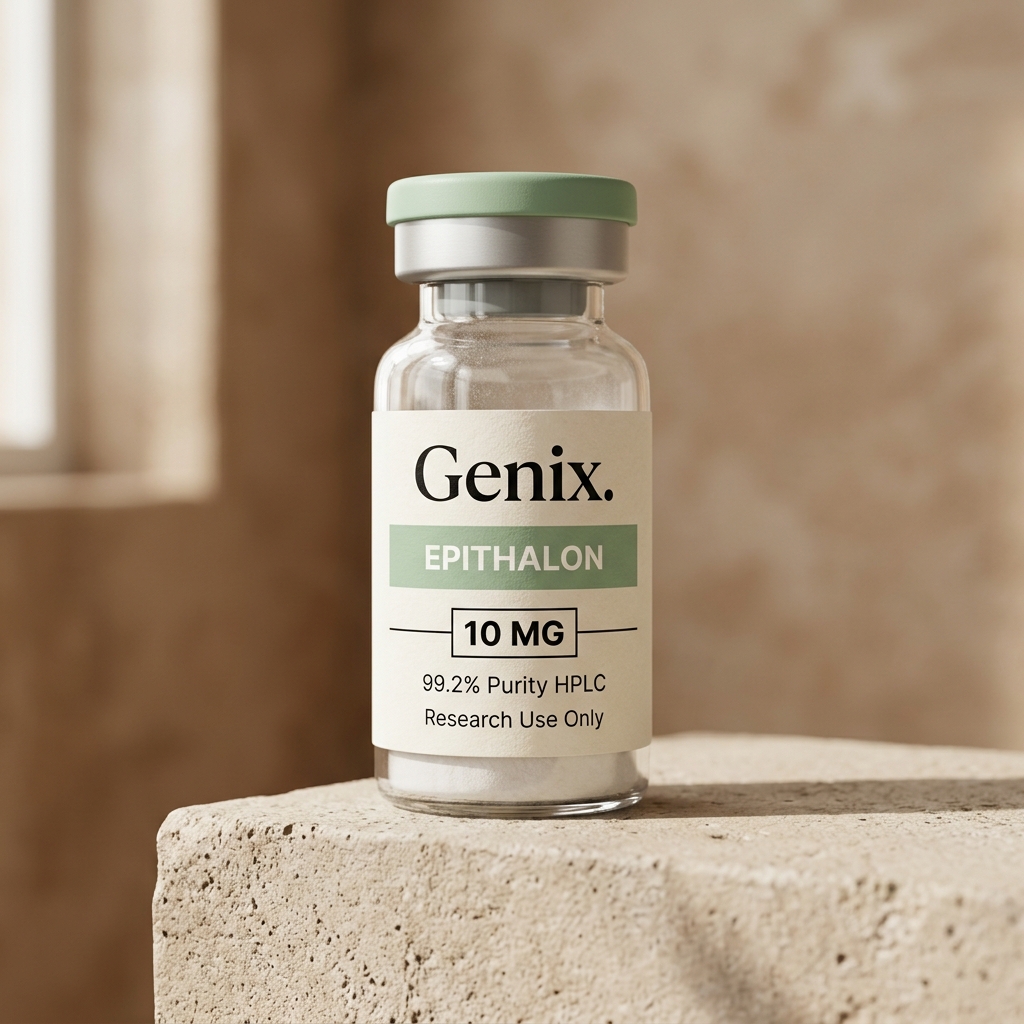
A Genix Labs 10mg epithalon vial is USD 49, or Rp 850.000, with the batch certificate of analysis included. That single vial covers far more than the largest amount used in any published human study, which was 0.5mg a day across 20 days.
Cost belongs on a safety page for one reason. Untested powder is cheaper, and the saving buys you the two risks that actually matter: unknown endotoxin and unknown identity. You can browse the lab-tested epithalon vial with its lot report, or see the wider longevity peptide guides for how it sits beside NAD+ and GHK-Cu.
Orders placed before 9 PM ship the same day, cold packed and tracked. Inside Bali that is often a two hour delivery with cash on delivery. Everything ships research use only.
What would actually settle this?
Three specific pieces of work, none of which exists. Naming them is useful, because it shows how far the topic is from settled and gives you a way to judge any new study that appears. Nothing short of these changes the answer on this page.
- A dose ranging human safety study that counts and publishes adverse events, at the amounts people actually discuss rather than microgram amounts in mice.
- A formal toxicology package: repeat dose toxicity, genotoxicity and a carcinogenicity readout in a second species, run to a modern standard.
- Long term follow up in people with telomerase activity and cancer incidence as named endpoints, which is the only way to close the mechanism question.
The 2025 review makes a related point about foundations. After 25 years of biological work, the physico-chemical and structural investigation of the peptide remains limited. A field that has not finished characterising a molecule has not finished characterising its risks either.
Until that work lands, the honest framing stays the one on this page. Real animal evidence, absent human evidence, an open mechanism question, and a set of vial risks you can actually rule out today.
Read any epithalon safety claim in 30 seconds
- Does the claim name a species? If it says mice, it is tier two. If it implies humans, ask for the trial.
- Does it name an amount and a unit? Micrograms in mice cannot support a milligram claim in people.
- Does it grade frequency? A percentage without a trial behind it is invented.
- Does it mention the vial? A page that ignores endotoxin and identity has missed the real risk.
Run those four questions on the first page you find after this one. Most pages fail at question one. That is the whole state of this topic, and it is why the honest answer here is narrower than the confident answer everywhere else.
Frequently asked questions
What does Epithalon do?
Epithalon is a four amino acid peptide, Ala-Glu-Asp-Gly, modelled on a natural pineal compound. Research studies it for two actions. It switches telomerase back on in human cells, which maintains the protective caps on DNA. And it helps restore the natural melatonin rhythm, which shows up as deeper sleep.
What are the potential side effects of Epitalon?
No human trial has published an adverse event table, so there is no graded list. Three long term animal studies reported no toxic effect, at microgram amounts. The headache, tiredness and nausea printed online are uncontrolled self reports. The measurable risk is contamination and wrong identity in the vial.
What are the potential side effects of using peptide hormone?
True peptide hormones push a regulated axis, so the effects follow that axis. Growth hormone is linked to fluid retention, joint pain and insulin resistance. Insulin can drop blood sugar. Epithalon is not a hormone but a short regulatory peptide, so those effects should not be copied across to it.
What are the potential side effects of using peptides in skin care products?
Topical peptides mostly cause local effects: redness, mild stinging, dryness or contact irritation. Copper peptides can leave a temporary blue green tint. Very little reaches the bloodstream, so the risk stays at the surface. Epithalon is not a skin care peptide and has not been studied topically.
How much does Epithalon cost?
A Genix Labs 10mg epithalon vial is USD 49, or Rp 850.000, with the batch certificate of analysis included. One vial covers far more than the largest amount in any published human study, which was 0.5mg a day across 20 days. Supplied for laboratory research only.
Does Epitalon make you tired?
It is plausible and has a mechanism, but no trial measured it. Epithalon supports the natural melatonin rhythm, and melatonin is the signal that it is night. So drowsiness or a shifted sleep window are the reasonable effects to expect. The research interest is better sleep rather than sedation.
Takeaway
The epithalon side effect list you keep reading is not a finding. No human trial of this peptide ever counted adverse events, so there is nothing to grade and no frequency to print. What does exist is a long term animal file, and it reported no toxic effect, fewer chromosome aberrations and no increase in tumours.
Two honest limits sit on top of that. The reassuring numbers came from microgram amounts in rodents, not milligram amounts in people. And the telomerase question stays formally open in humans because nobody has looked. Treat the animal record as real evidence about rodents and the human record as genuinely absent.
Then put your attention where the measurable risk actually is. Endotoxin, identity, the right water and an unbroken cold chain decide more about what happens in a vial than the four amino acids ever will. That part you can verify, on a lot report, before anything else happens. Research use only.