Search GHK-Cu side effects and you get the same short list every time. Redness. Itching. A bit of stinging. That list is not wrong. It is just the smallest part of the answer, because it was written about a cosmetic cream and then copied onto a research vial that holds two thousand times more.
This guide separates the two. It covers what the skin actually does, what the word copper uglies means, what happens to the copper your body cannot send back, and the question about copper and cancer that the top results skip entirely. Every Genix Labs compound is supplied for laboratory research only. Nothing here is medical advice or a use instruction.
What are the side effects of GHK-Cu?
Topical GHK-Cu is usually well tolerated. Reported effects are local and mild: redness, itching, stinging, dryness and occasional contact dermatitis. Injected GHK-Cu has no published human safety study, so its profile is unknown rather than clean. The deeper issue with any route is copper, which accumulates in the body and leaves slowly through bile.
- Skin level effects are real but mild, and almost always local.
- The injected route has no human safety file at all. Unknown is not the same as safe.
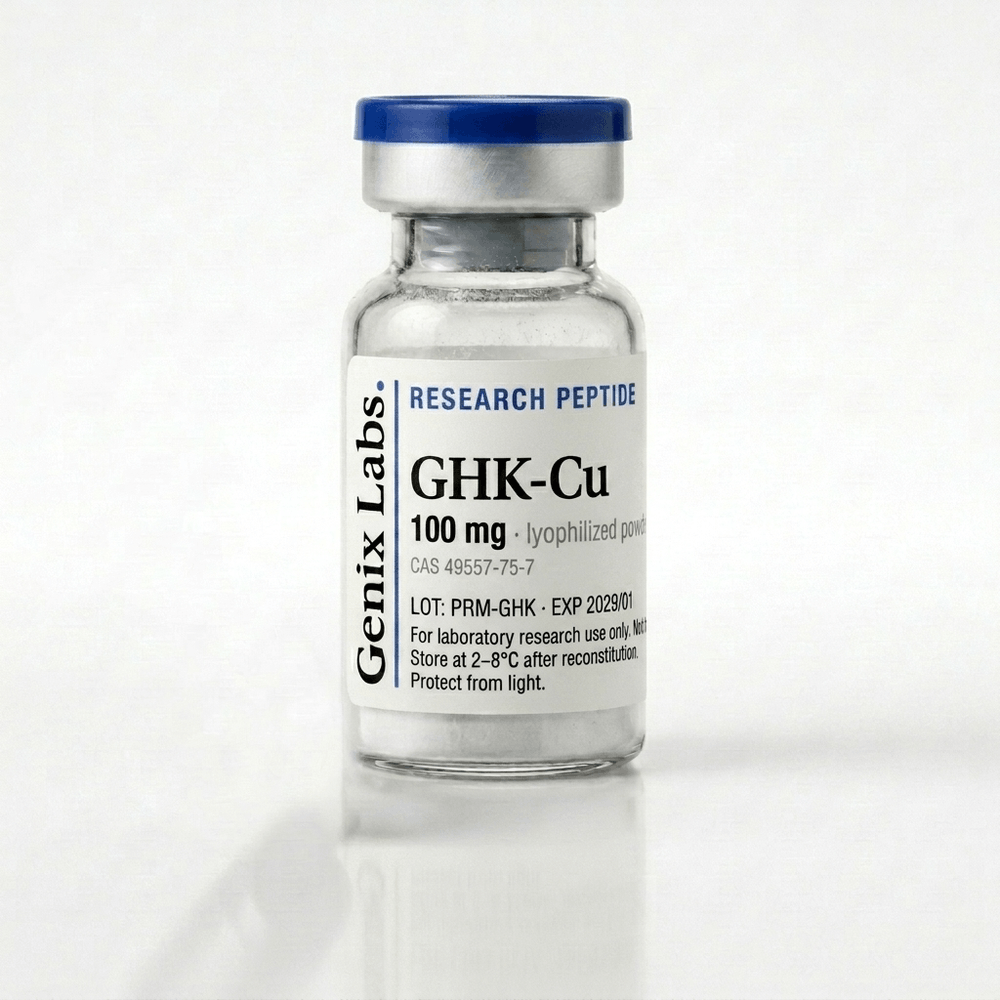
- A 100 mg vial carries about 15.8 mg of elemental copper, above the adult daily upper limit of 10 mg.
- Copper uglies is a community word, not a medical finding. No controlled study defines it.
- Most avoidable problems come from the vial, not the molecule. Identity testing matters more than purity.
What is GHK-Cu, and why does it react at all?
GHK-Cu is a tiny protein fragment your own blood already makes. Three amino acids, glycine, histidine and lysine, hold one copper atom between them. Scientists write it as Gly-His-Lys plus Cu two. The whole complex weighs about 401.9 daltons, which is very small as molecules go.
It is studied because it behaves like a repair signal. In cell work it tells skin cells to build collagen and elastin, the two fibres that keep skin firm. Our longer explainer on what GHK-Cu is and what the evidence rests on covers that side in full. This page is only about what can go wrong.
Two parts of the molecule can cause trouble, and they cause different trouble. The peptide part is a signal. It fades fast and the body breaks it down like any other small peptide. The copper part is a metal. It does not break down. It gets stored, reused, or slowly escorted out. Nearly every confusing thing about GHK-Cu side effects comes from mixing those two timelines together.
Why does the route change everything?
Almost all human GHK-Cu data comes from cosmetic studies. Those studies used creams at 0.05 to 0.1 percent. That is roughly half a milligram to one milligram of peptide in a whole gram of cream, spread over a face, with skin blocking most of it.
A research vial holds 100 mg of the same compound. Injected, it skips the skin barrier completely. The molecule is identical. The exposure is not close. Reading a cosmetic safety record and applying it to a vial is the single most common mistake in this topic.
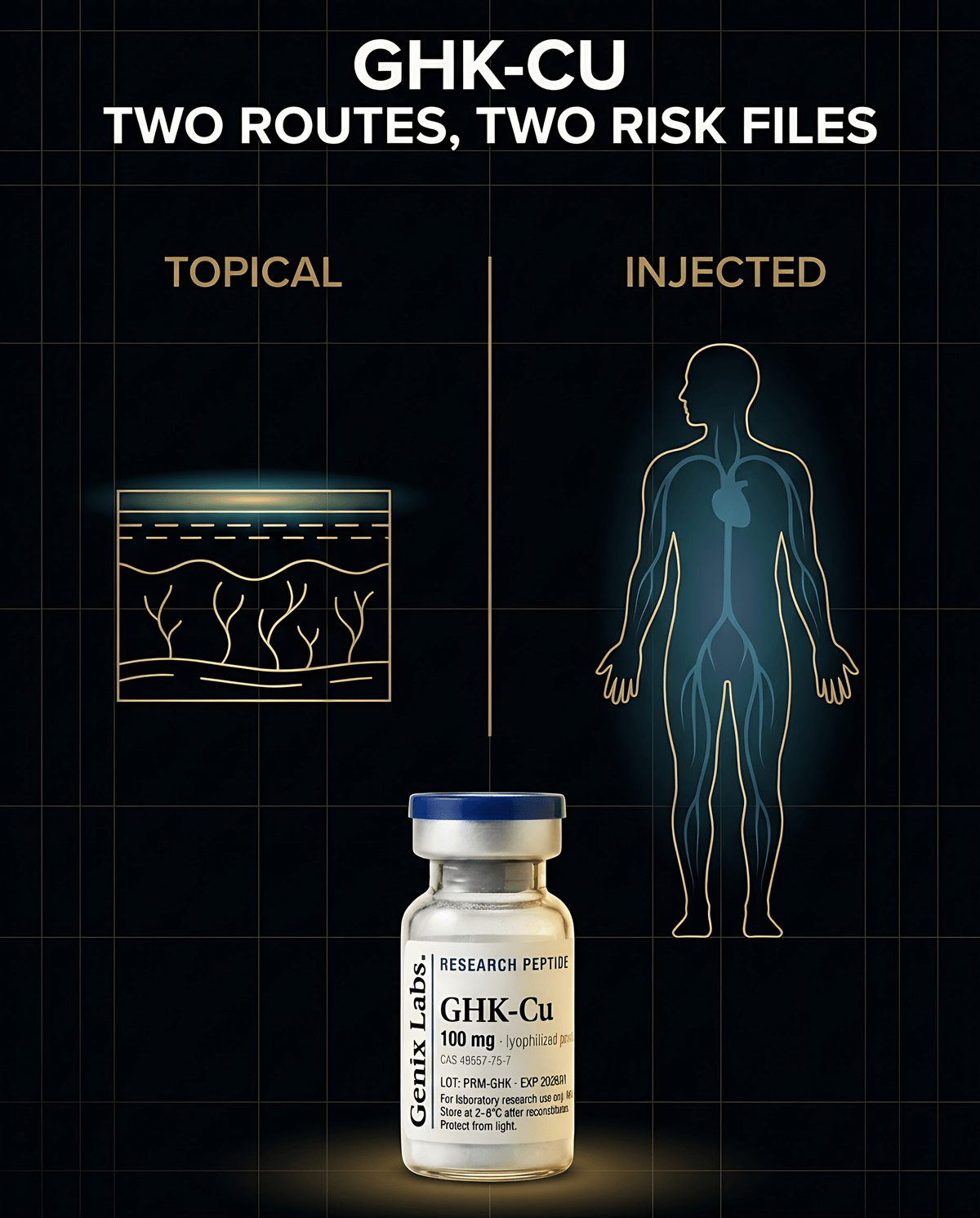
This is why the honest answer to the side effect question has to be split by route. Below, the topical file comes first, because that is where real data exists. The injected file comes second, and it is mostly a list of things nobody has measured.
What are the topical side effects?
Topical copper peptide effects are local, mild and usually early. They show up on the skin you treated, not somewhere else. Most settle within a week or two as the skin adjusts. The common reports are redness, itching, stinging on application, dryness or flaking, small breakouts, and in a minority of people a true contact dermatitis that needs the product stopped.
- Redness and warmth where it was applied, often strongest in the first few days.
- Stinging or tingling on application, especially on skin that is already irritated.
- Dryness, tightness or fine flaking as the barrier adjusts.
- Small bumps or breakouts in the first weeks, the thing people call copper uglies.
- Itching that keeps building rather than fading, which points at allergy rather than irritation.
- A spreading rash with swelling or blistering, which is contact dermatitis and is not a normal adjustment.
The distinction in those last two lines matters more than the length of the list. Irritation fades as exposure continues. Allergy gets worse. A reaction that is bigger in week three than it was in week one is behaving like an allergy.
What are copper uglies?
Copper uglies is a skincare community term for a rough patch after starting copper peptides. People describe breakouts, bumpy texture, redness or skin that looks worse before it looks better. It is not a medical diagnosis. No controlled study has defined it, measured how often it happens, or confirmed it is a real phase rather than ordinary irritation.
That matters, because the word carries an assumption inside it. Calling something a purge implies it will pass and the product is working. Nothing in the literature supports that implication for copper peptides. There are three plainer explanations, and they are easier to tell apart than the folklore suggests.
| What people call copper uglies | What it probably is | How it behaves |
|---|---|---|
| Breakouts in the first two weeks | Irritation, or a reaction to the cream base rather than the peptide | Settles as you continue, or clears when you drop the product |
| Dry, tight, flaking skin | Barrier disruption, usually from stacking acids or retinoids alongside | Improves fast once the other actives come out |
| Itchy rash that keeps spreading | Contact allergy, not a purge at all | Gets worse with every use. Continuing makes it worse, not better |
| Skin genuinely looking rougher for months | Not explained by any published copper peptide data | Treat the product as the suspect, not the cure |
Can copper peptides ruin your skin?
Permanent damage from a cosmetic strength copper peptide is not something the literature describes. What it does describe is contact dermatitis, which looks alarming and can take weeks to calm, but resolves once exposure stops. The reports of skin ruined by copper peptides almost always involve two other ingredients stacked on top, or a product used far past the point where it was clearly reacting.
The sequence that actually causes trouble is predictable. Someone layers a copper peptide with a strong acid or a retinoid. The barrier thins. Everything stings more. They read that as a purge and continue. By week four the skin is inflamed from the combination, and the copper peptide gets the blame for all of it.
Why does it sting or turn red?
Stinging is usually not an immune reaction. It is a barrier signal. When the outer layer of skin is thin or damaged, nerve endings sit closer to whatever you put on them, and almost any active will sting. Copper peptide formulas often sit at a pH that keeps the copper bound, and skin that is already compromised notices that.
Redness has a second possible cause that is specific to copper. Copper can take part in reactions that generate reactive oxygen species, the unstable molecules that drive inflammation. In the intact GHK complex the copper is held and that chemistry is largely controlled. If copper comes loose, it is not. That is one reason why how a product is made matters as much as what is in it.
What does a copper allergy look like?
True copper contact allergy exists but is uncommon. Dermatology patch test panels include copper sulfate, and positive results turn up far less often than for metals like nickel. When it does happen, it presents as allergic contact dermatitis: an itchy, spreading, sometimes blistering rash that appears a day or two after contact rather than immediately.
- Itching that intensifies over days instead of calming down.
- A rash with a defined edge that follows exactly where the product went.
- Swelling, weeping or small blisters rather than simple pink flushing.
- A reaction that appears 24 to 72 hours after use, not within minutes.
- Symptoms that return faster and harder each time the product is used again.
- Reaction at sites the product never touched, which points to something systemic and warrants a clinician.
That last point is the one worth separating out. Local means local. Anything that spreads beyond the treated area, or comes with breathing difficulty, facial swelling or feeling unwell, is no longer a cosmetic question and belongs with a doctor.
How does the research detect copper sensitivity?
Dermatology answers this with patch testing. A standardised low concentration of copper sulfate is applied to a small area of skin under an occlusive patch, left for about 48 hours, and read at 48 and 96 hours. A delayed reaction at the site indicates sensitisation. This is a clinical diagnostic procedure performed by a clinician, and it is described here as context, not as something to attempt.
Which actives turn it bad?
Most reported copper peptide disasters are combination problems. Two interactions have a real mechanism behind them, and the rest are barrier arithmetic.
| Combined with | What happens | Why |
|---|---|---|
| Vitamin C, high strength | Both can lose their effect, and irritation often rises | Ascorbic acid reduces copper two to copper one, which can free the metal and drive radical chemistry |
| Strong AHA or BHA acids | Stinging, redness, barrier loss | Low pH destabilises the complex and the acid thins the barrier at the same time |
| Retinoids | Compounding dryness and flaking | Not a chemical clash. Two irritants on one barrier |
| Benzoyl peroxide | Oxidation and wasted product | A strong oxidiser next to a redox active metal complex |
| Simple moisturisers and sunscreen | No known problem | No reactive chemistry and no barrier cost |
Notice the pattern. The ingredients that cause trouble are the ones that either unbind the copper or strip the barrier. Nothing on that list is exotic. Most people who report a bad experience were running at least two of them.
What about GHK-Cu injection side effects?
There is no published controlled human trial of injected GHK-Cu. That sentence is the entire honest answer, and it is very different from saying injection is safe. Clinic pages that list injection side effects are extrapolating from topical cosmetic data, from animal work, or from nothing at all.
What can be reasoned about is the copper, because copper biology is well studied independently of this peptide. One 100 mg vial carries about 15.8 mg of elemental copper. The adult daily requirement is around 0.9 mg and the tolerable upper intake level is 10 mg. Our guide to GHK-Cu dosage and the copper math works through where that number comes from.
What the injection file does not contain
It is worth naming the gaps explicitly, because a missing study is invisible in a search result. For injected GHK-Cu in people, none of the following exists in the published literature.
- No dose-ranging study, so no one has mapped where effects begin or where harm begins.
- No pharmacokinetic study, so nobody has measured how long it stays or where it goes.
- No repeat-dose toxicity study, which is the one that would catch accumulation.
- No copper balance study, so the running total in the tank has never been tracked.
- No long-term follow-up of any kind, at any dose, in any population.
Compare that to the topical column, where cosmetic trials at least measured tolerability in real people over weeks. The difference between the two files is not a difference of opinion. It is a difference of evidence.
Where does the copper actually go?
This is the part the standard side-effect list leaves out. The peptide is handled like any other small peptide and is gone quickly. The copper is not. It joins the pool of copper your body is already managing, and that pool has a tightly controlled inlet and a slow outlet.
Copper from food passes through the gut, where absorption is regulated. When stores are full, the gut takes up less. That valve is the reason copper poisoning from diet is rare. Injection goes around it entirely. The only meaningful exit for excess copper is through bile, made by the liver, and that route is narrow.
So the right mental model is a running balance, not a series of separate events. One exposure means little. A repeated pattern of exposures that each skip the gut valve is the thing with no safety data behind it, and the thing a short side-effect list cannot describe because nothing about it is felt on the day.
What does copper overload look like?
Copper toxicity is well described in medicine, independently of any peptide. Acute excess causes nausea, vomiting, abdominal pain and diarrhoea. Larger amounts can damage the liver and break down red blood cells. Chronic accumulation is quieter and shows up as rising liver enzymes, fatigue, and in severe long-standing cases neurological and psychiatric changes.
- Early and non-specific: nausea, stomach pain, a metallic taste, unusual fatigue.
- Liver signals: raised liver enzymes on a blood panel, which is why bloodwork sees it before you do.
- Blood: haemolysis, the breakdown of red cells, at high acute exposures.
- Long term and severe: tremor, coordination problems, mood and behaviour changes.
- Almost all of these are invisible day to day, which is exactly the problem.
None of this is a prediction about GHK-Cu. It is the reference profile for the metal that GHK-Cu delivers, and it is the context that makes 15.8 mg in a single vial a number worth knowing rather than a trivia fact.
Who should never go near it?
One group stands apart from every other caution on this page. People with Wilson disease carry a fault in the gene that makes the liver's copper export pump. They cannot clear copper normally, and it builds up in the liver and brain. For them, added copper in any form is a serious hazard rather than a theoretical one.
- Wilson disease or any diagnosed disorder of copper handling.
- Significant liver disease, because bile is the main copper exit.
- Anyone with a known copper contact allergy confirmed by patch testing.
- Pregnancy and breastfeeding, where no data exists and the default is avoidance.
- Anyone already taking copper supplements, who is adding to an existing load.
Is there a GHK-Cu and cancer question?
People search this, and the top results do not answer it. The honest position is that it is an open question with arguments pointing in both directions and no human data settling it. Saying GHK-Cu causes cancer would be unsupported. Saying it treats or prevents cancer would be equally unsupported, and that second claim appears far more often online than the first.
The argument for caution
Copper is required for angiogenesis, the growth of new blood vessels. Tumours need new blood vessels to grow beyond a tiny size. That link is solid enough that copper lowering drugs have been studied as anti-angiogenic cancer therapy. A compound whose job is to deliver copper and signal tissue growth sits on the wrong side of that logic, at least in principle.
The argument the other way
Copper also kills cells when it accumulates inside them. Researchers named this cuproptosis after showing copper triggers a distinct form of cell death by attacking specific proteins in the cell's energy machinery. Separately, parts of the GHK literature report gene expression patterns that look unfavourable to cancer cells in culture.
A further caveat applies to much of the favourable GHK literature. A large share of it comes from a single research group with a commercial interest in copper peptides. That does not make it wrong, but independent replication is thin, and that thinness should be weighed when a benefit claim is used to dismiss a safety question.
Can it cause hair problems?
Copper peptides are studied for hair because copper is involved in building the proteins and pigment in a hair shaft. The side-effect reports on the scalp mirror the ones on the face: itching, flaking, irritation, and occasional contact dermatitis. Scalp skin is not special in this respect.
Two things are worth separating. Shedding early in any hair intervention is common and usually reflects follicles cycling, not damage. Persistent scalp irritation is a different thing and is a reason to stop. Our guide to copper peptides for hair loss covers what the evidence does and does not support.
Can topical use reach your blood?
Only a little. GHK-Cu is small for a peptide but skin is a serious barrier, and charged metal complexes cross it poorly. The amounts measured in cosmetic use are very small relative to daily dietary copper. For intact skin at cosmetic strength, systemic copper load is not the practical concern.
Two situations change that. Broken, inflamed or freshly treated skin absorbs far more than intact skin. And microneedling, which is specifically designed to breach the barrier, turns a topical product into something closer to a delivery route. A product tested on intact skin has not been tested that way.
What a bad vial adds to the list
Here is the part most side-effect guides never mention. Several of the worst outcomes attributed to research peptides have nothing to do with the peptide. They come from what else is in the vial. These are manufacturing problems, and they are detectable on paper before anything is opened.
| Contaminant | What it can cause | Which test catches it |
|---|---|---|
| Bacterial endotoxin | Fever and strong inflammatory response. The classic pyrogen reaction | Endotoxin testing, reported in endotoxin units |
| Residual TFA | Cell toxicity in culture. A leftover from the purification step | Counterion analysis, often skipped on cheap lots |
| Free copper salts | Far more aggressive oxidative chemistry than the bound complex | LC-MS identity, which confirms the complex is actually intact |
| Wrong or partial peptide | Anything, because you are not using what the label says | LC-MS identity against the expected mass |
| Heavy metals and solvents | Unpredictable, and unrelated to the intended compound | Elemental and residual solvent screening |
This is the most actionable section on the page. The molecule's own risk profile is what it is. The vial's risk profile is a choice, and it is made before purchase by reading a document.
What the COA has to rule out first
For a metal complex, identity matters more than purity. A purity number tells you how much of the sample is one peak on a chromatogram. It does not tell you that the peak is GHK with its copper still attached. Those are different questions, and only one of them is usually advertised.
- LC-MS identity first. It confirms the mass matches the intact complex, around 401.9 daltons.
- HPLC purity second. Ours reports 99.10 percent area purity on lot 830472.
- Check the lot number on the document matches the lot on the vial. A generic COA is not a COA.
- Area percent is a share of what was detected, not a content assay. It is not the same as milligrams.
- Endotoxin and counterion data where available. Their absence is itself information.
- Colour as a crude cross-check. A reconstituted GHK-Cu solution should look blue. Colourless suggests the copper is not where it should be.
Do you need to cycle GHK-Cu?
No published study establishes a cycling schedule for GHK-Cu, and the cycles quoted online, usually eight to twelve weeks on followed by a break, come from community practice rather than data. That said, the reasoning behind taking breaks is sounder here than for most peptides, and the reason is copper rather than the peptide.
Because copper clears slowly, frequency matters more than any single amount. A pattern with no gaps gives the slow outlet no chance to catch up. That is an argument from copper biology, not from a trial showing that cycling works. Cosmetic topical studies ran continuously for weeks to months without a cycling requirement, which again shows how much the route changes the question.
How long do reactions last?
Simple irritation usually settles within one to two weeks as the barrier adapts, and within a few days of stopping. Allergic contact dermatitis is slower and can take two to four weeks to fully calm even after the product is gone, because the immune response has to wind down on its own schedule.
The timing itself is diagnostic. Something that improves while you keep using the product was irritation. Something that only improves after you stop, and comes straight back when you restart, was not.
Are peptides safe for your skin?
As a class, cosmetic peptides have a mild safety record. They are large enough that most of what you apply stays on the surface, and they are not strong irritants the way acids and retinoids are. Most reported problems trace to the formula around the peptide, such as preservatives and fragrance, rather than the peptide itself.
Copper peptides are a partial exception, and only because of the metal. The peptide behaves like other cosmetic peptides. The copper brings accumulation and contact allergy into the picture, which a plain peptide does not. That is the whole difference, and it is worth keeping in proportion rather than inflating.
Does Jennifer Aniston inject peptides?
There is no verified public statement that she injects peptides, and we are not going to guess. This question trends because peptides get attached to celebrity skincare stories, and the attachment is usually marketing rather than reporting. It is worth answering plainly because the inference underneath it is the problem.
A famous person's skin is not evidence. It tells you nothing about dose, route, duration, product quality, what else they use, or what they had done. For a question about side effects specifically, a celebrity anecdote is the weakest possible input, because the side effects anyone experienced would never be the part made public.
Can you overuse copper peptides?
On skin, yes, in the ordinary way any active can be overused. More frequent application, higher concentrations and stacking with other actives all raise irritation without evidence of better results. The cosmetic studies that found benefits used low concentrations, not high ones.
Beyond the skin, overuse means something different, and it is the running copper total again. There is no established ceiling for GHK-Cu because no one has studied one. In that situation, more is not a calculated risk. It is an uncalculated one.
Who should be extra cautious?
- Anyone with sensitive or reactive skin, or an already compromised barrier.
- People running retinoids, strong acids or benzoyl peroxide in the same routine.
- Anyone with eczema or rosacea, where the barrier is the underlying problem.
- People taking copper or multimineral supplements, who are adding to a load they cannot see.
- Anyone with liver concerns, since bile is the main exit for excess copper.
- Anyone whose only information source is a vendor page, including this one. Read the primary sources at the bottom.
How does its side-effect profile compare?
| Compound | Typical reported effects | The distinguishing risk |
|---|---|---|
| GHK-Cu | Local irritation, itching, occasional contact dermatitis | Carries a metal that accumulates and clears slowly |
| BPC-157 | Mostly local reports at the site | Essentially no long-term human data |
| Retinoids, for comparison | Predictable dryness, peeling, sun sensitivity | Well characterised, with decades of human data |
| Vitamin C, for comparison | Stinging at low pH, oxidation of the product | Well characterised and self-limiting |
The useful comparison is the right-hand column. For retinoids and vitamin C the risk is known and bounded. For GHK-Cu, one risk is known and local, and the other is a metal balance nobody has measured in this context. Our BPC-157 side effects guide makes the same split for a very different peptide.
What does the literature say happens after a reaction?
In the cosmetic studies, the standard handling of a reaction is simple and worth knowing as context. Exposure stops. The skin is left alone rather than treated with more actives. A clinician is involved when the reaction spreads, blisters, or comes with symptoms away from the application site.
Can bad storage create side effects?
It can change what is in the vial, which amounts to the same thing. Peptides degrade with heat, light and time, and a degraded sample is a mixture rather than the compound on the label. For a copper complex there is a second failure mode: the copper can come loose, and free copper is more reactive than bound copper.
Lyophilised powder is stable cold and away from light. Once reconstituted, the clock speeds up considerably. The colour check is useful here too, since a solution losing its blue is telling you something about the complex. Our guide on storing peptides in a hot climate covers why Bali is a harder storage problem than most places.
Mistakes that create side effects
- Reading cosmetic safety data and applying it to an injected milligram quantity.
- Treating worsening skin as a purge to push through instead of a signal to stop.
- Stacking it with vitamin C, acids or retinoids and blaming the peptide for the result.
- Buying on purity alone and never checking LC-MS identity, which is the test that matters for a metal complex.
- Ignoring the copper total across supplements, diet and product.
- Letting a reconstituted vial sit warm, then assuming the contents are unchanged.
- Using a celebrity story or a vendor page, this one included, in place of the primary literature.
What does a properly tested vial cost?
Our GHK-Cu 100 mg vial is $69, or Rp 1.090.000. That price includes the per-lot document trail: HPLC area purity of 99.10 percent and LC-MS identity confirmation on lot 830472, testing to ISO 17025 standards, cold-chain handling, same-day delivery inside Bali and cash on delivery.
The reason cost belongs in a side-effect guide is the contamination table above. The cheapest vials are cheap because something was skipped, and the skipped item is usually identity testing or endotoxin screening. Those are precisely the two things that turn a mild profile into an unpredictable one.
Frequently asked questions
What are the side effects of GHK-Cu?
Topical GHK-Cu is usually well tolerated. Reported effects are local: redness, itching, stinging, dryness and occasional contact dermatitis. Injected GHK-Cu has no published human safety study, so its profile is unknown rather than clean. The deeper issue is copper, which accumulates and leaves the body slowly through bile.
What are copper uglies?
Copper uglies is a skincare community term for breakouts or rough texture after starting copper peptides. It is not a medical diagnosis and no controlled study defines it. The plainer explanations are irritation, barrier damage from stacking acids or retinoids, or a contact allergy that will keep worsening.
Do you need to cycle GHK-Cu?
No published study establishes a cycling schedule. The eight to twelve week cycles quoted online come from community practice, not data. The reasoning is sounder than for most peptides though, because copper clears slowly, so frequency matters more than any single amount. Cosmetic topical studies ran continuously without cycling.
Are peptides safe for your skin?
As a class, cosmetic peptides have a mild safety record and are not strong irritants like acids or retinoids. Most reported problems trace to preservatives and fragrance in the formula rather than the peptide. Copper peptides are a partial exception, purely because the metal adds accumulation and contact allergy.
Does Jennifer Aniston inject peptides?
There is no verified public statement that she does, and we will not guess. The question trends because peptides get attached to celebrity skincare stories. A famous person's skin tells you nothing about dose, route, product quality or duration, and any side effects they had would never be public.
Can copper peptides ruin your skin?
Permanent damage at cosmetic strength is not described in the literature. Contact dermatitis is, and it resolves once exposure stops, though it can take weeks. Most ruined skin reports involve stacking acids or retinoids on top, or continuing to use a product that was clearly reacting.
Takeaway
The short list is accurate as far as it goes. Topical GHK-Cu causes mild local effects in most people and genuine contact dermatitis in a few. If that were the whole question, this would be a short page.
The longer answer has three parts the search results keep dropping. The injected route has no human safety file, and that is a gap rather than a clean record. The copper accumulates, with a wide way in and a narrow way out, which makes frequency matter more than any single amount. And the most avoidable risks are not in the molecule at all. They are in the vial, and they are decided by a document you can read before you buy. Start at the longevity and anti-aging peptide hub for the rest of this cluster.
Genix Labs supplies all compounds strictly for in-vitro laboratory research. They are not for human or veterinary use, and nothing on this page is medical advice.