Search "GHK-Cu dosage" and the top results are PDFs with no headings and a calculator with 142 words on it. None of them mention the number that actually sets the limit. GHK-Cu is a copper complex. The copper comes along for the ride, and copper is the part your body cannot simply flush. This guide explains what the research measured, how the vial math works, and why the copper, not the peptide, is the real ceiling.
The quick answer
GHK-Cu dosage has no official human chart. The human evidence is topical, at roughly 0.05 to 0.1 percent in a cream. Animal work used small milligram-per-kilogram amounts. Injected GHK-Cu has no controlled human trial at all. One 100 mg vial also carries about 15.8 mg of elemental copper, which is more than an adult's whole daily upper limit for copper.
What does GHK-Cu dosage actually mean?
A dose has three parts, not one. How much peptide. How often. And by which route. Most charts online give you a single number and drop the other two. That is why no two charts agree.
GHK-Cu makes this harder than usual. It is not one molecule. It is a tripeptide called glycyl-L-histidyl-L-lysine holding a copper ion. So every amount you read is really two amounts. The peptide amount, and the copper amount riding with it.
That second number is the one nobody prints. It is also the one that decides where the ceiling sits. We will do that math in a moment. If you want the background on the molecule itself, read GHK-Cu: The Copper Peptide, Honestly Explained first.
What does a GHK-Cu peptide do?
GHK-Cu is a copper-carrying signal your own blood already makes. In research it is studied for three jobs: telling skin cells to build new collagen and elastin, helping wounds and tissue repair, and damping inflammation as an antioxidant. Those are research questions, not promised results. Nothing here is a medical claim.
Here is the part that matters for dosing. GHK-Cu is a messenger, not a building block. A messenger does not work harder because you send more of it. Receptors saturate. Past a point, extra signal adds nothing useful and only adds copper.
That is the single biggest reason dosing logic for GHK-Cu looks nothing like dosing logic for a weight peptide. More is not a stronger version of the same thing.
How much copper is in a 100 mg vial?
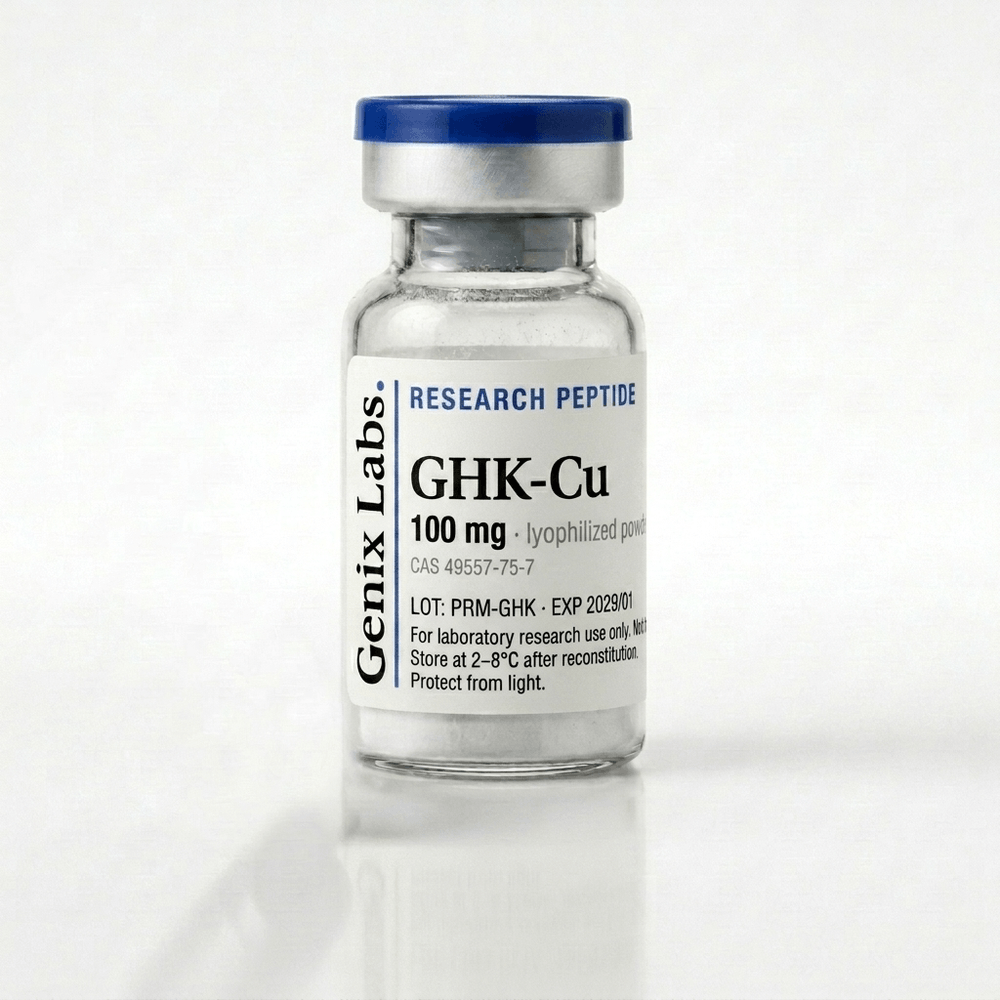
About 15.8 mg. Here is the arithmetic, which takes ten seconds and which no competing page shows.
- The GHK-Cu complex has a molecular weight of about 401.9 daltons.
- A copper atom weighs about 63.5 daltons.
- So copper is 63.5 divided by 401.9, which is 15.8 percent of the mass.
- 100 mg of GHK-Cu therefore carries about 15.8 mg of elemental copper.
Now compare that with the human copper numbers. An adult needs about 0.9 mg of copper a day. The tolerable upper limit is 10 mg a day. One vial holds more copper than a full day at the upper limit, and roughly seventeen days of ordinary requirement.
Nobody is swallowing a whole vial. That is not the point. The point is scale. When a chart online tells you to use a big fraction of a vial in a week, it is also telling you to add milligrams of copper, and it is not telling you that part.
Why copper sets the ceiling, not the peptide
Most peptides clear fast. The body chops them into amino acids and the amino acids go back in the pool. Copper does not work that way. Copper is a metal. The body has careful machinery for holding it, moving it, and letting it go slowly.
So the two halves of GHK-Cu leave on very different clocks. The peptide half is gone in minutes. The copper half joins your copper pool and waits its turn.
- The peptide half is broken down quickly by ordinary enzymes.
- The copper half enters the body's copper pool and leaves slowly, mostly through bile.
- Repeating a dose repeats the copper, even when the peptide signal has already faded.
- So frequency matters more for copper load than any single amount does.
This is why a weekly total is more honest than a per-dose number. A per-dose number looks small. A weekly copper total does not. Any protocol you find online should be checked that way before it is taken seriously.
How long does GHK-Cu last in the body?
The peptide half is short-lived. GHK is a tripeptide, which is three amino acids long, and the body carries enzymes that cut peptides like that quickly. Estimates for small peptides of this size sit in the minutes-to-hours range rather than days.
There is no reliable published human half-life for the injected complex. That gap matters. A half-life is how you justify an interval, and without one, every "every third day" schedule online is a guess dressed as a protocol.
The copper half has no half-life in the same sense at all. Copper is not cleared, it is managed. It binds to carrier proteins, cycles through the liver, and leaves slowly in bile. Weeks, not hours.
Why does the natural level fall with age?
Your own plasma carries GHK. Reported levels sit around 200 nanograms per millilitre at age twenty and fall to roughly 80 by age sixty. That decline is the origin of the whole "replacement" idea behind copper peptide products.
It is also the most useful scale check in this entire article. An adult carries about three litres of plasma. At 200 nanograms per millilitre, that is roughly 0.6 mg of GHK circulating in the whole body at once.
So a single vial holds about 167 times the amount your bloodstream carries naturally. Nobody uses a vial at once. But any protocol framed as "restoring youthful levels" should be read against that ratio, because the gap between a physiological level and a vial is enormous.
Why injected copper skips your body's safety valve
This is the piece that makes the copper number matter, and it is missing from every page currently ranking for this search.
Your gut does not absorb all the copper you eat. It regulates. When stores are high, absorption drops. When stores are low, absorption rises. That feedback loop is why a copper-rich diet does not poison anyone. The body has a dial, and the dial sits in the intestine.
An injection goes around the dial. Copper delivered under the skin or into muscle never passes the regulated step. The liver still manages what arrives, but the first line of control is simply skipped.
- Eaten copper passes a regulated gate that adjusts to your stores.
- Injected copper arrives whole, with no absorption step to throttle it.
- So the 10 mg daily upper limit was set for the eaten route, not this one.
- That makes it a floor for caution here, not a budget to spend against.
People also vary in how they handle copper. Genetics, liver function and other minerals all feed into it. Zinc and copper compete for the same uptake pathway, which is why heavy zinc supplementation lowers copper status over time.
None of that is a reason to panic about a cosmetic cream holding fractions of a milligram. It is a reason to treat milligram-scale injected copper as a genuinely different question, which is exactly what the internet charts refuse to do.
What amounts did the topical studies use?
This is where the human evidence actually lives. Cosmetic studies of copper peptide creams generally used concentrations around 0.05 to 0.1 percent GHK-Cu. Twelve weeks is a common study length.
Put that in milligrams. One gram of a 0.1 percent cream holds 1 mg of GHK-Cu. That is about 0.16 mg of copper. Compare it with the 15.8 mg sitting in a single vial.
So the route with the most human data is also the route with by far the smallest copper exposure. That is not a coincidence worth skipping past. It is the shape of the whole evidence base.
| Route | What the evidence looks like | Rough copper exposure |
|---|---|---|
| Topical cream | Most human data. Cosmetic studies, 0.05 to 0.1 percent, around 12 weeks. | Fractions of a milligram per application |
| Injected | No controlled human trial. Animal and cell work only. | Milligrams per dose, repeated |
| Oral | No human trial. Tripeptides are broken down in the gut. | Unknown, and poorly absorbed |
Why a lab concentration is not a dose
The famous GHK claim is that it shifts the activity of thousands of human genes. That work is real, and it was done in cell culture. Cell culture is a dish of cells bathed in liquid at a chosen concentration.
Those experiments generally used GHK in the low micromolar range, around 1 to 10 micromolar. Convert that to something you can picture. One micromolar GHK-Cu is about 0.4 micrograms per millilitre.
| Setting | Concentration | What that means |
|---|---|---|
| Cell culture dish | about 0.4 µg per mL | The concentration the gene data came from |
| A 100 mg vial in 2 mL | 50,000 µg per mL | About 125,000 times more concentrated |
| Human plasma, age 20 | about 0.2 µg per mL | Close to the culture concentration, not the vial |
Look at the third row, because it is the interesting one. The natural plasma level is in the same neighbourhood as the dish. The vial is in a different universe. Culture concentration is a research condition, never a dose instruction.
This is the single most common error in peptide dosing arguments online. Someone finds a striking in-vitro result, then reaches for a syringe as if the dish number converts. It does not.
What amounts did the animal studies use?
Animal work is where injected and local GHK-Cu was actually measured. Rodent and rabbit wound studies generally used small milligram-per-kilogram amounts, often applied right at the wound rather than given systemically.
Two things about those numbers are easy to misread. First, animal doses do not scale to people by simple multiplication. Body surface area, metabolism and copper handling all differ. Second, a wound study measures healing at a site. It does not measure what repeated whole-body dosing does over months.
When a forum post converts a rat dose into a human dose with a calculator, it is doing a conversion that the original authors never endorsed. That is the honest state of the file.
What about GHK-Cu injection?
GHK-Cu injection is the most searched version of this question and the least supported one. There is no controlled human trial that set an injected amount, an interval, or a maximum.
We do not publish human injection protocols, for GHK-Cu or for anything else. That is not us being coy. It is that the number does not exist in the literature, so anyone printing one made it up or copied someone who did.
Should I take GHK-Cu peptide every day?
No research supports a daily injected GHK-Cu schedule in people. Daily topical cosmetic use is what the human studies tested, at tiny concentrations. Daily injection is a different question entirely, and it is unstudied. Because copper accumulates and clears slowly, daily is the pattern where copper load builds fastest.
Think about the two clocks again. The signal fades in hours. The copper does not. Repeating daily stacks the slow half while chasing the fast half.
That is the mechanical reason most research protocols that do exist used intermittent schedules rather than daily ones. It is not caution for its own sake. It follows from how copper leaves the body.
How long did the studies actually run?
Duration is part of a dose and almost every chart drops it. The cosmetic skin studies that carry the human evidence generally ran about twelve weeks. Not two weeks. Not one application.
There is a biological reason for that length. GHK-Cu is studied as a signal that tells cells to rebuild matrix. Collagen and elastin turn over slowly. The tissue needs months to show a measurable change, no matter how strong the signal is.
Which cuts both ways. It means short trials would miss a real effect. It also means that any dramatic result reported after a week is reporting something other than matrix remodelling.
How do you reconstitute a 100 mg vial?
Reconstitution is the step where most confusion starts, and it is just division. The vial holds a fixed amount of peptide. Water decides how spread out that amount is, nothing else.
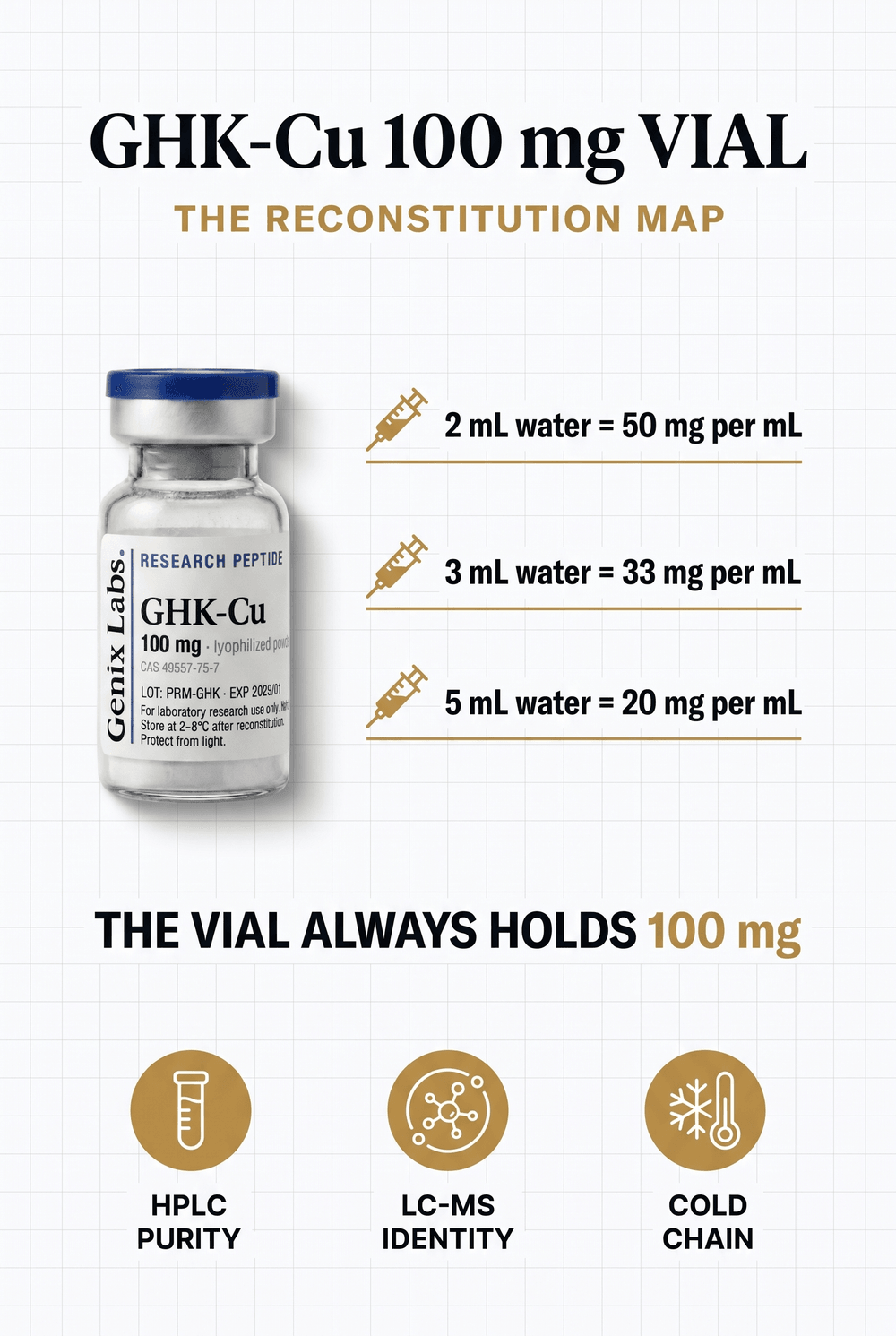
- 100 mg with 2 mL of bacteriostatic water gives 50 mg per mL.
- 100 mg with 3 mL gives about 33 mg per mL.
- 100 mg with 5 mL gives 20 mg per mL.
- In all three cases the vial still holds 100 mg. Only the concentration moved.
Two handling notes that are specific to copper peptides. Add the water slowly down the inside wall of the vial, not straight into the powder. And swirl, do not shake. For the full method, see how to reconstitute peptides and the guide to bacteriostatic water.
How do you read the dose in units?
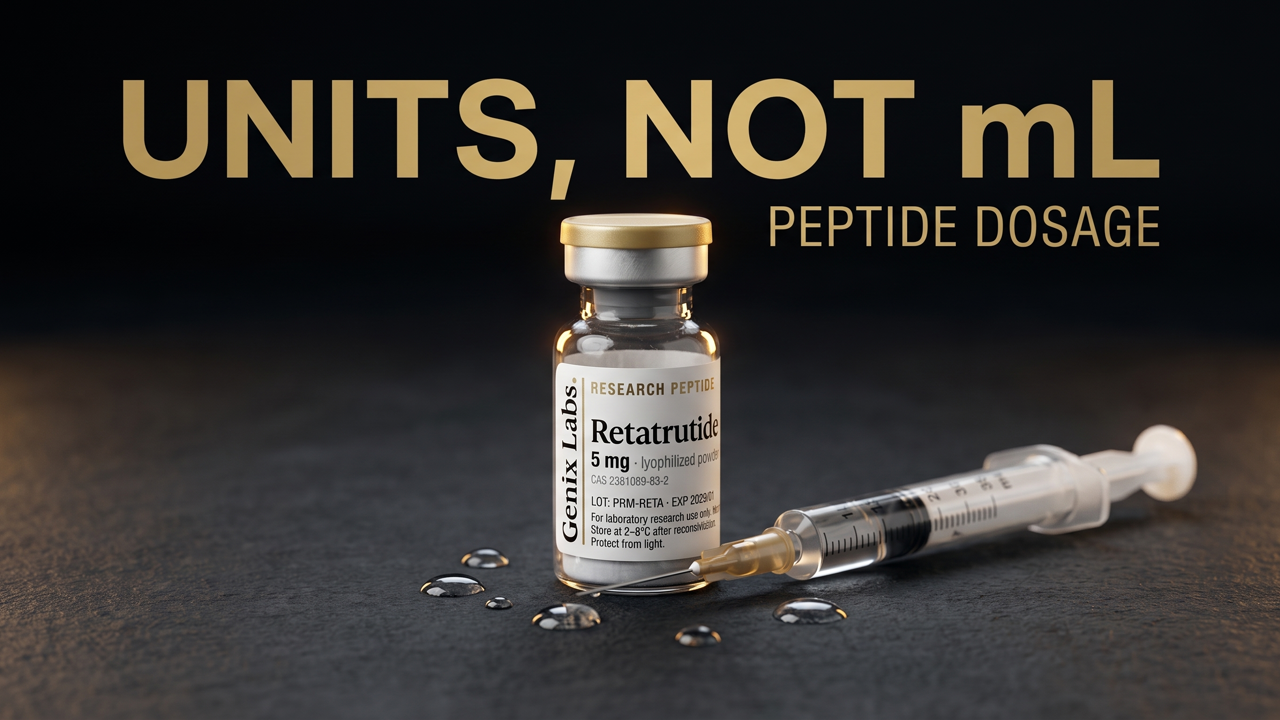
"Units" is the most misunderstood word in peptide dosing. A unit is not an amount of peptide. A unit is a volume mark on an insulin syringe. A 100-unit syringe holds 1 mL, so one unit is 0.01 mL.
Which means a "10 unit dose" tells you nothing on its own. At 50 mg per mL, 10 units holds 5 mg of GHK-Cu. At 20 mg per mL, the same 10 units holds 2 mg. Same mark, two and a half times the difference.
Now add the copper layer. 5 mg of GHK-Cu carries about 0.79 mg of copper, which is close to an adult's entire daily copper requirement, in one mark on a syringe. The full arithmetic lives in how to calculate peptide dosage.
Why a GHK-Cu dosage calculator misleads you
A dosage calculator currently ranks on page one for this search. It does one job well: it converts milligrams and millilitres into syringe units. That part is just arithmetic and it is correct.
The problem is what it cannot know. A calculator has no field for copper. It does not track how many vials came before. It does not know your diet, your supplements, or anything else carrying copper. It returns a tidy number that feels like an answer.
- The 15.8 percent of every milligram that is elemental copper.
- Cumulative copper from previous doses, which clears slowly.
- Copper from food and supplements already in the picture.
- That GHK-Cu is a saturating signal, so bigger numbers stop adding benefit.
A calculator answers "how do I measure this". It cannot answer "how much is sensible". Those look like the same question on screen. They are not.
Can GHK-Cu be mixed with other peptides?
Mixing peptides in one vial is common in research settings, and GHK-Cu is the worst candidate for it. The reason is the copper, again.
Copper is redox active. It can hand electrons back and forth, which is useful biology and bad chemistry in a shared vial. Amino acids like methionine and cysteine are vulnerable to oxidation, and copper can speed that up.
- Keep GHK-Cu in its own vial. A shared vial creates a chemistry problem nobody has characterised.
- Keep it away from direct vitamin C, which reduces copper and can break the complex apart.
- Keep it away from strong acids, which strip copper off the peptide.
- If two compounds are being studied together, separate vials remove the whole question.
Nobody has published a stability study for GHK-Cu co-mixed with the common recovery peptides. In the absence of that data, a shared vial is an experiment with an unmeasured variable in it.
How does GHK-Cu dosing compare with other peptides?
It helps to see where GHK-Cu sits. Most research peptides in this category are plain peptides. GHK-Cu is the only common one that arrives as a metal complex, and that single difference drives everything above.
| Compound | Typical vial | Metal complex? | Human dosing evidence |
|---|---|---|---|
| GHK-Cu | 100 mg | Yes, about 16 percent copper | Topical cosmetic studies only |
| BPC-157 | 10 mg | No | No controlled human trial |
| TB-500 | 10 mg | No | No controlled human trial |
| Epithalon | 10 mg | No | Older clinical reports, mostly one group |
Notice the vial size too. A GHK-Cu vial is ten times larger than a typical recovery peptide vial. That is not because the dose is ten times bigger. It is because the molecule is small and much of its weight is copper and counter-ions.
For the neighbouring charts, see BPC-157 dosing, TB-500 dosage, and Epitalon dosage.
Why a GHK-Cu solution should look blue
Here is a free check almost nobody mentions. Copper in solution is coloured. A properly loaded GHK-Cu solution carries a visible blue or blue-violet tint. That colour comes from the copper ion, not the peptide.
So if a reconstituted GHK-Cu vial gives you a completely water-clear solution with no tint at all, that is a question worth asking your supplier. It can mean the copper loading is low, or that what you have is largely free GHK without its copper.
Two honest caveats. The dry cake's shade varies with how it was freeze-dried, so judge the solution rather than the powder. And colour is a hint, never proof. The real test is the lot report, which is why we publish one.
What should you read on the COA first?
Read identity before purity. Always. Purity tells you how much of one thing is in the vial. Identity tells you whether that thing is what the label says.
For GHK-Cu, identity means mass spectrometry. LC-MS should confirm the expected mass for the complex, around 401.9 daltons, not just the 340 dalton free peptide. That distinction is the whole ballgame for a metal complex, and it is the line most suppliers hope you skim.
- Identity by LC-MS, matching the complex and not only the bare peptide.
- HPLC area purity, with a named lot number on the same page.
- A third-party, ISO 17025 accredited laboratory, not an in-house printout.
- A lot number that matches the one printed on the vial in your hand.
Every Genix lot ships with that paperwork. You can see the published report on the GHK-Cu 100mg product page before you order anything.
How do you check a supplier's numbers?
You do not need a laboratory to catch most problems. You need five minutes and a short list. Here is the one we use internally before a lot is cleared.
- Does a lot report exist at all, and is the lot number on it the one printed on your vial?
- Is there an LC-MS identity line, and does it match the complex at about 401.9 daltons?
- Is the testing laboratory third-party and ISO 17025 accredited, or is it the seller's own printout?
- Does the HPLC chromatogram appear, or only a number typed on a letterhead?
- Is the stated vial amount the complex, or the free peptide? Those are different masses.
That last one catches more mislabelled product than anything else. A vial sold as 100 mg of GHK-Cu and a vial sold as 100 mg of GHK are not the same vial. The second has no copper in it at all.
If a supplier cannot answer those five questions, the dosing conversation is premature. You cannot calculate anything from a number you cannot verify.
Why area percent is not content
A COA saying 99 percent does not mean the vial holds 99 mg of peptide per 100 mg of powder. HPLC area percent measures how much of what the detector saw was your target. It does not measure what else is in the vial.
Lyophilized powder also holds water and counter-ions, usually acetate. Those are real mass. They do not show up as impurities on an area percent readout, because the detector never sees them.
For a copper complex there is a second wrinkle. Acidic mobile phases can strip copper off the peptide during the run. A lab that is not careful can report a clean peak for free GHK while the label says GHK-Cu. That is exactly why the identity line matters more than the purity line.
Is the dosage for skin different from hair?
The honest answer is that nobody has run the head-to-head study. What differs is not a magic number but the route and the target depth.
Skin research is almost entirely topical, because the target is right there under the cream. Hair research is thinner still, and the follicle sits deeper, which is the usual argument people make for other routes. An argument is not a result.
If the hair question is what brought you here, we wrote it up properly in copper peptides for hair loss, alongside the wider peptides for hair loss picture.
Is there a GHK-Cu dosage chart for women?
No. There is no sex-stratified GHK-Cu dosing data of any kind, because there is no controlled human dosing data of any kind. A chart labelled "female" is a marketing label on the same guesses.
The one place sex does enter the picture is copper, and even there the official numbers barely move. The adult daily copper requirement is the same 0.9 mg for men and women. It rises during pregnancy and breastfeeding.
So if a page offers you a female-specific GHK-Cu chart, ask which study it came from. There is not one to name.
What about the bodybuilding numbers?
"GHK-Cu dosage bodybuilding" is a real search, and the numbers attached to it are the largest you will find anywhere. They are also the least sourced.
GHK-Cu is not an anabolic signal. The research interest is in matrix repair: collagen, elastin, wound closure. Scaling a repair signal up to bodybuilding-size amounts does not make it anabolic. It makes it a bigger copper delivery.
For tissue repair specifically, the better-studied options sit in the recovery pillar. Start with the recovery and repair hub if that is the actual goal.
What are the negative side effects of GHK-Cu?
Topical copper peptides are usually well tolerated. Reported problems are local: redness, itching, stinging, and occasional contact dermatitis in sensitive skin. The deeper concern is copper itself, which accumulates and clears slowly. No long human safety study has been run on injected GHK-Cu, so the injected side effect profile is genuinely unknown.
Note how that connects to dosing. The known side effects belong to the low-exposure route. The unknown ones belong to the high-exposure route. That is the opposite of reassuring.
Does GHK-Cu copper peptide actually work?
For topical skin outcomes, the signal is real but modest, and most of it comes from cosmetic studies rather than independent controlled trials. Reviews report better elasticity, density and firmness. For injected or oral use, there is no controlled human evidence at all. So the honest answer depends entirely on which route you mean.
There is one more thing worth knowing. A large share of the supporting literature comes from a single research group that also sells copper peptide products. That does not make the work wrong. It does mean independent replication is thinner than the citation count suggests.
How should a reconstituted vial be stored?
Dry powder is the stable form. Keep it cold, dark and sealed until the day you mix it. Once water goes in, the clock starts.
- Store the dry vial cold and away from light.
- After reconstitution, keep it refrigerated at 2 to 8 degrees Celsius.
- Protect it from light. Copper complexes are photosensitive.
- Never freeze a reconstituted vial. Freeze and thaw cycles damage peptides.
One copper-specific point. Avoid strong acids and strong reducing agents near the solution, including direct vitamin C. Low pH and redox-active compounds can pull the copper off the peptide and break the complex. Full handling detail is in how to store peptides.
Which mistakes waste a 100 mg vial?
- Reading purity and skipping identity. The identity line is what proves it is a copper complex.
- Shaking instead of swirling. Mechanical stress damages peptide in solution.
- Leaving a mixed vial at room temperature on a bench, in the light.
- Copying a units number from a forum without knowing that poster's concentration.
- Treating a dosage calculator's output as a judgement instead of as arithmetic.
Four of those five are handling. Only one is about the number. That ratio is roughly correct for how vials actually get wasted.
What does a 100 mg vial cost?
A Genix Labs GHK-Cu 100mg vial is USD 69, or Rp 1.090.000. Every lot carries third-party HPLC area purity at or above 99 percent and LC-MS identity confirmation from an ISO 17025 accredited laboratory.
Shipping is cold-chain. In Bali that means same-day delivery, with cash on delivery available. Elsewhere it means the vial stays cold until it reaches you, because a warm peptide is a degrading peptide.
Price per milligram is the wrong way to compare suppliers for a copper complex. A cheap vial with no LC-MS identity line could be free GHK with no copper in it at all, and you would have no way to know. Buy the paperwork, not the powder. Browse the full GHK-Cu 100mg listing for the current lot report.
Frequently asked questions
What does a GHK-Cu peptide do?
GHK-Cu is a copper-carrying tripeptide your own plasma already makes. Research studies it as a signal that tells skin cells to build collagen and elastin, as a tissue repair agent, and as an antioxidant that damps inflammation. Those are research questions, not promised outcomes. Research use only.
What are the negative side effects of GHK-Cu?
Topical copper peptides are usually well tolerated. Reported problems are local: redness, itching, stinging and occasional contact dermatitis. The deeper concern is copper itself, which accumulates and leaves the body slowly. No long human safety study exists for injected GHK-Cu, so that profile is genuinely unknown.
Should I take GHK-Cu peptide every day?
No research supports a daily injected GHK-Cu schedule in people. The human studies tested daily topical cosmetic use at tiny concentrations. Because copper accumulates and clears slowly, a daily injected pattern is the one where copper load builds fastest while the peptide signal has already faded.
Does GHK-Cu copper peptide actually work?
It depends on the route. For topical skin outcomes the signal is real but modest, and most of it comes from cosmetic studies rather than independent trials. For injected or oral use there is no controlled human evidence at all. Much of the literature also comes from one commercially interested group.
How much copper is in a 100 mg GHK-Cu vial?
About 15.8 mg. Copper makes up roughly 15.8 percent of the complex by mass, since a copper atom weighs about 63.5 daltons out of a total of about 401.9. That is more elemental copper than an adult's tolerable daily upper limit of 10 mg, and about 17 days of ordinary requirement.
What does a GHK-Cu dose in units mean?
Units are volume marks, never milligrams. A 100-unit insulin syringe holds 1 mL, so one unit is 0.01 mL. Ten units holds 5 mg at 50 mg per mL, but only 2 mg at 20 mg per mL. Without the concentration, a units number tells you nothing at all.
Takeaway
GHK-Cu dosing is not a missing chart. It is a missing number. Every page that gives you milligrams and skips the copper is giving you half the picture, and it is the easier half.
Hold three facts. The human evidence is topical and tiny. The injected route has no trial behind it. And 15.8 percent of every milligram you measure is a metal that leaves slowly.
So read the identity line first, do the copper arithmetic before the peptide arithmetic, and treat every confident protocol online as unverified. For the wider category, including how GHK-Cu sits beside Epithalon and the rest, start at the longevity and anti-aging pillar.
Every Genix Labs compound, including GHK-Cu 100mg, is supplied strictly for in-vitro laboratory research. It is not for human or veterinary use, and nothing on this page is medical advice.