
Search TB-500 dosage and you get charts. They look confident. They quote a loading phase, a maintenance phase, and a tidy milligram figure per week. Almost none of them say which molecule those milligrams belong to, and two different molecules are sold under this one name. That single gap undoes most of the arithmetic on those pages.
What is the TB-500 dosage in the research?
There is no established human TB-500 dose. The published amounts come from animals and are measured per kilogram of body weight. A rat stroke study tested 2, 12 and 18 mg/kg. Rat wound studies used about 5 micrograms placed in the wound. No human trial has set an injected amount. It is research use only.
Is TB-500 the same molecule as thymosin beta 4?
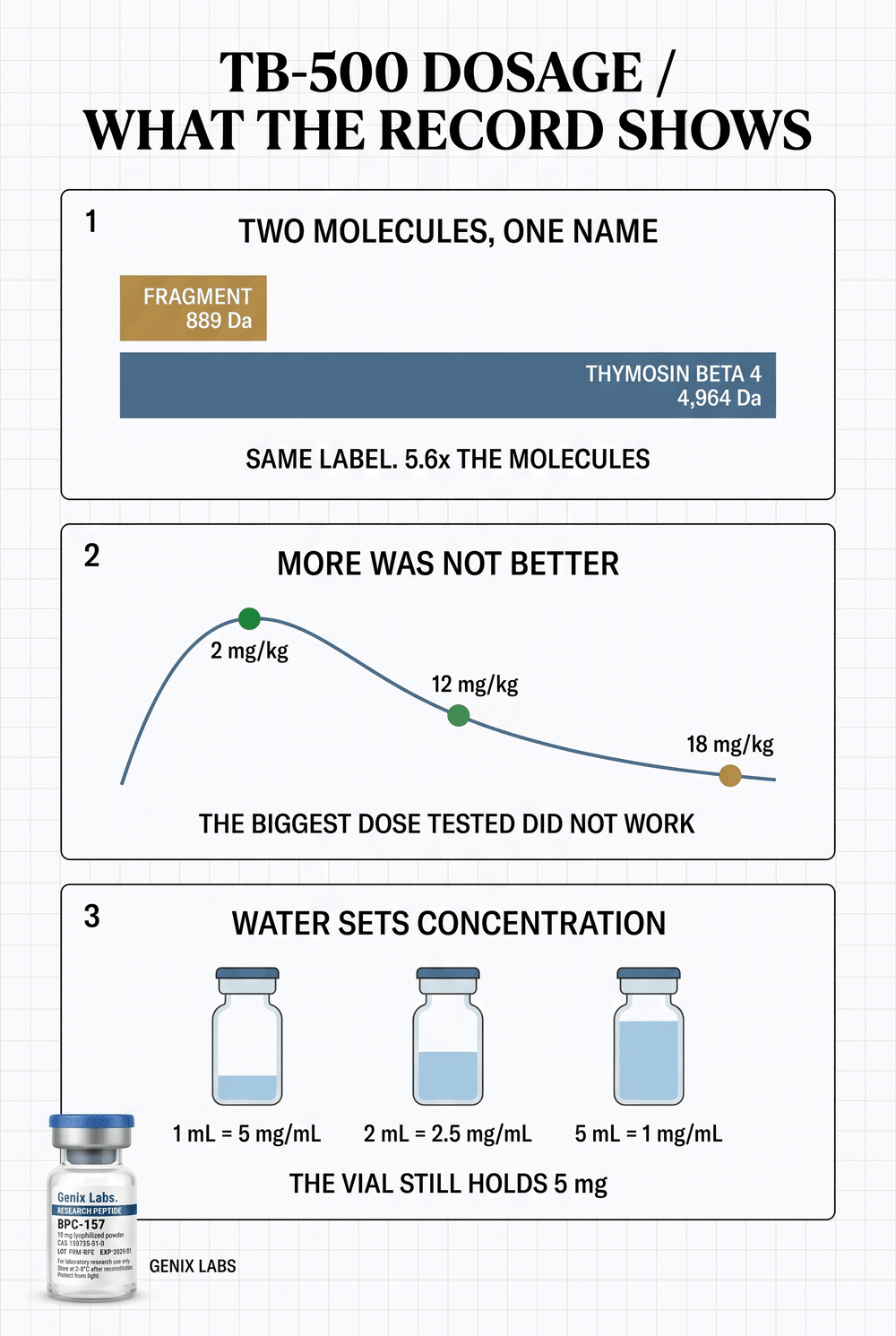
No, and this is where most dosage confusion starts. Thymosin beta 4 is a natural protein. It has 43 amino acids and weighs about 4,964 daltons. TB-500 is the short active piece of it. That piece is seven amino acids long, written Ac-LKKTETQ, and it weighs about 889 daltons.
The seven residue stretch sits at positions 17 to 23 of the parent protein. It is the part that binds actin, the scaffolding protein inside every cell. Research named it the active site. Vendors then started selling both the fragment and the whole protein under the shorter, catchier name.
So a page can say TB-500 and mean either one. Some labels say TB-500 and the vial holds the full protein. Some say thymosin beta 4 and the vial holds the fragment. The names drifted. The molecules did not.
One honest consequence. A dosage chart that does not name the molecule has skipped the first question. You cannot audit the number until you know what it weighs.
Why does the same milligram number mean two different doses?
Because a milligram is a weight and a cell responds to a count. Divide 4,964 by 889 and you get about 5.6. That means 5mg of the small fragment holds roughly 5.6 times as many molecules as 5mg of the full protein. Same number on the label. Very different amount of signal.
| What the vial holds | Molecular weight | Molecules in a 5mg vial, relative | Named on most charts? |
|---|---|---|---|
| TB-500 fragment, Ac-LKKTETQ | 889 Da | About 5.6 units | Rarely |
| Full thymosin beta 4 | 4,964 Da | 1 unit | Rarely |
This is not a rounding error. It is a 5.6 fold gap hiding behind an identical label. Any chart that converts milligrams into a protocol without naming the molecule is doing arithmetic on an unknown.
One document closes the gap. An LC-MS identity test reports the measured mass of what is actually in the vial. Our blend lot 726591 carries exactly that line, with both component masses confirmed. We walk through reading those documents in how to calculate peptide dosage.
What amounts did the animal studies actually use?
Small ones, and almost never daily. The dermal healing work in rats placed about 5 micrograms in 50 microlitres straight into an 8mm punch wound. A second arm injected 60 micrograms into the abdomen on day zero, then again on days two, four and six. Wound width fell about 18 percent by day four.
Note the schedule. Every other day, not every day. Note the unit too. Those are micrograms, a thousandth of a milligram, in an animal weighing a few hundred grams.
| Study type | Route | Amount used | Schedule |
|---|---|---|---|
| Rat dermal wound | Into the wound | About 5 mcg in 50 mcL | Applied at the wound |
| Rat dermal wound | Into the abdomen | 60 mcg per dose | Days 0, 2, 4 and 6 |
| Rat stroke model | Into the abdomen | 2, 12 or 18 mg/kg | Every 3 days, 5 doses |
| Mouse cardiac repair | Local and systemic | Reported per animal | Study specific |
| Any human injection | Not applicable | Never established | No published schedule |
Read the last row twice. It is the row the charts are built on top of, and it is empty.
Does a bigger TB-500 dose work better?
In the one study designed to answer that, no. Researchers gave rats thymosin beta 4 after a stroke. There were four groups of ten animals: control, 2 mg/kg, 12 mg/kg and 18 mg/kg. Dosing began 24 hours after the stroke, then repeated every three days for four more doses.
The 2 mg/kg group improved. The 12 mg/kg group improved. Both held that improvement out to day 56. The 18 mg/kg group, the largest amount tested, showed no significant improvement at all.
The authors then modelled the curve and estimated the best amount near 3.75 mg/kg. That figure sits at the bottom of the tested range, not the top. The relationship is a hill, not a ramp.
- The only published dose response curve for this peptide bends downward.
- The highest amount tested performed no better than saline.
- The modelled best amount was about one fifth of the highest tested.
- Charts that scale upward for bigger injuries are working against the curve.
This is the part the loading phase language gets backwards. More is not a stronger version of the research. In the research, more was worse.
Has any human study established a TB-500 dose?
Not for an injection. The parent protein reached people, but only as an eye drop and a topical gel. An ophthalmic solution at 0.1 percent was given six times a day for 28 days in a dry eye trial, then carried into a Phase III trial for neurotrophic keratopathy. Those are concentrations on a surface, not injected amounts.
An injectable version did exist. It completed a Phase 1 safety trial and was found well tolerated. The Phase 2 trial in heart attack patients was then placed on clinical hold, because the contract manufacturer failed good manufacturing practice rules. The study never produced a dose.
| Human programme | Form | Amount studied | How far it got |
|---|---|---|---|
| Dry eye trial | 0.1% eye drops | Six times daily, 28 days | Phase 2, positive |
| Neurotrophic keratopathy | 0.1% eye drops | Topical, per protocol | Phase 3 |
| Wound and skin gel | Topical gel | Low percentage strengths | Early phase |
| Injectable, heart attack | Intravenous | Phase 1 only | Phase 2 on hold |
So the honest summary is narrow. People have received this molecule on the eye and on the skin. Nobody has published an injected amount that worked. A newer heart attack trial is registered, which is where the next real number would come from.
Where do the loading and maintenance phases come from?
From each other. The loading and maintenance structure is a convention that spread between vendor pages and forum posts. It is internally consistent and widely repeated. It is not traceable to a study that tested two phases against one.
That does not make the idea silly. Front loading a compound with a long tissue residence is a reasonable guess. But a reasonable guess is a different object from a measured result, and charts present it as the second thing.
| Claim on a typical chart | Where it comes from | Evidence grade |
|---|---|---|
| A four to six week loading phase | Vendor and forum convention | Repeated, not measured |
| A lower maintenance phase after | Same convention | Repeated, not measured |
| Dosing every other day | Matches the rat wound schedule | Animal only |
| Amount scaled to injury size | No source | Invented |
| Amount per kilogram of body weight | The animal studies | Animal only |
Asking which row a figure belongs to is the fastest way to audit any TB-500 page. It works on this page too, which is why every number above names its study.
Does TB-500 dosage mean per day or per week?
Charts use both and rarely say which. That alone creates apparent disagreements of seven fold between pages that are actually quoting the same convention. Weekly totals are the most common format, and they are the furthest from anything measured.
The animal record uses neither format. It reports an amount per dose and a gap between doses. The rat wound work dosed on days zero, two, four and six. The stroke work dosed every three days. Converting either into a weekly human figure needs a species scaling step that no study performed.
| Format | Used by | Rests on |
|---|---|---|
| Amount per dose, plus a gap | The published animal studies | Measured data |
| Amount per kilogram | The published animal studies | Measured data |
| Amount per day | Forum posts | Convention |
| Amount per week | Vendor charts | Convention plus arithmetic |
How is a 5mg or 10mg TB-500 vial reconstituted?
Reconstitution means adding liquid to a dry powder so it can be measured. TB-500 ships as a lyophilised powder, which means freeze dried. Dry powder survives shipping and storage far better than a solution. Bacteriostatic water, water with a preservative added, is the standard diluent in the literature.
One rule answers every reconstitution question ever asked. The water sets the concentration, never the amount. A 5mg vial holds 5mg whether you add one millilitre or five. What changes is how many milligrams sit in each millilitre.
| Vial size | Water added | Concentration | Amount still in the vial |
|---|---|---|---|
| 5 mg | 1 mL | 5 mg per mL | 5 mg |
| 5 mg | 2 mL | 2.5 mg per mL | 5 mg |
| 5 mg | 5 mL | 1 mg per mL | 5 mg |
| 10 mg | 2 mL | 5 mg per mL | 10 mg |
| 10 mg | 5 mL | 2 mg per mL | 10 mg |
That is the whole of what a dosage calculator does. It is useful arithmetic and it is not a protocol. We cover the handling side step by step in how to reconstitute peptides.
Does the injection site change the amount?
Enormously, and this is the part most charts skip. Route decides how much of a peptide reaches the tissue being studied. The same biological effect can need a thousandfold different amount depending on delivery.
Look at the rat wound numbers again. Placed directly in the wound, about 5 micrograms did the job. Injected into the abdomen to travel through the body, the figure was 60 micrograms. Twelve times more, for the same reported outcome, purely because of distance.
TB-500 is usually described as the systemic one of the two repair peptides, because it is studied for travelling to tissue rather than acting where the needle went. That reputation is the reason people pair it with a local acting peptide, which we unpack in the BPC-157 and TB-500 stack.
Why is the TB-500 amount different from BPC-157?
Different molecules, different evidence bases, different units in the papers. BPC-157 is a pentadecapeptide, fifteen amino acids, about 1,419 daltons. Our measured identity figure for it is 1419.5 amu on lot 613480. TB-500 as the fragment is smaller, and as the full protein is much larger.
| Peptide | Size | Studied reach | Published human dose? |
|---|---|---|---|
| BPC-157 | 15 residues, about 1,419 Da | Mostly local | No |
| TB-500 fragment | 7 residues, about 889 Da | Described as systemic | No |
| Thymosin beta 4 | 43 residues, about 4,964 Da | Systemic and topical | Topical only |
Neither has a settled human number, so comparing their charts compares two conventions. What can be compared is what is in the vial. Our blend holds 5mg of each, and the certificate confirms both masses. The sibling guide BPC-157 dosing runs the same audit on the other half of the pair, and the wider category sits at recovery and repair peptides.
Can a dosage chart survive a purity gap?
No, and this is the quietest failure of the whole chart genre. Suppose a chart specifies 2mg. Suppose the vial is labelled 5mg but the powder is 85 percent pure by area. The peptide content is closer to 4.25mg, so the measured draw delivers about 1.7mg of peptide. The chart was followed. The amount was not.
| Labelled vial | HPLC area purity | Peptide mass implied | Gap against the label |
|---|---|---|---|
| 5 mg | 98.60% (our lot 726591) | About 4.93 mg | Under 1.5% |
| 5 mg | 95% | About 4.75 mg | 5% |
| 5 mg | 85% | About 4.25 mg | 15% |
| 5 mg | Untested | Unknown | Unknown |
Purity moves the real amount before any arithmetic starts. That is why a batch document matters more than a chart. Ours reports HPLC area purity at 220 nanometres against a minimum of 98 percent by area, plus an LC-MS identity line, for the printed lot only.
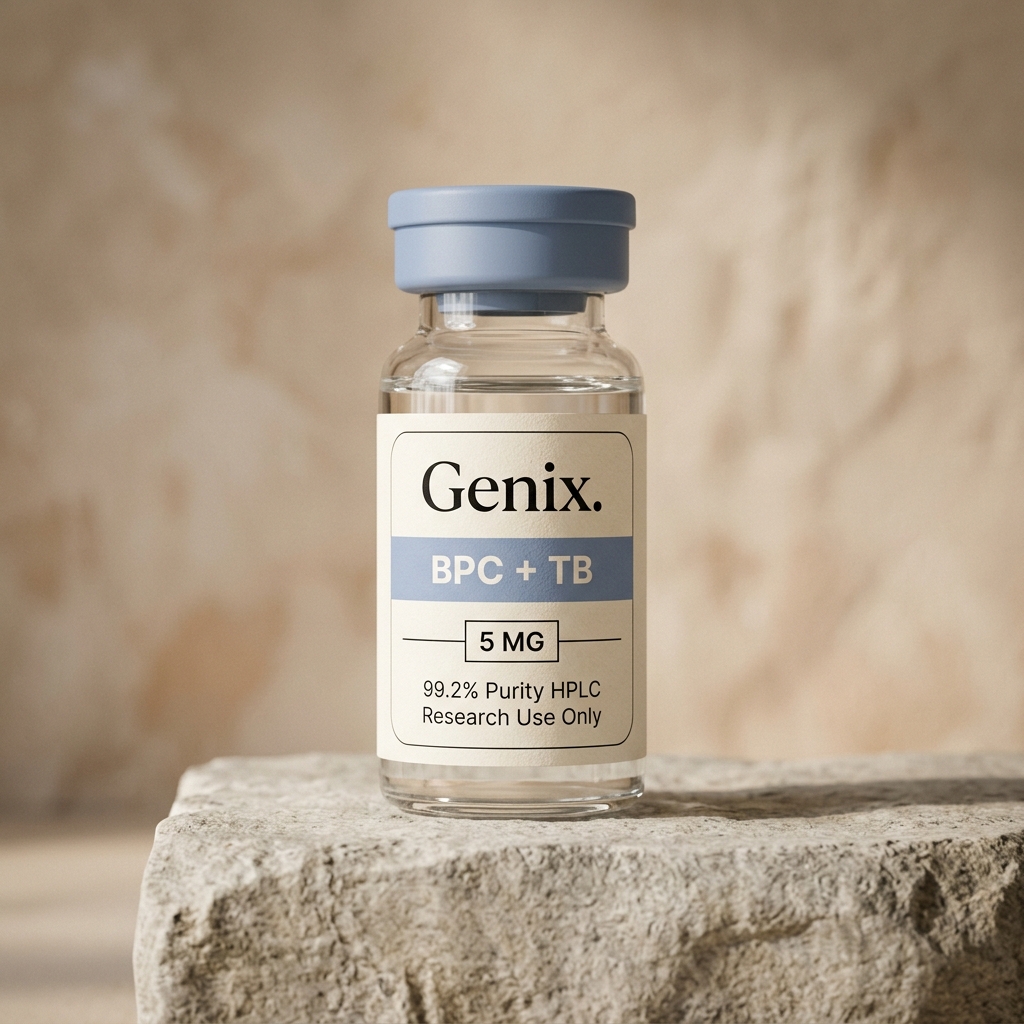
Each BPC-157 + TB-500 vial ships with its batch document, cold packed and tracked. The 5+5mg blend is Rp 1.650.000, about $99, and the BPC-157 only 10mg vial is Rp 1.450.000, about $89. In Bali it goes out same day, often inside two hours, with cash on delivery.
Is TB-500 allowed in tested sport?
No. TB-500 and thymosin beta 4 are prohibited at all times under section S2 of the World Anti-Doping Agency list, which covers peptide hormones, growth factors and related substances. Prohibited at all times means in competition and out of competition.
Equine racing bodies restricted it earlier than most human sport did, and it has featured in horse racing anti-doping cases. Dosage charts almost never mention any of this, even the ones aimed squarely at athletes searching for bodybuilding figures.
- Any tested athlete using it risks an anti-doping violation.
- There is no permitted low amount, because the ban is not dose based.
- A chart quoting athlete protocols is quoting a banned substance.
- Genix Labs supplies it for laboratory research only, not for use in people or animals.
How should a reconstituted vial be stored?
Cold and dark. A sealed dry vial is stable for months when refrigerated and shipped cold. Once water is added, the clock speeds up, and a mixed vial is handled as a short life solution kept refrigerated.
Storage links back to dosage in a way charts never show. A solution that has degraded still measures the same volume on a syringe. The millilitres look identical. The amount of intact peptide is not.
| State | Condition | Practical note |
|---|---|---|
| Sealed dry powder | Refrigerated, dark | Stable for months, how it ships |
| Reconstituted solution | Refrigerated, dark | Short life, handled in weeks |
| Warm or light exposed | Any | Volume unchanged, content not guaranteed |
| Frozen after mixing | Varies by peptide | Freeze thaw cycles are their own variable |
What are the most common TB-500 dosage mistakes?
They cluster, and they are all upstream of the number. Here are the ones we see most often in support messages, in rough order of how much damage they do to an amount.
- Not naming the molecule. The fragment and the full protein differ about 5.6 fold by weight. Everything downstream inherits that error.
- Reading mcg as mg. A thousandfold slip. The rat wound figure of 5 micrograms becomes 5 milligrams and starts to look like a chart number.
- Treating a weekly total as a per dose figure. Or the reverse. Charts frequently fail to say which, so the same page can be read two ways.
- Assuming a bigger amount heals faster. The only dose response curve says otherwise. The highest amount tested did nothing.
- Ignoring purity. An untested vial has an unknown peptide mass, so the measured draw is an unknown amount.
- Scaling animal mg/kg to a person. Species scaling is a modelling step with its own rules. No study did it for this peptide.
- Trusting a forum consensus as data. Reddit threads are real experience and real opinion. They are not a measured result.
TB-500 dosage questions, answered
These are the searches that bring people to this page. The answers stay inside the published record.
What is the TB-500 dosage per day?
No published study sets a daily TB-500 amount for people. The animal work dosed every two or three days, not daily, and measured amounts per kilogram of body weight. Daily figures on charts come from forums, not from studies. TB-500 is sold for research use only, never for human use.
What is the TB-500 dosage per week?
Weekly figures are a convention copied between vendor pages, not a measured result. The animal studies report amounts per dose and a gap of two or three days between doses. Converting that into a weekly human total means inventing a scaling step no study performed. This is not medical advice.
Is there a TB-500 dosage calculator?
Calculators online only do reconstitution math. They turn a vial size and a water volume into a concentration. That part is simple arithmetic and it is genuinely useful. What no calculator can supply is the amount to put in, because no human study has established one.
What is the TB-500 dosage for injury?
The injury research is animal research. Rat wound studies placed about 5 micrograms directly into the wound, or injected 60 micrograms into the abdomen every other day. Those are rat amounts at rat body weights. They are not a human injury protocol and were never tested as one.
How do you dose a 10mg TB-500 vial?
A 10mg vial holds 10mg whether you add one millilitre of water or five. Water only sets the concentration. Add 2mL and each millilitre holds 5mg. The vial size and the research amount are two separate questions, and only the first one has an arithmetic answer.
What is the BPC-157 and TB-500 dosage per day?
Our blend vial holds 5mg of each, confirmed by LC-MS on lot 726591. That tells you what is in the vial, which is a fact. It does not tell you a daily amount, because neither peptide has a settled human dose. Both are supplied strictly for laboratory research.
The takeaway
TB-500 dosage is not a hard question with a hidden answer. It is a question the research has not answered for people, dressed up by charts that look like it has. The published amounts are animal amounts, per kilogram, dosed every two or three days.
Three things are genuinely knowable. Which molecule is in the vial, which an LC-MS identity line settles. How concentrated the solution is, which is arithmetic. How pure the powder is, which a batch document reports. Everything else on a dosage chart is convention wearing a lab coat.
Our BPC-157 + TB-500 research vial ships with its batch document so the first two questions have real answers. The third stays with the literature, and the literature is still thin. Research use only, not for human or veterinary use.