Search "epitalon dosage" and every page returns the same number: 5 to 10mg a day for 10 to 20 days. The number is repeated so often it reads like settled science. It is not. This guide traces that figure back to its source, sets it beside what the published studies really dosed, and shows the vial math in plain words. It is a research overview, not medical advice, and epitalon is supplied strictly for laboratory research use.
What dose did epitalon research actually use?
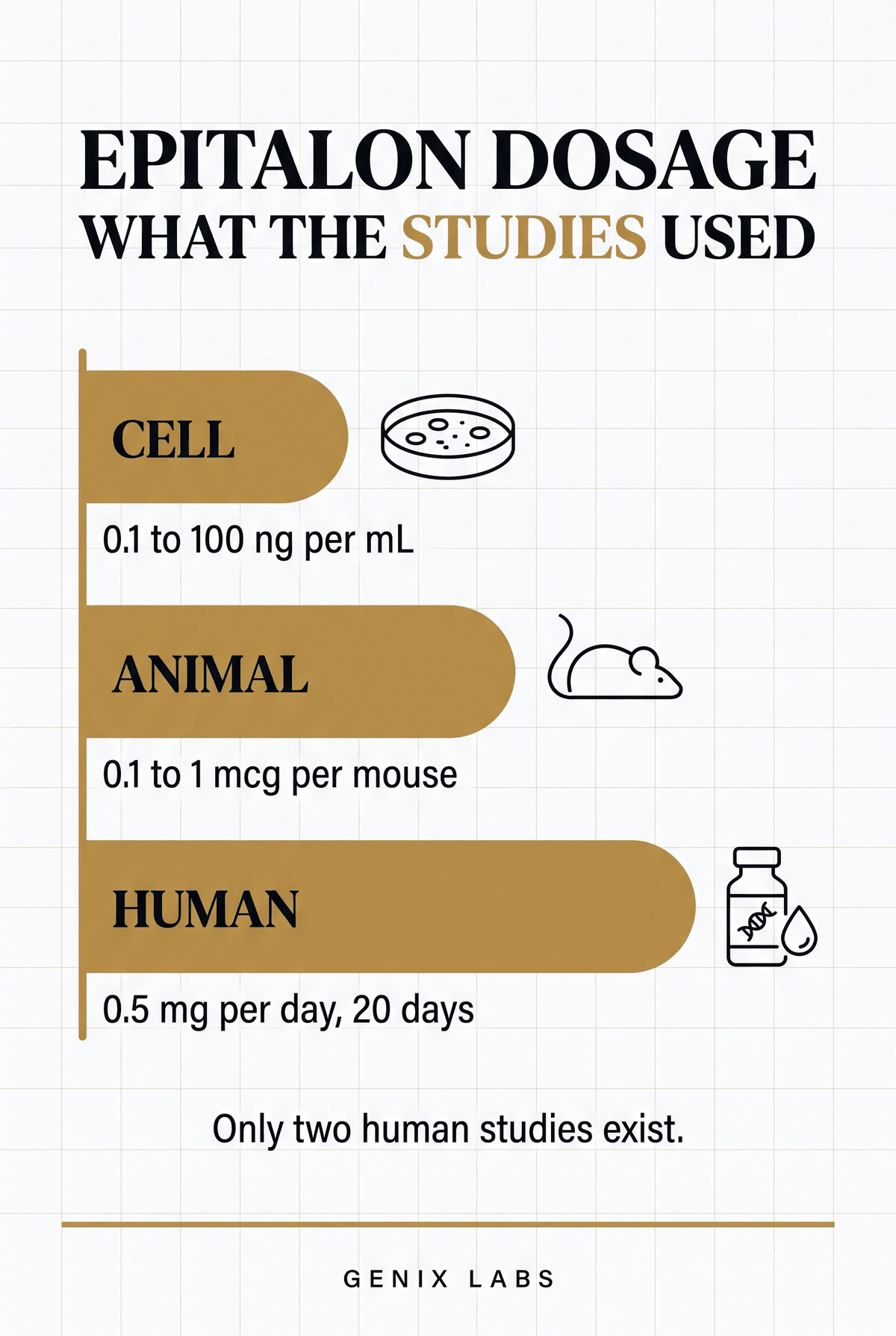
Two human studies of the synthetic peptide exist. One gave 0.5mg a day under the tongue for 20 days to 75 women. The other injected 5 micrograms beside each eye for 10 days in 162 patients. Cell work used 0.1 to 100 nanograms per millilitre. Nothing above 0.5mg a day appears in a published human epitalon trial.
That is the whole answer, and it is smaller than almost anyone expects. The rest of this page explains how a figure twenty times larger ended up on every chart, which parts of the record are solid, and which parts are simply repetition. If you want the compound itself explained first, start with our epithalon guide and come back here for the numbers.
What is epitalon?
Epitalon is a peptide four amino acids long. The sequence is alanine, glutamic acid, aspartic acid, glycine, written Ala-Glu-Asp-Gly and shortened to AEDG. A peptide is just a short chain of amino acids, the same building blocks proteins are made of. Four links is very short. Insulin, for comparison, has fifty one.
It was built in the 1980s by a Russian group led by Vladimir Khavinson. They had been working with epithalamin, an extract squeezed from the pineal glands of cattle. The pineal gland is the small organ in the brain that releases melatonin and sets the daily sleep clock. Epitalon was the attempt to find the active fragment inside that extract and make it synthetically.
That history matters more than it sounds, and it is the root of the dosage confusion. Epithalamin and epitalon are not the same substance. One is a crude glandular extract. The other is a defined four-link peptide. Most of the famous human numbers belong to the extract. Most of the dosage charts online attach them to the peptide.
Spelling varies because the research was translated from Russian. Epitalon, epithalon and AEDG all name the same molecule. Epithalamin names the older extract. Keeping those four words straight removes about half the confusion in this topic.
What does epitalon do?
In research, epitalon has been studied for three separate jobs. Each has a different quality of evidence behind it, and knowing which is which tells you how much weight any dose figure can carry.
The first is telomerase. Telomeres are protective caps on the ends of chromosomes that shorten each time a cell divides. Telomerase is the enzyme that rebuilds them. In human fetal fibroblasts, epitalon switched telomerase expression back on and lengthened the caps. Treated cells kept dividing to passage 44 while untreated cells stopped at 34.
The second is melatonin rhythm. In the 20 day sublingual study, melatonin output rose about 1.6 times against placebo, and expression of the Clock gene in white blood cells fell by a factor of 1.8. Clock is one of the genes that keeps the body on a daily schedule. That is the closest thing to a human outcome in the whole file.
The third is antioxidant and tissue support, mostly in animals and cell culture. Oocyte cultures at 0.05 and 0.1 millimolar showed lower reactive oxygen species. Rat work looked at kidney function and glucose transport. These are mechanism studies, not outcomes anyone felt.
- Strongest: telomerase activation and telomere lengthening, in cultured human cells.
- Moderate: melatonin rhythm shift, in one 75 person sublingual study.
- Weak: antioxidant and organ support, almost entirely animal and cell work.
- Absent: any blinded, placebo-controlled trial of the injected synthetic peptide.
Which human epitalon studies exist?
This is the question nobody asks before copying a chart, and it is the one that decides everything else. The 2025 review in the International Journal of Molecular Sciences collected the published record. For the synthetic peptide in humans, it found two studies. Two.
Study one: the retinal trial
162 patients, aged 18 to 72, with retinitis pigmentosa, a disease that slowly degrades the retina. Each received 5.0 micrograms of epitalon per eye, injected parabulbarly, which means into the tissue around the eyeball rather than into the bloodstream, for 10 consecutive days. The review records that none of the treated patients reported side effects.
Note what that dose is. Five micrograms is five thousandths of a milligram. A single 10mg vial holds two thousand of those amounts. The route is also local, placed next to the target tissue, which is exactly why the amount can be so small.
Study two: the circadian trial
75 women received 0.5mg a day, taken sublingually, meaning dissolved under the tongue, for 20 days. The researchers measured melatonin output and the expression of circadian genes, Clock and Cry2 in leukocytes and Csnk1e in lymphocytes. Melatonin rose around 1.6 fold against placebo.
That 0.5mg a day is the largest amount given to a human in any published epitalon study. It is also not an injection. Every chart that recommends an injected milligram amount is extrapolating past both of the only human studies that exist.
What doses appear in the published studies?
Here is the complete dosing record, pulled from the 2025 review, laid out so the scale is visible in one glance. Units are mixed deliberately, because that is how the literature reports them, and because the unit is where most readers go wrong.
| Model | Amount | Route | Duration |
|---|---|---|---|
| Human, retinal | 5 mcg per eye | Parabulbar injection | 10 consecutive days |
| Human, circadian | 0.5 mg per day | Sublingual | 20 days |
| Mouse | 0.1 to 1 mcg per mouse | Subcutaneous | 5 times a week |
| Mouse, genotoxicity | 5 mcg per kg | Single dose | One administration |
| Rat, long term | 0.5 mcg per rat | Subcutaneous | 30 to 42 days |
| Rat, glucose transport | 100 mcg per rat | Oral | One month |
| Rat, neuronal | 20 ng per rat | Intranasal | Study dependent |
| Human fibroblasts | 0.1 to 100 ng per ml | Culture medium | Up to 96 hours |
| Murine thymocytes | 10 to the minus 17 to minus 15 molar | Culture medium | Study dependent |
Read the column of amounts from top to bottom. Micrograms and nanograms dominate. The single milligram figure in the whole table is 0.5mg, and it was taken under the tongue, not injected. There is no published study anywhere in that list using 5 or 10mg a day of the synthetic peptide in a person.
Can an animal dose be converted to a human one?
It can, and pharmacologists do it routinely. The method is worth walking through, because when you apply it to the epitalon animal data it returns an answer that nobody selling a dosage chart seems to have checked.
You cannot simply scale by weight. A mouse weighs about one three-thousandth of a person, but it does not run at one three-thousandth of the metabolic rate. Small animals burn through compounds far faster per kilogram of body weight than large ones do. Scaling straight by weight overshoots badly, and this is a well understood trap rather than a subtle one.
The standard correction scales by body surface area instead of mass. Regulators publish conversion factors for it. Converting a mouse amount to a human equivalent means dividing the mouse figure in milligrams per kilogram by roughly twelve. Rats divide by about six. The factors are rough, which is the point: they produce a range to investigate, never a prescription.
Running the numbers on the mouse protocol
The published mouse work used 0.1 to 1 microgram per mouse, subcutaneously, five times a week. A laboratory mouse weighs about 20 grams, so that is 5 to 50 micrograms per kilogram. Divide by twelve and the human equivalent is roughly 0.4 to 4 micrograms per kilogram. For a 60 kilogram adult, that works out at about 0.02 to 0.25 milligrams.
| Step | Low end | High end |
|---|---|---|
| Mouse amount per animal | 0.1 mcg | 1 mcg |
| Mouse amount per kilogram | 5 mcg per kg | 50 mcg per kg |
| Divided by the surface area factor | 0.4 mcg per kg | 4 mcg per kg |
| Scaled to a 60 kg adult | About 0.024 mg | About 0.25 mg |
Now set that beside the two human studies. The sublingual trial used 0.5mg a day. The scaled mouse range lands at 0.02 to 0.25mg. Those are the same order of magnitude, which is as close as this kind of arithmetic ever gets. Two completely independent lines of evidence, animal scaling and the one human daily study, agree with each other.
Then set the chart figure beside them. Five to ten milligrams a day is twenty to four hundred times the scaled animal range, and ten to twenty times the published human amount. It is not a slightly aggressive reading of the research. It sits outside everything the research contains.
One caution on the method itself. Surface area scaling was built for small molecule drugs, and peptides behave differently, especially across routes with partial absorption. Treat the exercise as a sanity check on an order of magnitude, which is exactly what it is good for, and not as a protocol.
Why does every epitalon dosage chart say 10mg?
Because the figure is real, but it belongs to a different substance. The Russian clinical work of the 1980s and 1990s ran courses of epithalamin, the pineal extract, in roughly 10mg daily amounts over 10 day courses, repeated once or twice a year. That is where the shape of the modern chart comes from: the number, the course length, and the cycles per year.
When the synthetic peptide replaced the extract in conversation, the protocol travelled with the name and nobody re-derived it. An extract is a mixture of many molecules at low individual concentration. A synthetic peptide is one molecule at full strength. Transferring a milligram figure between them is not a conservative assumption. It is a category error.
The second ingredient is citation drift. One vendor page writes 5 to 10mg a day. The next copies it and adds a confident footnote to Khavinson. The third copies that. Within a few years the figure has dozens of sources and no origin. We checked the top ranking pages for this keyword. Not one of them cites a human epitalon study that used a milligram injected amount, because none exists to cite.
None of this means the circulating figure is dangerous or wrong. It means it is unverified. Those are different claims, and the difference is the entire point of reading a dosage page carefully.
- Epithalamin extract courses in the Russian clinical literature used roughly 10mg daily.
- The name changed to epitalon. The number did not change with it.
- Vendor pages copied each other, and the citation chain lost its first link.
- Nobody re-measured, because measuring requires a trial, and no trial was run.
Epitalon or epithalamin: whose protocol is on the chart?
Almost every strong claim in this topic belongs to one of two substances, and the two get merged constantly. Separating them is the single most useful thing a reader can do with this page, so here they are side by side.
| Epithalamin | Epitalon | |
|---|---|---|
| What it is | Extract from bovine pineal glands | Synthetic four amino acid peptide |
| Composition | A mixture, contents not fully defined | One defined molecule, Ala-Glu-Asp-Gly |
| Era | 1970s to 1990s Russian clinical work | Synthesised later, studied from the 1990s |
| Famous human data | The 266 person survival cohort | Two small studies |
| Course shape described | About 10 mg daily, 10 day courses | 0.5 mg daily sublingual, 20 days |
| What charts quote | This row, usually | Rarely this row |
The survival data is the clearest example of the mix-up. In the 2003 Neuroendocrinology Letters cohort, 266 older adults were followed for six to eight years, and the treated arm received epithalamin. That study is cited on page after page as evidence for epitalon. It is evidence for the extract.
The milligram course figure travelled the same way. An extract is many molecules at low individual concentration, so a 10 milligram dose of extract contains only a small and undefined fraction of any one active component. A 10 milligram dose of the synthetic peptide is 10 milligrams of that single molecule. Carrying the number across treats those two as interchangeable, and they are not.
This is not an argument that the extract research was poor. It is an argument that it was research about something else. The tetrapeptide was built because the extract was undefined, and the whole point of defining it was to stop reasoning from mixtures. Reattaching the mixture's dose to the pure compound undoes that work.
- Does it cite the 266 person cohort as epitalon evidence? That cohort used the extract.
- Does it give a milligram injected amount? No human study of the peptide used one.
- Does it name the route with the number? A figure without a route cannot be checked.
- Does it distinguish epithalamin from epitalon anywhere on the page? Most do not.
Micrograms or milligrams? The unit that changes everything
A milligram is one thousand micrograms. A microgram is one thousand nanograms. Three units, each a thousand times the one below it. Peptide research uses all three, often on the same page, and a misread unit moves an amount by a factor of a thousand in one keystroke.
The retinal study used 5 micrograms. Written carelessly as 5mg, that becomes a thousand times larger and starts to look like the chart figure. We cannot prove that is how the two merged. We can say the two numbers are one unit apart, and that the mix-up is the single most common error we see in support messages about peptide amounts.
Watch for mcg as well. Some sources write µg with the Greek letter mu, others write mcg, and a few write ug because the keyboard was easier. All three mean microgram. If a page mixes them, read every number on it twice. The same discipline applies across the catalogue, and we work through it step by step in how to calculate peptide dosage.
What does epitalon dosage per day actually refer to?
It refers to one of three different things, and sources rarely say which. Separating them resolves most apparent contradictions between charts.
| What is meant | Typical figure quoted | Where it comes from |
|---|---|---|
| Published human daily amount | 0.5 mg per day | The 20 day sublingual study |
| Extract era clinical course | About 10 mg per day | Epithalamin, not the peptide |
| Vendor and forum protocol | 5 to 10 mg per day | Copied from the extract era |
When a chart says per day without naming the route, it is almost always the third row. That row has the weakest provenance of the three and the widest circulation. Asking which row a figure belongs to is the fastest way to audit any epitalon page, including this one.
There is also a quieter question hiding in per day: per day of what schedule. Ten days is not thirty, and a figure that sounds modest daily becomes a very different total across a month. The next section deals with that.
How long were the research cycles?
Short, and separated by long gaps. The retinal study ran 10 consecutive days. The circadian study ran 20. The broader Russian literature describes courses of 10 or 20 days, repeated one to three times a year. Nothing in the published record tests continuous daily use for months.
The cycling pattern is not incidental. The pineal system the peptide is aimed at runs on rhythm, and the original work treated short pulses as the intervention, with the gap between them doing part of the job. A protocol that drops the gap is not a stronger version of the research protocol. It is an untested one.
| Pattern | Days on | Repeats per year | Evidence |
|---|---|---|---|
| Retinal study course | 10 | Not specified | Published, 162 patients |
| Circadian study course | 20 | Not specified | Published, 75 participants |
| Russian literature courses | 10 or 20 | One to three | Described, extract era |
| Continuous daily use | Ongoing | Not applicable | No published study |
One honest consequence: anybody promising results from a longer or heavier schedule is working past the file, not deeper into it. More days does not mean more data. It usually means less.
Does the route change the amount?
Enormously, and this is the part charts skip. Route decides how much of a peptide reaches the place being studied, so the same biological effect can need a thousandfold different amount depending on how it is delivered. Comparing a local injection figure with a systemic one is meaningless.
| Route | Studied in | Amount in that study | What it means |
|---|---|---|---|
| Parabulbar, beside the eye | Humans, 162 patients | 5 mcg per eye | Placed at the target, so tiny amounts suffice |
| Sublingual, under the tongue | Humans, 75 women | 0.5 mg per day | Systemic, absorption partial and variable |
| Subcutaneous | Mice and rats only | 0.1 to 1 mcg per animal | No published human equivalent |
| Intranasal | Rats | 20 ng per rat | Explored for direct brain access |
| Oral | Rats | 100 mcg per rat | Peptides are degraded in the gut |
| Intramuscular | Listed as tested in animals | Not standardised in humans | The route most charts assume |
Look at the last row. Intramuscular injection is the route almost every online protocol assumes, and it is the one with no standardised published human amount at all. The two human studies used neither it nor subcutaneous injection.
There is a pharmacology reason the amounts stay small in the local studies. Short peptides like this one degrade quickly in the body, which the 2025 review states plainly. Nothing about dose or route can be read off a chart without that context.
Do age, sex or body weight change the published amounts?
Not in the published record, and the reason is informative. Both human studies used a fixed amount for every participant. Nobody was dosed per kilogram, nobody was adjusted for age, and no study compared two groups to see whether any of those variables mattered.
The circadian study enrolled 75 women. That is the only human daily amount in existence, and it was measured exclusively in women. Searches for epitalon amounts for men are therefore asking a question the literature has never addressed. The answer is not a different number. The answer is that no number was measured.
The retinal study ran across ages 18 to 72, a very wide span, and still gave everyone the same 5 microgram amount per eye. No age adjustment appears in the method, and no age related difference in response is reported. For a local injection that is unsurprising, because the amount is placed at the target rather than distributed through the body.
| Variable | Was it tested? | What the record shows |
|---|---|---|
| Body weight | No | Fixed amounts, not per kilogram, in both human studies |
| Sex | No | The only daily amount was measured in women only |
| Age | No | Ages 18 to 72 received the identical amount |
| Baseline melatonin | Partly | Measured as an outcome, not used to set the amount |
Fixed dosing is common for peptides at these amounts, because the biological effect is often a signalling one rather than a concentration one. A signal either reaches the receptor or it does not, and doubling it for a heavier body does not necessarily double anything. That is a reasonable design choice, not an oversight.
The practical consequence is simple. Any page offering a weight-based epitalon calculation has invented the relationship it is calculating. The published studies contain no weight term to calculate with.
How is a 10mg epitalon vial reconstituted?
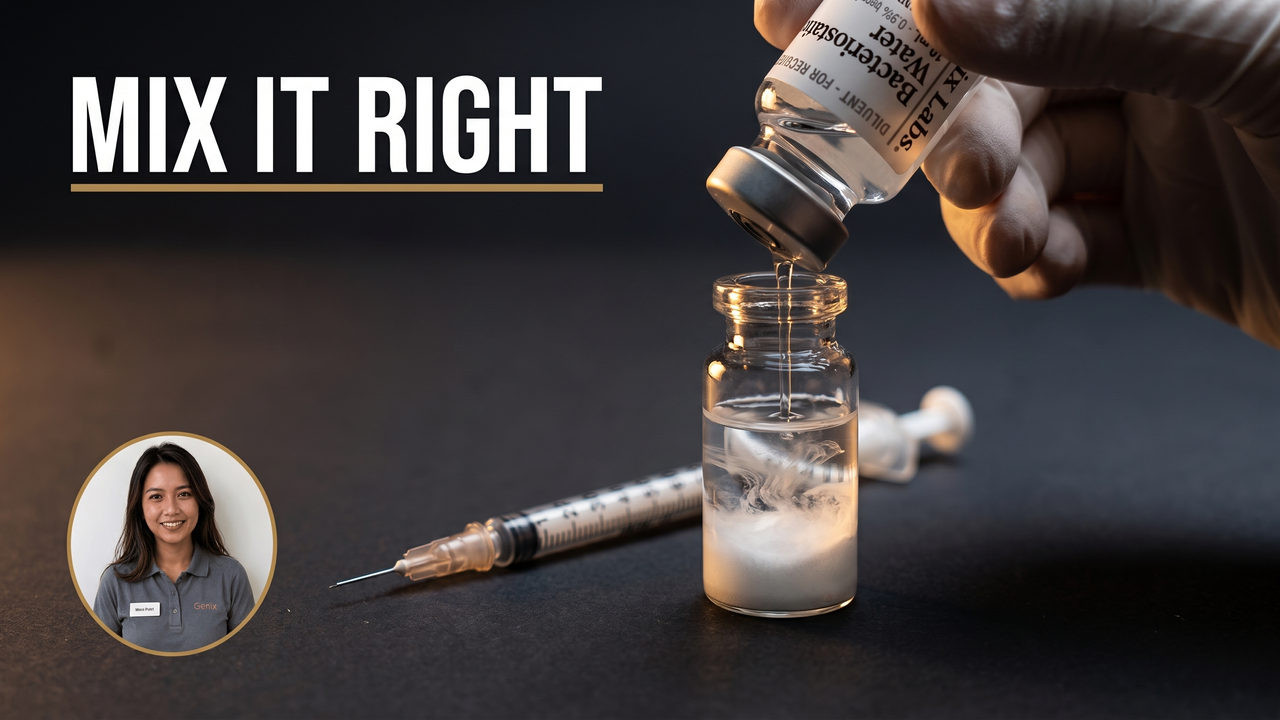
Reconstitution means adding liquid to a dry powder so it can be measured. Epitalon ships as a lyophilised powder, which means freeze dried, because the dry form survives transport and storage far better than a solution would. Bacteriostatic water, water containing a preservative, is the standard diluent in the research literature.
One rule covers every reconstitution question ever asked: the water sets the concentration, never the amount. A 10mg vial holds 10mg whether you add one millilitre or five. What changes is how many milligrams sit in each millilitre, and therefore where a given amount lands on the syringe.
Worked through once, with the published 0.5mg sublingual amount as the reference point. Add 2ml of water to a 10mg vial and the vial now reads 5mg per millilitre. Half a milligram is therefore one tenth of a millilitre. On a 100 unit insulin syringe, where the whole barrel is 1ml, one tenth is 10 units. Add 1ml instead and the same 0.5mg sits at 5 units.
Larger water volumes make small amounts easier to read, which is why they suit a compound whose published amounts are this small. The tradeoff is that more diluted solution means more liquid to store cold. The full method, including which water to use and why, is in how to reconstitute peptides.
Is there an epitalon dosage calculator?
Several exist, and the arithmetic they do is correct. They take vial strength, water volume and a target amount, then return syringe units. That calculation is simple division and no calculator gets it wrong.
The problem sits one step earlier. A calculator cannot tell you what to type into the target field. It inherits whatever number you bring, and most people bring the chart figure. A precise conversion of an unverified input returns an unverified output with three decimal places and a false air of authority.
| Vial | Water added | Concentration | Where 0.5 mg lands |
|---|---|---|---|
| 10 mg | 1 ml | 10 mg per ml | 5 units |
| 10 mg | 2 ml | 5 mg per ml | 10 units |
| 10 mg | 5 ml | 2 mg per ml | 25 units |
| 50 mg | 5 ml | 10 mg per ml | 5 units |
That table is the whole calculator for the published amount. If you want a different target, divide the target by the concentration to get millilitres, then multiply by 100 to get insulin syringe units. Two operations, no app required.
What about 50mg and 100mg epitalon vials?
Large vials are a packaging decision, not a protocol. No published study used a 50mg or 100mg vial, because studies measure amounts, not containers. A bigger vial yields more measurements from one piece of glass. It does not imply a bigger amount per measurement.
Reconstituted sensibly, a 50mg vial with 5ml of water reads 10mg per millilitre, exactly the same concentration as a 10mg vial with 1ml. The arithmetic is identical. The practical difference is time: a large vial sits reconstituted in the fridge for longer, and peptide solutions degrade with time, temperature and light.
That is the real argument against oversized glass for a compound with published amounts this small. At 0.5mg a day, a 50mg vial represents a hundred measurements. It will degrade long before it empties. Our catalogue lists epithalon at 10mg for exactly that reason, and the cold chain exists to protect the window after it is mixed.
- No study has ever specified a vial size. Studies specify amounts.
- A 50mg vial in 5ml is the same concentration as a 10mg vial in 1ml.
- Bigger vials mean longer storage after mixing, and more degradation risk.
- Match vial size to how fast the material is actually used, not to price per milligram.
Is there an epitalon dosage for bodybuilding?
No. This is worth saying flatly because the search term exists and the pages answering it do not disclose how little stands behind them. No epitalon study has measured muscle mass, strength, body composition, training volume or recovery in humans. Not one.
The measured endpoints are telomerase activity in cultured cells, telomere length, melatonin output, circadian gene expression, retinal function, and lifespan in mice, rats and fruit flies. None of those is a performance outcome. Any bodybuilding figure online was invented by analogy, usually by reasoning that better sleep helps recovery, which is true in general and still not a study of this peptide.
If the underlying interest is recovery, the research literature on that sits elsewhere, with the repair peptides rather than the pineal ones. That is a different pillar of this site and a different evidence base.
What are the side effects and safety limits?
The reported safety record is clean and thin at the same time, and both halves matter. In the 162 patient retinal study, none of the treated patients reported side effects. Rat work found no nephrotoxicity, meaning no kidney damage. A single dose genotoxicity assessment at 5 micrograms per kilogram raised no flag, and lifespan work in fruit flies found no sign of genetic harm.
Against that, the 2025 review states its own limitation without hedging: information about this peptide's safety is missing, and studies on short and long term toxicity are essential before it could be considered as an active ingredient. A clean record from two small studies is not the same as a safety profile.
One mechanism-level caution appears repeatedly in the literature. Telomerase is the enzyme epitalon is studied for switching on, and telomerase activity is also one of the things that lets cancer cells keep dividing. The research treats active or suspected malignancy as a hard exclusion for that reason. This is a reason the compound stays in laboratory research, not a reason to self-assess.
What the safety record does not cover
Reading what is absent from an evidence file is as useful as reading what is in it. For epitalon, four gaps stand out, and each one limits how far any dose figure can travel.
- No pharmacokinetics. The review reports no half-life, no bioavailability, no absorption data.
- No long term toxicity. Short and long term toxicity studies are named as still required.
- No injected human data. Neither human study used intramuscular or subcutaneous injection.
- No dose ranging. Nobody has tested several amounts against each other to find where effects begin.
That last gap is the one that makes every chart suspect. Dose ranging is the study type that produces a dosing recommendation. Without it, any figure, including the small published ones, is a point someone tried rather than an amount someone optimised.
The missing pharmacokinetics compound it. Without a half-life you cannot reason about once daily against twice daily, or about whether a 10 day course accumulates. The literature notes that short peptides degrade rapidly in the body, which is a direction, not a number.
What should a research log actually record?
A protocol nobody measures produces no information, only expense. Where the published endpoints are sleep and rhythm, a log that captures those endpoints is the difference between a record and a guess. This is the section no competing page carries, and it costs nothing to implement.
| What to record | Why it matters | When |
|---|---|---|
| Lot number and vial strength | Ties every observation to a specific tested batch | At the start |
| Water volume and resulting concentration | Makes the amount reproducible later | At reconstitution |
| Date reconstituted | Degradation runs on the clock, not the schedule | At reconstitution |
| Time of day, consistently | The measured endpoint is a rhythm, so timing is a variable | Every administration |
| Sleep onset and wake time | The one human endpoint with a measured effect | Daily |
| Storage temperature | Solutions lose potency warm or lit | Weekly spot check |
Two details carry most of the value. Record time of day, because the published effect is a circadian one and an inconsistent clock makes the data uninterpretable. And record the date of reconstitution separately from the start date, because the material begins degrading when it meets water, not when the schedule begins.
Mistakes that waste an epitalon vial
Most wasted material in this category is lost before anything is measured, to handling rather than to protocol. These are the ones support sees most often.
- Confusing mcg with mg, which moves an amount by a factor of one thousand.
- Shaking the vial to dissolve the powder instead of letting the water run down the glass wall.
- Reconstituting a large vial that will then sit for months in the fridge losing potency.
- Using plain sterile water, which has no preservative, then storing it for weeks.
- Leaving a mixed vial on a warm counter or in daylight, which costs potency quietly.
The shaking one surprises people. Peptides are long fragile chains, and mechanical agitation can break them. Aim the water at the side of the glass, let it run down, then leave it to dissolve on its own. A clear solution with no visible particles is the result you want.
Storage is the other quiet loss. Dry powder is stable cold and dark. Once mixed, the clock starts. Our guidance on this is practical rather than theoretical, because every order from Bali ships cold chain and we would rather the material arrive intact than arrive fast.
Epitalon vs NAD+ and GHK-Cu for longevity work
These three sit in the same category and answer different questions. Comparing their evidence quality is more useful than comparing their claims, because their claims all sound similar and their files do not.
| Compound | Studied for | Human evidence | Published amounts |
|---|---|---|---|
| Epitalon | Telomerase, melatonin rhythm | Two small studies | 0.5 mg a day, sublingual |
| NAD+ | Cellular energy metabolism | Several small human trials | Varies widely by route |
| GHK-Cu | Skin remodelling, hair | Topical trials, mostly cosmetic | Concentration based, topical |
Epitalon has the most striking cell data and the least human data. NAD+ has more human work and a messier story about what the body does with it, which we take apart in NAD+ for energy and aging. GHK-Cu has the most consistent measured outcomes but in the narrowest domain.
None of them substitutes for another, and none of their amounts transfers to another. The wider map of this category, and how the compounds relate, is laid out on our longevity and anti-aging peptides hub.
What does an epitalon cycle cost?
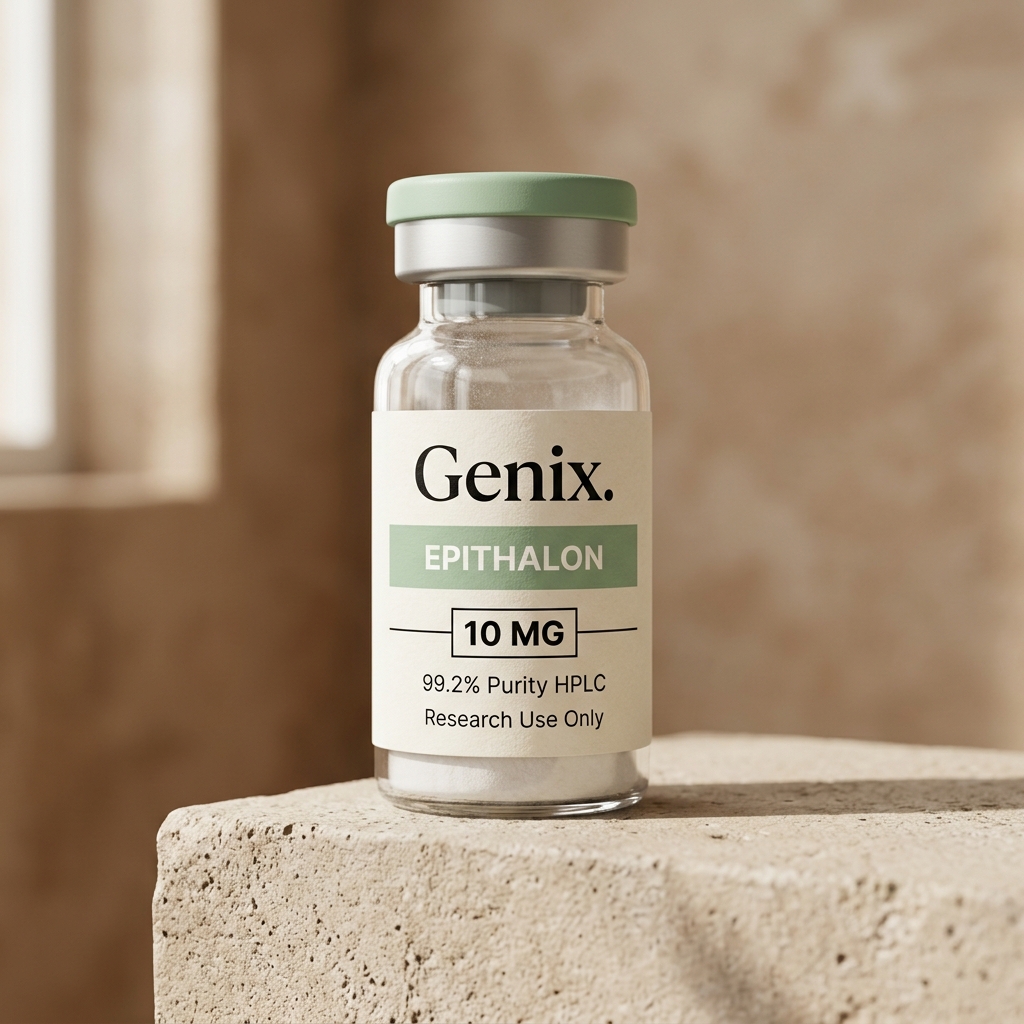
A Genix Labs epithalon vial is 10mg at USD 49, or Rp 850.000, with a batch certificate of analysis included. What a cycle costs then depends entirely on which of the three figures from earlier you are modelling, and the spread is dramatic.
| Protocol modelled | Amount per day | Days | Material needed | Approximate cost |
|---|---|---|---|---|
| Published sublingual study | 0.5 mg | 20 | 10 mg, one vial | USD 49 |
| Published retinal study | 0.005 mg per eye | 10 | Well under one vial | USD 49 |
| Circulating chart figure | 5 mg | 10 | 50 mg, five vials | USD 245 |
| Circulating chart figure, upper | 10 mg | 20 | 200 mg, twenty vials | USD 980 |
That bottom row is the cost of an unverified number. Twenty vials against one, for a figure whose first citation does not resolve to an epitalon study. We sell the vials, and we would still rather the arithmetic was done openly than quietly.
Pricing on lab-tested epithalon 10mg includes the batch report, cold-chain handling, same-day delivery in Bali, and cash on delivery. There is no bulk pricing trick that makes the top row cheaper, because the top row already costs one vial.
How do you know the epitalon is real?
Every dose argument on this page assumes the powder in the vial is what the label says. For a four amino acid peptide that assumption is not safe by default, because short peptides are cheap to imitate with inactive filler and nothing about the appearance of a white powder reveals the difference.
Two tests settle it. HPLC, high performance liquid chromatography, separates what is in the vial and reports purity as a percentage. LC-MS, liquid chromatography mass spectrometry, weighs the fragments and confirms the molecule is actually Ala-Glu-Asp-Gly and not something with a similar profile. Purity without identity is only half an answer.
- A lot number that matches the number printed on the vial in your hand.
- HPLC purity reported as a figure for that lot, not a brand-wide claim.
- LC-MS identity confirming the mass matches the tetrapeptide.
- A named ISO 17025 accredited laboratory, with a test date.
Purity figures are lot-specific results, not a guarantee attached to every size we sell. The honest version is to publish the report and let it be checked, which is why every Genix lot ships with its own.
Where to buy epitalon
Buy from a supplier that publishes a per-lot certificate you can match to the vial, ships cold, and states plainly that the material is for research use. Those three together filter out most of the market, and no price advantage compensates for missing any of them.
Genix Labs supplies epithalon 10mg for research use at USD 49 or Rp 850.000, with per-batch HPLC purity and LC-MS identity from an ISO 17025 accredited laboratory, cold-chain handling, same-day delivery across Bali, and cash on delivery. The batch report is published, not provided on request.
One closing note on sourcing. The cheapest vials in this category are usually cheap because nobody tested them, and an untested vial makes every number on this page irrelevant. The dose question only becomes interesting once the identity question is already answered.
Epitalon dosage FAQ
What is the epitalon dosage per day in the research?
The only human study with a daily amount used 0.5mg a day, taken sublingually for 20 days, in 75 women. The other human study gave 5 micrograms per eye by local injection for 10 days. Nothing larger than 0.5mg a day appears in a published epitalon trial. Research use only.
Is there an epitalon dosage calculator?
Calculators do not add data. They convert. You enter vial strength, water volume and target amount, and the tool returns syringe units. That math is reliable. The target amount you type in is the weak link, because no chart online traces its figure to a published epitalon trial.
What is the epitalon 10mg reconstitution and dosage?
A 10mg vial holds 10mg whatever you add. Adding 2ml of bacteriostatic water makes 5mg per millilitre, so 0.1ml is 0.5mg, the amount used in the sublingual study. Adding 1ml makes 10mg per millilitre instead. Water sets concentration, never the amount in the vial.
What is the epithalon 50mg dosage?
No published study used a 50mg vial. Large vials are a packaging choice, not a protocol. A 50mg vial reconstituted with 5ml gives 10mg per millilitre, the same concentration as a 10mg vial in 1ml. The vial size changes how many measurements it yields, not the amount per measurement.
Is there an epitalon dosage for bodybuilding?
No. No epitalon study measured muscle mass, strength, body composition or training recovery in humans. The research endpoints were telomerase activity in cell culture, melatonin rhythm, retinal function and lifespan in animals. Any bodybuilding figure online is invented, not measured.
How long is an epitalon cycle?
The Russian literature runs 10 day or 20 day courses, repeated one to three times a year. The retinal study dosed 10 consecutive days. The circadian study dosed 20. No published work tested continuous daily use for months, so long uninterrupted use has no evidence behind it either way.
The takeaway
Epitalon has a genuinely interesting cell biology file and a very small human one. Two studies, 0.5mg a day sublingually and 5 micrograms beside the eye, are the entire published human record. The 5 to 10mg figure that dominates search results belongs to epithalamin, the older extract, and travelled across to the peptide by name rather than by measurement.
That does not make the compound uninteresting. It makes the confident charts the weakest part of the topic. Short courses, small amounts, careful units, a verified vial and a log that records the endpoint the research actually measured. That is what the evidence supports, and it is a smaller and more honest answer than the one the first page of Google currently gives.
Everything here is a research overview of published literature. Epitalon is supplied strictly for in-vitro laboratory research, not for human or veterinary use, and nothing above is medical advice.