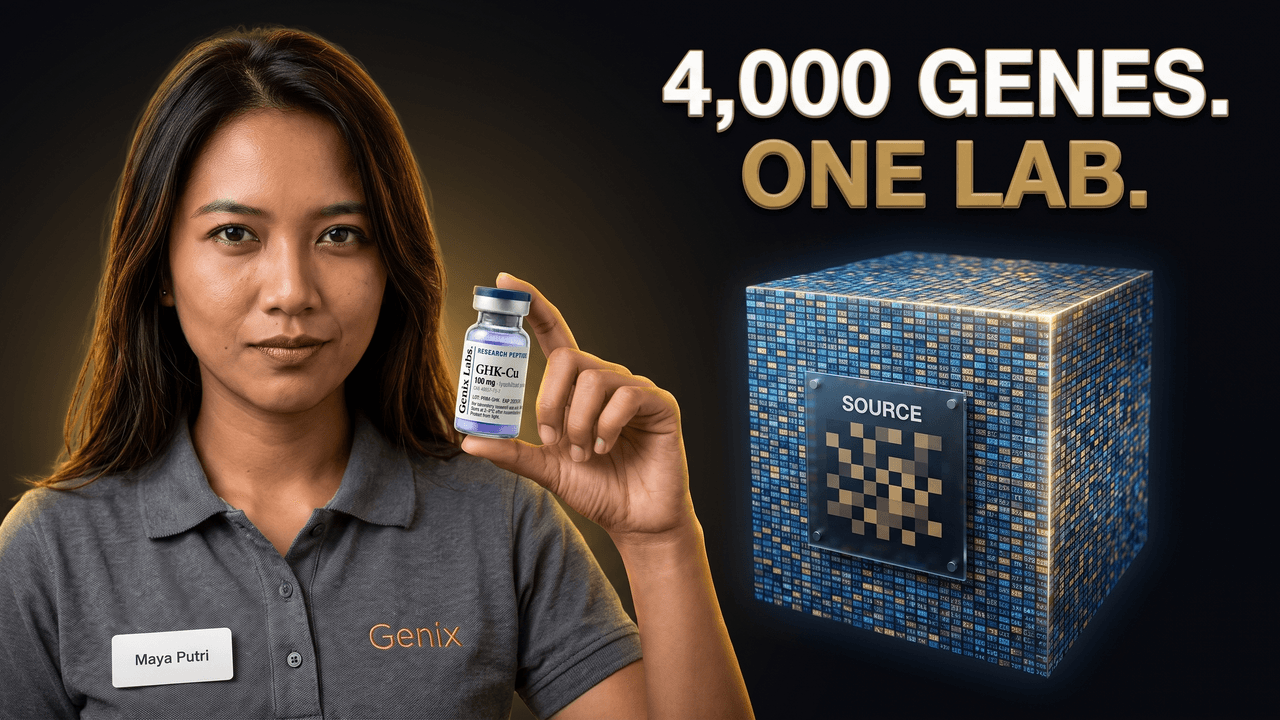
GHK-Cu is the rare anti-aging ingredient that is not borrowed from somewhere else. It is a three-amino-acid fragment your own blood already carries. Copper clips onto it. Together they appear to tell skin cells to start rebuilding. This guide covers what GHK-Cu is, what the research really supports, where the marketing runs far ahead of the data, and what a tested vial costs. Everything here is for research use only.
The quick answer
GHK-Cu is glycyl-L-histidyl-L-lysine bound to a copper ion. It weighs about 401.9 Da. It was found in human blood in 1973. In lab work it raises collagen, elastin and decorin, speeds wound repair, and shifts the activity of at least 4,000 human genes. The skin data is the strongest part of the file. The injected and oral routes are the weakest. It is sold for research use only.
What is GHK-Cu?
GHK-Cu is a copper peptide. Break the name in half and it stops being jargon. GHK is the peptide. Cu is copper, the metal it carries.
The peptide part is three amino acids in a row. Glycine, then histidine, then lysine. Written out, that is glycyl-L-histidyl-L-lysine. Three links is very short. Most peptides people talk about are ten times longer.
A peptide is just a short chain of amino acids. Amino acids are the beads that proteins are made from. Short chain, peptide. Long chain, protein.
GHK has a strong grip on copper. Put the two together in water and they lock into one unit. That unit is GHK-Cu. The copper is why the powder looks blue instead of white.
- GHK is three amino acids: glycine, histidine, lysine.
- Cu is copper(II), held tightly by the peptide.
- Together they form one complex of about 401.9 Da.
- Your plasma, saliva and urine all contain GHK already.
What is GHK-Cu peptide used for?
In research, GHK-Cu is used for three things. It is studied as a signal that tells skin cells to build fresh collagen and elastin. It is studied as a wound and tissue repair agent. And it is studied as an antioxidant that damps inflammation. Those are research uses, not promised outcomes.
Those three uses all come from the same root idea. GHK-Cu does not act like a filler. It does not add collagen to your skin. It acts like an instruction. The cell that makes collagen reads the instruction and gets back to work.
The 2018 review in the International Journal of Molecular Sciences lists a longer set of studied actions. Blood vessel growth. Nerve outgrowth. Repair in skin, lung, bone, liver and stomach lining. DNA repair. Cell cleanup through the proteasome. That is a wide list for one small molecule, and the width itself is worth being careful about.
Where did GHK-Cu come from?
The story starts with old liver tissue. In 1973, researchers were testing what in human blood made aged liver tissue behave like young tissue. They narrowed it down to an activity inside albumin, the most common protein in blood plasma.
That activity turned out to be a tiny three-amino-acid fragment. It was GHK. The finding is recorded in the 2012 review in Oxidative Medicine and Cellular Longevity.
This matters for how you read every GHK-Cu claim. GHK was not designed in a lab to sell skincare. It was found by asking why young tissue repairs better than old tissue. The commercial products came decades later.
Why does the copper matter?
Copper is not along for the ride. It is the working part. Your body uses copper as a cofactor, which means a helper that an enzyme cannot work without.
Three of those copper-dependent enzymes matter here. Lysyl oxidase locks collagen and elastin fibres together, which is what makes skin springy. Superoxide dismutase neutralises a common damaging molecule. Tyrosinase makes pigment.
Free copper on its own is a problem. It is reactive, and it can drive the exact oxidative damage you were trying to prevent. Bound copper is different. The peptide holds it, moves it, and hands it over in a controlled way.
That is the real argument for GHK-Cu over a copper supplement. Not more copper. Copper with a chaperone.
Why do GHK levels fall with age?
The 2015 review states it plainly. GHK is present in human plasma, saliva and urine, and it declines with age. Nobody has published a clean, independent age curve in a large population.
The proposed logic runs like this. Less GHK means less copper delivered to fibroblasts. Less copper delivered means slower matrix rebuilding. Slower rebuilding is what thinner, slacker, slower-healing skin actually is.
Treat that chain as a hypothesis with good support at each link, not as a proven cause of skin aging. Skin aging has many drivers. Sun exposure is still the largest one by a wide margin.
How does GHK-Cu work in skin?
The proposed mechanism has three steps. GHK-Cu reaches the dermis, the living layer under the surface. It delivers copper to fibroblasts, the cells that build skin structure. Those cells then change what they produce.
The interesting part is the third step. GHK-Cu does not simply push production up. The 2015 review reports that it stimulates both the making and the breaking down of collagen and glycosaminoglycans. It also modulates metalloproteinases and their inhibitors.
Why breaking things down is the point
Old, damaged, badly cross-linked collagen is not useful. Piling new fibres on top of it does not fix the texture. Remodelling means clearing the old and laying the new.
Metalloproteinases are the enzymes that clear old matrix. Their inhibitors hold them back. GHK-Cu is reported to adjust both sides. That is what remodelling looks like at the molecular level, and it is a more credible story than pure stimulation.
What does the gene data actually show?
This is where the marketing gets loud. The number you see everywhere is 4,000 genes. It comes from the 2015 review in BioMed Research International, which states GHK is capable of turning at least 4,000 human genes up or down.
The 2014 companion paper goes further. It describes GHK resetting gene patterns in diseased cells from cancer and COPD patients toward a healthier state. It lists effects on DNA repair, antioxidant systems, the proteasome, and the TGF-beta family.
Now the caveat that almost no article gives you. Affecting 4,000 genes is not automatically good news. It is a statement of scale, not of benefit. Any molecule that touches a third of the genome is doing many things at once, and not all of them will be things you wanted.
These results also came from cultured cells, matched against a gene-expression database. That is a legitimate screening method. It is not the same as a measured outcome in a person.
What does it do to collagen and elastin?
This is the best-supported part of the whole file. Across the reviews, GHK-Cu is reported to stimulate collagen, elastin, glycosaminoglycans, dermatan sulfate, chondroitin sulfate, and the small proteoglycan decorin.
Decorin is the one worth knowing. It is a small protein that sits on collagen fibres and controls how thick and orderly they grow. Skin with good decorin has neat, evenly sized fibres. That reads as smooth and firm.
There is one more finding in the 2015 review that deserves attention. GHK restored replicative vitality to fibroblasts after radiation therapy. Those are badly damaged cells. Getting them dividing again is a strong result.
- Collagen is the rope. It gives skin its tensile strength.
- Elastin is the elastic band. It lets skin snap back.
- Glycosaminoglycans hold water. They are why young skin looks plump.
- Decorin is the foreman. It keeps collagen fibres neat and evenly sized.
Does GHK-Cu help with pigmentation?
The 2015 review lists reduced hyperpigmentation among the effects observed with cosmetic GHK products. Hyperpigmentation means patches of skin that are darker than the skin around them. Sun spots and melasma are the common kinds.
Here is the part that should make you pause. Copper is a required cofactor for tyrosinase. And tyrosinase is the master enzyme that makes melanin, the pigment itself. So adding copper should, on paper, make pigment faster, not slower.
Resolving the contradiction
There are two reasonable explanations, and the literature does not firmly settle between them.
The first is that bound copper behaves differently from free copper. GHK holds the copper tightly and hands it to specific targets. It may never become available to tyrosinase in the way a loose copper ion would.
The second is that the pigment change is indirect. Faster cell turnover and matrix remodelling clear pigmented cells out faster. The pigment is not made less. It is cleared sooner.
Either way, treat GHK-Cu as a weak pigment agent at best. If pigment is the actual target, the molecules with real controlled human data are different ones. We cover the brightening evidence in the glutathione injection guide, including why the injected route there is also the weakest.
Are copper peptides good for your skin?
The skin evidence is the strongest part of the GHK-Cu file, and it is still mostly cosmetic-product data rather than independent trials. Reviews report improved elasticity, density and firmness, with softer fine lines and less photodamage. That is a real signal. It is not the same as a controlled clinical result.
The 2015 review is specific about what cosmetic products containing GHK were found to do. Tighten loose skin. Improve elasticity, skin density and firmness. Reduce fine lines and wrinkles. Reduce photodamage and hyperpigmentation. Increase keratinocyte proliferation.
Read that list carefully and you will notice what kind of evidence it is. These are observations from cosmetic use, summarised by reviewers. They are not pooled results from randomised controlled trials with blinding and a placebo arm.
So the honest answer is yes, with a qualifier. The direction of the evidence is positive and consistent. The quality of the evidence is moderate, not high.
What peptide will tighten loose skin?
GHK-Cu is the peptide with the most direct published claim here. The 2015 review reports that cosmetic products containing GHK were found to tighten loose skin and improve elasticity, density and firmness. No peptide replaces what a surgical or energy-based procedure does. The effect described is a gradual change in skin quality, not lifting.
It is worth separating two different problems. Skin that is thin and slack because the matrix has thinned is a matrix problem. Skin that is hanging because of volume loss or gravity is a structural problem. GHK-Cu research addresses the first one.
Other peptides get mentioned in this space. Palmitoyl pentapeptide, sold as Matrixyl, is the main one. It also signals collagen production. GHK-Cu is the one with the copper cofactor and the larger published literature behind it.
What about scars and stretch marks?
This question follows logically from the wound healing data, and the honest answer is that nobody has published a controlled human trial on it.
The reasoning people use is sound enough. A scar is disorganised collagen. Fibres laid down fast and in the wrong direction. If GHK-Cu genuinely adjusts both matrix building and matrix breakdown, remodelling a messy scar is exactly the kind of job it should suit.
Decorin strengthens that reasoning. Decorin is the protein that keeps collagen fibres neat and evenly sized, and scar tissue is low in it. GHK-Cu is reported to stimulate decorin production.
But reasoning is not evidence. The animal wound studies measured how fast wounds closed. They did not measure how good the resulting scar looked months later. Those are different endpoints, and only the first one was tested.
Does GHK-Cu do anything for hair?
The reviews include hair follicles in the list of tissues where GHK accelerated wound healing. Follicles are skin structures, so the same matrix logic applies to the scalp.
The evidence for hair is thinner than the evidence for skin, and the marketing is louder. We pulled that apart separately in copper peptides for hair loss, including what the before and after photos really show. If you are comparing options, the broader landscape is in peptides for hair loss.
What about wound healing and repair?
This is the oldest use in the literature and the one with the broadest animal support. The 2015 review reports accelerated wound healing in skin, hair follicles, the gastrointestinal tract, bone, and the foot pads of dogs. It reports systemic wound healing in rats, mice and pigs.
The mechanism described is not just building. GHK-Cu is reported to attract immune and endothelial cells to the site of an injury. Endothelial cells line blood vessels. Pulling them in means new blood supply, which is what a healing wound needs most.
Note the species list. Rats, mice, pigs, dogs. Pig skin is the closest common model to human skin, which makes that one useful. None of it is a human wound trial.
What about lung, bone and nerve research?
Most people meet GHK-Cu as a skincare ingredient. The literature is considerably wider than that, and the wider parts are worth knowing about even though they are further from anything practical.
The 2018 review lists tissue repair findings for skin, lung connective tissue, bone, liver and stomach lining. It describes lung protection and the restoration of fibroblasts taken from patients with chronic obstructive pulmonary disease. It reports blood vessel and nerve outgrowth.
It also lists effects that sound startling on a skincare page. Multiple anti-cancer activities in cell models. Suppression of NF-kappa-B, a master switch for inflammation. Activation of cell cleanup through the proteasome system. DNA repair.
How to hold that list
All of it is cell and animal work. None of it means GHK-Cu treats any disease, and we are not suggesting it does. The COPD finding, for example, is about how cultured fibroblasts from COPD patients behaved in a dish.
What the breadth does tell you is something about the molecule. A copper chaperone that touches thousands of genes will show up in many tissue models, because copper and matrix repair matter in many tissues. Breadth here is a sign of a general mechanism, not a sign of a miracle.
How strong is the evidence really?
Here is the thing almost no GHK-Cu article will tell you. Look at the author list on the four major reviews. Pickart. Vasquez-Soltero. Margolina. The same small group wrote nearly all of them.
Now look at the affiliation printed on those papers. Skin Biology, Research and Development Department, Bellevue, Washington. Skin Biology is a company that sells copper peptide products.
This does not make the science wrong. Loren Pickart co-discovered GHK, so of course he is the person who published most about it. Deep specialist knowledge and a commercial interest often sit in the same person.
But it does change how much weight one review should carry. Independent replication by unrelated labs is the thing that turns a promising molecule into an established one. For GHK-Cu, that independent layer is thin.
- Randomised, placebo-controlled human skin trials from unrelated labs.
- Published dose-response data, so concentration stops being guesswork.
- Long-term copper load measurements in people using it regularly.
- Any controlled human data at all on the injected route.
What the research does not show
A good guide is as clear about the gaps as the findings. These are the things GHK-Cu research has genuinely not established.
- No established human concentration. There is no published dose-response curve for topical GHK-Cu. Nobody can tell you what percentage is the effective one.
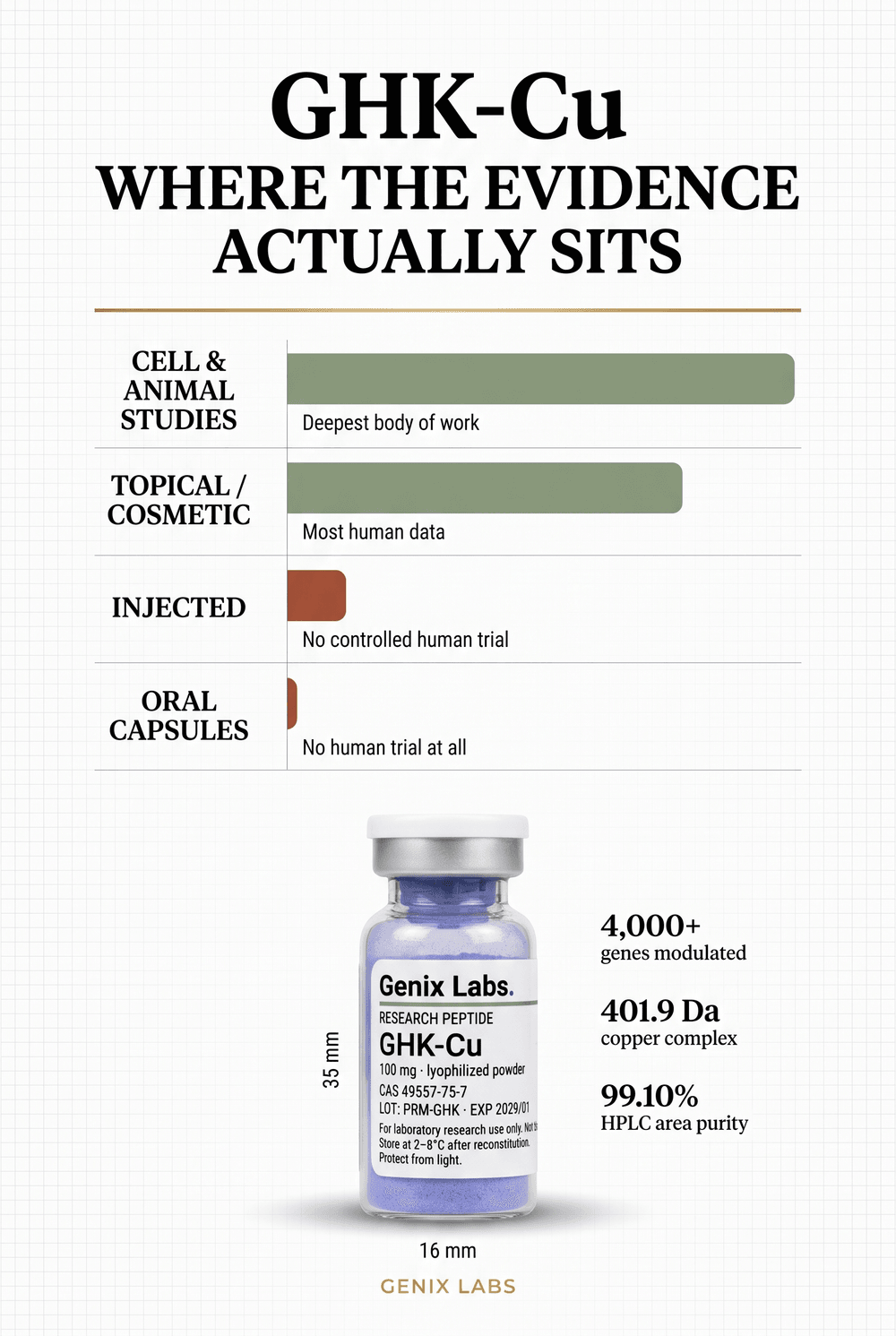
- No injected human schedule. Not one controlled trial has tested an injected protocol in people.
- No oral absorption data. No human study shows swallowed GHK-Cu arriving intact anywhere useful.
- No long-term copper safety data. Copper accumulates, and nobody has tracked copper load in regular long-term users.
- No head-to-head against retinoids. The obvious comparison trial has not been published.
- No independent large-scale skin trial. The human observations come from cosmetic use, summarised largely by one group.
None of those gaps make GHK-Cu useless. They do mean anyone quoting a precise protocol, a percentage, or a timeline is filling a blank the literature left empty.
Do oral GHK-Cu supplements work?
Search GHK-Cu and most of the top results are capsules. Oral copper peptide supplements, sold as collagen support. There is no human trial showing that swallowed GHK-Cu does what topical GHK-Cu was observed to do.
The reason is digestion. Your gut is built to take peptides apart. Protein-cutting enzymes in the stomach and small intestine break chains into single amino acids before absorption.
A three-amino-acid chain is a very easy target. What is likely absorbed is glycine, histidine, lysine and copper, separately. Those are ordinary nutrients. They are not a copper peptide signal arriving intact at a fibroblast.
Could some fraction survive? Small peptides do sometimes cross intact through specific transporters. The point is that nobody has published human data showing it happens with GHK-Cu at a level that does anything. Until that exists, an oral copper peptide capsule is an expensive way to buy three common amino acids.
Is it better than a copper supplement?
This is the fair challenge to the whole copper peptide idea. If copper is the working part, why not just take copper?
The answer is that your body already controls copper tightly, and it is very good at it. Copper absorption from the gut is regulated. Blood copper is carried bound to proteins, mostly ceruloplasmin. Free copper floating around is not a normal state.
So a copper supplement raises whole-body copper, slowly, within limits your gut sets. It does not deliver copper to a particular fibroblast at a particular moment. Most healthy people are not copper deficient in the first place.
The GHK-Cu argument is about targeting, not quantity. A peptide that carries copper and binds to specific sites is a delivery claim. That claim is well supported in cell work and much less tested in humans.
| Approach | What it changes | Targeting | Main risk |
|---|---|---|---|
| Copper supplement (oral) | Raises whole-body copper stores. | None. Systemic and slow. | Copper excess if overdone. Little benefit if not deficient. |
| GHK-Cu (topical) | Delivers bound copper into skin locally. | Local, at the site applied. | Local irritation. Formulation quality varies widely. |
| GHK-Cu (injected) | Unstudied in controlled human work. | Systemic, bypassing gut regulation. | Copper load, with no human safety data. |
| Oral GHK-Cu capsule | Likely digested to amino acids and copper. | None demonstrated. | Paying peptide prices for common nutrients. |
Why most copper peptide serums underdeliver
Topical is the route with the best evidence. It is also the route where product quality varies wildly. Three problems come up again and again.
The concentration is usually hidden
Most serums list copper peptides in the ingredients and never state how much. An ingredient listed near the bottom of the list can be present in trace amounts. Without a number, the label tells you nothing useful.
The pH has to be right
The copper is held by the peptide only within a certain pH range. Push the formula too acidic and the complex starts to come apart. Now you have free copper and a loose peptide, which is not the molecule the research studied.
The complex has to be stable in the bottle
Stability is a formulation job. Light, heat and certain preservatives all work against a copper complex. A serum that sat warm in a warehouse for a year is a different product from the one that was bottled.
This is the practical reason researchers work from a weighed lyophilised powder with a published lot report rather than a finished cosmetic. You know what you have, and you mix it fresh.
What makes a good copper peptide product?
People search for the best copper peptides for skin and get a ranked list of brands. A more useful answer is a set of things to check, because the brand names change every year and the chemistry does not.
- A stated concentration. A real number, not just the ingredient name on a list. If it is not stated, assume it is low.
- Opaque, air-limited packaging. Light and oxygen both work against a copper complex. A clear dropper bottle is a bad sign.
- A sensible pH, and no acid partners in the formula. Copper peptides and low-pH actives do not belong in one bottle.
- The blue or blue-green colour. The complex is coloured. A completely colourless copper peptide product is worth a question.
- For raw material, a lot-matched COA. With LC-MS identity, not purity alone.
The last point is the difference between a cosmetic and a research material. A finished serum asks you to trust the formulator. A weighed lyophilised powder with a published lot report lets you verify what you have before anything is mixed.
What shouldn't you mix with copper peptides?
Keep copper peptides away from direct vitamin C, strong AHA or BHA acids, and benzoyl peroxide in the same layer. Those are low-pH or strongly redox-active. They can strip copper off the peptide and break the complex apart. If you use both, separate them by time of day rather than layering them wet.
The chemistry behind that is simple enough. Ascorbic acid is a reducing agent. Copper(II) is an oxidising partner. Put them together in water and they react with each other instead of doing their separate jobs.
Acids work differently but end in the same place. Glycolic acid and salicylic acid need a low pH to function. That low pH is outside the window where the copper stays bound.
| Combination | What happens | Practical handling |
|---|---|---|
| Direct vitamin C (ascorbic acid) | Reducing agent meets copper(II). They react with each other. | Separate them. Different times of day. |
| Strong AHA or BHA acids | Low pH pulls the copper off the peptide. | Separate them. Let skin settle in between. |
| Benzoyl peroxide | Strong oxidiser, degrades the peptide. | Do not combine in the same layer. |
| Retinol | No direct chemical conflict reported. | Usually fine, though both can irritate. |
| Niacinamide, peptides, hyaluronic acid | No reported conflict. Similar pH range. | Generally compatible. |
| Bacteriostatic water (for reconstitution) | Standard diluent, no conflict. | See our reconstitution guide. |
One note on that last row. If you are reconstituting a lyophilised powder rather than using a finished serum, the mixing question is a different one. We cover it step by step in how to reconstitute peptides.
What are the negative side effects of GHK-Cu?
Topical copper peptides are usually well tolerated. Reported problems are local: redness, itching, stinging and occasional contact dermatitis in sensitive skin. The deeper concern is copper itself, because copper accumulates and the body has no fast way to dump an excess. Nobody has run a long human safety study on injected GHK-Cu.
The local reactions
These are the common ones and they are mild. Redness, itching, a stinging feeling on application. Some people get true contact dermatitis, which is an allergic skin reaction. A few notice a temporary blue or green tint, because the complex is coloured.
The copper question
This is the one that deserves real attention. Copper is an essential mineral, and it is also one your body regulates carefully. There is a normal range, and going above it is not better.
Excess copper is linked to nausea, headache and liver strain. People with Wilson disease cannot clear copper properly at all. For them, added copper in any form is a genuine hazard.
Route changes this risk completely. A serum on the surface of the skin delivers a tiny amount. An injected copper complex bypasses every barrier your body uses to control copper uptake. Those are not the same safety question, and they are often discussed as if they were.
What are the downsides of using copper peptides?
Four real ones. Most consumer serums never state their GHK-Cu concentration. The peptide is pH-sensitive, so formulation matters more than the label. Nearly all of the supporting literature comes from one commercially interested group. And copper loads up over time, which matters far more for injected use than topical.
There is a fifth that is less about the molecule and more about expectations. Matrix change is slow. The published cosmetic observations are measured over weeks and months, not days. Anyone expecting a visible result in a week will conclude it does not work.
- Unstated concentration. Most labels give you an ingredient name, not a dose.
- pH sensitivity. The complex only holds together in a narrow range.
- Single-source literature. Independent replication is thin.
- Copper accumulation. A real concern for any systemic route.
- Slow timelines. Weeks to months, not days.
Is it safe to inject GHK-Cu every day?
We do not give human dosing guidance, and no controlled human trial has ever set an injected GHK-Cu schedule. Every human finding in the literature comes from topical or cosmetic use. Daily injection of a copper complex is unstudied, and copper accumulates. Treat any daily injected protocol as unsupported by evidence.
It is worth being blunt about how large that gap is. The reviews that generate all the excitement describe cell cultures, animal wounds, and cosmetic creams. Not one of them establishes an injected human schedule.
So when a forum post quotes a daily injected amount with confidence, ask where the number came from. In practice it came from another forum post. There is no trial underneath it.
GHK-Cu versus other anti-aging actives
GHK-Cu is usually compared against three other ingredients. They work differently, and the evidence behind each is a different shape.
| Active | How it works | Evidence quality | Main limitation |
|---|---|---|---|
| GHK-Cu | Signals fibroblasts and delivers copper. Remodels matrix. | Broad cell and animal work. Cosmetic-product observations in humans. | Literature dominated by one commercially interested group. |
| Retinoids (retinol, tretinoin) | Speeds cell turnover, raises collagen through nuclear receptors. | Strongest of the four. Many independent controlled trials. | Irritation, peeling, sun sensitivity. |
| Vitamin C (ascorbic acid) | Antioxidant, and a required cofactor for collagen synthesis. | Good, with independent human data. | Unstable in formula. Conflicts with copper peptides. |
| Matrixyl (palmitoyl pentapeptide) | Signal peptide. Mimics a collagen breakdown fragment. | Moderate. Mostly manufacturer-sponsored studies. | No copper cofactor. Smaller literature. |
If you want the honest ranking by evidence strength alone, retinoids win. GHK-Cu is interesting for a different reason. It is the only one of the four that is a native human molecule with a metal cofactor, and the only one with a published gene-level dataset behind it.
How to read a GHK-Cu certificate of analysis
A certificate of analysis, or COA, is the lab document that says what is actually in the vial. For a copper peptide, four lines matter.
- Identity by LC-MS. Mass spectrometry should confirm a mass near 401.9 Da. This proves it is the right molecule, not just something of the right purity.
- Purity by HPLC. Reported as area percent. Look for a real number and a real chromatogram, not a rounded marketing figure.
- The lot number. A COA describes one batch. It must match the number printed on the vial you are holding.
- The tested size. A result for a 100mg fill does not transfer to a different fill size.
Our current published GHK-Cu lot is 830472, tested at 100mg, with HPLC area purity of 99.10% and LC-MS identity confirmed. Testing runs through an ISO 17025 accredited laboratory. The report is linked from the GHK-Cu product page so you can check it before buying, not after.
Why HPLC area percent is not content
This trips up almost everybody, so it is worth being precise. A 99.10% HPLC area result does not mean the vial contains 99.10% GHK-Cu by weight.
HPLC separates what is in a sample and measures the area under each peak. Area percent tells you how much of the detected material is your target molecule. It is a measure of relative purity among things the detector can see.
Content, sometimes called assay, is a different test. It answers how many milligrams are in the vial. That requires a quantitative method against a reference standard.
So read a purity figure for what it is. It is a strong signal that the synthesis was clean. It is not a statement about fill weight, sterility, safety or effect. Any vendor implying otherwise is overselling a real number.
How should GHK-Cu be stored?
Sealed lyophilised powder is the stable form. Keep it cold and away from light and it holds for months. Once reconstituted, it belongs in a fridge at 2 to 8 degrees Celsius and should be used within about 30 days.
Copper complexes have one extra weakness worth knowing. Light and heat both push the complex toward falling apart. A clear vial left on a warm bench is the worst case. Cold and dark is not fussiness here, it is the whole job.
Tropical climates make this harder, and Bali is about as tropical as it gets. Our full handling notes for hot, humid conditions are in how to store peptides in Bali.
What should the powder look like?
This is a practical check almost nobody writes about, and it is genuinely useful for a copper peptide specifically.
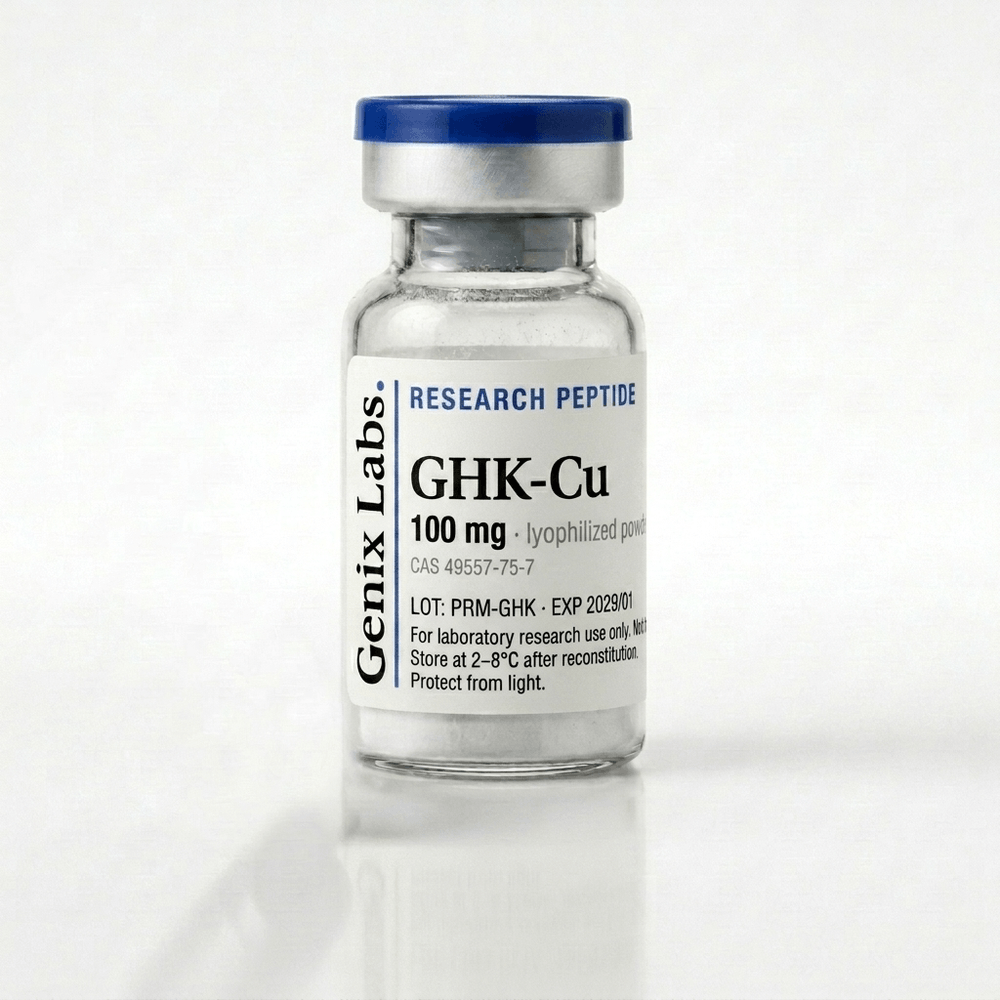
GHK-Cu powder is coloured. It runs from light blue to a deeper blue-violet, because copper(II) complexes absorb light in the visible range. That colour is the copper doing what copper does.
A pure white powder sold as GHK-Cu deserves a question. White suggests free GHK peptide without the copper bound, which is a different molecule from the one the research studied. This is exactly the failure that an LC-MS identity line catches and an HPLC purity line does not.
Colour is a screening signal, not a test. Fill weight, shade and lighting all affect what you see, and a good-looking powder can still be wrong. Read the lot report. The colour check is just the five-second version you can do while holding the vial.
What does GHK-Cu cost?
A Genix Labs GHK-Cu vial is 100mg at $69, or Rp 1.090.000. That is a larger fill than most research peptides, because GHK-Cu work is typically done at higher weights than a GLP-1 or a nootropic peptide.
Compare that to the supplement aisle carefully. An oral copper peptide capsule bottle often costs a similar amount, for a route with no human trial behind it at all. Price per milligram is a misleading comparison when one route has evidence and the other does not.
- 100mg vial, lyophilised powder, $69 or Rp 1.090.000.
- Published lot report with HPLC area purity and LC-MS identity.
- Cold-chain packed, tracked, same-day dispatch on orders before 9 PM.
- Same-day delivery in Bali, often within 2 hours, cash on delivery available.
Full specifications, the current lot report, and Indonesian pricing are on the GHK-Cu catalog page.
Mistakes that waste a vial
- Layering it with vitamin C or acids. The complex comes apart. You paid for copper peptide and got free copper.
- Judging it in a week. Matrix remodelling is measured in weeks and months.
- Leaving it warm or in the light. Both degrade a copper complex faster than people expect.
- Buying without a lot-matched COA. A generic certificate with no lot number describes nothing you own.
- Reading area percent as content. Purity and fill weight are separate tests.
- Assuming oral works like topical. The gut takes three-amino-acid chains apart.
Who is this research for?
GHK-Cu is supplied for in-vitro laboratory research. In practice, the people reading a page like this fall into a few groups.
Researchers working on skin models, fibroblast behaviour, wound repair or copper biology. People evaluating the gap between the gene-level claims and the human evidence. And people who read the Amazon listings, felt something was off, and wanted the actual literature.
If you came here from the last group, the single most useful thing on this page is the evidence chart. The loudest marketing sits on the routes with the least data. That pattern is worth remembering beyond copper peptides.
For the wider category, including how GHK-Cu sits beside Epithalon and the other longevity compounds, start at the longevity and anti-aging pillar.
Frequently asked questions
What is GHK-Cu peptide used for?
In research, GHK-Cu is used for three things. It is studied as a signal that tells skin cells to build fresh collagen and elastin. It is studied as a wound and tissue repair agent. And it is studied as an antioxidant that damps inflammation. Those are research uses, not promised outcomes. Research use only.
Are copper peptides good for your skin?
The skin evidence is the strongest part of the GHK-Cu file, and it is still mostly cosmetic-product data rather than independent trials. Reviews report improved elasticity, density and firmness, with softer fine lines and less photodamage. That is a real signal. It is not the same as a controlled clinical result.
What are the negative side effects of GHK-Cu?
Topical copper peptides are usually well tolerated. Reported problems are local: redness, itching, stinging and occasional contact dermatitis in sensitive skin. The deeper concern is copper itself, because copper accumulates and the body has no fast way to dump an excess. Nobody has run a long human safety study on injected GHK-Cu.
What are the downsides of using copper peptides?
Four real ones. Most consumer serums never state their GHK-Cu concentration. The peptide is pH-sensitive, so formulation matters more than the label. Nearly all of the supporting literature comes from one commercially interested group. And copper loads up over time, which matters far more for injected use than topical.
What shouldn't you mix with copper peptides?
Keep copper peptides away from direct vitamin C, strong AHA or BHA acids, and benzoyl peroxide in the same layer. Those are low-pH or strongly redox-active. They can strip copper off the peptide and break the complex apart. If you use both, separate them by time of day rather than layering them wet.
Is it safe to inject GHK-Cu everyday?
We do not give human dosing guidance, and no controlled human trial has ever set an injected GHK-Cu schedule. Every human finding in the literature comes from topical or cosmetic use. Daily injection of a copper complex is unstudied, and copper accumulates. Treat any daily injected protocol as unsupported by evidence.
Takeaway
GHK-Cu is one of the more genuinely interesting molecules in this category. It is native to human blood. It was found by asking a good question about why young tissue repairs better. The collagen and matrix work behind it is real, and the gene-level dataset is unusual for a cosmetic ingredient.
It is also a molecule whose literature is thinner than it looks. Four reviews from one group with a commercial stake is not the same as independent replication. The topical route carries the human evidence. The injected route carries almost none, and the oral route carries none at all.
So hold both halves. A promising, well-characterised repair signal, and a marketing story that has run well ahead of the trials. Check the lot report, read the identity line first, and treat every protocol you find online as unverified.
Every Genix Labs compound, including GHK-Cu 100mg, is supplied strictly for in-vitro laboratory research. It is not for human or veterinary use, and nothing on this page is medical advice.