An NAD+ injection puts the finished coenzyme straight into the body. No pill, no gut, no liver conversion. That sounds like it should settle the argument. Then you read the only human study of infused NAD+, and the plasma level does not move for two hours. This guide covers where it went, how the four routes really compare, what the research supports, what it does not, and what a tested 1,000mg vial actually costs. Everything here is for research use only.
The quick answer
An NAD+ injection delivers nicotinamide adenine dinucleotide directly, by vein or under the skin. It skips digestion, so none of the dose is lost in the gut. In the one human infusion study, plasma NAD+ did not rise for two hours. The body pulled it out of circulation that fast. NAD+ is studied for cellular energy, repair and aging. It is supplied for research use only.
What is an NAD+ injection?
An NAD+ injection is a shot of the finished coenzyme. The powder is mixed with sterile water. The liquid then goes into a vein, under the skin, or into muscle. Nothing has to be converted first. That is the whole point of the route.
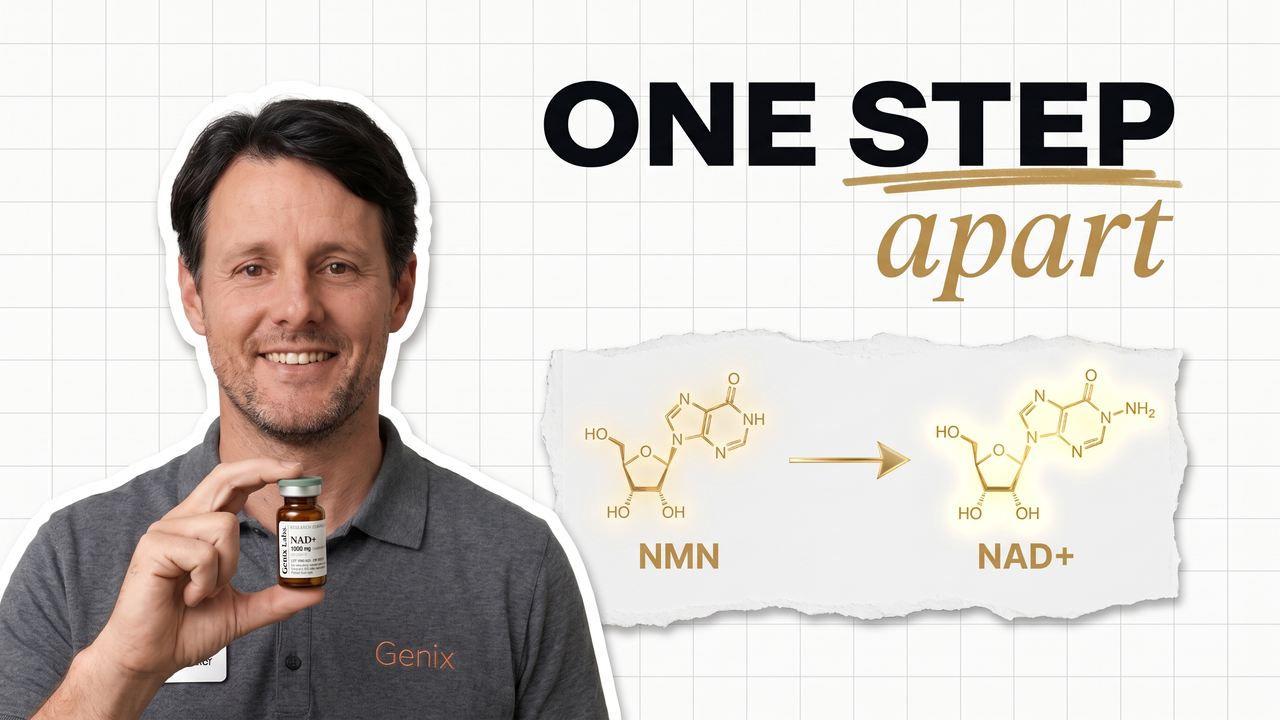
Compare that with a pill. A pill of NMN or NR is a precursor. Your cells have to build NAD+ out of it. The injection hands over the finished molecule instead. New to the topic? Start at the hub, Longevity and Anti-Aging Peptides.
- Full name: beta-nicotinamide adenine dinucleotide.
- CAS number 53-84-9, molecular weight about 663 daltons.
- Found in every living cell, plant and animal.
- Supplied as a lyophilized powder, mixed before use.
- Studied for energy metabolism, DNA repair and aging. Research use only.
What is NAD+ itself?
NAD+ is a coenzyme. A coenzyme is a helper molecule. Enzymes cannot do their job without one. NAD+ is the helper that carries electrons around inside a cell.
Think of it as a shuttle bus. It picks up electrons from the food you break down. It drops them at the mitochondria, the tiny engines in each cell. Those engines turn that cargo into usable energy. Then the shuttle goes back for more.
NAD+ does a second job too. It is the fuel for a family of repair enzymes. Sirtuins use it. PARPs use it. Both of those spend NAD+ to fix DNA and tidy up proteins. So the same molecule pays for energy and for maintenance.
Here is the part most articles skip. Your cells do not keep a tank of NAD+. They recycle the same small pool over and over. That loop is called the salvage pathway.
Follow the loop and the numbers make sense. NAD+ gets cleaved into nicotinamide. An enzyme called NAMPT turns nicotinamide back into NMN. Another enzyme called NMNAT finishes the job. The pool is small. The turnover is enormous.
Why do NAD+ levels fall with age?
Measured NAD+ does drop as people get older. A 2012 study measured human tissue across a wide age range. NAD+ fell with age, and markers of oxidative damage rose alongside it. That paper is one of the few that looked at real human samples rather than mice.
Reviews point to two reasons at once. Production slows, and consumption speeds up. Both push the same direction.
| What changes with age | Which side of the ledger | Why it matters |
|---|---|---|
| NAMPT activity falls | Less made | The salvage loop refills the pool more slowly |
| CD38 activity rises | More spent | An immune enzyme that chews through NAD+ and its precursors |
| Chronic inflammation | More spent | Keeps CD38 and other consumers switched on |
| Accumulated DNA damage | More spent | PARP enzymes burn NAD+ every time they repair a break |
| Less physical activity | Less made | Exercise is one of the few things shown to lift NAD+ turnover |
So the decline is not one broken part. It is a slow squeeze from both ends. That is also why a single injection is unlikely to reset anything on its own.
Why is NAD+ a target for cellular aging?
Aging research keeps landing on the same handful of hallmarks. Mitochondria work less cleanly. DNA damage piles up. Cells stop dividing and start leaking inflammatory signals. Repair systems run short of resources.
NAD+ sits underneath all four. The energy chain needs it. The repair enzymes spend it. The sirtuins that help regulate stress responses cannot act without it. Restore the molecule and in theory you restore the budget those systems draw on.
That is the logic. It is a good hypothesis, and it is still a hypothesis in humans. The gap between a clean mechanism and a measured human outcome is the whole story of this field.
What are NAD+ injections good for?
In research settings, NAD+ is studied for four things. Cellular energy production. DNA and tissue repair. Brain and nerve function. And the broad bucket of healthy aging. Those are research directions, not promises, and this is research use only.
| Studied area | What has been measured | Strength of the human evidence |
|---|---|---|
| Raising blood NAD+ | Precursors clearly raise whole blood NAD+ | Good. Controlled trials exist for NR |
| Energy and fatigue | Mostly self reported, small groups, often open label | Weak. Easy to confuse with placebo |
| Cognition and brain fog | Early, small, mixed results | Weak |
| Metabolic markers | Mixed. Some insulin sensitivity signals in subgroups | Early |
| Skin aging | Lab and tissue work, plus one dermatology review | Preclinical mostly |
| Neurodegeneration | Animal data strong, human data early | Preclinical mostly |
Notice the shape of that table. The further you move from a blood test and toward how someone feels, the thinner the evidence gets. That pattern is not unique to NAD+. It is just unusually stark here.
What does the human data actually show?
Split the human file into two piles. One pile is about precursors. The other is about infused NAD+ itself. They are not the same evidence, and they get mixed up constantly.
The precursor pile
This pile is the stronger one. A 2018 trial gave nicotinamide riboside to healthy middle aged and older adults for six weeks. It was well tolerated. Whole blood NAD+ rose by roughly 60%. That is a clean, repeatable, measurable result.
What that trial did not show was a dramatic change in how people performed or felt. Blood chemistry moved. Outcomes mostly did not. We cover the precursor comparison in depth in NAD+ versus NMN.
The infused NAD+ pile
This pile is almost empty. In 2019, a research group in Australia ran the first human study of directly infused NAD+. They tracked plasma and urine through a six hour intravenous infusion. It was a pilot study with a small group.
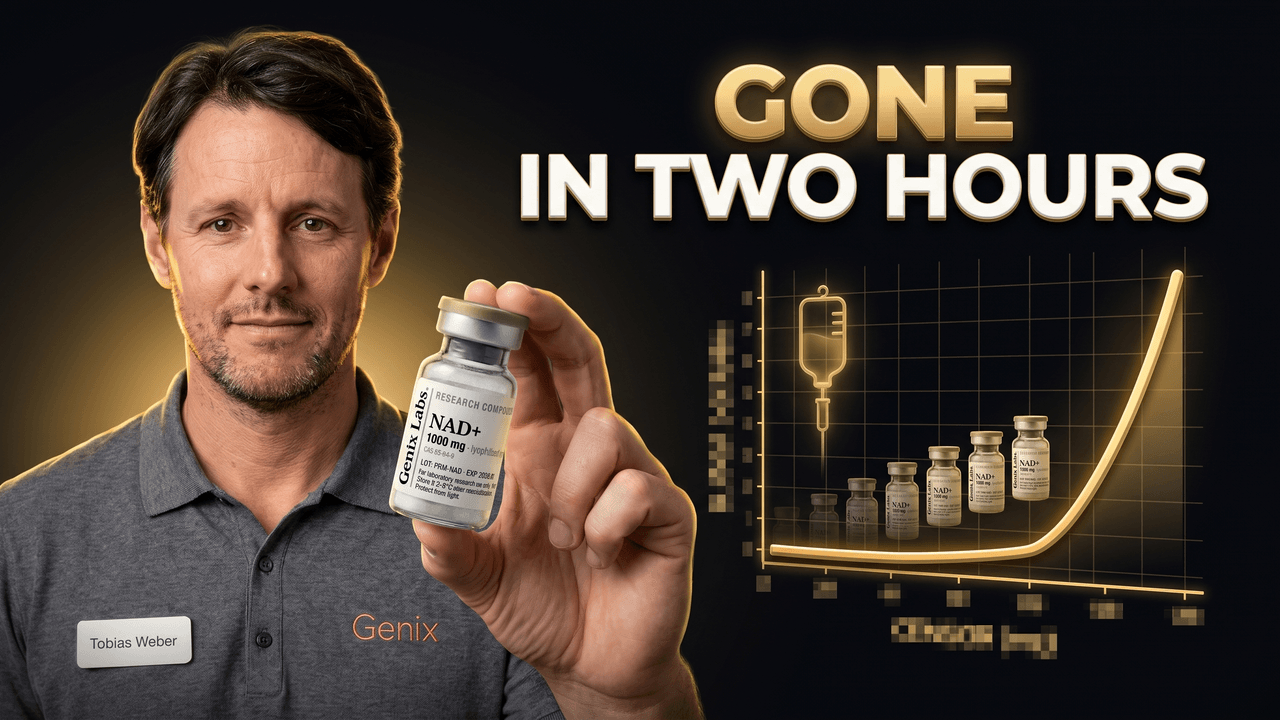
The result surprised the authors, and they said so in print. Nothing moved for two hours.
The two hour gap nobody explains
Here is the finding in plain words. The drip ran at 3 micromoles per minute. For the first two hours, plasma NAD+ did not rise. Neither did nicotinamide, methylnicotinamide, ADP ribose or NMN. The infused molecule was being cleared from the blood as fast as it arrived.
After two hours, metabolites began to appear. By six hours, the urine carried NAD+ itself and methylnicotinamide. Interestingly, urinary nicotinamide did not rise much. The metabolite pattern fitted enzymes that cleave NAD+ apart rather than absorb it whole.
Now do the arithmetic the study implies. Three micromoles per minute, for 360 minutes, is 1,080 micromoles. At about 663 daltons, that is roughly 0.7 grams of NAD+ in total. Six hours of drip for about two thirds of a gram.
One pilot study does not settle a field. But it is the only direct human measurement of this route, and it points somewhere uncomfortable. The finished coenzyme does not simply pool in the blood waiting to be used.
What that 2019 study did not do
We lean on one pilot study a lot in this article, so it is only fair to state its limits plainly. Five of them matter.
- It was a pilot, with a small group. Small groups find big effects and miss small ones.
- It tested one infusion rate. A different rate could produce a completely different curve.
- It measured plasma and urine. It did not measure whole blood, where most NAD+ actually sits.
- It measured molecules, not outcomes. Nobody tracked energy, cognition or anything a buyer cares about.
- It did not include a subcutaneous arm, so it tells us nothing direct about injections under the skin.
So the correct reading is narrow. We know that plasma NAD+ did not rise for two hours at one rate, in one small group. We do not know that NAD+ infusion does nothing.
That narrowness cuts both ways though. It is the only direct human measurement that exists for this route. Every confident claim about what an NAD+ drip does to your blood is built on less evidence than this one modest paper.
Why do I feel so good on NAD+?
People do report a lift, often sharply. Four plausible explanations exist, and they are not exclusive. Honest reading means holding all four at once.
- Real metabolic effect. Nicotinamide released from the infused NAD+ does reach cells and does feed the salvage loop.
- Context effect. An infusion is a long, quiet, attended hour or more. Rest alone changes how people feel.
- Contrast effect. The infusion itself can feel rough. Relief when it stops reads as a lift.
- Expectation. This is an expensive, highly anticipated intervention. That is textbook placebo territory.
None of that means the feeling is fake. It means the feeling is not a measurement. If you want to know whether NAD+ did something, feeling good is the weakest evidence available.
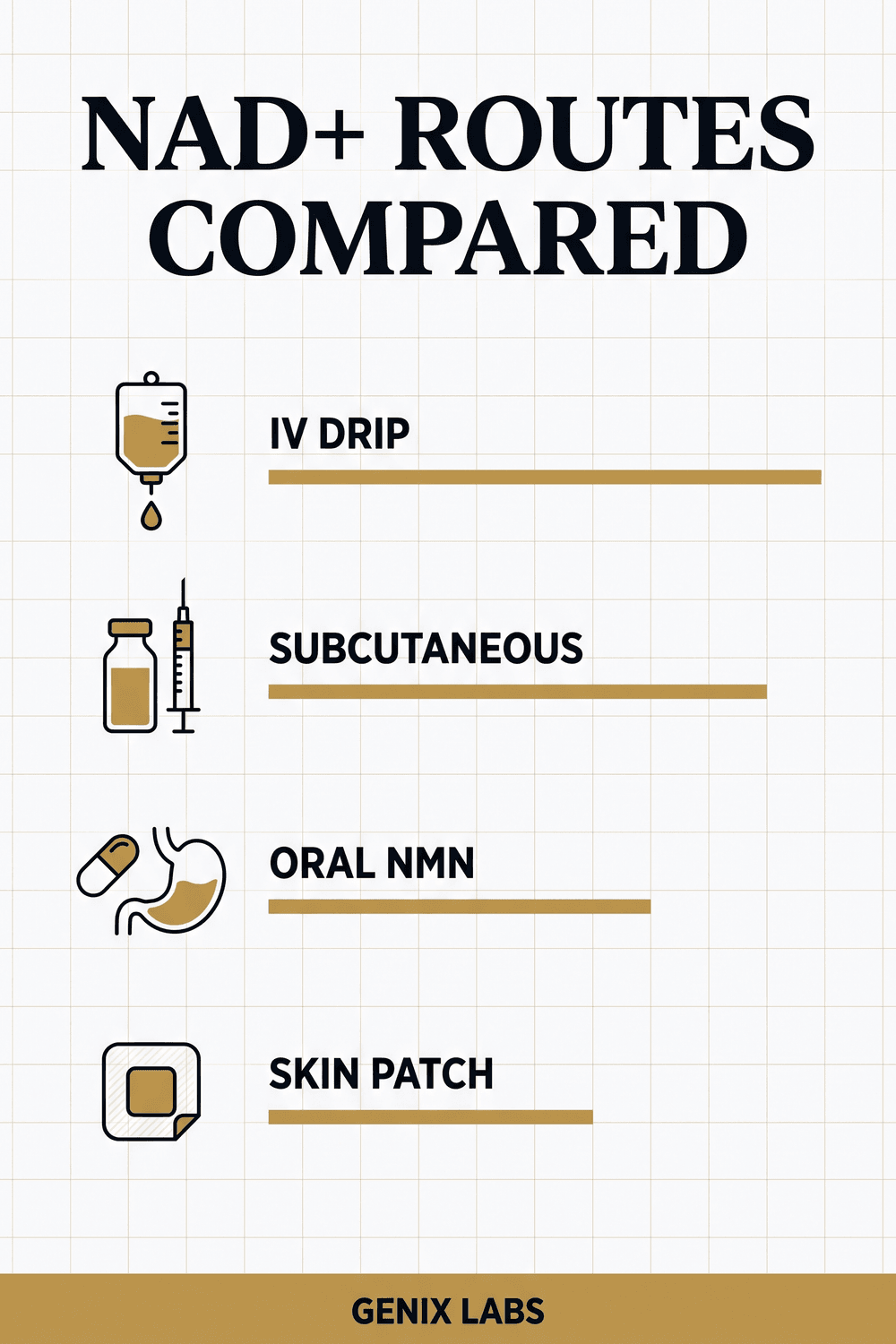
How do the delivery routes compare?
Four routes get used. Each one trades something away. There is no head to head human trial comparing them, so treat the ranking below as reasoning from pharmacology, not from a trial.
| Route | What it skips | What it costs you | Honest verdict |
|---|---|---|---|
| IV drip | The gut and the liver entirely | Hours in a chair, clinic pricing, the roughest side effects | The most studied route, and still only one pilot study |
| Subcutaneous injection | The gut and the liver | Self handling, sterile technique, small volumes | No human study of this exact route for NAD+ |
| Intramuscular injection | The gut and the liver | More discomfort, larger needle, no clear advantage | Rarely used for NAD+ and poorly studied |
| Oral NMN or NR | Nothing. It goes the long way | Conversion losses, but real trial data | Weakest on paper, strongest on actual trials |
| Patch or nasal spray | The gut | Very small amounts cross, concentrations rarely disclosed | Mostly a marketing format |
Read the last column twice. The route with the best human trial data is the one that looks worst on paper. That inversion is the single most useful thing to understand here.
How does an NAD+ IV drip work?
An NAD+ drip is a bag of saline with NAD+ dissolved in it. A line runs into a vein in the arm. The bag empties slowly, over anywhere from one hour to several.
The slow part is not optional. Run it quickly and most people feel it immediately. Chest tightness, nausea, cramping and flushing all get reported. Clinics manage this by slowing the drip rate until the sensation settles.
That rate limit is the hidden ceiling of the whole route. You cannot simply deliver more by turning the tap up. The 2019 pilot data suggests the body is already clearing it at full speed.
How does a subcutaneous injection differ?
Subcutaneous means under the skin, into the fat layer. The needle is short and fine. The volume is small, usually well under a millilitre.
The fat layer has fewer blood vessels than a vein does. So absorption is slower and more spread out. In theory that avoids the sharp spike that makes an infusion feel rough.
Be clear about the evidence though. There is no published human pharmacokinetic study of subcutaneous NAD+. The slow release logic is borrowed from other injectables. It is reasonable. It is not measured.
What about intramuscular NAD+?
Intramuscular means into the muscle, usually the shoulder or thigh. Muscle has a richer blood supply than fat. Absorption is faster than subcutaneous and slower than a vein.
It is uncommon for NAD+. The needle is longer and it stings more. It does not solve any problem that the other two routes leave open. For research purposes it adds discomfort without adding clarity.
Are oral NAD+ supplements effective?
Split that question in two, because the honest answers go in opposite directions.
Oral NAD+ itself
Swallowing NAD+ is close to pointless. It is a large, charged, fragile molecule. Stomach acid and gut enzymes break it apart before absorption. What gets through is mostly nicotinamide, which you could have taken directly for pennies.
Oral precursors
This is the opposite case. NR and NMN are small and stable enough to survive the trip. They are designed to be converted. And unlike injected NAD+, they have real controlled trials showing blood NAD+ going up.
So the sentence that sounds contradictory is actually the correct one. Oral NAD+ is a poor idea, and oral NAD+ precursors have the best human data in this entire topic.
NAD+ versus NMN and NR
NMN is nicotinamide mononucleotide. NR is nicotinamide riboside. Both sit one or two steps back from NAD+ on the salvage loop. Both are smaller and sturdier than the finished coenzyme.
| NAD+ injected | NMN oral | NR oral | |
|---|---|---|---|
| What you are giving | The finished coenzyme | One step back | Two steps back |
| Survives digestion | No, so it is injected | Largely yes | Yes |
| Controlled human trials | One pilot infusion study | Several small trials | Several, including six week trials |
| Blood NAD+ clearly raised | Not demonstrated in plasma | Yes in several studies | Yes, about 60% in one trial |
| Main weakness | Cleared almost immediately | Regulatory status keeps shifting | Benefit beyond the blood test unclear |
One row deserves a pause. Injected NAD+ is the only option here with no demonstrated plasma rise. It is also the most expensive and the most invasive. That combination should make anyone cautious.
Do NAD+ patches and nasal sprays work?
A patch has to push a 663 dalton charged molecule through skin. Skin is built to stop exactly that. Most molecules that cross well are small, oily and uncharged. NAD+ is none of those.
Nasal sprays have a slightly better case, because the nasal lining is thin and well supplied with blood. But the volume you can hold in a nostril is tiny. The arithmetic limits the dose before biology even gets a say.
The practical tell is disclosure. Patches and sprays rarely print how much NAD+ they contain, and almost never publish a lot report. When a format cannot show its own numbers, that is the answer.
What do NAD+, NADH, NMN and NR all mean?
This topic drowns in abbreviations. Most confusion online comes from two of them being swapped. Here is the whole alphabet in one place.
| Short name | Full name | What it is in one line |
|---|---|---|
| NAD+ | Nicotinamide adenine dinucleotide | The finished coenzyme, in its empty state, ready to collect electrons |
| NADH | The same molecule, loaded | NAD+ carrying the electrons it just picked up |
| NAM | Nicotinamide | What is left when NAD+ is cleaved. Also a form of vitamin B3 |
| NMN | Nicotinamide mononucleotide | One step before NAD+ on the salvage loop |
| NR | Nicotinamide riboside | One step before NMN. A form of vitamin B3 |
| NAMPT | An enzyme | Turns NAM into NMN. The slowest step, and it fades with age |
| NMNAT | An enzyme | Turns NMN into NAD+, finishing the loop |
| CD38 | An enzyme on cell surfaces | Consumes NAD+ and NMN. Rises with age and inflammation |
| PARP | A repair enzyme family | Spends NAD+ every time it patches damaged DNA |
| SARM1 | An enzyme in nerves | Destroys NAD+ when a nerve is injured, triggering degeneration |
| Sirtuins | A regulator family | Cannot act at all without NAD+. Linked to stress responses |
Keep two rules in mind and most marketing becomes readable. Anything ending in riboside or mononucleotide is a precursor. Anything called NAD+ is the finished molecule.
What is the difference between NAD+ and NADH?
They are the same molecule in two states. NAD+ is the empty shuttle. NADH is the loaded shuttle. Your cells flip between the two constantly.
What matters biologically is the ratio between them, not the absolute amount of either. A healthy cell keeps plenty of NAD+ free and available. When that ratio tips, the enzymes that need the empty form start to stall.
This is why some supplement labels sell NADH and some sell NAD+. They are selling the two ends of one seesaw. Neither one is the complete story, and neither label tells you the ratio inside a cell.
How is this different from a vitamin B3 supplement?
Honestly, less than you would expect. Nicotinamide is a form of vitamin B3. It is also the main thing NAD+ turns into once it is cleaved.
So the honest framing is a spectrum, not a wall. Niacin and nicotinamide sit at the cheap, well studied end. NR and NMN sit in the middle. Injected NAD+ sits at the expensive, least studied end.
The difference is in the entry point to the loop and in how fast each one gets there. Vendors who describe NAD+ as something categorically different from vitamin B3 are overselling the distance.
What do sirtuins and PARPs spend NAD+ on?
These two families are why NAD+ gets called a longevity molecule. Both of them burn it as fuel rather than using it as a catalyst. That distinction is important, because fuel runs out.
Sirtuins, the regulators
Sirtuins strip chemical tags off proteins, which changes what those proteins do. They help regulate stress responses, mitochondrial activity and how DNA is packaged. Every single action costs a molecule of NAD+.
If NAD+ runs low, sirtuins slow down. The genes they influence drift. This is the strongest mechanistic link between NAD+ levels and anything that looks like aging.
PARPs, the emergency crew
PARP enzymes respond to DNA breaks. They flag damage and recruit repair machinery. They are extremely useful and extremely expensive, because they consume NAD+ in large amounts.
So a day of heavy DNA damage, from sun or toxins or inflammation, is also a day of heavy NAD+ spending. Sirtuins and PARPs are effectively competing for the same budget.
What happens to NAD+ once it is in the blood?
This is the pharmacology the 2019 study pointed at, and it is worth spelling out, because it explains almost everything odd about this route.
NAD+ is a large, charged molecule. Cell membranes are built to keep exactly that kind of molecule out. So intact NAD+ does not simply drift into cells from the bloodstream.
Instead it meets enzymes sitting on the outside of cells. CD38 is one. NAD+ glycohydrolases and pyrophosphatases are others. They cut the molecule into smaller pieces at the cell surface.
Those smaller pieces, mainly nicotinamide and nicotinamide riboside, can cross the membrane. Once inside, the salvage loop rebuilds them into NAD+. So the dose arrives, but it arrives disassembled.
Read the 2019 metabolite pattern again with that in mind and it stops being surprising. The enzymes that showed up were cutting enzymes. The plasma stayed flat because the molecule was being taken apart at the kerb rather than carried inside whole.
How long does NAD+ last in the body?
Shorter than almost anyone expects. The 2019 infusion data points to very fast clearance from plasma, measured in minutes rather than hours.
Inside cells the picture is different but still fast. Different tissues turn their NAD+ pool over at different speeds, and some estimates put the whole pool turning over several times a day. The molecule is not stored. It is spent and rebuilt continuously.
Two consequences follow from that, and they are the practical ones. First, any single exposure is a short event, not a lasting change. Second, anything that measures NAD+ a long time after an exposure is measuring the salvage loop, not the thing you gave.
This is also why the marketing language of topping up a tank is wrong. There is no tank. There is a conveyor belt, and you briefly put more on it.
How often are NAD+ injections used in research?
Research designs usually follow one of two shapes. A loading phase, where exposure is frequent and close together. Then a maintenance phase, where it spaces out. The logic comes from the salvage loop, not from a trial result.
Here is why the loop matters. NAD+ turnover is fast. A single exposure cannot hold a level up for weeks. So designs that give one dose and measure a month later tend to find nothing, which tells you about the design rather than the molecule.
We will not print a human frequency here, because none has been established. If you see a confident weekly schedule online, ask which study it came from. The answer is usually a clinic blog quoting another clinic blog.
Why NAD+ dosage charts mislead
Search for a dosage chart and you will find plenty. Almost all of them share three problems.
- They convert milligrams into a human schedule that no trial ever tested.
- They ignore rate, which the 2019 infusion data suggests is the real limit.
- They copy each other. The same numbers appear across unrelated sites with no citation.
There is one calculation that is genuinely useful, and it is not a dose. It is concentration. When you add sterile water to a 1,000mg vial, you decide how many milligrams sit in each millilitre. That is laboratory arithmetic, and it has a right answer.
| Water added to a 1,000mg vial | Concentration | What each 0.1 mL holds |
|---|---|---|
| 2 mL | 500 mg per mL | 50 mg |
| 5 mL | 200 mg per mL | 20 mg |
| 10 mL | 100 mg per mL | 10 mg |
That table is maths, not medicine. It tells you what is in the vial, nothing more. The full method is in how to reconstitute peptides.
What did the animal research find?
The preclinical file is where the excitement comes from, and it is genuinely interesting. In aged mice, raising NAD+ improved mitochondrial function, muscle performance and insulin sensitivity. Some studies reported restored blood vessel function and better exercise capacity.
Nerve research is the strongest thread. NAD+ depletion drives axon degeneration through an enzyme called SARM1. Block that pathway and nerves survive injuries that would normally kill them. It is a clean, causal, repeatable mechanism.
Then comes the usual caution. Mice are not small humans. Rodent NAD+ metabolism is faster, the doses used are proportionally enormous, and aged lab mice are a very particular model. Striking mouse results have failed to carry over in this field before.
Does NAD+ do anything for skin aging?
Skin is a reasonable place to look. It divides often, it takes constant ultraviolet damage, and every repair event spends NAD+. A 2022 review in a plastic surgery journal gathered the regenerative medicine angle in one place.
What the evidence supports is a mechanism. Ultraviolet light activates PARP enzymes. PARPs consume NAD+ while repairing DNA. Keep NAD+ available and repair has more to work with.
What the evidence does not yet support is a visible outcome from injection. There is no controlled trial showing injected NAD+ changing wrinkle depth, elasticity or pigment. Topical niacinamide, which is a completely different molecule, has far more skin data behind it.
Can NAD+ make you look younger?
No controlled human trial has shown that. The honest answer has to start there.
What exists is mechanism plus anecdote. The mechanism is real, as described above. The anecdote comes from people who paid a lot, rested for several hours, and expected a change. Those are the exact conditions that produce confident reports without reliable evidence.
There is also a quiet confound in the before and after photos. Hydration, lighting and a few hours of rest change how skin reads on camera. That is not a trick. It is just not a durable result.
What about brain fog and focus?
The brain is the most NAD+ hungry organ you have, relative to its size. Neurons cannot store much energy and cannot stop working. So the idea that NAD+ affects mental clarity is not far fetched.
Human cognitive data is thin though. The studies are small, often open label, and typically rely on self reported scales. Those scales respond strongly to expectation, which is exactly the problem.
If you want our fuller treatment of the energy and clarity angle, it is in NAD+ benefits for energy and aging.
What does NAD+ do to metabolism?
NAD+ sits at the centre of how cells burn fuel. Glycolysis needs it. The citric acid cycle needs it. The electron transport chain regenerates it. Without NAD+ the whole chain stalls within seconds.
Human trials of precursors have looked for metabolic payoffs. Results are mixed. Some found improved insulin sensitivity in specific groups, such as men with prediabetes. Others found nothing beyond the blood NAD+ rise.
Mixed is the accurate word. It is not a failure, and it is not a win. It is an early file with small numbers and short durations.
What else raises NAD+ without an injection?
This is the section that saves people the most money, so it comes before any purchase advice. Four levers have real support behind them.
| Lever | What it does to NAD+ | Evidence quality |
|---|---|---|
| Regular exercise | Raises NAMPT activity, so the salvage loop runs faster | Good. Repeatedly shown in human muscle |
| Avoiding constant overfeeding | Lowers the demand side of the ledger | Moderate. Strong in animals, reasonable in humans |
| Protecting sleep | Keeps the daily NAD+ rhythm intact | Moderate. NAD+ follows a circadian cycle |
| B3 in the diet or as a precursor | Supplies the raw material for the loop | Good for raising blood NAD+, unclear beyond that |
| Reducing chronic inflammation | Lowers CD38 driven consumption | Mechanistic, with growing support |
Exercise deserves the top line. It is the only intervention here that reliably raises NAD+ machinery, costs nothing, and has decades of outcome data behind it for everything else it does.
No vendor wants that sentence on their product page. It is still the most evidence-backed statement in this entire article.
Why do addiction clinics use NAD+ drips?
It is worth knowing where this practice came from, because it explains the shape of the research. NAD+ infusion was used in addiction recovery settings long before it became a longevity product.
The 2019 pilot study itself involved a wellness centre that ran NAD+ infusions for exactly that population. The reasoning is that withdrawal is metabolically brutal and NAD+ is a metabolic resource.
The evidence here is early and mostly observational. Controlled trials are scarce. We mention it because the longevity marketing rarely tells you that the clinical track record it borrows from is in a completely different setting, with a completely different purpose.
Are there NAD+ benefits specific to men?
Not in any way the research supports as male specific. NAD+ biology is identical in everyone. The salvage loop does not have a sex.
Two indirect points are fair. Men carry more skeletal muscle on average, and muscle is a major NAD+ consumer, so exercise effects may be easier to measure. And many trials have recruited men specifically, so some findings exist only in male groups.
That is a quirk of who got recruited, not a biological difference. Any page promising male specific NAD+ benefits is marketing to a search term rather than reporting a result.
What do NAD+ before and after claims really mean?
Search before and after and you get photographs and testimonials. Almost none come with a measurement. Ask four questions of any one of them.
- What was measured, and by whom?
- Was blood NAD+ actually tested, before and after?
- What else changed in that period, like sleep, travel or diet?
- Who paid for the photo, and what are they selling?
A result you cannot measure is a story. Stories are fine. They are just not data, and nobody should spend a thousand dollars on one.
What are the side effects of NAD+ injections?
The reported effects split cleanly in two. There are effects during the infusion, and there are effects at the injection site.
| Reported effect | When it shows up | What it tracks with |
|---|---|---|
| Chest tightness or pressure | During an IV infusion | Infusion rate. Eases when the drip slows |
| Nausea and abdominal cramping | During an IV infusion | Infusion rate |
| Flushing and warmth | During an IV infusion | Nicotinamide release, same family as niacin flush |
| Lightheadedness | During an IV infusion | Rate, and sometimes a drop in blood pressure |
| Redness, swelling or a lump | After a subcutaneous injection | Technique, volume and concentration |
| Fatigue afterwards | Hours later | Poorly characterised. Commonly reported, rarely measured |
Notice how many of those say rate. That is the pattern across the whole route. The discomfort is largely a speed problem, not a quantity problem.
Long term safety is a different question, and the answer is short. Nobody has run a multi year safety study of injected NAD+ in humans. That is not a reassurance and it is not an alarm. It is a blank page.
Why does an NAD+ drip feel so rough?
The leading explanation is breakdown speed. NAD+ gets cleaved in the bloodstream and nicotinamide is released. Nicotinamide and its relatives are known to cause flushing and gut upset at speed.
The 2019 metabolite pattern supports that reading. The molecules that appeared matched enzymes that cut NAD+ apart. So a fast drip effectively floods you with breakdown products.
This also explains the clinic ritual of slowing the drip. They are not reducing the dose. They are reducing the rate at which breakdown products arrive.
What is the downside of taking NAD+?
Five real downsides, ranked by how much they should actually bother you.
- The human evidence for injection is one pilot study. Everything else is precursor data or mouse data.
- Cost per gram is extreme compared with every alternative, and the cost repeats.
- The infusion experience is genuinely unpleasant for many people.
- Long term safety has never been studied in humans at these exposures.
- The open question about NAD+ and cell growth has not been resolved either way.
None of those is a reason nobody should research NAD+. Together they are a reason to be unimpressed by confident marketing.
The open question researchers argue about
NAD+ fuels growth as well as repair. Dividing cells need it. That includes cells you would rather not feed.
Preclinical work has pointed both ways. Some models suggest raising NAD+ supports tumour metabolism. Others suggest better DNA repair reduces the damage that starts cancers in the first place. Serious reviews describe this as unresolved.
We flag it because almost no vendor page does. An unresolved question is not the same as a known risk. It is also not nothing.
Who should stay out of NAD+ research entirely?
Research material is for laboratory work. It is not for people. Beyond that basic line, the literature flags groups where the unknowns stack up fastest.
- Anyone with an active or recent cancer diagnosis, because of the unresolved growth question.
- Pregnancy and breastfeeding, where there is no data at all.
- People on medication that affects blood pressure, given the lightheadedness reports.
- Anyone with significant kidney or liver impairment, since those organs clear the metabolites.
The sterility question nobody wants to discuss
This is the most important practical section on this page, and it is the one vendor sites leave out. Research material is not prepared as an injectable medicine.
A lyophilized research compound is tested for what it is and how pure it is. That is what a lot report covers. It is not the same as the testing an injectable product goes through.
| Question | Answered by a lot report | Answered by injectable manufacturing |
|---|---|---|
| Is this the right molecule | Yes, by LC-MS identity | Yes |
| How pure is the main peak | Yes, by HPLC area percent | Yes |
| Is it sterile | No | Yes, with validated sterility testing |
| Is it free of endotoxin | No | Yes, with a pyrogen or endotoxin limit |
| Is the fill amount verified | Not by area percent | Yes, by content assay |
| Is it approved for human use | No | That is a separate regulatory question |
Read that middle column honestly. A good lot report is real evidence about identity and purity. It is silent on sterility and endotoxin, because those are different tests entirely.
That silence is exactly why research compounds are labelled research use only. It is not a legal formality bolted on at the end. It describes what the testing does and does not cover.
Are NAD+ injections worth it?
It depends entirely on what you are buying. Separate the two things people are actually paying for.
If you are buying a measured rise in blood NAD+, the injection is the worst value on the shelf. An oral precursor has done that in controlled trials for a fraction of the price. The injection has not demonstrated it at all.
If you are buying research access to the finished coenzyme, with a published lot report and a known concentration, that is a different purchase. It is legitimate, and the arithmetic below is how to judge it.
What does an NAD+ injection cost?
Three price points exist, and they are wildly far apart.
| Format | Typical advertised price | What you get |
|---|---|---|
| Clinic IV infusion | Commonly advertised at a few hundred US dollars upward per session | One session, staff time, a chair and the bag |
| Genix NAD+ 1,000mg vial | USD 125, or IDR 2.000.000 | One gram of lot-tested powder, plus the published report |
| Oral NMN or NR | Tens of dollars a month | Grams per month, through the gut, with trial data behind it |
Clinic prices vary enormously by city and by how long the drip runs, so treat that first row as a range you must check locally rather than a figure we are quoting.
The cost per gram nobody shows you
Almost every comparison online compares a session with a bottle. Those are not comparable units. Convert everything to cost per gram and the picture changes fast.
Start with the one number the research gives us. The 2019 study delivered about 0.7 grams over six hours. So a long clinic infusion is somewhere under a gram of actual NAD+.
Now hold those side by side. A clinic session commonly costs several times the price of a whole gram of tested powder, and that session may deliver less than a gram. Most of the money is buying the chair, the line and the staff, not the molecule.
That is not an argument that the clinic is overcharging. Sterile intravenous delivery is a real service with real costs. It is an argument that the molecule is the cheapest part of an NAD+ drip, and nobody advertises it that way.
Clinic drip or a vial you handle yourself?
| Clinic infusion | Lot-tested research vial | |
|---|---|---|
| Who handles sterility | Trained staff | You, entirely |
| Do you know the exact amount | Usually stated on the bag | Yes, you set the concentration |
| Do you get a lot report | Rarely offered | Yes, with lot number, purity and identity |
| Cost per gram | High, and it repeats every visit | USD 125 at Genix pricing |
| Monitoring if something goes wrong | On site | None |
| Legal framing | A compounded preparation | Research use only, not for human use |
The last row is the one people skip past. These are genuinely different categories of product, with different rules, and they should not be compared as if they were two shops selling the same thing.
What do 503A and 503B actually mean?
You will see those two codes on American clinic pages. They describe compounding pharmacies in the United States.
- A 503A pharmacy compounds for a named patient against a prescription. Small batches, patient specific.
- A 503B outsourcing facility makes larger batches, registers with the FDA, and works to stricter manufacturing rules.
- Neither route means the product has been approved as a drug. Compounded is not the same as approved.
Research supply is a third, separate category. Genix Labs supplies research compounds, with lot testing and cold chain handling, and states plainly that they are not for human use. Honest shopping starts with knowing which of the three categories you are in. For the Indonesian picture specifically, see are peptides legal in Indonesia.
What gets researched alongside NAD+?
NAD+ rarely appears alone in research programmes. Three companions come up repeatedly, and each one is studied for a different reason.
| Companion | Why it appears next to NAD+ | Where to read more |
|---|---|---|
| Glutathione | The main cellular antioxidant. Studied alongside NAD+ for oxidative stress work | Our glutathione guide |
| Epithalon | A longevity peptide studied for the pineal rhythm and telomeres | Our epithalon guide |
| NMN or NR | Precursors. Studied as the oral comparator in the same experiments | Our NAD+ versus NMN guide |
Be careful with the word stack. In research it means two variables in one design, which makes the result harder to interpret, not easier. In marketing it means a bundle. Those are opposite meanings.
If you want the companion reading, start with glutathione injection and epithalon. Both pages follow the same evidence first approach as this one.
How do you read an NAD+ certificate of analysis?
A certificate of analysis, or COA, is the lab document for one specific batch. For NAD+ it should carry four things.
- A lot number that matches the number printed on your vial.
- HPLC purity, reported as area percent, with the method stated.
- LC-MS identity, confirming a mass near 663 daltons for NAD+.
- The tested size, because a result applies to the lot that was tested and nothing else.
The published Genix NAD+ lot, number 158390, reports 98.70% HPLC area purity with LC-MS identity confirmation on a 1,000mg size. That figure belongs to that lot. Always match the number on the vial in your hand.
Why HPLC area percent is not content
This trips up almost everyone, so take it slowly. HPLC separates what is in the vial and draws a peak for each component. Area percent says how much of the total signal belongs to the main peak.
It does not say how many milligrams are in the vial. It does not say the vial is sterile. It does not say the material is safe or that it does anything. Those are four separate questions and purity answers only the first.
Why NAD+ is the least stable vial in the fridge
Most research peptides are tough once dried. NAD+ is not a peptide, and it is noticeably more delicate. Three things break it down.
| Enemy | What it does | What to do about it |
|---|---|---|
| Water | Drives hydrolysis, splitting NAD+ apart | Keep it dry until the moment you use it |
| Heat | Speeds every breakdown reaction | Cold chain in, fridge after |
| Light and alkaline pH | Degrades the nicotinamide ring | Amber or boxed storage, never a sunny shelf |
Dried and cold, a sealed vial holds for months. Once you add water, the clock starts and runs much faster than it would for a dried peptide. Mix only what you will actually use. Our storage guide is how to store peptides in a hot climate.
How is an NAD+ vial prepared?
The method is the same as any lyophilized research compound. Alcohol swab both stoppers. Draw bacteriostatic water. Let it run down the inside wall of the vial, slowly.
Never jet the water straight onto the powder cake, and never shake the vial. Swirl it gently instead. Shear forces and foam damage delicate molecules.
One NAD+ specific note. The solution often comes out with a faint colour rather than water clear. That is normal for this compound. Cloudiness, visible particles or a dark shift are not normal, and a vial that looks like that should be set aside.
Mistakes that waste a 1,000mg vial
- Reconstituting the whole gram at once, then watching most of it degrade before use.
- Leaving it on a bench in a tropical room while you set up. Heat is the fastest enemy here.
- Shaking to dissolve it faster. It dissolves fine with patience.
- Storing the mixed vial in the fridge door, where the temperature swings every time it opens.
- Trusting a purity number from a different lot than the one on your vial.
- Comparing a clinic session with a vial without converting both to cost per gram.
How would you even measure a result?
This is the section almost nobody writes, and it is the most useful one. If a result cannot be measured, it cannot be judged.
Blood NAD+ can be assayed. It is usually measured in whole blood rather than plasma, because most NAD+ lives inside red blood cells. That detail matters, and it explains part of the 2019 result. Plasma is the compartment least likely to show a rise.
- A whole blood NAD+ baseline, taken before anything starts.
- The same assay, same lab, same time of day, afterwards.
- A record of sleep, training and travel across the period.
- A stated endpoint chosen in advance, not picked afterwards from whatever moved.
Without that, you have an expensive anecdote. With it, you have something worth discussing. The difference costs a blood draw.
Can you test your own NAD+ level?
Yes, with caveats that matter more than the test itself. Several laboratories now offer NAD+ assays, including dried blood spot kits you post back.
The first caveat is the sample. Most NAD+ in blood sits inside red cells, so whole blood and plasma give very different answers. A test that measures plasma will look flat even when something real happened.
The second caveat is handling. NAD+ degrades in a warm sample. Time between collection and analysis changes the number. Two kits processed differently are not comparable, and neither are results from two different laboratories.
The third caveat is the reference range. There is no agreed normal value for blood NAD+ by age. Ranges printed on consumer reports are built from that laboratory's own customers, which is not the same thing at all.
- Use the same laboratory and the same kit every time.
- Collect at the same time of day, because NAD+ follows a daily rhythm.
- Take at least two baselines before changing anything, so you can see your own noise.
- Compare yourself with yourself, never with a printed population range.
Searching for NAD+ injections near me
If you are evaluating any supplier or clinic, the vetting list is short and it works everywhere.
- Will they show a lot report with a lot number you can match to your vial?
- Do they state the exact amount of NAD+, not just the name of a package?
- Do they ship or store cold, and can they describe how?
- Do they state what category the product is in, rather than blurring research and medicine?
- Do their claims survive a search, or do they promise outcomes no trial supports?
A supplier that answers all five without flinching is rare. That is the bar.
Where is NAD+ research heading?
Three directions look genuinely promising, and none of them is a wellness drip.
- Blocking the consumers rather than adding more fuel. CD38 inhibitors aim to stop the leak instead of topping up the tank.
- The SARM1 pathway in nerve injury, which is the cleanest causal NAD+ mechanism anyone has found.
- Better measurement. Reliable whole blood and tissue assays would let trials finally test outcomes rather than inputs.
Notice the pattern. The serious science is moving toward precision, toward mechanisms and toward measurement. The consumer market is moving toward bigger bags and bolder claims. Those two directions are drifting apart, not converging.
Buying NAD+ in Bali
Genix Labs delivers lab-tested NAD+ across Bali, often within 2 hours in Canggu, Seminyak, Ubud, Sanur and Denpasar. Every order ships cold with its batch certificate of analysis. Order before 9 PM to ship the same day, with cash on delivery available.
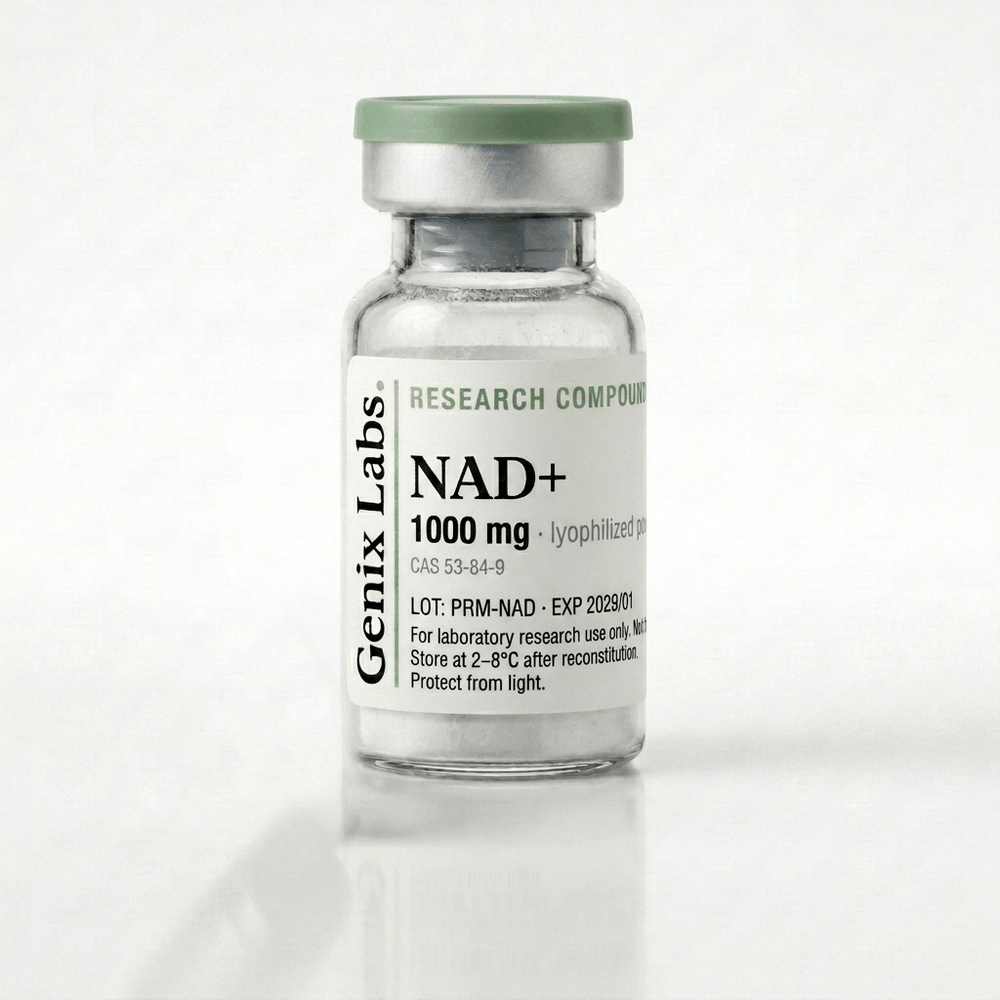
HPLC area purity and LC-MS identity published for the printed lot, cold-chain handling, and a batch certificate of analysis in every order. USD 125 for 1,000mg, same-day in Bali.
Buy lab-tested NAD+ in BaliFrequently asked questions
What is the downside of taking NAD+?
Five downsides are real. Human evidence for injection is one pilot study. Cost per gram is extreme and it repeats. Infusions feel genuinely rough for many people. Long term safety has never been studied at these exposures. And the question of NAD+ and cell growth stays unresolved.
Are NAD injections worth it?
It depends what you are buying. If you want a measured rise in blood NAD+, oral precursors have done that in controlled trials for far less money. If you want research access to the finished coenzyme with a published lot report, that is a different and legitimate purchase. Research use only.
Can NAD make you look younger?
No controlled human trial has shown that. What exists is a mechanism and a pile of anecdotes. Ultraviolet damage does consume NAD+ during DNA repair, which is real biology. Nobody has measured injected NAD+ changing wrinkle depth, elasticity or pigment in a controlled study.
Why do I feel so good on NAD?
Four explanations overlap. Nicotinamide released from the infused NAD+ genuinely feeds the salvage loop. An infusion also means hours of rest. The infusion itself feels rough, so relief afterwards reads as a lift. And expensive, anticipated treatments produce strong placebo effects.
How often should NAD+ injections be done?
No controlled human trial has established a frequency, so we do not publish one. Research designs usually use a close together loading phase then a wider maintenance phase, because NAD+ turnover is fast. Any confident weekly schedule online is opinion, not a trial result.
What is the price of an NAD+ injection?
Clinic infusions are commonly advertised from a few hundred US dollars per session upward, and that price repeats each visit. A lot-tested Genix NAD+ 1,000mg vial is USD 125, or IDR 2.000.000, which works out at about 12.5 cents per milligram. Research use only.
Takeaway
NAD+ is one of the best understood molecules in biology and one of the least understood interventions. The mechanism is textbook. The human file for injection is a single pilot study, and that study found the plasma level flat for two hours while the drip ran.
So read the marketing with that in mind. Rate matters more than milligrams. Whole blood matters more than plasma. Cost per gram matters more than the price of a session. And a feeling is not a measurement.
If you work with NAD+, work with material that shows its lot number, keep it cold and dry, mix only what you need, and measure something real. This is research use only, and it is education rather than medical advice.