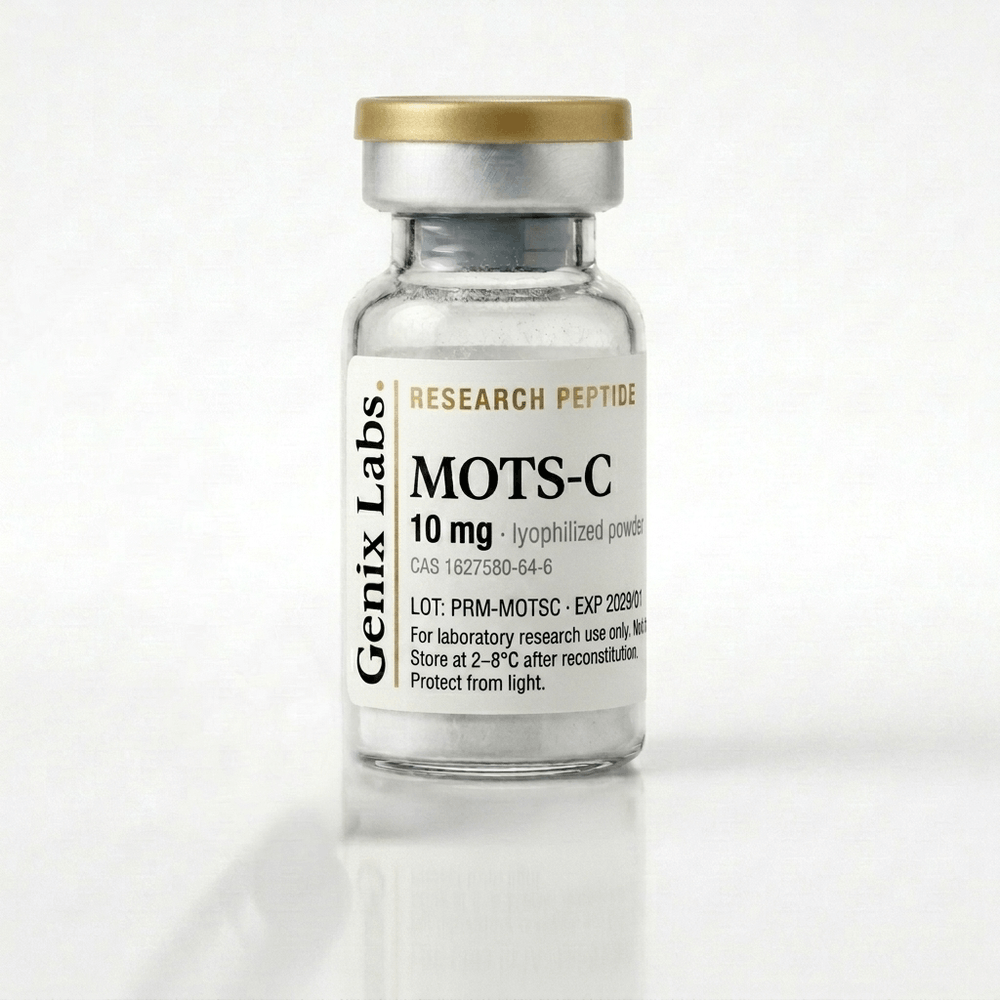

Search MOTS-c benefits and every page gives you the same list. More energy. Better metabolism. Longer life. The lists are not invented. They came from real studies. What the lists leave out is the species those studies used, and the fact that the human blood data points two opposite ways at once.
This guide sorts the claims by evidence instead of by enthusiasm. You will see what was measured in mice, what was measured in people, and the one finding that changes how to read the whole list. Genix Labs supplies MOTS-C for laboratory research only. Nothing here is medical advice.
What are the benefits of MOTS-c?
In published research MOTS-c improved insulin sensitivity, blocked diet-driven obesity, and raised running capacity in mice, including old mice. It also protected bone, liver and lung tissue in animal models. Those results are from animals. No published trial has tested whether giving MOTS-c to a person does anything at all.
- The mechanism is solid and repeatable. MOTS-c switches on AMPK, the cell's fuel sensor.
- The benefit list is a mouse list. Almost every item on it was measured in rodents.
- Human work is mostly blood levels, and those levels split in two directions.
- A gene variant that weakens MOTS-c tracked diabetes risk in 27,527 people.
- Research use only. These are laboratory findings, not outcomes in people.
What is MOTS-c?
MOTS-c is a 16 amino acid peptide. The unusual part is where its instructions live. Most of your proteins are coded in the nucleus, the main library of the cell. MOTS-c is coded inside the mitochondria, the tiny engines that make your energy. Mitochondria carry their own small strip of DNA, left over from an ancient bacterium.
In 2015 a team at the University of Southern California found a short reading frame hidden inside the mitochondrial 12S rRNA gene. That frame codes for MOTS-c. The name is an acronym: mitochondrial open reading frame of the 12S rRNA type-c. It sounds like jargon because it is a map reference, not a description.
Why does that matter for the benefit list? Because it means your mitochondria can send a message to the rest of the body. They are not only a power plant. They also talk. A peptide that carries that message is called a mitochondrial-derived peptide. Humanin was the first one found. MOTS-c was next.
Your body makes MOTS-c on its own. That is the second thing most lists skip. It is not a foreign chemical. It is a signal you already produce, which is exactly why researchers got excited, and also why measuring blood levels turned out to be so confusing.
What other peptides do mitochondria make?
MOTS-c has relatives. Humanin was found first, in 2003, hiding in a different mitochondrial gene. Then came a set of six called the small humanin-like peptides, SHLP1 through SHLP6. Together they are the mitochondrial-derived peptides, and MOTS-c is the best studied of the newer ones.
The family matters for reading the evidence, because the studies often measure more than one. When a paper reports that mitochondrial-derived peptides rose after exercise, check which one actually rose. Sometimes it is humanin. Sometimes it is SHLP2. The headline often says peptides and the data says one peptide.
In the human study that found liver fat tracking with MOTS-c, SHLP2 moved in step with it. Both rose in people with metabolic syndrome. That the two move together supports the idea that something common is driving them, most likely stress on the mitochondria themselves rather than anything specific to MOTS-c.
It is a young field with a shared problem. These peptides are short, they are made and destroyed quickly, and they are measured by assays built in individual laboratories. Progress has been fast on mechanism and slow on the boring groundwork that makes numbers comparable between labs.
How does MOTS-c work in a cell?
MOTS-c slows down the folate cycle, a chain of reactions a cell uses to build new DNA parts. When that chain slows, a molecule called AICAR builds up. AICAR switches on AMPK, the cell's fuel sensor. AMPK then tells the cell to burn fuel rather than store it. That is the whole mechanism in one line.
The 2015 paper reported that skeletal muscle appears to be the main target organ. That is a useful detail. Muscle is the largest single consumer of glucose in the body. A signal that makes muscle hungrier for glucose will move blood sugar, which is exactly what the mouse studies observed.
There is a second half to the mechanism. Under metabolic stress, MOTS-c moves out of the mitochondria and into the nucleus. There it influences which genes get read, including genes for stress response and antioxidant defence. So MOTS-c is not only a metabolic nudge. It is also a messenger that changes the cell's reading list.
Both halves are well replicated in cells and in rodents. If somebody tells you the mechanism is speculative, they are wrong. The mechanism is the strongest part of the MOTS-c story. The weak part comes later, when that mechanism has to become a result in a person.
How did the MOTS-c research unfold?
Eleven years, roughly four phases. Knowing the order helps, because a 2015 claim and a 2026 claim are not the same kind of claim. The field moved from discovery, to animal benefits, to human observation, and most recently to a direction nobody predicted.
| Year | What was published | What it changed |
|---|---|---|
| 2015 | MOTS-c described in Cell Metabolism. Folate cycle, AMPK, mouse obesity and insulin results. | Established the peptide and the mechanism |
| 2015 to 2016 | Aging Cell raises a longevity variant. Bone loss study in rodents. | Opened the aging and tissue protection lines |
| 2018 to 2019 | Human blood level studies begin. Lean versus obese split appears. Senescence warning published. | First signs the human picture was not simple |
| 2021 | Nature Communications exercise and healthspan paper. The 27,527 person variant study. Liver fat association. | The field's peak year, and its most contradictory |
| 2022 to 2024 | Fibre type genetics, fatty liver mechanism, membrane repair, meta-analysis of blood levels. | Mechanism deepened, the human split was confirmed |
| 2026 | eLife reports MOTS-c as a host defence peptide with direct antibacterial action. | A new identity nobody expected: part of the immune system |
Notice what is not in that table. There is no row for a clinical trial. Eleven years of productive laboratory science has not yet produced a published study in which MOTS-c was given to people and an outcome was measured. That absence is the single most important fact about the field.
Notice also the shape of 2021. Three major papers landed that year and they do not tell one story. One said MOTS-c improves capacity in old mice. One said a weakened variant tracks diabetes in tens of thousands of people. One said blood MOTS-c goes up, not down, with liver fat. All three are good studies.
Which MOTS-c benefits have real evidence?
Every claimed MOTS-c benefit traces to a real paper. The difference between them is species and study design. The table below grades each one. Read the species column first. It is the column that decides what a finding can and cannot tell you about a person.
| Claimed benefit | Best evidence | Species | What it can support |
|---|---|---|---|
| Better insulin sensitivity | Lee 2015, Cell Metabolism | Mice, cells | A strong mechanism and a repeatable mouse result |
| Less diet-driven fat gain | Lee 2015, Cell Metabolism | Mice | Prevention of weight gain in mice fed a high-fat diet |
| More running capacity | Reynolds 2021, Nature Communications | Mice, three age groups | Physical performance in young, middle-aged and 22-month-old mice |
| Healthspan late in life | Reynolds 2021, Nature Communications | Mice from 23.5 months | Capacity gained even when treatment starts late, in mice |
| Less muscle wasting | AJP Endocrinology 2021 | Mice, cells | Lower myostatin and atrophy signalling in muscle |
| Bone protection | BBRC 2016, Eur Rev 2018 | Rodents, stem cells | Less bone loss after ovary removal, via AMPK |
| Liver protection | Cell Reports 2024 | Mice, cells | Slower fatty liver disease progression through Bcl-2 |
| Antibacterial and immune effects | eLife 2026 | Bacteria, mice, human cells | Direct killing of E. coli and MRSA, macrophage reprogramming |
| Exercise raises your own MOTS-c | Reynolds 2021, Sci Rep 2021 | Humans | Training lifted natural MOTS-c, though not in every group |
| Giving MOTS-c helps a person | No published trial | None | Nothing. This step has not been tested |
Nine of those ten rows are animal or laboratory work. The one human row is not about taking MOTS-c. It is about exercise raising the MOTS-c you already make. That gap at the bottom of the table is the honest state of the field in October 2026.
Does MOTS-c improve insulin sensitivity?
In mice, yes, and clearly. The 2015 Cell Metabolism paper reported that MOTS-c treatment prevented both age-related and high-fat-diet-related insulin resistance. The effect fits the mechanism, since AMPK activation pushes muscle to take up glucose. In people, no study has given MOTS-c and measured insulin sensitivity.
Human work has gone at the question sideways, by measuring natural MOTS-c in blood. One 2018 study found that plasma MOTS-c tracked insulin sensitivity in lean people, but not in people with obesity. That is a strange result if MOTS-c is a simple metabolic helper. The link held in one group and vanished in another.
It gets stranger. The same peptide that improves glucose handling in mice sits at higher levels in people with more fat around the middle. We unpack that in the section on the data split, because it is the single most important thing to understand before reading any MOTS-c benefit list.
For a practical comparison, the metabolic compounds with real human outcome data are the incretin peptides, not the mitochondrial ones. Our write-up on what the retatrutide trials measured shows what a human efficacy dataset looks like when one exists.
Does MOTS-c cause fat loss?
In mice on a high-fat diet, MOTS-c prevented weight gain. That is the finding behind every fat loss claim online. Note the verb. It prevented gain in animals being fattened. That is not the same as stripping fat off an animal, and it is a long way from a result in a person.
A second mouse study added a detail worth knowing. High-fat-fed male mice injected with MOTS-c lost weight and handled glucose better. Mice given the variant form of the peptide did not. Female mice were unaffected either way. So in the one place a clean before and after exists, the result depended on sex and on the exact peptide sequence.
People searching for MOTS-c before and after photos are looking for human evidence that has not been published. What circulates instead is self-reported forum logs with no control group, no verified compound and no measurement. Those are not results. They are stories, and they are usually stories about people who also changed their training and their food.
What about MOTS-c before and after results?
There are no published before and after results in people, because no trial has given MOTS-c to anyone and measured them. What you find under that search is forum posts, vendor pages and photo pairs with no control group, no verified compound and no measurement of anything.
It is worth being precise about why those are weak, rather than just dismissing them. A photo pair cannot separate the compound from everything else that changed. People who start a research compound usually also change training, food and sleep in the same week. Any one of those moves the photo.
There is also no way to know what was in the vial. Without a lot-matched certificate showing HPLC purity and LC-MS identity, a self-reported result is a report about an unknown substance. That is not a criticism of the person reporting. It is a limit on what their report can mean.
The closest thing to a clean before and after sits in the animal literature, and it is more interesting than any photo. High-fat-fed male mice given MOTS-c lost weight and handled glucose better. The same mice given the K14Q variant peptide did not. Female mice did not respond either way. One compound, three different outcomes, depending on sex and sequence.
Does MOTS-c increase energy and stamina?
The strongest animal result in the whole field is about physical capacity. In 2021 a team reported that MOTS-c improved running performance in mice at three ages: two months, twelve months and twenty-two months. Twenty-two months is an old mouse. The effect did not need a young animal to show up.
The same paper went further. Treatment started at 23.5 months of age, given three times a week, still raised physical capacity and healthspan. Late starting is unusual in aging research. Most interventions only work if you begin early, so a late-start result is genuinely notable.
Then comes the human half of that paper, and it is the part that gets misquoted. In humans, exercise raised the body's own MOTS-c, in muscle and in blood. Nobody gave the humans MOTS-c. A separate 2021 study tested a single bout of exercise and found the picture was more mixed, which we unpack in the next section.
So the honest sentence is this. Exercise raises your MOTS-c. Whether raising MOTS-c by other means raises your capacity has never been tested in a person. The arrow has only been proven to run one way.
- Running capacity improved in young, middle-aged and old mice.
- Late-life treatment, three times a week, still raised capacity in mice.
- In people, exercise lifts natural MOTS-c, though not in every study or every group.
- No human study has given MOTS-c and measured stamina.
What happened when people actually exercised?
Two human studies tested it properly, and the results are more careful than the slogan. In a randomised acute study, endurance exercise significantly raised circulating humanin. MOTS-c only showed a trend toward rising. Resistance exercise raised neither. So the clean statement is about humanin, not MOTS-c.
That study added a second finding worth more than it gets credit for. Blood levels of these peptides were not related to fitness at all. They did not track peak oxygen uptake, leg strength, or the amount of mitochondrial DNA in muscle. If MOTS-c were a mitochondrial fitness marker, you would expect at least one of those links.
The second study ran longer. Breast cancer survivors did sixteen weeks of combined aerobic and resistance training in a randomised trial. MOTS-c rose significantly in the non-Hispanic White group, compared with both their own baseline and the usual care group. In the Hispanic group it did not rise.
In the group where MOTS-c did rise, the increase went with real changes: less fat mass, lower body weight, better insulin resistance scores, lower C-reactive protein and more lean mass. That is the most encouraging human dataset in the field. It is also a secondary analysis, and it measured exercise, not MOTS-c given as a treatment.
- One bout of endurance exercise clearly raised humanin. MOTS-c only trended up.
- Resistance exercise raised neither peptide acutely.
- Blood levels did not track fitness, strength or muscle mitochondrial DNA.
- Sixteen weeks of training raised MOTS-c in one ethnic group and not the other.
- Where it rose, it rose alongside less fat, more lean mass and better markers.
That ethnic difference is not a footnote. It is the same thread running through the genetics work, where a mitochondrial variant common in people of Asian descent changes the peptide itself. MOTS-c may simply not be one story that applies to everybody.
Is MOTS-c an exercise mimetic?
An exercise mimetic is a compound that copies the effects of training without the training. MOTS-c gets that label because it switches on AMPK, and exercise switches on AMPK too. The label is doing a lot of work. Exercise flips hundreds of switches. MOTS-c flips one of them hard.
There is a better way to frame it, and one mouse study points straight at it. When MOTS-c was combined with exercise training, the pair worked together on PGC-1 alpha, a master regulator of making new mitochondria. The combination beat either one alone. That reads less like a substitute and more like a partner.
The human genetics support that reading. In the large variant study, the diabetes risk linked to a weakened MOTS-c only showed up in men in the lowest third for physical activity. Men who moved more did not show it. The researchers called that a kinesio-genomic interaction, which is a long way of saying the peptide and the exercise argue over the same ground.
If you are reading MOTS-c as a way to skip training, the published work does not back that. If you are reading it as something that may interact with training, the published work is more interesting, and still entirely in animals.
Does MOTS-c protect muscle?
One 2021 study reported that MOTS-c reduced myostatin and muscle atrophy signalling. Myostatin is a brake on muscle growth. Less myostatin signalling means less of a brake. The work was done in mice and in muscle cells, so it tells you about a pathway rather than about a person's leg.
A separate line of work found that the K14Q variant of MOTS-c tracked muscle fibre composition and muscular performance in people. That is a human finding, and a real one. It still measures the variant you were born with, not the effect of giving anyone anything.
Put together, muscle looks like the tissue with the most consistent MOTS-c signal across species. Skeletal muscle was named as the main target organ in 2015. The exercise work, the atrophy work and the fibre-type genetics all point at the same tissue. That is a coherent story, and coherence is worth something even when trials are missing.
Does MOTS-c slow aging?
No study has shown MOTS-c extending lifespan in any species. What the 2021 mouse work showed was healthspan: more physical capacity late in life, including when treatment started at 23.5 months. More capacity is not more years. The distinction matters and is usually dropped.
The human angle on aging comes from genetics, not from treatment. A 2015 paper in Aging Cell raised the possibility that a MOTS-c mitochondrial variant plays a role in exceptional longevity in Japanese people. That is a hypothesis built on population frequencies, which is a reasonable place to start and a poor place to stop.
There is also a counter-finding that longevity pages never mention. A 2018 review reported that MOTS-c and humanin both worsened the senescence-associated secretory phenotype in already senescent cells. In plain words, in cells that had already aged badly, MOTS-c pushed out more inflammatory signals, not fewer.
That does not make MOTS-c pro-aging. It makes it context dependent. The same protective quality that keeps a healthy cell alive may also keep a worn-out cell alive and noisy. If you want the longevity picture across compounds, our NAD+ benefits guide walks through the same evidence gap in a better-funded field.
Does MOTS-c help with immunity?
A 2026 paper in eLife reported that MOTS-c acts as a host defence peptide. It damaged the membranes of E. coli and MRSA directly. In a mouse model of acute peritonitis, MOTS-c fully neutralised MRSA infectivity. That is the newest and most surprising result in the field, and it is cell and mouse work.
The mechanism makes sense once you look at the peptide's chemistry. MOTS-c is amphipathic and cationic. In plain words, one end likes water and one end likes fat, and it carries a positive charge. That is the standard recipe for a peptide that punches holes in bacterial membranes.
The immune half of the paper is just as interesting. In human monocytes, interferon gamma, bacterial LPS and ordinary differentiation signals each raised the cell's own MOTS-c. So an immune alarm turns MOTS-c production up. That is a human cell finding, not a human body finding, but it is still human tissue.
Adding MOTS-c from outside while mouse monocytes were maturing pushed them into macrophages with a different gene signature, tilted toward antigen presentation and interferon signalling. Those macrophages cleared bacteria faster and ran a different metabolism. Immunity is now the fastest moving corner of MOTS-c research.
Does MOTS-c lower blood pressure?
No published study has tested that. Nobody has given MOTS-c to people or to animals and measured blood pressure as an outcome. The honest answer is that the question is open. What exists instead is one human dataset that measured both, and it points the other way.
In a study of 125 adults, several parts of metabolic syndrome were positively associated with plasma MOTS-c. Blood pressure was one of them, along with fasting glucose and triglycerides. Higher blood pressure went with higher MOTS-c, not lower. The strongest association of all was with waist circumference.
An association is not a cause, and it runs in whichever direction the biology actually goes. If MOTS-c rises because the body is under metabolic strain, then high MOTS-c and high blood pressure would travel together even if MOTS-c were protective. That is exactly the reading the authors favoured.
There is indirect vascular work too. Circulating MOTS-c was reported lower in patients with coronary endothelial dysfunction, and lower in children with obesity where it tracked vascular function. Those point the opposite way from the metabolic syndrome cohort. The vascular picture is unsettled.
What else has MOTS-c been studied for?
Quite a lot, and almost all of it in animals. Grouping the work by tissue is the fastest way to see the shape of the field. Nearly every entry below is a protection study, where researchers injured a tissue and then asked whether MOTS-c limited the damage.
- Bone. In rodents, MOTS-c reduced bone loss after ovary removal, acting through AMPK. A separate study reported better bone-forming differentiation of marrow stem cells.
- Liver. A 2024 Cell Reports paper found MOTS-c binding Bcl-2 and slowing the progression of fatty liver disease in mice.
- Lung. MOTS-c limited damage in mouse acute lung injury caused by bacterial LPS, and in a lung ischaemia-reperfusion model.
- Heart and vessels. MOTS-c reduced myocardial damage in diabetic rats, and mitochondrial peptides have been studied in atrial fibrillation models.
- Fat tissue. MOTS-c helped keep fat tissue in balance after ovary removal in mice, a model used for post-menopausal metabolic change.
- Muscle membranes. A 2024 paper reported MOTS-c helping repair torn cell membranes by moving a repair protein into place.
- Gut. An orally delivered MOTS-c analogue reduced inflammation in a mouse colitis model, which matters because the peptide itself is fragile.
Read that list carefully and a pattern appears. MOTS-c keeps showing up as a tissue protector under stress, in many organs, in many injury models. It is a broad, consistent signal. It is also a signal that has never once been tested as a treatment in a human being.
Why does the human data disagree?
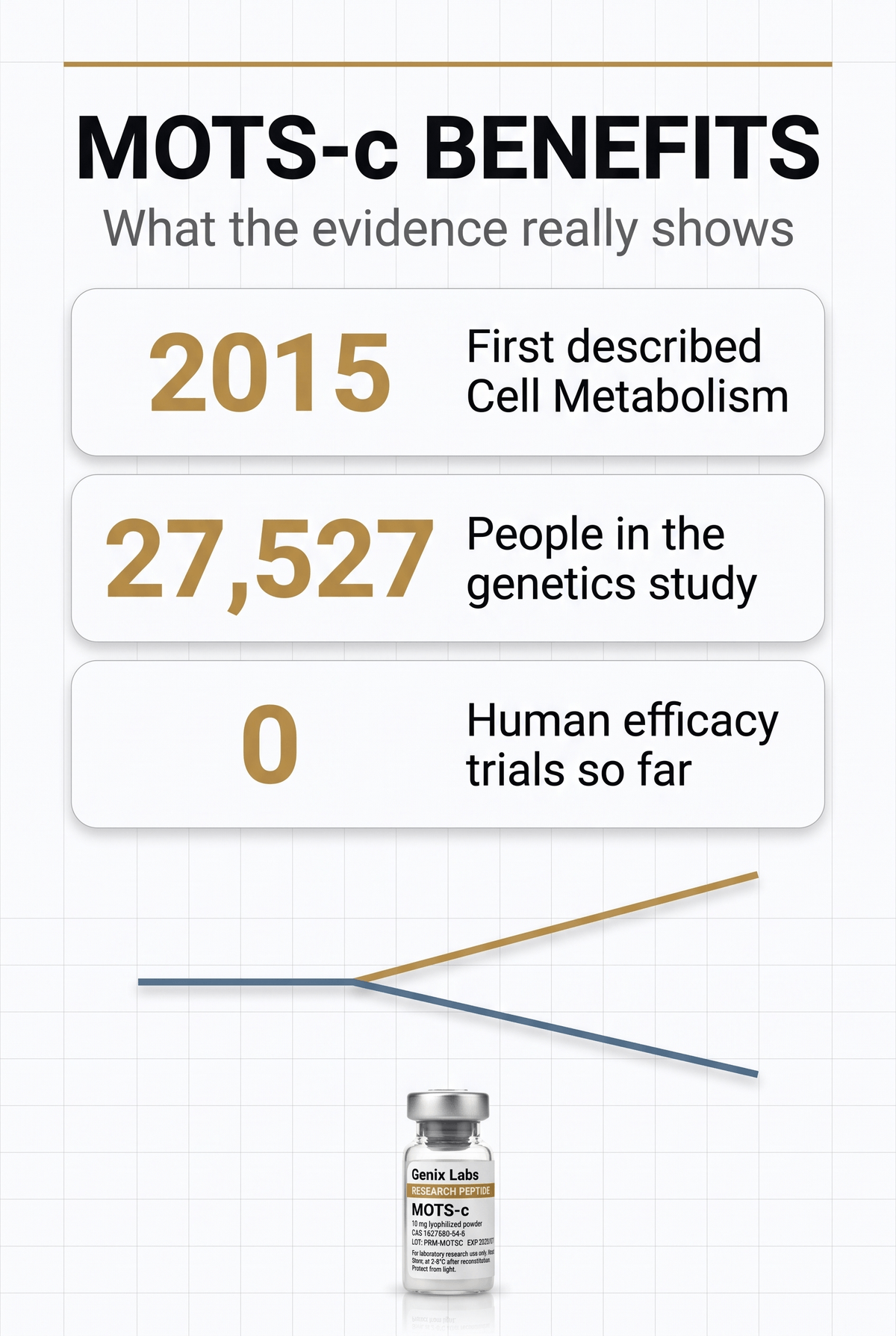
Because MOTS-c is low in some metabolic problems and high in others. A 2024 meta-analysis pooled 602 people. Overall it found blood MOTS-c lower in diabetes and obesity combined. Then the subgroups split. In type 2 diabetes MOTS-c was clearly lower. In obesity it was clearly higher.
Those are not small differences. The diabetes subgroup came out at a standardized mean difference of minus 0.89. The obesity subgroup came out at plus 0.51. Pooling them produced a middling minus 0.37 that describes neither group. The pooled number is the one that gets quoted.
The same analysis reported another awkward detail. MOTS-c correlated positively with total cholesterol and with LDL cholesterol. If MOTS-c were a straightforward marker of metabolic health, you would expect the opposite. Publication bias was not detectable, so the oddity is not an artefact of which studies got published.
A larger human study pointed the same way. In 125 adults, plasma MOTS-c was higher in those with metabolic syndrome. Liver fat, measured properly by imaging, was positively associated with MOTS-c. People with raised liver damage markers had more MOTS-c, not less. The pattern repeated in mice fed a liver-stressing diet.
So the answer to the question is that both things are true. MOTS-c goes down in established type 2 diabetes. MOTS-c goes up in obesity and in fatty liver. Any benefit list built on the sentence "low MOTS-c means poor metabolic health" is built on half the evidence.
Fuel gauge or stress alarm?
The best explanation for the split is that MOTS-c is not a fuel gauge. It is an alarm. When a tissue comes under metabolic load, especially the liver, mitochondria push out more MOTS-c as a protective response. Levels rise because something is wrong, not because everything is right.
That model explains obesity and fatty liver neatly. Load goes up, the alarm gets louder, blood MOTS-c rises. It also explains type 2 diabetes. By that stage, mitochondrial function itself is damaged, so the alarm gets quieter. High then low is one curve, read at two different points on it.
Researchers call this a hormetic response. Hormesis means a small stress that triggers a protective reaction stronger than the stress itself. Exercise is the cleanest everyday example. You damage muscle slightly and the repair leaves you stronger than before.
If MOTS-c is a hormetic alarm, two practical things follow. First, a blood MOTS-c number on its own means very little without knowing the person's metabolic stage. Second, the case for adding more MOTS-c from outside gets more complicated, not less. You would be turning up an alarm that is already sounding.
- High MOTS-c has been reported with obesity, fatty liver and metabolic syndrome.
- Low MOTS-c has been reported with established type 2 diabetes.
- Exercise raises it acutely, so timing of the blood draw matters.
- No reference range exists for clinical use. It is a research measure.
Can you measure your own MOTS-c?
Not usefully, and not in a clinic. There is no approved clinical test for MOTS-c and no agreed reference range. The published studies used assays built in individual laboratories, which means a number from one study cannot be compared directly with a number from another.
To give a sense of scale, one human study reported average plasma MOTS-c around 315 picograms per millilitre. A picogram is a trillionth of a gram. Measuring something at that concentration, in blood full of other proteins, is genuinely hard, and small differences in method produce large differences in result.
Three further problems stack on top. The peptide is short lived, so the value moves quickly. Exercise shifts it within hours. And the studies that matter most used an in-house test rather than a standardised commercial one, so cross-study comparison is shaky by design.
This is why the meta-analysis mattered. Pooling across labs was an attempt to see past assay noise. It found a real signal, and found that the signal pointed two ways depending on the condition. Both halves of that result survived the noise, which makes the split harder to dismiss.
Why might MOTS-c not work for everyone?
Because a common mitochondrial variant changes the peptide itself. A single letter change called m.1382A>C swaps one amino acid in MOTS-c, producing a version named K14Q. It is found mainly in people of Asian descent. The variant peptide works less well, and the consequences are measurable.
Researchers combined three cohorts covering 27,527 people. Men carrying the variant had a higher rate of type 2 diabetes. Women did not. In one cohort the effect appeared only in men in the lowest third for physical activity. More movement, no visible effect of the variant.
The animal arm tied it together. High-fat-fed male mice given ordinary MOTS-c lost weight and handled glucose better. Male mice given the K14Q version did not. Female mice were unaffected in both arms. In cells, the variant peptide sensitised to insulin less than the standard one did.
A second study linked the same variant to muscle fibre composition and muscular performance in people. So the variant touches both metabolism and muscle, which are the two tissues the rest of the MOTS-c story keeps returning to.
For a benefit list, the implication is uncomfortable. The strongest human evidence for MOTS-c mattering at all also says its effect depends on your mitochondrial genotype, your sex and how much you move. A single list of benefits that applies to everyone was never a realistic output from this literature.
Does MOTS-c work the same in everyone?
The published work says no, twice over. Sex changed the result in both the animal and the human arm of the variant study. Ancestry changed the result in the sixteen week exercise trial. Those are two separate lines of evidence pointing at the same conclusion.
Sex
In the human cohorts, men carrying the K14Q variant had a higher rate of type 2 diabetes. Women carrying the same variant did not. In the mouse arm, male mice given MOTS-c lost weight and improved glucose tolerance. Female mice were unaffected in both the standard and the variant arms.
Nobody has explained that cleanly yet. Mitochondrial DNA is inherited only from the mother, which has led to a long-running idea in genetics that mitochondrial variants may be filtered by selection in females and not in males. Whether that explains this result is open.
Ancestry
The m.1382A>C variant is found mainly in people of Asian descent, which is why the large cohorts were Japanese and multi-ethnic. In the exercise trial, training raised MOTS-c in non-Hispanic White survivors and not in Hispanic survivors. The authors suggested ethnic-specific mitochondrial DNA differences as the likely reason.
For a benefit list, that is the end of the idea of one list. The same training produced a different peptide response in two groups in the same trial. Before anyone can say what MOTS-c does for a person, the honest follow-up question is which person.
Activity level
The third modifier is behaviour. In the Japanese cohort, the variant only tracked diabetes among men in the lowest third for physical activity. Men who moved more showed no visible effect of carrying it. A genetic weakness in this pathway appears to be something exercise can cover for.
Can you scale a mouse result to a person?
Not reliably, and this is where most peptide content quietly goes wrong. A rodent amount can be converted to a human equivalent using body surface area, which is standard practice for designing a first human study. That conversion is a starting point for regulators, not a prediction that the effect will transfer.
Three things break the transfer for MOTS-c specifically. The first is metabolic rate. A mouse burns energy far faster per gram than a person does, so a peptide acting on an energy sensor is acting in a very different setting. AMPK signalling sits on top of a different baseline.
The second is the model itself. Most MOTS-c results come from mice made obese or diabetic by diet, or injured on purpose, over weeks. Human metabolic disease develops over decades, alongside other conditions and other drugs. Preventing a fast artificial problem is easier than reversing a slow real one.
The third is the one the field found on its own. The variant study showed the effect disappearing when a single amino acid changed, and disappearing again in female mice. A result that fragile within one species is not a safe bet to carry across to another.
This is why the species column in the benefits table earlier is not a technicality. It is the column that decides whether a number means anything for a person, and for MOTS-c it reads mouse almost all the way down.
What are the side effects of MOTS-c?
Unknown in people, because no human safety study has been published. Animal work has not reported an obvious toxicity signal at the amounts studied, which is reassuring as far as it goes. It does not go far. Absence of a reported signal in mice is not a safety record.
Two findings in the literature are worth flagging honestly, because they are the closest thing to a warning that exists. Neither is proof of harm. Both are reasons the research is not finished.
- The senescence result. In cells that had already aged badly, MOTS-c increased the output of inflammatory signals including interleukin 6, interleukin 1 beta and tumour necrosis factor alpha. A protective peptide that protects worn-out cells too is a double-edged tool.
- The direction-of-travel problem. Blood MOTS-c is already elevated in obesity and fatty liver. If those elevated levels are a stress response, adding more from outside is not obviously the same as correcting a deficiency.
There is also the question nobody can answer about any unapproved peptide: what else is in the vial. Impurities, residual solvents and incorrect sequences are real risks in an unregulated supply chain, and they are risks a certificate of analysis exists to narrow. That is a manufacturing question, not a biology question.
Genix Labs supplies MOTS-C strictly for in-vitro laboratory research. We publish the lot report rather than making safety claims, because a purity figure is something we can evidence and a safety profile in people is not something anyone can evidence yet.
What the benefit lists leave out
Four things keep getting dropped. None of them kills the MOTS-c story. All of them change how much weight the story can carry. A reader who knows these four is better informed than almost every page currently ranking for this keyword.
The senescence finding
A 2018 review reported that MOTS-c and humanin both increased inflammatory output from cells that had already become senescent. The cytokines named were interleukin 6, interleukin 1 beta, interleukin 8, interleukin 10 and tumour necrosis factor alpha. That is the opposite of what an anti-aging compound is supposed to do.
The authors' reading is that MOTS-c protects cells indiscriminately. Protecting a healthy cell is good. Protecting a worn-out cell keeps a noisy neighbour alive. They suggested pairing MOTS-c with something that clears senescent cells first. Nobody has tested that pairing in an animal, let alone a person.
The fragility problem
MOTS-c is a short peptide. Short peptides are broken down quickly by enzymes in blood and in the gut. That is why the published work injects it, and why one team had to build a modified analogue before it could be given by mouth in a colitis study. Fragility is a practical ceiling on the whole idea.
It also complicates every blood level study. You are measuring a molecule that is being made and destroyed continuously, in a sample taken at one moment. Add that exercise raises it acutely and you have a measurement that moves a lot for reasons unrelated to the condition being studied.
The disclosure trail
Several of the central MOTS-c papers carry a conflict of interest statement. A senior author on the founding work, the exercise work, the genetics work and the 2026 immunity work has been a consultant to and shareholder in a company developing mitochondrial peptide analogues. The disclosures are printed openly in the papers.
This is not an accusation. Declared interests are how science is supposed to work, and the findings have been replicated by other groups. It is context. A field where much of the foundational work shares a commercial thread deserves independent replication before anyone treats it as settled.
The missing trial
Everything above would change the day a randomised human trial of MOTS-c was published. As of October 2026 there is not one. Not a negative one, not a positive one, not a small one. The top rung of the evidence ladder is empty, and no benefit list can fill it with enthusiasm.
How strong is the evidence overall?
Strong on mechanism, strong in rodents, thin in people. That is the fair summary. The mechanism has been reproduced by multiple groups in multiple tissues. The rodent results are consistent and span several labs. The human work is observational and points in more than one direction.
It helps to score each layer rather than the field as a whole. The table below does that. A claim is only as strong as the weakest link between the experiment and the person reading about it.
| Evidence layer | How much exists | Strength | What it cannot do |
|---|---|---|---|
| Cell and molecular work | Extensive, many labs | Strong | Cannot show a whole-body effect |
| Rodent treatment studies | Dozens across tissues | Strong for rodents | Cannot be scaled to a human amount |
| Human blood level studies | Hundreds of participants | Moderate, and conflicting | Cannot show cause in either direction |
| Human genetic studies | 27,527 people | Strong for the variant | Cannot show that adding MOTS-c helps |
| Human trials of MOTS-c | None published | Absent | Nothing, because nothing has been run |
| Forum reports | Plentiful | None | No control, no verified compound, no measurement |
That last row deserves a sentence. Threads about MOTS-c results are easy to find. They describe unverified compounds, taken alongside other changes, with no measurement beyond how somebody felt. They are worth reading to see what people try. They are worth nothing as evidence.
If you want the same honesty applied to amounts rather than outcomes, our guide to MOTS-C dosing and reconstitution sets out what the research actually used and where the published numbers stop.
How does it compare to GLP-1 peptides?
They are different kinds of compound at different stages of proof. GLP-1 and GIP based peptides act on gut hormone receptors and have large randomised human trials behind them. MOTS-c acts inside the cell on an energy sensor and has none. Comparing them is a lesson in evidence, not a contest.
| MOTS-c | GLP-1 class peptides | |
|---|---|---|
| Where it acts | Inside the cell, on AMPK | On gut hormone receptors |
| Origin | Coded in mitochondrial DNA | Based on a gut hormone |
| Main studied tissue | Skeletal muscle | Pancreas, brain, stomach |
| Human trial data | None published | Large randomised trials |
| Approved medicines | None | Several, for diabetes and obesity |
| Appetite effect | Not a reported mechanism | Central to how they work |
| Evidence stage | Preclinical | Clinical and in wide use |
The useful takeaway is about reading. When somebody writes that a peptide reduces weight, ask which column the claim sits in. For the incretin class the answer is a trial. For MOTS-c the answer is a mouse. Our semaglutide versus tirzepatide comparison shows what that difference looks like in numbers.
It is also why the two are not substitutes for each other in a research setting. They are studied for different questions. The whole weight and metabolism peptide hub lays out which compound is studied for what, and how far each one has got.
What is the regulatory status of MOTS-c?
MOTS-c is not an approved medicine anywhere in the world. No regulator has licensed it for any use, in any country. It is not a controlled substance either. It sits in the category of research chemicals: legal to supply and hold for laboratory work, not legal to market for human use.
That status has a knock-on effect in sport. Anti-doping rules include a catch-all category for pharmacological substances that no health authority has approved for human therapeutic use. A compound with no approval anywhere falls inside that description by definition, whether or not it is named on a list.
For a laboratory, the practical consequences are documentation and labelling. Research compounds should arrive labelled for research use, with a lot-matched certificate, and should be recorded and stored as research material. Those are the same standards any reagent is held to.
Our guide on whether peptides are legal in Indonesia covers how that framing works in our own jurisdiction, including what research-use-only actually obliges a supplier to do.
What are peptides most used to treat?
Approved peptide medicines treat diabetes and obesity, growth hormone deficiency, osteoporosis, some cancers and several hormone disorders. Insulin was the first and is still the most used. Semaglutide and tirzepatide are the best known of the newer ones. MOTS-c is not in that group and has no approved use anywhere.
That split is the single most useful thing to hold onto when reading about peptides. Some are licensed medicines with regulators, labels and trial data. Others are research chemicals studied in laboratories. The word peptide covers both, which is exactly why the category is so easy to misread.
A peptide is just a short chain of amino acids. Your body runs on thousands of them. Being a peptide says nothing about safety, effect or legality. It says something about size. Anyone selling the word as a benefit is selling grammar.
Genix Labs supplies research compounds, not medicines. Every vial we ship is for in-vitro laboratory research, is not for human or veterinary use, and carries no therapeutic claim. If you want the wider picture, start at our overview of peptide injections in research.
When is the best time to start?
No clinical trial has set a starting point for people, so there is no established answer. The closest published finding is from mice. Treatment begun at 23.5 months of age, late in a mouse life, still raised physical capacity. That speaks to mouse timing, not to human timing.
For a laboratory, the question is different and answerable. Timing in a research protocol is set by the question being asked, the model being used and the endpoint being measured. The 2021 work used an intermittent schedule, three times a week, rather than daily exposure. That design choice came from the biology, not from a calendar.
One more timing detail is worth knowing for anyone measuring MOTS-c rather than giving it. A single bout of endurance exercise raises circulating mitochondrial-derived peptides in people. A blood draw after training is not comparable to a blood draw at rest.
What would change this picture?
One study would. A randomised, placebo-controlled trial in people, with a real endpoint, would move MOTS-c from a promising mechanism to a tested one. Until that is published, every benefit claim is an extrapolation, however good the laboratory work behind it is.
A useful trial would have to solve the problems the current literature already exposed. It would need to stratify by sex, because the mouse and human data both split that way. It would need to record the mitochondrial variant, because the variant changes the peptide. It would need to control for training, because exercise moves the same measure.
It would also need to decide what it is testing. Correcting a deficiency and adding a stress signal on top of an existing one are different experiments. The human blood data suggests obesity and fatty liver come with more MOTS-c, not less, so the deficiency framing may be the wrong one in exactly the group most interested in it.
Watch the immunity line too. The 2026 host defence work opened a direction with a much shorter path to a testable endpoint than metabolism has. Antibacterial effects can be measured in weeks. Metabolic healthspan cannot.
- The first randomised human trial of MOTS-c, whatever it finds.
- Independent replication of the human blood split by groups with no commercial ties.
- Whether the antibacterial finding holds up outside the group that reported it.
How do you verify a MOTS-c vial?
By reading the lot document, not the label. A certificate of analysis should name the exact lot on your vial and report two separate things. HPLC gives an area purity figure. LC-MS confirms the molecule is the one it claims to be, by matching its measured mass. Purity without identity is half a check.
Our published MOTS-C lot 559238 reports 98.90 percent HPLC area on the tested 10 mg size, with LC-MS identity on the same lot report. Testing runs in an ISO 17025 accredited facility. HPLC area percent is not a statement about content, sterility, safety or effect. It is one measurement, on one lot.
- Match the lot number on the vial to the lot number on the document.
- Look for both HPLC purity and LC-MS identity, not only one of them.
- Check the tested size matches the size you hold.
- Check the testing facility is accredited, not just named.
- Treat a document with no lot number as no document at all.
Handling matters as much as paperwork. MOTS-c ships as a lyophilised powder, which is a dry cake made by freeze drying. Kept sealed, cold and out of light it is stable for months. Once mixed with bacteriostatic water it goes into the fridge at 2 to 8 degrees Celsius and has a far shorter working life.
A Genix MOTS-C 10 mg vial is 79 USD, or Rp 1.290.000, cold packed and tracked. In Bali we deliver the same day, often within two hours, with cash on delivery. Orders elsewhere ship cold across Southeast Asia, Europe and Australia. The MOTS-C research vial page carries the lot report and the full handling notes.
If you are mixing a vial for the first time, our step by step on how to reconstitute peptides covers the arithmetic and the sterile handling, and the MOTS-C dosage chart does the concentration maths for the 10 mg size.
FAQ
What are the benefits of MOTS-c?
In published research MOTS-c improved insulin sensitivity, prevented diet-induced obesity, and raised running capacity in mice, including old mice. It also protected bone, liver and lung tissue in animal models. Those are animal findings. No trial has tested whether giving MOTS-c benefits a person. Research use only.
What are peptides most commonly used to treat?
Approved peptide medicines treat diabetes and obesity, such as semaglutide and tirzepatide, plus growth hormone deficiency, osteoporosis and some cancers. MOTS-c is not in that group. It is an unapproved research compound with no licensed use, supplied for laboratory work only, and nothing here is medical advice.
When is the best time to start MOTS-c therapy?
There is no established answer, because no clinical trial has set a starting point for people. The closest finding is from mice: treatment begun at 23.5 months of age, late in life, still raised physical capacity. That tells you about mouse timing, not human timing. Research use only.
Does MOTS-c help with immunity?
A 2026 eLife paper reported that MOTS-c acts as a host defense peptide. It damaged the membranes of E. coli and MRSA, cleared MRSA infection in a mouse peritonitis model, and reprogrammed monocytes into macrophages that killed bacteria faster. That work is cell and mouse based, not human.
Does MOTS-c lower blood pressure?
No study has tested that. The one human dataset that measured both found the opposite pattern: in people with metabolic syndrome, higher blood pressure went with higher MOTS-c, not lower. That is an association in one cohort, so it shows a link and proves nothing about cause.
Why do MOTS-c blood levels go down in diabetes but up in obesity?
A 2024 meta-analysis of 602 people found exactly that split. The leading explanation is that MOTS-c rises as a stress signal when tissue, especially liver, is under metabolic load, then falls once mitochondria are damaged enough to stop making it. Low and high mean different stages.
Does MOTS-c have side effects?
Animal studies have not reported a clear toxicity signal, but no human safety trial exists, so the honest answer is unknown. One 2018 review flagged a possible downside: MOTS-c increased inflammatory cytokine output from already senescent cells. Genix supplies it for laboratory research only.
Takeaway
MOTS-c is a real signal with a real mechanism. Your mitochondria make it. It switches on AMPK. In mice it improves insulin handling, blocks diet-driven weight gain and raises running capacity, even in old animals. None of that is hype, and none of it is a human result.
The human evidence says something more interesting than the benefit lists do. Blood MOTS-c runs high in obesity and fatty liver, and low in established diabetes. It behaves like an alarm that gets louder under strain and then fades as the machinery fails. A gene variant that weakens it tracked diabetes in 27,527 people, in men, mostly in those who moved least.
So the honest benefit list has two columns. One holds a large, consistent body of animal work. The other, the column for what happens when you give MOTS-c to a person, is still empty. Anybody who tells you otherwise has skipped the species column.
Genix Labs supplies MOTS-C strictly for in-vitro laboratory research. It is not for human or veterinary use, and nothing in this article is medical advice.