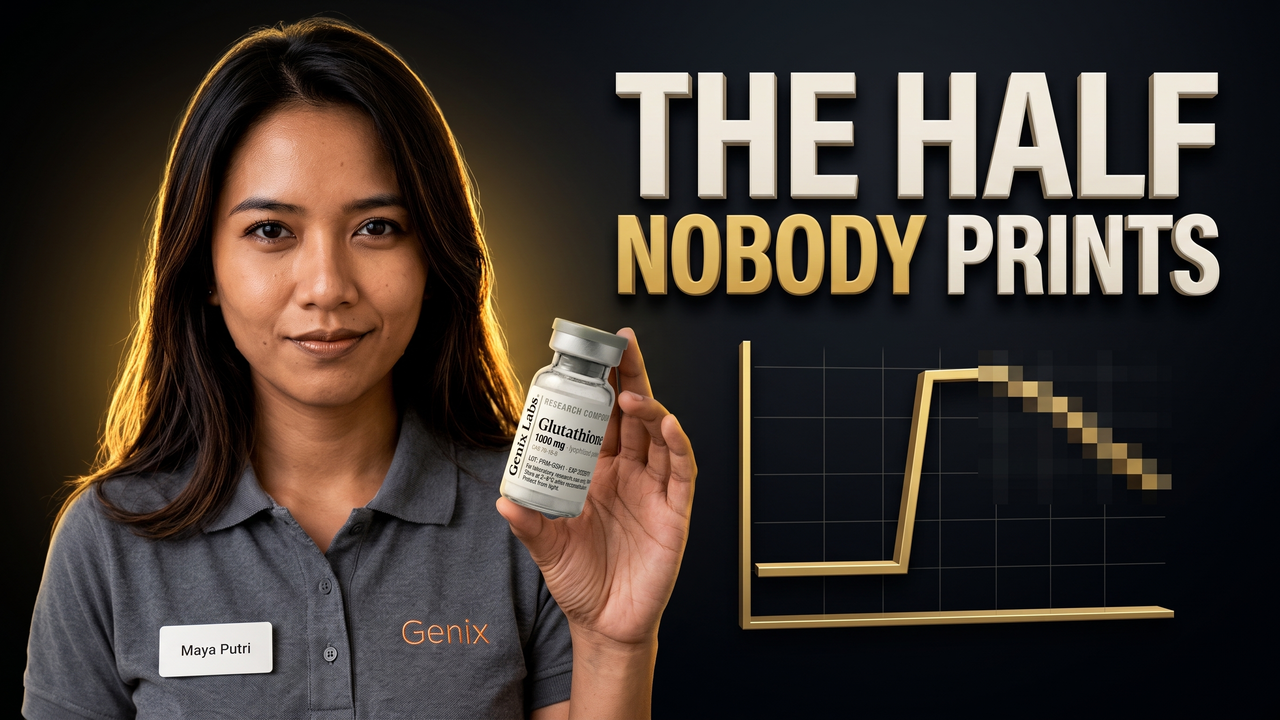
Search glutathione benefits and you get the same list everywhere. Detox. Glow. Immunity. Energy. Anti-aging. What you almost never get is the study behind each line. So here is the whole file, graded, with the number of people in each trial attached. One finding changes how you read all of it. Every measured gain reversed when the supplement stopped.
What are the benefits of glutathione?
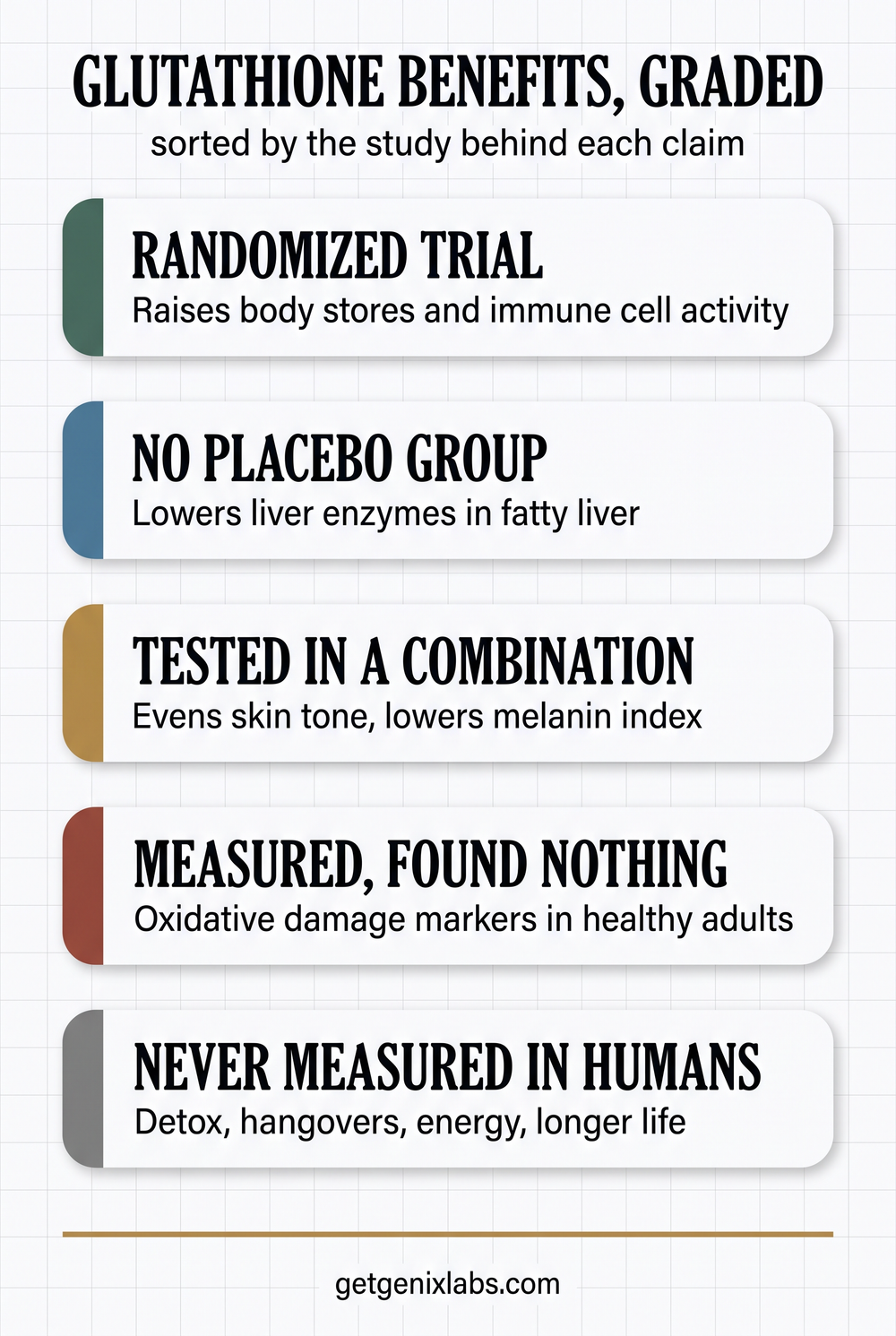
Three benefits have been measured in people. Oral glutathione raises body stores by 30 to 35% in blood. It raises immune cell activity, by up to 400% for natural killer cells in one study. And in one liver pilot it lowered ALT, triglycerides and ferritin. Skin tone results exist but are small. Everything else on the usual list is inferred, not measured.
- It names the study, the design and the headcount behind every single claim.
- It prints the washout data. Two trials measured what happens after you stop.
- It includes the trial that found nothing, because that trial is half the story.
- It separates what glutathione did in a trial from what the molecule does in a cell.
What is glutathione?
Glutathione is a tiny protein your own cells build. It is made of three amino acids joined in a chain. The chain is glutamate, cysteine and glycine. Scientists call a three part chain like this a tripeptide. Its short name is GSH. Every cell in your body makes its own supply, all day, without being asked.
It is often called the master antioxidant. An antioxidant is a molecule that absorbs damage so other parts of the cell do not. Glutathione is called the master one for two reasons. There is more of it than any other. And it recharges several others, including vitamin C and vitamin E, after they have been used up.
It is not a vitamin. A vitamin is something you must eat because your body cannot build it. Glutathione is the opposite. Your body builds it constantly, and the raw material matters more than the finished molecule. That single fact explains most of the confusion in the next few thousand words.
What will glutathione do to your body?
Measurably, three things. It increases how much glutathione sits inside your blood cells. It increases the activity of immune cells that kill damaged cells. And in one small liver study it lowered liver enzymes and blood fats. Those are the measured effects. The rest of the usual list has no human trial behind it.
It helps to separate two different questions. The first is what glutathione does inside a cell. That is well understood textbook biochemistry. The second is what happens when a person takes extra glutathione. That is a much shorter list, and a much more interesting one.
Why does one molecule have so many claims?
Because it sits in the middle of almost everything. Glutathione is the molecule your cells spend to neutralise waste. It is involved in clearing alcohol byproducts, handling heavy metals, and protecting DNA. Anything central to that many processes can be linked, on paper, to almost any outcome you like.
That is where benefit lists come from. Someone takes a real mechanism and writes the outcome it should produce. The step that gets skipped is checking whether anyone measured that outcome. A mechanism is a reason to run a trial. It is not a result.
The recycling loop behind every claim
Glutathione works in a loop. The fresh form is called reduced glutathione, written GSH. When it absorbs damage it becomes the spent form, GSSG. An enzyme then recharges the spent form back to fresh, using energy from your food. So the same molecules get reused many times a day.
This is why the ratio matters more than the total. Researchers often measure the share of your glutathione that is fresh versus spent. A low fresh to spent ratio means the loop is falling behind. That ratio is the number good studies report, and it is the number marketing never mentions.
Every claimed benefit, graded
Here is the same list you see everywhere, with the study attached to each line. Read the headcount and the design, not the bold text. A claim from 54 randomized adults is not the same kind of claim as one from a cell culture dish.
| Claimed benefit | Best human evidence | People | Design | Grade |
|---|---|---|---|---|
| Raises body glutathione stores | Richie 2015, 6 months | 54 | Randomized, placebo controlled | Strong |
| Raises immune cell activity | Sinha 2018, 4 weeks liposomal | 12 | Open label, two dose groups | Moderate |
| Lowers liver enzymes in fatty liver | Honda 2017, 4 months | 34 | Open label, single arm, no placebo | Weak but real |
| Lowers melanin index, evens tone | Weschawalit 2017, 12 weeks | small | Randomized, placebo controlled | Moderate |
| Improves strength and cognition in aging | Kumar 2021, precursors not GSH | 16 | Open label, withdrawal arm | Indirect |
| Lowers oxidative damage markers | Allen 2011, 4 weeks | 40 | Randomized, placebo controlled | Not supported |
| Slows Parkinson progression | Hauser 2009, intravenous | 21 | Randomized, double blind | Not supported |
| Detox, hangovers, energy, longer life | None | 0 | No human trial | Unmeasured |
The immune result is the strongest one
The best measured glutathione benefit is not cosmetic. It is immune. Two separate studies found that raising body glutathione raised the activity of natural killer cells. These are immune cells that destroy damaged and infected cells. One trial saw activity more than double. Another saw it rise by up to 400%.
This is the opposite of how glutathione is sold. It is marketed for skin and for detox, where the evidence is thinner. The strongest numbers in the whole file sit in immune function, which almost no product page leads with.
Where the 400% number comes from
It comes from a one month study of liposomal glutathione in 12 healthy adults. Liposomal means the molecule is wrapped in a fat bubble to help it survive digestion. After two weeks, whole blood glutathione was up 40%, and glutathione inside immune cells was up 100%. Natural killer cell activity peaked up to 400% above baseline.
Two caveats belong next to that number. Twelve people is very few. And it was open label, meaning everyone knew what they were taking. The same study also measured a 35% drop in plasma 8-isoprostane, a marker of oxidative damage, which is a genuinely useful second finding.
Why the dose made no difference
The liposomal study ran two groups. One took 500mg a day. One took 1000mg a day. The results were the same. There was no measurable difference between the two groups on any endpoint. The authors were careful to say the study was too small to settle it.
The larger six month trial pointed the same way. It compared 250mg a day against 1000mg a day. Both raised body stores. Four times the amount did not give four times the result. If a product page tells you more is better, no published trial is backing that up.
What happened to liver enzymes?
One pilot study gave 300mg a day of oral glutathione to patients with fatty liver for four months. ALT, a blood marker of liver stress, fell significantly. Triglycerides, free fatty acids and ferritin fell too. Liver fat measured by elastography fell in the patients whose ALT responded. It was a small, single arm study.
The 34 patient liver pilot
The design deserves a close look, because its weakness is instructive. Thirty four patients enrolled and 29 finished. Everyone first spent three months improving diet and exercise. Only then did the glutathione start. There was no placebo group at all. Everybody got the supplement and everybody knew it.
So the honest reading is this. Something improved over four months in people already improving their habits. Glutathione is a plausible cause. It is not a proven one. The authors said so themselves and called for large scale trials. Those trials have not arrived.
One detail in the results is worth keeping. The patients whose ALT fell most were younger and did not have severe diabetes. That is a hint that the effect, if real, depends on how much damage is already there.
Glutathione benefits for skin and face
Skin is the most searched glutathione benefit and the most oversold. The best data is a 12 week placebo controlled trial at 250mg a day. Melanin index and ultraviolet spots tended lower. Some skin sites showed a significant reduction in wrinkles. The effect was gradual and modest, not a transformation.
What the 12 week skin trial measured
It measured the melanin index, which is an instrument reading of pigment in the skin. It did not measure how anybody looked in a photograph. Both the fresh form and the spent form of glutathione were tested, and both trended lower than placebo. No serious adverse effects occurred across the 12 weeks.
A second, larger trial ran across three teaching hospital clinics in Indonesia, in Fitzpatrick skin types four and five. That one is often quoted as proof. It should not be. It tested glutathione combined with vitamin C, alpha lipoic acid and zinc. Any result belongs to the combination.
Do the benefits differ for women and men?
No trial has been designed to answer that. The six month stores trial enrolled both men and women and did not report a split. The 12 week cosmetic trial enrolled healthy female subjects only, which is why skin claims get aimed at women. That is a feature of who got studied, not of biology.
So any page promising specific glutathione benefits for women, or for men, is filling a gap the research has not filled. The honest answer is that the measured effects, on stores and on immune cells, were measured in mixed groups and reported for everyone together.
What about aging, strength and cognition?
This is the most interesting corner of the file, and it does not use glutathione itself. It uses the raw materials. A 36 week trial gave older adults glycine plus N-acetylcysteine, two precursors the body uses to build glutathione. The results were broad. Strength, gait speed, cognition and insulin resistance all improved.
The trial that tested withdrawal
Eight older adults and eight young adults enrolled. The older group took the precursor pair for 24 weeks. Their red cell glutathione deficiency corrected. Oxidative stress fell. Mitochondrial fuel use improved, along with inflammation, blood vessel function, genomic damage, grip strength, walking speed and cognitive scores. Body fat and waist size fell.
That is a remarkable list from eight people, and the headcount is the point. Eight is a pilot. It was open label. It used precursors, not glutathione. So it cannot be quoted as proof that a glutathione vial does any of those things. What it can do is something no other trial did.
It kept measuring after the supplement stopped.
The finding no benefit list prints
After the 24 weeks of supplementation, the older adults stopped for 12 weeks and were measured again. The benefits declined. Not all the way to zero in every measure, but down. The same pattern appeared in the six month oral glutathione trial, which included a one month washout. Body stores returned to baseline.
Put those two results side by side and a rule appears. Glutathione status tracks current intake. The gain is not banked. It is held only while the input continues, which is exactly what you would expect from a molecule your cells recycle and spend every day.
This single fact reframes every benefit claim on this page. None of the measured effects are permanent changes. They are a maintained state. That is a much less exciting headline, and it is the one the data supports.
- It separates a maintained state from a lasting change. Almost no page makes that distinction.
- It explains why short trials and long trials can both be right about different things.
- It means a 4 week result tells you nothing about what month 12 looks like.
- It tells you that any protocol comparison must say how long it ran, and what happened after.
What happens if I take glutathione daily?
In the six month randomized trial, body stores rose 30 to 35% in red cells, plasma and lymphocytes, and 260% in cheek cells. Natural killer cell activity more than doubled by month three. No serious adverse effects were reported at either 250mg or 1000mg a day. One month after stopping, levels returned to baseline.
The blood change starts early. Stores had already risen by month one. But a separate four week trial at the same daily amount found no change in oxidative damage markers. So the first month raises the supply without a proven change in damage. Those are two different outcomes, and they get mixed up constantly.
Why do the two oral trials disagree?
They do not actually disagree. They measured different things. One measured how much glutathione was in the body. The other measured how much oxidative damage was happening. The first went up. The second did not change. Both results can be completely true at the same time.
Stores are not the same as damage
Think of a fire extinguisher cabinet. One trial counted the extinguishers and found more of them. The other counted the fires and found the same number. More extinguishers is a real finding. It is not the same finding as fewer fires, and it does not promise it.
There is a second reason for the gap. The four week trial enrolled healthy adults. Healthy adults do not have much oxidative damage to reduce. A marker already near the floor cannot fall far. That is why the liver study, in people with a measurable problem, found something the healthy volunteer study could not.
| Trial | What it measured | Result | Who was enrolled |
|---|---|---|---|
| Richie 2015, 6 months | Glutathione stored in blood cells | Up 30 to 35% | 54 healthy non smokers |
| Allen 2011, 4 weeks | Markers of oxidative damage | No change at all | 40 healthy adults |
| Sinha 2018, 4 weeks | Stores plus immune cell function | Both up sharply | 12 healthy adults |
| Honda 2017, 4 months | Liver enzymes and blood fats | ALT and triglycerides down | 34 fatty liver patients |
Which conditions has it been studied in?
Research has explored glutathione in fatty liver disease, Parkinson's disease, skin pigmentation, and kidney protection during heart imaging. It has also been studied in cystic fibrosis and in asthma. Results are mixed and most studies are small. Nothing here is a treatment claim. These are research settings, not outcomes you can buy.
The pattern across those settings is worth noticing. Where there is a measurable deficit, something sometimes moves. Where the people studied were healthy, usually nothing moved. That is consistent with a molecule that tops up a system rather than one that pushes it beyond normal.
The route with the least benefit data
Intravenous glutathione is the most expensive version and has the weakest benefit file. The best controlled intravenous study randomized 21 Parkinson's patients. Eleven received 1400mg three times a week for four weeks. It was well tolerated. It produced no significant change in Parkinson rating scores against placebo.
For skin lightening, which is what most drips are sold for, a peer reviewed review found no studies of intravenous glutathione at all. Not weak studies. None. The safety file for that route is a separate and more serious story, covered in our route by route side effects guide.
What is a normal glutathione level?
There is no single number you can aim for. Glutathione is measured in several places, and each has its own range. Researchers measure it in whole blood, in red blood cells, in plasma, in immune cells and in cheek cells. The same person can look fine in one and low in another.
This is why trials report percentage change from a person's own baseline rather than a target value. It is also why a home test promising your glutathione number should be read carefully. Ask which compartment was measured, and whether the fresh to spent ratio was reported.
What drains glutathione?
- Age. Levels fall across adult life, which is why aging trials target it.
- Alcohol. Your liver spends glutathione to clear acetaldehyde, alcohol's toxic byproduct.
- Poor sleep and sustained stress, both linked to lower measured levels.
- Smoking and air pollution, which raise the oxidative load the loop has to handle.
- Illness and infection, when immune cells are working hard and spending their supply.
- Low protein intake, because the raw materials are amino acids from food.
Which foods raise glutathione?
Food helps mostly by supplying raw material rather than finished glutathione. The limiting ingredient is cysteine, a sulphur containing amino acid. Foods rich in sulphur compounds and cysteine give your cells more to build with. This is the cheapest lever available and it needs no vial.
- Sulphur rich vegetables. Broccoli, cabbage, cauliflower, Brussels sprouts, bok choy.
- Garlic and onions, both high in the sulphur compounds the pathway uses.
- Whey protein, a concentrated source of cysteine.
- Eggs, fish, chicken and legumes, for the amino acid backbone generally.
- Avocado, spinach, asparagus and okra, which contain glutathione itself in small amounts.
- Selenium sources such as Brazil nuts, since the recycling enzyme needs selenium to work.
One caution about the last two lines. Glutathione in food is largely broken down during digestion, the same problem supplements have. The selenium point is different and underrated. Without enough selenium, the enzyme that recharges spent glutathione cannot keep up, no matter how much you supply.
How to raise glutathione levels
There are four honest levers, and they are not equally strong. Supply the raw materials through protein and sulphur rich food. Reduce what drains it, especially alcohol and poor sleep. Supply the precursors directly. Or supply the finished molecule in a form built to survive digestion.
Why precursors beat the finished molecule
The broadest results in the whole file came from precursors, not glutathione. The 36 week aging trial used glycine plus N-acetylcysteine. Hospitals reach for N-acetylcysteine too, because it reliably raises glutathione inside cells. Giving your cells the parts works better than handing them the assembled product.
The reason is the loop described earlier. Cells build glutathione internally, where it is needed. A finished molecule in your bloodstream still has to get inside a cell. Precursors cross that boundary easily. This is the single most useful fact in this article for anyone comparing options.
Tablets, liposomal, sublingual or vial?
| Form | Human evidence it raises stores | Notes |
|---|---|---|
| Plain oral tablets or capsules | Yes, in a 6 month randomized trial | Cheapest. Most of the dose is digested before absorption. |
| Liposomal oral | Yes, in a 12 person open label study | Fat wrapped to survive the gut. Strongest immune numbers on file. |
| Sublingual or lozenge | Small trials only | Bypasses some digestion. Thin evidence base. |
| Nebulized or inhaled | Not for benefit | Carries the clearest documented harm, in mild asthma. |
| Intravenous | No benefit trial for cosmetic use | Most expensive, least evidence, worst safety file. |
| Precursors, such as N-acetylcysteine | Yes, consistently | Raises glutathione inside the cell. Not glutathione itself. |
Does swallowed glutathione survive the gut?
Partly, and this was argued about for years. The old view was that digestion breaks the tripeptide apart completely. The six month trial settled the practical question. Body stores went up and stayed up for six months. So enough gets through, or enough raw material does, to change the measurement.
What is still unsettled is the mechanism. Stores may rise because intact glutathione is absorbed. Or because the broken down amino acids are absorbed and reassembled inside cells. Both routes end with more glutathione in your blood. Only one of them justifies paying extra for a special delivery form.
What are the side effects of glutathione?
The route decides. Two randomized oral trials, up to 1000mg a day for six months, reported no serious adverse effects. The intravenous record is different and holds a Stevens-Johnson syndrome case report plus a national regulator warning. Nebulized glutathione dropped FEV1 by 19% in mild asthma, the clearest measured harm on file.
That is the short version. The full file, sorted by route, with the case reports and the regulator warning, is in our dedicated glutathione side effects guide. It is the other half of this page and worth reading before any benefit claim changes your mind.
What to avoid when taking glutathione?
- Inhaled or nebulized forms, if asthma or sulfite sensitivity is in the picture. That is where the measured harm is.
- Unregulated drip clinics. The documented severe reactions happened with intravenous infusions.
- Assuming the vitamin C in a drip is inert. Reviewers say it makes every cosmetic result unreadable.
- Reading oral trial safety data as if it covered the intravenous route. It does not.
- Paying for a dose escalation no trial supports. 500mg and 1000mg gave the same immune result.
- Any vendor who will not show a lot specific certificate of analysis for the batch in your hand.
What is known about interactions?
Less than you would hope. No large interaction study exists. The one interaction that matters for reading the literature is vitamin C, because it is bundled into almost every cosmetic protocol and confounds the result. Selenium matters in the other direction, since the recycling enzyme cannot work without it.
Beyond that, the honest answer is that the interaction file is mostly empty. That is not the same as safe. It means nobody has done the work. Any confident interaction list you find online is going further than the published evidence allows.
What about too much, or a missed day?
No human overdose threshold has been established for oral glutathione. The highest amount tested in a long randomized trial was 1000mg a day for six months, with no serious adverse effects reported. Above that, there is no data, which is a reason for caution rather than confidence.
A missed day is unlikely to matter much, and the washout data is why. Stores took a full month to fall back to baseline after six months of daily use. That is a slow decay curve. It also means catching up with a double amount has no published rationale behind it.
The benefits the evidence does not support
A benefits article that only lists benefits is marketing. Here is the other column. These claims are either unmeasured in humans, or were measured and did not hold up. Both kinds appear constantly on pages that look authoritative.
| Common claim | What the evidence actually says |
|---|---|
| Detoxes your body | Mechanism is real. No human trial measured a detox outcome. Unmeasured. |
| Cures or prevents hangovers | No trial. The acetaldehyde link is biochemistry, not a tested result. |
| Boosts energy | No trial endpoint. The aging trial used precursors and measured walking speed, not energy. |
| Stops you getting sick | Immune cell activity rose. Illness rates were never measured in any trial. |
| Lowers oxidative damage in healthy people | Measured in 40 adults for 4 weeks. Every marker unchanged. |
| Slows Parkinson's progression | Measured in 21 patients. No significant change in rating scores. |
| Whitens skin reliably | A review found no studies of the intravenous version for this at all. |
| Extends lifespan | No human longevity trial exists for glutathione. None. |
What a lot report rules out
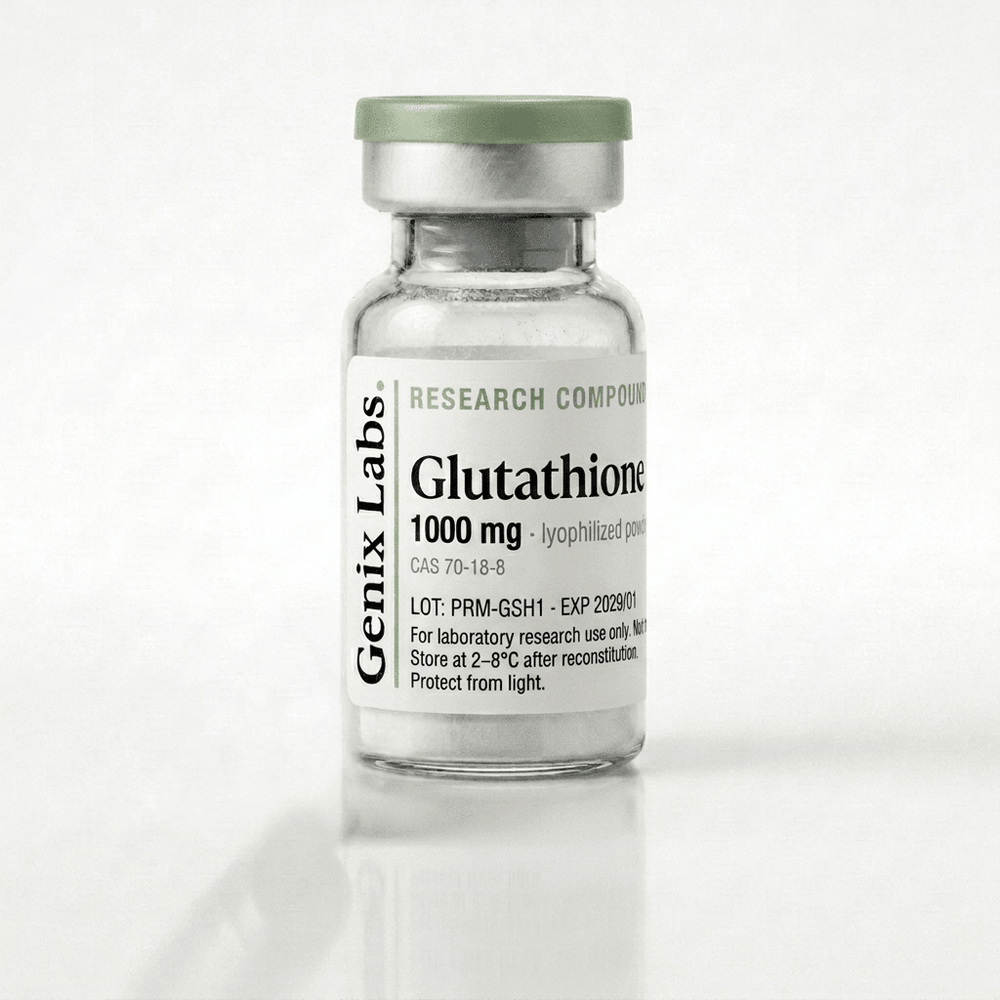
Before any benefit question matters, one plainer question comes first. Is the vial what the label says? A batch certificate of analysis answers that and nothing else. For the published Genix Labs glutathione lot 264817, HPLC area purity reads 99.20% and LC-MS confirms identity.
Here is what those two tests rule out. HPLC area purity rules out a lot heavily diluted with something else. LC-MS identity rules out the wrong molecule entirely. Together they answer the two cheapest ways a research compound goes wrong. Neither one says anything about benefit.
- It is not a statement of content, sterility, safety or efficacy.
- It applies only to the printed lot. Match the lot number on the vial you received.
- HPLC area percent is not the same as milligrams of active material in the vial.
- No purity figure makes an unmeasured benefit claim true.
Handling is the part people skip, and glutathione is unusually sensitive to it. The fresh form oxidises to the spent form on exposure to air, light and warmth. That is the same chemistry described earlier, happening in the vial instead of the cell. Cold chain is not a sales line for this compound. See how to store peptides properly for the handling detail, and the Longevity and Anti-Aging pillar for how glutathione sits beside NAD+ and GHK-Cu.
How much does glutathione cost?
A Genix Labs lab-tested glutathione 1000mg vial is USD 63, or Rp 1.000.000, with the batch certificate of analysis included. Orders placed before 9 PM ship the same day, cold packed and tracked. In Bali that is often same-day delivery, with cash on delivery available.
For context on the comparison most people are really making, a single intravenous glutathione session at a drip clinic typically costs several times that, for the route with the weakest benefit evidence and the worst documented safety file. The price gap runs opposite to the evidence.
What would actually settle this?
- A randomized placebo controlled trial of oral glutathione alone, with no vitamin C in either arm.
- A liver trial with a real placebo group, large enough to confirm the ALT signal.
- An immune trial that measures illness episodes, not just natural killer cell activity in a dish.
- A head to head of finished glutathione against precursors, measuring glutathione inside cells.
- Any trial at all of intravenous glutathione for the cosmetic use it is mostly sold for.
- Longer washout arms, so we learn whether anything at all persists past twelve weeks.
Until those exist, the file stays as it is. Three measured benefits, one clear negative result, a long unmeasured list, and a withdrawal curve that nobody puts on the sales page.
Grade any benefit claim in 30 seconds
- Does it name a study? No study named means mechanism, not result.
- How many people? Under 20 is a pilot. Say pilot out loud and reread the claim.
- Was there a placebo group? Open label and single arm cannot separate the supplement from everything else.
- Was glutathione given alone? If vitamin C or three other ingredients were in it, the result is theirs too.
- Which route? Oral, inhaled and intravenous have separate evidence files and separate safety files.
- What endpoint? Stores going up is not damage going down, and neither is a health outcome.
- Did anyone measure after stopping? Both trials that did found the gains faded.
FAQ
What happens if I take glutathione daily?
In a 6 month randomized trial at 250mg or 1000mg a day, body stores rose 30 to 35% in red cells, plasma and lymphocytes, and natural killer cell activity more than doubled by month three. A separate 4 week trial at 1000mg a day found no change in oxidative damage markers. One month after stopping, levels returned to baseline.
What will glutathione do to your body?
Measurably, three things. It raises the amount of glutathione stored in your blood cells. It raises immune cell activity, by up to 400% for natural killer cells in one liposomal trial. And in one liver pilot it lowered ALT, triglycerides and ferritin. Everything beyond those three is inferred from the mechanism, not measured.
What are the side effects of taking glutathione?
The route decides. Two randomized oral trials, up to 1000mg a day for 6 months, reported no serious adverse effects. The intravenous record is different and holds a Stevens-Johnson syndrome case report plus a national regulator warning. Nebulized glutathione dropped FEV1 by 19% in mild asthma, the clearest measured harm on file.
What to avoid when taking glutathione?
Four things come from the published record. Inhaled or nebulized forms with asthma or sulfite sensitivity. Unregulated drip clinics, where the documented severe reactions happened. Assuming the vitamin C in a drip is inert, since reviewers say it confounds every cosmetic result. And reading oral trial safety data as if it covered intravenous use.
Do glutathione benefits last after you stop?
The two trials that measured it both say no. In the 6 month oral trial, body stores returned to baseline one month after the supplement stopped. In a 36 week aging trial, the gains in strength, gait speed, cognition and mitochondrial function declined after 12 weeks of withdrawal. The effect tracks current intake.
How much does glutathione cost?
A Genix Labs 1000mg glutathione vial is USD 63, or Rp 1.000.000, with the batch certificate of analysis included. The published lot shows 99.20% HPLC area purity and LC-MS identity confirmation. Purity is a lot-specific result and is not a statement of content, sterility, safety or efficacy. Supplied for laboratory research only.
Takeaway
Glutathione has three measured benefits in people. It raises body stores. It raises immune cell activity, strongly. And in one small liver pilot it lowered liver enzymes and blood fats. Skin results are real but modest, and usually tangled with vitamin C. Everything else on the standard benefits list is unmeasured or was measured and did not hold.
The finding that should change how you read every other page is the washout. Two trials measured what happened after the supplement stopped. Body stores fell back to baseline in a month. The strength and cognition gains faded over twelve weeks. Nothing here is banked. It is rented, for as long as the input continues.