Search glutathione side effects and you get the same short list everywhere. Mild stomach upset. Maybe a rash. Nothing serious. That list is describing a pill. The documented serious harms in the published record come from a drip, and almost no page tells you which one it is talking about. This page sorts the whole file by route, grades every claim by what produced it, and names the two things that actually went wrong in print.
What are the side effects of glutathione?
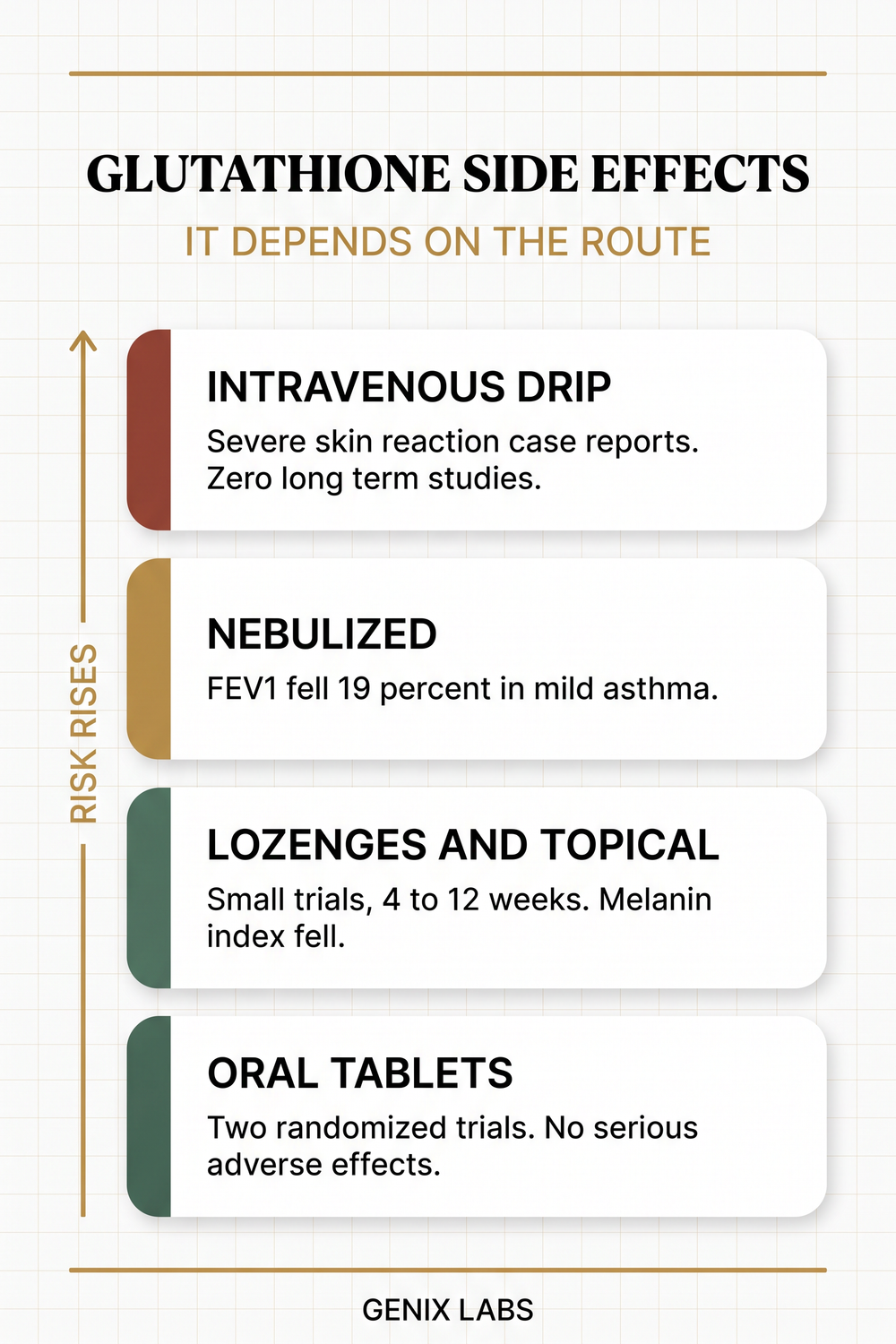
It depends entirely on how it is given. Oral glutathione has been through two randomized controlled trials in healthy adults and neither reported serious adverse effects. Nebulized glutathione caused real airway narrowing in people with mild asthma. Intravenous glutathione has published case reports of Stevens-Johnson syndrome, a severe skin and mucous membrane reaction, and a national regulator has issued a formal warning about it. Same molecule. Four very different safety files.
That sentence is the whole page in short form. Hold onto it, because it is the thing the popular lists leave out. A page that prints one list for all four routes is not answering your question. It is averaging four answers into something that is true of none of them.
- The route decides the risk. Pills, lozenges, nebulizers and drips have separate records.
- Two randomized oral trials found no serious adverse effects. They disagree on whether oral glutathione does anything.
- Nebulized glutathione dropped FEV1 by 19% in mild asthma. That is a real, measured harm.
- Intravenous glutathione has Stevens-Johnson syndrome case reports and a regulator warning.
- No study of long term intravenous glutathione exists, for skin lightening or anything else.
- One review raises a sun cancer question that no side effect list prints.
What is glutathione?
Glutathione is a small molecule your own cells build. It is made of three amino acids joined together, which makes it a tripeptide. Chemists write the sequence as gamma-Glu-Cys-Gly. Its molecular weight is about 307 daltons, which is tiny next to most research peptides.
It is often called the master antioxidant. The job is simple to describe. Reactive molecules build up inside cells and damage them. Glutathione hands over a hydrogen atom, neutralizes the reactive molecule, and becomes oxidized itself. An enzyme then recycles it back. That cycle runs constantly in every cell you have.
Two words matter for the rest of this page. Reduced glutathione, written GSH, is the active form. Oxidized glutathione, written GSSG, is the spent form. The ratio between them is how researchers measure oxidative stress. When you see a trial reporting a GSH to GSSG ratio, that ratio is the real endpoint.
Your body already makes it, in grams
This is the fact that reframes every side effect question. Glutathione is not a foreign compound. Your liver alone holds millions of molecules of it per cell. Healthy adults carry several grams of it at any moment. Levels fall with age, with heavy alcohol, with poor sleep and with illness.
So the body is not meeting glutathione for the first time when a supplement arrives. That is part of why the oral safety record is quiet. A molecule your cells manufacture by the gram is unlikely to poison you at 500mg a day.
It also sets up the real question. If your body already makes plenty, does swallowing more change anything? Two trials went looking. They came back with different answers, and that disagreement is where most of the confusion online begins.
How does glutathione work?
Three mechanisms get cited, and only the first is settled. One, it neutralizes reactive oxygen species directly, which is the antioxidant role. Two, it is the cofactor your liver uses in phase two detoxification, where it binds to a toxin so the toxin can be excreted. That is why glutathione is the antidote pathway in paracetamol overdose.
Three is the cosmetic one, and it is the shakiest. The idea is that glutathione interferes with tyrosinase, the enzyme that makes pigment, and pushes pigment production from brown eumelanin toward red and yellow pheomelanin. The 2026 review of all three routes calls this the biological hypothesis, then says plainly that translating it into real outcomes remains uncertain.
What does research actually use it for?
The honest list is shorter than the marketing list. Published human work clusters in four places. Reducing chemotherapy toxicity, where systematic reviews exist. Parkinson disease, where a small randomized pilot was run. Preventing kidney stress after a dye based heart scan. And skin lightening, which is where almost all the current demand sits.
Note what is missing. There is no large trial of glutathione for hangovers, for immunity, for energy or for general detox, which are the four reasons people most often buy it. Those uses rest on mechanism reasoning, not on outcome trials. That is not the same as being wrong, but it is a weaker kind of evidence and it should be labelled as such.
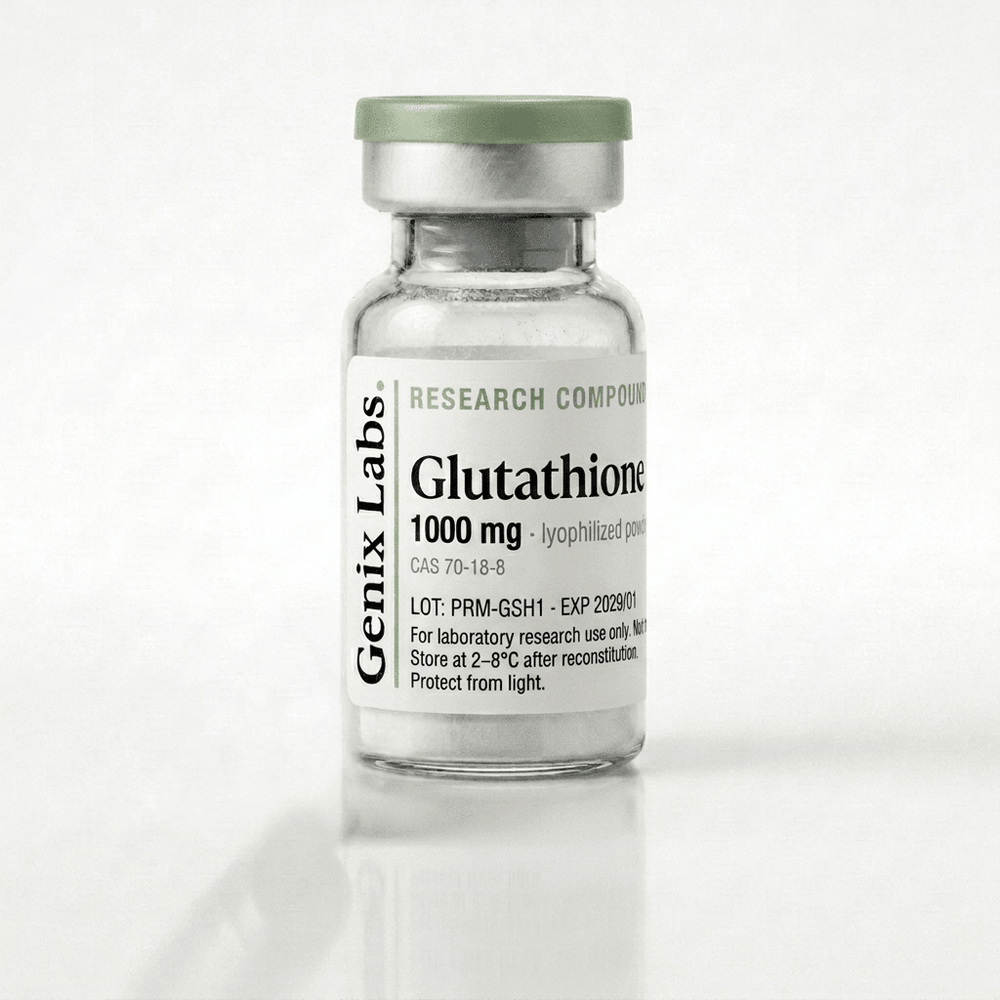
Everything Genix Labs supplies, glutathione included, is sold for laboratory research only. It is not for human or veterinary use. The studies below are described so you can read the evidence accurately, not as a protocol for anybody.
Why does the route change the answer?
Because the route decides how much reaches the blood, how fast, and what else arrives with it. A swallowed tablet meets stomach acid and gut enzymes first. Much of the tripeptide is broken into its three amino acids before absorption. The rise in blood levels, if there is one, is slow and small.
A drip skips all of that. The full amount lands in the bloodstream in minutes, at a concentration the gut could never produce. It also arrives with whatever else is in the bag, usually vitamin C, plus the preservatives and the handling of whoever prepared it. Those extras matter, and we deal with them below.
So when a page tells you glutathione is well tolerated, the useful reply is one word. Which route? The answer changes the risk by more than any dose number does.
What did the oral trials find?
Oral glutathione has something most research compounds never get. Two randomized, double blind, placebo controlled trials in healthy adults. Both are small. Both are real. Neither reported a serious adverse effect. And they reached opposite headline conclusions.
This is not a scandal. It is what happens when two teams measure different things over different timescales. Reading them side by side tells you more about oral glutathione than any list of symptoms will.
The 4 week trial that found nothing
In 2011, forty healthy adults were given 500mg of oral glutathione twice a day for four weeks, against placebo. The team measured urinary F2-isoprostanes and 8-OHdG, which are standard markers of oxidative damage. They also measured red blood cell glutathione, both forms, by mass spectrometry.
Nothing moved. The damage markers did not differ between groups at week four. Total reduced glutathione, oxidized glutathione and the ratio between them were all unchanged. The authors concluded that no significant changes were observed, including in glutathione status itself.
This is the trial quoted by every page that tells you oral glutathione does not absorb. The quote is fair. The conclusion drawn from it usually is not, because of what happened four years later.
The 6 month trial that found stores rose
In 2015, fifty four non smoking adults took either 250mg or 1000mg of oral glutathione daily, or placebo, for six months. This team did not measure damage markers as the primary endpoint. They measured body stores, in whole blood, red cells, plasma, lymphocytes and cells scraped from the inside of the cheek.
Stores rose. At six months the high dose group showed glutathione up 30 to 35% in red cells, plasma and lymphocytes, and up 260% in cheek cells. The low dose group rose 17% in whole blood and 29% in red cells. The oxidized to reduced ratio in whole blood fell, which points the right way. Natural killer cell activity more than doubled at three months in the high dose group.
Then came the detail that matters most. After a one month washout, levels returned to baseline. Whatever had been built up did not stay.
Why do those two trials disagree?
Three differences explain it. First, time. Four weeks against six months. If stores build slowly, a four week trial can easily miss it.
Second, the endpoint. The 2011 trial asked whether oxidative damage fell. The 2015 trial asked whether glutathione levels rose. Those are different questions. You can raise a level without reducing damage, especially in healthy people who had little damage to start with.
Third, the population. Both trials used healthy adults. Healthy adults have working glutathione systems and low baseline damage, so there is not much room to improve. A trial in healthy people is the hardest place to show a benefit and the easiest place to show safety.
What will happen if I take glutathione daily?
For the oral route, the published answer is modest and specific. Over six months at 250mg or 1000mg a day, body stores of glutathione rose, the oxidized to reduced ratio improved, and no serious adverse effects were reported. One immune marker, natural killer cell activity, more than doubled at three months on the higher amount.
What did not happen is also worth stating. A separate four week trial at 1000mg a day found no change in oxidative damage markers at all. So daily use raising a level is better supported than daily use producing a felt effect. Those two things get sold as one thing constantly.
And the gains were not permanent. One month after stopping, levels were back where they started. Glutathione behaves like a tap, not a reservoir. That is a fair thing to know before committing to anything long term.
What happens to your body when you start taking glutathione?
Less than the marketing suggests, at least measurably. In the six month trial, blood glutathione had already risen by month one, so the biochemical change starts early. But the four week trial found no change in oxidative damage markers over the same window.
On the cosmetic side, a twelve week trial of 250mg a day, in reduced and oxidized forms, reported that melanin index and ultraviolet spots tended to be lower than placebo, with some sites showing a significant wrinkle reduction and a trend toward better skin elasticity. The authors recorded no serious adverse effects across the study.
So the honest timeline is weeks to months, measured with instruments, not days. Anyone reporting a dramatic change within hours of a first oral amount is describing something other than what these trials found.
Glutathione tablets side effects
The tablet record is the quietest part of this whole topic. Across the two randomized trials and the twelve week cosmetic trial, the reported picture is the same. No serious adverse effects. That covers roughly 130 people, at amounts from 250mg to 1000mg a day, for four weeks to six months.
Mild effects do get reported outside trials. Stomach upset, loose stools, gas and a sulphur taste are the usual ones. These are plausible for a sulphur containing molecule passing through the gut, and they are the kind of thing small trials are underpowered to count properly. Grade them honestly as common report, not as trial finding.
What the tablet record cannot tell you is anything about years. The longest published trial is six months. Nobody has run a multi year study of oral glutathione. Absence of a signal over six months is reassuring. It is not the same as a clean bill of health for a decade.
What does the intravenous record actually hold?
This is where the topic turns. Intravenous glutathione is the version sold in clinics for skin lightening, hangovers and wellness drips. It is also the version with the serious published harms. And it is the version with almost no supporting evidence.
A 2016 review in the South African Medical Journal went looking for studies of intravenous glutathione for skin lightening. It found none. Not none that were good. None at all. The authors searched MEDLINE through September 2015 and concluded that despite widespread reported use, there are no studies of intravenous glutathione for skin lightening, or of its safety for chronic use for any indication.
That finding has not been overturned. A narrative review published in 2026, searching four databases from inception through March 2026, reached a similar place. The evidence is limited by small samples, differing methods, no standard outcomes and short follow up. Its conclusion is blunt. Current evidence is too limited to justify routine use for cosmetic skin lightening.
The Stevens-Johnson syndrome case report
In 2025, a burn care journal published a case. A 33 year old woman developed Stevens-Johnson syndrome and toxic epidermal necrolysis after an intravenous vitamin infusion containing glutathione, vitamin C and vitamin D.
Those two conditions need describing plainly, because the names hide how serious they are. They are severe reactions in which the skin and the linings of the mouth, eyes and other surfaces blister and peel away. They are treated in burn units. They carry high rates of lasting injury and death.
The authors noted that glutathione has been reported as the inciting agent in previous Stevens-Johnson cases. They also made a point that applies directly to anyone reading a side effect list. With the rise of lightly regulated drip clinics, doctors now have to ask patients about wellness infusions when hunting for the cause of a severe skin reaction.
Why a national regulator issued a warning
The Philippines is where intravenous glutathione for skin lightening became most widespread, and it is where the regulator acted. Concerns about the link between glutathione and Stevens-Johnson syndrome led the Philippine Food and Drug Administration to issue a warning about the potential association.
That detail is reported in the 2025 case report itself, which is why it belongs on this page rather than in a footnote. A regulator reviewing its own national adverse event reports and then publishing a warning is a different quality of signal from a forum thread. It is not a controlled trial. It is a real world safety flag raised by the body that collects the reports.
Note what the warning is about. Not the molecule in general. The intravenous route, used cosmetically, outside an approved indication. That distinction runs through this entire page.
Liver, kidney and hormone signals
The 2026 route by route review names the emerging concerns directly. It lists hepatotoxicity, meaning liver injury, hypersensitivity reactivity, meaning allergic type reactions, and potential renal and endocrine effects, meaning possible effects on the kidneys and on hormone systems such as the thyroid.
Read the wording closely, because the wording is the finding. Potential. These are flagged concerns that complicate the risk and benefit balance, not demonstrated rates. The same review says the literature is too small and too short to settle them, and calls for adequately powered randomized trials and prolonged safety studies.
That is an uncomfortable answer and it is the correct one. The signals exist in the literature. The studies that would confirm or dismiss them have not been run.
Can glutathione cause kidney problems?
There is no trial showing that it does, and no trial large enough to show that it does not. The 2026 review lists potential renal effects among the emerging safety concerns for the intravenous route, without reporting a rate, because no study has measured one.
There is a twist worth knowing. The best quality kidney data on glutathione points the other way. A 2011 trial found that intravenous glutathione prevented kidney oxidative stress after coronary angiography more effectively than oral N-acetylcysteine. In that setting it protected the kidney rather than harming it.
So the fair summary has two halves. In a controlled hospital setting, for a short course, against a specific kidney stress, glutathione performed well. For repeated cosmetic drips over months or years, nobody has looked. The concern in the review is about the second situation, not the first.
Glutathione side effects on skin
Skin is the reason most people take it and the place the risks are least discussed. The documented skin problems fall into two groups that could not be further apart in severity.
The first group is severe reactions. Stevens-Johnson syndrome and toxic epidermal necrolysis, described above, are skin events. They are rare and they are catastrophic. Every published example involves the intravenous route.
The second group is the pigment change itself, which is the intended effect. Whether that is a side effect depends on a mechanism question that is genuinely unresolved, and that almost no page covers.
The switch from brown pigment to red
The proposed mechanism for skin lightening is not that glutathione removes pigment. It is that it redirects which pigment gets made. Human skin makes two kinds. Eumelanin is brown and black. Pheomelanin is red and yellow. Glutathione is thought to block tyrosinase and push production toward pheomelanin.
Here is the part that matters. Those two pigments are not cosmetically different versions of the same thing. Brown eumelanin is the one that absorbs ultraviolet light and shields the cell nucleus underneath. Red pheomelanin is a much weaker shield. It is the pigment that predominates in people who burn rather than tan.
Does glutathione raise skin cancer risk?
No study has measured that, and the question deserves a straight answer about why it is being asked. The 2016 South African Medical Journal review raised it as a specific concern. Its wording is that the switch from brown to red melanin production may increase the risk of sun induced skin cancers in previously protected individuals.
Read the condition in that sentence. Previously protected individuals. The concern applies most to people with naturally darker skin, whose brown pigment was doing real protective work, who then lighten it in a high ultraviolet environment. Which describes a large share of the people buying skin lightening drips across tropical Asia.
Grade this correctly. It is a mechanism based concern raised in a peer reviewed review, not a measured outcome. There is no trial of skin cancer rates after glutathione use, and there probably never will be, because it would take decades. But it is the single most important unanswered question in this file, and you will not find it on a vendor page.
The asthma finding almost nobody prints
This is the clearest documented harm in the entire glutathione literature, and it is missing from nearly every side effect page. It concerns inhaled glutathione, which is sold in some places in nebulizer form.
In 1997, eight patients with mild asthma were given nebulized glutathione or matched saline placebo, in a randomized, double blind, crossover design, one week apart. Lung function was measured by FEV1, the volume you can force out in one second, and by total pulmonary resistance.
The glutathione arm caused major airway narrowing. FEV1 fell 19% from baseline. Resistance rose 61%. Four of the eight patients coughed. Three became breathless. The placebo arm moved barely at all, with FEV1 down 1%.
Why sulfite explains the asthma result
The team did not stop at the measurement. They tested what was causing it. Osmolarity did not explain it. Neither did pH. But the size of each patient's FEV1 fall tracked their sensitivity to metabisulfite, and did not track their sensitivity to methacholine.
That pattern points at one thing. Sulfite. Glutathione contains sulphur, and the authors concluded that the bronchoconstriction was provoked by sulfite formation. In other words it is not the antioxidant action causing trouble. It is a chemical byproduct hitting airways that are already sulfite sensitive.
This is a textbook example of why mechanism matters. It predicts who is at risk, which a bare list never can. People with asthma, and especially people with known sulfite sensitivity, are the group this finding is about.
What to avoid when taking glutathione?
Four things come straight out of the published record rather than from guesswork.
- Inhaled or nebulized forms if you have asthma or known sulfite sensitivity. This is the one route with a randomized trial showing measured airway narrowing.
- Unregulated drip clinics. The published severe reactions come from intravenous infusions, and the 2025 case report specifically flags the rise of lightly regulated infusion centres.
- Assuming vitamin C in the bag is inert. It is almost always co-administered, and reviewers say it makes the independent effect of glutathione impossible to isolate.
- Treating a pill study as a drip study. Most reassuring safety sentences online come from oral trials and are quoted to defend intravenous use.
Notice what is not on that list. There is no published drug interaction table for glutathione of the kind you would see for a prescription medicine, because the interaction studies have not been done. Anyone printing a confident interaction list is reasoning from the molecule, not reporting from a study.
The vitamin C problem
Nearly every glutathione drip contains vitamin C as well. The 2026 review names this as a specific analytical problem. Regular co-administration of vitamin C has made it difficult to know the independent effect of intravenous glutathione in those individuals.
That cuts both ways, and this is the useful part. If you cannot attribute the benefit to glutathione alone, you cannot attribute the harm to it alone either. The 2025 Stevens-Johnson case involved glutathione, vitamin C and vitamin D together. The authors were careful about that, and so should any page summarising it be.
It also means the drip you are comparing against a trial is probably not the thing the trial studied. Different bag, different additives, different preparation, different everything.
What the Indonesian trial measured
One trial deserves a mention here because of where it was run. A multicentre, randomized, double blind controlled trial across three teaching hospital dermatology clinics in Indonesia tested an oral supplement combining L-glutathione from fermentation with ascorbic acid, alpha lipoic acid and zinc aspartate, as a skin lightening agent. It is registered as NCT04105504.
The trial matters for two reasons. It is one of the few properly randomized skin lightening trials in the exact population most affected, people with Fitzpatrick skin types IV and V. And it used the oral route, which is the route with the better safety record.
It also illustrates the combination problem again. The supplement contained four active ingredients. Any result belongs to the combination, not to glutathione by itself. That is a limitation the authors are clear about and most summaries are not.
Where does the real intravenous safety data come from?
Not from cosmetic clinics. It comes from oncology and neurology, where glutathione was given intravenously for medical reasons and somebody counted what happened.
The 2016 review pulled this together. Two systematic reviews covered intravenous glutathione for preventing chemotherapy induced toxicity. A third covered it as an add on therapy in Parkinson disease. Between them they included ten trials. Most of those trials reported either no adverse effects or minimal ones.
That sounds reassuring, and partly it is. But read the limitation the reviewers attached to it. Every one of those trials ran either a few intravenous doses, or four to twelve weeks. Not one studied long term use. So the medical evidence base for intravenous glutathione safety is short course evidence being used to defend indefinite cosmetic use.
The 21 patient Parkinson trial
It is worth looking at the best controlled intravenous safety data in detail, because most people assume it is bigger than it is. A 2009 randomized, double blind, placebo controlled pilot trial gave intravenous glutathione to patients with Parkinson disease whose symptoms were not well controlled on their medication.
The amount was 1,400mg intravenously, three times a week, for four weeks. Twenty one patients were randomized. Eleven received glutathione and ten received placebo. One withdrew for personal reasons before any assessment.
On safety the result was clean. Glutathione was well tolerated. There were no withdrawals because of adverse events in either group. Reported adverse events were similar between the two groups. The authors stated plainly that no safety concerns were identified.
On benefit it was less clear. There was no significant difference in Parkinson rating scale scores. Scores improved slightly more on glutathione during treatment, then worsened slightly more in the eight weeks after. Neither movement was statistically significant. The authors called it a possible mild symptomatic effect needing a larger study.
So the strongest controlled evidence that intravenous glutathione is safe rests on eleven people, for four weeks, under medical supervision, in 2009. That is the foundation under every reassuring sentence written about drips since.
Does swallowed glutathione even reach the blood?
This is the mechanism question under the two disagreeing trials, and it has a specific answer. Glutathione is a tripeptide, so the gut treats it like food protein. Enzymes in the small intestine split peptide bonds. Much of the molecule arrives as its three separate amino acids, glutamate, cysteine and glycine, rather than intact.
Then the liver gets first look at whatever did survive. Blood from the gut goes to the liver before it reaches the rest of the body, and the liver is the organ that consumes glutathione most heavily. So even intact molecules face a second filter before general circulation.
That explains both trials at once. If most of an oral amount arrives as building blocks, your cells can use those blocks to make more glutathione slowly, which is what rising body stores over six months would look like. But you would not see a sharp change in damage markers over four weeks, because nothing dramatic reached the tissues in that window.
Two consequences follow for a safety page. First, the oral route is gentle partly because it is inefficient. Second, you cannot transfer its gentleness to a drip, which bypasses both filters entirely.
Why hospitals reach for N-acetylcysteine instead
There is a clue in how emergency medicine actually handles glutathione depletion. When paracetamol overdose strips the liver of glutathione, hospitals do not give glutathione. They give N-acetylcysteine, which is a precursor the body converts into cysteine and then into glutathione.
The reasoning is delivery. A precursor enters cells more readily than the finished tripeptide does, so supplying the rate limiting raw material works better than supplying the product. That is a practical judgement made under time pressure in real hospitals, which gives it weight.
One study complicates the picture in glutathione's favour. In 2011, intravenous glutathione prevented kidney oxidative stress after coronary angiography more effectively than oral N-acetylcysteine. Note the mismatch though. Intravenous against oral. That comparison tests the route as much as it tests the molecule.
Why does every side effect list match?
Because they share a parent, not a study. Someone wrote a plausible list of mild complaints years ago. The next page copied it. Agreement spread, and agreement looks like evidence when enough pages repeat it.
You can test this in under a minute. Open any glutathione side effect page and look for a citation attached to the list itself, not somewhere else on the page. You will rarely find one. Then check whether the page names a route. Most do not.
The echo also explains an odd absence. The findings with the strongest evidence behind them, the 19% drop in lung function in asthma and the severe skin reactions from drips, are the ones least likely to appear. They entered the literature after the list was already written, and nobody went back to update the copy.
Who did the studies leave out?
Knowing who was never studied is as useful as knowing what was found. The oral trials used healthy adults, and the six month trial specifically recruited non smokers. The twelve week cosmetic trial used healthy female volunteers.
So the published safety record says nothing about several large groups. Pregnant and breastfeeding people were not studied. People with existing kidney or liver disease were not studied. Children were not studied. People with asthma were studied only in the nebulized trial, and that is the trial where harm was measured.
This is the gap that turns an absence of reported side effects into something weaker than it sounds. No serious adverse effects in healthy non smoking adults over six months is a real finding. It is not a statement about anybody outside that description.
How should a glutathione claim be graded?
Grade by what produced the claim, not by how often you have seen it. A number from a randomized controlled trial is the strongest thing on offer. A case report proves an event is possible. A regulator warning reflects collected real world reports. Mechanism reasoning is a prediction. A forum post is a hypothesis.
| Tier | What it means | What glutathione has here |
|---|---|---|
| A. Randomized controlled trial | Counted and published, with a placebo arm | Three oral trials. One nebulized trial. All small |
| B. Systematic or narrative review | Pooled appraisal of the whole literature | Several, 2016 through 2026. All say the evidence is thin |
| C. Case report | A documented single event | Stevens-Johnson syndrome after an IV infusion |
| D. Regulator warning | Collected national adverse event reports | Philippine FDA, on IV glutathione and Stevens-Johnson |
| E. Mechanism reasoning | Predicted from how the molecule behaves | The pheomelanin and sun cancer concern |
| F. Uncontrolled self report | Someone online said it happened | Most of the lists you have read |
Every claim in the table below gets one of those tiers. Where something sits at tier F, we say so rather than dressing it up as a finding.
Every claimed side effect, graded
| Claimed effect | Route it belongs to | Tier | What the record actually says |
|---|---|---|---|
| Stevens-Johnson syndrome, toxic epidermal necrolysis | Intravenous | C and D | Published 2025 case report, plus a national regulator warning. Rare, severe, real |
| Bronchoconstriction, cough, breathlessness | Nebulized or inhaled | A | FEV1 fell 19%, resistance rose 61% in mild asthma. Attributed to sulfite formation |
| Liver injury | Intravenous | E | Named as an emerging concern in the 2026 review. No rate published |
| Kidney effects | Intravenous | E | Listed as potential in the 2026 review. A 2011 trial found kidney protection instead |
| Thyroid or other hormone effects | Intravenous | E | Listed as potential endocrine effects. No trial has measured it |
| Allergic and hypersensitivity reactions | Intravenous | E and C | Flagged in review, and the severe skin cases are hypersensitivity events |
| Higher sun cancer risk in darker skin | Any systemic route | E | Mechanism concern from the 2016 review. Pigment shifts from brown to red. Never measured |
| Stomach upset, loose stools, gas | Oral | F | Commonly reported, not a finding in the randomized trials, which saw no serious effects |
| Sulphur taste or smell | Oral | F | Plausible for a sulphur containing molecule. No trial counted it |
| Zinc depletion with long use | Oral | F | Repeated online, traced to no study we could find |
| Permanently stopping your own production | Oral | F | Not what the washout data shows. Levels returned to baseline, they did not fall below it |
Two things stand out when it is laid out this way. The severe entries all belong to the intravenous route. And the entries that appear on almost every list, the stomach complaints, sit at the weakest tier in the table.
What is known about interactions?
Very little, and the honest version of that sentence is useful. There is no published interaction study programme for glutathione of the kind a licensed medicine goes through. What exists is reasoning from the pathways it sits in.
Two pieces of that reasoning are grounded in real data. Vitamin C is almost always given alongside intravenous glutathione, and reviewers say this confounds both the benefit and the harm. And glutathione is the pathway paracetamol overdose depletes, which is why N-acetylcysteine, a glutathione precursor, is the hospital antidote. That is a genuine pharmacological relationship, documented in emergency medicine.
Everything beyond those two is prediction. If a page gives you a confident list of drugs that interact with glutathione, check whether a single citation sits next to that list. Usually none does.
What about an overdose or a missed amount?
No published overdose threshold exists for glutathione. There is no established toxic amount in humans, because the trials stopped at 1000mg a day orally and nobody has run a dose escalation study to find a ceiling.
The missed amount question answers itself from the washout data. One month after stopping a six month course, levels were back at baseline. A molecule that clears that completely in weeks does not have a meaningful missed dose problem. It also does not accumulate into a reservoir, which is the other half of the same fact.
Genix Labs supplies glutathione for laboratory research only, so we publish no human amounts and no schedules. Our guide to calculating peptide concentrations covers the arithmetic researchers use to work out what is in a vial, which is a different question from what anyone should do with it.
The risks nobody puts on the list
Every risk so far has been a molecule risk. There is a second category, and for a lyophilized research vial it is the category that actually goes wrong. Call them vial risks. They have nothing to do with glutathione chemistry and everything to do with what is in the glass.
Vial risks are shared by every research compound, which is why they never appear on a compound specific side effect page. They are also the only risks on this page you can check before anything happens.
What if the vial is not what the label says?
Then every safety discussion above is irrelevant, because you are not studying glutathione. Identity is the first thing to establish and the easiest to fake. A printed label is a claim. A mass spectrometry result tied to a lot number is a measurement.
This is what LC-MS identity testing is for. It confirms the molecular weight of what is in the vial matches the compound named. For glutathione that target is about 307 daltons. HPLC then reports purity as an area percentage, which tells you how much of the signal is the main peak rather than something else.
Endotoxin, sterility and the drip problem
Endotoxin is a fragment of bacterial cell wall. It survives processes that kill the bacteria themselves, and it causes fever and inflammatory reactions. It is the reason sterility and endotoxin limits exist as separate tests for anything intended for injection.
This links straight back to the clinic drip question. The 2025 case report flagged lightly regulated infusion centres. Preparation, handling and sterility sit entirely with whoever mixes the bag. A purity certificate for a powder says nothing about how a third party reconstituted and administered it.
Water, storage and handling
The diluent is part of the experiment. Using the wrong water, or water that has been open too long, introduces variables and contamination risk that get blamed on the compound. Our guides on reconstituting peptides and on storage in a tropical climate cover this in detail, and the tropical part is not a small detail. Heat and humidity degrade lyophilized material faster.
Genix Labs ships cold packed and fully tracked, with same day delivery inside Bali and cold chain shipping across Southeast Asia, Europe and Australia. A broken cold chain is a quiet failure. Nothing looks different and the material is no longer what the certificate described.
What a lot report rules out
A certificate of analysis is narrow on purpose, and knowing its edges makes it more useful, not less. The published Genix Labs lot document for glutathione, lot 264817, reports 99.20% HPLC area purity at the 1000mg size, with LC-MS identity confirmation.
Here is exactly what that rules out and what it does not. It rules out the wrong molecule. It rules out gross contamination showing as extra peaks. It does not establish content, meaning how many milligrams are really in the vial. It does not establish sterility. It does not establish safety or efficacy. And the result applies only to the printed lot, not to every vial a vendor has ever sold.
Confirm the lot number on the vial matches the document. A certificate for a different lot is a certificate for a different batch of material. You can see the current glutathione lot report alongside the product listing.
Which vendor claims are red flags?
- Any purity number without a lot number next to it. Purity is a property of a batch, not of a brand.
- A side effect list with no route named. If it does not say pill, lozenge, nebulizer or drip, it is not answering the question.
- Reassuring safety language sourced from oral trials but printed beside an intravenous product.
- Claims that glutathione treats, cures or prevents anything. No trial supports that and no compliant supplier says it.
- A drip offered with no sterility or preparation information. That is where the documented severe reactions came from.
- Confident drug interaction tables. The interaction studies have not been published.
How much does glutathione cost?
A Genix Labs 1000mg glutathione vial is USD 63, or Rp 1.000.000, with the batch certificate of analysis included. Clinic drips across Southeast Asia commonly run USD 80 to USD 250 per session, usually with no purity paperwork attached at all.
The gap is documentation, not molecule. A session price buys administration. A vial price with a published lot report buys a measurement you can check. Given that the serious published harms in this file came from infusions prepared by third parties, that difference is not only about money.
What would actually settle this?
Three studies, and the reviewers have already named them. First, an adequately powered randomized controlled trial of intravenous glutathione with a real placebo arm and glutathione given alone, not beside vitamin C. That single design would resolve most of the confusion on this page.
Second, a prolonged safety study. Everything published runs four weeks to six months. The use being sold runs for years. That gap is the whole problem.
Third, a long term follow up in people with darker skin who lightened it, measuring sun damage and skin cancer rates. That is the one study that would answer the pheomelanin question. It would take decades and nobody has started it.
Read any glutathione claim in 30 seconds
- Which route? Pill, lozenge, nebulizer or drip. If the page does not say, stop reading.
- Which tier? Randomized trial, review, case report, regulator warning, mechanism or forum post.
- How long? Four weeks and six months are the only durations in the oral record. Nothing is longer.
- What else was in it? Vitamin C beside glutathione means the finding belongs to both.
- Is there a lot number? A purity figure without one describes nothing in particular.
- Does it claim to treat anything? If yes, it is marketing, whatever else is on the page.
Frequently asked questions
What will happen if I take glutathione daily?
In a 6 month randomized trial at 250mg or 1000mg a day, body stores of glutathione rose 30 to 35% in red cells, plasma and lymphocytes, with no serious adverse effects reported. A separate 4 week trial at 1000mg a day found no change in oxidative damage markers. One month after stopping, levels returned to baseline.
What to avoid when taking glutathione?
Four things come from the published record. Inhaled or nebulized forms if you have asthma or sulfite sensitivity. Unregulated drip clinics, where the documented severe reactions occurred. Assuming the vitamin C in a drip is inert, since reviewers say it confounds every result. And treating oral trial safety data as if it covered intravenous use.
Can glutathione cause kidney problems?
No trial has shown that it does. A 2026 review lists potential renal effects among emerging concerns for the intravenous route, without a rate, because none has been measured. A 2011 trial found the opposite in one setting, where intravenous glutathione protected the kidney after coronary angiography better than oral N-acetylcysteine.
What happens to your body when you start taking glutathione?
Less than the marketing suggests. Blood glutathione had already risen by month one in the 6 month trial, so the biochemical change starts early. But a 4 week trial found no change in oxidative damage markers. A 12 week cosmetic trial at 250mg a day saw melanin index trend lower, with no serious adverse effects recorded.
Does glutathione have side effects on the skin?
Two very different kinds. Severe hypersensitivity reactions, including Stevens-Johnson syndrome and toxic epidermal necrolysis, are documented after intravenous infusions. Separately, the lightening effect itself shifts pigment from brown eumelanin toward red pheomelanin, which one review flagged as a possible sun cancer risk in previously protected skin.
How much does glutathione cost?
A Genix Labs 1000mg glutathione vial is USD 63, or Rp 1.000.000, with the batch certificate of analysis included. The published lot shows 99.20% HPLC area purity and LC-MS identity confirmation. Purity is a lot-specific result and is not a statement of content, sterility, safety or efficacy. Supplied for laboratory research only.
Takeaway
Glutathione does not have one side effect profile. It has four, one per route, and they are not close to each other. The oral record is the quiet one. Two randomized controlled trials, up to 1000mg a day for six months, no serious adverse effects, and an honest disagreement about whether anything measurable happens.
The serious published harms belong to the needle. A Stevens-Johnson syndrome case report. A national regulator warning. Liver, kidney and hormone concerns named in a 2026 review as potential and unmeasured. And zero studies of long term intravenous use, for skin lightening or for anything else.
Then there is the question nobody is asking. Skin lightening works, if it works, by trading brown pigment for red. Brown pigment is the one that blocks ultraviolet light. A peer reviewed review raised that as a sun cancer concern in 2016 and it has still never been measured.
For a research setting, the controllable risks are the vial risks. Identity, purity, lot traceability, sterility, the diluent and the cold chain. Those you can verify before anything is opened. Read the pillar hub on longevity peptides for how glutathione sits beside NAD+ and GHK-Cu, or read our deeper piece on glutathione injection evidence.