Search NAD+ side effects and the same short list comes back. Flushing. Nausea. Chest tightness. Maybe fatigue. Almost nobody tells you which molecule that list belongs to, and four different molecules are sold under the NAD name. One of them has 544 patients and a full year of randomized data. One of them has a single pilot study. The list you were shown probably came from neither. This page sorts the whole file by molecule, grades every claim by what produced it, and names the one thing the published record actually caught.
What are the side effects of NAD+?
It depends on which molecule and which route. Oral NAD+ precursors have a quiet record. Pooled randomized trials of NMN and of nicotinamide riboside found no rise in adverse events, no rise in serious events, and no liver enzyme changes against placebo. Infused NAD+ is different. The sensations people report, chest pressure, flushing, nausea and abdominal cramping, track how fast the drip runs. Plain nicotinamide at 1000mg a day for a year produced no excess adverse events in 544 randomized patients.
That paragraph is the whole page in short form. Hold onto one idea from it. The route and the molecule decide the answer, and a page that prints one list for all of them is averaging four answers into something that is true of none of them.
- Four molecules share the NAD name. Their safety files are separate and not interchangeable.
- The strongest long term data belongs to plain nicotinamide. 544 patients, 1000mg a day, 12 months, no excess adverse events.
- Pooled NMN trials, 250 to 2000mg a day for up to 24 weeks, found no rise in adverse events or liver enzymes.
- Nicotinamide riboside raised blood NAD+ by 22 to 142% and caused no flushing at all.
- Infusion sensations are rate linked. In the one human infusion study, plasma NAD+ had not moved for two hours.
- Nothing published on any of these molecules runs beyond one year. That is the honest limit.
One name, four molecules
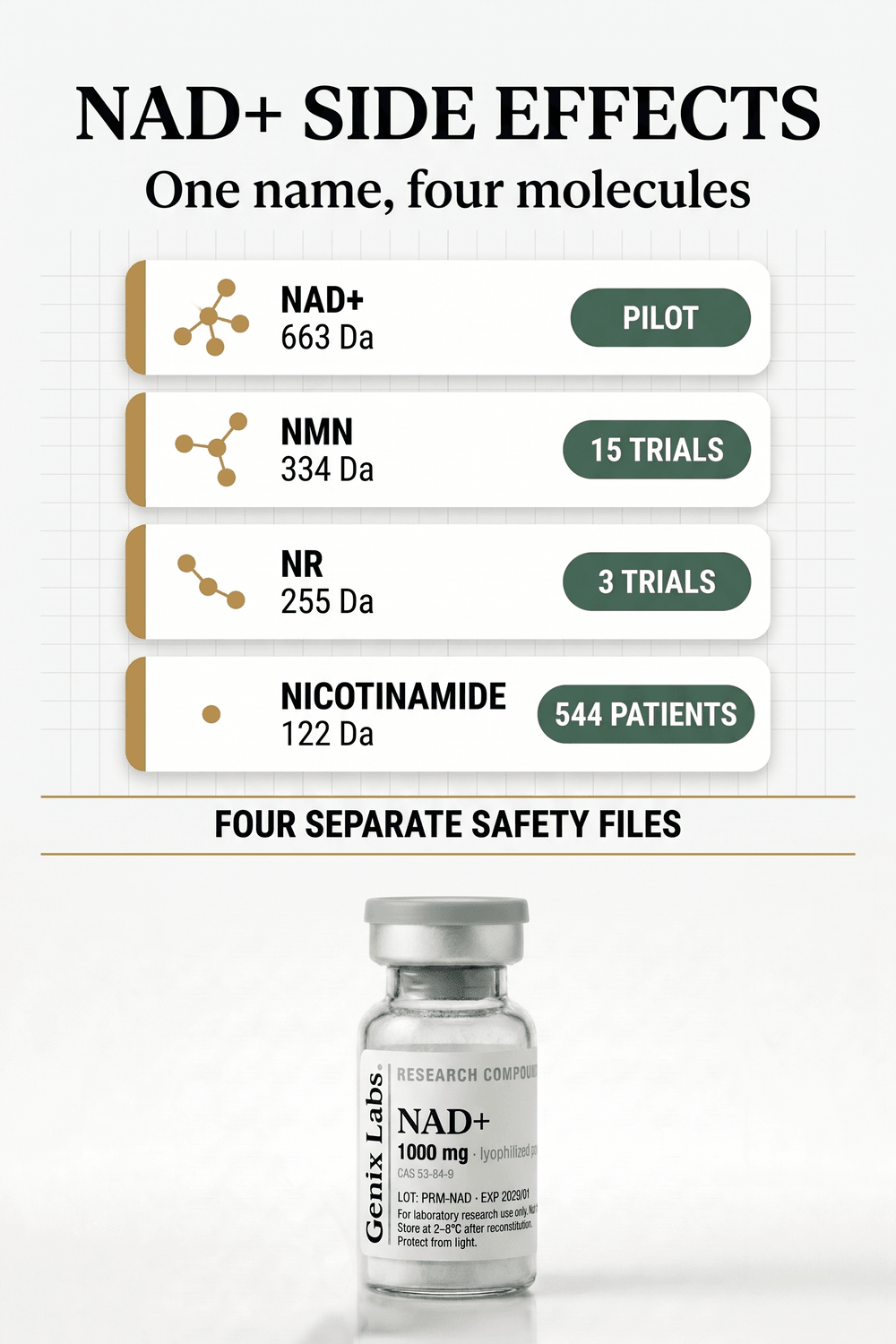
This is the fact that reorganizes everything else. When a page says NAD+, it may mean any of four separate compounds, and they are not the same size, not given the same way, and not backed by the same evidence.
- NAD+ itself. The finished coenzyme, about 663 daltons. This is what is in an intravenous drip, an injection, and a research vial.
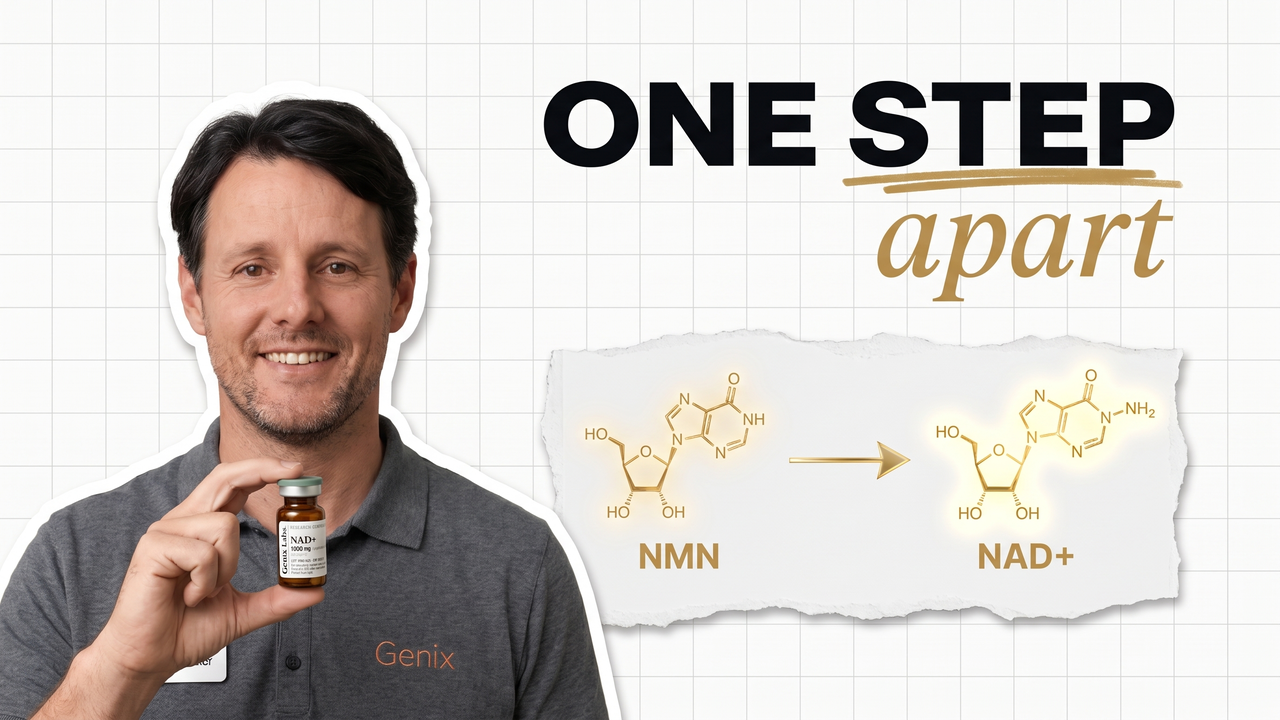
- NMN, nicotinamide mononucleotide. About 334 daltons. One enzymatic step before NAD+. Usually a capsule.
- NR, nicotinamide riboside. About 255 daltons as the free cation. Two steps before. Usually a capsule.
- Nicotinamide. About 122 daltons. Plain vitamin B3, the smallest and cheapest of the four, sold for a century.
A fifth molecule sits nearby and causes most of the confusion. Nicotinic acid, also called niacin, is the form that makes people flush bright red. It is a different molecule from nicotinamide despite the near identical name, and the flush belongs to it alone. We come back to that below, because half the internet attributes the niacin flush to NAD+.
Which molecule is the claim about?
This is the single most useful question to ask of any NAD+ side effect claim. Three quick checks sort almost every page you will read.
- Does it say flushing? That is almost certainly nicotinic acid, not NAD+ and not nicotinamide.
- Does it say chest pressure during the session? That is an infusion report, so it belongs to the drip and the rate, not to a capsule.
- Does it cite a trial at all? If the numbers have no study behind them, the list is copied, and copied lists are where errors live.
What is NAD+ and what does NAD stand for?
NAD stands for nicotinamide adenine dinucleotide. The plus sign marks the oxidized form, the one ready to accept electrons. It is a coenzyme, which means it is a helper molecule an enzyme needs in order to work. Every living cell you have contains it.
It is not a vitamin, although the question comes up often. It is built from vitamin B3 inside your cells. The B3 you eat, or swallow in a capsule, is raw material. NAD+ is the finished part. That distinction explains why a capsule and a drip behave so differently.
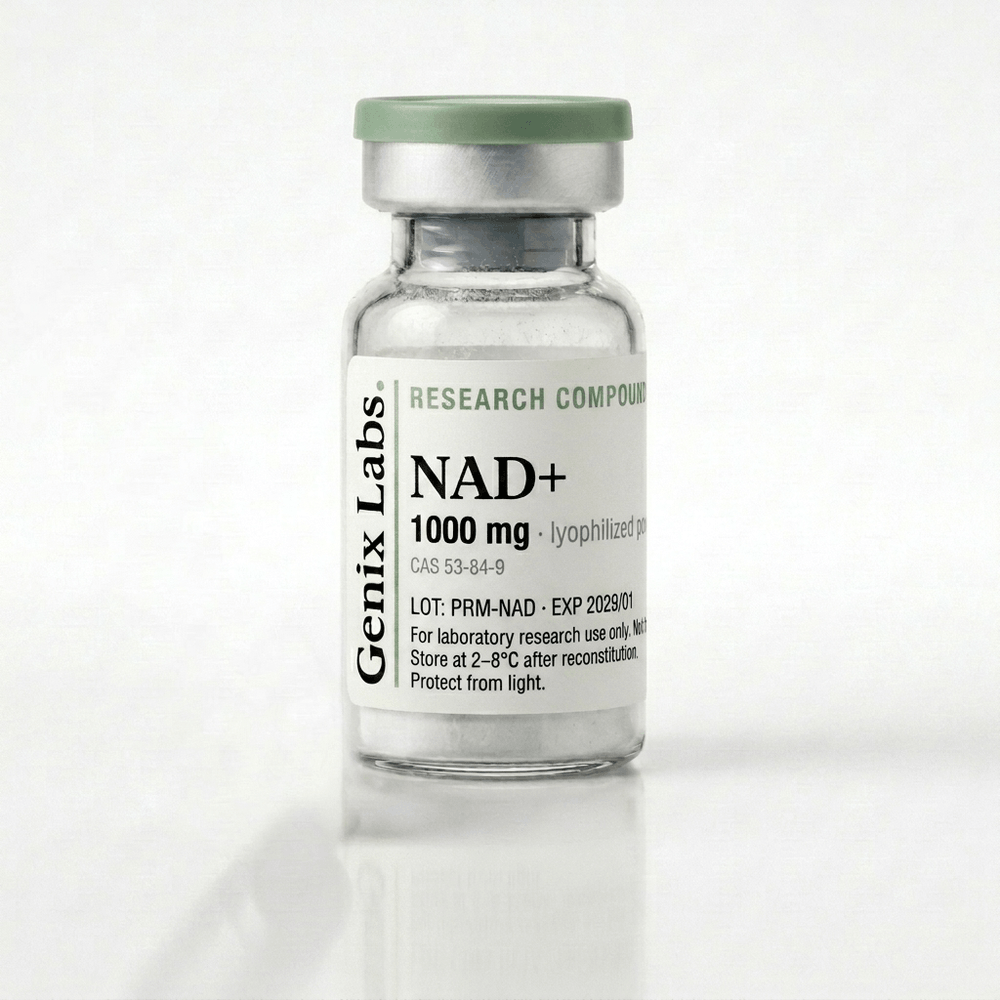
Its molecular weight is about 663 daltons, with CAS number 53-84-9. That is large for something expected to cross a cell membrane, and it is a clue to where some of the argument about infusions comes from.
How does NAD+ work in a cell?
Two jobs, and both matter for the safety discussion. The first is energy. NAD+ carries electrons from the food you break down into the mitochondria, the small structures that make cellular fuel. It picks up electrons, becomes NADH, drops them off, and goes back to being NAD+. That cycle runs millions of times a second.
The second job is as a consumable. Certain enzymes do not borrow NAD+, they spend it. Sirtuins, which are linked to repair and aging research, use it up. So do PARP enzymes, which respond to DNA damage. Every time one of those fires, a NAD+ molecule is destroyed and has to be rebuilt.
That second job is why the compound became a longevity target, and it is also why a careful reader raises an eyebrow. Anything that raises the fuel supply of a repair pathway is worth asking questions about. We take that question seriously in the cancer section, because it has a real literature behind it.
Why do NAD+ levels fall?
Levels decline with age in multiple tissues, which is the observation the whole field is built on. The leading explanations are an increase in the enzymes that consume NAD+, chronic low grade inflammation raising that consumption further, and a drop in the salvage pathway that recycles nicotinamide back into NAD+.
Note what that implies. If the decline is driven by consumption rather than by a shortage of raw material, then adding more raw material may or may not fix it. Several trials have gone looking for the downstream benefit and come back with nothing, and we list those honestly below rather than quietly skipping them.
What does research actually use NAD+ for?
The honest list is shorter than the marketing list. Published human work clusters in a few places. Insulin sensitivity and metabolic measures, where several randomized trials exist and results are mixed. Blood pressure and arterial stiffness, where one crossover trial found a signal worth following. Skin cancer prevention, where nicotinamide has two full phase 3 trials. And sleep and ophthalmic measures, which the Japanese NMN work tracked as safety endpoints.
Notice what is missing. There is no large trial of NAD+ for hangovers, for addiction recovery, for chronic fatigue or for general anti aging, which are four of the most common reasons people seek out a drip. Those uses rest on mechanism reasoning, not outcome trials. That is not the same as being wrong, but it is a weaker kind of evidence and it should be labelled as such.
Everything Genix Labs supplies, NAD+ included, is sold for laboratory research only. It is not for human or veterinary use. The studies below are described so you can read the evidence accurately, not as a protocol for anybody.
Why does the route change the side effect list?
Because the route decides how much arrives, how fast, and what arrives with it. A swallowed capsule meets stomach acid and gut enzymes. A large coenzyme does not survive that intact, so oral products use the smaller precursors instead and let your cells do the final assembly. The rise in blood levels is gradual.
An infusion skips all of it. The full amount enters the bloodstream over hours at a concentration the gut could never produce. It also arrives with whatever else is in the bag, and with the preparation and handling of whoever mixed it.
So when a page tells you NAD+ is well tolerated, the useful reply is two words. Which molecule, and which route. Those two answers change the risk picture more than any amount number does.
What did the only human infusion study find?
In 2019 a research group published the first look at what happens to infused NAD+ in a human being. It was a pilot, and it remains the only published human infusion pharmacokinetic work of its kind. The infusion ran for six hours at about 3 micromoles a minute, which works out to roughly 2mg a minute, or around 700mg across the session.
The result surprised the authors. Plasma NAD+ did not change. Neither did nicotinamide, methylnicotinamide, ADP ribose or NMN. Not for the first two hours. The authors concluded that at that rate the infused NAD+ was being rapidly and completely removed from plasma. By hour six, urinary methylnicotinamide and NAD+ were up, so the molecule was clearly being processed and excreted.
Where do the drip sensations actually come from?
Here is the mismatch that makes this page worth reading. The sensations clinics consistently describe, a pressure in the chest, flushing, nausea, stomach cramping, start within the first minutes of a session. The plasma data says the molecule is not measurably there yet.
No controlled study has established the mechanism, so this has to be graded honestly as an open question. What the timing does rule out is the explanation most pages imply, which is that these feelings are the body responding to a high NAD+ level. They are not, because the level has not risen yet.
What the clinic reports agree on is the one practical finding in this whole area. The sensations track the rate. Run the drip slower and they ease. Run it faster and they intensify. That is a dose rate relationship, not a toxicity.
Why does the rate matter more than the amount?
A rate effect and a toxicity behave differently, and telling them apart is useful. A toxicity scales with total exposure. A rate effect scales with how fast the exposure arrives and fades when you slow it down.
Everything reported about infused NAD+ fits the second pattern. The same total amount given over six hours is described as uneventful. Given over one hour it is described as rough. That is the signature of a rate effect.
How often can you get NAD injections?
No trial has established a schedule, and that is the real answer. The published human infusion work consists of one six hour session in a pilot study. There is no randomized trial comparing weekly to monthly, no dose finding study, and no published safety data on repeated infusions at all.
Clinic schedules, typically a loading run of consecutive days followed by monthly sessions, come from practice patterns rather than from trials. They may be reasonable. They are not evidence based in the sense that word usually carries, and anyone presenting them as established protocol is overstating the file.
Genix Labs supplies NAD+ for laboratory research only. We do not publish human schedules and this page is not one.
What did the oral nicotinamide riboside trials find?
NR has the cleanest dose response data in the family. An eight week randomized, double blind, placebo controlled trial in 140 overweight but otherwise healthy adults tested 100, 300 and 1000mg a day. Whole blood NAD+ rose 22%, 51% and 142% respectively, within two weeks, and stayed up.
On safety the trial reported no flushing at all, no significant difference in adverse events between NR and placebo or between the dose groups, no elevation of LDL cholesterol, and no dysregulation of one carbon metabolism. That last point matters and we return to it in the methyl group section.
One disclosure belongs here. That trial was funded by the company that sells the ingredient, and two authors were employees while a third was the inventor of the licensed intellectual property. The study design is sound and the data are useful. The funding is still worth knowing, and a page that hides it is not being straight with you.
A separate investigator initiated trial pushed higher. Forty obese, insulin resistant men took 1000mg of NR twice daily, so 2000mg a day, for twelve weeks. No serious adverse events were attributed to NR and the safety bloods were normal. Insulin sensitivity, glucose disposal, energy expenditure, lipolysis and body composition were all unchanged.
A third trial, a six week crossover in healthy middle aged and older adults at 1000mg a day, reported that chronic supplementation was well tolerated and effectively stimulated NAD+ metabolism, with an early signal for lower blood pressure and arterial stiffness worth testing properly.
What did the oral NMN trials find?
NMN safety work began in Japan. The first human study gave single oral amounts of 100, 250 and 500mg to ten healthy men and watched them for five hours. No significant clinical symptoms. No change in heart rate, blood pressure, oxygen saturation or body temperature. Eye examinations and sleep quality scores were unchanged before and after.
The laboratory panel moved slightly in three places and every movement stayed inside the normal range. Serum bilirubin edged up. Creatinine, chloride and blood glucose edged down. None of it was dose dependent, which is the pattern you expect from ordinary biological noise rather than from an effect.
A later eight week study in eleven middle aged Japanese men at 250mg a day found the regimen well tolerated, with NAD+ content rising in peripheral blood cells over the course of administration. It was open label and single arm, so it carries no placebo comparison and should be read as a tolerability study, not as efficacy.
The best known NMN result is a randomized trial in prediabetic women at 250mg a day for ten weeks, which reported improved muscle insulin sensitivity. It is worth knowing that the finding drew a published comment and a published response in the same journal, which is how science is supposed to work and is a reason to treat the result as interesting rather than settled.
What does the pooled NMN evidence say?
In 2026 a systematic review and meta analysis pooled the randomized NMN trials. Fifteen trials were included and ten contributed to the safety analysis. Amounts ranged from 250 to 2000mg a day and durations from fourteen days to twenty four weeks. The review was registered in advance, which raises its credibility.
| Safety outcome | Pooled result |
|---|---|
| Overall adverse events | No increase against control |
| Serious adverse events | No increase against control |
| Withdrawals due to adverse events | No increase against control |
| System specific adverse events | No increase against control |
| ALT and AST, liver enzymes | No significant elevation |
| Body weight, BMI, fasting glucose, HbA1c, lipids | No significant effect |
| Systolic blood pressure | No significant effect |
| Diastolic blood pressure | Small decrease |
| HOMA-IR, insulin resistance | Non significant downward trend |
Read that table in both directions, because it is the most honest thing on this page. The safety column is reassuring. The efficacy column mostly is not. Short term oral NMN looks well tolerated and does not obviously deliver the broad metabolic benefits it is sold for. The authors say exactly that, and they call for larger and longer trials.
Does NAD+ have long term side effects?
Nobody can answer that beyond one year, because no published trial of any molecule in this family has run longer. That is the honest ceiling and any page claiming to know about year three is not reading from the literature.
Within one year, the data are better than most people expect, and they belong to the molecule nobody markets. We cover that next.
The two trials almost nobody cites
Plain nicotinamide, the cheapest member of the family, has been through two phase 3 randomized controlled trials, both published in the New England Journal of Medicine, both running a full twelve months at 500mg twice daily.
The first randomized 386 people at high risk of skin cancer. New non melanoma skin cancers were 23% lower in the nicotinamide group. On safety the trial recorded no noteworthy between group differences in the number or types of adverse events across the twelve month period.
The second randomized 158 organ transplant recipients to the same regimen for the same twelve months. This time there was no benefit. New keratinocyte cancers were 207 in the nicotinamide group and 210 on placebo, a rate ratio of 1.0. Adverse events and laboratory changes were again similar between groups.
Put those together and you have 544 randomized patients taking a gram a day of a B3 molecule for a year, monitored by dermatologists every three months, with no excess adverse events in either trial. That is the strongest long term safety signal anywhere in this family, and it almost never appears on a NAD+ side effect page.
What the failed trial teaches
The transplant trial is worth more attention than it gets, for a reason that has nothing to do with skin. It is a clean demonstration that a result in one population does not transfer to another. Same molecule, same amount, same duration, same research group, opposite outcome.
It also failed honestly. It stopped early for poor recruitment, reported a rate ratio of exactly 1.0, and said so in a top journal. When you are deciding how much to trust a field, the published failures tell you more than the published successes.
Why does niacin flush when NAD+ does not?
This is the most common mix up in the whole category. Nicotinic acid, sold as niacin, activates a receptor in the skin that triggers a prostaglandin release. The result is intense warmth, redness and tingling, usually across the face and chest, starting within half an hour and fading within about an hour. It is uncomfortable, harmless in itself, and extremely memorable.
Nicotinamide does not do this. Neither does NR. The 140 person NR trial specifically reported no instances of flushing at any amount tested, up to 1000mg a day for eight weeks.
So if you read a NAD+ side effect list that leads with flushing, you have found a page that copied from a niacin source. It is the single fastest way to spot an unreliable article in this category.
The methyl group question
This is the one mechanistic concern in the family with a real literature behind it, and it deserves a straight explanation rather than either dismissal or alarm.
Your body clears excess nicotinamide by attaching a methyl group to it, producing methylnicotinamide which leaves in urine. The methyl group comes from a shared cellular pool that also supplies DNA methylation and other reactions. The theoretical worry is that pushing a lot of B3 through that pathway could draw down that pool.
Two pieces of published evidence speak to it. The infusion pilot found urinary methylnicotinamide rising by hour six, which confirms the methylation route really does carry the load. And the 140 person NR trial specifically measured one carbon metabolism markers at up to 1000mg a day for eight weeks and reported no dysregulation.
Honest grading. The mechanism is real. It has been looked for once, properly, at ordinary amounts and over eight weeks, and was not found. Nobody has looked for it at high amounts over years, because no such study exists.
Could raising NAD+ feed a tumour?
This question gets either ignored or sensationalized, and it deserves neither. Here is what is actually known.
The mechanistic case for concern is genuine. Dividing cells need NAD+. Many tumours increase the enzyme that regenerates it, and drug developers have built NAMPT inhibitors, compounds designed to starve tumours of NAD+, as anticancer candidates. A pathway being targeted for suppression in oncology is a reasonable thing to ask questions about when a supplement promises to raise it. Review literature on NAD+ metabolism in cancer lays this out directly.
The human outcome data points the other way, as far as it goes. The only randomized trials in this family with cancer endpoints and a twelve month horizon are the two nicotinamide skin cancer trials. One found fewer new cancers. The other found no difference. Neither found more.
So the honest statement is this. Mechanism says ask the question. The limited human outcome data available, in one molecule, in two trials, over one year, did not show harm. Anyone telling you the question is settled in either direction is ahead of the evidence.
Who should avoid NAD+?
Our compounds are supplied for laboratory research only, so the honest framing is who the trials excluded, not who should avoid a product we do not sell for human use. The exclusion lists are consistent across the studies above.
- Pregnant and breastfeeding people. Excluded from every trial cited here. No safety data exists.
- Children and adolescents. The trials enrolled adults, mostly middle aged or older.
- People with active cancer. Excluded from the metabolic trials, and the mechanism question above is unresolved.
- People with significant liver or kidney impairment. Routinely excluded, and these are the organs that process and excrete the molecule.
- Anyone on medication without a clinician involved, because the interaction file is close to empty.
Who did the trials leave out?
Worth seeing in one place, because it defines what the safety data can and cannot cover. The NR trials enrolled healthy or overweight adults and obese insulin resistant men. The NMN trials enrolled healthy Japanese men and prediabetic women. The nicotinamide trials enrolled people at high skin cancer risk and organ transplant recipients.
That is a narrow slice of humanity. Mostly middle aged. Mostly without major comorbidities. Mostly not on complex medication. If you are outside that slice, the reassuring safety numbers on this page were not measured on anyone like you.
What is known about interactions?
Very little, and saying so is more useful than inventing a list. No dedicated interaction study of NAD+, NMN or NR has been published. What exists comes from the trial safety panels, which were run in people not taking much else.
Two things can be said from the mechanism rather than from outcome data. The clearance pathway uses methyl groups, so anything else competing for that pool is at least worth thinking about. And the related molecule nicotinic acid has well documented interactions at lipid lowering amounts, which do not automatically transfer to nicotinamide or to the precursors but are often quoted as though they do.
How do you minimize NAD+ side effects?
Within a research setting, the published record suggests four things. None of this is guidance for human use.
- Match the claim to the molecule. Most reported problems belong to nicotinic acid or to fast infusion, not to the compound in question.
- Rate before amount, for anything infused. Every consistent clinic report says the sensations track the rate and ease when it is slowed.
- Stay inside the studied range. The randomized trials sit between 250 and 2000mg a day orally. Outside that, nothing has been measured.
- Know the lot. A certificate of analysis rules out a whole class of problems that have nothing to do with the molecule.
How long do NAD+ side effects last?
For infusion sensations, the clinic reports are consistent. They ease when the rate is reduced and resolve when the session ends. They are described as minutes, not days.
For the oral precursors there is usually nothing to resolve, because the pooled trials found no excess adverse events to begin with. Where mild gastrointestinal complaints appeared, they appeared at similar rates on placebo, which is the signal that they were not caused by the compound.
One durability fact is worth knowing. The effect itself is not permanent either. In the NR trial the blood NAD+ rise appeared within two weeks and held while supplementation continued. The biology follows the exposure in both directions.
What are the reviews like for NAD+ supplements?
Mixed, and the pattern inside the mix is the interesting part. Positive reports cluster on subjective measures, mostly energy and mental clarity, in the first weeks. Negative reports cluster on two things, cost and the absence of any noticeable effect.
Forum threads about infusions describe the same cluster the clinics do. Chest pressure during the session, stomach cramping, a flushed feeling, all strongly linked to how fast the drip ran, all gone afterwards.
Read all of it as what it is. User reports are unblinded, unverified and self selected, and the subjective endpoints they track are exactly the ones placebo moves most. They are useful for spotting patterns worth testing. They are not evidence of effect, in either direction.
What are the benefits of NAD+ supplements?
Graded by what produced the claim, the list is short. Raising blood NAD+ is established. Oral NR raised whole blood NAD+ by 22 to 142% depending on amount, and oral NMN raised NAD+ content in blood cells. That is a measured biochemical change in randomized trials.
What that change delivers downstream is much less settled. Blood pressure and arterial stiffness showed an early signal in one crossover trial and were called out by the authors as worth testing properly. Muscle insulin sensitivity improved in one randomized NMN trial in prediabetic women and drew a published scientific exchange. The pooled NMN analysis found a small diastolic blood pressure decrease and nothing significant on weight, glucose, HbA1c or lipids. The 2000mg NR trial in obese men found no metabolic benefit at all.
So the fair summary is that the biochemical step works and the clinical payoff is unproven. Our longer write up at NAD+ benefits for energy and aging goes through the mechanism side in plain words.
When do the trials give NAD+ precursors?
People search for the best time of day, so here is what the protocols actually did rather than a recommendation. The Japanese NMN trials dosed once daily before breakfast. The NR trials dosed daily, with the 2000mg trial split into two doses, morning and evening.
No trial has compared morning against evening for either outcome or side effects. The morning convention comes from circadian reasoning and from study convenience, not from a head to head comparison. Anyone stating a best time as established is filling a gap in the literature with an opinion.
What are the metabolic implications?
Competitor pages raise this and then leave it vague, so here is the concrete version from the trials. Across the pooled NMN analysis, body weight, BMI, fasting glucose, HbA1c, lipid profile and systolic blood pressure were all unchanged. Diastolic blood pressure fell slightly. Insulin resistance trended down without reaching significance.
The NR side is similar. Twelve weeks at 2000mg a day in obese insulin resistant men moved none of insulin sensitivity, endogenous glucose production, glucose disposal, resting energy expenditure, lipolysis, fat oxidation or body composition. Those are hard endpoints measured with a clamp, indirect calorimetry and imaging, which makes a null result meaningful rather than merely inconclusive.
The implication is the opposite of the usual framing. The metabolic concern with these compounds is not that they disrupt metabolism. It is that in well measured trials they largely did not change it.
How should a claim be graded?
Four tiers cover almost everything written about this family. Applying them turns an intimidating literature into something you can sort in a minute.
| Tier | What produced it | How much weight |
|---|---|---|
| A | Randomized, placebo controlled, in humans | Highest. Includes the pooled NMN analysis and both nicotinamide trials |
| B | Single arm or open label human study | Useful for tolerability, not for effect. No placebo comparison |
| C | Mechanism, cell or animal work | Generates questions. Does not answer them |
| D | Clinic reports, forum posts, vendor copy | Pattern spotting only. Unblinded and self selected |
Every claimed side effect, graded
This is the table the search result should have given you in the first place.
| Claimed effect | Which molecule | What the record shows | Tier |
|---|---|---|---|
| Flushing, redness, tingling | Nicotinic acid | Well documented for niacin. Specifically absent in the 140 person NR trial | A |
| Chest pressure during a session | Infused NAD+ | Consistent clinic reports. Rate linked. No controlled study | D |
| Nausea, abdominal cramping | Infused NAD+ | Same cluster, same rate link, same absence of controlled data | D |
| Mild gastrointestinal upset | Oral NMN and NR | Reported at rates similar to placebo in pooled analysis | A |
| Liver enzyme elevation | Oral NMN | No significant ALT or AST change across pooled trials | A |
| Raised LDL cholesterol | Oral NR | Specifically measured and not found at up to 1000mg a day | A |
| Methyl group depletion | All B3 forms | Mechanism real. One carbon markers measured once and normal | C |
| Fuelling tumour growth | All B3 forms | Mechanism real. No excess cancers in 544 randomized patients over a year | C |
| Fatigue, headache, insomnia | Various | Common on both arms of placebo controlled trials. No separation | A |
| Long term organ damage | Any | Never studied beyond one year in any molecule. Unknown, not refuted | None |
The risks nobody lists
Every section above is about the molecule. In practice a meaningful share of what goes wrong with any research compound has nothing to do with the molecule at all.
- Identity. Is the powder the compound on the label, or a cheaper relative from the same family? Four molecules share this family, and three of them cost less than NAD+.
- Purity. What else came along in the vial, and in what proportion?
- Content. Does a vial marked 1000mg contain 1000mg? Purity and content are different questions and vendors blur them constantly.
- Sterility and handling. For anything reconstituted, this is the risk category with the shortest path to real harm.
- Cold chain. A coenzyme that degraded in transit is not the compound that was tested.
None of those appear on a typical side effect list, and all of them are more actionable than the copied list usually is.
What does a lot report actually rule out?
A certificate of analysis addresses the first two items on that list and not the others. Knowing exactly where the line falls is the point.
The published Genix Labs NAD+ lot, number 158390, shows 99 percent class HPLC area purity at the 1000mg size with LC-MS identity confirmation. HPLC separates what is in the vial and reports the main peak as a share of total peak area. LC-MS confirms the molecule is what the label says by matching its mass. Together they answer identity and relative purity.
Which vendor claims are red flags?
- A side effect list that leads with flushing. That is niacin data wearing a NAD+ label.
- Pharmaceutical grade. The phrase has no regulatory definition for research compounds.
- 99.9% pure with no lot number. A purity figure that is not tied to a specific tested lot describes nothing.
- Clinically proven to reverse aging. No trial in this family has an aging endpoint at all.
- A human dosing schedule on a research use only product. That is a compliance failure, and it is also someone guessing.
- No certificate of analysis, or one with the lot number removed.
How much does NAD+ cost?
A Genix Labs NAD+ 1000mg vial is USD 125, or Rp 2.000.000, with the batch certificate of analysis included and cold chain shipping. In Bali that is same day delivery, often within two hours, with cash on delivery available. Supplied for laboratory research only.
For comparison, the oral precursors are far cheaper per gram, which is part of why the research literature is dominated by them. You can see the full range on the lab tested NAD+ catalog page, including the published lot document.
What would actually settle this?
Three studies, none of which exist, and naming them is more useful than another round of speculation.
- A randomized infusion trial. Same total amount, two different rates, symptoms recorded on a scale. That would answer the rate question in a single study.
- A multi year randomized trial of any precursor with adverse events as a primary endpoint. One year is currently the ceiling.
- A head to head trial of NAD+, NMN, NR and nicotinamide with the same endpoints. Nothing like it has been published, which is why the four files cannot be compared properly.
Read any NAD+ claim in 30 seconds
- Which molecule? NAD+, NMN, NR, nicotinamide and nicotinic acid are five different things.
- Which route? Capsule, injection and infusion have separate records.
- Which tier? Randomized trial, open label study, mechanism, or forum post.
- How long did it run? If longer than a year, there is no study behind it.
- Does it mention flushing? If yes, it is probably describing niacin.
Frequently asked questions
Does NAD have long term side effects?
Nobody knows past one year, because no published trial in this family has run longer. Within one year the record is quiet. Two phase 3 trials gave 544 patients 1000mg a day of nicotinamide for twelve months with no noteworthy adverse event differences against placebo. Beyond that horizon, nothing has been measured.
What are the reviews like for NAD+ supplements?
Mixed, and patterned. Positive reports cluster on subjective energy and clarity in the first weeks. Negative reports cluster on cost and on feeling nothing. Infusion threads describe chest pressure and cramping linked to how fast the drip ran. All of it is unblinded and self selected, so treat it as pattern spotting rather than evidence.
How often can you get NAD injections?
No trial has established a schedule. The published human infusion work is a single six hour session in one pilot study. There is no randomized comparison of weekly against monthly and no published safety data on repeated infusions. Clinic schedules come from practice patterns, not from trials. Genix Labs supplies NAD+ for laboratory research only.
What are the benefits of NAD+ supplements?
Raising blood NAD+ is established. Oral nicotinamide riboside raised whole blood NAD+ by 22 to 142% depending on amount, and oral NMN raised NAD+ in blood cells. What that delivers downstream is unsettled. Pooled NMN trials found no change in weight, glucose, HbA1c or lipids, and a small diastolic blood pressure decrease.
Why does NAD+ make your chest feel tight?
The sensation is reported during infusions and tracks how fast the drip runs. The timing is the interesting part. In the only published human infusion study, plasma NAD+ and its metabolites had not changed at all for the first two hours, so the feeling arrives before the molecule is measurable. No controlled study has established the mechanism.
Is NAD+ the same as niacin?
No, and this mix up explains most bad side effect lists. Nicotinic acid, sold as niacin, activates a skin receptor and causes intense flushing. Nicotinamide and nicotinamide riboside do not. A 140 person randomized trial of nicotinamide riboside at up to 1000mg a day specifically reported no instances of flushing.
How much does NAD+ cost?
A Genix Labs NAD+ 1000mg vial is USD 125, or Rp 2.000.000, with the batch certificate of analysis included and cold chain shipping. The published lot shows HPLC area purity and LC-MS identity confirmation. Purity is a lot specific result and is not a statement of content, sterility, safety or efficacy. Supplied for laboratory research only.
Takeaway
The NAD+ side effect question has a clean answer once you stop treating four molecules as one. Oral NMN and NR have randomized evidence showing no excess adverse events, no liver enzyme changes, and no flushing. Plain nicotinamide has 544 patients and a full year of monitored data with nothing to report. Infused NAD+ has one pilot study, and the sensations people describe arrive before the molecule is measurable in plasma, which points at the rate rather than the biology.
What is genuinely unknown is anything past one year, in anyone the trials excluded, at amounts nobody has tested. That is a real gap and it should be stated as a gap rather than filled with either reassurance or alarm.
Every Genix Labs compound is supplied strictly for in vitro laboratory research. It is not for human or veterinary use, and nothing here is medical advice. If you want the route analysis in more depth, read NAD+ injection: what the human data shows. For the molecule comparison, read NAD vs NMN. For the rest of this pillar, start at the longevity and anti aging hub.