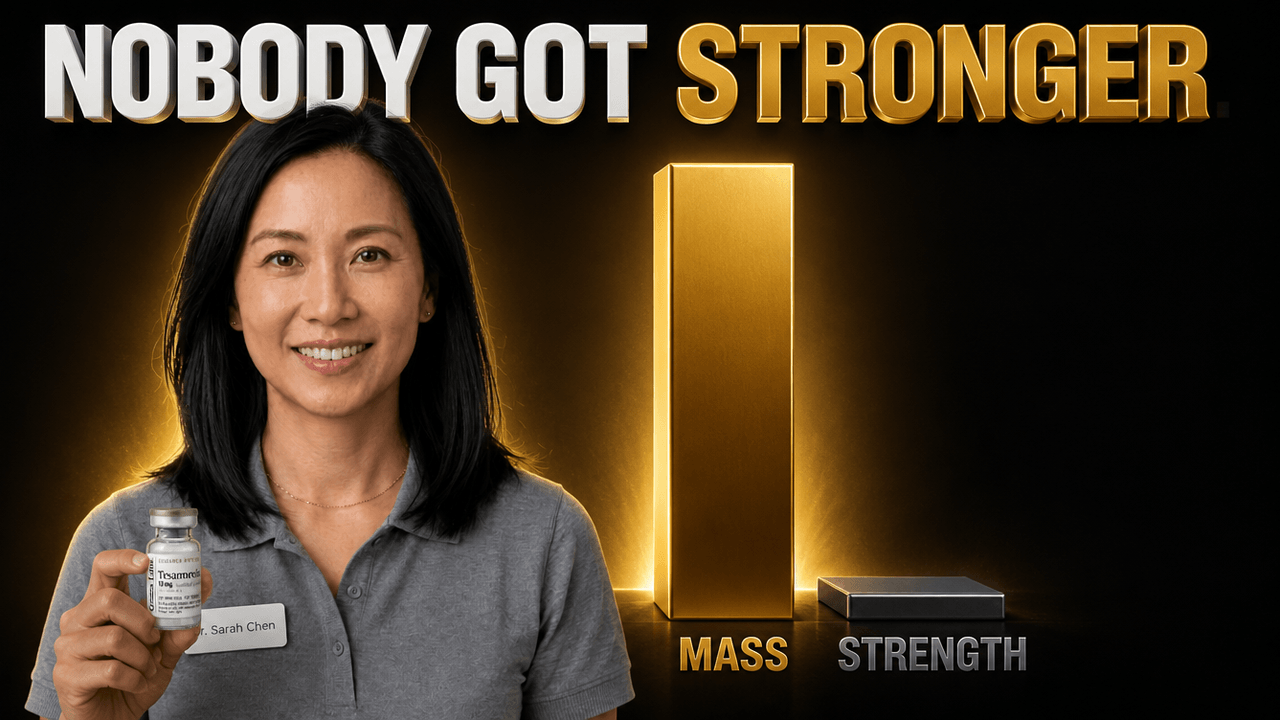
Search this topic and you get a list of seven injectables and a lean mass number next to each one. The number is usually real. The problem is what it leaves out. Lean mass on a body scan is not the same thing as working muscle. This page sorts every compound sold for muscle growth by the kind of study behind it, prints the strength result next to the mass result, and names the one peptide class with a human trial that measured both.
What peptides help with muscle growth?
No injectable peptide has a human trial showing it builds muscle strength. Growth hormone peptides such as CJC-1295, ipamorelin, sermorelin and tesamorelin raise growth hormone and IGF-1. In trials that measured body composition, that added lean mass but did not improve strength or function. Collagen peptides, taken by mouth, are the exception. Research use only.
How every claim on this page was graded
One rule decides everything here. A claim is only as strong as the study type behind it. We asked four questions of each compound.
- Is there a human trial, or only animals and cells?
- Was it randomised and placebo controlled?
- Was muscle a planned endpoint, or found later in old scans?
- Was strength measured, and did it move?
A compound that passes all four sits at the top. A compound with glowing forum reports and no human trial sits at the bottom. Nothing on this page is graded on how popular it is.
The muscle growth peptide ledger, in one table
This is the whole page in one view. Read the last column first. It is the one every other page leaves out.
| Compound | Best human evidence | Muscle measured? | Strength result |
|---|---|---|---|
| Growth hormone | 27 randomised samples, 303 on GH | Yes, lean mass +2.1 kg | No improvement |
| MK-677 (ibutamoren) | 12 month randomised trial, 65 adults | Yes, fat-free mass +1.1 kg | No change |
| Tesamorelin | Two phase 3 trials, 806 patients | Secondary scan analysis only | Not measured |
| CJC-1295 | 28 and 49 day dose studies | No, hormones only | Not measured |
| Sermorelin | Small 16 week study | Lean mass only | Not measured |
| Ipamorelin | Rat cells, rats, conscious swine | No | Not measured |
| GHRP-2 and GHRP-6 | Short human hormone studies | No | Not measured |
| BPC-157 | Preclinical repair models | No | Not measured |
| TB-500 | Preclinical repair models | No | Not measured |
| IGF-1 LR3 | No published human trial | No | Not measured |
| Follistatin | No published human trial | No | Not measured |
| Collagen peptides | Randomised trial, 53 older men | Yes, fat-free mass +4.2 kg | Up 16.5 Nm |
What are peptides, and which ones get sold for muscle?
A peptide is a short chain of amino acids. Amino acids are the beads that proteins are built from. A chain of a few dozen beads is a peptide. A chain of hundreds is a protein. The length matters because short chains can act like signals.
The compounds sold for muscle fall into four groups. Mixing them up is the most common mistake on this topic.
- Releasing peptides. They ask the pituitary gland for growth hormone. CJC-1295, sermorelin and tesamorelin sit here.
- Secretagogues. They copy ghrelin, a hunger hormone, to trigger the same release. Ipamorelin, GHRP-2, GHRP-6 and MK-677 sit here.
- Repair peptides. They are studied for healing tissue, not for growing it. BPC-157 and TB-500 sit here.
- Food peptides. These are broken down proteins you swallow. Collagen peptides and whey hydrolysates sit here.
Only the fourth group is a food. The other three are research compounds. One of them, tesamorelin, is an approved medicine, and the approval is for a fat condition in people living with HIV. None of them is approved anywhere for building muscle.
How do muscle growth peptides work?
Indirectly, through one hormone chain. Releasing peptides and secretagogues both ask your pituitary gland to send out growth hormone. Growth hormone tells the liver to make IGF-1. IGF-1 is the signal that reaches muscle. Nothing in that chain is an anabolic steroid, and nothing in it touches muscle directly.
That indirect route has two results people rarely separate. The hormone part works. The muscle part is where the chain gets thin. CJC-1295 lifted growth hormone 2 to 10 fold and IGF-1 1.5 to 3 fold in healthy adults. Those are real, measured, published numbers.
What that study did not measure was muscle. It was a pharmacokinetic study. It asked how long the hormone stays up, not what the hormone builds. The half-life came back at 5.8 to 8.1 days. Body composition was never a planned endpoint.
Why lean mass is not the same thing as muscle
Lean mass is everything in your body that is not fat and not bone mineral. It includes muscle. It also includes water, glycogen, organs and connective tissue. A body scan cannot tell those apart. So lean mass can rise without a single new muscle fibre.
This matters more for growth hormone than for almost any other compound. Growth hormone makes the body hold sodium and water. The review of randomised growth hormone trials found soft tissue swelling was reported more often by the people getting the hormone. Swelling is water. Water is lean mass on a scan.
So when a page tells you a growth hormone peptide added two kilograms of lean mass, the honest reading is this. Some of that is muscle. Some of it is fluid. The scan cannot say which, and the scan is all most of these studies ran.
- Lean mass includes water. A compound that holds water inflates it.
- A strength test cannot be faked by fluid. Fluid does not pull harder.
- If a study reports mass but no strength, treat the mass as unproven muscle.
- If a study reports both, and both moved, that is a real result.
The strength gap in every growth hormone trial
Two large randomised datasets measured mass and strength in the same people. Both found the same split. Mass went up. Strength did not. That is the strength gap, and it is the single most useful fact on this topic.
The first dataset is a systematic review of growth hormone itself in healthy people aged 13 to 45. It pooled 27 study samples with 303 people on the hormone. Lean body mass rose 2.1 kilograms. The authors wrote that strength and exercise capacity did not seem to improve.
They went further. Lactate during exercise was significantly higher in two of the three studies that measured it. Higher lactate at the same workload points the wrong way. The published conclusion was that claims about growth hormone and physical performance are not supported by the literature.
If growth hormone itself does not raise strength, a peptide whose whole job is to raise growth hormone has a hard problem. It is downstream of a signal that already failed this test.
What the longest secretagogue trial actually found
MK-677 is an oral ghrelin mimic. It is not a peptide, but it is sold beside them and it has the longest randomised trial of any growth hormone secretagogue. Sixty-five healthy adults aged 60 to 81 took 25 mg a day or placebo. The first year was placebo controlled.
It worked on the hormone. Growth hormone and IGF-1 rose to the levels of healthy young adults. On body composition it also worked. Fat-free mass rose 1.1 kilograms while the placebo group lost 0.5 kilograms. Body weight rose 2.7 kilograms against 0.8.
Then the trial reported the part that rarely gets quoted. The rise in fat-free mass did not produce any change in strength or function. The authors said so directly. Fasting blood sugar rose about 5 mg/dL and insulin sensitivity fell.
Does the CJC-1295 and ipamorelin stack build muscle?
No trial has tested it. The pairing is the most promoted stack in this category and it has no randomised human trial with a muscle endpoint. What exists is one dose study of CJC-1295 on its own, and animal work on ipamorelin.
The CJC-1295 study ran 28 and 49 days in healthy adults. It measured hormones. Growth hormone rose 2 to 10 fold and stayed up for six days or more. IGF-1 rose 1.5 to 3 fold and stayed up 9 to 11 days. The doses best tolerated were 30 and 60 micrograms per kilogram.
Ipamorelin is thinner still. Its founding paper studied rat pituitary cells, anaesthetised rats and conscious pigs. Its real finding was selectivity. Ipamorelin released growth hormone without lifting ACTH or cortisol, even at doses more than 200 times its effective dose. That is a clean hormone profile. It is not a muscle result.
So the gold standard stack rests on a human hormone study plus a pig study. Neither one weighed a muscle. Anyone quoting kilograms for this pairing is quoting someone's experience, not a trial.
Does sermorelin build muscle?
The evidence is one small study and it is thin. Sermorelin is a short fragment of the same releasing hormone as tesamorelin. A 16 week study in adults aged 55 to 71 reported an average lean body mass gain of about 1.26 kilograms in the men.
Three things keep that number weak. The group was small. Strength was not the headline result. And a lean mass gain of roughly a kilogram over four months sits inside the range that fluid and normal variation can produce. Sermorelin has no randomised trial with a strength endpoint.
Does tesamorelin build muscle?
A little, in a look back at old scans, and only in the people whose fat already moved. Tesamorelin has the deepest trial file in this whole group. Two phase 3 trials, 806 patients, a pooled analysis and a withdrawal arm. None of them was designed around muscle.
Researchers went back to the phase 3 scans and measured four trunk muscle groups. Lean muscle area rose between 0.64 and 1.08 square centimetres. Muscle density rose between 1.56 and 4.86 Hounsfield units. Those are small numbers from a secondary analysis.
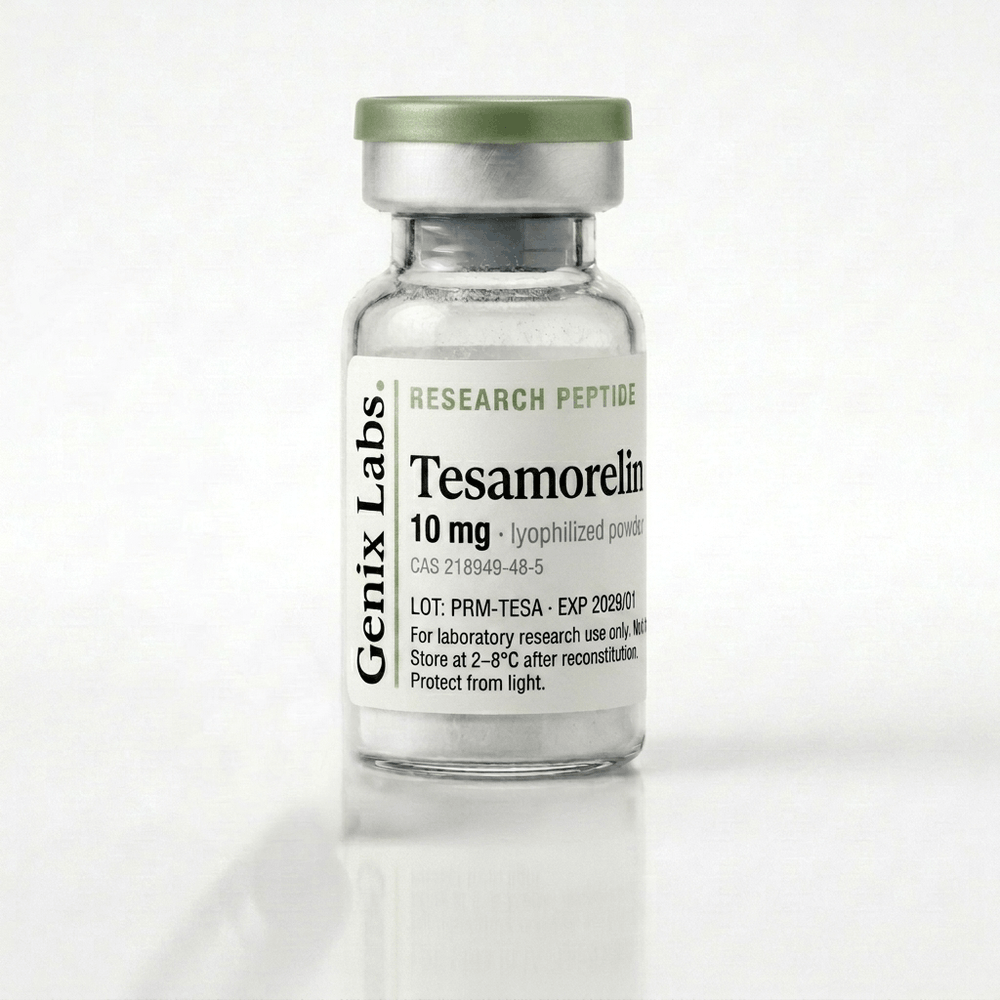
The analysis also only included the 193 people who had already responded on fat, against 148 on placebo. That is a responder subgroup inside a trial run for another reason. Our full breakdown of what the trials did and did not show is in the tesamorelin benefits ledger, where every claim is labelled with the trial behind it.
What tesamorelin did do, clearly and repeatedly, was move deep belly fat. Visceral fat fell 15.4% against placebo across the pooled data, while the fat under the skin barely changed. That is a body composition result. It is a fat result, not a muscle result. Research use only, and the lab-tested tesamorelin lot we supply is for in-vitro laboratory research.
What about IGF-1 LR3 and follistatin?
Neither has a published human trial. IGF-1 LR3 is a modified version of the growth factor that sits at the end of the hormone chain. Follistatin is sold as a blocker of myostatin, a protein that limits muscle size. Both stories are mechanistically neat and empirically empty in humans.
That gap is not a small one. These two are the compounds whose mechanism would predict direct muscle growth, and they are the compounds with the least human data. Interesting biology is not evidence. It is a reason to run a trial, which nobody has published.
Do BPC-157 and TB-500 build muscle?
They are repair compounds, not growth compounds. Both are studied for healing tissue after damage. Neither has a human randomised trial with muscle size or strength as an endpoint. Their published record is preclinical, which means animals and cells.
The distinction is worth keeping. Repairing a tendon so you can train is not the same as growing a muscle. If training is what builds the muscle, then anything that keeps you training has an indirect case. That case is still untested in humans for these two.
We cover both in depth elsewhere. See TB-500 benefits, every claim graded and how the BPC-157 and TB-500 pairing works. For the joint and tendon side of the same question, read peptides for joint pain. The research material itself is on the BPC-157 and TB-500 catalog page.
Do these peptides help recovery, even if not growth?
Recovery is a more defensible claim than growth, and it is still not a proven one. The growth hormone axis is tied to deep sleep, and deeper sleep is how most people describe the first weeks on a secretagogue. MK-677 raises appetite and sleep-linked hormones measurably.
But recovery was not an endpoint in any randomised trial in this group either. No trial measured soreness, time to return to training, or repeat performance. So the recovery claim sits on mechanism and self-report, which is one rung above the growth claim and still below a result.
The repair compounds have the better mechanistic story for recovery, and the same gap in human trials. That is why we grade them where we do rather than where the forums do.
The one peptide with a human muscle trial
Collagen peptides. It is the cheapest thing in this article and the only one with a randomised human trial that measured muscle and measured strength and found both moved. That is an uncomfortable finding for a page about injectables, so here is the trial in full.
Fifty-three men around age 72 with low muscle mass trained with weights three times a week for 12 weeks. Half took 15 grams of collagen peptides a day. Half took a silica placebo. Everyone did the same training.
| Outcome at 12 weeks | Collagen plus training | Training plus placebo |
|---|---|---|
| Fat-free mass | +4.2 kg | +2.9 kg |
| Fat mass | -5.4 kg | -3.5 kg |
| Isokinetic quadriceps strength | +16.5 Nm | +7.3 Nm |
Every between-group difference was statistically significant. The compound was swallowed, not injected. There was no hormone manipulation anywhere in the design.
One disclosure belongs here. The trial was funded in part by a collagen manufacturer, and one author was affiliated with a collagen research institute. That is a real conflict and it should lower your confidence a little. It does not erase the result, because the result is still the only one of its kind in this entire category.
The control arm nobody quotes
Look again at the placebo column above. Older men with low muscle mass, doing nothing but resistance training for 12 weeks, gained 2.9 kilograms of fat-free mass and 7.3 newton metres of quadriceps strength.
That placebo arm beats every injectable number on this page. Growth hormone managed 2.1 kilograms over longer periods with no strength gain. MK-677 managed 1.1 kilograms over a year with no strength gain. Twelve weeks of training beat both, in a frailer group, for free.
This is the comparison the category never runs. Almost no study of a growth hormone peptide includes a training-only arm, so there is no published trial where an injectable is measured against the thing it is sold as an upgrade to.
Why before and after photos mislead here
Before and after photos are the most common evidence offered for these compounds, and they are the weakest. Three things change a physique photo without changing a muscle. Water, glycogen and light. All three move in days.
Growth hormone compounds make this worse, not better. They make the body hold sodium and water, which fills out a limb and smooths the skin. The randomised trials recorded that swelling as a side effect. A photo reads the same swelling as a result.
There is also a confound nobody can remove from a photo. Almost everybody who starts one of these compounds also tightens their training, their sleep and their protein at the same time. The photo cannot separate the compound from the three habits that changed with it.
- Whether the change is muscle or fluid.
- Whether anything got stronger.
- What the training and food were doing over the same weeks.
- What the same person would have looked like with training alone.
Does stacking two peptides work better than one?
There is no trial that can answer this. Not one randomised human study has tested any combination of these compounds with a muscle endpoint. Every stacking protocol published online is built from mechanism and experience, not from a comparison.
The usual logic is that a releasing peptide and a secretagogue push the pituitary two different ways, so together they push harder. That is plausible. It also stacks two unproven muscle results on top of each other, and raises more hormone in a system where more hormone did not produce more strength.
Do peptides build muscle without working out?
No published trial supports that. The two randomised trials that added lean mass without training, growth hormone and MK-677, both reported no gain in strength or function. So the mass that appeared without training was mass that did not do anything measurable.
The only arm in this whole evidence base where strength clearly improved had resistance training in it. Both arms of that trial trained. The compound changed how much they gained. It did not replace the gaining.
How long do peptides take to work for muscle growth?
The hormone changes come in days. The body composition changes, where they exist, were measured in months. CJC-1295 raised IGF-1 for 9 to 11 days after a single dose. That is a hormone effect, visible fast, and it tells you nothing about muscle.
Every body composition endpoint in this article was measured at 12 weeks or longer. The collagen trial ran 12 weeks. The MK-677 trial ran a full year for its placebo controlled phase. The tesamorelin trials measured at 26 weeks.
So the honest timeline is this. Anything you notice in two weeks is sleep, appetite or fluid. Anything structural takes a quarter of a year to measure, and in the growth hormone arms it still did not reach strength.
Are peptides as effective as anabolic steroids?
No, and the two work differently. Anabolic steroids act on muscle directly through the androgen receptor, and randomised trials of testosterone show gains in both muscle size and strength. The growth hormone peptides act indirectly, and their trials show mass without strength.
That is the core difference and it is not a matter of dose. One route has a published strength result. The other does not. Saying so is not an endorsement of steroids, which carry their own documented harms.
Do peptides for muscle growth work for women?
The data is too thin to answer separately. The MK-677 trial included 42 women out of 65 participants, which is unusually good for this field. The growth hormone review covered adults aged 13 to 45 without reporting a split result for women.
The tesamorelin trials were 86 to 87% men, so every figure from them is effectively a male result. The collagen trial enrolled men only. So for the one compound with a real strength result, there is no female arm at all.
Can one peptide build muscle and cut fat at once?
The two body composition trials did move both numbers at once. MK-677 raised fat-free mass and raised body weight, so it was not a recomposition. Tesamorelin cut deep belly fat 15.4% while the fat under the skin barely changed, with only a small secondary muscle signal.
The clearest both-directions result again came from the collagen trial. Fat-free mass up 4.2 kilograms, fat mass down 5.4 kilograms, in 12 weeks, with training. If recomposition is the goal, that is the arm with the published numbers. For the fat side on its own, see best peptides for weight loss.
Are peptides for muscle growth safe?
Safety is not established for any of them in this use, because this use has not been trialled. What the trials do record are specific, measured harms. Those are worth knowing exactly rather than in general terms.
- Growth hormone: soft tissue swelling and fatigue reported more often than in controls.
- Growth hormone: exercise lactate significantly higher in two of three studies that measured it.
- MK-677: fasting blood sugar up about 5 mg/dL, and insulin sensitivity fell.
- MK-677: body weight up 2.7 kg, more than the fat-free mass gain accounted for.
- Tesamorelin: injection site complaints more common than on placebo.
- Collagen peptides: no significant adverse events reported at 15 g a day.
Two further points sit outside the trials. None of these compounds has long term safety data in healthy young people using them for muscle. And the growth hormone axis is a growth signal, which is why every long term discussion of it raises questions that short trials cannot settle.
What about the cancer question?
No trial on this page found a cancer signal, and none of them was built to find one. The question is raised because IGF-1 is a growth signal, and growth signals are studied in tumour biology. That is a reason for caution, not a finding.
What the evidence does and does not support is worth stating plainly. Observational work links higher natural IGF-1 levels with higher rates of some cancers. No randomised trial of a growth hormone peptide has run long enough, in enough people, to test whether raising IGF-1 on purpose changes anyone's risk.
So this is an open question with a plausible mechanism and no trial answer. Anyone treating it as settled in either direction is going past the evidence.
Are peptides for muscle growth legal or FDA approved?
None is approved for building muscle anywhere. Tesamorelin is the only compound here with any approval at all, and that approval is for excess abdominal fat in people living with HIV. Every other use of it is outside the approval.
The compounding picture has moved repeatedly. Several of these peptides have been flagged, nominated, withdrawn and reviewed across different regulatory lists in recent years, and the status of individual compounds has changed more than once. Check the current regulator list rather than any article, including this one.
One thing has not changed. Being removed from a safety flag list is not the same as being approved. A compound can be legal to sell for laboratory research and still have no approval for any use in a person. Every Genix Labs compound is supplied on exactly that basis.
Do muscle growth peptides show up on drug tests?
Growth hormone, its releasing factors and its secretagogues are prohibited in competitive sport at all times, in and out of competition. That covers the releasing peptides and the secretagogues as a class, not as a list of brand names, so a new compound in the same family is covered the day it appears.
Non-approved substances are also banned as a category, which catches compounds with no approval anywhere. Testing methods differ by compound and some are easier to detect than others. Anyone subject to testing should read the current prohibited list directly, because it is revised every year.
Research grade against medical grade
The phrase research grade describes who the material is sold to, not how pure it is. A research compound is supplied for laboratory work. It is not dispensed for a person, it carries no approval for use in a person, and no certificate changes that.
What a good supplier can tell you is narrower and more useful. Which lot you have. What that lot's purity by area came back as. Whether the mass matches the molecule it is labelled as. Those are answerable questions and they should be answered on paper.
What should be measured in any research plan?
The trials themselves answer this. They measured the things that moved. A plan that copies the trials measures the same four.
- IGF-1, because it is the signal every growth hormone compound actually changes.
- Fasting glucose and insulin sensitivity, because MK-677 moved both the wrong way.
- A strength test, because it is the only endpoint fluid cannot fake.
- Fat and lean mass separately, because a single weight figure hides both.
Note what is missing from that list. There is no established target IGF-1 level for muscle growth in healthy people, because no trial has found one. Measuring is still better than guessing.
Do the gains stop when the peptide stops?
For the hormone driven compounds, the published answer is yes. Tesamorelin is the clearest case. Patients re-randomised to placebo after 26 weeks lost the body composition changes they had gained. The published conclusion was explicit that the effects do not outlast the treatment.
That follows from the mechanism. A releasing peptide works for as long as it is asking the pituitary to release. Stop asking and the hormone returns to baseline. Training works differently, which is why the training arms are the ones with lasting structural change.
What is peptide cycling, and is there evidence for it?
Cycling means running a compound for a set stretch, then stopping for a stretch. The usual reasoning is that the pituitary gets less responsive over time, so a break restores it. Common online patterns are a few months on and a month off.
No trial has compared a cycled schedule against a continuous one for any endpoint in this group. The MK-677 trial ran continuously for a year and the hormone stayed elevated. The tesamorelin trials ran continuously for 26 and 52 weeks. Neither tested a break.
So cycling is a convention, not a protocol with evidence behind it. The one thing the trials do show about stopping is that the body composition changes went away when the compound did.
What do these compounds cost?
Prices below are our current research material prices in USD and Indonesian rupiah, for laboratory use only. They are listed so the evidence and the cost can be read side by side.
| Research material | Size | USD | IDR |
|---|---|---|---|
| Tesamorelin | 10 mg | $149 | Rp 2.450.000 |
| BPC-157 | 10 mg | $89 | Rp 1.450.000 |
| BPC-157 and TB-500 | 5 + 5 mg | $99 | Rp 1.650.000 |
For context, the one compound in this article with a human strength result costs a few dollars a week in a grocery store. That is not a sales point. It is the most honest cost comparison the evidence allows.
What a lot report rules out, and what it does not
Our current tesamorelin lot, 447106, carries a published HPLC area purity of 98.20% for the tested size, plus LC-MS identity confirmation. That answers one narrow question. Is the material in the vial the peptide the label names, and how clean is that lot by area.
- It is not a statement of content, sterility, safety or efficacy.
- It applies only to the printed lot. Check that the number on the vial matches.
- HPLC area percent is not the same thing as how much peptide is in the vial.
- No certificate turns a research compound into an approved medicine.
- No certificate establishes any muscle result on this page. Only trials do that.
Grade any muscle peptide claim in 60 seconds
You can check almost any claim on this topic with four questions. They take longer to read than to use.
- Is there a human trial? If the only citation is a rat study, stop there.
- Was muscle a planned endpoint, or found later in scans taken for something else?
- Was strength measured? If only mass is reported, the mass may be water.
- Was there a training arm? Without one, the compound was never compared to the gym.
Run those four on any page in this category, this one included. Most claims fail at question one or question three.
FAQ
What peptides help with muscle growth?
No injectable peptide has a human trial showing it builds strength. Growth hormone peptides such as CJC-1295, ipamorelin, sermorelin and tesamorelin raise growth hormone and IGF-1. Where body composition was measured, that added lean mass without improving strength. Oral collagen peptides are the one exception with a human muscle trial.
Do peptides build muscle without working out?
No published trial supports that. The two randomised trials that added lean mass without training, growth hormone and MK-677, both reported no gain in strength or function. The only arm where strength clearly improved had resistance training in it, and so did its placebo arm.
Are peptides for muscle growth safe?
Safety is not established for this use, because this use has not been trialled. The trials do record specific harms. Growth hormone raised soft tissue swelling and fatigue. MK-677 raised fasting blood sugar about 5 mg/dL and lowered insulin sensitivity. Tesamorelin raised injection site complaints.
Are peptides for muscle growth FDA approved?
None is approved for building muscle anywhere. Tesamorelin is the only one with any approval at all, and that is for excess abdominal fat in people living with HIV. Compounding status for several of these has changed repeatedly, and removal from a safety flag list is not approval.
How long do peptides take to work for muscle growth?
Hormone changes show in days. CJC-1295 raised IGF-1 for 9 to 11 days after one dose. Every body composition endpoint on this page was measured at 12 weeks or longer. Anything noticed in two weeks is sleep, appetite or fluid rather than structure.
Are peptides as effective as anabolic steroids for muscle growth?
No, and they work differently. Steroids act on muscle directly through the androgen receptor, and trials of testosterone show gains in both size and strength. Growth hormone peptides act indirectly through IGF-1, and their trials show mass without strength. That is not an endorsement of steroids.
Takeaway
The honest summary is short. No injectable peptide sold for muscle growth has a human trial showing it makes anyone stronger. The two compounds with randomised body composition data added lean mass and moved no strength, and growth hormone makes the body hold water, which is part of why.
The one compound in this category with a trial that measured mass and strength and found both improved is a food peptide you swallow, and its trial had resistance training in both arms. The placebo arm of that trial out-gained every injectable number on this page.
That does not make these compounds uninteresting. It makes them under-studied. The hormone effects are real and well measured. The muscle effects are the part nobody has run the trial for. Until somebody does, the strongest evidence for building muscle still points at the training arm. For the rest of the recovery and repair research, start at the recovery and repair peptides hub. Every Genix Labs compound is supplied for in-vitro laboratory research only. It is not for human or veterinary use, and nothing here is medical advice.