Search TB-500 benefits and you get a list. Faster healing. New blood vessels. Looser joints. More flexibility. Thicker hair. The list is almost identical on every page, because almost every page copied it from the same place.
This guide does something different. It takes each benefit one at a time and asks a single question. Where did this come from, and how strong is it? Some claims hold up well. Some came from a different molecule. Some came from nowhere at all. Every Genix Labs compound is supplied for laboratory research only. Nothing here is medical advice or a use instruction.
What are the benefits of TB-500?
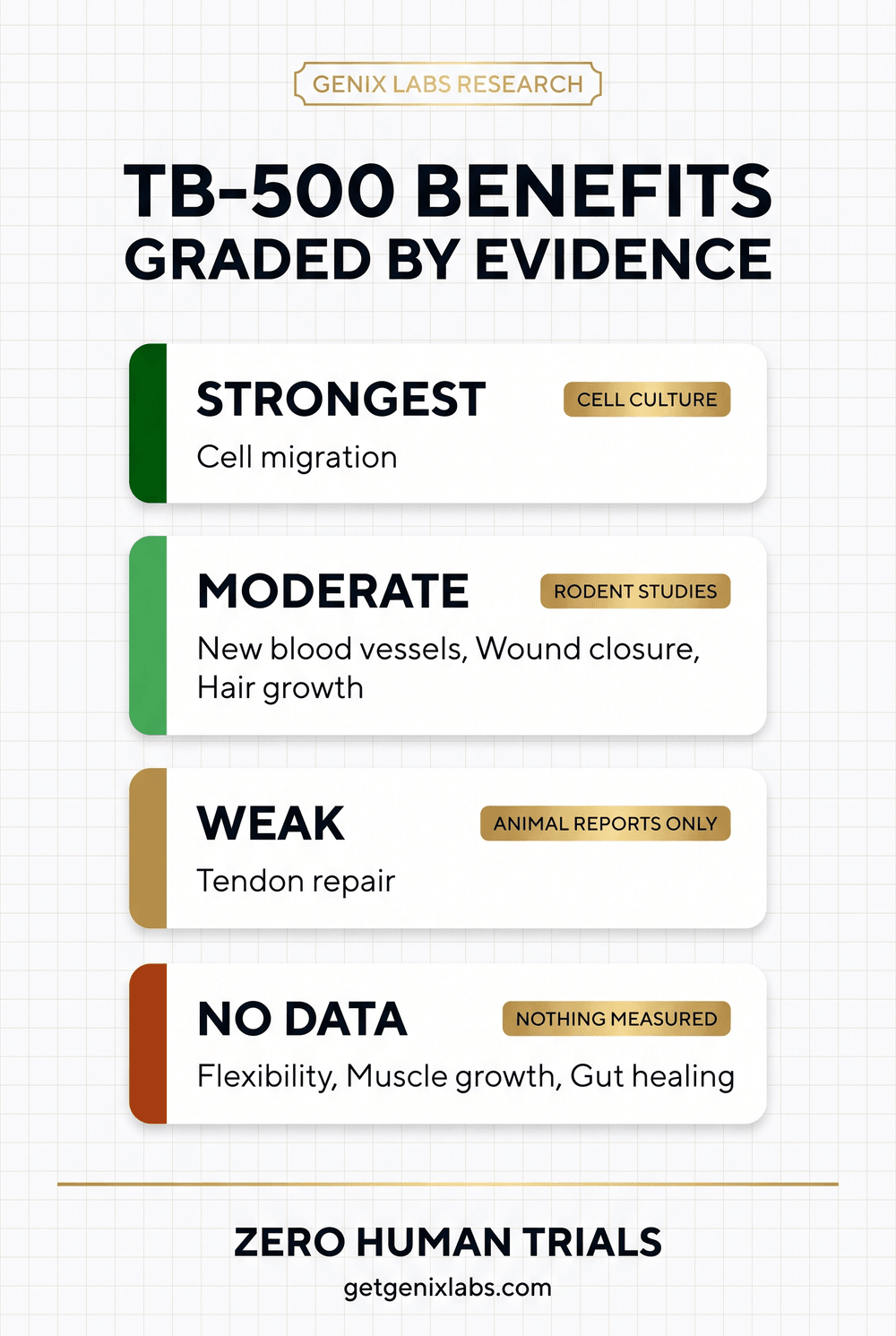
In published research, TB-500 is studied for one core action. It helps cells move. From that follow the studied effects: faster wound closure, new blood vessel growth, and tissue repair signalling. Most of that work used thymosin beta-4, the full protein, in mice and cell culture. No human efficacy trial exists.
- The firmest finding is cell migration. Everything else is built on top of it.
- Most of the benefit file belongs to thymosin beta-4, a 43 amino acid protein. TB-500 is a 7 amino acid piece of it.
- Wound closure, angiogenesis and hair growth all have real published papers. All of them are animal or cell work.
- Tendon, flexibility and muscle repair are the loudest claims and the quietest evidence.
- No randomised human trial has tested a single one of these benefits.
Whose benefits are these, really?
This is the part the top results skip, and it changes everything after it.
Thymosin beta-4 is a real protein your own cells make. It is 43 amino acids long. It has a large research file going back to the 1980s. Wound healing, heart repair, eye surface repair, hair follicles, inflammation. Hundreds of papers.
TB-500 is not that protein. It is a short synthetic fragment. Seven amino acids, built around the part of the protein that grips actin. Actin is the scaffolding protein inside cells. The fragment was made because the active region sits there, and a short peptide is far cheaper to produce.
So when a page lists a TB-500 benefit and cites a paper, check the paper. Nine times out of ten the study used the full protein. That does not make the claim worthless. It does make it a borrowed claim, and borrowed claims should be labelled.
How should a benefit claim be graded?
Not all evidence is the same weight. A result in a dish is a hint. A result in a mouse is a lead. A result in a randomised human trial is a finding. Most peptide pages treat all three as the same sentence.
We use five rungs on this page. Cell culture. Rodent studies. Large animal work. Human case reports. Randomised human trials. Every benefit below gets placed on one.
Notice the shape. The widest rungs are the furthest from a person. That is the honest summary of this entire topic, and it is why we grade rather than list.
Which TB-500 benefits survive the grading?
Here is every commonly claimed benefit, with the strongest real source behind it and the rung it sits on. The rest of this guide walks through each row.
| Claimed benefit | Strongest published source | Evidence rung |
|---|---|---|
| Cell migration and repair signalling | Cell culture work on actin binding | Cell culture, strong |
| Faster wound closure | Malinda 1999, rodent skin wounds | Rodent, moderate |
| New blood vessel growth | Smart 2007 in Nature, mouse heart | Rodent, moderate |
| Cardiac tissue repair | Smart 2007, mouse infarct model | Rodent, moderate |
| Corneal and eye surface repair | Full protein clinical programmes | Human, but not the fragment |
| Hair growth | Philp 2004 in FASEB J, mice | Rodent, single paper |
| Reduced inflammation | Goldstein 2012 review, mixed models | Cell and rodent, mixed |
| Tendon and ligament repair | Veterinary reports, no controlled human work | Large animal, weak |
| Improved flexibility and range of motion | No controlled study at all | Anecdote only |
| Muscle growth or strength | No controlled study at all | Anecdote only |
| Gut lining repair | This is BPC-157 territory, not TB-500 | Not studied for TB-500 |
Four rows carry real papers. Two rows carry nothing but forum posts. One row belongs to a different peptide entirely. That spread is the actual answer to the question.
How does TB-500 work?
One job, repeated everywhere. It binds actin.
Actin is the internal frame of a cell. To move, a cell has to pull that frame apart at the back and rebuild it at the front. Thymosin beta-4 holds loose actin units in reserve, ready to be used. That reserve is what makes fast rebuilding possible.
So the molecule does not heal anything by itself. It makes cells better at moving to where healing happens. Everything on the benefit list is downstream of that one action. Keep that in mind and the list stops looking magical.
What is the core benefit, in one sentence?
Cells move faster and further. That is it.
In culture, keratinocytes and endothelial cells migrate more readily when thymosin beta-4 is present. Keratinocytes are skin cells. Endothelial cells line blood vessels. Both have to travel for a wound to close.
This is the strongest rung on the ladder, and it is also the least exciting claim. Nobody buys a peptide because cells migrate. But every real benefit traces back here, so a page that skips it is selling the roof without the foundation.
Does TB-500 grow new blood vessels?
In animals, the full protein does. The evidence is good for a rodent finding.
The landmark paper is Smart and colleagues in Nature in 2007. In mice with heart damage, thymosin beta-4 mobilised progenitor cells in the outer heart layer and grew new vessels. That is a strong journal and a clean result.
Why it matters for repair is simple. New tissue needs a blood supply. Tendon and ligament heal slowly in part because they are poorly supplied. A molecule that helps vessels form is a plausible repair tool, and plausible is the correct word.
Does it close wounds faster?
In rodents, yes. This is the oldest and best replicated benefit on the list.
Malinda and colleagues published it in the Journal of Investigative Dermatology in 1999. Full thickness skin wounds in rats and mice closed faster with thymosin beta-4 applied. The paper reported more keratinocyte migration and earlier granulation tissue, the soft new tissue that fills a wound bed.
It is a clean, specific, measurable endpoint. Wound area over time. That is far better science than most of what gets quoted in this topic. It is still a rodent skin wound, not a human tendon.
Does TB-500 repair tendons and ligaments?
This is the most repeated TB-500 benefit and one of the weakest rungs.
The reasoning is sound. Tendons heal slowly because they have poor blood supply and slow cell turnover. A molecule that improves cell migration and vessel growth should help. Mechanism is on the claim's side.
The data is not. There is no controlled human tendon trial. The evidence that gets cited is veterinary, mostly horses, and mostly uncontrolled. Our guide to peptides for joint pain goes through what the connective tissue literature actually contains.
So the honest grade is this. Plausible mechanism, real interest from researchers, no human proof. Anyone telling you it is proven for tendons is ahead of the papers.
Does it help muscle recovery?
There is no controlled study that measures this. Not in people, not in animals.
The claim is an inference. Muscle repair involves satellite cells migrating to damaged fibres. Migration is what the molecule does. So the inference is reasonable. It is also unmeasured, which makes it a hypothesis rather than a benefit.
Be especially careful with claims about muscle growth or strength. TB-500 is not a growth hormone pathway compound and has no anabolic action in the published work. Those claims come from marketing, not from a journal.
Does it improve flexibility and range of motion?
No study has ever measured flexibility after TB-500. Zero.
This claim is interesting because of where it came from. It appears to have started in veterinary and community use, where handlers described animals moving more freely. That got repeated, then printed as a bullet point, then cited as if it were a finding.
It is possible that less pain and better tissue quality would show up as easier movement. That is a reasonable guess. A guess printed in a benefit list is still a guess, and this one has been recycled for over a decade with no data added.
Does it calm inflammation?
Partly, and the picture is mixed rather than clean.
The Goldstein review from 2012 collects anti-inflammatory findings across several models. Thymosin beta-4 reduced certain inflammatory signals in cell and animal work, particularly in the eye and in heart tissue.
But inflammation is not one thing. It is dozens of signals doing different jobs, and some of them are needed for repair. A molecule that trims one signal in a mouse cornea is not a general anti-inflammatory. The review itself is careful here. The blogs quoting it usually are not.
Does TB-500 help with hair growth?
There is one real paper behind this, and it is better than you might expect. Philp and colleagues published it in FASEB J in 2004. Thymosin beta-4 activated hair follicle stem cells and sped hair growth in mice. The work used the full 43 amino acid protein, and no human hair trial has followed it.
The mechanism is the same one as everywhere else on this page. Follicle stem cells sit in a bulge region of the follicle. To start a new growth phase, they have to migrate. The paper reported more migration and faster hair regrowth after the mouse skin was depilated.
So the claim is not invented. It is a single rodent study, from over twenty years ago, using a different molecule from the one in the vial. That is a long distance from a hair treatment. If hair is the research interest, our guide to peptides studied for hair loss compares what each compound actually has behind it.
What about the heart data?
It is the single most impressive result in the file, and it is the least relevant to why most people search this topic.
Smart's 2007 Nature paper showed thymosin beta-4 waking up dormant progenitor cells in the mouse heart after injury, then building new vessels. Published in Nature. That is as good as a rodent result gets.
It drove a real clinical programme, with the full protein, for heart tissue. Nobody searching TB-500 benefits is researching heart infarcts. But this paper is the reason the molecule is taken seriously at all, so it belongs on the list.
Where do humans appear in this file at all?
In the eye, and only with the full protein.
Thymosin beta-4 was developed as an eye drop for corneal surface problems and dry eye. That programme reached human trials. It is the closest the molecule family has come to a clinical product.
Two things follow from that. First, human exposure to this molecule family is not theoretical. Second, those trials tested a topical eye drop of a 43 amino acid protein. Reading them as support for an injected seven amino acid fragment is not a small stretch. It is a different molecule, a different route and a different tissue.
Does TB-500 help the gut?
No. This is a case of two peptides getting their files mixed together.
Gut lining repair is BPC-157 territory. BPC-157 came out of human gastric juice and most of its rodent work is digestive. TB-500 has no comparable gut file. When a page lists gut healing under TB-500 benefits, it has merged the two.
If the gut is the research question, read our breakdown of BPC-157 benefits instead. Picking the right molecule for the question beats stacking two and hoping.
Is there a brain benefit?
There is early animal work, and it is thinner than the rest.
Thymosin beta-4 has been studied in rodent models of nerve injury and stroke, where it supported repair of the insulating sheath around nerve fibres. That is interesting biology. It is also a long way from anything a person would notice.
No cognitive endpoint has been measured. There is no focus, mood or memory finding. Anyone listing mental clarity under TB-500 benefits has left the literature behind entirely.
How does TB-500 make you feel?
Published research does not measure feelings, so there is no honest answer from the literature. TB-500 has no stimulant or hormone action, so there is no expected acute sensation. Reports of feeling looser or calmer are self reported and uncontrolled.
This matters more than it sounds. With a stimulant, you feel something quickly and that tells you it is active. With a repair signal, there is nothing to feel. The work happens at the level of cells moving a few micrometres.
So a person expecting a sensation will either imagine one or assume the vial is dead. Both conclusions are wrong, and both are common. The absence of a feeling is the expected result, not a failure.
When do the benefits appear?
In the animal studies, differences showed up over days to weeks, not hours.
The rodent wound studies measured wound area across roughly one to two weeks. The hair study ran over a growth cycle. The cardiac work measured tissue weeks after the injury. Repair biology runs on a slow clock.
Anyone promising a change in a few days is describing something other than tissue repair. Swelling can settle fast. Collagen does not. That gap is where most disappointed reports and most overblown reviews both come from.
What do researchers actually measure?
This is the question that separates a real benefit from a repeated one. A benefit only exists if somebody measured something.
In the published work, the measured endpoints are specific and dull. Wound area in square millimetres over time. Capillary density counted in a tissue slice. Distance travelled by cells across a culture dish. Expression of VEGF, the signal that tells vessels to grow. Granulation tissue thickness. Hair shaft counts per patch of skin.
Now compare that with the words on a typical benefit page. Faster recovery. Better mobility. Feeling repaired. None of those is an endpoint. None of them was measured. They are translations of a lab number into a sales sentence, and the translation is where the accuracy goes.
- Measured: wound area over days. Printed: heals injuries fast.
- Measured: capillary density in a tissue slice. Printed: boosts circulation.
- Measured: cell migration distance in a dish. Printed: repairs tendons.
- Measured: hair shafts per skin patch in mice. Printed: regrows hair.
- Measured: nothing at all. Printed: improves flexibility.
The gap on the last line is the whole problem with this topic in one row.
Can you use TB-500 every day?
We cannot give a human schedule, because TB-500 is supplied for laboratory research only. What the literature shows is that the animal studies behind these benefit claims used repeated dosing over weeks rather than single doses.
The daily versus weekly question has never been tested head to head in people. The schedules circulating online are community practice built backwards from animal papers. Our guide to what TB-500 dosage research measured shows exactly which numbers came from where, and which were invented.
One technical point is real though. The fragment is small and clears quickly, which is why frequency gets discussed at all. The full protein behaves differently. Again, the two molecules keep getting treated as one.
Why does the fragment behave differently?
Because cutting a protein down changes more than its length. Three things shift at once, and all three affect the benefit question.
Stability shifts first. A 43 amino acid protein folds and shields parts of itself. A seven amino acid chain has nowhere to hide. Enzymes in blood cut short peptides quickly, which is why the fragment is described as fast clearing.
Reach shifts second. The full protein has several active regions, not one. It binds actin, and it also does other jobs through other parts of its sequence. Keeping the actin region keeps one job. The rest of the protein's effects do not come with it.
Amount shifts third. Equal milligrams of a small fragment and a large protein are not equal numbers of molecules. A smaller molecule means more molecules per milligram, which is one reason animal numbers do not translate across cleanly. Our dosage research guide works through that arithmetic in full.
Which is better, BPC-157 or TB-500?
Neither wins outright, because they are studied for different jobs. Comparing them on a single scale is the wrong question.
| BPC-157 | TB-500 | |
|---|---|---|
| Size | 15 amino acids | 7 amino acids |
| Origin | A sequence from human gastric juice | A fragment of thymosin beta-4 |
| Rodent literature | Large, hundreds of papers | Smaller, mostly the full protein |
| Studied focus | Gut lining, tendon, local repair | Cell migration, vessels, systemic repair |
| Best evidenced action | Tissue protection and healing in rodents | Actin binding and cell migration |
| Human efficacy trials | None published | None published |
| Strongest single paper | Multiple rodent gut and tendon studies | Smart 2007 in Nature, mouse heart |
| Common research framing | Target one problem area | Support repair body wide |
Read that table and the answer gets clearer. BPC-157 has the bigger file and the more specific targets. TB-500 has the more interesting single paper and the broader reach. Both are missing the same thing, which is a human trial.
Why are the two stacked so often?
Because the mechanisms do not overlap, which makes the pairing logical rather than just double dosing.
BPC-157 is studied for protecting and rebuilding tissue in a specific place. TB-500 is studied for getting cells to that place. One is the builder, one is the transport. That is the reasoning, and it is reasoning rather than a trial result.
No controlled study has compared the pair against either one alone. Our full breakdown of the BPC-157 and TB-500 stack goes through what the pairing is built on and where the gaps sit. The BPC-157 and TB-500 research vial exists because that is the pairing researchers ask for most.
Do the benefits differ for men and women?
No published study compares benefit by sex in people, because no human efficacy trial exists at all.
The rodent work used animals of both sexes without reporting a split in results. The mechanism is not hormonal, so there is no obvious reason to expect a difference. That is a prediction, not a measurement.
This question ranks because the phrase gets searched, not because the answer differs. Anyone publishing a benefits for men or benefits for women list on this compound is filling a search gap with words rather than data.
What the benefit lists leave out
A benefit list with no cost column is marketing. Here is the other side.
- No human safety trial exists either. The unknowns run in both directions.
- The angiogenesis action that helps repair is the same action researchers flag around tissue that should not be fed.
- It is banned in tested sport, which removes it from a whole population of interested readers.
- Most reported problems trace to the vial, not the molecule.
- A borrowed benefit comes with a borrowed safety record, and that record was built on a different compound.
None of that erases the research interest. It does mean the honest framing is a set of open questions. For the full picture on this pillar, our recovery and repair peptide hub collects every guide we have written on it.
Why is there no human trial?
Three reasons, and none of them is a conspiracy.
First, a seven amino acid fragment is hard to patent and cheap to copy. There is little commercial reason to fund a trial. The money went into the full protein, which is where the clinical programmes ran.
Second, the endpoints are difficult. Proving faster tendon healing in people needs imaging, long follow up and large numbers. That is an expensive trial for a molecule nobody can own.
Third, the regulatory status pushed it into the research supply channel instead. Once a compound is sold for laboratory use, the incentive to run a clinical trial disappears almost entirely.
Does any benefit survive tested sport?
No. TB-500 is prohibited by the World Anti-Doping Agency under growth factors, at all times, in and out of competition.
It is named specifically rather than caught by a general clause. Testing methods for it exist and have been used. For any tested athlete, the entire benefit list is academic.
This is worth stating plainly because so many benefit pages are written for an athletic audience while leaving the ban in a footnote.
Which benefits does a bad vial erase?
All of them, and this is the most practical section on the page.
TB-500 is a fragment. That creates a specific problem the longer peptides do not have. A vial can contain a peptide that looks clean on a purity chart and is still the wrong sequence. Short peptides are easy to get subtly wrong.
So identity testing matters more here than purity does. An HPLC purity number tells you how much of the vial is one single thing. Mass spectrometry tells you whether that thing is the molecule on the label.
What does a lot report actually prove?
Less than most people assume, and enough to matter.
Our published blend lot, 726591, reports HPLC area purity of 99.30 percent for BPC-157 and 98.60 percent for TB-500, with LC-MS identity confirmation. Testing is done by independent ISO 17025 accredited laboratories.
- It proves the tested lot was what the label said, on the day it was tested.
- It does not prove sterility, safety, efficacy, or anything about a different lot.
- HPLC area percent is not the same as how many milligrams are in the vial.
- A report with no lot number on it is not a report. Match the number on the vial.
- A supplier who will not publish one has answered the question for you.
That is the whole honest scope of a lot document. Anyone who stretches it into a health claim has misread their own paperwork.
Can storage erase the benefit?
Yes, and silently. There is no taste, smell or colour change to warn you.
Lyophilized peptide is stable when kept cold and dark. Once reconstituted, the clock starts. Heat, light and repeated temperature swings all degrade peptides, and a degraded fragment simply does not bind actin.
So the research failure mode here is quiet. Nothing looks wrong. Nothing happens. Our guide to storing peptides in a hot climate covers the handling side that no benefit list mentions.
How to read any TB-500 benefit claim in 30 seconds
Four questions. Run them on any page, including this one, and most claims sort themselves immediately.
- Which molecule did the study use? If it says thymosin beta-4, the claim is borrowed.
- What species? Cell dish and mouse are hints. Human is a finding. Most of this topic is mouse.
- What exactly was measured? If the page cannot name an endpoint, nobody measured anything.
- Who paid and who is selling? A benefit list on a product page needs the sharpest reading of all.
Apply question one alone and the standard eleven item benefit list usually shrinks by half. Apply question three and the flexibility and muscle rows vanish. That is not scepticism for its own sake. It is just reading the sources that are already cited.
Benefit claims to walk away from
If you see any of these stated as fact, the page is not reading its own sources.
- Clinically proven for tendon or ligament repair. No human trial exists.
- Builds muscle or increases strength. There is no anabolic action in the literature.
- Improves flexibility by a measured amount. Nothing has ever measured it.
- Heals the gut lining. That is BPC-157's file, not this one.
- Safe for long term use. No long term human safety study exists for the fragment.
- Works in days. Every animal study measured across weeks.
- Same as thymosin beta-4. It is a seven amino acid piece of a 43 amino acid protein.
Mistakes that cost the benefit
Four, in the order they usually happen.
Buying on purity alone. A clean chart on an unverified sequence is a clean chart of the wrong thing. Ask for identity confirmation, not just a percentage.
Expecting a sensation. There is nothing to feel, so a dead vial and a working vial feel identical. That is exactly why the paperwork carries the weight here.
Judging it in a week. The published differences took weeks to appear. A short look answers nothing.
Reading the full protein's record as the fragment's record. This single mistake produces most of the inflated claims in the topic, and it happens on page after page.
What does a tested vial cost?
BPC-157 10 mg is 1,450,000 rupiah, about 89 US dollars. The BPC-157 and TB-500 5 plus 5 mg blend is 1,650,000 rupiah, about 99 US dollars, and it is the vial most researchers choose because the pairing is what the literature discusses.
Both ship cold packed and tracked, same day for orders before 9 PM, with same day and often two hour delivery inside Bali and cash on delivery available. Every order includes the published lot document. See the lab tested BPC-157 and TB-500 vial for the current lot and full specification.
Frequently asked questions
Can I take TB 500 every day?
We cannot give a human schedule, because TB-500 is supplied for laboratory research only. What the literature shows is that the animal studies behind the benefit claims used repeated dosing over weeks, not single doses. The daily versus weekly question has never been tested head to head in people.
What is better, BPC or TB500?
Neither wins outright, because they are studied for different jobs. BPC-157 has a far larger rodent literature and a local, gut and tendon focus. TB-500 is studied for systemic cell migration and new blood vessel growth. Both lack human efficacy trials, so better depends on the research question.
Does TB500 help with hair growth?
The hair claim traces to a real paper, Philp and colleagues in FASEB J in 2004, where thymosin beta-4 activated hair follicle stem cells and sped hair growth in mice. That work used the full 43 amino acid protein, not the TB-500 fragment, and no human hair trial has followed it.
How does TB 500 make you feel?
Published research does not measure feelings, so there is no honest answer from the literature. TB-500 has no stimulant or hormone action, so there is no expected acute sensation. Reports of feeling looser or calmer are self reported, uncontrolled, and run alongside rest, training changes and other compounds.
Are TB-500 benefits different for men and women?
No published study compares benefit by sex in people, because no human efficacy trial exists. The rodent work used both sexes without reporting a benefit split. Any online claim about different results for men or women is extrapolation, not data from a controlled comparison.
Is TB-500 the same as thymosin beta-4?
No, and this is the most important distinction on the topic. Thymosin beta-4 is a natural 43 amino acid protein with a large research file. TB-500 is a short synthetic fragment built around its actin binding region. Most benefit claims online cite the full protein, then print the fragment's name.
Takeaway
TB-500 benefits are not fake. They are borrowed, graded, and smaller than the lists suggest. Cell migration is solid. Wound closure, vessel growth and hair growth have real published papers behind them, all in animals, almost all with the full protein. Tendon repair is plausible and unproven. Flexibility and muscle claims have nothing at all. Gut healing belongs to another peptide.
That is the whole file. A page that prints eleven benefits as eleven equal facts has not read it. The useful next steps are our TB-500 explainer, the dosage research breakdown, and the recovery peptide hub for everything around it.