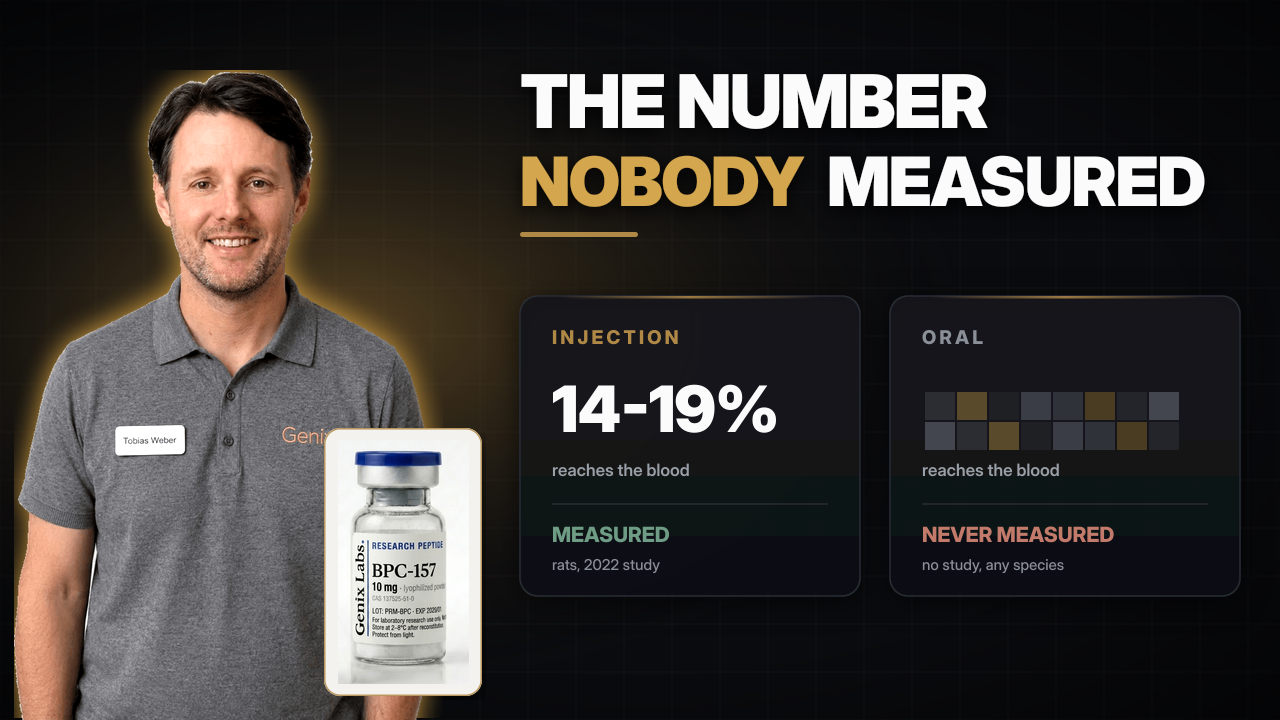
Nearly every page that ranks for this question prints an oral bioavailability number. Ten percent. Twenty. Sometimes thirty. None of them cites a study, because no study has measured it. In any species. That missing number is the real answer here, and it changes how the whole comparison should be read.
Is oral or injected BPC-157 better?
Neither has been shown to be better in people. Injection is the only route with published pharmacokinetic data, measured in rats and dogs. Oral dosing has produced gut effects in rat models, but its absorption has never been quantified. So the honest comparison is not strong against weak. It is measured against unmeasured.
- One published study measured BPC-157 blood levels. It tested intravenous and intramuscular dosing only.
- No study has measured oral bioavailability of BPC-157 in rats, dogs, or humans.
- Surviving stomach acid is not the same as crossing the gut wall into the blood.
- Oral research is concentrated on the gut lining. Injection research is concentrated on tendon, muscle, and joint models.
- The peptide clears fast. Its measured half-life was under half an hour.
That is the summary. The rest of this guide shows the working, because the working is where every competing page on this keyword goes wrong. If you want the compound explained from scratch first, start with what BPC-157 is and how it works.
What is BPC-157, and why does route come up at all?
BPC-157 is a chain of fifteen amino acids. Its full name in the literature is stable gastric pentadecapeptide BPC 157, and the sequence was originally described as part of a protein found in human gastric juice. That origin story is the reason route is argued about at all.
A peptide first identified in the stomach invites an obvious thought. If it lives there naturally, perhaps it survives being swallowed. The word stable sitting in its own name pushes the same idea. Both are reasonable hunches. Neither is an absorption measurement.
The mechanisms studied in animals are mostly about repair signalling. Published work points at three overlapping pathways, and all three have been studied by both routes in different models.
- Angiogenesis, meaning new blood vessel growth, with VEGF signalling repeatedly reported in animal wound models.
- The nitric oxide system, which governs blood flow and shows up across the Zagreb group's work.
- Cell migration machinery, including the FAK and paxillin pathway that pulls cells into a healing site.
None of those mechanisms is route specific on paper. A pathway does not care how the molecule arrived. What differs is how much molecule arrives, and where it is concentrated when it does.
What does the route actually change?
Three things, and they are worth separating. First, how much of the peptide reaches the bloodstream. Second, where the peptide is most concentrated. Third, what a study is able to measure afterwards.
Route does not change the molecule. BPC-157 is a pentadecapeptide, meaning a chain of fifteen amino acids, at about 1,419 daltons. The same chain goes in whichever way you send it. What changes is the journey, and the journey decides the dose that arrives.
Where do the bioavailability numbers come from?
This is the section no competing page has, so it goes early. There are two numbers in circulation for this keyword. One was measured. One was not. They get printed side by side as if they belong together.
The measured figures come from a 2022 paper in Frontiers in Pharmacology. A team led by He and colleagues ran a full pharmacokinetic workup in rats and beagle dogs. After intramuscular dosing, absolute bioavailability was about 14 to 19 percent in rats and about 45 to 51 percent in beagles. Those are real numbers from a real study.
Read the methods, though. The routes tested were intravenous and intramuscular. Oral dosing was not tested. So that paper cannot tell you anything about capsules, and it does not claim to.
- The 14 to 19 percent figure is rat data, after an injection into muscle.
- The 45 to 51 percent figure is dog data, after the same injection route.
- The gap between those two species is large, which is itself a warning about guessing at human figures.
- The widely quoted 10 to 30 percent oral figure appears in no published study we could trace.
Does surviving stomach acid mean it gets absorbed?
No, and this is the single biggest error in the oral case. The claim that BPC-157 is stable in human gastric juice traces back to work from the Zagreb group, repeated in review papers since 2011. One review describes the peptide as staying intact in gastric juice for more than twenty four hours.
Take that at face value. It still only tells you the peptide is not destroyed by acid. Absorption is a separate step. The molecule has to cross the intestinal wall and enter the blood. Stability says the parcel survived the journey. It says nothing about whether the parcel got through the door.
- Stability asks: is the peptide still intact after acid and enzymes?
- Absorption asks: how much of it reached the bloodstream?
- The published work addresses the first question. The second is open.
- A 2026 review of BPC-157 formulation called gastric stability the claim most often used to justify oral dosing, while noting the compound still lacks basic pharmaceutical characterisation.
There is a second wrinkle. Most of the stability evidence comes from one research group. That is not a scandal, and it is not fraud. It is a replication gap, and a replication gap is a reason to describe a finding carefully rather than build a dosing theory on top of it.
What happens to a swallowed dose, step by step?
Four obstacles sit between a capsule and the bloodstream. The gastric stability claim addresses the first one only. Walking the full route makes the size of the open question obvious.
- Stomach acid. Strongly acidic, and this is the step the stability work speaks to.
- Digestive enzymes. Pepsin in the stomach, then trypsin and chymotrypsin from the pancreas, all built to cut peptide chains apart.
- The gut wall. The lining is covered in its own peptidases, and the cells are joined by tight junctions that large molecules struggle to cross.
- The liver. Whatever is absorbed from the gut travels first to the liver, which can clear a share of it before it ever reaches general circulation. This is called first pass metabolism.
Surviving step one is genuinely useful. It is also the easiest of the four for a small peptide. Steps two through four are where oral peptide delivery usually fails, and no published study has followed BPC-157 through them with a blood measurement at the end.
Why do peptides usually fail when swallowed?
Because of size and chemistry. Small drug molecules slip through the gut wall easily. Peptides are large by comparison, water loving, and shaped exactly like the food protein your digestive system is built to dismantle. BPC-157 sits at about 1,419 daltons, which is big for oral absorption.
The best worked example is a peptide drug that did get approved as a tablet. Oral semaglutide only works because the tablet carries a large amount of an absorption enhancer alongside it, roughly a hundred times more enhancer than active peptide by weight. The enhancer raises local pH and shields the peptide long enough for a narrow absorption window to open.
Look at the middle figure. A multi-billion dollar formulation programme, built around a dedicated absorption enhancer, got a peptide to about one percent. That is what serious oral peptide delivery looks like when it succeeds.
BPC-157 is a different molecule, and this is not proof that it absorbs poorly. It is context. Against that benchmark, a 10 to 30 percent oral figure quoted with no study, no species, and no formulation behind it should read as implausible until somebody measures it.
What did the only pharmacokinetic study measure?
It measured concentration over time, in blood, after dosing. That is what a pharmacokinetic study does. The He 2022 paper gave rats intramuscular doses spanning 5 to 120 micrograms per kilogram, and dogs 6 to 150 micrograms per kilogram. It also ran a seven day repeat dosing arm.
| What was measured | Rats | Beagle dogs |
|---|---|---|
| Absolute bioavailability, intramuscular | about 14 to 19% | about 45 to 51% |
| Elimination half-life, intravenous | about 15 minutes | about 5 minutes |
| Dose range tested | 5 to 120 mcg/kg | 6 to 150 mcg/kg |
| Kinetics across doses | Linear | Linear |
| Oral arm included | No | No |
Linear kinetics is good news for study design. It means doubling the dose roughly doubles the exposure, so results scale predictably within the range tested. It is the kind of boring finding that makes a compound easier to study properly.
Note what is absent from that table. There is no human column. There is no oral row. Anyone presenting a clean oral versus injected percentage for people is filling in boxes nobody has filled in.
Why does a short half-life matter for route?
Because it shapes what either route can plausibly do. The measured elimination half-life was under thirty minutes, around fifteen minutes in rats and about five in dogs after intravenous dosing. The peptide does not linger in blood.
That has two consequences. A short half-life means systemic blood exposure is brief whatever the route. It also means the interesting action may be local, where the peptide first arrives, rather than from a sustained blood level. Several researchers make exactly that argument.
Is the action local or systemic?
This question decides the route, and it gets skipped on most pages. If a compound works mainly where it lands, route is about delivery to a target. If it works through the bloodstream, route is about how much arrives in blood.
The animal literature points both ways, which is honest rather than unhelpful. Gut models respond to oral dosing, where the peptide meets the gut lining directly. Muscle and tendon models respond to injected dosing, often near the injury. Both patterns fit a peptide that does a lot of work close to where it arrives.
What is oral BPC-157 studied for?
Mostly the gut. Rat studies have used oral gavage, which means dosing directly into the stomach, or dosing in drinking water. Models include ulcer healing, inflammatory bowel style injury, and damage from anti-inflammatory drugs. Effects were reported.
Those results are meaningful, and they are often misread. An effect after oral dosing proves the peptide is biologically active by that route. It does not prove systemic absorption, because a compound acting on the gut lining never needs to leave the gut.
- Oral dosing in rodents produced gut effects across several injury models.
- An oral formulation of the peptide has been taken into clinical development for bowel disease, which tells you industry considers the route plausible.
- No published figure describes how much of an oral dose reaches human blood.
- Capsules and liquids sold for oral use are not the same product as a lyophilised research vial.
Our wider look at the gut evidence sits in peptides for gut health, which grades each claim by the study behind it.
What is injected BPC-157 studied for?
Tissue repair, mostly, in animals. The orthopaedic literature is where injection dominates. A 2025 systematic review in HSS Journal scoped to sports medicine searched three decades of literature and included 36 studies. Thirty five were preclinical. One was clinical.
In those animal models the review reported improved functional, structural, and biomechanical outcomes across muscle, tendon, ligament, and bone injuries. The single clinical paper was a retrospective series of twelve people with chronic knee pain given an injection into the joint. Seven reported relief beyond six months.
Subcutaneous or intramuscular?
Inside the injected route there are two common choices. Subcutaneous means into the fat layer under the skin. Intramuscular means into muscle. The published pharmacokinetics used the intramuscular route, so that is the one with numbers behind it.
Animal studies have used both, and also direct injection into a joint. No published head to head comparison establishes one as better for a given outcome. Study protocols chose a route to suit the model, not because a comparison had settled the question.
For how studies have handled amounts and schedules, our BPC-157 dosing guide sticks to what each paper measured rather than what forums repeat.
Does it have to be injected near the injury?
Many animal studies did dose near the injured tissue, and the idea makes sense for a short lived peptide. But the same literature also reports effects after dosing far from the injury, and even after oral dosing in gut models. So proximity is not a requirement the evidence establishes.
What the evidence does suggest is that local delivery is the better studied choice for a local target. The one human series used an injection directly into the painful knee, not a distant site.
What about nasal BPC-157?
Nasal delivery is a real technique for some peptides. Semax is given that way in published work. For BPC-157 specifically, there is no published pharmacokinetic or outcome study using the nasal route that we can point to.
That makes nasal BPC-157 an extrapolation. Someone reasoned from other peptides to this one. That reasoning may prove correct. It is currently a hypothesis with a price tag, and pages that rank it in a three way comparison are comparing two measured routes to an idea.
Does injection work faster than oral?
No published study has compared onset by route in the same model, so the honest answer is that nobody has measured it. Injection does reach the bloodstream faster, which is plain pharmacology. Faster into blood is not the same as faster to an outcome.
Timelines quoted online, two weeks for this and six for that, come from vendor pages and anecdote rather than measurement. The animal work that did track healing over time tended to assess tissue at set intervals such as 28 and 42 days, which is a different kind of statement entirely.
Is oral better for gut research?
It is the better studied route for gut models, yes. That is a statement about where the literature is, not a proven superiority. Oral dosing puts the peptide in direct contact with the tissue those models are about, and the gut results are the oldest part of this compound's record.
The limit is sharp. One review of the human evidence concluded there is no high quality human data showing oral BPC-157 is an effective treatment for any gut condition. Rat ulcer models are not a clinic.
Is injection better for tendon and joint research?
Again, better studied rather than proven better. The musculoskeletal literature is built on injected dosing, usually in rats, often near the injury. If you want the route with published tendon and ligament outcomes behind it, that is injection.
Our peptides for joint pain guide goes through those models one at a time, including what the rat tendon work did and did not show.
Can both routes be used together?
People do combine them in protocols shared online. No published study has tested a combined oral and injected protocol in any species. So there is no data on added benefit, and no data on added risk.
There is also a measurement problem. Run two routes at once and you cannot attribute an outcome to either. For a research design, that is a reason to keep them separate.
How do the routes compare, line by line?
Here is the full comparison with the honest column included. Most tables on this keyword have a bioavailability row filled in for every route. Ours says what is known.
| Oral | Injected (SC or IM) | Nasal | |
|---|---|---|---|
| Published blood level data | None | Rats and dogs, 2022 | None |
| Bioavailability figure | Never measured | 14 to 19% rats, 45 to 51% dogs, IM | Never measured |
| Best studied target | Gut lining | Muscle, tendon, ligament, joint | Nothing published |
| Human studies | No controlled data | One retrospective series, 12 people | None found |
| Needle required | No | Yes | No |
| Route specific risks | Unknown absorption | Injection site reaction, infection, bruising | Unknown |
| Sold as | Capsules, liquids | Lyophilised powder for reconstitution | Pre-mixed sprays |
| Verifiable by lot report | Rarely | Yes, with HPLC and LC-MS | Rarely |
What forms are actually sold for each route?
This is where the comparison stops being abstract. The three routes are not three settings on one product. They are different products, made differently, and verified to different standards.
- Lyophilised powder in a sealed vial. Freeze dried peptide, stable cold, mixed before use. This is the format the injected literature used.
- Capsules or tablets. A powder blend inside a shell, usually with excipients that are not listed on a peptide lot report.
- Oral liquids and sprays. Pre-mixed, so purity and concentration depend entirely on the maker and on how long the bottle has been open.
A lyophilised vial can be tested as itself. The lab runs HPLC for purity and LC-MS for identity on the powder, and the lot number on the certificate matches the label. A capsule with a proprietary blend cannot be checked the same way.
Why is a research vial route specific by design?
Because of how it is supplied. A freeze dried peptide is a solid. It is reconstituted with sterile bacteriostatic water into a measured solution, and that solution is what the published injected studies worked with.
That design choice is not marketing. It is what makes a dose knowable. You know the milligrams in the vial, you know the millilitres you added, so you know the concentration. Our bacteriostatic water guide covers why the diluent matters as much as the peptide.
Does handling differ by route?
It does, and the difference favours the vial. A lyophilised powder is stable while it stays sealed, dry, and cold. Nothing has been mixed yet, so nothing has started degrading.
- Sealed lyophilised vials keep best refrigerated and away from light, which is why shipments travel cold packed.
- Once reconstituted, a solution is on a clock, and the published guidance we work to is refrigerated and used within weeks rather than months.
- Capsules and pre-mixed liquids arrive already combined, so their clock started at the factory and you cannot see where it is.
- Heat in transit is the quiet risk for every format, and the one a cold chain exists to remove.
This is a real part of the route comparison. A dose you can define, from material whose handling you can account for, is the only kind of dose a study can report.
How would a lab compare the two routes properly?
Nobody has run this study, so it is worth writing down what it would take. This is the section that turns the whole argument from opinion into a design.
- One species, one injury model, one peptide lot. Change the route and nothing else.
- Three arms at minimum: oral gavage, injection, and a vehicle control that gets the diluent alone.
- Blood sampling at timed points in both dosed arms, so bioavailability is measured and not assumed.
- A pre-declared primary endpoint, chosen before dosing starts, such as tendon load to failure or a scored tissue measure.
- Blinded assessment of that endpoint, because whoever scores the tissue should not know which arm it came from.
- Published lot purity for the material used, so another lab can repeat it with equivalent peptide.
Read that list against any oral versus injection article you find, including the ones currently ranking. None of them is describing a study like this, because there is not one to describe.
Can you convert an oral amount into an injected one?
No. A conversion needs a measured bioavailability for both routes in the same species. We have one route in two non human species, and nothing for oral. There is no factor to multiply by.
You will still see the arithmetic done. Pages suggest oral amounts several times the injected amount to compensate for lower absorption. That multiplier is derived from the unsourced percentage in the diagram above. Multiplying by an invented number produces an invented answer.
What human evidence exists at all?
Very little, and it is worth being precise about it. Reviews published in 2025 identified only a handful of human studies of BPC-157 in any form. They include the retrospective knee series, work in interstitial cystitis, and a safety and pharmacokinetic study using the intravenous route.
No controlled trial has compared oral against injected dosing in people. Clinical development of an oral formulation for bowel disease has been reported, which is the closest thing to a formal oral programme, and published outcome data from it is not something we can point you to.
Where does the intravenous route fit in?
It is the quiet third route, and it is the only one with any human pharmacokinetic work at all. The 2025 reviews list a human safety and pharmacokinetic study using intravenous dosing among the small set of human papers on this compound.
That matters for the oral argument in a specific way. Intravenous dosing is the reference point every bioavailability figure is measured against, because it puts one hundred percent of the dose in the blood by definition. Without an intravenous arm in the same species, you cannot calculate bioavailability for any other route.
So the shape of the evidence is this. Intravenous dosing anchors the measurement. Intramuscular dosing has been measured against it in two animal species. Oral dosing has never been put next to it. That is the structural reason the oral number does not exist, rather than simply having been overlooked.
Is BPC-157 approved, by any route?
No. No drug regulator has approved BPC-157 for human use in any form, oral or injected. In September 2023 the United States Food and Drug Administration placed it in category two of its bulk drug substances list, the group flagged for possible safety concerns, which stopped compounding pharmacies working with it.
That categorisation has since been revisited and reporting in 2026 describes the peptide being removed from category two. Removal from that list is not approval, and it is not the same as being placed in category one. The compound remains unapproved. Treat any page that reads the change as a green light with caution.
Is it banned in sport?
Yes. The World Anti-Doping Agency prohibits BPC-157 at all times under category S0, which covers substances with no current regulatory approval for human therapeutic use. The route makes no difference to that. A capsule is as prohibited as a syringe.
What should tested athletes know?
That the format offers no protection. S0 is written around the substance, not the delivery method, so an oral product is prohibited in exactly the same way as an injectable one. Testing looks for the compound and its metabolites.
The short measured half-life is sometimes read as a reason detection windows are narrow. Treat that as speculation. Clearance from blood is not the same as clearance from every tissue or from a testing method's reach, and no published detection window study settles it.
Why does purity decide the comparison?
Because a route comparison is only as good as the material in both arms. If the oral product is 80 percent peptide and the injected product is 99 percent, you are not comparing routes. You are comparing two different amounts of peptide.
That is why a lot report matters more here than in most comparisons. Ours for the recovery vials lists HPLC area purity at or above 99 percent, identity confirmed by LC-MS, and testing at an ISO 17025 accredited laboratory. The lot number on the document matches the label on the vial.
- HPLC measures how much of the content is the peptide you ordered.
- LC-MS confirms the mass, which is how you know it is the right molecule.
- ISO 17025 accreditation describes the laboratory, not the product.
- A certificate with no matching lot number certifies nothing.
Our BPC-157 research vials ship with the lot report for the batch you receive, cold packed, with same day dispatch in Bali and cash on delivery available locally.
What does each route cost?
Price is the one place oral and injected products are genuinely easy to compare, and the comparison is unflattering to capsules. A lyophilised vial states its milligrams. A capsule states a figure you cannot verify against a lot report.
| Format | What you get | Genix price | Verifiable |
|---|---|---|---|
| BPC-157 10mg vial | Lyophilised powder, sealed | $89 USD / IDR 1.450.000 | Yes, lot report |
| BPC-157 + TB-500 5+5mg vial | Two peptide blend, sealed | $99 USD / IDR 1.650.000 | Yes, lot report |
| Typical oral capsule | Blend with unlisted excipients | Varies by seller | Rarely |
If the pairing interests you, the BPC-157 and TB-500 stack explainer covers how the two peptides were studied together and separately.
What are the route specific risks?
Each route carries its own, and they are not interchangeable. Injection adds a mechanical risk that swallowing does not. Oral dosing adds an uncertainty that injection does not.
- Injection: site reactions, bruising, local infection, and abscess if sterile technique fails.
- Oral: unknown absorption, so an unknown amount of the dose does anything at all.
- Both: no long term human safety record, by either route, at any amount.
- Both: contamination risk from unverified material, which no route protects you from.
What is actually recorded, rather than rumoured, sits in our BPC-157 side effects guide.
What breaks a route comparison?
- Quoting an oral bioavailability percentage. There is no study to cite.
- Treating gastric stability as proof of absorption. They are different steps.
- Reading a rat figure as a human figure. The rat and dog numbers differ by a factor of three.
- Converting between routes with a multiplier. No conversion factor has been measured.
- Comparing two products of unknown purity and calling it a comparison of routes.
- Citing the knee series as human proof. Twelve people, no control group, records read afterwards.
What should you ask before picking a route?
Six questions, and they are the ones a vendor page will rarely answer for you.
- Which study is this route claim based on, and in which species was it run?
- Does the bioavailability figure quoted here cite a primary source, or does it cite another blog?
- Is the target in this research question local tissue, or does it need blood levels?
- Can the purity of this specific lot be verified by HPLC and LC-MS on a document that names the lot?
- What is in the product besides the peptide, and is that list published anywhere?
- How was it stored and shipped, and can the supplier tell you?
Which route suits which question?
Framed as research questions rather than advice, the literature splits cleanly.
| If the research question is about | The better studied route is | Because |
|---|---|---|
| Gut lining and ulcer models | Oral | Decades of rodent gut work used oral dosing |
| Tendon, ligament, muscle repair | Injected | The orthopaedic literature is built on injection |
| Blood levels and exposure | Injected | It is the only route with published pharmacokinetics |
| Joint specific delivery | Injected into the joint | The single human series used that route |
| Convenience and no needles | Oral | Honest, and unrelated to evidence |
For the wider map of this category, the recovery and repair peptides hub collects every guide in this cluster in one place.
FAQ
Is oral BPC-157 as effective as injectable BPC-157?
No study has compared them in the same model, so effectiveness by route has never been measured. Injection is the only route with published blood level data, taken in rats and dogs. Oral dosing has produced gut effects in rodents. Neither route has a controlled human comparison behind it.
What is known about oral BPC-157 bioavailability?
Nothing has been measured. No published study reports oral bioavailability for BPC-157 in any species. The 10 to 30 percent figure quoted on vendor pages has no primary source. The measured figures, 14 to 19 percent in rats and 45 to 51 percent in beagles, describe intramuscular injection.
Is oral BPC-157 better for gut health?
Oral dosing is the better studied route for gut models, which is not the same as proven better. Rat studies using gavage or drinking water reported effects on ulcer and bowel injury models. Reviews of the human evidence found no high quality data showing oral BPC-157 helps any gut condition.
Is injectable BPC-157 better for tendons or joints?
The musculoskeletal literature is built on injected dosing, often near the injured tissue, so it is the route with published tendon and ligament outcomes. A 2025 systematic review found 36 studies in that field, and 35 of them were preclinical. The single clinical paper used an injection into the knee.
Does injectable BPC-157 work faster than oral?
Nobody has measured onset by route in the same model. Injection reaches the bloodstream faster, which is basic pharmacology, but faster into blood is not faster to an outcome. The two and six week timelines quoted online come from vendor pages and anecdote, not from measurement.
Does BPC-157 have to be injected near the injury?
The evidence does not establish that requirement. Many animal studies did dose near the injured tissue, and the short measured half-life makes local delivery a sensible study design. The same literature also reports effects after dosing at a distance and after oral dosing in gut models.
The takeaway
The oral versus injection debate is settled less by evidence than by what evidence is missing. Injection has pharmacokinetics in two animal species and the orthopaedic literature behind it. Oral has gut models and a stability claim. Neither has a controlled human comparison, and the percentage that gets quoted to decide the argument has no study behind it.
If you are designing research, match the route to the tissue the model is about, keep the arms separate, and work with material whose purity you can verify from a lot report. Every Genix Labs compound is supplied strictly for in vitro laboratory research. It is not for human or veterinary use, and nothing here is medical advice.