Look up this peptide and you will meet the same two numbers everywhere. Growth hormone up 2 to 10 fold. IGF-1 up for 9 to 11 days. Both numbers are real. Both come from one set of trials, on one molecule. And a large share of what is sold as CJC-1295 is a different molecule, about 279 daltons lighter, cleared from the body in hours instead of days. This page sorts out which is which, then grades every claim against the study behind it.
What is CJC-1295?
CJC-1295 is a lab-made copy of growth hormone releasing hormone, the pituitary signal that tells your body to make its own growth hormone. It was built by a Canadian company called ConjuChem. Its trick is a chemical handle that grips a blood protein, so one injection keeps working for days instead of minutes. It is not approved as a medicine anywhere.
Why are there two CJC-1295s?
Because the name got stretched to cover two compounds. The real CJC-1295 carries an extra piece on the end, called a drug affinity complex, or DAC. Vendors who sell the peptide without that piece still call it CJC-1295, with "no DAC" added. That shorter peptide has its own proper name: modified GRF (1-29). It is a different molecule with a different mass.
This is not a quibble about naming. The DAC is the entire reason the compound was interesting. It is a maleimidopropionyl group on a thirtieth residue, and it grabs albumin, the most common protein in blood. Bound to albumin, the peptide rides around for days instead of being cleared in minutes. Take the handle off and you have changed what the molecule does, not just what it weighs.
DAC against no DAC
The short answer is time. The DAC version has a half-life of roughly 6 to 8 days, so one dose produces a long, flat lift. The no DAC version clears in a few hours, so it produces a sharp spike and then nothing. Those are two very different signals to send a pituitary, and they have been studied to very different depths.
| CJC-1295 (with DAC) | CJC-1295 no DAC | |
|---|---|---|
| Proper name | CJC-1295, DAC:GRF | Modified GRF (1-29) |
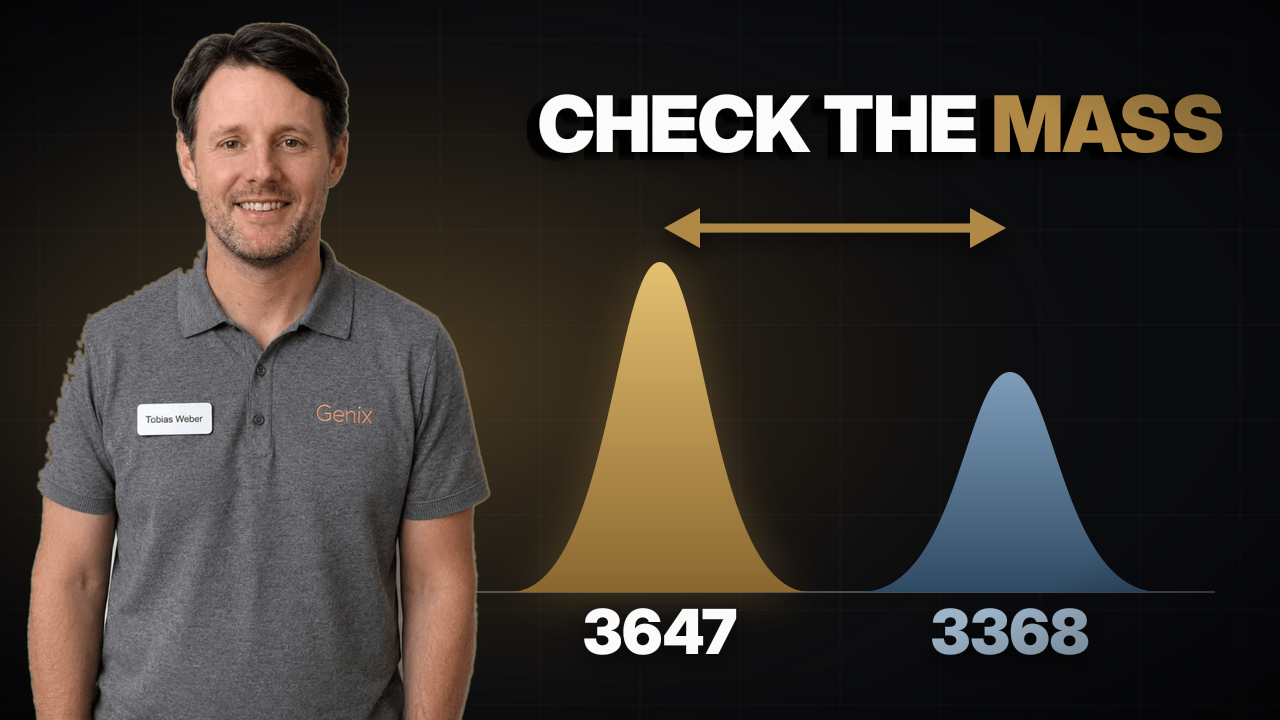
| Molecular weight | 3647.2 Da | 3367.9 Da |
| Formula | C165H269N47O46 | C152H252N44O42 |
| CAS number | 446262-90-4 | 863288-34-0 |
| Binds albumin | Yes, that is the point | No |
| Human half-life | About 6 to 8 days | Minutes to hours |
| Signal shape | Days-long raised floor | One short spike |
| Published human trials | Two, plus one terminated phase 2 | None under this name |
| Owns the 6 day GH data | Yes | No |
Read that last row twice. It is the single most useful line on this page. Pages that sell the no DAC peptide routinely quote the DAC data to do it, because the no DAC peptide has no human trial of its own under that name.
Which molecule is in the vial?
A mass spectrometer answers that in one run. The two candidates sit 279.3 daltons apart, which is an enormous gap at this scale. An identity test reports an observed mass. If it reads near 3647 you have the DAC version. If it reads near 3368 you have modified GRF (1-29). There is no ambiguity and no judgement call involved.
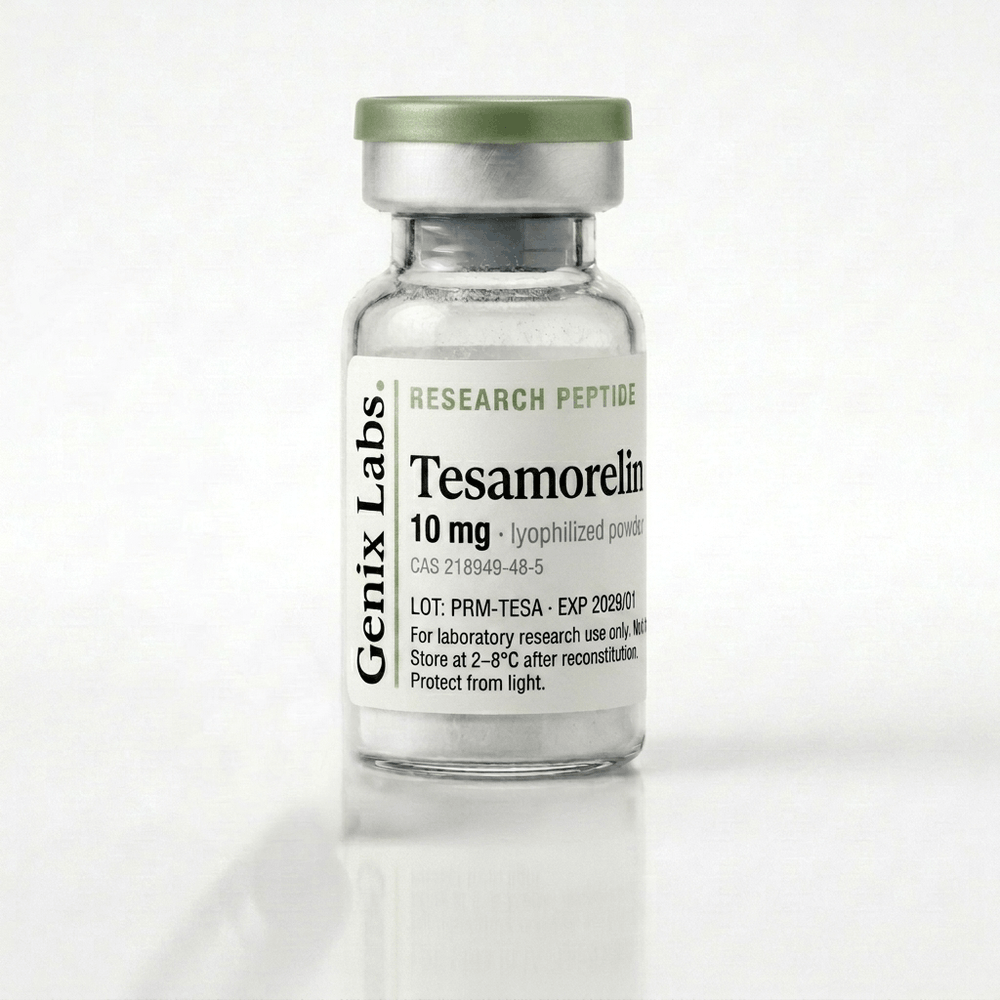
This is why we publish an observed mass on every lot report rather than a purity figure alone. Our tesamorelin lot 447106 report prints 5135.9 amu next to its 98.20 percent HPLC area purity. The purity number tells you how clean the vial is. The mass number tells you what is in it. For a compound sold under two names, the second number is the one that settles the argument.
- A vial of modified GRF (1-29) can be 99 percent pure modified GRF (1-29) and still not be CJC-1295.
- HPLC area percent measures how much of the sample is the main peak. It does not say which molecule that peak is.
- Identity confirmation by mass is a separate test. For this compound it is the more important one.
- A report with no observed mass cannot distinguish the two molecules at all.
Which results survive the swap?
Here is the audit nobody else runs. Take every published human finding for CJC-1295, then ask whether it still holds if the vial actually contains the no DAC peptide. The answer is that almost nothing survives, because almost every finding depends on the long half-life the DAC provides.
| Published finding | Measured on | Survives the swap to no DAC? |
|---|---|---|
| GH up 2 to 10 fold after one injection | DAC version | Partly. A spike happens, but not the size or the duration |
| That GH rise lasting 6 days or more | DAC version | No. The molecule is gone in hours |
| IGF-1 up 1.5 to 3 fold | DAC version | No published equivalent |
| That IGF-1 rise lasting 9 to 11 days | DAC version | No. Depends entirely on albumin binding |
| IGF-1 above baseline for up to 28 days on repeat dosing | DAC version | No. This is a cumulative effect of a long half-life |
| Half-life of 5.8 to 8.1 days | DAC version | No. This is the DAC, by definition |
| Trough GH 7.5 fold higher one week after a dose | DAC version | No. Nothing is left a week later |
| Pulsing preserved during continuous stimulation | DAC version | Not applicable. There is no continuous stimulation |
How does CJC-1295 work?
It copies a natural signal. Your hypothalamus makes growth hormone releasing hormone. That hormone travels a short distance to the pituitary gland and tells certain cells there to release growth hormone. CJC-1295 is a modified copy of the first 29 pieces of that natural signal, so it lands on the same receptor and gives the same instruction.
Four pieces of the natural sequence were swapped to make it tougher. The changes sit at positions 2, 8, 15 and 27. Position 2 is the important one. The natural hormone is chopped there within minutes by an enzyme in the blood. Swapping that piece for a mirror-image version blocks the chop. Then the DAC handle was added on the end to grab albumin.
What the GHRH receptor does
The receptor sits on somatotrophs, the pituitary cells that store growth hormone. When the receptor is switched on, those cells both release what they hold and make more. Growth hormone then travels to the liver, which responds by producing IGF-1. Most of what people want from growth hormone is actually attributed to IGF-1.
That chain matters for a reason that comes up later on this page. Three separate things can be measured along it: the growth hormone pulse, the average growth hormone level, and the IGF-1 level. They do not have to move together. In the one study that measured all three properly, they did not.
Does CJC-1295 increase growth hormone?
Yes, and this is the strongest claim the compound has. It was measured in two randomised, placebo-controlled, double-blind trials in healthy adults aged 21 to 61, running 28 and 49 days. A single injection raised mean plasma growth hormone by 2 to 10 fold depending on dose, and the rise lasted 6 days or more. That result is solid.
It is worth pausing on how unusual that is in this category. Most peptides sold for the growth hormone axis have no randomised human data at all. CJC-1295 has two placebo controlled trials with dose-dependent results. The problem with this compound is not that the pharmacology is fake. The pharmacology is the best-evidenced part of it.
Why 2 to 10 fold is the wrong number to quote
Because it is a peak, not a level. A second study went back a week after a single dose and sampled blood every 20 minutes across a whole night. Trough growth hormone, the floor between natural pulses, was 7.5 times higher. But the mean across the night rose only 46 percent, and IGF-1 rose 45 percent. Those are the sustained numbers.
Both findings are from the same compound and both are true. They answer different questions. "How high can it push growth hormone right after a shot" gets the 2 to 10 fold answer. "What does a week on this compound actually look like" gets a 46 percent higher average. Pages quote the first number and let readers assume it describes the second.
What happened to IGF-1
IGF-1 rose 1.5 to 3 fold after a single injection, and stayed up for 9 to 11 days. On repeat weekly or biweekly dosing, mean IGF-1 stayed above baseline for up to 28 days, which means the effect accumulated. The estimated half-life of the compound itself was 5.8 to 8.1 days, which explains all of it.
This is the number vendors reach for when they want to imply muscle and fat results, because IGF-1 is the hormone that does most of growth hormone's downstream work. A sustained IGF-1 rise is a real and meaningful finding. It is also a blood marker, not a body composition outcome, and the trial designed to turn one into the other did not finish.
The correlation that was not there
Here is a finding that almost no page reports. In the overnight sampling study, the IGF-1 increases did not correlate with any measure of growth hormone secretion. Not the mean, not the trough, not the pulse amplitude. The two things moved, but they did not move together subject by subject.
That breaks the clean story everyone tells. The standard pitch is a chain: more signal, more growth hormone, more IGF-1, more result. If the middle link does not predict the next one in the only study that checked, then the chain is a model rather than a measurement. It also means you cannot reason from someone's growth hormone response to their IGF-1 response.
Does it flatten the GH rhythm?
No, and that was the point of the second study. Growth hormone is normally released in pulses, mostly at night. A long-acting signal might reasonably be expected to wipe that pattern out. It did not. Pulse frequency and pulse size were both unchanged a week after a single 60 or 90 microgram per kilogram dose.
This is the strongest argument for the whole releasing-hormone approach over injecting growth hormone directly. The pituitary stays in charge of the timing. Whether preserved pulsing produces better outcomes than flat dosing was never tested, because the trial that would have tested it stopped.
The only phase 2 trial
This is the part of the file that page one leaves out entirely. CJC-1295 reached a phase 2 efficacy trial, and it is on the public registry as NCT00267527. It was a multicentre, randomised, placebo-controlled, double-blind study in HIV infected patients with HIV associated visceral obesity. Patients got low dose, high dose or placebo for 12 weeks.
| Field | What the registry records |
|---|---|
| Registry ID | NCT00267527 |
| Sponsor | ConjuChem |
| Phase | 2 |
| Design | Multicentre, randomised, placebo-controlled, double-blind |
| Population | HIV infected patients with HIV associated visceral obesity |
| Registered enrolment | 120 |
| Treatment period | 12 weeks, with a 6 week follow-up |
| Start | December 2005 |
| Listed status | Terminated |
| Posted results | None |
So the one study that would have told us whether a sustained IGF-1 rise translates into less visceral fat in people was designed, registered, started, and stopped. No efficacy result was ever posted. Every body composition claim made for this compound today sits on top of that hole.
Why the program stopped
The registry lists the trial as terminated and gives no reason. That is all the primary record says, and we will not pretend otherwise. Secondary accounts, including the encyclopedic summary of the compound, report that a participant died of a cardiac event during the trial, that the attending physician judged the most likely cause to be pre-existing coronary artery disease with a plaque rupture, and that development was halted anyway as a precaution.
Treat that account as what it is: a secondary report that the registry neither confirms nor contradicts. What is documented is that the trial terminated, no results were posted, and ConjuChem wound down over the following years. The causal question was never settled, which is a different thing from being settled in the compound's favour.
The analogue that finished
Now the comparison that makes sense of all of it. CJC-1295 was not the only growth hormone releasing hormone analogue taken after visceral fat in HIV patients. Tesamorelin was taken after exactly the same problem. It completed its phase 3 program, and in November 2010 the FDA approved it to reduce excess abdominal fat in HIV patients with lipodystrophy.
Two compounds, one receptor family, one indication, two endings. That tells you something important and often missed: the GHRH approach to visceral fat is not speculative. It was taken all the way through and it worked well enough to be approved. What is speculative is whether this particular molecule does it, because the trial that would have shown it stopped in 2006.
It is also why the growth hormone axis compound we actually stock is tesamorelin, at $149 for a 10mg vial, and not this one. The comparison is laid out in full in tesamorelin against sermorelin, and the compound itself in tesamorelin, the deep belly fat peptide.
Every study, listed
Here is the whole human file in one place. It is short. Two pharmacology papers and one terminated trial carry everything written about this compound.
| Study | Design | What it measured | What it found |
|---|---|---|---|
| Teichman 2006, J Clin Endocrinol Metab | Two randomised, placebo-controlled, double-blind ascending-dose trials, 28 and 49 days, healthy adults 21 to 61 | GH, IGF-1, half-life, tolerability | GH up 2 to 10 fold for 6 days or more. IGF-1 up 1.5 to 3 fold for 9 to 11 days. Half-life 5.8 to 8.1 days. No serious adverse reactions reported |
| Ionescu 2006, J Clin Endocrinol Metab | Overnight sampling every 20 minutes, before and one week after one 60 or 90 microgram per kilogram dose, healthy men 20 to 40 | GH pulse pattern, mean GH, trough GH, IGF-1 | Trough GH up 7.5 fold. Mean GH up 46 percent. IGF-1 up 45 percent. Pulse frequency and size unchanged. IGF-1 did not correlate with any GH measure |
| NCT00267527, ConjuChem | Phase 2, multicentre, randomised, placebo-controlled, double-blind, 12 weeks, enrolment 120 | Efficacy and safety in HIV associated visceral obesity | Terminated. No results posted |
That is the entire human record. Every claim about muscle, sleep, recovery, skin, joints, injury healing or longevity is an extrapolation from the first two rows, not a result in its own right.
What is CJC-1295 used for?
In published research it was used to raise growth hormone and IGF-1 for days at a time, and then taken into a trial for visceral fat that stopped. In practice today it is sold for muscle, fat loss, sleep, recovery and anti-aging. None of those have a completed trial on this compound behind them.
The honest way to describe the current position: CJC-1295 is a research compound with good pharmacology data and no efficacy data. That is a legitimate thing to study. It is not the same as a compound with proven outcomes, and the distinction is worth holding onto.
Does CJC-1295 help lose belly fat?
No published trial shows that. The study designed to answer this exact question, in exactly this population, is the terminated phase 2. It never reported a fat outcome. So the direct evidence for the most popular claim made about this compound is zero, and the reason is that the trial stopped rather than that nobody tried.
The indirect argument is reasonable but it is still indirect. Growth hormone does mobilise fat, visceral fat appears to respond most, and tesamorelin proved the class can do it. That chain of reasoning is a hypothesis about CJC-1295. It is a demonstrated result for tesamorelin for visceral fat.
Does it build muscle?
No study measured muscle. Not lean mass, not strength, not cross-sectional area, in any species, in any published work on this compound. The claim rests entirely on IGF-1 rising, and IGF-1 is a signal rather than an outcome.
If muscle is the question, the useful reading is peptides for muscle growth, sorted by evidence tier, which prints the strength result next to the mass result for every compound sold for this. CJC-1295 has neither.
Does it improve sleep?
No sleep outcome was measured. The idea comes from biology that is real: growth hormone release is tied to deep sleep, so a compound that raises growth hormone is assumed to deepen sleep. No study on this compound recorded sleep quality, sleep architecture or any sleep measure at all.
The honest version is that the direction of the arrow is unclear. Deep sleep drives growth hormone release more clearly than growth hormone drives deep sleep. We ranked the whole category by actual evidence in peptides for sleep.
Does CJC-1295 increase testosterone?
No published study reports that. The receptor CJC-1295 acts on sits on somatotrophs, which are a different pituitary cell type from the gonadotrophs that release luteinising hormone. Luteinising hormone is the signal that tells the testes to make testosterone. Nothing in the published work shows it moving.
Is CJC-1295 the same as HGH?
No. HGH is growth hormone itself, a 191 amino acid protein, injected directly. CJC-1295 is a 29 amino acid releasing signal that asks your pituitary to make its own. The practical differences are real, and they cut both ways.
| Growth hormone (HGH) | CJC-1295 | |
|---|---|---|
| What it is | The hormone itself, 191 amino acids | A releasing signal, 29 amino acids plus a DAC |
| Where it acts | Receptors throughout the body | The pituitary gland only |
| Natural rhythm | Overridden by the injected dose | Preserved, as measured in Ionescu 2006 |
| Ceiling | Whatever is injected | Whatever that pituitary can still produce |
| Needs a working pituitary | No | Yes |
| Approval status | Approved for several conditions | None anywhere |
| Human efficacy trials | Many, completed | One, terminated |
How does ipamorelin differ from CJC-1295?
They push the same gland through two different doors. CJC-1295 copies growth hormone releasing hormone. Ipamorelin copies ghrelin, the hunger hormone, and lands on a separate receptor. Both cause growth hormone release. Neither is approved, and neither has a completed trial showing a body composition result.
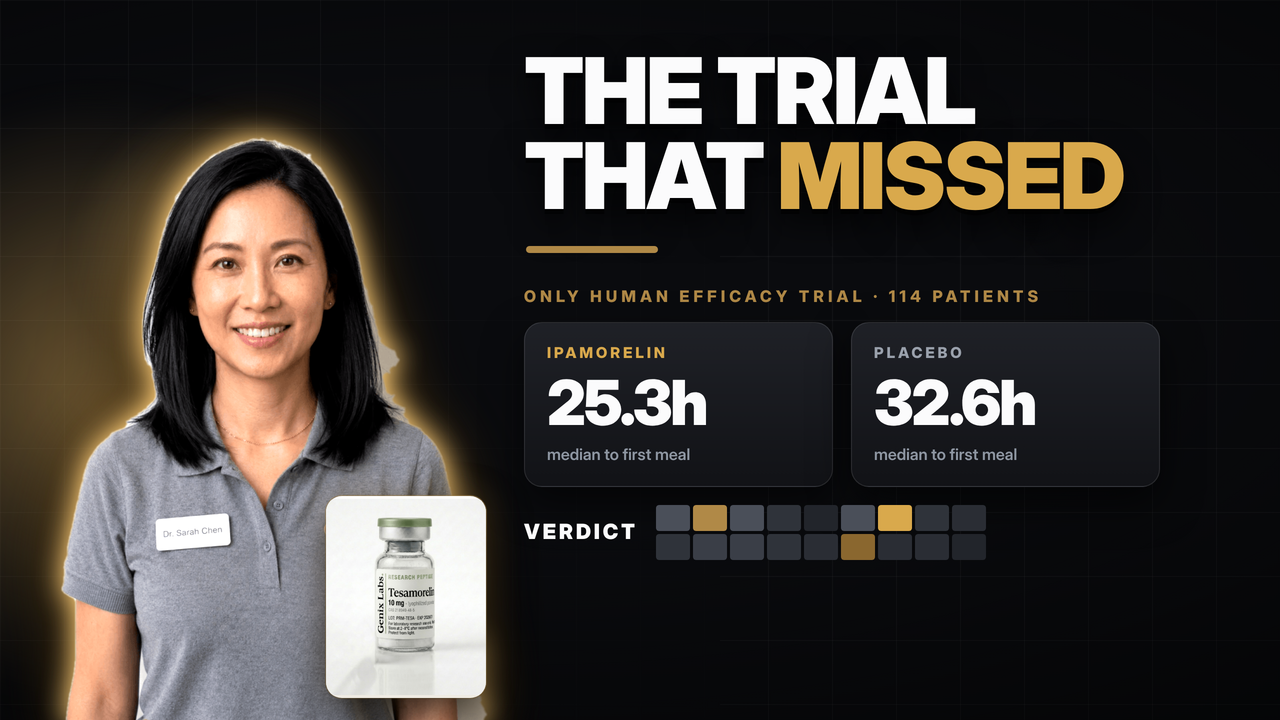
Their evidence profiles differ in a way worth knowing. Ipamorelin's human efficacy trial reached a result and missed its endpoint. CJC-1295's never reported one. The full grading of the other compound is in ipamorelin, every claim against what was measured.
Why is CJC-1295 paired with ipamorelin?
Because the two receptors are different, so in theory the effects add up rather than competing. The usual phrasing is that one builds the signal and the other triggers the release. The underlying biology is genuinely cooperative, and that part of the pitch is sound.
What is missing is any published head to head. No trial has compared the pair against either compound alone in people, on any outcome. The stack is sold as settled and is in fact untested. It is also commonly sold as the no DAC version paired with ipamorelin, which means neither half of that vial has human efficacy data under the name on the label.
Sermorelin against CJC-1295
Sermorelin is the plain version of the same 29 amino acid signal, with no substitutions and no DAC. It is chopped up in the blood within minutes. CJC-1295 is that sequence, toughened at four positions, with the albumin handle added. One was an approved medicine that was later withdrawn from the market. The other was never approved.
| Sermorelin | CJC-1295 no DAC | CJC-1295 (DAC) | Tesamorelin | |
|---|---|---|---|---|
| Sequence | GHRH 1-29, unmodified | GHRH 1-29, 4 substitutions | Same, plus DAC on residue 30 | GHRH 1-44 analogue |
| Half-life | Minutes | Minutes to hours | 6 to 8 days | Minutes, dosed daily |
| Human efficacy trials | Yes, historically | None | One, terminated | Phase 3 completed |
| Approval | Approved then withdrawn | None | None | FDA approved, 2010 |
| Visceral fat result | Not the indication | None | Never reported | Demonstrated |
The GH peptides line by line
Widen the frame and the picture gets clearer. Everything sold for this axis falls into two groups by receptor, and into very different groups by evidence.
| Compound | Receptor | Best human evidence | Approved anywhere |
|---|---|---|---|
| Tesamorelin | GHRH | Phase 3 completed, imaging endpoints | Yes, HIV lipodystrophy |
| Sermorelin | GHRH | Historic approval, diagnostic and paediatric use | Approved then withdrawn |
| CJC-1295 (DAC) | GHRH | Two phase 1 pharmacology trials | No |
| CJC-1295 no DAC | GHRH | None under this name | No |
| Ipamorelin | Ghrelin | One phase 2, endpoint missed | No |
| Ibutamoren (oral) | Ghrelin | Multiple trials, heart failure safety signal | No, and in FDA Category 2 |
Note the bottom row. Ibutamoren is the only compound in this group currently sitting in the FDA's Category 2 list of bulk substances with identified safety risks, flagged for possible congestive heart failure. CJC-1295 is not on that list, for reasons covered below that are routinely misreported.
What side effects were recorded?
The phase 1 trials reported no serious adverse reactions, and described the regimens as generally well tolerated, particularly at 30 or 60 micrograms per kilogram. That is a genuinely reassuring short-term result from placebo-controlled work, and it is the only systematic safety data that exists.
What is missing is everything beyond that. There is no long-term safety data, because the 12 week trial terminated. Effects reported anecdotally for this class, water retention, tingling in the hands, joint aches and raised blood sugar, are known growth hormone effects rather than measured CJC-1295 findings.
- No serious adverse reactions in the phase 1 program. Doses of 30 and 60 micrograms per kilogram were described as best tolerated.
- No completed study longer than 49 days.
- No posted safety results from the 12 week phase 2.
- A secondary report of one cardiac death during that trial, judged by the attending physician to be from pre-existing coronary disease, which the registry does not address.
- No published data in anyone under 21 or over 61.
Who should be most careful
In a research context the groups flagged across the growth hormone literature are consistent: anyone with an active or past cancer, because IGF-1 is a growth signal; anyone with diabetes or poor blood sugar control, because growth hormone pushes glucose up; and anyone pregnant or breastfeeding, where no data exists at all.
Add one specific to this compound. A signal with a 6 to 8 day half-life cannot be switched off. If something unwanted appears, stopping the next dose does not stop the current one. Short-acting compounds in this class are easier to back out of, and that is a real design difference rather than a footnote.
How long does it take to work?
It depends what "work" means. The blood markers move fast and were measured precisely: growth hormone within hours, IGF-1 rising over the first days and staying up for 9 to 11 days. On repeat dosing, IGF-1 accumulated and stayed above baseline up to 28 days.
Body composition is a different question with no answer. The study built to measure it over 12 weeks did not report. So the honest statement is that the markers respond in days and nobody has published what happens to a body over weeks.
How would you know it is working?
In research terms, by measuring IGF-1. It is the stable downstream marker, it moves reliably, and it stays moved for days, which makes it far easier to sample than growth hormone itself. Growth hormone is pulsatile, so a single draw tells you almost nothing about the average.
One caution from the data. Because IGF-1 did not correlate with any growth hormone measure in the overnight study, an IGF-1 result does not tell you about the growth hormone response, or the reverse. They have to be measured separately if both matter.
What doses were studied?
This is study design, not guidance, and nothing here is a protocol for use in a person. The phase 1 program gave single ascending subcutaneous doses, then two or three doses weekly or biweekly. The regimens described as best tolerated were 30 and 60 micrograms per kilogram. The overnight sampling study used single doses of 60 or 90 micrograms per kilogram and found no significant difference between them.
One structural point that follows from the half-life. Weekly or biweekly schedules in the trials were not a convenience choice. With a 6 to 8 day half-life, more frequent dosing stacks the compound, and the 28 day IGF-1 result shows the accumulation is real and measurable.
Is CJC-1295 FDA approved?
No. CJC-1295 is not approved as a medicine in the United States or anywhere else, and it never has been. It reached phase 2 and stopped. There is no marketing application, no approved label and no indication. It is sold legally as a research chemical, not as a treatment.
The Category 2 story, corrected
Here the internet splits into two camps and both are wrong. One says CJC-1295 is banned by the FDA. The other says the FDA cleared it. The actual sequence is a third thing, and it is on the FDA's own page.
| When | What happened | What it meant |
|---|---|---|
| September 2023 | CJC-1295 placed in Category 2 of the interim policy on bulk drug substances for compounding | Compounding pharmacies risked enforcement if they used it. Not a ban, not a scheduling action |
| September 2024 | Removed from Category 2 because the nominators withdrew the nominations | Procedural. The substance left the list without the agency finding it safe |
| December 2024 | Pharmacy Compounding Advisory Committee reviewed it; the recommendation went against adding CJC-1295 to the 503A bulks list | Removal from Category 2 did not put it on the permitted list either |
| Current | Not in 503A Category 2, and not on the 503A bulks list | In neither column. The withdrawn-nominations list is where it sits |
The FDA's current page on bulk substances that may present significant safety risks lists six substances in 503A Category 2: cesium chloride, domperidone, germanium sesquioxide, ibutamoren mesylate, kisspeptin-10 and quinacrine hydrochloride. CJC-1295 is not among them. It appears instead on the separate list of substances previously in Category 2 whose nominations were withdrawn by the nominators.
Is it banned in sport?
Yes. Growth hormone releasing factors and their analogues are prohibited at all times under the World Anti-Doping Agency's peptide hormones and growth factors category. That covers CJC-1295 in either form, and it does not depend on approval status. Tested athletes should treat the whole class as off limits.
Handling and storage
Standard lyophilised peptide handling applies. Keep the sealed vial cold and out of light. Reconstituted peptide is far less stable than the dry powder and belongs refrigerated, shielded from light, and used within a short window. Freeze and thaw cycles degrade peptides, so repeated freezing is worth avoiding.
The mechanics are the same across this whole class, and we wrote them up once in how to reconstitute peptides. Nothing about CJC-1295 changes those steps.
Why identity beats purity here
For most compounds, purity is the number that matters most. For this one, identity matters more, and the reason is specific. Two different molecules are sold under one name. A high purity figure confirms the vial is clean. It does not confirm which of the two is in it.
An HPLC area percentage says how much of the sample is the dominant peak. A mass confirmation says what that peak is. With 279 daltons between the candidates, the mass line is decisive and the purity line is silent. Any report that omits an observed mass cannot answer the only question that matters about this compound.
That is the standard we hold our own lots to, and it is why every Genix report prints an observed mass beside the purity figure. The method behind those numbers is set out in peptides 101, and the reports themselves are public.
What is actually sold as CJC-1295
Three things, under one name. The DAC version, which is the molecule with the data. The no DAC version, which is modified GRF (1-29) and has none under that name. And blends, usually with ipamorelin, where the label may not say which version is inside or how much of each.
The blends are the hardest to verify, because a report on a mixture has to resolve and quantify two peptides rather than confirm one. If a blend's report shows a single purity figure and no per-component identity, it cannot tell you what you have.
We do not stock CJC-1295 in any form. The growth hormone axis compound in our tesamorelin catalog listing is the one with completed phase 3 trials and an approval behind the class claim, tested by HPLC-UV-MS with the observed mass published for every lot.
What to ask before sourcing
- Which molecule is this: CJC-1295 with DAC, or modified GRF (1-29)? Make the seller answer in those words.
- What observed mass does the lot report show? Near 3647 is the DAC version. Near 3368 is modified GRF (1-29).
- Does the report cover the lot number printed on my vial, or a different lot?
- Is there an identity test at all, or only an HPLC purity figure?
- If this is a blend, does the report identify and quantify each peptide separately?
- Was the analysis done by an accredited laboratory, and is the full report published rather than summarised?
A seller who cannot say which of the two molecules they are shipping is telling you something useful. On this compound, that single question separates the suppliers who test from the suppliers who relabel.
What breaks a CJC-1295 claim
- Quoting the 6 day GH rise or the 11 day IGF-1 rise for the no DAC peptide. Those numbers belong to the DAC molecule.
- Quoting the 2 to 10 fold GH increase as a sustained level. It is a peak after a single injection. The measured mean a week later was 46 percent higher.
- Treating the IGF-1 rise as a body composition result. It is a blood marker, and the trial meant to convert it into an outcome terminated.
- Saying the FDA banned it. It was in Category 2 for a year, then left when the nomination was withdrawn. It is in neither column now.
- Saying the FDA cleared it. A withdrawn nomination is not a safety finding, and the advisory committee recommendation went the other way.
- Reasoning from a GH response to an IGF-1 response. In the only study that checked, they did not correlate.
- Calling the ipamorelin pairing proven. There is no published head to head on any outcome.
Which peptide for which question?
| If the question is | The compound with the most relevant data | Why |
|---|---|---|
| Visceral abdominal fat | Tesamorelin | Completed phase 3 trials with imaging endpoints and an FDA approval in that indication |
| A long, flat GH and IGF-1 lift | CJC-1295 with DAC | Two placebo-controlled trials measured exactly that, with a 6 to 8 day half-life |
| A short GH pulse | Modified GRF (1-29) or ipamorelin | Both are short-acting. Neither has efficacy data |
| Preserving the natural GH rhythm | CJC-1295 with DAC | The one study that measured pulsing found frequency and size unchanged |
| Muscle or strength | None of them | No compound in this class has published strength or muscle data |
| Sleep | None of them | No study on any of them recorded a sleep outcome |
The honest summary of the class is in our Weight and Metabolism peptide hub, which sorts every compound we cover by the kind of study behind it rather than by how often it gets recommended.
Frequently asked questions
What is CJC-1295 used for?
In published human work it was used for one thing: raising growth hormone and IGF-1 for days at a time. It was taken into a phase 2 trial for visceral fat in HIV patients, and that trial was terminated. Muscle, sleep and anti-aging uses come from vendors, not from trials.
What is the difference between CJC-1295 with DAC and without DAC?
They are different molecules. CJC-1295 carries a drug affinity complex on a thirtieth residue that grips albumin, giving a half-life of roughly 6 to 8 days. Remove it and you have modified GRF 1-29, about 279 daltons lighter, cleared in hours. Every multi-day human result belongs to the DAC form.
Does CJC-1295 increase growth hormone?
Yes, and it is measured rather than assumed. A single injection raised mean plasma growth hormone 2 to 10 fold in healthy adults, and the rise lasted 6 days or more. Measured again overnight a week after one dose, trough levels were 7.5 times higher while the mean rose 46 percent.
Does CJC-1295 help lose belly fat?
No published trial shows that. The one study designed to answer it, a phase 2 in HIV associated visceral obesity, is listed as terminated on the public registry, so it never reported a fat result. Tesamorelin ran that question to completion instead and holds the approval.
Is CJC-1295 the same as HGH?
No. HGH is growth hormone itself, injected directly. CJC-1295 is a releasing hormone analogue, so it asks the pituitary to make its own. That difference is why pulsing survived in the one study that looked, and why the ceiling is whatever a given pituitary can still produce.
Does CJC-1295 increase testosterone?
No study reports that. CJC-1295 acts on the growth hormone releasing hormone receptor, which sits on a different pituitary cell type from the one that makes luteinising hormone. Luteinising hormone is the signal that drives testosterone, and nothing in the published work shows it moving.
Takeaway
CJC-1295 is a well-characterised piece of pharmacology attached to an empty efficacy file. The two things it was shown to do, raise growth hormone for days and raise IGF-1 for longer, were measured carefully in placebo-controlled trials. Everything after that is missing, because the trial that would have supplied it terminated in 2006 and posted nothing.
Two practical things to carry away. First, check which molecule you have, because the name covers two and only the heavier one owns the data. One observed mass settles it. Second, the GHRH approach to visceral fat is not unproven. It was proven by tesamorelin, which finished the trials this compound started.
- Two molecules share the name. They are 279 daltons apart and one mass check tells them apart.
- Every multi-day human number belongs to the DAC version only.
- The 2 to 10 fold GH figure is a peak. The sustained mean rise, measured a week later, was 46 percent.
- The one phase 2 trial, in HIV associated visceral obesity, is listed as terminated with no results posted.
- Tesamorelin took the same question through phase 3 and holds the approval. That is where the completed evidence is.