
What are the side effects of MOTS-c?
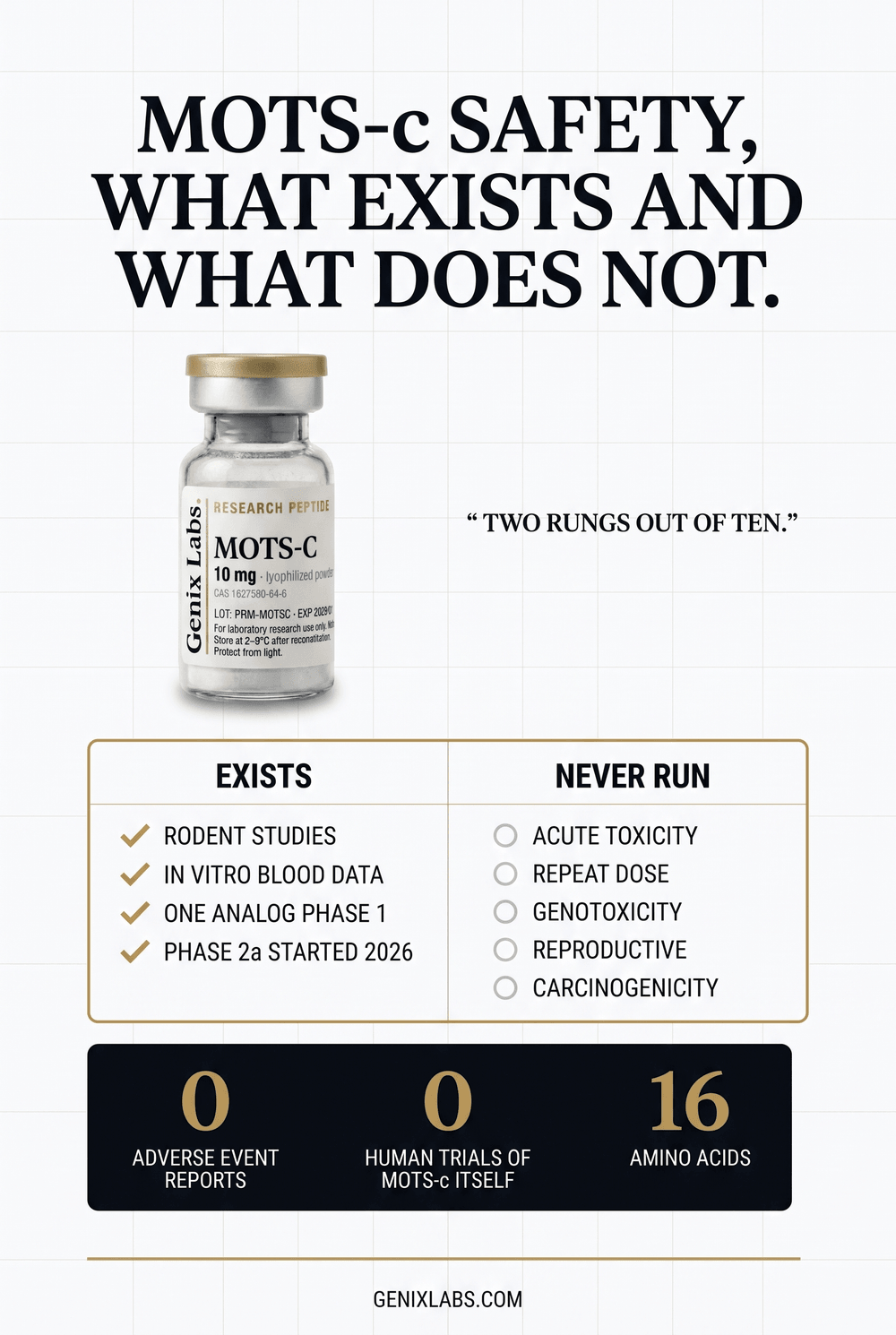
Nobody knows. That is not a dodge. In July 2026 the US Food and Drug Administration published its own review of MOTS-c. It searched its adverse event database twice and found zero reports. It looked for acute, repeat-dose, genotoxicity, reproductive and carcinogenicity studies and found none. It found no human exposure data by any route.
So every side effect list you have read online was written by somebody filling a gap. Some of those lists say mild nausea. Some say fatigue. Some say nothing at all. None of them cite a study, because there is no study to cite.
This article is about what is actually in the file. We will go through the FDA review line by line. We will look at the single human trial of a MOTS-c lookalike, which is the only place real numbers exist. We will look at the trial of MOTS-c itself that started in February 2026. And we will spend real time on the risk FDA named first, which is not a symptom at all.
- An empty side effect list means nobody looked, not that nothing happens.
- FDA could not name the target organs, because the molecular target is unknown.
- The named risk is immunogenicity: antibodies against an injected peptide.
- Those antibodies could neutralise the MOTS-c your own cells make.
- Research use only. Genix supplies MOTS-C for laboratory work, not for people.
What is MOTS-c?
MOTS-c is a peptide 16 amino acids long. A peptide is a short chain of amino acids, the beads that proteins are built from. The unusual part is where its recipe is kept. Most proteins are coded in the nucleus, the main library of the cell. MOTS-c is coded inside the mitochondria.
Mitochondria are the parts of a cell that turn food into usable energy. They carry a small separate strip of DNA, left over from an ancient bacterium. In 2015 a team found a short reading frame hidden in that strip. It codes for MOTS-c.
Your body already makes it. That matters more here than in a benefits article. When you inject a copy of a signal your own cells produce, you are not only adding a drug. You are adding a stranger that looks exactly like family. The immune system has opinions about that, and we will come back to it.
If you want the full mechanism and the effect side of the story, our companion piece on MOTS-c benefits walks through the folate cycle, AMPK and where the human data splits. This page stays on safety.
Why does every MOTS-c side effect list differ?
Because they are all reasoning from somewhere else. There is no shared source, so each writer borrows from a different neighbour. Put four pages side by side and you can see exactly which neighbour each one picked.
- Some borrow from GLP-1 drugs and list nausea, because those drugs cause nausea.
- Some borrow from growth hormone peptides and list water retention and joint ache.
- Some borrow from the general act of injecting and list redness, soreness and bruising.
- Some borrow from the mechanism and reason that AMPK activation might lower blood sugar.
- Some simply write that it is well tolerated, which is a claim with no measurement behind it.
Only the third group is on solid ground, and it is solid for a boring reason. Any needle in any skin can cause a local reaction. That has nothing to do with MOTS-c.
The fourth group is interesting but it is not evidence. A plausible mechanism is a hypothesis. It tells you what to measure. It does not tell you what happened.
The fifth group is the one to walk away from. The phrase well tolerated has a technical meaning. It means a trial recorded adverse events and the count was acceptable. Applied to a compound with no trial, it is a decoration.
What did FDA's own review of MOTS-c find?
FDA published a 2.2 MB briefing document on MOTS-c in July 2026, written for its Pharmacy Compounding Advisory Committee. It is the most thorough safety review of this peptide in existence, and it is free to read. Its bottom line is one sentence: the evaluation criteria weigh against putting MOTS-c on the list of substances pharmacies may compound with.
Here is how the document came to exist. A compounding pharmacy nominated MOTS-c for the list. The nomination asked for 5 mg and 10 mg products for injection under the skin. The proposed uses were insulin resistance, obesity, osteoporosis, vascular calcification, muscle and fat metabolism, and longevity.
The nomination cited 12 papers. None of them was a clinical study. The nominator later withdrew, and FDA decided to finish the evaluation on its own initiative anyway. That is why we have the file.
FDA checked four things in order. Is the substance well characterised? Has it been used historically in compounding? Are there safety concerns? Is there evidence it works? The safety section is the one that matters here, and it splits in two: animal work, then human work.
Which MOTS-c safety studies were never run?
Five of them, and they are the five every medicine has to clear. FDA wrote the same sentence five times in a row: the nominator did not submit, and FDA did not identify, studies of that type for MOTS-c free base or MOTS-c acetate. Not thin studies. None.
| Study type | What it would answer | Status for MOTS-c |
|---|---|---|
| Acute toxicity | What one large dose does within a day | Never run |
| Repeat-dose toxicity | What daily dosing does to organs over weeks | Never run |
| Genotoxicity | Whether it damages DNA or chromosomes | Never run |
| Developmental and reproductive | Effects on fertility, pregnancy and offspring | Never run |
| Carcinogenicity | Whether long use raises tumour risk | Never run |
| In-vivo pharmacokinetics | Where it goes and how long it lasts in a body | Never run |
Read that table slowly, because people skim tables. The reproductive row means nobody has checked what MOTS-c does in pregnancy, in a developing animal, or to fertility. The carcinogenicity row means nobody has checked what months of exposure does to tumour rates.
FDA also noted something subtler. The animal studies that do exist never mapped a dose-response curve in a living animal. A dose-response curve is the basic shape of pharmacology: more of this gives more of that, up to a point, then harm starts. Without it you cannot say where the harmful end begins.
And all the animal work is in rodents. Rats and mice. No dog study, no primate study, no second species of any kind. Regulators want two species before a first human dose for a reason: species disagree, and the disagreements are where surprises live.
Has anyone ever reported a MOTS-c side effect?
Not to FDA. The Office of Surveillance and Epidemiology searched the FDA Adverse Event Reporting System for MOTS-c through 28 February 2024, then searched again from 26 February 2024 through 9 March 2025. The searches retrieved no reports at all.
Now read the footnote FDA attached, because it is the whole story. Compounders working under section 503A generally do not report adverse events to FDA. Unless somebody files a report, the agency may never learn an event happened.
So the zero is a measure of reporting, not of harm. Think of a town with no fire statistics because it has no fire department. The number of recorded fires is zero. You would not conclude the town does not burn.
Grey market peptides make this worse than usual. Buyers often do not have a prescriber. A person who injects something bought online and feels unwell has no obvious place to file. If they go to a hospital, the compound may never be named in the chart.
Is there any human safety data for MOTS-c?
For MOTS-c itself, no. FDA put it plainly: the nomination did not include, and FDA has not identified, any clinical studies or human exposure data for MOTS-c via any route of administration. Therefore the potential safety risks in humans are unknown.
There is one thing nearby. A biotech called CohBar built a modified version of MOTS-c, named CB4211, and put it through a Phase 1 programme. An analog is a redesigned copy: same idea, different molecule, built to survive longer in the body. It is the closest human data that exists.
It is also not MOTS-c. A change to a peptide chain can change how fast it breaks down, which tissues it reaches and how the immune system reads it. Treat CB4211 as the nearest neighbour, not as a stand-in.
Human blood levels of MOTS-c have been measured in many observational studies, including in kidney disease, diabetes and after exercise. Those studies measure the MOTS-c people already have. None of them gave anybody a dose, so none of them says anything about side effects.
What happened in the one human trial of a MOTS-c analog?
It was small, it was careful, and the safety result was unremarkable in the good sense. In the Phase 1a part, 65 healthy adults received single doses or seven days of dosing, across a range from 0.2 to 3.0 mg per kilogram per day, or placebo. Then came a four-week study in people with fatty liver.
That second part enrolled 23 subjects with at least 10% liver fat on an MRI scan, a body mass index of 30 or more, and a Fibroscan reading of 300 decibels per metre or higher. They were randomised one to one to CB4211 at 25 mg once daily under the skin, or placebo, for four weeks. Eleven finished on drug and nine on placebo.
Every subject lived in an inpatient unit for the whole four weeks and ate a standardised diet built from their own measured energy use. That detail matters later.
The safety result, in the authors' own words
Treatment was safe and well tolerated with no serious adverse events. Three subjects discontinued: two for positive COVID-19 tests and one who withdrew consent. Generally mild to moderate injection site reactions were the only treatment related adverse event in more than 10% of subjects.
That is the entire human adverse event record for anything MOTS-c shaped. Injection site reactions, mild to moderate, in a trial of 11 treated people over four weeks.
The efficacy numbers are worth seeing because they tell you how to read the safety numbers. Against placebo at week four, ALT fell 25 percentage points and AST fell 17, both liver enzymes, both statistically significant. Fasting glucose fell 6 points, also significant. Body weight showed a trend down and nothing more.
So a MOTS-c analog did move real markers in real people. That is genuinely promising. It is also 11 people for 28 days. A four-week study in 11 subjects cannot detect anything that appears in one person in a hundred, or anything that takes six months to show up.
One more honest note. CB4211 is no longer in development. The company behind it went through a merger and the programme did not continue. A compound that reaches Phase 1 and stops there has not been shown unsafe. It has simply not been shown anything.
Is MOTS-c being tested in people right now?
Yes, for the first time. A Phase 2a trial of MOTS-c itself began on 2 February 2026. It is sponsored by Hudson Biotech and registered as NCT07505745. It plans 120 adults with prediabetes and overweight or obesity, randomised one to one to MOTS-c or placebo, with a fixed dose once daily for 12 weeks.
The design detail that matters for this page is the endpoint list. There are two primary endpoints, not one. The first is a change in insulin sensitivity measured by the Matsuda index after an oral glucose test. The second is the incidence of treatment-emergent adverse events, followed through week 16.
In other words, counting side effects is a co-primary purpose of the first human trial of this peptide. Primary completion is estimated for 14 February 2027. The single listed site is Peking University Shenzhen Hospital.
Until that reads out, anybody quoting a MOTS-c side effect rate is quoting nothing. After it reads out, there will be a number, from 120 people, over 12 weeks. That will be a real starting point and still not a full safety picture.
Can MOTS-c trigger an immune reaction?
This is the risk FDA named first, and it is the part almost no article covers. Immunogenicity means a substance provokes your immune system into building antibodies against it. FDA wrote that it is concerned about this for MOTS-c given by injection, and that there is not enough information to rule it out.
Two details make the worry concrete. First, MOTS-c is proposed for injection under the skin. FDA noted that the subcutaneous route is associated with more immunogenicity than the intravenous route. The skin is patrolled by immune cells whose job is to notice things.
Second, the consequences are not a fixed severity. FDA described the range plainly: responses may run from antibodies with no clinical sign at all, to life-threatening and catastrophic reactions, and the outcome is often unpredictable in any given person.
No study has measured antibody formation against MOTS-c in a human. The Phase 2a trial that started in 2026 is the first chance to find out.
Can antibodies switch off the MOTS-c you make yourself?
FDA raised that exact possibility. One consequence of an immune response, it wrote, is neutralising antibody activity, which may cause loss of effect or even neutralise the activity of the endogenous peptide counterpart. Endogenous means the version your own body produces.
Sit with that for a second. The reason people find MOTS-c interesting is that it is something your mitochondria already make. That is exactly what makes this risk different from a normal drug side effect.
A normal side effect stops when you stop the drug. An antibody that learns to recognise your own signalling peptide does not have to stop. It is a mechanism for a lasting change, in the wrong direction, in a system that was working before.
We want to be careful here. This has not been observed with MOTS-c. Nobody has looked. It is a named, mechanistically grounded concern from the agency that reviews peptides for a living, and it sits in a file with no data to settle it either way.
What is peptide aggregation and why does it matter?
Aggregation is when peptide chains stick to each other and form clumps. FDA explained that peptides, unlike small chemical drugs, have an inherent tendency to do this. Chains as short as two amino acids have been shown to aggregate. MOTS-c has 16.
Clumps matter for three reasons. They change how the peptide behaves. They can form visible or invisible particles in the liquid. And they are a known risk factor for immunogenicity, because the immune system reads a repeating clumped pattern as a danger signal.
Aggregation can be reversible or permanent. It can happen during manufacture, during shipping, during storage, or after you add water to the powder. Heat, shaking, freezing and thawing all push in the wrong direction.
FDA found no study of aggregation for MOTS-c free base or MOTS-c acetate. That is why the handling section further down is not housekeeping advice. In a peptide, handling is part of the safety profile.
What else is in a MOTS-c vial?
Whatever the synthesis left behind. Peptides are built by solid phase peptide synthesis, a process that adds amino acids one at a time on a solid support. It uses reagents, catalysts and scavenger chemicals. FDA listed all three as potential process related impurities, plus peptide related aggregates.
There are also sequence impurities. A synthesis that misses one coupling step leaves a 15 amino acid chain in the batch. A chain with an extra residue or a modified side group is a different molecule with unknown behaviour. These are the impurities a purity figure is meant to bound.
Here is the uncomfortable part of the FDA file for the whole category. For MOTS-c free base there was no certificate of analysis in the nomination package at all. FDA went looking and found one in the literature that contained purity testing only.
FDA also wrote what a compounder is supposed to do with impurity data: weigh the amount of each impurity against the dose, the route and how long dosing continues. You cannot do that arithmetic without a document. Many buyers never see one.
What is an endotoxin and why does it matter here?
An endotoxin is a fragment of the outer wall of certain bacteria. It is debris, not a living organism, so killing the bacteria does not remove it. Injected into a body it can cause fever, chills and a sharp inflammatory response, and at high enough load it is dangerous.
This is why sterility and endotoxin are different tests. A batch can be sterile, meaning nothing is alive in it, and still carry endotoxin from bacteria that were alive earlier in the process. Autoclaving kills. It does not clean.
FDA was explicit about the standard for any injectable product. Sterility, the bacterial endotoxins test and foreign particulates are considered critical safety factors. Microbial enumeration and endotoxin testing are critical for a substance used in compounded injections.
Then it reported the gap: because there was no certificate for MOTS-c free base, FDA does not know whether microbial bioburden or endotoxin controls are in place at all, and found nothing relevant in the public domain either.
We are going to apply that chart to ourselves, because it would be dishonest not to. Our MOTS-C lot 559238 document reports HPLC area purity of 98.90% and an LC-MS identity confirmation for the tested size. Those are the top two bands of the chart. They are real, they are lot specific, and they are more than most sellers publish.
They are also not the bottom four bands. An HPLC area percentage is not a content assay, not a sterility result, not an endotoxin result and not a safety clearance. Anybody who tells you a purity number makes a research compound safe to inject has misread the document, including if they work for us.
Is the vial even the molecule on the label?
Not necessarily, and this is one of the sharpest findings in the whole review. FDA wrote that MOTS-c is a common name, not an official adopted name, and that it has encountered multiple salts and derivatives, including different active moieties, sold commercially under that same common name.
An active moiety is the part of the molecule that actually does the work. FDA stated the consequence directly: different active moieties are not interchangeable, because they can have different safety and efficacy profiles. So two vials both labelled MOTS-c can be two different substances.
The practical version is this. The free base and the acetate salt are not the same material. Ten milligrams of one is not ten milligrams of the other by peptide content. Yet both are sold as MOTS-c, and plenty of listings never say which.
FDA called this a safety risk for patients, because they may receive a different substance than was intended. It also breaks laboratory work: if you cannot tell which material a reference standard refers to, your analysis is anchored to nothing.
- Free base or acetate salt? These are different substances with different mass per vial.
- Is there a lot number on the vial that matches a published document?
- Does the document show identity, by mass, or only a purity percentage?
- What were the storage and shipping conditions, and for how long?
Which organs could MOTS-c affect?
FDA could not say, and it explained why. The pharmacological effects of MOTS-c appear to depend at least partly on AMPK signalling, but the molecular target it binds to remains unknown. Without a known target, it is difficult to predict which organs might be affected.
AMPK is the cell's fuel sensor, the switch that flips when energy runs low. It is not in one organ. It is in essentially every cell you have. A signal that nudges AMPK is a signal with a very wide address list.
Compare that with a drug whose target is known. If a medicine binds one receptor, you can list the tissues carrying that receptor and go look there first. For MOTS-c there is no such list, so toxicology would have to check everything.
The rodent studies do point somewhere. Skeletal muscle looks like a main site of action, and effects have been reported in liver, bone and blood vessels. Those are places to look, not a map of where harm would appear.
Does MOTS-c reach the brain?
Injected into the body, no. A 2021 study set out to test MOTS-c for memory effects and found that peripheral MOTS-c does not cross the blood-brain barrier. The authors had to attach a cell penetrating carrier peptide to get it into the brain at all.
The blood-brain barrier is a tight filter around the brain's blood vessels. It keeps most large molecules out. A 16 amino acid peptide is large by that standard.
This cuts two ways for safety. It is reassuring, because direct effects on brain tissue from a peripheral injection are unlikely. It is also a reason to be sceptical of any marketing that promises focus, mood or cognitive benefits from an ordinary injection.
If clearer thinking is the goal, the honest comparison is with peptides studied for that purpose. Our write-up on Semax for focus covers one of them and is equally blunt about the limits of the evidence.
How long does MOTS-c survive in blood?
Not long, based on the one relevant measurement. FDA found a single pharmacokinetic study in the whole literature, and it was done in a test tube. Researchers incubated MOTS-c at 5 micrograms per millilitre in human whole blood at body temperature for 15 or 60 minutes.
Using high resolution mass spectrometry they found the peptide had been chopped from the front end. They identified shortened versions running from the second, third, fourth and fifth amino acid to the end. The authors reported that this breakdown was rapid and did not need a long incubation.
FDA drew the obvious question out of that. It remains to be determined whether giving MOTS-c to a human can produce useful concentrations of the intact peptide over time at all.
For safety this is a double-edged finding. Rapid breakdown limits how long an injected dose can act. It also means the body is exposed to a family of fragments, and nobody has studied what any of those fragments do.
Could MOTS-c make inflammation worse?
In one specific setting, yes, and it was reported by researchers who were looking for the opposite. A 2018 paper in Rejuvenation Research described mitochondrial-derived peptides exacerbating senescence.
Senescent cells are cells that have stopped dividing but refuse to die. They sit in tissue and leak inflammatory signals. That leak has a name, the senescence-associated secretory phenotype, and it is one of the better supported drivers of aging damage.
The finding was that humanin and MOTS-c both increased that leak. In senescent cells they stimulated secretion of IL-6, IL-1 beta, IL-8, IL-10 and tumour necrosis factor alpha. Those are the main inflammatory messengers in the set.
The proposed explanation is almost ironic. The same protective quality that keeps a stressed cell alive may keep a senescent cell alive too, and a living senescent cell keeps leaking. Protecting cells is not automatically good when some of those cells should be cleared.
This is cell culture work, not a human outcome. It is still the single clearest mechanistic reason to doubt the simple story that a mitochondrial peptide must be anti-aging.
Does MOTS-c cause cancer?
No carcinogenicity study of MOTS-c has ever been run, so the question is formally open. What exists is laboratory and observational work, and it points in two directions at once depending on which tissue you look at.
In liver cancer the signal looks protective. A 2025 study in Experimental Cell Research reported that MOTS-c levels in the blood of liver cancer patients were significantly lower than in healthy people. In the laboratory, MOTS-c pushed liver cancer cells toward self-destruction under low oxygen, and in mice it slowed tumour growth.
In prostate tissue the signal looks like the opposite. A 2025 study of 375 men found MOTS-c levels raised in precancerous lesions compared with benign enlargement. The authors suggested this points to involvement in early malignant change.
| Setting | What was measured | Direction |
|---|---|---|
| Liver cancer blood levels | MOTS-c lower in patients than controls | Looks protective |
| Liver cancer cells, low oxygen | MOTS-c increased cancer cell death | Looks protective |
| Liver tumours in mice | MOTS-c slowed growth | Looks protective |
| Prostate precancerous lesions | MOTS-c raised versus benign tissue | Looks concerning |
| Senescent cells in culture | MOTS-c increased inflammatory output | Looks concerning |
There is a sensible way to hold both. A raised level in diseased tissue may be a response to stress rather than a cause of it. A peptide that kills cancer cells in a dish is not the same as a peptide that is safe to inject for months.
The mechanism gives a reason for genuine caution. AMPK activation helps cells survive metabolic stress. Tumour cells live under metabolic stress. A signal that helps stressed cells cope is not obviously a signal you want more of if some of those cells are malignant.
None of this says MOTS-c causes cancer. It says the one study type that could answer the question has never been performed, and the surrounding biology is not reassuring enough to skip it.
Could a gene variant change the risk?
It changes the effect, which makes it plausible that it changes the risk too. There is a known variant in the mitochondrial DNA region that codes for MOTS-c, called m.1382A>C. It swaps one amino acid, lysine for glutamine, at position 14.
A 2021 analysis across 27,527 people found that variant tracked type 2 diabetes risk, chiefly in men, and most clearly in those who were least physically active. In mice, the variant form of the peptide failed to reproduce the effects of the normal form.
The variant is common in some East Asian populations and rare elsewhere. So a person's mitochondrial background may determine whether injected MOTS-c does anything at all, and whether their own endogenous signal is working normally to begin with.
Nobody screens for this. No study has tested whether variant carriers respond differently to an injected dose, or whether they are more or less likely to form antibodies. It is a known source of variation sitting entirely unmeasured.
The deeper version of this story, with the full meta-analysis and what it means for the benefit claims, sits in our MOTS-c benefits guide.
What about kidney and liver disease?
These are the groups whose own MOTS-c is already abnormal, which makes adding more a different proposition. In advanced kidney disease, a 2019 study found MOTS-c reduced in both skeletal muscle and blood serum compared with age-matched controls with normal kidney function.
That same study linked the reduced levels to lower mitochondrial density and signs of oxidative stress in muscle. So the low reading was a marker of damage, not a simple deficiency waiting to be topped up.
Liver disease points the other way. In the human dataset that measured liver fat, higher liver fat went with higher plasma MOTS-c. In people with metabolic syndrome, levels ran up, not down.
There is also the plain pharmacology problem. The kidney and liver are the organs that clear most substances from the body. When they are impaired, exposure to anything injected tends to rise, and nobody has measured MOTS-c exposure in a healthy person, let alone an impaired one.
Does MOTS-c cause fat loss?
In mice it prevented diet-induced obesity and improved how the body handled fat. In the one human trial of a MOTS-c analog, body weight moved down only as a trend over four weeks, and the change was not statistically significant.
That trial detail is worth repeating. Every subject lived in an inpatient unit for the whole four weeks and ate a standardised diet matched to their measured energy needs. The authors themselves noted that participants may have eaten a healthier diet during confinement.
When diet is controlled that tightly, a weight difference between drug and placebo is a cleaner signal than usual. There was not much of one.
Why does a fat loss question belong in a side effects article? Because unexpected weight change is itself something safety monitoring tracks, and because people reading side effect pages are usually weighing an upside against a risk. The honest summary is that the human upside for fat loss is currently a trend in 11 people.
If weight is the actual goal, the compounds with real human outcome data are the GLP-1 family, and our guide to the best peptides for weight loss ranks them by evidence rather than by hype.
What injection site problems actually show up?
This is the one category with real human numbers, and they come from the CB4211 trial. Generally mild to moderate injection site reactions were the only treatment related adverse event in more than 10% of subjects. Nothing else crossed that line.
An injection site reaction is a local response where the needle went in. It covers redness, itching, a rash, hives, pain, swelling, irritation and small bleeding. It is usually temporary and it usually resolves without treatment.
It is worth knowing that local reactions are common for injected peptides in general, not specific to this one. On the approved peptide tesamorelin, injection site reactions occurred in 25% of patients against 14% on placebo in the first 26 weeks. Even the placebo arm had them, because the needle is doing part of the work.
A local reaction is also a signal, not just a nuisance. A reaction that keeps getting worse with each injection, rather than settling, is the pattern that can indicate the immune system is learning the substance.
What goes wrong before the needle?
In an unregulated supply chain, most of what can hurt a person happens before anything is injected. These are not exotic risks. They are ordinary handling failures, and they are the ones a careful laboratory controls for.
- Non-sterile water. Plain water is not bacteriostatic water, and tap water is not sterile. The diluent is part of the product.
- A dirty stopper. The rubber top needs wiping with alcohol and drying before each puncture, every time.
- Shaking the vial. Force makes peptides clump. Clumps feed the aggregation problem FDA flagged.
- A warm shelf. Lyophilised powder wants cold and dark. Reconstituted peptide degrades faster in heat.
- Freezing after mixing. Freeze and thaw cycles damage peptide structure.
- Reusing a needle. The single fastest route to a contaminated vial and a local infection.
- Mixing arithmetic errors. A tenfold slip in concentration is easy and invisible once the powder dissolves.
The storage detail FDA recorded is specific. Lyophilised MOTS-c free base is expected to be stable when stored below minus 20 degrees Celsius, dried, protected from light, in a tightly closed container. That is colder than a kitchen freezer and far colder than a shelf.
Our handling guides cover the practical side: the clean method in how to reconstitute peptides and the heat problem in how to store peptides in Bali's heat. Both are written for laboratory handling, not for dosing anybody.
Is there a downside to using peptides?
Yes, and a 2026 review in Sports Medicine put it clearly. Looking across approved and unapproved peptides sold direct to patients, including MOTS-C, BPC-157, CJC-1295, GHK-Cu, ipamorelin, sermorelin, tesamorelin and TB-500, the authors found that rigorous human safety data are scarce and that there is potential for serious harm.
The same review made a point worth repeating. It discussed the placebo effect as a mediator of peptide effectiveness, and how social media amplifies it. Feeling better after an injection is real. It is not proof the injection did it.
Grouping all peptides together is the first mistake people make. Semaglutide is a peptide and so is insulin. Both have labels, trial data and regulators. MOTS-c is a peptide with none of those. The word peptide describes chemistry, not safety.
| Downside | Applies to | How real is it? |
|---|---|---|
| Unknown effect profile | Unapproved research peptides | Certain. No toxicology exists for MOTS-c. |
| Unregulated supply | Grey market sellers | Certain. Purity, identity and endotoxin vary. |
| Immunogenicity | Any injected peptide | Plausible and unmeasured for MOTS-c. |
| Local injection reactions | Any injection | Common. The one documented human effect. |
| Placebo-driven belief | Anything bought with hope | Documented in the 2026 review. |
| Legal and sporting consequences | Athletes and some countries | Certain. MOTS-c is on the prohibited list. |
What are the potential side effects of CJC-1295?
CJC-1295 has no published human safety label either, so the honest answer has the same shape as the MOTS-c one. It is a growth hormone releasing hormone analog, which means it nudges the pituitary to release more growth hormone. That family does have measured effects, just not from CJC-1295 itself.
The closest real numbers come from tesamorelin, an approved peptide in the same family that went through full trials. Its label records injection site reactions, joint pain, swelling in the limbs, muscle pain, tingling and numbness, rash and indigestion, each more common than on placebo.
The serious one on that label is metabolic. An HbA1c of 6.5% or higher appeared in 5% of treated patients against 1% on placebo, and the hazard ratio for developing diabetes was 3.3. Raising growth hormone tends to work against insulin sensitivity.
None of those numbers belong to CJC-1295. They belong to a different molecule in the same class that was actually studied. Quoting them as CJC-1295 side effects would be the exact error this article is about.
CJC-1295 was also placed by FDA in the category of substances raising significant safety concerns in 2023, and it was not among the seven peptides reviewed at the July 2026 advisory meeting. Our guide to tesamorelin covers the approved member of that family in detail.
What does a real safety label look like?
It looks like a table of percentages with a placebo column next to it. That is the thing MOTS-c does not have, and seeing a real one makes the absence easier to feel.
| Adverse reaction | Placebo | Tesamorelin | What it is |
|---|---|---|---|
| Injection site reaction | 6% | 17% | redness, itch, rash or pain at the site |
| Joint pain | 11% | 13% | aching joints |
| Muscle pain | 2% | 6% | aching muscles |
| Swelling in limbs | 2% | 6% | fluid retention in hands or feet |
| Tingling | 2% | 6% | pins and needles |
| Reduced sensation | 2% | 5% | numbness |
| HbA1c 6.5% or higher | 1% | 5% | a step toward diabetes |
Every row came from 806 people, 543 on drug and 263 on placebo, tracked for 26 weeks. The placebo column is what makes it useful. Eleven percent of people on nothing reported joint pain, which tells you how much of any symptom list is simply life.
For MOTS-c, that table has no rows. The nearest thing is one line from 11 people over four weeks. When you see a confident percentage attached to a MOTS-c side effect, ask where the placebo column is.
How much MOTS-c should I inject?
There is no human dose and we will not invent one. Genix Labs supplies MOTS-C strictly for in-vitro laboratory research. It is not for human or veterinary use, and nothing on this page is medical advice.
It is still worth knowing why this question has no answer, because the reason is the same reason the side effect question has no answer. FDA recorded that the animal studies never mapped a dose-response relationship in a living animal, and that no human exposure data exist for any route.
A dose is not a number somebody picks. It is the output of toxicology, pharmacokinetics and dose-ranging trials. For MOTS-c, all three inputs are missing. Any figure circulating online was reverse engineered from a vial size, a rodent paper, or another website.
For context only, here is what appears in the formal record. The compounding nomination proposed 5 mg and 10 mg products. The CB4211 analog trial used 25 mg daily, of a different molecule, in a hospital, with monitoring. The new Phase 2a uses a fixed once-daily dose it has not published.
For the laboratory arithmetic of turning powder into a known concentration, our MOTS-C dosage chart does the maths for the 10 mg size. It is concentration work for bench use, not a protocol for a person.
Will MOTS-c fail a drug test?
Yes. FDA recorded in its review that MOTS-c is a prohibited substance on the Global DRO database. Global DRO is the reference tool athletes and support staff use to check whether a substance is banned in sport.
This is a side effect in the plain sense of the word: a consequence you did not want. For a tested athlete it can mean a suspension, a lost season or a lost career. It does not depend on whether the compound worked.
It is also a risk that does not care about purity. A vial can be exactly what the label says and still end a sporting career. Of everything on this page, this is the most certain consequence, because it is a rule rather than a biological unknown.
What is the regulatory status of MOTS-c?
It is not an approved medicine anywhere. There is no monograph for MOTS-c in the United States Pharmacopeia or the National Formulary. FDA also searched the European Pharmacopoeia and the Japanese Pharmacopoeia and found none, and the European Medicines Agency lists no authorised product containing it.
A monograph is an official recipe and test standard for a substance. Without one, there is no agreed way to say whether a given batch is acceptable. Every seller writes their own specification.
In 2023 FDA placed MOTS-c, along with a group of other peptides, in the category of substances that raise significant safety concerns for compounding. In April 2026 it removed twelve peptides including MOTS-c from that category, after the nominations were withdrawn.
Removal from that category did not make MOTS-c compoundable. It was not moved to the permitted list. It moved into an unresolved middle, which is what set up the July 2026 advisory meeting.
For where this sits in Indonesian law, including what BPOM regulates and what research-use supply means in practice, see our guide to whether peptides are legal in Indonesia.
What did the FDA advisory committee decide?
It voted to recommend MOTS-c for the compounding list, against the advice of FDA's own scientists. The Pharmacy Compounding Advisory Committee met on 23 and 24 July 2026 and reviewed seven peptides. On MOTS-c the vote was seven in favour, five against, two abstentions.
FDA staff had recommended against all seven, citing insufficient safety, effectiveness and characterisation information. The committee agreed with the staff on one compound only, emideltide, which was rejected six to seven with one abstention.
| Substance | Committee vote | Outcome |
|---|---|---|
| BPC-157 | 8 for, 6 against, 1 abstention | Recommended |
| KPV | 8 for, 6 against, 1 abstention | Recommended |
| TB-500 | 8 for, 6 against, 1 abstention | Recommended |
| Semax | 8 for, 5 against, 1 abstention | Recommended |
| MOTS-c | 7 for, 5 against, 2 abstentions | Recommended |
| Epitalon | 7 for, 4 against, 1 abstention | Recommended |
| Emideltide (DSIP) | 6 for, 7 against, 1 abstention | Not recommended |
Read the MOTS-c row carefully. Seven to five with two abstentions is the narrowest margin on the list. On the narrowest evidence base on the list. That is not a vote of confidence in the data. It is a committee splitting on a judgement call.
It also changes nothing yet. An advisory committee recommendation is advice. FDA has to decide whether to act, and acting means a formal rulemaking process with a proposed rule and a final rule. The agency has gone against its advisory committees before.
So if you see a page saying FDA approved MOTS-c in 2026, that is wrong twice over. No approval happened, and compounding approval would not be a medicine approval either.
Who should stay away from MOTS-c?
Because this is a research compound and not a medicine, the honest framing is not a list of patients. It is a list of situations where the unknowns matter most, drawn from what the file actually says.
- Anyone who is pregnant, trying to conceive, or breastfeeding. No reproductive or developmental study has ever been run.
- Anyone with a current or past cancer. No carcinogenicity study exists, and the tissue signals point both ways.
- Any tested athlete. MOTS-c is prohibited in sport, regardless of purity or outcome.
- Anyone with impaired kidney or liver function. Those organs clear injected substances and exposure has never been measured.
- Anyone with an autoimmune condition. The named risk on this file is an immune response to an injected peptide.
- Anyone holding a vial with no lot number, no identity test and no handling history.
Notice what is missing from that list: a dose threshold or a duration limit. Those would require a dose-response curve, and there is not one.
How do you verify a MOTS-c vial?
You cannot verify safety, because safety is not a vial property. You can verify identity, purity and traceability, and those three narrow the share of risk that comes from the supply chain rather than from the molecule.
- Find the lot number printed on the vial, then find that same lot number on a published document. A generic certificate with no lot is a brochure.
- Look for an identity test, not only a purity figure. LC-MS confirms the mass of the peptide. HPLC area percent does not confirm what the peptide is.
- Check which material it is. Free base and acetate salt are different substances with different peptide content per milligram.
- Ask what the storage and shipping conditions were, and for how long. Cold chain is part of the product.
- Treat any claim of sterility or endotoxin testing as a separate document. It is not implied by a purity result.
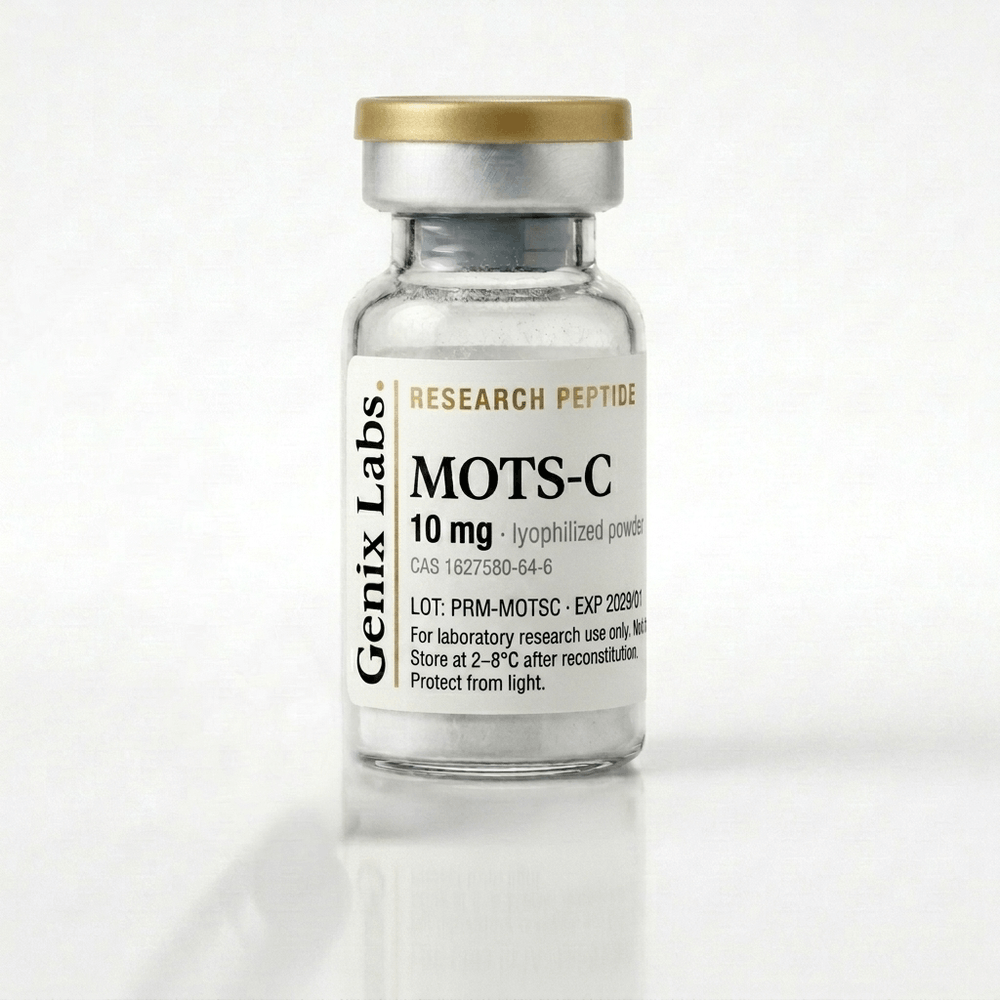
Our own position, stated plainly. The MOTS-C research vial is a 10 mg lyophilised powder at 79 USD, or 1,290,000 IDR, with a lot document for lot 559238 showing 98.90% HPLC area purity and LC-MS identity confirmation. It ships cold-packed, same day in Bali, with cash on delivery available.
That document tells you what is in the vial. It does not tell you that injecting the contents into a person is safe, and we will not pretend otherwise. FDA has published the reason in 97 pages, and we have spent this article summarising it.
What would change this picture?
Specific things, and some of them are already in motion. This is the section to bookmark, because a safety file this empty can only move in one direction.
- The Phase 2a readout. 120 people, 12 weeks, with adverse event incidence as a co-primary endpoint. Estimated February 2027.
- Any repeat-dose toxicity study in a second species. One dog or primate study would do more than a hundred mouse papers.
- An immunogenicity assay in treated humans. That single measurement would settle the risk FDA named first.
- A published in-vivo pharmacokinetic profile. Where it goes, how long it lasts, what the fragments do.
- A USP monograph, or any agreed standard that makes one vendor's MOTS-c comparable to another's.
- FDA's formal response to the July 2026 vote, through proposed and final rulemaking.
Until several of those land, the answer to what are the side effects of MOTS-c stays the same. Unknown, with one named mechanism to watch and one documented local reaction.
FAQ
What are the side effects of MOTS-c?
Nobody knows, and that is the accurate answer. FDA searched its adverse event database twice and found no reports. It also found no acute, repeat-dose, genotoxicity, reproductive or carcinogenicity studies of MOTS-c. With no human exposure data published, FDA concluded that the potential safety risks in people are unknown. Research use only.
Is there a downside to using peptides?
Yes, several. A 2026 Sports Medicine review of approved and unapproved peptides found that human safety data for the grey market compounds are scarce and that there is potential for serious harm. The downsides sit in three places: an unknown effect profile, an unregulated supply chain, and injection itself. Research use only.
Does MOTS-c cause fat loss?
In mice, MOTS-c prevented diet-induced obesity and improved fat handling. In the one human trial of a MOTS-c analog, body weight showed only a trend downward over four weeks, not a significant drop, and every subject ate a standardised diet in an inpatient unit. No study has tested MOTS-c itself for fat loss in people.
How much MOTS-c should I inject?
There is no human dose, and we cannot give you one. FDA noted that no study has mapped a dose-response relationship for MOTS-c in a living animal, and that no human exposure data exist. Genix supplies MOTS-C strictly for in-vitro laboratory research, not for human or veterinary use. Nothing here is medical advice.
What are the potential side effects of using CJC-1295 peptide?
CJC-1295 has no published safety label either. The closest real numbers come from tesamorelin, an approved peptide in the same growth hormone releasing family, whose label records injection site reactions in 25% of patients, joint pain, swelling, tingling and a raised risk of developing diabetes. CJC-1295 sits on no approved label at all.
Does MOTS-c cause cancer?
No carcinogenicity study of MOTS-c has ever been run, so the question is open. Laboratory work points both ways. MOTS-c pushed liver cancer cells toward self-destruction in one 2025 study, while in a 375-patient prostate cohort MOTS-c levels ran higher in precancerous tissue than in benign tissue. Neither answers the safety question.
What is the biggest risk nobody talks about?
Immunogenicity. FDA flagged that a 16 amino acid peptide injected under the skin can provoke antibodies, that aggregation and impurities raise that risk, and that the antibodies could neutralise the MOTS-c your own mitochondria make. That is a mechanism for lasting harm, and no study has measured it.
Takeaway
The MOTS-c side effect question has a real answer, and the answer is that the file is nearly empty. FDA searched its adverse event database twice and found nothing. It looked for five standard toxicology studies and found none of them. It looked for human exposure data by any route and found none.
An empty file is not a clean file. It is a file nobody has opened. The town with no fire statistics still burns at whatever rate it burns.
What does exist is worth knowing. One human trial of a redesigned analog, 11 people on drug for four weeks, found mild to moderate injection site reactions and nothing else above 10%. That is genuinely the entire human adverse event record for anything MOTS-c shaped.
The risks FDA actually named are not on any symptom list. They are immunogenicity from an injected peptide, antibodies that could neutralise the MOTS-c your own mitochondria make, aggregation, synthesis impurities, endotoxin, and the fact that two vials labelled MOTS-c may not contain the same molecule.
In February 2027 one of those unknowns starts to close, when the first human trial of MOTS-c itself reports. Until then, anybody quoting you a MOTS-c side effect rate is quoting something they made up.
Genix Labs supplies MOTS-C strictly for in-vitro laboratory research. It is not for human or veterinary use, and nothing in this article is medical advice.