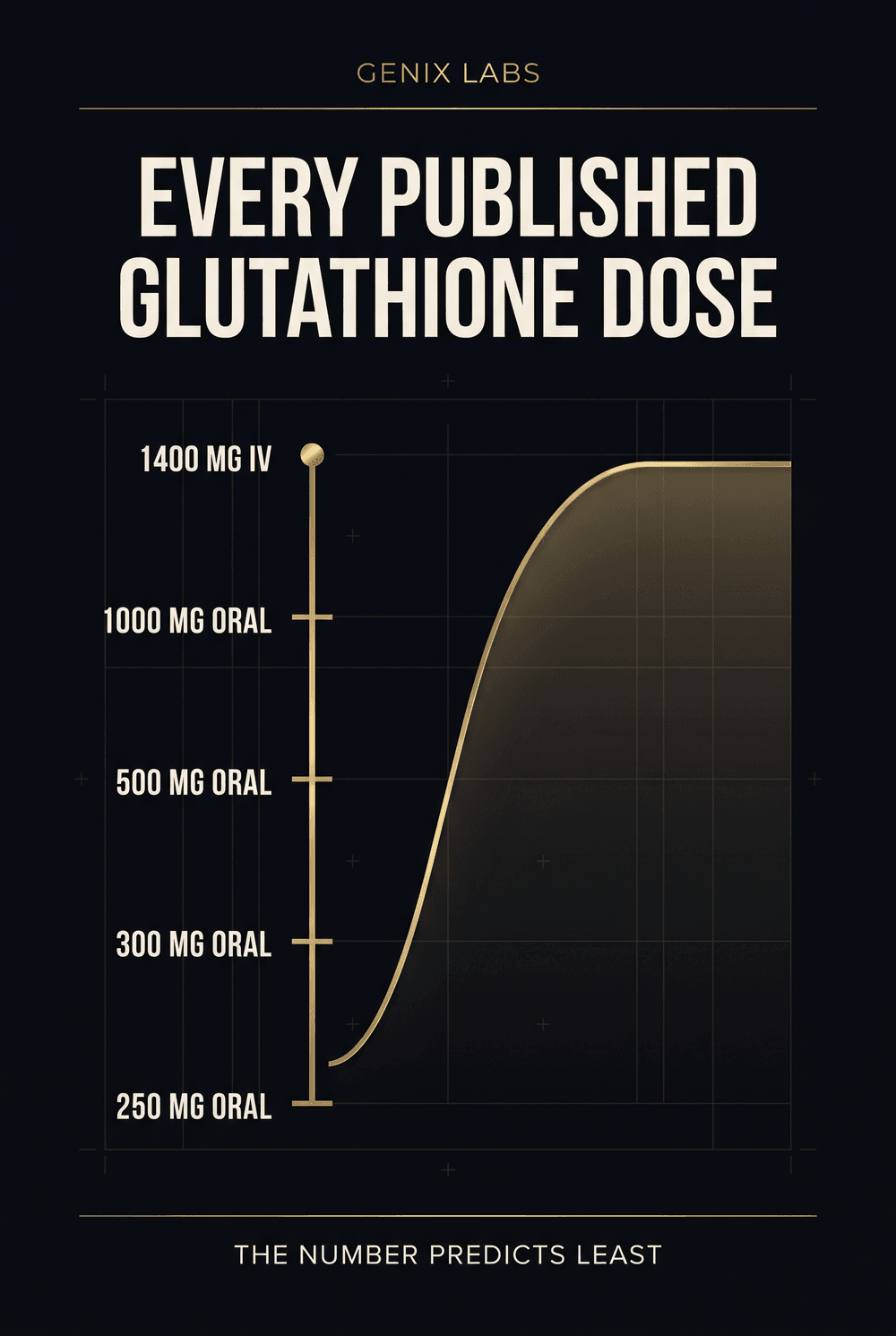
Search for a glutathione dose and you get round numbers with no source. The published human record is small enough to read in one sitting. It runs from 250mg a day to 1,400mg per infusion. Inside that band the milligram number turns out to be the weakest predictor of what happened. Route, endpoint and duration all beat it.
What is the dosage for glutathione?
Published human trials used 250mg to 1,000mg a day by mouth, and 1,400mg three times a week into a vein. No dose is established as correct. The one clean head to head, 500mg against 1,000mg a day, found no difference between the groups. Genix Labs supplies glutathione for laboratory research only.
- The entire published human range is 250mg to 1,400mg. Nothing outside it has been tested.
- Doubling an oral dose from 500mg to 1,000mg produced no measurable difference.
- The largest dose on record went into a vein and beat placebo at nothing.
- The smallest dose on record, 250mg a day, produced the most visible change.
- Route changes everything. The three routes have three separate evidence files.
What is the full published dose range?
It is narrower than the internet suggests. Six amounts cover almost the whole human literature. Those are 250mg, 300mg, 500mg, 600mg, 1,000mg and 1,400mg. Everything else being quoted online is clinic practice or marketing, not a published trial figure.
That last number matters most. Any page quoting 1,500mg or 2,000mg is quoting a figure nobody has studied. It may be harmless. It is simply not evidence.
Every published human dose, in one table
This is the table no competing page prints. Each row is one trial. It names the route, the amount, how often, how long, how many people, and what actually moved. Read the last two columns together, because a dose with nothing beside it is the most useful entry here.
| Trial | Route | Dose | Design | What moved | What did not |
|---|---|---|---|---|---|
| Weschawalit 2017 | Oral | 250mg daily | 12 weeks, randomized, 3 arms, women only | melanin index and UV spots trended down, wrinkles fell at some sites | no serious adverse effects |
| Honda 2017 | Oral | 300mg daily | 4 months, open label, 34 enrolled and 29 finished | ALT, triglycerides, free fatty acids and ferritin all fell | no placebo group, so a 3 month diet run-in is inside the result |
| Richie 2015, low arm | Oral | 250mg daily | 6 months, randomized, placebo controlled, 54 split across arms | blood stores up 17%, red cells up 29% | smaller gains than the high arm |
| Richie 2015, high arm | Oral | 1,000mg daily | 6 months, randomized, placebo controlled, 54 split across arms | red cells, plasma and lymphocytes up 30 to 35%, buccal cells up 260%, NK activity more than doubled | everything returned to baseline after one month off |
| Sinha 2018 | Oral, liposomal | 500mg and 1,000mg daily | 1 month, randomized, 12 people | whole blood up 40%, PBMC up 100%, 8-isoprostane down 35%, NK activity up to 400% | no difference at all between the two dose arms |
| Allen 2011 | Oral | 1,000mg daily, as 500mg twice | 4 weeks, randomized, placebo controlled, 40 people | nothing | F2-isoprostanes, 8-OHdG, reduced and oxidized glutathione, all unchanged |
| Sitohang 2021 | Oral, 4 ingredient blend | glutathione plus vitamin C, ALA and zinc | 12 weeks, randomized, 83 completed, 3 hospital sites | small trends in spot and tone measures | nothing reached statistical significance |
| Hauser 2009 | Intravenous | 1,400mg, 3 times a week | 4 weeks, randomized, double blind, 21 randomized and 11 treated | tolerability, with no withdrawals for adverse events | no significant change in Parkinson rating scores against placebo |
| Marrades 1997 | Nebulized | 600mg, single challenge | 25 minutes, randomized, crossover, 8 people with mild asthma | lung function fell 19%, airway resistance rose 61% | this row is a harm, not a benefit |
Nine rows. Two of them are nulls, one is a harm, and one is a blend where the result belongs to four ingredients. That is the honest state of glutathione dosing evidence in 2026.
What is glutathione?
Glutathione is a tripeptide. That means three amino acids joined in a chain. The three are glutamate, cysteine and glycine. It weighs about 307 daltons, which is tiny for a peptide. Every cell in your body makes it, continuously, without being asked.
Its job is to hand over electrons. Reactive molecules strip electrons from cell parts and damage them. Glutathione gives up an electron first, so the damage lands on it instead. Then an enzyme recycles it back. For a fuller walk through the mechanism, see our guide to what the glutathione trials actually measured.
What does the master antioxidant label mean?
It is a nickname, not a measurement. Glutathione earns it because it is the most abundant antioxidant your cells make, and because it recycles other antioxidants like vitamin C and vitamin E back into working form.
The label does real damage to the dose question. It makes glutathione sound like a thing you top up, like a fuel tank. The trials do not read that way. They read like a thing your body manages, which you can nudge.
Why a molecule you already make breaks the dose question
With most compounds, the dose is the input and the body is passive. Glutathione is not like that. Your liver makes several grams a day on its own. A 250mg capsule is a small fraction of that daily output.
So a swallowed dose is not the main supply. It is an adjustment to a system that is already running. That is one reason doubling the capsule did not double the result in the trial that tested it.
Why does the route change the dose?
Because the dose on the label is not the dose that arrives. A swallowed tripeptide meets gut enzymes first. Those enzymes split it back into its three amino acids. An injected dose skips that entirely. An inhaled dose lands somewhere else again.
Does swallowed glutathione survive the gut?
Partly, and the argument is still open. Gut enzymes break most of the tripeptide apart. What the trials prove is the outcome, not the mechanism. Body stores did rise on oral dosing, measurably and repeatedly.
Whether that rise came from intact glutathione crossing the gut, or from the body rebuilding it out of the delivered amino acids, the published work does not settle. For practical purposes the distinction matters less than people argue. Stores rose either way.
Why the form dictates the dosage
Three oral forms appear in the literature. Plain reduced glutathione, oxidized glutathione, and liposomal glutathione wrapped in a fat bubble. The liposomal form is sold as the one that survives digestion.
The liposomal trial did show fast and large rises, including a 100% jump in immune cell glutathione by week two. But it never ran head to head against plain glutathione. So the form comparison that would justify a different dose has not been done.
Glutathione dosage per day, by mouth
Four daily amounts appear in published oral trials. They are 250mg, 300mg, 500mg and 1,000mg. The 6 month trial used 250mg or 1,000mg. The liver pilot used 300mg. The skin trial used 250mg. Nothing above 1,000mg a day has ever been published.
- 250mg a day for 12 weeks shifted skin pigment and wrinkle measures.
- 250mg a day for 6 months raised blood stores 17% and red cell stores 29%.
- 300mg a day for 4 months lowered liver enzymes in an uncontrolled pilot.
- 500mg a day liposomal for 1 month raised stores and immune activity sharply.
- 1,000mg a day for 6 months raised stores 30 to 35% and doubled natural killer activity.
- 1,000mg a day for 4 weeks, measured a different way, changed nothing at all.
The six month trial at 250mg and 1,000mg
This is the backbone of the oral record. Fifty four non smoking adults were randomized to 250mg a day, 1,000mg a day, or placebo. It ran for six months, double blind. Blood was measured at one, three and six months.
Both doses raised body stores. The high dose arm gained 30 to 35% in red cells, plasma and lymphocytes, and 260% in cheek cells. Natural killer cell activity more than doubled at three months. Then the supplement stopped, and everything fell back to baseline within one month.
Did the higher oral dose do more?
In that trial, yes, somewhat. The low dose arm gained 17% in blood and 29% in red cells. The high dose arm gained 30 to 35% across three compartments. The authors described the increases as dose and time dependent in most cases.
So a four times larger dose bought roughly a doubling of the storage gain. That is a real effect. It is also a poor return, and it only describes stores. Nobody showed that the larger store did more for anyone.
The trial where doubling the dose changed nothing
Twelve healthy adults took liposomal glutathione for one month, at either 500mg or 1,000mg a day. Whole blood glutathione rose 40%. Immune cell glutathione rose 100%. A marker of oxidative damage fell 35%. Natural killer activity rose up to 400%.
Then the key line. The authors report no differences between the two dose groups. The 1,000mg arm did not beat the 500mg arm on anything measured.
The trial at 1,000mg a day that found nothing
Forty adults took 500mg twice daily for four weeks, randomized and placebo controlled. That is the same 1,000mg a day as the top arm of the six month trial. The result was nothing.
Urinary F2-isoprostanes did not change. Urinary 8-OHdG did not change. Red cell reduced glutathione, oxidized glutathione and the ratio between them did not change. Same dose, no effect.
Why do two trials at the same dose disagree?
Because the dose was never the variable. Two other things differed. The six month trial ran for six months and measured stores. The null trial ran for four weeks and measured damage markers.
- Duration: six months against four weeks. Stores in the longer trial were still climbing at month one.
- Endpoint: how much glutathione you hold, against how much oxidative damage you show.
- Compartment: red cells, plasma, lymphocytes and cheek cells, against urine markers.
- Population: non smoking adults in one, healthy adults with no disease in the other.
Any of those explains the gap. The milligram number explains none of it, because it was identical.
The endpoint decides, not the milligrams
This is the single most useful idea on this page. A dose does not have an effect. A dose has an effect on something. Change the something and the same dose changes answer.
| Same dose, 1,000mg a day | Endpoint measured | Duration | Result |
|---|---|---|---|
| Richie 2015 high arm | glutathione held in red cells, plasma, lymphocytes | 6 months | up 30 to 35% |
| Richie 2015 high arm | natural killer cell activity | 3 months | more than doubled |
| Allen 2011 | urinary F2-isoprostanes, a damage marker | 4 weeks | no change |
| Allen 2011 | urinary 8-OHdG, a DNA damage marker | 4 weeks | no change |
| Allen 2011 | red cell glutathione and its oxidized ratio | 4 weeks | no change |
One dose, five answers. Three positive, two flat. Nobody arguing about milligrams online is arguing about the thing that produced this spread.
Glutathione 1500mg dosage: is there any evidence?
No. It is above everything published. The largest oral amount in any controlled trial is 1,000mg a day. The largest injected amount is 1,400mg per infusion. A 1,500mg figure sits outside the tested range entirely.
It is also the wrong direction given the evidence. The one trial that compared two oral doses found the larger one did no better. Pushing past the top of the tested range chases a return that the data does not show exists.
What are glutathione injections?
Glutathione supplied as a sterile solution and delivered by needle rather than swallowed. Three forms circulate. Intravenous, straight into a vein, usually in a clinic drip. Intramuscular, into muscle. Subcutaneous, under the skin.
Only the intravenous route has a randomized published dose. The other two are practice, not evidence. Our glutathione injection guide walks through the full route comparison.
How are glutathione shots and IVs given?
A lyophilized vial is reconstituted first. That means sterile liquid is added to the freeze dried powder until it dissolves. The resulting solution has a concentration, in milligrams per millilitre.
- Intravenous: diluted into a bag or given as a slow push, over minutes, in a clinical setting.
- Intramuscular: a small volume into a large muscle, because muscle tolerates more volume than skin.
- Subcutaneous: a smaller volume under the skin, where volume is the practical limit.
- Clinic drips frequently add vitamin C, which makes any result belong to the combination.
Glutathione dosage IM
No randomized trial has published an intramuscular glutathione dose. That is the honest answer, and it is the one nobody gives. Every intramuscular number circulating comes from clinic habit, supplier literature or forum reports.
Intramuscular exists mainly for a volume reason, not a potency reason. Muscle accepts a larger injection volume than the layer under the skin. When a solution is dilute, that matters. It does not make the route better studied.
Glutathione injection dosage and frequency
One schedule appears in a controlled trial. Three times a week, for four weeks, at 1,400mg per infusion, intravenously. That is the whole published record on frequency. It found no significant benefit over placebo.
Weekly, twice weekly and three times weekly schedules all run in clinics. None has been compared against another in a published trial. Anyone presenting one of them as optimal is presenting a preference.
Glutathione IM injection dosage per week
There is no published weekly intramuscular amount. The nearest published figure is intravenous: 1,400mg three times a week, which totals 4,200mg across a week. That total is from the single trial described above, and that trial was negative.
The only controlled intravenous dose on record
Twenty one people with Parkinson's disease were randomized. Eleven received intravenous glutathione at 1,400mg, three times a week, for four weeks. Ten received placebo. It was double blind.
Glutathione was well tolerated. Nobody withdrew for side effects. Adverse events looked similar in both groups. And there was no significant difference in Parkinson rating scores. Over the following eight weeks the treated group drifted slightly worse.
Why the biggest dose has the thinnest evidence
This is the inversion worth carrying away. Dose size and evidence quality run in opposite directions here. The most studied amounts are the smallest ones. The least studied route carries the largest numbers.
| Route | Published dose | Controlled trials | Positive result? | How it is mostly sold |
|---|---|---|---|---|
| Oral | 250mg to 1,000mg a day | four or more | yes, on stores and immune markers | capsules, modest claims |
| Intravenous | 1,400mg per infusion | one | no | drip clinics, strong claims |
| Intramuscular | none published | none | unknown | clinic practice |
| Nebulized | 600mg single dose | one | no, a measured harm | rarely sold now |
A review of intravenous glutathione for skin lightening reached the same conclusion from the safety side. Practice has run far ahead of published dosing evidence. No safe infusion amount can be quoted from the literature, because the literature never established one.
Glutathione injection dosage chart
An honest chart has a lot of blanks. Here is what can actually be charted from published sources, and what cannot. Treat every empty cell as a real gap, not an oversight.
| Route | Lowest published | Highest published | Published frequency | Evidence grade |
|---|---|---|---|---|
| Oral, plain | 250mg a day | 1,000mg a day | daily, up to 6 months | randomized, placebo controlled |
| Oral, liposomal | 500mg a day | 1,000mg a day | daily, 1 month | randomized, 12 people |
| Intravenous | 1,400mg | 1,400mg | 3 times a week, 4 weeks | randomized, one trial, negative |
| Intramuscular | not published | not published | not published | none |
| Subcutaneous | not published | not published | not published | none |
| Nebulized | 600mg | 600mg | single challenge | randomized, harm recorded |
Glutathione injection dose for liver
The liver evidence is oral, not injected. An open label pilot gave 300mg a day by mouth for four months, to 34 patients with fatty liver. Twenty nine finished. ALT fell significantly, along with triglycerides, free fatty acids and ferritin.
Two caveats make this weaker than it looks. There was no placebo group. And every patient first did three months of diet and exercise before the glutathione started. Some of that result belongs to the run-in.
Glutathione dosage for bodybuilding
No trial has tested glutathione for muscle growth, strength or training recovery at any dose. The whole category is extrapolation from the antioxidant mechanism.
There is one relevant finding, and it points sideways. A combination of glycine and N-acetylcysteine, which are glutathione building blocks rather than glutathione itself, improved strength and gait speed in older adults. The gains faded about twelve weeks after stopping.
What dose did the skin trials use?
The cleanest skin trial used 250mg a day. It was deliberately set below the 500mg a day used in earlier work, to test whether less would still do something. Over twelve weeks, melanin index and ultraviolet spots trended lower at every site measured, and some sites showed a significant wrinkle reduction.
An Indonesian multicentre trial ran 83 participants on a four ingredient blend for twelve weeks. Trends favoured the blend. Nothing reached statistical significance, and any result there belongs to four ingredients, not to glutathione alone.
The route with a measured harm at 600mg
Eight people with mild asthma inhaled 600mg of nebulized glutathione in 4ml of saline, over 25 minutes. It was randomized, double blind and placebo controlled.
Lung function fell 19%. Airway resistance rose 61%. Four coughed and three became breathless. The authors traced it to sulfite forming in the solution, not to the peptide itself. Salbutamol given beforehand blocked the effect. This is the only dose in the entire record with a measured harm attached.
How a vial becomes a known concentration
A lyophilized vial contains freeze dried powder. On its own it has a mass, not a concentration. The concentration appears only once liquid is added. This is the step a laboratory actually controls, and the step most dose confusion comes from.
The rule is one line. Mass in the vial, divided by millilitres added, equals milligrams per millilitre. Our peptide dosage calculation guide covers that arithmetic in full, including the syringe conversion below.
Milligrams, millilitres and syringe units
A U-100 syringe is marked in units, not millilitres. One hundred units is one millilitre. So each unit is 0.01ml. That is the conversion that trips people up.
| Vial | Liquid added | Concentration | 0.5 mL carries | 0.5 mL in units |
|---|---|---|---|---|
| 1,000mg | 5 mL | 200 mg/mL | 100 mg | 50 units |
| 1,000mg | 10 mL | 100 mg/mL | 50 mg | 50 units |
| 600mg | 3 mL | 200 mg/mL | 100 mg | 50 units |
| 600mg | 6 mL | 100 mg/mL | 50 mg | 50 units |
Look at the last two columns. The unit mark is identical in every row. The amount it carries is not. A syringe measures volume. It has no idea what is dissolved in it.
Why volume, not potency, caps a single site
Tissue only accepts so much liquid at one spot. Under the skin that limit is small. Muscle takes more. A vein takes the most, because the solution goes straight into circulating blood.
That is the real reason routes split the way they do. It is a plumbing constraint, not a pharmacology one. A dilute solution needs a larger volume to carry the same mass, and at some point the volume, not the compound, becomes the thing that will not fit.
How long does a reconstituted vial last?
Once liquid is added, the clock starts. Lyophilized powder is stable for months when kept cold and dark. In solution it is far less stable, and glutathione in particular oxidizes.
- Sealed and lyophilized: stable for months at refrigerated temperature, longer when frozen.
- Reconstituted: keep cold, keep dark, and treat it as a short lived preparation.
- A solution that yellows has changed. Discard it rather than reasoning about it.
- Label the vial with the concentration and the date the moment the liquid goes in.
- Repeated warming and cooling degrades more than steady cold storage does.
Cold chain handling matters more in a tropical climate than in a temperate one, because every warm hour spent in transit is an hour the solution is not being held at temperature.
What changes the requirement between people?
Competing pages list body weight, age, stress and diet as dose modifiers. None of those has been tested as a dose modifier in a glutathione trial. Here is what the record supports and what it does not.
| Factor | Does the literature test it? | What is actually known |
|---|---|---|
| Body weight | no | every trial used fixed amounts, not milligrams per kilogram |
| Age | indirectly | the glycine and NAC trial recruited older adults, but tested precursors, not glutathione |
| Smoking | excluded | the 6 month trial deliberately recruited non smokers only |
| Baseline level | no | no trial dosed to a target blood level or adjusted by starting value |
| Sex | partly | the skin trial used women only, so its result does not transfer automatically |
| Disease state | yes | liver and Parkinson trials recruited patients, and results differed from healthy volunteers |
How would a careful protocol start?
In a research setting, the starting question is never which number. It is which endpoint, measured how, for how long. The dose follows from that, and the published range is narrow enough to pick from directly.
- Decide the endpoint first. Stores, a damage marker and a clinical outcome are three different studies.
- Set the duration against the endpoint. Four weeks was long enough for stores, not for damage markers.
- Choose a dose inside the published band. Outside it, there is nothing to compare against.
- Keep the route fixed. Mixing routes mid study makes the result uninterpretable.
- Avoid combination products. Add vitamin C and the result stops being about glutathione.
- Plan a washout measurement. Both trials that measured after stopping found the gains faded.
What is a realistic expectation?
Modest, measurable and temporary. Body stores rise reliably on oral dosing. Immune cell activity rises sharply in two trials. Liver enzymes fell in one uncontrolled pilot. Skin markers shifted gently over twelve weeks.
And it is rented, not banked. One month after the supplement stopped, stores were back at baseline. That finding comes from the same six month trial that produced the headline rise. It almost never appears beside it.
Safety and professional guidance
The oral safety record is reassuring and the injected one is not. Oral trials up to 1,000mg a day for six months reported no serious adverse effects. The intravenous file contains a Stevens-Johnson syndrome case report and a national regulator warning.
Those two records are not interchangeable. Quoting oral safety data to justify an infusion is the most common error in this space. The side effects guide separates them properly.
What to avoid around dosing
- Treating a number from a clinic price list as a studied dose. Most of them are not.
- Scaling past 1,000mg orally because more sounds better. The one comparison found no gain.
- Reading an oral safety record as permission for an injected amount.
- Inhaled or nebulized forms, where the only published dose produced measurable harm.
- Combination drips, where vitamin C makes any result belong to the mixture.
- Assuming a syringe unit means a fixed milligram amount. It means a volume.
What a lot report rules out
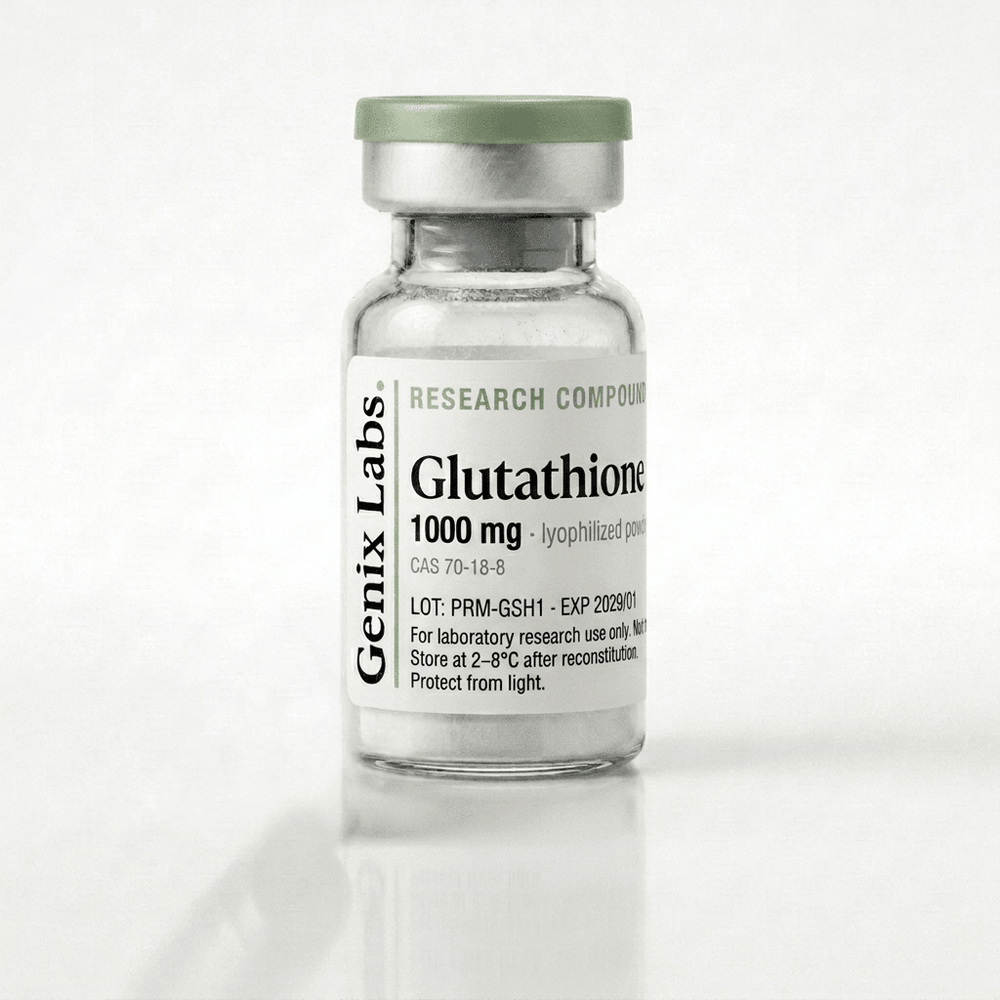
A certificate of analysis answers identity and purity for one printed lot. The Genix Labs glutathione lot 264817 shows 99.20% HPLC area purity with LC-MS identity confirmation. HPLC separates what is in the vial. LC-MS confirms the molecule is the one named.
What it does not do is set a dose. Purity is a lot-specific area result. It is not a statement of content, sterility, safety or efficacy. It tells you what you are weighing. It says nothing about how much of it should ever be used.
Glutathione injection and IV prices
A Genix Labs 1000mg glutathione vial is USD 63, or Rp 1.000.000, with the batch certificate of analysis included. Orders placed before 9 PM ship the same day, cold packed and tracked, with same-day delivery and cash on delivery available in Bali.
Clinic drips across Southeast Asia commonly run USD 80 to USD 250 a session, usually with no purity paperwork attached. You can browse the lab-tested glutathione vial with its published lot report, or read the wider longevity and anti-aging pillar for how it sits beside NAD+ and the other compounds in that group.
What would actually settle the dose question?
- A dose ranging trial with three or more arms, powered properly, measuring one endpoint.
- A head to head of plain against liposomal glutathione at the same milligram amount.
- Any randomized trial of intramuscular glutathione, at any dose, for any endpoint.
- An intravenous trial for the cosmetic use that most infusions are actually sold for.
- A weight based arm, to test whether fixed dosing is hiding a real per kilogram effect.
- Longer washout arms, so we learn whether anything persists past twelve weeks.
Until those exist, the dose question stays answered the way this page answers it. Here is the band that was tested, here is what each amount bought, and here is where the record simply stops.
Grade any dose claim in 30 seconds
- Is the number inside 250mg to 1,400mg? Outside that band, nothing has been published.
- Which route? Oral, intravenous and nebulized have three separate files and three separate answers.
- Does it name a trial? A dose without a citation is a preference wearing a number.
- What endpoint did that dose move? Stores going up is not damage going down.
- How long did the trial run? Four weeks and six months gave opposite answers at the same dose.
- Was glutathione given alone? Add vitamin C and the result belongs to the mixture.
- Does the page mention that the gains fade after stopping? If not, it has read half the paper.
FAQ
What is the dosage for glutathione?
Published human trials used 250mg to 1,000mg a day by mouth, and 1,400mg three times a week intravenously. No dose is established as correct. The clearest head to head comparison, at 500mg against 1,000mg a day, found no difference between the two groups.
What is the glutathione dosage per day?
Across the oral record the daily amounts tested were 250mg, 300mg, 500mg and 1,000mg. The 6 month trial used 250mg or 1,000mg. The liver pilot used 300mg. The skin trial used 250mg. Nothing above 1,000mg a day has been tested orally in a published trial.
What is the glutathione dosage IM?
No randomized trial has published an intramuscular glutathione dose. The injectable evidence that exists is intravenous, at 1,400mg three times a week. Anything presented as a standard intramuscular amount comes from clinic practice, not from a controlled trial, so it carries no published safety or efficacy record.
Is 1500mg of glutathione a normal dose?
It is above everything ever published. The largest oral amount in a controlled trial is 1,000mg a day, and the largest intravenous amount is 1,400mg per infusion. A 1500mg figure sits outside the tested range, and the trial that compared two oral doses found the larger one did no better.
How often are glutathione injections given per week?
The only controlled schedule on record is three times a week, from a 4 week intravenous trial at 1,400mg per infusion. That trial found no significant benefit over placebo. Weekly, twice weekly and three times weekly clinic schedules all exist, and none of them has a published comparison.
What glutathione dose was used for liver?
An open label pilot gave 300mg a day by mouth for 4 months to 34 patients with fatty liver, after a 3 month diet and exercise run-in. Twenty nine finished and ALT fell significantly, along with triglycerides and ferritin. There was no placebo group, so the run-in confounds the result.
Takeaway
The whole published human dose range for glutathione fits in one line. 250mg to 1,000mg a day by mouth, and 1,400mg three times a week into a vein. Nine trials, two nulls, one harm, and one blend where the credit belongs elsewhere.
Inside that band, the milligram number is the weakest thing on the page. The same 1,000mg a day raised stores 35% in one trial and moved nothing in another. The difference was the endpoint and the duration, not the dose. The largest amount anyone ever gave, 1,400mg into a vein, beat placebo at nothing at all.
So the useful question is not how many milligrams. It is which route, measured against what, for how long, and what happens when it stops.