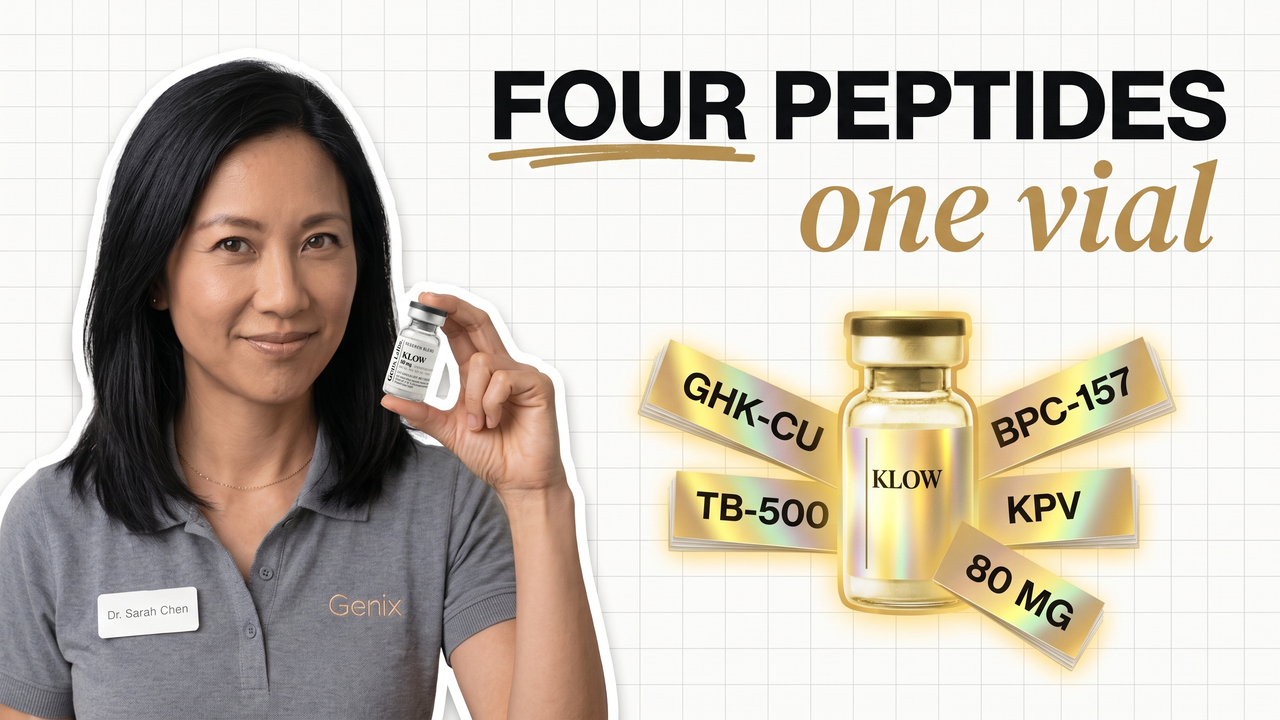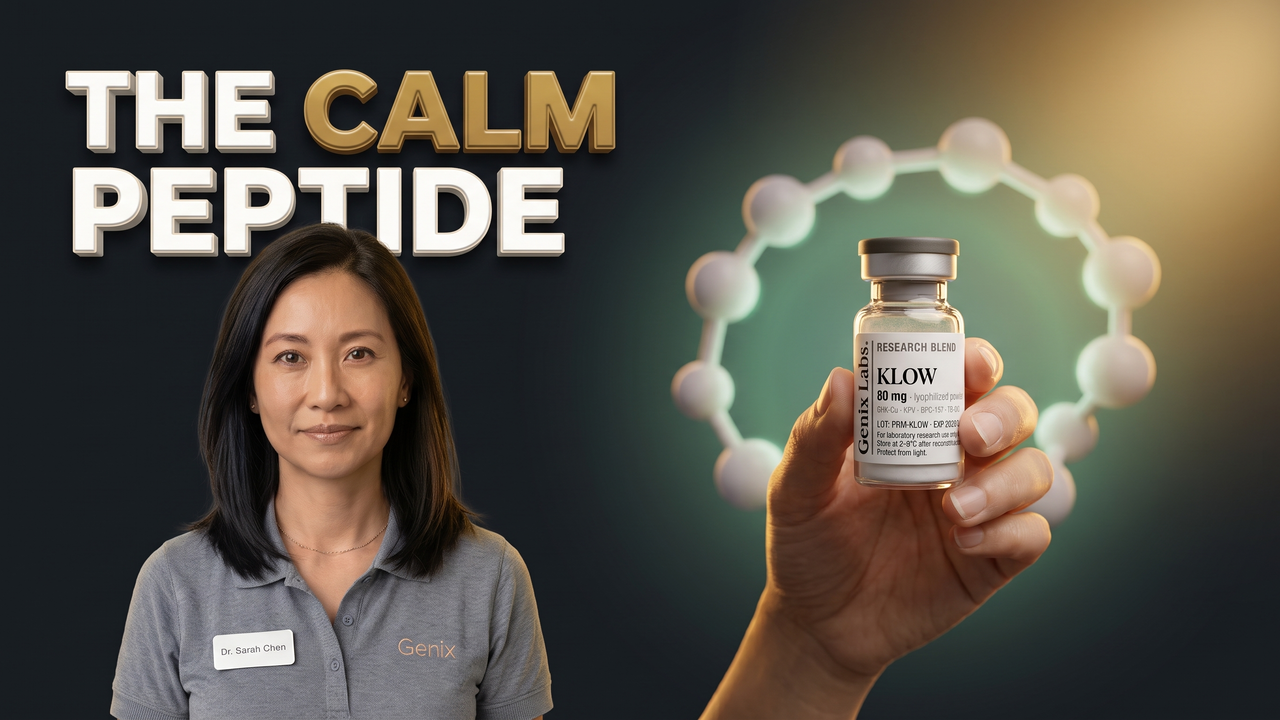
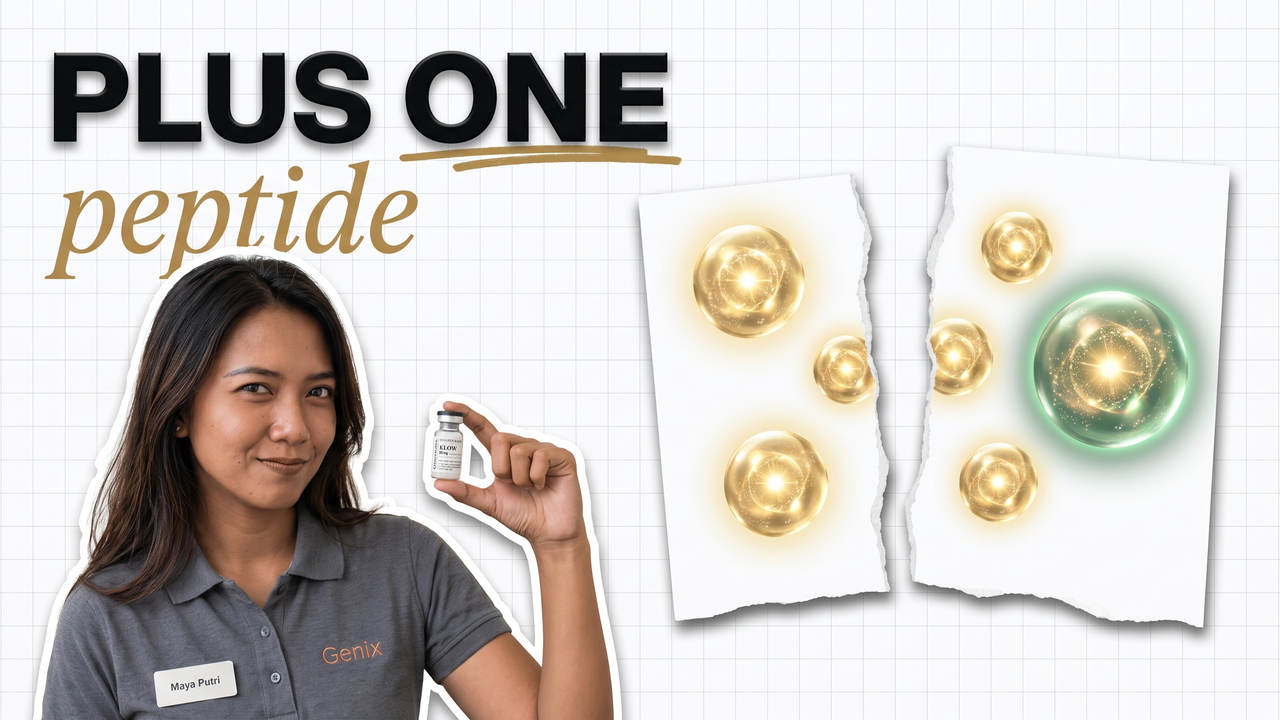
GLOW and KLOW are two of the most popular repair peptide blends, and their names are almost the same on purpose. They share most of the same ingredients. The difference is a single peptide. GLOW is a three-peptide blend for skin and tissue repair. KLOW is that exact blend plus a fourth peptide called KPV, which adds an anti-inflammatory and gut angle. This guide compares them head to head, so you can see which blend fits your research, and whether the KLOW premium is worth it. Everything here is for research use only.
The quick answer
KLOW is GLOW plus one more peptide. GLOW holds three peptides: GHK-Cu for skin and collagen, and BPC-157 and TB-500 for tissue repair. KLOW holds those same three, then adds KPV, a small peptide studied for calming inflammation, especially in the gut. So GLOW covers skin and repair, while KLOW covers skin, repair, and inflammation in one vial. If your research is about the skin and general recovery, GLOW is enough. If it also touches the gut or whole-body inflammation, KLOW is the fuller tool. Both are for research use only.
What is the GLOW blend?
GLOW is a blend of three research peptides in a single vial. The name is a hint at its focus: skin. It pairs GHK-Cu, the famous copper peptide, with BPC-157 and TB-500, the two peptides most studied for tissue repair. The idea is to cover the two things people care about most in recovery research, skin and healing, without mixing three separate vials.
In a standard GLOW blend, GHK-Cu is the largest share by weight, which is why the blend leans skin-forward. A typical GLOW vial holds about 70 mg of total peptide: 50 mg of GHK-Cu, 10 mg of BPC-157, and 10 mg of TB-500. That heavy GHK-Cu share is the source of the skin and collagen angle the name promises. Genix does not sell GLOW as a separate product, because KLOW contains the exact same three peptides and then some.
- A three-peptide blend: GHK-Cu, BPC-157, and TB-500.
- Weighted toward GHK-Cu, so it leans skin-forward.
- Roughly 70 mg of total peptide in a standard vial.
- Covers skin and tissue repair, but not inflammation directly.
What is the KLOW blend?
KLOW is the four-peptide blend. It takes the three peptides in GLOW and adds a fourth: KPV. So the letters tell the story. Both names end the same because they share the same core. KLOW just carries one extra peptide. That fourth peptide is the whole reason KLOW exists as its own product.
A Genix KLOW vial holds 80 mg of total peptide across four peptides: 50 mg GHK-Cu, 10 mg BPC-157, 10 mg TB-500, and 10 mg KPV. Notice the first three amounts are the same as a GLOW vial. The extra 10 mg is the KPV. So KLOW is not a different recipe. It is GLOW with an anti-inflammatory peptide stirred in. That makes the comparison unusually clean: everything GLOW does, KLOW also does, plus the KPV layer on top. You can read the full breakdown in our KLOW peptide dosing guide.
- A four-peptide blend: GHK-Cu, BPC-157, TB-500, and KPV.
- The three GLOW peptides, plus 10 mg of KPV.
- 80 mg of total peptide in a standard Genix vial.
- Covers skin, tissue repair, and inflammation in one mix.
KLOW vs GLOW at a glance
Here is the whole comparison in one table. Read it first, then we will unpack each row below.
| Feature | GLOW | KLOW |
|---|---|---|
| Peptides | Three | Four |
| What is inside | GHK-Cu, BPC-157, TB-500 | GHK-Cu, BPC-157, TB-500, KPV |
| Total peptide | About 70 mg | 80 mg |
| Main lean | Skin and tissue repair | Skin, repair, and inflammation |
| The extra piece | None | KPV, an anti-inflammatory peptide |
| Best research fit | Skin, collagen, general recovery | Whole-body repair, gut, inflammation |
| Reconstitution | Mix once, measure the liquid | Mix once, measure the liquid |
| Sold by Genix | No, KLOW covers the same three | Yes, lab-tested with a COA |
The key difference: what KPV adds to KLOW
Everything about this comparison comes down to one peptide, so it is worth understanding well. KPV is a tiny peptide, just three amino acids long. It is a fragment of a natural body signal called alpha-MSH, and the part it copies is the part that calms inflammation. So KPV is not a repair peptide like BPC-157 or a skin peptide like GHK-Cu. It is an anti-inflammatory signal.
That is the layer GLOW does not have. GLOW can help repair tissue and support skin, but it does not carry a peptide whose main job is turning inflammation down. KLOW does. In research, KPV is studied most for gut inflammation, where it appears to calm the overactive immune signals that irritate the gut lining. It has also been looked at in wound and skin inflammation. Our full write-up on the KPV peptide goes deeper on how it works.
What does each peptide in the blend do?
Both blends are teams, not single ingredients. To choose well, it helps to know what each player brings. Three of them are shared, and one is the KLOW-only addition.
- GHK-Cu is the copper peptide. It is the biggest share of both blends and the skin specialist, studied for collagen, firmness, and tone. It is the reason the name GLOW makes sense.
- BPC-157 is a tissue-repair peptide. In research it is studied for tendons, muscle, and the gut lining, and it is one half of the classic repair pair.
- TB-500 is the other half of that pair. It is studied for flexibility, muscle recovery, and helping cells move to where repair is needed.
- KPV is the KLOW-only peptide. It is the anti-inflammatory of the group, studied for calming inflammation, especially in the gut. This is the layer GLOW lacks.
You can see why the two names rhyme. Three of the four peptides are identical. Reading them side by side makes the choice concrete: GLOW is the repair-and-skin team, and KLOW is that same team with a dedicated inflammation player added. For the individual peptides, see our guides to BPC-157 benefits, TB-500, and copper peptides.
What does each blend actually cover?
The cleanest way to compare the two is by what they cover, not by counting peptides. GLOW covers three jobs. KLOW covers those same three, plus one more. Here is the picture.
Notice the top three rows are identical on both sides. That is the point. GLOW is not a weaker version of KLOW at the jobs they share. On skin, on tissue repair, on muscle and tendon, the two blends bring the same peptides at the same amounts. The only difference is the extra bottom row on the KLOW side, the inflammation-and-gut coverage that KPV provides. So the question is never really which blend is better in general. It is whether you need that fourth row.
Is GLOW for skin and KLOW for the whole body?
That is the popular shorthand, and it is roughly right, but it is worth being precise. GLOW is not skin-only. It carries two strong tissue-repair peptides alongside the skin peptide. So calling it a face blend undersells it. A fairer way to put it is that GLOW is a skin-and-repair blend, while KLOW widens that to a skin-repair-and-inflammation blend.
The reason people reach for the face-versus-body framing is the KPV. Because KPV is studied so much for the gut and for whole-body inflammation, adding it pushes KLOW toward a more systemic, deeper research use. GLOW stays closer to the surface, skin and localized repair. So if you had to sum it in one line: GLOW leans toward how tissue looks and heals, and KLOW extends that toward how the body feels and settles. Both are research framings, not treatment claims.
- GLOW: skin plus tissue repair, closer to the surface.
- KLOW: the same, extended toward gut and inflammation.
- The shift is caused by one peptide, KPV.
- Neither is a cosmetic or medical treatment. Research use only.
What does the research on the components show?
Neither GLOW nor KLOW has been studied as a finished blend in a large trial. What has real research behind it is each component. That is an honest but important point, and it is where a blend earns trust: from the science on its parts, not from marketing on the mix.
GHK-Cu, the shared skin peptide, has decades of published work on collagen, skin repair, and protective effects. BPC-157 has a large body of animal research on tendon, muscle, and gut-lining healing. TB-500 is studied for cell migration and flexibility in recovery models. And KPV, the KLOW addition, has been researched for reducing gut inflammation, including work showing it calms inflammatory signals in the intestine. So both blends rest on researched peptides. KLOW simply adds one more researched peptide on top.
Does KLOW peptide help with wrinkles?
This is one of the most common questions, and it is really a question about GHK-Cu, because that is the skin peptide in the blend. GHK-Cu is the most studied copper peptide for skin, and in research it supports collagen production and skin firmness. Those are the pathways tied to smoother, fuller-looking skin over time. Since GHK-Cu is the largest share of both GLOW and KLOW, the two blends have the exact same skin angle.
So on wrinkles specifically, KLOW does not beat GLOW, and GLOW does not beat KLOW. They carry the same amount of the same skin peptide. If skin is your only interest, the KPV in KLOW does not add anything on that front, which is a fair reason some researchers pick GLOW for pure skin work. This is reported research context on GHK-Cu, not a cosmetic promise or medical advice.
Does GLOW peptide really work?
GLOW is only as real as its three peptides, and those three are among the most researched repair peptides there are. GHK-Cu, BPC-157, and TB-500 each have their own literature. GLOW puts them in one vial so a research setup does not have to mix three. So the honest answer is that GLOW is not magic, but it is also not empty. It is a convenient blend of researched peptides.
The bigger variable is not the recipe, it is the quality. A GLOW or KLOW blend only delivers what is actually in the vial. If a cheap blend is under-dosed or impure, no clever recipe saves it. That is why the paperwork matters more than the name. A blend with a real certificate of analysis, tied to the lot number on the vial, is one you can actually study with confidence. One with no paperwork is a guess.
Which peptide blend is the most effective?
There is no single most effective blend, and any vendor who says otherwise is selling, not explaining. Effectiveness depends entirely on the research goal. For a skin and general recovery question, GLOW and KLOW are equally matched on the shared peptides, so GLOW is fully effective and cheaper. For a question that also touches the gut or inflammation, KLOW is the more complete tool, because GLOW simply does not carry an anti-inflammatory peptide.
So the more useful question is not which is stronger, but which covers your target. KLOW covers a wider area. GLOW covers a narrower one at lower cost. Neither is wasted if it is matched to the right research design. The mistake is buying the wider blend and never using the extra coverage, or buying the narrower one and needing the piece it lacks.
| If your research is about | Better fit | Why |
|---|---|---|
| Skin, collagen, firmness | Either (same GHK-Cu) | Both carry the same skin peptide at the same share. |
| General tissue repair | Either (same BPC-157 and TB-500) | The repair pair is identical in both blends. |
| Gut or whole-body inflammation | KLOW | Only KLOW carries KPV, the anti-inflammatory peptide. |
| Lowest cost for skin work | GLOW | You are not paying for a peptide you will not use. |
When should you choose GLOW?
GLOW is the right pick when your research stays in the lane of skin and general repair. If the question is about collagen, skin firmness, tone, or recovering from ordinary training and wear, GLOW carries every peptide you need for that. The KPV in KLOW would sit unused. In that case, GLOW is the leaner, cheaper choice, and leaner is not worse when the extra piece is not needed.
- The research target is skin, collagen, or firmness.
- You want general tissue-repair support only.
- The gut and systemic inflammation are not part of the question.
- You want the lower-cost blend for a narrower goal.
When should you choose KLOW?
KLOW is the right pick when inflammation is part of the picture. Because it adds KPV, KLOW is the blend for research that touches the gut, systemic inflammation, or a recovery setting where calming inflammation is a goal alongside repair. You still get the full skin and tissue-repair coverage of GLOW, so nothing is lost. You simply gain the fourth layer.
KLOW is also the simpler choice if you are not sure. Since it contains everything GLOW does, buying KLOW guarantees you are not missing the anti-inflammatory piece if the research turns that way later. That is why Genix stocks KLOW rather than GLOW: it is the fuller blend that covers the most research ground from one lab-tested vial.
- The research touches gut or whole-body inflammation.
- You want repair and calming coverage in one mix.
- You want the fullest blend so nothing is missing later.
- You are unsure and want the wider coverage by default.
Is the KLOW premium worth it?
KLOW costs more than a typical GLOW blend, usually by roughly the price of the extra peptide. That premium buys one specific thing: the KPV, pre-blended into the same vial. So the value question is simple. If your research needs an anti-inflammatory peptide, the premium is money well spent, because a separate KPV vial would cost more and add a second reconstitution. If you do not need that layer, the premium is paying for coverage you will not use.
| Item | Details |
|---|---|
| Genix KLOW | 80 mg blend, four peptides |
| Price | $179 USD (about IDR 2.900.000) |
| What the premium buys | 10 mg of KPV in the same vial, no extra mixing |
| What is included | HPLC purity of at least 99%, LC-MS identity, batch COA |
| Delivery | Same-day across Bali, cold-chain, cash on delivery |
There is a hidden cost saving in a blend, too. Buying four peptides separately means four vials, four certificates to check, and four reconstitutions, each a chance to make a mistake. KLOW pre-measures all four into one vial, so you mix once. For a research setup that wants the full four-peptide coverage, that convenience is part of what the price reflects.
What are the side effects?
Both blends draw from the same peptide family, and in research these peptides are generally reported as gentle. Because KLOW and GLOW share three of their peptides, their reported profiles overlap heavily. The extra peptide in KLOW, KPV, is itself studied as an anti-inflammatory, so it does not add a stimulant-style effect.
- Mild irritation or redness at an injection site.
- Occasional lightheadedness or tiredness soon after a dose.
- For GHK-Cu, the skin peptide, temporary local skin reactions.
- None of this is medical advice. Results vary, and this is education only.
A key point on side effects applies to both blends equally: many complaints traced back to cheap peptides are really about impurities, not the peptide itself. An under-tested vial can carry leftover solvents or the wrong compound. That is not a side effect of the blend, it is a side effect of poor manufacturing. It is one more reason a certificate of analysis is not optional.
Before and after: what do results look like?
In research reports, both blends work gradually, not overnight. Because GHK-Cu is the largest share of both, skin is often the first thing people watch, with subtle changes in tone and firmness described over a full cycle rather than in days. Tissue-repair and recovery shifts tend to build over roughly eight to twelve weeks in reported experience.
With KLOW, the added KPV means some research also watches gut comfort and general inflammation alongside the skin and repair changes. But the honest framing is the same for both: timelines vary a lot between individuals, this is reported research experience rather than a promise, and nothing here is a treatment claim. Anyone expecting an instant before-and-after is misreading how these peptides are studied to work.
How do you reconstitute and store both blends?
Here the two blends are identical, which is convenient. Both arrive as a freeze-dried powder that has to be mixed with bacteriostatic water before use. The method is the same whether the vial holds three peptides or four. You swab the stopper, draw your chosen volume of water, and pour it slowly down the inside wall of the vial rather than blasting it onto the powder.
Then you swirl gently, never shake, and let the mix turn clear. Because both blends are measured as the mixed liquid, the water you add sets the concentration, not the amount of peptide. An 80 mg KLOW vial always holds 80 mg no matter how much water goes in. Our step-by-step guide to reconstituting peptides covers the mixing math in full, and our guide to storing peptides in a hot climate covers keeping a delicate blend cold.
- Mix with bacteriostatic water, poured slowly down the vial wall.
- Swirl gently, never shake, and wait for a clear solution.
- Water sets concentration, not the amount of peptide.
- Keep the vial cold and out of light, before and after mixing.
Common research protocol mistakes to avoid
Most problems with either blend are not about the peptides at all. They are handling and buying mistakes. Here are the ones that come up again and again in research settings, and they apply to GLOW and KLOW alike.
- Buying a blend with no certificate of analysis, so you cannot prove what is in the vial or how pure it is.
- Shaking the vial to speed up mixing, which can damage delicate peptides. Swirl and wait instead.
- Assuming more water means more peptide. Water only changes concentration, never the amount.
- Choosing KLOW and never using the KPV coverage, or choosing GLOW and needing the piece it lacks.
- Letting the vial sit warm or in light, which degrades peptides before the research even starts.
The theme is the same across all of them: the blend is only as good as its purity and its handling. Get those right, match the blend to the goal, and the choice between three and four peptides becomes clear rather than confusing.
How to check blend quality before you buy
Whichever blend you choose, the same rule decides everything: the label means nothing without proof. A blend can list four impressive peptides and still be under-dosed or impure. Only a lab can confirm what is really inside. Before you trust any GLOW or KLOW vial, ask for the paperwork.
- A batch certificate of analysis, tied to the real lot number printed on your vial.
- HPLC purity of at least 99 percent, so you know how much is actual peptide.
- LC-MS identity, which confirms the vial holds the peptides it claims.
- Cold-chain handling, because heat degrades peptides in transit.
Genix tests every component in the KLOW blend to these standards and ships each order with its certificate of analysis, so the vial you study is the blend you paid for. That E-E-A-T layer, a real lab report tied to a real lot number, is exactly what most GLOW-versus-KLOW vendor pages leave out. Keep the vial cold and out of light, and mix it gently when the time comes.
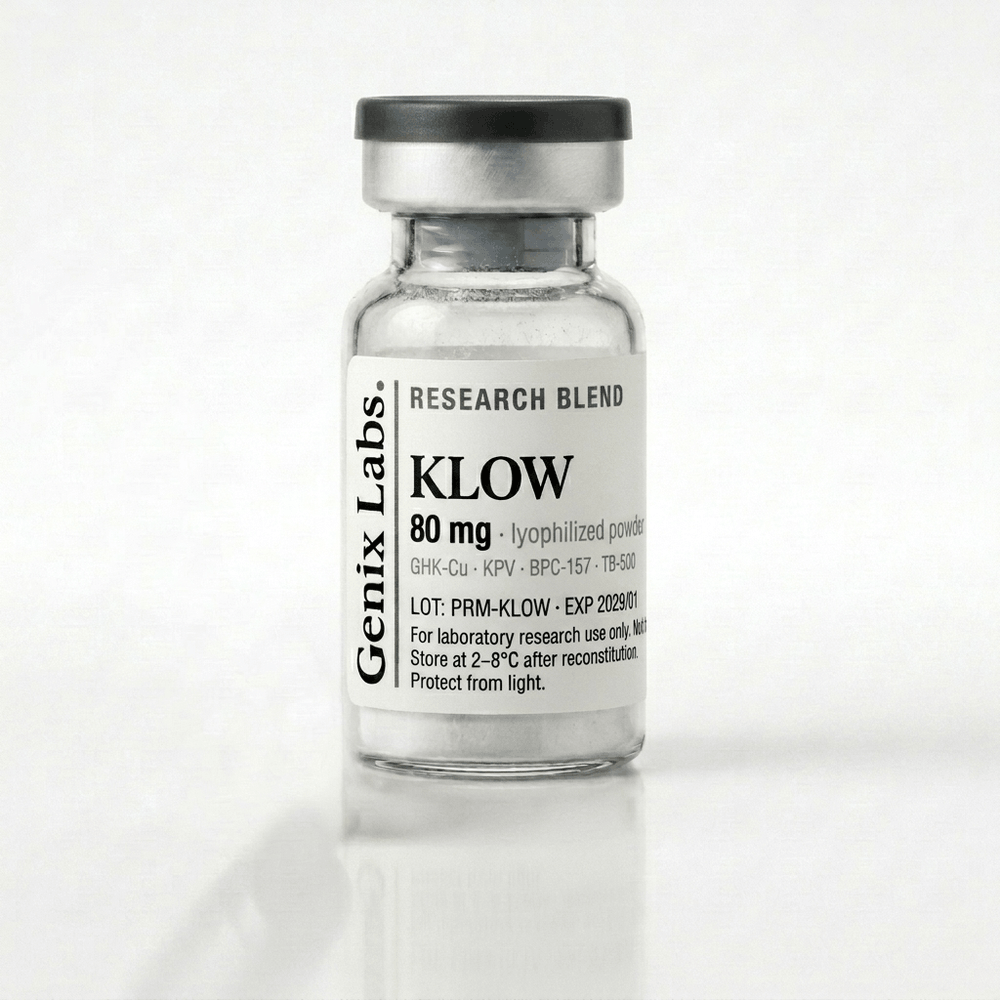
GLOW's three peptides plus KPV, 80 mg in one vial. Purity of at least 99% by HPLC, LC-MS identity, and a batch certificate of analysis in every order. $179, same-day in Bali.
Buy the KLOW blend in BaliWhich blend is right for your research?
Match the blend to the target, and the choice makes itself. The two blends share three peptides, so they are equally matched on skin and tissue repair. The only question that separates them is whether your research also needs the anti-inflammatory coverage of KPV.
- Skin and general repair only? GLOW covers it for less.
- Gut or inflammation in the picture? KLOW, for the KPV.
- Not sure yet? KLOW covers the most ground by default.
- Either way, verify purity with a certificate of analysis first.
For most people comparing the two, the appeal of KLOW is that it never leaves a gap: it does everything GLOW does and adds the inflammation layer. That is why it is the blend Genix stocks and tests. For the wider view of repair peptides, see our Recovery and Repair peptide hub, and for the fourth peptide itself, our guide to the KPV peptide.
Frequently asked questions
Which peptide blend is the most effective?
There is no single most effective blend, because it depends on the research goal. GLOW covers skin and tissue repair with three peptides. KLOW adds a fourth, KPV, for inflammation and gut support, so it covers more ground. For a whole-body repair question, KLOW is the fuller tool. For skin-only work, GLOW is enough. Research use only.
Does KLOW peptide help with wrinkles?
KLOW contains GHK-Cu, the copper peptide most studied for skin. In research, GHK-Cu supports collagen and skin firmness, which is the pathway tied to smoother, fuller-looking skin. KLOW carries the same large GHK-Cu share as GLOW, so its skin angle is identical. This is reported research context, not a cosmetic or medical claim.
Does GLOW peptide really work?
GLOW combines three of the most researched repair peptides: GHK-Cu for skin and collagen, plus BPC-157 and TB-500 for tissue repair. Each has a real body of published research behind it. GLOW simply puts all three in one vial. It works as well as its components and its purity allow, which is why a certificate of analysis matters. Research use only.
Is KLOW peptide worth it?
The KLOW premium over GLOW buys one thing: the fourth peptide, KPV, pre-blended into the same vial. KPV is studied for calming inflammation, especially in the gut. If your research needs that anti-inflammatory angle, KLOW is worth the difference. If you only need skin and repair, GLOW covers it for less. Research use only.
What is the difference between KLOW and GLOW?
GLOW is a three-peptide blend: GHK-Cu, BPC-157, and TB-500. KLOW is that exact blend plus a fourth peptide, KPV. KPV adds an anti-inflammatory and gut-signaling angle the three-peptide GLOW does not have. Everything else, including the large GHK-Cu skin share, is the same. KLOW is simply the fuller four-peptide version. Research use only.
Are KLOW and GLOW lab-tested?
They should be, and at Genix every component in the KLOW blend is tested by an independent third-party lab, HPLC for purity and LC-MS for identity, with a batch certificate of analysis you can review before you pay. The lot number on it matches the label on your vial. Never trust a blend with no paperwork. Research use only.
Takeaway
GLOW and KLOW are close cousins, and the difference is a single peptide. GLOW is the three-peptide blend: GHK-Cu for skin, plus BPC-157 and TB-500 for tissue repair. KLOW is that exact blend with a fourth peptide, KPV, which adds anti-inflammatory and gut coverage. On skin and repair they are equally matched. KLOW simply reaches further. Choose GLOW for skin and general recovery, choose KLOW when inflammation is part of the question, and verify purity with a certificate of analysis either way. Both are for research use only, and this guide is education, not medical advice.