
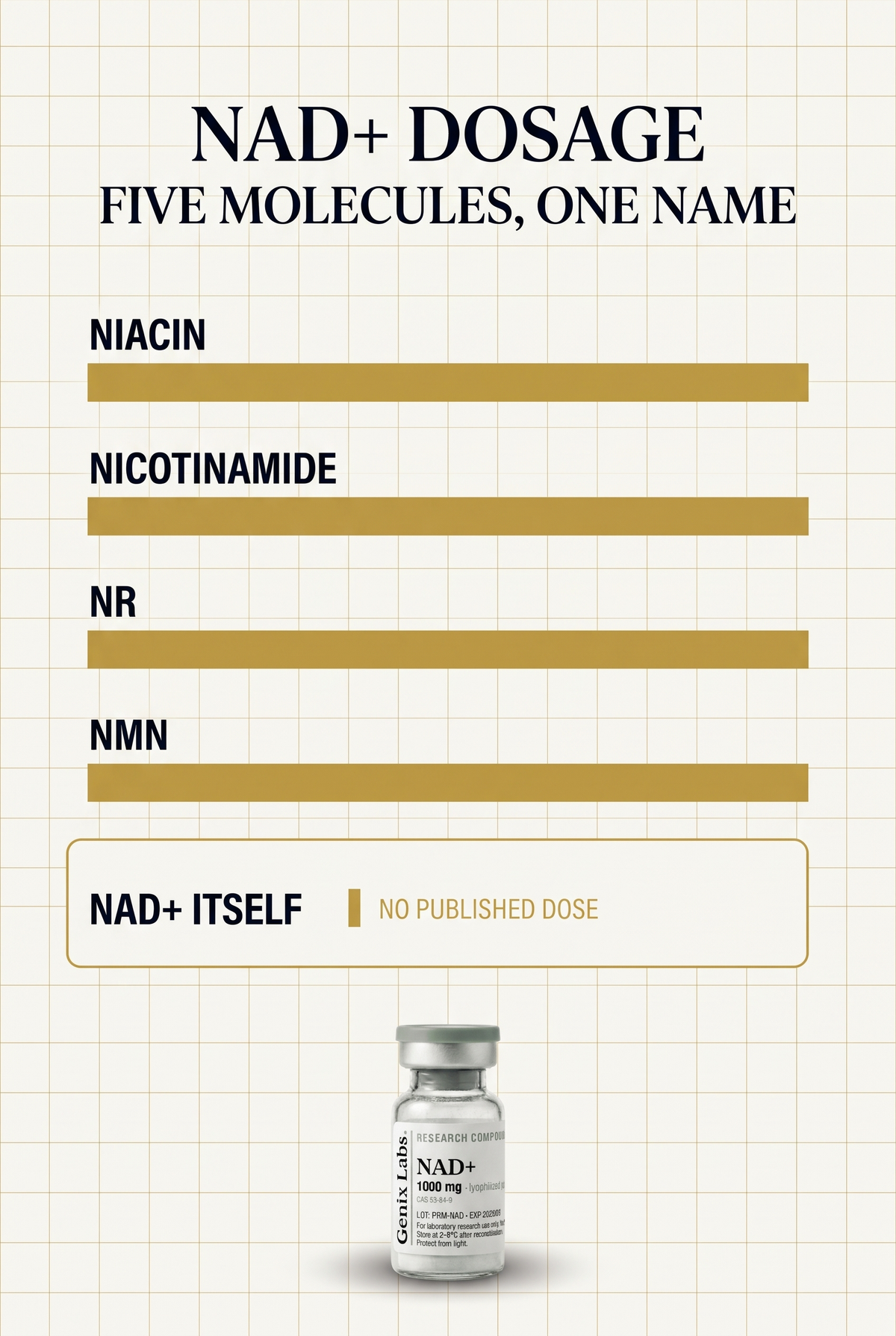
Search for an NAD+ dosage and you get a chart. The chart looks official. Almost none of the numbers on it came from a trial of NAD+. They came from four different precursor molecules that share the same name in search results. Here is the whole published record, sorted by which molecule it belongs to.
What is the dosage for NAD+?
There is no established dose for NAD+ itself. One published human study infused 750mg over six hours. Every other number you see belongs to a precursor. Those ranges are 100mg to 2,000mg a day for nicotinamide riboside, 100mg to 1,200mg a day for NMN, and 1,000mg a day for nicotinamide. Genix Labs supplies NAD+ for laboratory research only.
- NAD+ itself has one published human dose. 750mg, infused over six hours, in eleven men.
- Plasma NAD+ did not move for the first two hours of that infusion.
- The cleanest dose response in the file is oral nicotinamide riboside. Blood NAD+ rose 22%, 51% and 142% at 100mg, 300mg and 1,000mg.
- The biggest rise on record, up to eight fold, came from niacin, the cheapest molecule in the group.
- The highest dose ever randomized, 2,000mg a day for 12 weeks, moved no metabolic endpoint at all.
- Raising blood NAD+ is a dosing signal. It is not an outcome. Two trials raised it in muscle and changed nothing.
Which molecule is the dose actually about?
This is the first question, and almost no page asks it. Five different compounds get called NAD+ in search results. They are niacin, nicotinamide, nicotinamide riboside, nicotinamide mononucleotide, and NAD+ itself. Each one has its own dose record. Mixing them is how a 250mg figure and a 2,000mg figure end up on the same chart.
A precursor is a building block. Your body takes it and makes NAD+ out of it. NAD+ is the finished molecule. The four precursors enter the pathway at different points, so the same milligram number means a different thing for each one. Our NAD versus NMN comparison walks through that pathway step by step.
Every published human dose, in one table
This is the table no competing page prints. Each row is one trial. It names the molecule, the route, the amount, how long, how many people, and what moved. Read the last column hardest. A dose with nothing beside it is the most useful entry in the whole table.
| Trial | Molecule | Dose | Design | What moved | What did not |
|---|---|---|---|---|---|
| Trammell 2016 | NR, oral | 100mg, 300mg, 1,000mg single doses | first human pharmacokinetic trial of NR | the blood NAD+ metabolome rose with the dose; one pilot subject rose 2.7 fold | single doses only, so nothing about sustained use |
| Conze 2019 | NR, oral | 100mg, 300mg, 1,000mg daily | 8 weeks, randomized, placebo controlled, 140 overweight adults | whole blood NAD+ rose 22%, 51% and 142% across the three arms | no flushing, no LDL rise, no excess adverse events; industry funded |
| Martens 2018 | NR, oral | 1,000mg daily | two 6 week periods, randomized crossover, 30 healthy middle aged and older adults | NAD+ metabolism rose and the regimen was well tolerated | the blood pressure and arterial stiffness signal was flagged for proper testing, not claimed |
| Elhassan 2019 | NR, oral | 1,000mg daily | 21 days, randomized, placebo controlled crossover, 12 aged men | the muscle NAD+ metabolome rose and inflammatory cytokines in blood fell | muscle mitochondrial bioenergetics did not change at all |
| Remie 2020 | NR, oral | 1,000mg daily | 6 weeks, randomized, placebo controlled crossover, 13 overweight or obese adults | muscle NAD+ markers, fat free mass and sleeping metabolic rate all rose | insulin sensitivity and mitochondrial function were unchanged |
| Dollerup 2018 | NR, oral | 2,000mg daily | 12 weeks, randomized, placebo controlled, 40 obese insulin resistant men | nothing; safety bloods stayed normal | insulin sensitivity, glucose disposal, energy expenditure, lipolysis and body composition, all unchanged |
| Irie 2020 | NMN, oral | 100mg, 250mg, 500mg single doses | first human NMN safety study, 10 healthy men | nothing clinically; the first evidence a single dose is tolerated | no change in heart rate, blood pressure, oxygen saturation or temperature |
| Okabe 2022 | NMN, oral | 250mg daily | 12 weeks, randomized, placebo controlled, 30 healthy adults | whole blood NAD+ rose significantly | no abnormal physiological or laboratory findings, and NMN itself did not accumulate |
| Yoshino 2021 | NMN, oral | 250mg daily | 10 weeks, randomized, placebo controlled, postmenopausal prediabetic women | muscle insulin sensitivity and muscle insulin signalling rose | a small single site trial; the result has been contested in print |
| Liao 2021 | NMN, oral | 300mg, 600mg, 1,200mg daily | 6 weeks, randomized, placebo controlled, 48 trained amateur runners | oxygen uptake and ventilatory threshold power rose in the 600mg and 1,200mg arms | the 300mg arm did not beat placebo, and peak VO2max did not move in any arm |
| Yi 2023 | NMN, oral | 300mg, 600mg, 900mg daily | 60 days, randomized, multicentre, placebo controlled, 80 middle aged adults | blood NAD+ rose in all three arms, highest at 600mg and 900mg; six minute walk distance rose in all three | insulin resistance did not change; 900mg did not beat 600mg |
| Chen 2015 | Nicotinamide, oral | 500mg twice daily, so 1,000mg a day | 12 months, phase 3 randomized, 386 participants | new non melanoma skin cancers fell 23% | no noteworthy difference in the number or type of adverse events |
| Allen 2023 | Nicotinamide, oral | 1,000mg a day | 12 months, randomized, 158 organ transplant recipients | nothing; 207 cancers against 210, a rate ratio of exactly 1.0 | the same dose that worked in 2015 did not work here |
| Pirinen 2020 | Niacin, oral | titrated up to 750 to 1,000mg a day | 10 months in patients with mitochondrial myopathy, 4 months in matched controls | blood NAD+ rose up to 8 fold, muscle strength rose, liver fat fell as much as 50% | some patients showed a tendency toward anemia |
| Grant 2019 | NAD+ itself, intravenous | 750mg over 6 hours, about 2mg a minute | open label pilot, 11 healthy men, no placebo and no comparison dose | urinary methylnicotinamide and NAD+ were up by hour 6 | plasma NAD+ and its metabolites did not change for the first 2 hours |
Fifteen rows. Fourteen of them are precursors. Exactly one studied NAD+ itself, and that one had no placebo group and no second dose to compare against. That is the honest state of NAD+ dosing evidence in 2026.
Why does NAD+ itself have almost no published dose?
Because NAD+ is a big, charged molecule. It does not cross cell membranes well on its own. Researchers worked on the precursors instead, because a precursor gets absorbed, enters the cell, and gets built into NAD+ inside. That design choice is why the dose record belongs to the building blocks.
So when a page prints an NAD+ dosage chart with tidy weekly amounts, those amounts came from somewhere else. Usually a clinic menu. Our NAD+ injection guide takes the infusion evidence apart in detail.
What is NAD+ and what does it do?
NAD+ stands for nicotinamide adenine dinucleotide. It is a coenzyme, which means a helper molecule an enzyme needs in order to work. It weighs about 663 daltons. Every living cell holds some. Its main job is carrying electrons during the reactions that turn food into usable energy.
It has a second job that matters more for the dose question. Two families of repair enzymes consume NAD+ as a raw material. One family is the sirtuins. The other is the PARPs, which patch damaged DNA. Both use it up. So the cell has to keep remaking it, all day, forever.
Why do NAD+ levels fall with age?
Two things happen at once. The cell makes less, and it spends more. Repair demand rises with age, so the PARP enzymes draw harder on the pool. An enzyme called CD38 also rises, and it breaks NAD+ down. Supply drops while the bill goes up.
That is the reasoning behind every dose in this article. If the pool is low, refill it. The reasoning is sound. The trials are where it gets complicated.
How much does each dose raise blood NAD+?
One trial answers this properly. Conze 2019 gave 140 overweight adults 100mg, 300mg or 1,000mg of nicotinamide riboside a day for eight weeks. Whole blood NAD+ rose 22%, 51% and 142%. Three doses, three results, one trial, one measurement method. That is the cleanest dose response in the entire file.
Where the dose response is real
In blood, and only in blood. More milligrams reliably means more NAD+ in a blood sample. Conze showed it across three arms. Trammell showed it with single doses. Yi showed it with NMN at 300mg, 600mg and 900mg. This part of the picture holds up.
That is genuinely useful. It means a blood NAD+ measurement tells you the dose arrived. It confirms the molecule was absorbed and converted. What it does not tell you is whether anything downstream changed.
Where the dose response breaks
At the outcome. The highest oral dose ever randomized was 2,000mg of nicotinamide riboside a day for twelve weeks, in forty obese insulin resistant men. Insulin sensitivity did not change. Glucose disposal did not change. Energy expenditure, fat breakdown and body composition did not change. Nothing changed.
Then look at the small end. Yoshino 2021 used 250mg of NMN a day, one eighth of that amount, and measured a real rise in muscle insulin sensitivity. Different molecule, different people, different endpoint. But the direction is the opposite of what a dose response predicts.
Which dose raised NAD+ the most?
Niacin did, by a wide margin. Pirinen 2020 titrated niacin up to 750 to 1,000mg a day in patients with mitochondrial myopathy, over ten months. Blood NAD+ rose up to eight fold. Muscle NAD+ in the patients climbed all the way up to the level of their healthy controls.
That result is worth sitting with. The largest NAD+ rise in the human record came from the oldest and cheapest molecule in the group. It also came with a cost. Some patients showed a tendency toward anemia, which is a real finding, not a footnote.
What is the NAD+ dosage per day, by mouth?
There is no oral dose of NAD+ itself in the published record. By mouth, the studied molecules are the precursors. The daily amounts actually tested are 100mg, 250mg, 300mg, 500mg, 600mg, 900mg, 1,000mg, 1,200mg and 2,000mg. Which one applies depends entirely on which molecule is in the bottle.
| Molecule | Daily amounts tested | Longest trial | Best measured result |
|---|---|---|---|
| Nicotinamide riboside | 100, 300, 1,000, 2,000mg | 12 weeks | blood NAD+ up 142% at 1,000mg |
| Nicotinamide mononucleotide | 100, 250, 300, 500, 600, 900, 1,200mg | 24 weeks in the pooled set | muscle insulin sensitivity up at 250mg |
| Nicotinamide | 1,000mg | 12 months | skin cancers down 23% in one trial of two |
| Niacin | 750 to 1,000mg, titrated | 10 months | blood NAD+ up 8 fold |
| NAD+ itself | none published | none | no oral trial exists |
What doses did the nicotinamide riboside trials use?
Six trials, four amounts. The range runs from 100mg to 2,000mg a day. The most studied amount by far is 1,000mg a day, which appears in Martens 2018, Elhassan 2019, Remie 2020 and the top arm of Conze 2019. If there is a default in this literature, that is it.
Those four trials at the same dose did not agree on outcomes. One moved fat free mass and metabolic rate. One moved inflammatory markers. One flagged a blood pressure signal and declined to claim it. One moved the blood metabolome and little else. Same molecule, same dose, four different answers.
What doses did the NMN trials use?
More arms, and a wider spread. The published amounts are 100mg, 250mg, 300mg, 500mg, 600mg, 900mg and 1,200mg a day. A 2026 systematic review pooled fifteen randomized trials covering 250mg to 2,000mg a day, over periods from fourteen days to twenty four weeks.
That pooled review found no increase in overall adverse events, no increase in serious ones, no liver enzyme elevation, and no broad metabolic benefit either. Across fifteen trials and a seven fold dose range, the safety picture was flat and so was the benefit picture.
The 1,000mg a day with a full year behind it
Nicotinamide has the longest and largest randomized record in this family. Two trials, both twelve months, both at 500mg twice a day. Together they randomized 544 people. No other molecule in this article has anything close.
In 2015, in 386 participants, that dose cut new non melanoma skin cancers by 23%. In 2023, in 158 organ transplant recipients, the identical dose did nothing. 207 cancers against 210. A rate ratio of exactly 1.0. The dose did not change. The population did.
Why do two trials at the same dose disagree?
Because the dose is only one of five variables, and it is rarely the one that differs. The two nicotinamide trials ran the identical 1,000mg a day for the identical twelve months. One cut skin cancers 23%. The other produced a rate ratio of exactly 1.0. The dose was fixed. The population was not.
The same pattern runs through the nicotinamide riboside file. Four trials used 1,000mg a day. They differed in length, from 21 days to twelve weeks. They differed in who enrolled, from healthy older adults to obese insulin resistant men. They differed in what they measured, from blood metabolites to muscle biopsies to a glucose clamp.
So a dose that worked and the same dose that failed are not a contradiction. They are two different experiments that happen to share one number. Any page quoting a milligram figure without the other four variables has thrown away most of the information.
What is the highest oral dose ever randomized?
2,000mg of nicotinamide riboside a day, for twelve weeks, in forty obese insulin resistant men. It is the ceiling of the randomized record. It was well measured, with a hyperinsulinemic clamp and full metabolic phenotyping. No serious adverse events were attributed to it, and safety bloods stayed normal.
It also did not work. Every primary and secondary metabolic endpoint came back unchanged. That is the single most important row in the table, because it rules out the simplest hypothesis in the field: that the earlier trials just did not use enough.
Is there an NAD+ dose for weight loss?
No published dose has produced weight loss. Two trials looked properly and found nothing. Dollerup 2018 ran the highest dose on record, 2,000mg a day for twelve weeks in obese men, and body composition did not change. The trial was built to detect exactly that.
Remie 2020 found something more interesting at half the dose. Fat free mass rose about 1.3 percentage points, and sleeping metabolic rate rose. That is a body composition shift without a weight loss claim attached, in thirteen people, over six weeks. It is a signal worth testing, not a result to act on.
If weight is the question, the evidence sits elsewhere entirely. Our guide to the weight loss peptide evidence grades those compounds against their trial data.
Does raising blood NAD+ raise it in muscle?
Partly, and this is the gap the dosage charts never mention. Elhassan 2019 gave aged men 1,000mg of nicotinamide riboside a day for 21 days. The muscle NAD+ metabolome did rise, measured in real biopsies. Muscle mitochondrial bioenergetics did not change.
Remie 2020 found the same split. Muscle NAD+ markers rose on 1,000mg a day for six weeks. Insulin sensitivity and mitochondrial function did not. Two independent teams, two biopsy studies, same answer. The molecule arrives in the tissue. The tissue does not do anything new.
What is the only published intravenous NAD+ dose?
750mg, infused over six hours, in eleven healthy men. That is the entire published intravenous record for NAD+ itself. It was an open label pilot with no placebo arm and no second dose to compare against. It measured where the molecule went, not whether it helped.
What it found is the most quoted fact in this whole area. Plasma NAD+ and its metabolites did not change at all during the first two hours. By hour six, methylnicotinamide and NAD+ were rising in urine. The molecule was being handled somewhere before it showed up in plasma.
Why the infusion rate matters more than the amount
Work out the arithmetic in that study and the rate is about 3 micromoles a minute, which is roughly 2mg a minute. Six hours at 2mg a minute gets you to 750mg. The total is small. The time is long. That ratio is the design, not an accident.
Clinic reports of discomfort during drips track with rate, not with total amount. That is consistent with a slow infusion being the only published protocol. A faster drip is not a bigger version of the same thing. It is a different exposure with no published record at all.
NAD+ injection dosage chart: what can honestly go in one?
Only one row, if the chart is restricted to published evidence. Here is what an honest chart looks like. Every other row people expect to see is blank, and the blanks are the useful part.
| Route | Amount in the literature | Schedule | Published evidence |
|---|---|---|---|
| Intravenous | 750mg over 6 hours | single infusion | one open label pilot, 11 men, pharmacokinetics only |
| Intramuscular | none | none | no published trial of any amount |
| Subcutaneous | none | none | no published trial of any amount |
| Oral NAD+ | none | none | no published trial of any amount |
| Nasal | none | none | no published trial of any amount |
Four of those five rows are empty. Any chart that fills them in is filling them in from practice or from marketing. That is not the same as evidence, and it is worth knowing which one you are reading.
Is there an NAD+ dosage per day for subcutaneous use?
No published trial has given NAD+ under the skin at any amount. The search term exists because the practice exists, not because the evidence does. There is no controlled subcutaneous dose, no frequency, and no safety record specific to that route.
That matters more than it sounds. Route changed the entire answer for every molecule in this article. A number borrowed from a six hour intravenous drip does not transfer to a different route, because the exposure over time is completely different.
Is there evidence for a 500mg NAD+ injection?
Not for NAD+ by injection. 500mg appears twice in the published record, and both times by mouth. It is one of the single oral NMN doses in Irie 2020, and it is half of the daily nicotinamide amount in the two twelve month trials. Neither is an injection.
So a 500mg injection sits outside the literature. It is below the one infused amount that was studied, and it uses a different route and a different timescale. There is no trial to point at either way.
Where does the 1,000mg vial number come from?
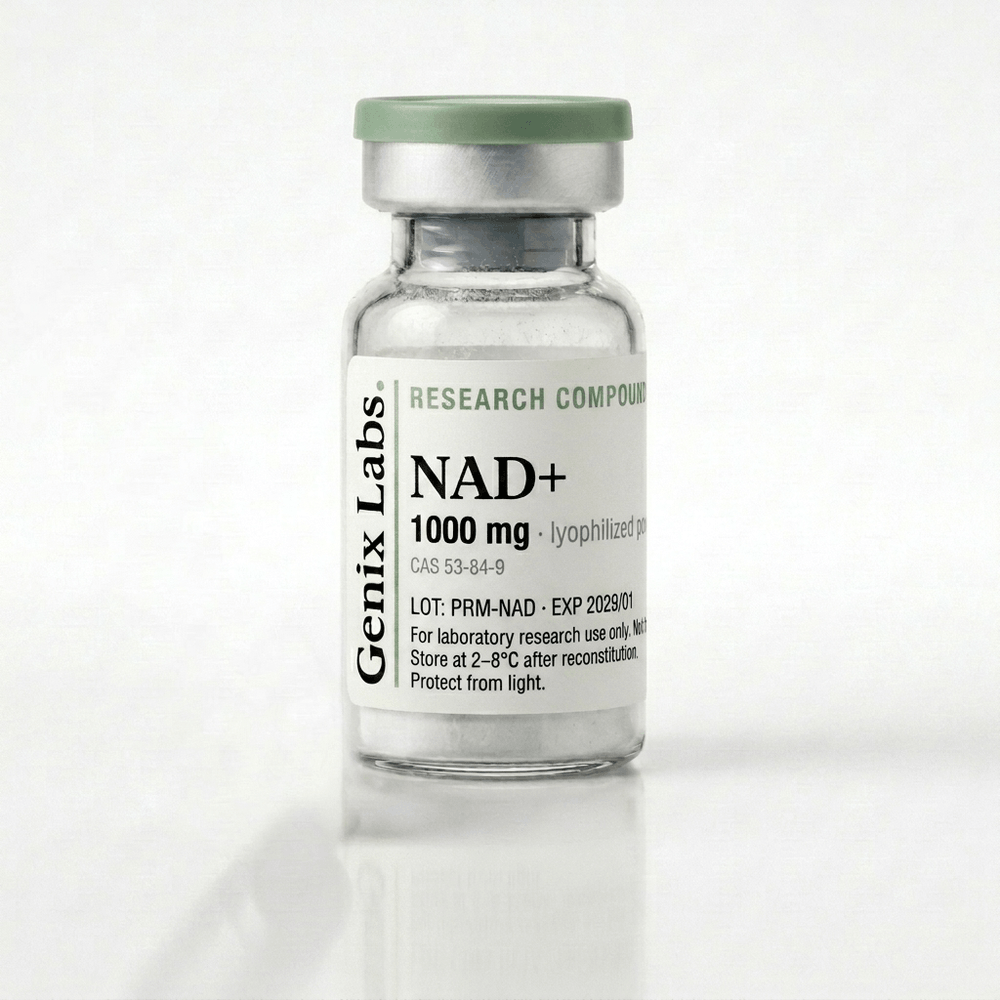
From manufacturing, not from a trial. 1,000mg is a convenient amount to freeze dry into a single glass vial. It is a package size. The Genix Labs lab-tested NAD+ 1000mg vial is exactly that: one gram of lyophilized powder with a lot document attached.
A vial size is not a dose. The one infused amount in the literature is 750mg, which is three quarters of a vial, spread over six hours. Treating a vial as a serving is a packaging assumption wearing a number.
What does the record say about injection frequency?
Nothing. There is no published frequency for NAD+ by any injected route. The only infusion study gave one infusion and measured for six hours. It never asked how often. Weekly, twice weekly and monthly clinic schedules all exist, and none of them has a published comparison.
Compare that to the oral record, where frequency is nailed down. Nicotinamide was 500mg twice a day for a full year, in two separate trials. NMN was once daily in almost every trial. Those schedules came from protocols, and that is why they can be quoted.
What about an NAD+ dosage per week?
No weekly amount has been published for NAD+ itself. The weekly figures in circulation are clinic practice. For the precursors, weekly totals can be worked out from daily amounts, so 1,000mg a day is 7,000mg a week. That is arithmetic, not a separate finding.
Weekly framing hides something important. A dose spread evenly across seven days and the same total given in one sitting are different exposures. The infusion study makes that point by design, with a small total stretched across six hours.
How often was it given in the trials?
| Molecule | Frequency used | Longest run | Published? |
|---|---|---|---|
| Nicotinamide riboside | once or twice daily | 12 weeks | yes, six trials |
| Nicotinamide mononucleotide | once daily | 24 weeks in the pooled set | yes, fifteen trials |
| Nicotinamide | twice daily | 12 months | yes, two phase 3 trials |
| Niacin | daily, titrated upward | 10 months | yes, one trial |
| NAD+ intravenous | one infusion, then nothing | 6 hours | pharmacokinetics only |
Why frequency cannot be copied from a menu
Because the trials that produced the numbers enrolled specific people for specific reasons. Pirinen enrolled patients with a diagnosed mitochondrial disease and a measured NAD+ deficiency. Yoshino enrolled postmenopausal women with prediabetes. Dollerup enrolled obese insulin resistant men.
Those three populations are not interchangeable, and neither are their results. A menu that prints one schedule for everybody has quietly dropped the part of each study that explains why the number came out the way it did.
How does a 1,000mg vial become a known concentration?
Lyophilized means freeze dried. The vial holds dry powder, so it has no volume you can measure. Adding bacteriostatic water turns it into a solution of known strength. The amount of water you add is what sets that strength, and nothing else does.
The arithmetic is simple division. Milligrams in the vial, divided by millilitres of water added, equals milligrams per millilitre. Our guide to reconstituting peptides covers the technique, and how to calculate peptide dosage works through the maths in full.
Milligrams, millilitres and syringe units
Here is a 1,000mg vial at four common dilutions. The vial never changes. Only the concentration does. Read this as laboratory arithmetic for handling a known solution, not as a protocol.
| Water added | Concentration | 1ml holds | 0.1ml holds |
|---|---|---|---|
| 2ml | 500mg per ml | 500mg | 50mg |
| 5ml | 200mg per ml | 200mg | 20mg |
| 10ml | 100mg per ml | 100mg | 10mg |
| 20ml | 50mg per ml | 50mg | 5mg |
Notice what happened. The same vial can read as 500mg per millilitre or 50mg per millilitre, a tenfold spread, purely from how much water went in. This is why a milligram figure with no concentration attached cannot be acted on at all.
Understanding an insulin syringe
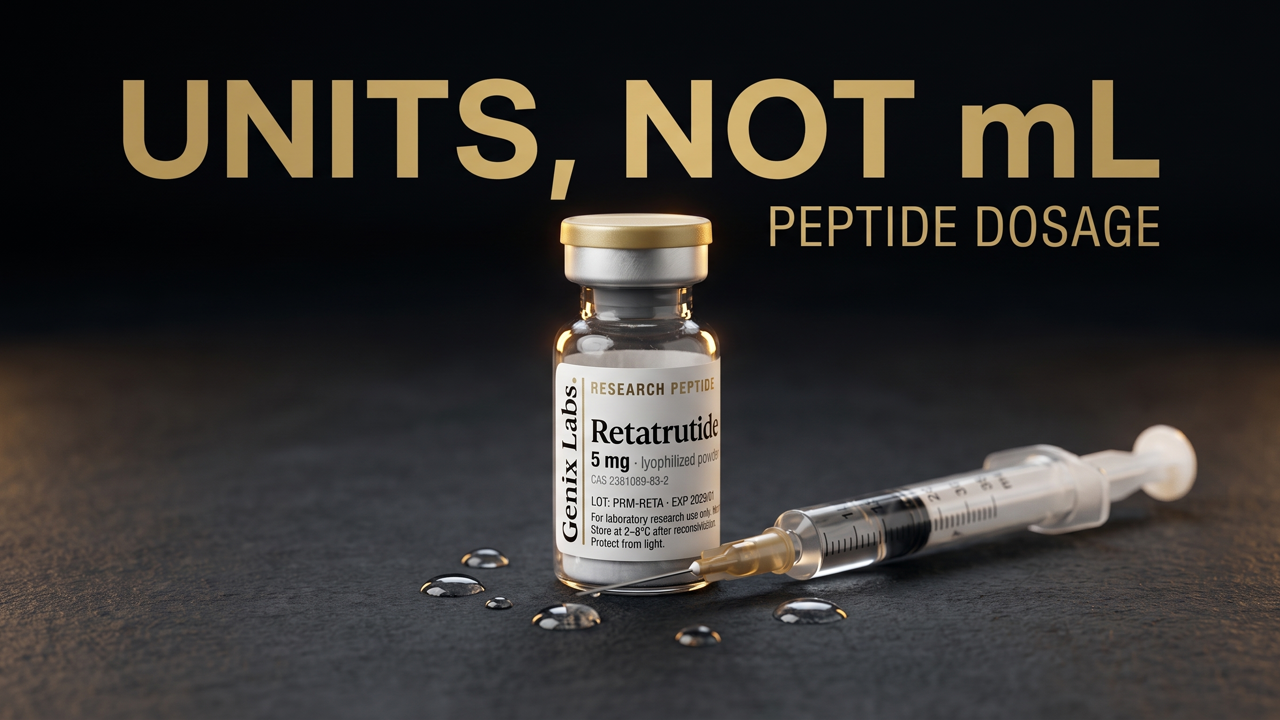
An insulin syringe is marked in units, not in millilitres. On a standard U-100 syringe, 100 units equals 1 millilitre. So one unit is 0.01ml. The markings say units because the syringe was designed for insulin, and the scale carried over.
That is the single most common source of error in peptide handling. Units are a volume scale. They are not a milligram scale. The same 20 units can hold 100mg or 10mg, depending only on how the vial was mixed.
| Syringe reading | Volume | At 100mg per ml | At 500mg per ml |
|---|---|---|---|
| 10 units | 0.10ml | 10mg | 50mg |
| 20 units | 0.20ml | 20mg | 100mg |
| 50 units | 0.50ml | 50mg | 250mg |
| 100 units | 1.00ml | 100mg | 500mg |
Why volume caps a single site, not potency
A small tissue site holds only so much liquid comfortably. That ceiling is about volume, and it has nothing to do with how many milligrams are dissolved in it. Dilute a vial heavily and the volume needed goes up fast, which is the real practical limit.
This is why heavy dilution is not automatically the safer choice. It lowers concentration and raises volume at the same time. For NAD+ specifically there is no published injected protocol to work from, so none of this is a recommendation.
How should an NAD+ vial be stored?
Sealed and cold, away from light. A lyophilized vial is stable for months refrigerated at 2 to 8 degrees Celsius, and longer at minus 20 for long term storage. Cold chain matters from the moment it leaves the lab, which is why Genix Labs ships cold packed with live tracking.
Once water goes in, the clock starts. A reconstituted solution belongs in the fridge and gets used inside about a month. Our peptide storage guide for Bali covers heat, humidity and what a warm courier journey does to a vial.
How long does a reconstituted vial last?
Roughly a month refrigerated, for most lyophilized research peptides handled with clean technique. Bacteriostatic water contains a small amount of benzyl alcohol, which suppresses bacterial growth. It does not sterilise, and it does not stop chemical breakdown.
- Freeze thaw cycling degrades a solution faster than steady refrigeration.
- Light exposure matters. Keep the vial in its box or in a dark part of the fridge.
- Any cloudiness, colour change or visible particles means the vial is finished.
- Label the vial with the date water went in, and the concentration you made.
What can a researcher actually expect to measure?
One thing reliably, and the rest not at all. Blood NAD+ goes up, in a dose dependent way, for the oral precursors. That is the finding that replicates. Conze, Trammell, Yi and Okabe all show it with different molecules and different methods.
Everything past that is inconsistent. Muscle NAD+ rose in two biopsy studies and function did not follow. Insulin sensitivity rose in one small trial and failed in three larger ones. Walking distance rose in one multicentre trial. Our NAD+ benefits guide grades each claim against its evidence.
What changes the requirement between people?
| Factor | Why it changes the picture | Evidence behind it |
|---|---|---|
| Baseline NAD+ | a deficient person has more room to move than a healthy one | Pirinen: patient muscle NAD+ climbed to control level |
| Age | repair demand and breakdown both rise with age | Elhassan studied aged men specifically |
| Body composition | obesity and insulin resistance shifted every result | Dollerup and Remie both enrolled obese participants |
| Which molecule | each precursor enters the pathway at a different point | the whole table above |
| Route | a six hour drip and a daily capsule are different exposures | Grant 2019 against every oral trial |
| Endpoint measured | blood, muscle, performance and disease give different answers | two biopsy nulls against one blood win |
Did the trials enrol men and women equally?
No, and it shows. The two clearest results in this article came from single sex groups. Yoshino 2021 enrolled only postmenopausal women and measured a rise in muscle insulin sensitivity. Dollerup 2018 enrolled only obese men and measured nothing at eight times the dose.
Those two trials are often quoted side by side as a dose comparison. They are not one. They differ in molecule, in sex, in metabolic status and in endpoint. Nobody has run a trial that varies the dose while holding everything else steady across both sexes, so the question stays open.
Safety and professional guidance
The oral safety record is reassuring and narrow. Two twelve month trials at 1,000mg of nicotinamide a day reported no noteworthy difference in adverse events. A pooled review of fifteen NMN trials found no increase in overall or serious events and no liver enzyme elevation.
Narrow matters. Those trials excluded pregnancy, active cancer, and significant organ disease. Niacin at high amounts showed an anemia tendency in one patient group. And the injected routes have no safety record of their own. Our NAD+ side effects breakdown separates the four molecules properly.
What to avoid around dosing figures
- A milligram number with no molecule attached. It is the single most common error on this topic.
- A dosage chart with filled in intramuscular or subcutaneous rows. No trial has published either.
- A dose quoted without the concentration it came from. Units and millilitres are meaningless without it.
- Blood NAD+ presented as an outcome. It is a dosing signal that the molecule arrived.
- A number above 2,000mg a day. That is the top of the randomized record for any molecule here.
- A clinic schedule presented as evidence. No injected frequency has ever been compared in a trial.
Why niacin flushes and the others do not
Niacin triggers a skin flush. It binds a receptor called GPR109A on immune cells in the skin, which releases prostaglandins and opens blood vessels. The face and chest go red and warm. It is harmless and it fades.
Nicotinamide riboside does not do this. Conze 2019 reported no flushing across all three dose arms, up to 1,000mg a day. That is a genuine difference between two molecules that share a dose range, and it is a good example of why the name on the label decides the answer.
What a lot report rules out, and what it does not
A certificate of analysis answers one narrow question well. Is the powder in this specific lot the molecule it claims to be, at the purity printed. The Genix Labs NAD+ lot 158390 document reports 98.70% HPLC area purity at 1,000mg, with LC-MS identity confirmation.
- HPLC area purity is a lot-specific result. It is not a statement of content, sterility, safety or efficacy.
- LC-MS identity confirms the molecule is NAD+ and not something cheaper wearing the label.
- ISO 17025 accreditation means the testing lab itself is audited to a standard.
- A lot number lets you match the paper to the vial in your hand. Check that they agree.
- No certificate tells you a dose. Purity and dosing are completely separate questions.
How much does a tested NAD+ vial cost?
A Genix Labs NAD+ 1000mg vial is USD 125, or Rp 2.000.000, with the batch certificate included. In Bali it ships same day, often inside two hours, with cash on delivery available. Outside Bali it ships cold across Southeast Asia, Europe and Australia.
Set that against the one published infusion. 750mg over six hours is three quarters of one vial. The vial price is not the interesting number here. The interesting number is that the protocol it would supply has been run exactly once, in eleven men, with no control group.
What would actually settle the dose question?
- A randomized trial of NAD+ itself, with at least two doses and a placebo arm. None exists.
- A head to head of a precursor against infused NAD+, measuring the same endpoint in the same people.
- A dose ranging trial with a hard outcome rather than a blood level. Blood NAD+ is a proxy and it keeps passing while outcomes fail.
- Repeat biopsy work to explain why muscle NAD+ rises and muscle function does not.
- A published injected protocol of any kind, with a frequency that was compared rather than chosen.
- Trials in the people who actually buy it. The clearest wins so far came from a diagnosed deficiency, not from healthy adults.
Grade any NAD+ dose claim in 30 seconds
- Which molecule? Niacin, nicotinamide, NR, NMN and NAD+ have five separate dose records.
- Which route? NAD+ by injection has one pilot study. Everything else injected has none.
- Does it name a trial? A dose without a citation is a preference wearing a number.
- What endpoint did that dose move? Blood NAD+ going up is not function going up.
- Is the number inside 100mg to 2,000mg a day? Above that, nothing has been randomized.
- Does the page admit the 2,000mg null? If not, it has read half the literature.
- Is a concentration given with the milligrams? Without it, no syringe reading means anything.
FAQ
What is the dosage for NAD+?
No dose is established for NAD+ itself. One published human study infused 750mg over six hours in eleven men. Every other number belongs to a precursor: 100mg to 2,000mg a day for nicotinamide riboside, 100mg to 1,200mg a day for NMN, and 1,000mg a day for nicotinamide.
What is the NAD+ dosage per day, by mouth?
There is no published oral dose of NAD+ itself. By mouth the studied molecules are precursors, and the daily amounts actually tested are 100mg, 250mg, 300mg, 500mg, 600mg, 900mg, 1,000mg, 1,200mg and 2,000mg. Which figure applies depends entirely on which molecule is in the bottle.
Is there an NAD+ injection dosage chart?
Only one row of it can be filled from published evidence. That row is 750mg infused over six hours, from a single open label pilot in eleven men. Intramuscular, subcutaneous, oral and nasal NAD+ have no published trial at any amount, so those rows stay empty.
What is the NAD+ injection dosage and frequency?
No frequency has been published for NAD+ by any injected route. The one infusion study gave a single infusion and measured for six hours, so it never asked how often. Weekly, twice weekly and monthly clinic schedules all exist, and none has a published comparison behind it.
Is there evidence for a 500mg NAD+ injection?
Not by injection. 500mg appears twice in the human record and both times by mouth, as a single oral NMN dose and as half the daily nicotinamide amount in two twelve month trials. A 500mg injection sits outside the published literature entirely.
What is the NAD+ dosage per day subcutaneous?
No published trial has given NAD+ under the skin at any amount. There is no controlled subcutaneous dose, no frequency and no route specific safety record. Route changed the answer for every molecule here, so a figure borrowed from a six hour drip does not transfer.
Does a higher NAD+ dose work better?
Not past a point. More milligrams reliably means more NAD+ in a blood sample. It does not reliably mean more result. The highest dose ever randomized, 2,000mg a day for twelve weeks, moved no metabolic endpoint, while 250mg a day of NMN moved muscle insulin sensitivity.
What is the NAD+ dosage per week?
No weekly amount has been published for NAD+ itself. For the precursors a weekly total is just arithmetic, so 1,000mg a day is 7,000mg a week. Weekly framing hides the exposure pattern, and the one infusion study shows that spreading a small total over hours was the design.
Takeaway
The published NAD+ dose record fits in two lines. For the precursors, 100mg to 2,000mg a day by mouth, across roughly two dozen randomized trials. For NAD+ itself, 750mg infused over six hours, once, in eleven men, with no placebo group.
Inside that record, milligrams buy one thing reliably. More NAD+ in a blood sample. They do not reliably buy anything downstream. The highest dose ever randomized moved nothing. The biggest rise ever measured came from the cheapest molecule and brought an anemia tendency with it. Two biopsy studies got the molecule into muscle and changed no muscle function.
So the useful question was never how many milligrams. It is which molecule, by which route, measured against what, in whom. Start at the longevity peptides hub if you want the rest of this cluster read the same way.