Search TB-500 side effects and six items come back on nearly every page. Tiredness. Head pressure. Flushing. Nausea. A sore injection site. A vague warning about cancer. The order changes. The list does not.
That list has a source problem. No human trial has ever tested TB-500, the seven amino acid fragment sold in a research vial. So every item on the list was either borrowed from a different molecule or self reported with no control group. This guide separates the two, then shows you the risk that is actually measurable. Every Genix Labs compound is supplied for laboratory research only. Nothing here is medical advice or a use instruction.
What are the side effects of TB-500?
There is no verified side effect profile for TB-500, because the fragment has never been through a human trial. The closest real data covers thymosin beta-4, the full protein it comes from. Two phase I trials found adverse events that were infrequent, mild or moderate, with no serious events. Everything else reported online is uncontrolled.
- Zero human trials of the TB-500 fragment have been published. That is the headline, not a footnote.
- Two phase I trials of thymosin beta-4, the full protein, found mild to moderate adverse events and no serious ones.
- Injection site soreness, tiredness and head pressure are the most reported effects. All are self reported, not trial findings.
- The cancer question is open rather than answered, because thymosin beta-4 is studied as a tumour target itself.
- The measurable risk is in the vial: endotoxin, wrong identity, wrong water, broken cold chain.
Why is there no real side effect list?
A side effect list comes from a trial. Give a group the compound. Give another group a placebo. Count what happens in both. Subtract. What is left is a side effect.
That has never been done with TB-500. Not once. The fragment has no approved medical use anywhere, so no regulator required the work and no sponsor paid for it. It is supplied as a research chemical, and research chemicals do not get safety labels.
So when a page prints a confident list, ask one question. Where did you count this? There is no honest answer available. That does not mean the compound is safe. It means nobody measured.
Whose safety data is this?
Two molecules share one conversation, and that is the root of the confusion.
Thymosin beta-4 is a natural protein your own cells make. It is 43 amino acids long. It went into real clinical programmes for heart attack, eye surface repair and wound healing. Those programmes generated human safety data.
TB-500 is not that protein. It is a short synthetic fragment, seven amino acids long, built around the region that grips actin. It never entered a clinical programme. Our full TB-500 explainer covers the molecule itself in detail.
What did the human trials actually record?
Two phase I trials of the full protein exist. They are the only controlled human safety data in this entire topic, and almost no page about TB-500 mentions either one.
Ruff and colleagues, 2010
Forty healthy adults, in four groups of ten. Each group received a single intravenous dose of synthetic thymosin beta-4 or placebo. The doses climbed from 42 mg to 1,260 mg. After a safety review, the same daily dose ran for 14 days.
The result: adverse events were infrequent, and mild or moderate in intensity. There were no dose limiting toxicities and no serious adverse events. The authors concluded the protein was well tolerated across the whole range.
Wang and colleagues, 2021
A first in human study of recombinant thymosin beta-4 in Beijing. Fifty four subjects took a single intravenous dose across seven ascending groups. Another 30 subjects took a daily dose for 10 days. Everyone was watched for 28 days.
Same shape of answer. Adverse events were mild to moderate. No dose limiting toxicity. No serious adverse events. The team also tested for anti-drug antibodies, which is the formal way of asking whether the immune system started reacting to it.
How should a reported side effect be graded?
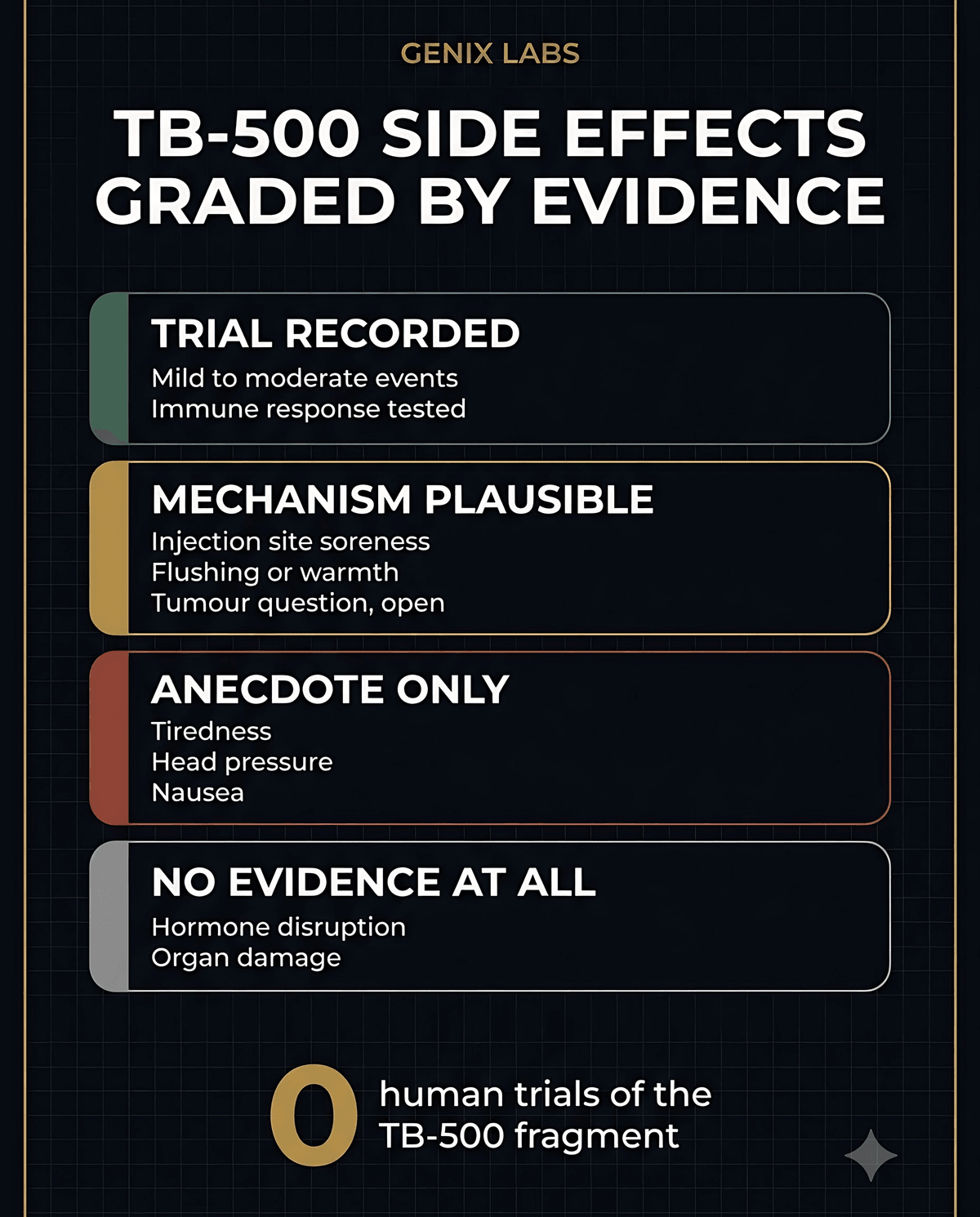
Not every report carries the same weight. We use four tiers on this page, and every effect below gets placed on one.
- Trial recorded. Counted in a controlled human study, against placebo. The gold standard.
- Animal signal. Seen in rodents or cell work, in a study designed to measure something else.
- Mechanism plausible. Not observed, but it follows from what the molecule does.
- Anecdote only. Self reported with no control, no blinding and no test on the vial.
Most of what gets printed as a TB-500 side effect lands on tier four. A few land on tier three. One or two borrow from tier one by citing the full protein.
Which reported effects survive grading?
Here is every commonly listed TB-500 side effect, with the strongest real source behind it and the tier it sits on. The rest of this guide walks each row.
| Reported effect | Strongest real source | Tier |
|---|---|---|
| Injection site soreness or redness | Expected for any injected peptide | Mechanism plausible |
| Tiredness or lethargy | Self reports only | Anecdote only |
| Head pressure or headache | Self reports only | Anecdote only |
| Flushing or warmth | Vasodilation is plausible from angiogenic signalling | Mechanism plausible |
| Nausea or stomach upset | Self reports only | Anecdote only |
| Light headedness | Self reports only | Anecdote only |
| Immune response to the sequence | Anti-drug antibody testing in Wang 2021 | Trial recorded, full protein |
| Mild or moderate general adverse events | Ruff 2010 and Wang 2021, both phase I | Trial recorded, full protein |
| Tumour growth or spread | Thymosin beta-4 tumour biology, Xiao 2012 | Mechanism plausible, unresolved |
| Fever or inflammatory reaction | Endotoxin in non sterile material | Trial recorded, but a vial problem |
| Hormone disruption | No study of any kind | No evidence at all |
| Liver or kidney damage | No study of any kind | No evidence at all |
Two rows carry controlled human data, and both of them belong to the full protein. Two rows carry nothing at all. The loudest rows are the thinnest.
What happens at the injection site?
This is the most common report, and the least mysterious. Any peptide put under the skin can leave the spot sore, pink or slightly swollen for a day.
The cause is usually not the sequence. It is the volume, the needle, the depth, or the water it was mixed with. Research protocols rotate sites for exactly this reason. Our peptide reconstitution guide covers the handling side of that properly.
A site that stays hot, hard or painful for days is a different signal. That pattern points at contamination, not at the molecule. More on that below.
Does TB-500 cause tiredness?
Tiredness is the single most repeated TB-500 side effect online. It has no controlled data behind it at all.
There is also no obvious mechanism. TB-500 is not a hormone and not a stimulant. It does not act on the systems that set alertness. Nothing in the actin biology predicts fatigue.
What the reports do share is context. People reach for recovery compounds when they are injured, training hard, sleeping badly, or stacking several things at once. Any of those produces tiredness on its own. Without a placebo group, there is no way to tell them apart.
What about head pressure and headaches?
Second most reported, same evidence problem. No trial counted it.
Here a mechanism is at least arguable. Thymosin beta-4 drives new blood vessel growth and signals through vascular pathways. Vascular signalling can widen vessels, and widened vessels can produce a pressure sensation. That is a chain of plausible steps, not a measurement.
Two mundane causes deserve more credit than they get. Dehydration, which tracks with hard training. And the solvent, if someone used the wrong water or too much of it.
Does it upset the stomach?
Nausea appears on most lists. It belongs to tier four.
TB-500 has no reported action on the gut. That is BPC-157 territory, and even there the gut work is about repair rather than upset. If a research protocol pairs both compounds, attributing a stomach effect to one of them is guesswork.
Neither phase I trial reported nausea as a notable event, and those trials put the protein straight into a vein at up to 1,260 mg.
Does TB-500 affect the heart?
This question has the best data in the topic, and it points the other way.
Thymosin beta-4 was developed for heart attack, not away from it. The 2010 trial existed because the protein looked like it might help heart muscle cells survive an infarct. The 2021 trial was run for the same indication.
Neither found a cardiac safety problem in healthy adults. No dose limiting toxicity at any level tested. That is the strongest negative finding available on this page.
It still does not clear the fragment. A seven amino acid piece distributes differently, clears differently, and was never in either trial.
Can it change blood pressure?
No published human study reports a blood pressure effect from thymosin beta-4 or from TB-500. Both phase I trials monitored vital signs as standard practice and neither flagged it.
The theoretical argument runs through vasodilation again. Angiogenic signalling and vessel widening sit close together in the biology. Close is not the same as measured.
Does it affect the immune system?
Here is the one tier one finding worth knowing, and it is subtle.
The 2021 trial tested for anti-drug antibodies. That means the researchers expected the possibility that the body would start treating the protein as foreign and build a response to it. It is routine for any injected protein.
For a synthetic fragment the question is sharper, not softer. Short peptides can still trigger a response, especially if the vial also carries process residues or a partial sequence. The immune system reacts to what is in the vial, not to what the label says.
Does TB-500 cause cancer?
No study shows that. The honest position is that the question is open, and it is the most serious open question in this file.
The logic is simple and uncomfortable. Thymosin beta-4 helps cells move and helps build new blood vessels. Those are two of the things a tumour needs most. Something that helps healthy tissue repair could in principle help the wrong tissue grow.
This is not a forum theory. Thymosin beta-4 is studied as a cancer target in its own right, because it is overexpressed in several metastatic tumours and tracks with VEGF, the main vessel growth signal.
What does the tumour literature actually say?
Three strands run through it. None of them involves a person taking TB-500.
- Expression. Thymosin beta-4 shows up at higher levels in several metastatic tumour types than in matching normal tissue.
- Association. That higher level tracks with VEGF, the signal that recruits new blood vessels into a tumour.
- Function. In laboratory models, raising thymosin beta-4 increases cell migration, which is the same action that makes it interesting for repair.
Put together, those strands make it a proposed target for cancer therapy. A molecule being studied as something to block is a reason to be careful about adding it.
Could it worsen inflammation?
Most of the literature points the opposite way. Thymosin beta-4 is studied for calming inflammatory signalling, in cell models and in rodents.
The results are mixed rather than uniform, which is normal for an inflammation file. Mixed is not the same as harmful. No human trial has reported an inflammatory flare from the protein.
An inflamed reaction after an injection is far more likely to be an endotoxin problem. That is a vial issue with a real test attached to it.
Any skin or hair changes?
Hair sits on the benefit side of this topic, from a single rodent paper, and our graded benefit breakdown covers where that claim comes from.
On the side effect side, there is nothing. No study reports hair loss, skin changes or pigment changes from thymosin beta-4 or from TB-500. Claims in either direction run far ahead of the data.
Are TB-500 side effects different in women?
TB-500 side effects in women is a common search, and there is no study behind any answer to it.
Both phase I trials enrolled healthy adults and neither published a split of adverse events by sex. No animal work compared harm by sex either. Any page that lists different effects for women is extrapolating from nothing.
One real difference exists and it is mechanical, not hormonal. Body weight scaled research amounts differ, so the same vial does not mean the same exposure.
What about long term use?
Nobody knows, and that is the most important gap on this page.
The longest controlled human exposure in the literature is 14 days of daily dosing, with observation out to 28 days. A compound used in repeated multi week research blocks sits far outside that window.
No chronic toxicity study, no carcinogenicity study and no reproductive study has been published for TB-500. Those are the three studies a regulator would require before anyone could write a real long term safety section.
What is known about interactions?
No interaction study has been published. That is the complete answer.
Mechanism gives one area worth flagging in a research design. Anything that acts on clotting or vessel growth sits in the same neighbourhood as an angiogenic signal. Neighbourhood is a prompt for caution, not a documented interaction.
What are the potential benefits of taking TB-500 peptide?
TB-500 is studied for one core action. It helps cells move. From that follow the researched effects: faster wound closure, new blood vessel growth, and tissue repair signalling. Almost all of that work used the full protein, in mice and cell culture. No human efficacy trial of the fragment exists.
The benefit claims divide the same way the side effect claims do. Cell migration is firm. Wound closure, vessel growth and hair growth have real papers, all in animals. Tendon repair, flexibility and muscle growth have almost nothing. We graded every one of them in the TB-500 benefits breakdown.
What are the bad side effects of taking peptides?
Peptides are not one class, so there is no single answer. A GLP-1 peptide and a repair peptide have almost nothing in common. What they share are three failure modes.
- Injection site reactions. Common, usually minor, and often caused by handling rather than the sequence.
- Immune response. The body can treat an injected sequence as foreign, which is why trials test for anti-drug antibodies.
- Contamination. Endotoxin, non sterile material, or a vial that does not hold what the label says. This is where the documented harm lives.
For compounds with real clinical files, the specific effects are documented. Our retatrutide side effect breakdown is the contrast case: a compound with phase 3 trial data has a real list, with real frequencies. TB-500 has none of that.
Does oral TB-500 change the risk?
Oral TB-500 is sold, and there is no published work on it at all. Not on absorption, not on safety.
Peptides are generally broken down by stomach acid and gut enzymes. Both human trials used the intravenous route for that reason. An oral format moves the question from what does this do to how much of it even survives.
Does stacking with BPC-157 add risk?
No study has tested the pair for safety. The combination is popular because of how the two research files read together, not because a trial compared them.
Two practical points matter for a research design. First, attribution breaks. If something happens, you cannot tell which compound did it. Second, every compound added doubles the handling surface where contamination enters.
Our BPC-157 and TB-500 stack explainer covers how the pairing is framed, and the BPC-157 side effect file covers the other half of the vial.
What are the risks nobody lists?
This is the section the top results do not have, and it is the one that matters most. The documented harm in peptide research almost never comes from the sequence. It comes from the vial.
Four doors, and a published lot document closes three of them. That is the real safety conversation, and it is a testing conversation rather than a side effect conversation.
How bad is the contamination risk?
Endotoxin is the fragment of a dead bacterium. It survives heat. It is not removed by filtering for sterility alone. Injected, it produces fever, chills and a strong inflammatory response.
Every reliable account of someone getting genuinely unwell from a research peptide looks like this, not like a molecular side effect. The compound did nothing. The material was dirty.
This is testable. Endotoxin and sterility are standard assays with numeric limits. A vendor who cannot show them is asking you to trust rather than verify.
What if the vial holds the wrong molecule?
For a seven amino acid fragment this is a bigger risk than for a long peptide. Short sequences are easier to get subtly wrong, and a wrong one still looks like a white powder.
Purity and identity are two different tests. HPLC purity says how much of the sample is one compound. It does not say which compound. LC-MS identity confirms the mass, which is how you know the sequence is the one on the label.
Can the water cause the side effect?
Yes, and this is underrated. The powder does nothing until something dissolves it. What goes in the vial goes in the sample.
- Bacteriostatic water contains 0.9 percent benzyl alcohol, which suppresses bacterial growth in a multi use vial.
- Plain sterile water has no preservative, so a vial used more than once can grow bacteria.
- Tap or filtered drinking water is never acceptable and introduces both bacteria and endotoxin.
- Too little volume gives a concentrated, stinging sample. Too much wastes the vial.
Our reconstitution walkthrough covers the correct solvent and volume maths for a research sample.
Can storage create a problem?
Degradation is the quiet failure. A peptide that has been warm for too long loses potency without changing colour or smell.
Lyophilized powder is stable for a long time at minus 20 degrees Celsius. Once reconstituted it belongs at 2 to 8 degrees and has a short usable window. Heat, light and repeated freeze thaw cycles all cost you material.
In a tropical climate this is a real constraint rather than a theoretical one. Our guide on storing peptides in Bali heat covers the cold chain end to end.
The side effect nobody counts: a sanction
TB-500 is on the World Anti-Doping Agency prohibited list, banned at all times, in and out of competition. It sits with other growth factors and peptide hormones.
For anyone in a tested sport, that is the most predictable adverse outcome in this whole article. It has a far higher documented rate than any symptom on the standard list.
What does a lot report rule out?
A real certificate of analysis is specific to one batch. Ours carries the lot number, the HPLC area purity, and the LC-MS identity confirmation, from an ISO 17025 accredited laboratory.
For the BPC-157 and TB-500 blend, lot 726591 reports 99.30 percent HPLC area for BPC-157 and 98.60 percent for TB-500. The BPC-157 10 mg vial, lot 613480, reports 99.32 percent.
- It rules out the wrong molecule, through LC-MS identity on that lot.
- It rules out gross impurity, through HPLC area purity on that lot.
- It does not rule out a side effect, because purity is not safety.
- It applies only to the printed lot. A certificate for a different batch proves nothing about yours.
Match the lot number on the document to the lot number on the vial. That single check removes most of the real risk in this topic.
Which vendor claims are red flags?
- No side effects at all. Nothing injected has no side effects, and nobody has measured this one.
- Completely safe, or clinically proven safe. There is no clinical file for the fragment to prove anything from.
- A certificate with no lot number, or one that never changes between batches.
- A purity figure with no identity test beside it.
- Human dosing instructions printed on a research product page.
- A specific side effect frequency, like affects 3 percent of users. No trial produced that number.
How to read any side effect claim in 30 seconds
Four questions. They work on any page about this compound, including this one.
- Which molecule was studied, the 43 amino acid protein or the 7 amino acid fragment?
- Was there a control group, or is this a self report?
- Was the species a human, a rodent, or a dish of cells?
- Was the vial ever tested, so we know what was actually administered?
Most pages fail on the first question. Nearly all fail on the fourth.
Mistakes that create the side effect
- Buying on purity alone and never asking for the identity test.
- Using plain sterile water in a vial that will be accessed more than once.
- Letting the vial sit at room temperature after reconstitution.
- Starting two compounds the same day, so nothing can be attributed.
- Reading a thymosin beta-4 trial as a TB-500 safety result.
- Treating an absent side effect list as a clean safety record.
What does a tested vial cost?
The BPC-157 and TB-500 blend, 5 plus 5 mg, is 1,650,000 rupiah, about 99 US dollars. BPC-157 10 mg on its own is 1,450,000 rupiah, about 89 US dollars.
Both ship cold packed and tracked, same day for orders placed before 9 PM, with same day and often two hour delivery inside Bali and cash on delivery available. Every order includes the published lot document. See the lab tested BPC-157 and TB-500 research vial for the current lot and the full specification.
Frequently asked questions
What are the bad side effects of taking peptides?
Across the published literature the recurring problems are injection site reactions, an immune response to a foreign sequence, and contamination from non sterile or wrongly identified material. Peptides are not one class, so risk depends on the molecule. The largest documented harms in this space come from the vial, not the sequence.
What are the potential benefits of taking TB-500 peptide?
TB-500 is studied for one core action, helping cells move. From that follow the researched effects: faster wound closure, new blood vessel growth, and tissue repair signalling. Almost all of that work used thymosin beta-4, the full protein, in rodents and cell culture. No human efficacy trial of the fragment exists.
What peptides does Joe Rogan take?
Joe Rogan has discussed BPC-157 and TB-500 on his podcast, alongside NAD and other peptide stacks, in conversation rather than in any published protocol. Podcast mentions are not evidence and not a protocol. Genix Labs supplies these compounds for laboratory research only, and nothing said on a podcast changes that.
How to take BPC-157?
We cannot give a human schedule, because BPC-157 is supplied for laboratory research only. The published rodent work used repeated daily administration over one to four weeks, by injection and by mouth, at body weight scaled amounts. Our BPC-157 dosing guide walks through exactly what those studies measured.
Are TB-500 side effects different in women?
No trial has compared TB-500 side effects by sex, because no human trial of the fragment exists. The two phase I trials of thymosin beta-4 enrolled healthy adults without publishing a sex split in adverse events. Claims about different effects in women are extrapolation, not a controlled comparison.
Does TB-500 cause cancer?
No study shows that, and the honest answer is that the question is open. Thymosin beta-4 is studied as a tumour target in its own right, because it is overexpressed in several metastatic tumours and travels with VEGF. That is a reason for caution in research design, not a finding in people.
Takeaway
TB-500 side effects are not documented, because TB-500 has never been through a human trial. The six item list on every page is borrowed or self reported. The only real human safety data covers thymosin beta-4, the full protein, in two small phase I trials that found mild to moderate events and nothing serious.
The cancer question stays open and deserves respect rather than a reassuring sentence. Everything else that has actually hurt people in this corner of research came from the vial: endotoxin, the wrong sequence, the wrong water, a broken cold chain. Those have tests. Use them.
The useful next steps are our TB-500 explainer, the dosage research breakdown, and the recovery peptide hub for everything around it.