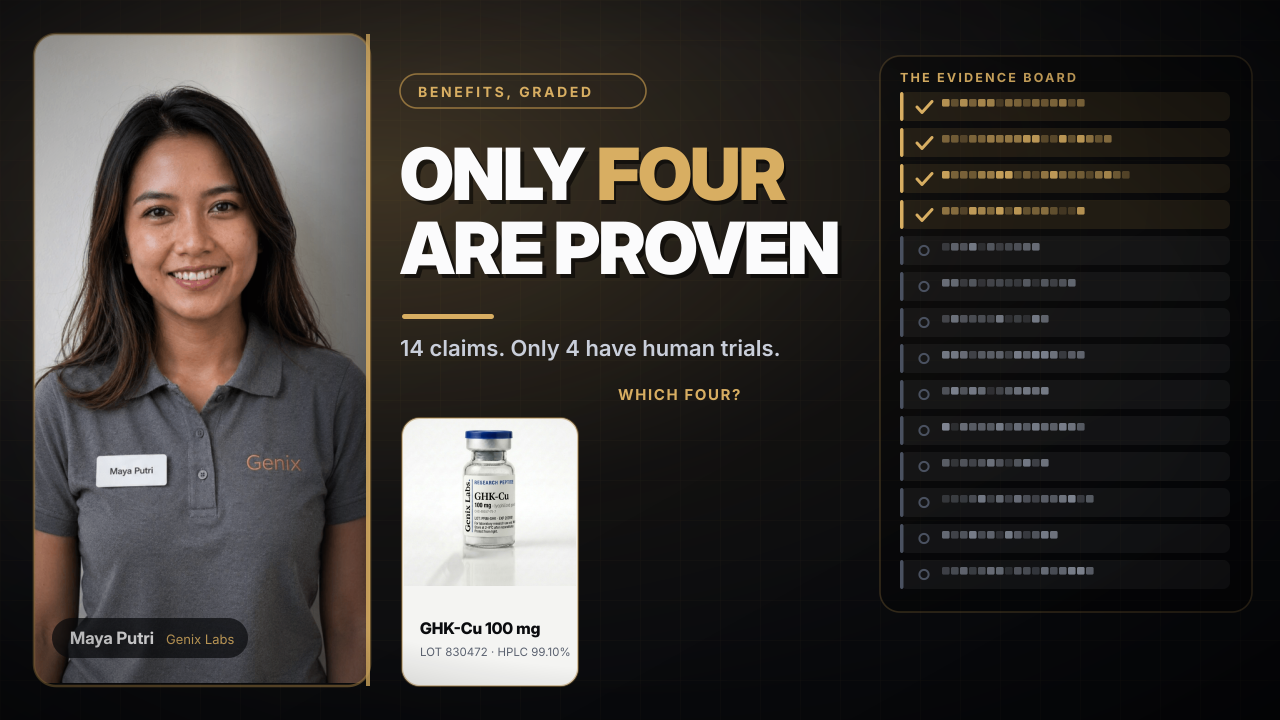
Search GHK-Cu benefits and you get a list of fourteen wonderful things. Firmer skin. Thicker hair. DNA repair. Gene expression reset. The list is not made up. It is just flattened. Four of those claims rest on human skin trials. The rest rest on a dish, a mouse or a database, and nobody tells you which is which.
What are the benefits of GHK-Cu?
GHK-Cu is a copper peptide studied for skin repair. In human cream trials it improved skin firmness and density, softened fine lines, evened out blotchy skin and raised collagen on biopsy. Wound healing, hair and gene level effects come from animal and cell work, not from people. Research use only.
Which GHK-Cu benefits actually have proof?
This is the section every other page skips. A benefit is only as good as the study type under it. A result measured on human faces for twelve weeks is a different animal from a result measured in a petri dish for two days. Both are real science. Only one of them tells you what happens to skin.
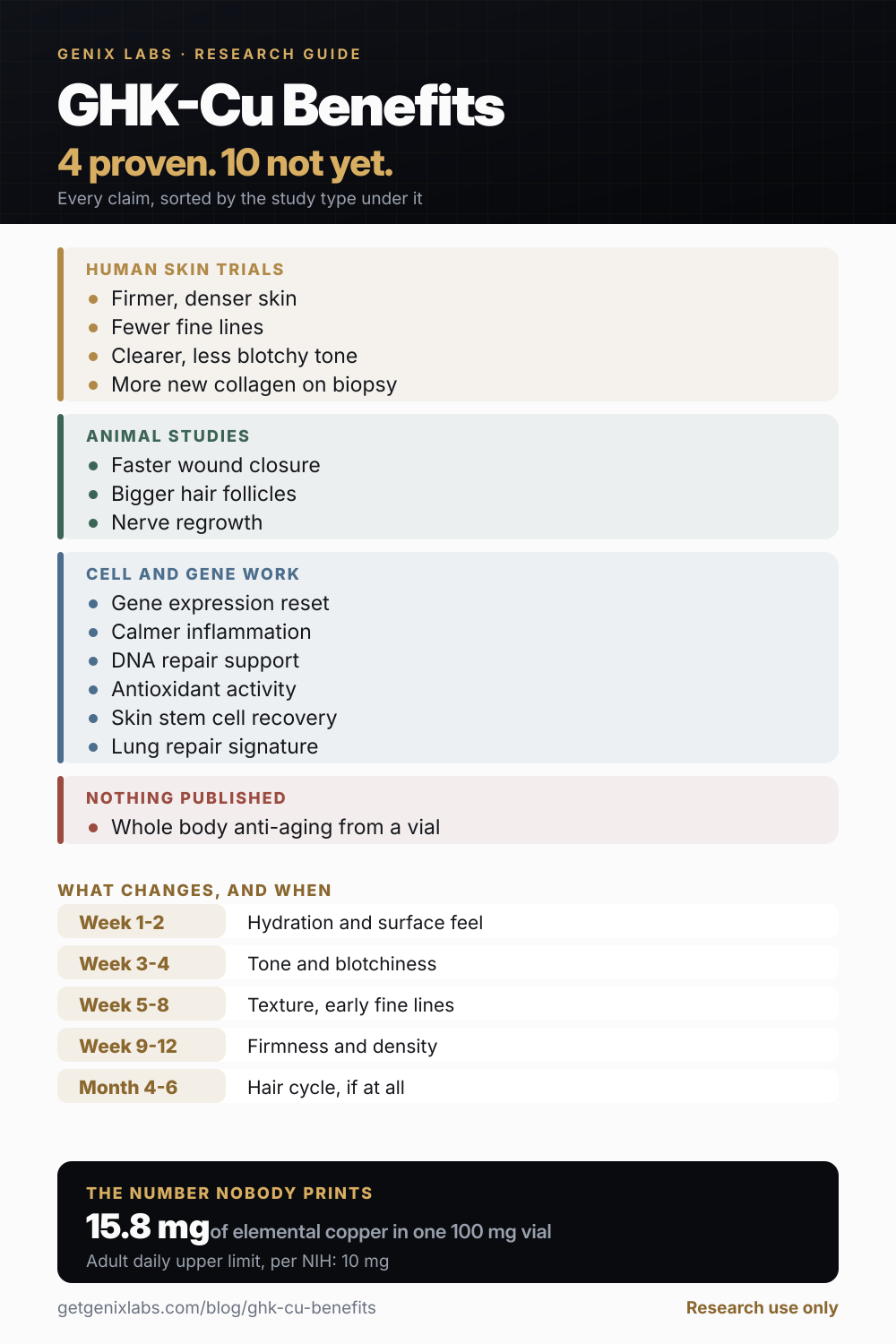
So here is every claim we could find, graded. We used four grades. Human trial means it was measured on people. Animal means rodents, rabbits or pigs. Cell means a dish or a gene database. None means we found no published study at all for that route and that outcome.
| Claimed benefit | Strongest evidence | Grade | What that really means |
|---|---|---|---|
| Firmer, denser skin | 12 week facial cream trials | Human | The strongest single claim on the list |
| Fewer fine lines | 12 week facial cream trials | Human | Measured, modest, and slow to appear |
| Clearer, less blotchy skin | Photodamage cream studies | Human | Often the first visible change |
| More new collagen | Skin biopsy comparisons | Human | Small studies, but they cut the skin and looked |
| Faster wound healing | Rodent, rabbit and pig models | Animal | Consistent in animals, thin in people |
| Thicker hair | Animal follicle work | Animal | Promising, and nowhere near settled |
| Nerve regrowth | Cultured neurons, animal nerve injury | Animal | Interesting, far from skin care |
| Gene expression reset | Connectivity Map analysis | Cell | A database result, not a person |
| Calmer inflammation | Cell models, IL-6 suppression | Cell | Mechanism, not outcome |
| DNA repair support | Gene expression analysis | Cell | Genes moved. Nothing was measured in skin |
| Antioxidant activity | Test tube chemistry | Cell | Real chemistry, unproven relevance |
| Skin stem cell recovery | Aged skin cell cultures | Cell | A dish of old cells, not an old face |
| Lung repair signature | Emphysema lung fibroblasts | Cell | Famous study, nothing to do with your face |
| Whole body anti-aging from a vial | No published study | None | Unstudied is not the same as disproven |
What is GHK-Cu?
GHK-Cu is a tiny protein fragment bound to a copper atom. The protein part is three amino acids long: glycine, histidine and lysine. That is where the letters come from. Copper clips onto the middle piece and the pair travels together.
Your body already makes it. It was found in human blood in 1973 by a researcher looking at why young plasma behaved differently from old plasma. The whole field started with that one observation. For a full primer on the molecule, read our plain explainer on GHK-Cu.
The complex weighs about 401.9 daltons. That matters later, because skin blocks most things bigger than roughly 500 daltons. GHK-Cu squeaks under the ceiling, which is part of why a cream version is even plausible.
- Three amino acids: glycine, histidine, lysine, written Gly-His-Lys.
- One copper atom, bound tightly, which is what the Cu stands for.
- About 401.9 daltons, just under the usual skin cutoff of 500.
- Found naturally in human plasma, saliva and urine.
- Falls steeply with age, which is the origin of the whole research line.
Why do your own levels fall?
Plasma GHK sits near 200 nanograms per millilitre at age twenty. By sixty it is closer to eighty. That is a fall of about sixty percent across forty years. The 2018 review that collects the GHK literature reports those figures.
Nobody knows exactly why the fall happens. The leading guess is simple wear. The tissues that release GHK get slower, and the demand for repair signals goes up at the same time. The curve is what made researchers ask the obvious question. If young skin has more of this, does adding it back help?
That question is still open. A falling level is a reason to test something. It is not evidence that topping it up works. Plenty of things fall with age without being worth replacing. Keep that distinction in mind for the rest of this page.
How does GHK-Cu work?
It behaves like a messenger, not a building block. It does not become collagen. It tells cells to make collagen, and it carries copper to the enzymes that need it. Think of a foreman rather than a brick.
Three jobs show up over and over in the literature. First, it signals skin cells to produce collagen, elastin and the gel like molecules between them. Second, it delivers copper to enzymes that cross link collagen fibres, which is what makes new collagen strong instead of floppy. Third, it damps down some of the inflammatory signalling around a wound.
There is a fourth job that gets quoted the most and understood the least. GHK changes gene expression broadly, which we cover in its own section further down. That finding is real and it is also the most misread item in the whole file.
Why copper is not a side detail
Several of the enzymes behind firm skin are copper enzymes. Lysyl oxidase is the clearest example. It locks collagen fibres to each other. Without copper it does not work. So the peptide is both the message and the delivery van.
That also means the copper is not optional cargo you can ignore. It arrives with every dose. We do the arithmetic on that further down, because it is the number that turns a skin conversation into a metal conversation.
Does GHK-Cu really rebuild collagen?
This is the strongest claim on the list, and it survives scrutiny better than the rest. Skin biopsy work is the reason. Researchers applied copper peptide cream, then cut a small sample of skin and looked at it under a microscope.
In a small comparison study, copper peptide cream produced more new collagen than either vitamin C cream or tretinoin cream in the same design. That is a striking result, and it is also a small study. One small study does not beat decades of retinoid trials. It does put the claim on a different floor from the rest.
What the biopsies showed was thicker collagen bundles and more of the gel like material between fibres. In plain terms, the scaffold under the surface got denser. Denser scaffold is what firmness actually is.
Can it soften fine lines?
Yes, modestly, in the cream trials. Twelve week facial studies of copper peptide cream reported fewer and shallower fine lines at the end than at the start. The effect was real and small.
Fine lines respond before deep folds do. That pattern is normal for anything that works by rebuilding the dermis. A fine line is a shallow dip in a thinning layer. Thicken the layer and the dip fills in slightly. A deep fold involves muscle and fat and bone, and no cream touches those.
So the honest version of this benefit is narrow. Expect fine lines around the eyes and mouth to soften a little across a full cycle. Do not expect a nasolabial fold to disappear. Pages that blur those two things are the reason people feel let down at week eight.
Does skin get firmer and thicker?
Firmness and density came out as the headline findings in the facial cream work. Researchers measured skin density with instruments rather than opinions, and the numbers moved. Firmness is the benefit with the most consistent support.
The mechanism lines up with the measurement, which is reassuring. More collagen and more cross linking should produce denser skin. It did. When the mechanism and the outcome agree, a finding is more believable.
One caveat belongs here. Skin density instruments are sensitive to hydration. A well formulated cream hydrates skin whether or not the active does anything. Good studies control for that with a vehicle arm. Not every study quoted online did.
Does it help spots, dullness and blotchy skin?
This one surprises people, because it usually appears first. Photodamage studies of copper peptide cream reported clearer skin tone, less blotchiness and fewer visible sun spots over twelve weeks. Clarity moved earlier than firmness.
The likely reason is turnover. Surface tone depends on how fast the top layer renews and how much low grade inflammation is running underneath. Both can shift in weeks. Collagen takes months.
This matters for judging your own result. If something changes in the first month it is probably tone and texture. Firmness is a month three question. People who quit at week four usually quit before the slow benefit had any chance to appear.
What did the human trials actually test?
Almost all of the human evidence comes from cosmetic creams at concentrations near 0.1 percent, applied to the face, usually twice a day, usually for twelve weeks. That is the shape of the entire human file.
Read that sentence again, because it decides how much of the rest of this page applies to you. The human data is topical. It is cosmetic strength. It is twelve weeks long. It is facial skin. Every claim that lives outside those four walls is an extrapolation.
| What the human studies used | What people often assume | The gap |
|---|---|---|
| A cream at about 0.1 percent | A reconstituted research vial | Thousands of times more material |
| Applied to the skin surface | Injected under the skin | A route with no published human trial |
| Twelve weeks | Open ended use | Nothing published past a few months |
| Facial skin | Scalp, joints, whole body | Different tissue, different access |
| Cosmetic outcomes | Systemic anti-aging | Never measured in a person |
None of that makes the trials worthless. They are the best thing on the shelf. It just means the honest sentence is narrow. Copper peptide cream improves facial skin modestly over twelve weeks. Everything beyond that needs its own evidence, and mostly does not have it yet.
Does it speed up wound healing?
In animals, clearly yes. Wound models in rats, rabbits and pigs have reported faster closure, better organised collagen and less scarring with copper peptide treatment. The animal wound file is the oldest and most consistent part of the whole literature.
In people the file is much thinner. Older work on stubborn ulcers reported benefit, but those studies are small, dated and hard to compare. Wound care has moved on a great deal since. So the honest grade is animal, with a human footnote.
This gap is worth sitting with. Animal wound healing is the single most reliable GHK-Cu finding in the entire body of work, and it still has not produced a modern human trial. That tells you something about how little commercial money has gone into testing this molecule properly.
Does GHK-Cu thicken hair?
Partly, and the honest answer is less exciting than the marketing. Animal work reported larger hair follicles and a longer growth phase with copper peptides. Follicle size is a reasonable proxy for hair thickness. That is a real signal.
There is no large human trial for hair. What exists is small studies, clinic reports and a lot of community photographs. Copper peptides are also used after hair transplant procedures, where the goal is healing rather than growth.
We wrote a whole guide on this, because the hair question has its own evidence base and its own disappointments. Read copper peptides for hair loss for the detail, and peptides for hair loss for how it compares with the rest of that category.
Why is the hair timeline different?
Because hair grows on a cycle and skin does not. A follicle spends years growing, a few weeks shutting down and a few months resting. Anything that acts on follicles has to wait for the cycle to come round.
In practice that means the first honest read on hair is six months, not twelve weeks. Skin gives you a tone answer in a month. Hair gives you nothing useful until a whole resting phase has turned over.
It also means early shedding is not automatically bad news. When a resting follicle restarts, the old hair gets pushed out first. People see that, panic and stop. The published hair literature on this molecule is too thin to promise anything, so treat early changes as noise rather than signal.
What is the gene expression claim?
This is the most quoted GHK-Cu statistic on the internet. It says the peptide resets around 31.2 percent of human genes. The number is real. What it means is almost always misreported.
It comes from a gene expression database built at the Broad Institute. Researchers added compounds to cultured cells, then measured which genes moved up and which moved down. GHK moved a very large share of the genes tested. Roughly four thousand went up and about two thousand went down.
Here is what the number does not say. It does not say which direction is good. It does not say the change lasted. It does not say it happened in skin, in a person, or at any amount a person could reach. It is a screen result from cells in a dish.
The useful part of the gene work is direction, not headline. The genes that moved clustered around repair, collagen production and DNA maintenance, and away from inflammation. That pattern lines up with the cream results, which is a point in its favour. It is still a dish.
Why does a lung study keep showing up?
Because it is the most dramatic finding in the file, and it has nothing to do with your face. A 2012 study looked at lung tissue from people with emphysema. The researchers found a gene signature of destroyed lung.
They then searched a database for anything that would reverse that signature. GHK came back as a hit. When they added GHK to lung cells from those patients, the cells behaved more like healthy repair cells again in a collagen gel.
That is a beautiful piece of science. It is also cells in a dish, from lungs, with no treatment outcome in a patient. When a product page implies it means the peptide repairs organs, that is the step too far. The study reversed a signature, not a disease.
What about the metastasis gene finding?
The same type of analysis reported that GHK suppressed a set of genes linked to aggressive, spreading colon cancer. This gets quoted both ways online, as proof the peptide fights cancer and as proof it causes it.
Both readings are wrong and both are irresponsible. Nothing here involves treating a person. It is gene expression in a model system. No cancer outcome has been measured for this compound in humans, in either direction.
There is a separate and more reasonable question underneath, which is about copper rather than the peptide. Copper is involved in how new blood vessels form, and tumours need blood vessels. That is a reason for caution and more study, not a claim. We cover it properly in GHK-Cu side effects.
Does it protect skin stem cells?
In cultured cells, there is a signal. Work on aged skin cells reported that GHK raised markers associated with basal stem cells, the population that keeps renewing the outer layer. More of those markers means a younger looking cell profile.
Why this matters in theory is simple. Skin thins with age partly because the renewing population shrinks. Anything that keeps that population active would slow the thinning. That is a genuinely attractive idea.
Why it stays theory is also simple. A dish of old cells is not an old face. Nobody has shown that applying this to human skin increases the stem cell population in a way you could see or measure in the mirror.
Is it an antioxidant and a DNA helper?
It has real antioxidant chemistry. GHK blocks iron from escaping ferritin, which is one of the ways cells get damaged after injury. It also mops up some of the reactive breakdown products that come from damaged fats.
The DNA repair claim is softer. It rests on gene expression, meaning repair genes were switched up in the screening work. Nobody counted repaired DNA strands in human skin after using a cream.
There is a twist worth knowing. Copper on its own can generate damaging reactive molecules. Bound inside the GHK complex it behaves much better than loose copper. That is an argument for the complex being intact, which is an argument about product quality rather than about biology.
Does it calm inflammation?
In cell models it reduces interleukin 6, one of the main inflammatory messengers. Lower inflammatory signalling fits with the wound results, where tissue healed with less disorganised scarring.
For skin this is a plausible route to the clarity benefit. A lot of what reads as dull, reddish, uneven skin is low grade inflammation. Settle that and tone improves before any collagen has been laid down.
It is still mechanism rather than outcome. No human study set out to measure inflammation in skin before and after copper peptide and report it as the primary result. We are joining dots, and we should say so.
Does it do anything for nerves?
There is animal and cell work on nerve regrowth. Cultured nerve cells extended more fibres with GHK present, and animal nerve injury models reported better recovery. It is a small, old and interesting corner of the literature.
It is also a corner with no bearing on a skin or hair decision. We include it because the claim circulates, and because leaving it out would make the graded table look conveniently tidy. Grade: animal.
Does GHK-Cu actually work?
For facial skin, applied as a cosmetic cream, over about twelve weeks: yes, modestly, with measured improvements in firmness, fine lines and clarity. For everything else on the benefit list: not proven in people. That is the whole answer in two sentences.
The reason this question keeps getting asked is that the two halves get mixed. A page quotes the lung study and the gene number, then sells you a jar of cream. The cream might work. The lung study is not why.
A fair comparison helps. Against doing nothing, copper peptide cream has decent support. Against tretinoin, a prescription retinoid with hundreds of trials behind it, the evidence base is far smaller. Both things can be true.
- The skin benefits are real, measured, and modest.
- The dramatic benefits are all from dishes, databases or animals.
- The human file is topical, cosmetic strength, and twelve weeks long.
- Injected use has no published human study at all.
What does the timeline look like?
Based on how the cream studies ran, and on what each benefit mechanically requires, the order of events is fairly predictable. Tone first. Texture second. Firmness third. Hair last, if at all.
| Window | What the mechanism allows | What is almost certainly not happening yet |
|---|---|---|
| Week 1 to 2 | Hydration and surface feel from the formula | Any collagen change at all |
| Week 3 to 4 | Early tone and blotchiness improvement | Measurable firmness |
| Week 5 to 8 | Texture smoothing, early fine line softening | Deep fold change |
| Week 9 to 12 | Firmness and density, the trial endpoints | Hair density change |
| Month 4 to 6 | Slow continued dermal change, hair cycle turnover | Anything whole body |
Notice that the published trials stop at week twelve. The month four to six row is reasoning, not data. We have marked it that way on purpose, because this is exactly the point where other guides quietly stop labelling their guesses.
Do results differ by body area?
Yes, and the difference is mostly about how thick the skin is and how much sun it has taken. The face was studied. The rest was not. What follows is mechanism based reasoning, clearly labelled.
| Area | Skin thickness | What to reasonably expect | Evidence |
|---|---|---|---|
| Face | Thin, well supplied with blood | The measured benefits above | Human trials |
| Neck | Very thin, poorly supported | Slower, less visible change | Reasoning only |
| Hands | Thin on top, heavily sun exposed | Tone change before firmness | Reasoning only |
| Body | Thick, slow turnover | Little visible change | Reasoning only |
| Scalp | Thick, follicle driven | Judged in months, not weeks | Animal work |
The neck deserves a specific note, because it is where people are most disappointed. Neck skin is thin and it has less underlying support than the face. Lines there are often structural. No topical anything fixes structural.
Topical or injected, which one was studied?
Topical. Overwhelmingly, almost exclusively topical. Every human benefit on the graded table came from something applied to the skin surface at cosmetic strength.
The injected route is where research vials live, and it has no published human safety or benefit study. That is an unusual situation and it deserves to be said plainly rather than buried. The route that people buy vials for is the route with the least human evidence.
This is not an argument that one route is good and the other is bad. It is an argument about what you can claim. Anyone transferring a cream result onto a vial is making a leap of roughly a thousandfold in amount and a complete change of route.
| Question | Topical cosmetic cream | Reconstituted research vial |
|---|---|---|
| Human benefit data | Yes, several 12 week studies | None published |
| Human safety data | Yes, mild local effects | None published |
| Amount per use | Roughly 1 mg per gram of cream | Milligram quantities |
| Copper load | Trivial | Material, see the next section |
| Barrier in the way | Yes, which limits it | No |
| What our catalog supplies | Not a cosmetic | Research use only material |
How much copper is actually in one vial?
About 15.8 milligrams in a 100 milligram vial. That figure is arithmetic, not opinion. Copper weighs 63.55 of the 401.9 daltons in the complex, which is 15.8 percent of the total mass.
Put the reference numbers next to it. An adult needs about 0.9 milligrams of copper a day. The published tolerable upper intake level is 10 milligrams a day. One vial holds more elemental copper than that upper limit.
Three honest caveats. A vial is not taken in one go. Not all copper delivered to tissue behaves like dietary copper. And the upper limit was set for food and supplements, which is a different route. None of that makes the number go away.
We print this in a benefits article on purpose. A benefit list that leaves out the metal is an incomplete benefit list. The copper is why several of the skin effects work at all, and it is also the part that accumulates. Both facts come from the same atom.
Can you use GHK-Cu every day?
In the cosmetic trials, the cream was applied daily, usually twice a day, for twelve weeks straight with no break. So for the topical cosmetic form, daily use is exactly what was studied and reported as well tolerated.
Two caveats carry weight. First, those were cosmetic concentrations, where the copper load is trivial. Second, daily use alongside acids or retinoids is where most irritation reports come from, not from the copper peptide alone.
For research vials there is no published schedule, because there is no published human study of that route. Anyone quoting a daily protocol for injected material is quoting community practice. We supply material for in-vitro laboratory research only, and we do not publish human protocols.
How long should GHK be used for?
The honest answer is that twelve weeks is the only well studied window. Every cosmetic trial that reported the benefits above ran for about three months. That is the length the evidence actually covers.
The eight to twelve week cycles quoted all over the internet come from community practice rather than data. They are not unreasonable, because copper clears slowly and a break lowers the running load. They are just not a published finding.
What nobody can tell you is what happens at month twelve or year three. That research does not exist for this molecule in either direction. Our GHK-Cu dosing guide goes through what the published studies used and where the numbers stop.
What amounts did the studies use?
Cosmetic creams in the trials sat around 0.05 to 0.1 percent copper peptide. In plain terms that is roughly half a milligram to one milligram of peptide per gram of cream. Most of that never crosses the barrier.
A research vial is a different world. One hundred milligrams of lyophilised powder is thousands of times more material than a day of cream, and it is not held back by the skin barrier at all.
We do not publish human dosing. What we will say is that the gap between those two worlds is the single most important thing to understand before reading any protocol online. For handling and preparation of research material, see how to reconstitute peptides.
What are the negative side effects of GHK-Cu?
For topical cosmetic use, reported effects are local and mild: redness, itching, stinging, dryness, and occasional contact dermatitis in people allergic to copper. Most reports trace to the formula rather than the peptide. Injected use has no published human safety study, so its profile is unknown rather than clean.
Copper uglies is the community name for breakouts or rough texture after starting. It is not a medical diagnosis and no controlled study defines it. The plainer explanations are irritation, a damaged barrier from stacking actives, or a real copper allergy that will keep getting worse.
We have a full guide on this, including the copper accumulation question and who should stay away entirely. Read GHK-Cu side effects before deciding anything.
Why do results stall?
This section does not exist on any page currently ranking for this keyword, which is odd, because stalling is the most common real world outcome. Five reasons cover almost every case.
| Reason a cycle underdelivers | What is really happening | What it looks like |
|---|---|---|
| Stopped too early | Quit at week four, before the slow benefit | Tone improved, then nothing |
| Wrong expectation | Wanted fold change from a dermal active | Fine lines moved, folds did not |
| Barrier damage | Stacked on acids or retinoids daily | Redness, stinging, worse texture |
| Degraded material | Heat, light or old reconstituted liquid | Nothing at all happens |
| No identity testing | The vial may not hold what the label says | Nothing at all happens |
Note that the last two look identical from the outside. Nothing happens. That is why a document trail matters more in this category than in most. If a cycle does nothing, you cannot tell a weak molecule from an empty vial without paperwork.
What changes your own result?
Several things, and most of them are not about the product. Age matters because your starting collagen and your own GHK level are both lower. Sun history matters because damaged dermis has further to come back.
- Age. Older skin has lower baseline GHK and thinner dermis, so there is more room to improve and slower machinery to do it.
- Sun history. Heavy photodamage responds, but from a lower starting point, and tone usually moves before structure.
- Skin barrier state. A damaged barrier reacts to everything, which gets blamed on the active.
- What else is in the routine. Strong acids and retinoids used daily are the usual reason a cycle feels like a failure.
- Consistency. The trials applied the cream twice daily for twelve weeks with no gaps.
- Product quality. Purity, identity, and whether the copper complex is intact when it reaches you.
Does microneedling change anything?
Mechanically, yes. The skin barrier is the main thing limiting a topical copper peptide. Microneedling makes temporary channels through it. More of the molecule gets in.
That cuts both ways and the second half rarely gets printed. More in means more copper in, and more risk of irritation in freshly injured skin. The cosmetic safety record was built on intact skin, not needled skin.
There is no controlled trial of copper peptide plus microneedling with a proper control arm that we would call strong. The pairing is popular in clinics and the logic is sound. The evidence grade is still low.
What should it be paired with?
Vitamin C is the famous conflict, and the reason is chemistry rather than folklore. Strong vitamin C is an acid and a reducing agent. Copper sits in an oxidised state inside the complex. Putting them on together risks pulling the complex apart.
The practical workaround that most formulators suggest is separation in time rather than avoidance. One in the morning, the other at night. Nothing is lost by doing that and the chemistry stops fighting.
| Paired with | Verdict | Why |
|---|---|---|
| Strong vitamin C | Separate them | Acid and reducing conditions can break the copper complex |
| Retinoids | Separate them | Not chemistry, just stacked irritation on one barrier |
| Exfoliating acids | Separate them | Low pH plus a damaged barrier is where most reports come from |
| Niacinamide | Fine together | No meaningful interaction reported |
| Hyaluronic acid | Fine together | Humectant, no chemistry in the way |
| Sunscreen | Essential | Protects the collagen you are trying to build |
Sunscreen deserves its own line rather than a table row. The benefit you are chasing is new collagen. Ultraviolet light breaks collagen down faster than any peptide builds it. Skipping sun protection makes the rest of the effort pointless.
Which peptides are studied alongside it?
In research settings copper peptides turn up next to repair peptides rather than metabolic ones. The logic is that one signals structural rebuild while the other works on tissue repair. No controlled human study has tested those combinations for cosmetic outcomes.
Our KLOW blend is the formulation that puts GHK-Cu alongside other repair compounds, and it exists because that grouping keeps appearing in the literature. You can read the research framing on the GHK-Cu product page and compare it with the single compound.
Our honest position on stacking is that it multiplies unknowns. Two compounds with thin human data do not produce thick human data when combined. If a cycle does nothing, a stack also makes it impossible to tell which half failed.
How does it compare to retinoids and vitamin C?
Retinoids win on evidence by a wide margin. Tretinoin has decades of controlled trials behind it for wrinkles, texture and photodamage. Nothing in the peptide world comes close to that body of work.
Copper peptides win on tolerability. Retinoids cause peeling, redness and a break in period that a lot of people never get through. Copper peptide cream is usually boring to use, and boring means people finish the cycle.
| Copper peptide | Tretinoin | Vitamin C | |
|---|---|---|---|
| Evidence depth | A handful of 12 week studies | Decades of controlled trials | Good, mostly for tone |
| Main benefit | Firmness and density | Wrinkles, texture, photodamage | Brightness and tone |
| Tolerability | Usually mild | Often difficult | Can sting at low pH |
| Time to visible change | Tone weeks, firmness months | Months | Weeks for tone |
| Works by | Signalling collagen and carrying copper | Receptor driven gene change | Enzyme cofactor and antioxidant |
| Best used | Alone, or spaced from actives | At night, slowly introduced | Morning, under sunscreen |
The sensible reading is that these are not rivals doing the same job. They act through different routes. The reason to separate them in a routine is irritation and chemistry, not competition.
Who is this actually for?
In research terms, this molecule is studied by people working on skin repair, collagen signalling and wound models. That is the honest population. Everything we supply goes to that setting.
The groups that should look elsewhere are clearer than the groups that should look here. Anyone with a copper handling disorder. Anyone with a known copper allergy. Anyone wanting fold correction, which is not what dermal actives do.
If the interest is hair rather than skin, the evidence is thinner and the timeline is longer. Start with our hair specific guide instead of this page.
How do you spot a real vial?
Three documents, and they are not interchangeable. Purity by HPLC. Identity by mass spectrometry. A lot number that matches the vial in your hand. Most sellers publish one of the three and hope you stop reading.
| What you are shown | What it proves | What it does not prove |
|---|---|---|
| HPLC purity percentage | How much of the sample is one peak | That the peak is the right molecule |
| LC-MS identity | That the molecular weight matches | Sterility or endotoxin status |
| A lot number on the report | Which batch was tested | That your vial came from that batch, unless it matches |
| A generic certificate with no lot | Almost nothing | Anything useful at all |
| A blue cap and nice label | Nothing | Nothing |
For a copper peptide there is a fourth question that does not apply to other compounds. Is the copper actually complexed, or is it a free peptide with copper listed on the label? The benefit, and the safety profile, both depend on the complex being intact.
What can a lab report promise about benefits?
Less than most people assume, and this is the second section nobody writes. A certificate is about the contents of a vial. It is not about what happens next. Those are separate questions and conflating them is a sales trick.
- It can tell you the tested sample was mostly one compound, by peak area.
- It can tell you the molecular weight matched the expected molecule.
- It can tell you which lot was tested and when.
- It cannot tell you the compound will produce any benefit.
- It cannot tell you the material is sterile or endotoxin free unless those tests are listed.
- It cannot carry over to a different lot, which is why the number on the vial matters.
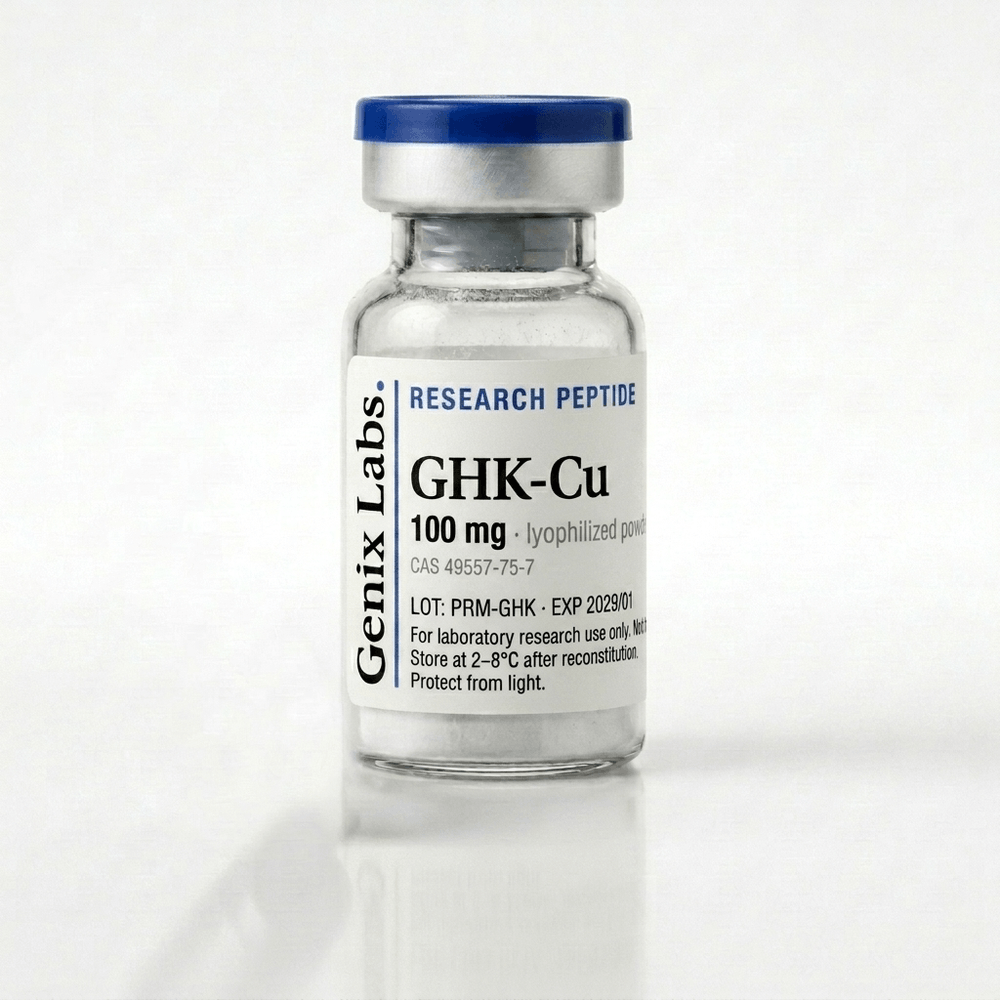
Our GHK-Cu 100 mg lot report shows HPLC area purity of 99.10 percent and LC-MS identity confirmation on lot 830472, tested to ISO 17025 standards. That tells you the vial holds what it says. It does not tell you what the vial will do, and we will not pretend otherwise.
The reason a document still matters for a benefits conversation is the stall table above. Two of the five reasons a cycle does nothing are product problems. A report removes those two from the list. That is its actual job.
Is GHK-Cu legal?
Copper peptides appear in cosmetics in most markets, and that use is ordinary. What changes the answer is the form and the claim. A cosmetic cream is regulated as a cosmetic. A research vial is supplied for laboratory use only.
GHK-Cu is not an approved medicine for any condition. Nobody should describe it as a treatment, and we do not. In Indonesia, cosmetic products go through BPOM notification, and research material sits outside that route entirely because it is not sold for personal use.
Everything Genix Labs supplies is for in-vitro laboratory research. It is not for human or veterinary use. For the wider legal picture in this region, read are peptides legal in Indonesia.
What does a tested vial cost?
Our GHK-Cu 100 mg vial is $69, or Rp 1.090.000. That price includes the per lot document trail, testing to ISO 17025 standards, cold-chain handling, same-day delivery inside Bali and cash on delivery.
Price belongs in a benefits article for one reason. The cheapest vials are cheap because something got skipped, and the skipped item is usually identity testing. Identity is the test that separates a working cycle from an expensive nothing.
Browse the lab-tested GHK-Cu copper peptide with its published lot report, or see the rest of the range in the Genix Labs catalog.
Which mistakes waste a cycle?
- Judging it at week four. Tone moves early, firmness does not. The trials ran twelve weeks for a reason.
- Stacking it with acids and retinoids daily. Most bad experiences are barrier damage, not copper.
- Expecting fold correction. Dermal actives change dips in the skin, not structure underneath it.
- Skipping sunscreen. Ultraviolet light breaks collagen down faster than any peptide builds it.
- Buying on purity alone. Purity without identity testing does not tell you what is in the vial.
- Treating gene and lung findings as skin promises. Those are dish results, not outcomes.
- Storing it badly. Heat and light degrade peptides, and a degraded vial looks exactly like a useless one.
Is it a growth factor?
It behaves like one without being one. A true growth factor is a large protein that locks onto a receptor on the cell surface. GHK-Cu is tiny by comparison, at about 401.9 daltons against tens of thousands for a real growth factor.
What it does instead is switch on the same downstream machinery. In cell work it raises production of collagen, elastin and the cushioning molecules between fibres, which is the output a growth factor would produce. It was first described in the 1970s as a liver cell growth factor for exactly that reason.
The practical consequence is size. A growth factor cream has a delivery problem it cannot solve, because the molecule is far too big to cross skin. A copper tripeptide is small enough to have a chance. That is the single biggest argument for this molecule over the growth factor serums sold beside it.
How does it differ from other peptides?
Most cosmetic peptides are signal peptides or they are muscle relaxing peptides. Copper peptides are a third category, because they carry a metal that enzymes need. That makes the comparison less like brand against brand and more like tool against tool.
| Peptide type | Example | What it does | Evidence depth |
|---|---|---|---|
| Copper carrying | GHK-Cu | Signals rebuild and delivers copper to enzymes | A handful of human cream trials |
| Signal peptide | Palmitoyl pentapeptide | Tells cells to make matrix proteins | Mostly manufacturer studies |
| Neuromuscular | Argireline type peptides | Softens expression line formation | Small, mixed |
| Repair peptides | BPC-157, TB-500 | Studied for soft tissue repair in animals | Animal and cell, not cosmetic |
| Carrier peptides, general | Various | Transport trace metals | Thin |
The repair peptide row is the one people conflate most often. Compounds like BPC-157 and TB-500 are studied for tendon and tissue repair in animals, not for facial skin in people. We cover those in the recovery and repair hub. They answer a different question entirely.
What do the before and after photos really show?
Less than they appear to. Before and after photographs are the most persuasive and least reliable evidence in this category. Four ordinary things can produce a dramatic pair with no biology involved at all.
- Lighting. Soft front light fills shadows and erases lines. Hard side light carves them in. The same face can look ten years apart in one afternoon.
- Angle and chin position. Lifting the chin a few degrees tightens the jaw and neck in the frame.
- Hydration and time of day. Skin at 8 am after sleep looks different from skin at 6 pm. Facial puffiness is a morning phenomenon.
- Everything else that changed. New sunscreen, better sleep, less alcohol, a different camera, makeup. Nobody holds those constant.
This is exactly why the twelve week cream trials matter more than any gallery. They measured skin density with instruments and they looked at biopsies. Those methods are boring and they do not care about lighting.
If you want to judge your own result properly, copy the method rather than the marketing. Same light, same time of day, same angle, no makeup, twelve weeks apart. Most people who do that find the change is real and smaller than they remembered expecting.
Does it help scars and stretch marks?
The animal wound work is the reason this question exists. Those studies reported not just faster closure but better organised collagen, which is the difference between a tidy scar and a raised one.
In people it has not been tested properly for either scars or stretch marks. A mature scar is settled tissue, and nothing applied to the surface reorganises it. A new wound is a different situation, and that is where the animal evidence sits.
So the honest grade is animal, with a sensible mechanism and no human proof. We would rather say that than repeat the stretch mark claim that circulates with no study attached to it anywhere.
Do men and women get different results?
The cream trials were run mostly in women, so the human data is weighted that way. There is no biological reason to expect the collagen signalling to work differently, because the pathway is the same in both.
Two practical differences do show up. Male facial skin is thicker on average and carries more collagen to begin with, which can mean a slower visible change. And the hair question is usually a different one, because male pattern loss is driven by hormones that a copper peptide does not touch.
That second point is worth being blunt about. If hair loss is hormonal, the evidence based options act on hormones. A copper peptide is not one of them, and our peptides for hair loss guide sets out which category does what.
Why does formulation decide the result?
Because the copper complex is fragile in the wrong company. The benefit depends on copper staying bound to the peptide. Several common cosmetic ingredients pull it apart, and a broken complex is just free copper and a short peptide.
| Formulation factor | Why it matters | What goes wrong |
|---|---|---|
| pH | The complex is stable in a narrow band | Low pH products can strip the copper |
| Strong reducing agents | They change the copper oxidation state | The complex comes apart |
| Chelators in the base | They compete for the copper | The peptide is left without its metal |
| Light and heat | Peptides degrade | A vial or jar that did nothing |
| Stated concentration | The trials used about 0.1 percent | Products that list it last in the ingredients |
Researchers have spent real effort building copper complexes that resist breaking down, which tells you how much of a problem this is. For lyophilised research material the same logic applies in a simpler form. Keep it cold, keep it dark, and treat reconstituted liquid as a short lived thing.
Our handling guidance is specific for this reason. Sealed powder stays stable cold and away from light. Once mixed, store at 2 to 8 degrees Celsius. The full method is in how to reconstitute peptides.
Are there better or complementary options?
For wrinkles and photodamage specifically, a prescription retinoid has more evidence than anything else discussed here. If the only goal is the strongest evidence base, that is the honest recommendation and it is not our product.
| Goal | Strongest evidence option | Where a copper peptide fits |
|---|---|---|
| Fewer wrinkles | Prescription retinoid | Gentler, less proven, easier to stick with |
| Brighter, more even tone | Vitamin C, niacinamide, sunscreen | Tone benefit reported, usually early |
| Firmer, denser skin | Retinoid, procedures | This is where the peptide data is strongest |
| Preventing damage | Sunscreen, every day | No substitute at all |
| Hair regrowth | Hormonal and growth phase options | Thin evidence, long timeline |
| Wound repair research | Established wound care | Where most of the animal data sits |
Notice that sunscreen is in two rows and is the only item with no alternative. In a category full of actives, the thing with the best evidence to effort ratio remains the one people skip.
How do you get research grade GHK-Cu?
Cosmetic copper peptide creams are sold everywhere, and for the human benefits on this page that is the studied form. Research material is a separate supply chain with a separate purpose, and it is supplied for laboratory work only.
What to check before buying research material is the document set, not the website. Ask for the lot specific report. Check that the lot on the report matches the vial. Confirm identity testing is included and not just a purity percentage.
We publish ours. The GHK-Cu 100 mg research vial carries lot 830472 with HPLC area purity of 99.10 percent and LC-MS identity confirmation, tested to ISO 17025 standards, cold-chain shipped, with same-day delivery and cash on delivery inside Bali.
What would move a claim up a floor?
This is the question we would want answered if we were reading someone else page. Grades are not permanent. Here is exactly what study would move each lower claim onto the human floor, so you can watch for it instead of guessing.
| Claim | Current grade | The study that would upgrade it |
|---|---|---|
| Faster wound healing | Animal | A modern controlled human wound trial with a vehicle arm |
| Thicker hair | Animal | A six month randomised trial counting hairs per square centimetre |
| Gene expression reset | Cell | Skin biopsies before and after, in people, showing the same shifts |
| DNA repair support | Cell | A measured repair endpoint in human skin, not a gene list |
| Lung repair signature | Cell | A clinical outcome, which nobody has attempted |
| Stem cell recovery | Cell | A biopsy showing a larger basal population after use |
| Whole body anti-aging | None | Any published human study of the injected route at all |
The last row is the important one. For the route that research vials exist for, the bar is not a better study. The bar is a first study. That is a remarkable thing to be able to say about a molecule discovered in 1973.
We will update this table when any of those appear. If a page you are reading never says what would change its mind, it is not reporting evidence. It is decorating a sales pitch with citations.
Frequently asked questions
Does GHK-Cu actually work?
For facial skin, applied as a cosmetic cream over about twelve weeks, yes, modestly. Trials reported firmer and denser skin, fewer fine lines and clearer tone. Everything beyond that, including the famous gene and lung findings, comes from cells in a dish rather than from people.
Can you use GHK-Cu everyday?
Daily use is exactly what the cosmetic cream trials studied, usually twice a day for twelve weeks, and it was reported as well tolerated. Those were cosmetic concentrations where the copper load is trivial. For research vials there is no published human schedule at all.
What are the negative side effects of GHK-Cu?
Topical effects are local and mild: redness, itching, stinging, dryness and occasional contact dermatitis. Most reports trace to the formula rather than the peptide. The injected route has no published human safety study. Copper also accumulates, because it leaves the body slowly through bile.
How long should you take GHK for?
Twelve weeks is the only well studied window, because that is how long the cosmetic trials ran. The eight to twelve week cycles quoted online come from community practice, not data. Nothing published tells you what happens at month twelve or year three, in either direction.
Which GHK-Cu benefits have the strongest evidence?
Four of them. Firmer and denser skin, fewer fine lines, clearer and less blotchy tone, and more new collagen seen on skin biopsy. All four come from twelve week facial cream studies at around 0.1 percent. They are real, measured and modest rather than dramatic.
Is the 31.2 percent gene claim real?
The number is real and it is misread constantly. It comes from a gene expression database using cultured cells, where GHK shifted a large share of the genes tested. It does not say the change was good, that it lasted, or that it happened in human skin.
Takeaway
The GHK-Cu benefit list is not fiction. It is a real list that has been flattened, and flattening it is what makes the topic confusing. Four claims stand on human skin trials. Firmer and denser skin. Fewer fine lines. Clearer tone. More collagen on biopsy. Those are worth taking seriously, and they are modest.
The spectacular claims all live one or more floors below. Gene expression resets, lung repair signatures, DNA maintenance and stem cell recovery are dish results. They are the reason researchers keep studying this molecule. They are not reasons to expect anything in a mirror.
Two numbers are worth carrying away. The route with the most human evidence is the cream, not the vial. And a 100 milligram vial holds about 15.8 milligrams of elemental copper, which is a metal conversation as much as a peptide one. Start at the longevity and anti-aging peptide hub for the rest of this cluster.
Genix Labs supplies all compounds strictly for in-vitro laboratory research. They are not for human or veterinary use, and nothing on this page is medical advice.