Search sermorelin and you will read the same four words on page after page. FDA approved in 1997. That is true. It is also about a third of the story. There were two approvals, not one. They were seven years apart and they did two different jobs. Both were withdrawn in 2009 because the company that owned them asked for that. Four years later FDA put on the record that the pullout had nothing to do with safety or effectiveness, which cleared the way for any firm to file a generic. Thirteen years on, nobody has. This guide works through that file line by line, then through what the human studies actually measured.
What is sermorelin?
Sermorelin is a 29 amino acid peptide. It copies the first 29 pieces of a natural hormone called growth hormone releasing hormone, or GHRH. It is the shortest fragment that still does the full job. It tells the pituitary gland to release the body's own growth hormone. It does not supply growth hormone itself.
The gland sits just under the brain. GHRH is the message the brain sends it. Sermorelin is a copy of the working end of that message. Because the signal still has to be answered by a real gland, the ceiling is whatever that gland can still produce. That single fact is why one of its two FDA approvals was for a test rather than a treatment.
- It is GHRH 1-29, the active front end of a natural brain hormone.
- It asks the pituitary to release growth hormone. It is not growth hormone.
- One approved product measured whether a pituitary could still answer.
- The other treated children who were not growing properly.
- No approved sermorelin product exists in the United States today.
The file almost nobody reads
Most pages on this peptide cite each other. The primary record is public and short. It is a Federal Register notice from 4 March 2013, filed at 78 FR 14095 under docket FDA-2012-P-1071. It runs to about two printed pages. It names both applications, both approval dates, both indications, the letters the sponsor sent, and the date the approvals ended.
We read it rather than summarising a summary. Everything in the next six sections comes from that notice or from FDA's own drug application database, which still returns the same two records and nothing else.
Why are there two FDA approvals?
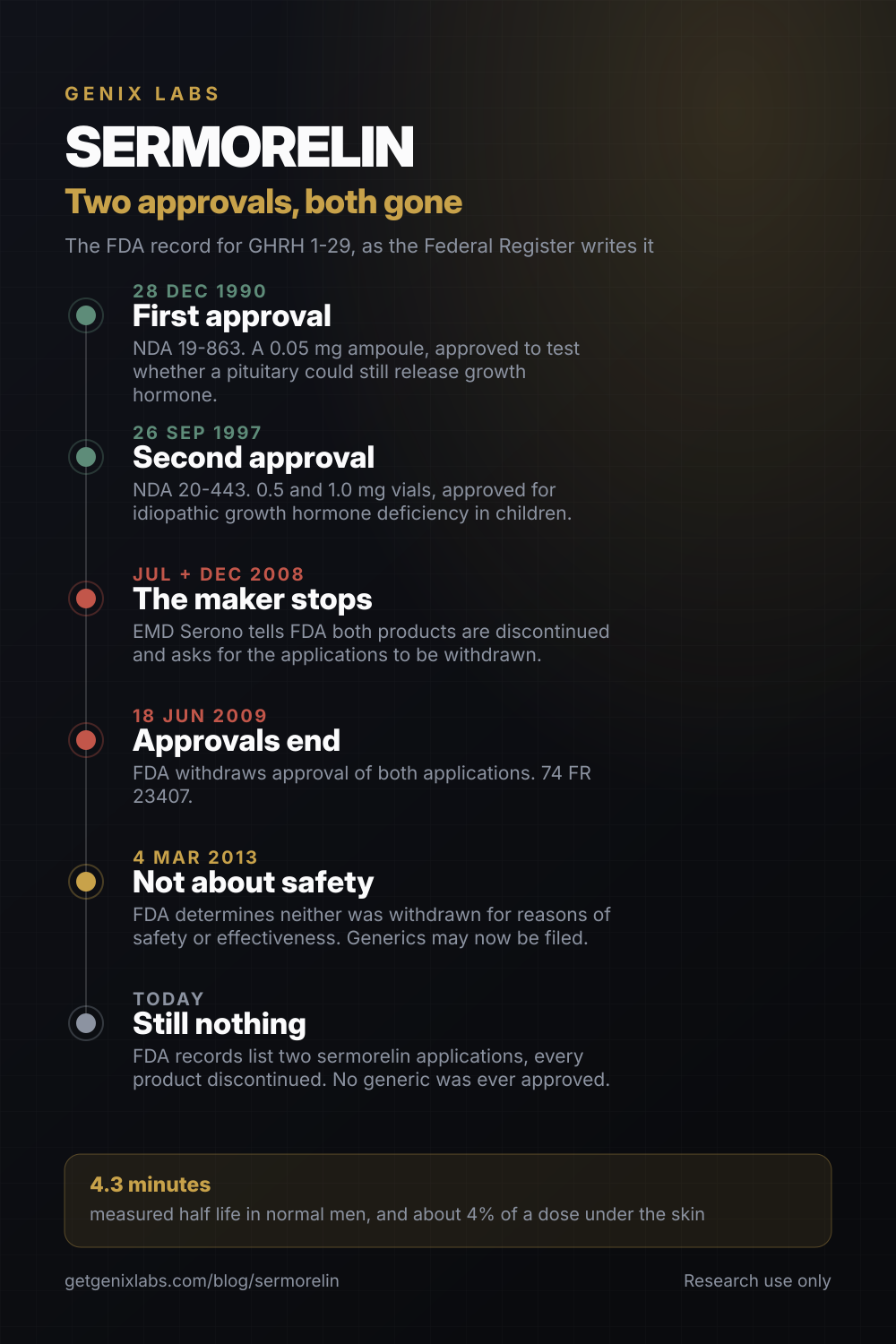
Because sermorelin was approved twice, for two different purposes. NDA 19-863 covered a 0.05 mg ampoule and was approved on 28 December 1990. NDA 20-443 covered 0.5 mg and 1.0 mg vials and was approved on 26 September 1997. Both were held by EMD Serono. The strengths differ by a factor of twenty.
That gap in strength is the clue. A tiny ampoule and a twenty times larger vial are not two sizes of the same product. They are two products. One was given once to ask a question. The other was given every night to treat a child.
The 1990 approval was a test
The 0.05 mg ampoule was approved for one job. FDA records it as indicated for evaluating the ability of the somatotroph of the pituitary gland to secrete growth hormone. The somatotroph is the cell that makes growth hormone. In plain words, the product was a probe. It asked a gland a question and the blood test read the answer.
This is the part the market skips. The first approved sermorelin product was never a therapy. It was a diagnostic. Doctors gave about 1 microgram per kilogram into a vein, then drew blood over the next hour to see how much growth hormone came out. A healthy gland answered. A failing one did not.
The 1997 approval was for children
The larger vials carried a different indication. FDA records it as the treatment of idiopathic growth hormone deficiency in children with growth failure. Idiopathic means the cause was never found. Growth failure means the child was not growing at a normal rate. That is the entire approved treatment population.
No adult indication was ever approved. Not for body composition. Not for sleep. Not for recovery, energy or ageing. When a clinic page says sermorelin is FDA approved and then lists adult benefits, the approval it is borrowing belonged to prepubertal children who were short for their age.
Why was sermorelin discontinued?
The company stopped making it and asked FDA to cancel the paperwork. EMD Serono wrote to FDA on 11 July 2008 about the ampoule and on 2 December 2008 about the vials, saying both were being discontinued. A further letter on 12 December 2008 asked for the ampoule application to be withdrawn. FDA announced the withdrawal of both in the Federal Register of 19 May 2009, effective 18 June 2009.
So the end was administrative, not scientific. A sponsor decided two small products were not worth keeping on the shelf. The vials had been on the market for about eleven years. The ampoule had been there for about eighteen.
Was it pulled for safety?
No. FDA looked at that question directly and said no on the record. In the 2013 notice the agency wrote that it had reviewed its files on the withdrawal, independently evaluated the literature, and looked for possible postmarketing adverse events for both products. Its conclusion was that neither was withdrawn from sale for reasons of safety or effectiveness.
That matters in both directions. It means nobody should claim sermorelin was banned for hurting people. It also means nobody should claim the 2013 finding is a fresh endorsement. FDA was answering a narrow procedural question. It was not re-approving anything.
The door FDA opened in 2013
The 2013 determination had a practical purpose. Under FDA rules a generic application has to point at an approved listed drug. If the agency decides a listed drug left the market for safety or effectiveness reasons, that reference is taken away. The determination kept the reference alive for both Geref products.
FDA said so plainly. Generic applications referring to the two products may be approved as long as they meet all other legal and regulatory requirements. The route was open. A company could have brought an approved sermorelin back. The petition that triggered the finding was filed on 12 October 2012 by a private petitioner, not by FDA and not by a drug maker.
Thirteen years, no filing
Nothing came through the door. We queried FDA's drug application database while writing this guide. It returns exactly two sermorelin records, NDA 19-863 and NDA 20-443, both held by EMD Serono, and every product under them is marked discontinued. There is no approved generic. There is no new brand.
That silence is informative. A generic filing is cheap next to a new drug application. The reference drug was available, the chemistry is a 29 residue peptide, and the regulatory path was explicitly cleared. Thirteen years of no filings suggests nobody saw a market worth the fee, which is a commercial judgement, not a scientific one.
The whole record, dated
| Date | What happened | Source |
|---|---|---|
| 28 December 1990 | NDA 19-863 approved. 0.05 mg base per ampoule. Indicated for evaluating pituitary growth hormone secretion. | 78 FR 14095 |
| 26 September 1997 | NDA 20-443 approved. 0.5 and 1.0 mg base per vial. Indicated for idiopathic growth hormone deficiency in children with growth failure. | 78 FR 14095 |
| 11 July 2008 | EMD Serono notifies FDA the 0.05 mg ampoule is being discontinued. | 78 FR 14095 |
| 2 December 2008 | EMD Serono notifies FDA the vials are being discontinued and requests withdrawal of NDA 20-443. | 78 FR 14095 |
| 12 December 2008 | EMD Serono requests withdrawal of NDA 19-863. | 78 FR 14095 |
| 19 May 2009 | FDA announces withdrawal of both approvals, effective 18 June 2009. | 74 FR 23407 |
| 12 October 2012 | Citizen petition filed asking FDA to determine the reason for the withdrawal. | Docket FDA-2012-P-1071 |
| 4 March 2013 | FDA determines neither product was withdrawn for reasons of safety or effectiveness. Generic applications may be approved. | 78 FR 14095 |
| December 2017 | Macimorelin, an oral agent, is approved for diagnosing adult growth hormone deficiency. | FDA approval record |
| Today | FDA records list two sermorelin applications, all products discontinued. No approved generic. | Drugs@FDA |
Is sermorelin FDA approved?
Not today. Two sermorelin products were approved, in December 1990 and September 1997, both held by EMD Serono. FDA withdrew both approvals effective 18 June 2009 after the company asked it to. FDA's own drug database still lists no approved sermorelin product anywhere.
The honest phrasing is past tense. Sermorelin held FDA approvals. It does not hold one now. Any page that writes is FDA approved in the present tense about sermorelin is wrong, whatever it says next.
Is compounded sermorelin approved?
No. Compounding and approval are different things. An approved drug has been reviewed by FDA for safety, effectiveness and manufacturing. A compounded preparation has not. Compounding operates under separate sections of the law that let pharmacies prepare medicines that are not approved products.
So compounded sermorelin is not an FDA approved drug, and the 2013 determination did not make it one. That determination was about generic applications, which are a different route with a full review at the end of it. Nobody has taken that route.
Where it sits on the FDA lists
FDA keeps lists of bulk substances that have been put forward for use in compounding. There are two, one for traditional pharmacies under section 503A and one for outsourcing facilities under section 503B. Each has three categories. Sermorelin sits in a strange spot across the two.
On the 503A list, which FDA updated on 14 May 2026, sermorelin does not appear at all. Not in category 1, not in category 2, not in category 3. On the 503B list, updated 21 March 2025, Sermorelin Acetate is in category 1, the group under evaluation, and it carries FDA's footnote marking substances that are components of approved drugs. That footnote exists because of Geref.
The class, listed line by line
Reading one peptide's listing in isolation tells you little. Here is where the whole growth hormone secretagogue family sits, taken from the two current FDA list documents rather than from vendor summaries.
| Substance | 503A list, 14 May 2026 | 503B list, 21 Mar 2025 |
|---|---|---|
| Sermorelin acetate | Not listed in any category | Category 1, under evaluation, flagged as a component of an approved drug |
| Ipamorelin acetate | Not listed in any category | Category 2, significant safety risks |
| Ibutamoren mesylate | Category 2, significant safety risks | Category 2, significant safety risks |
| GHRP-2 | Category 3, nominated without adequate support | Category 2, for injectable and nasal routes |
| GHRP-6 | Category 3, nominated without adequate support | Category 2, significant safety risks |
| Vasoactive intestinal peptide | Category 1, under evaluation | Not in category 1 |
Three things fall out of that table. Sermorelin is the only member of the family that FDA marks as a component of an approved drug. It is also the only one with no 503A listing at all. And ipamorelin, whose claims we graded separately, sits in the category FDA uses for significant safety risks. These are not the same regulatory position, and they are routinely sold as though they were.
How does sermorelin work?
Sermorelin binds a receptor on the pituitary gland called the GHRH receptor. That binding tells the cell to release stored growth hormone and to make more. The growth hormone then travels to the liver and other tissues, where it raises a second messenger called IGF-1. Most of what growth hormone does, it does through IGF-1.
One brake stays in place. A second hormone called somatostatin opposes GHRH. When growth hormone and IGF-1 rise, somatostatin rises too and quietens the gland. That brake is why this class produces bursts rather than a flat high level, and why it cannot simply be pushed higher without limit.
What the GHRH receptor does
The receptor only sits on one kind of pituitary cell, the somatotroph. That is the cell that makes growth hormone and nothing else. The cells that make luteinising hormone, thyroid stimulating hormone and prolactin are different cells with different receptors.
This has a practical consequence that gets ignored. A GHRH analogue has no direct route to testosterone, thyroid or prolactin. The FDA label for tesamorelin, the one approved analogue in this family, says exactly that. No clinically significant changes in other pituitary hormones, including thyroid stimulating hormone, luteinising hormone, adrenocorticotropic hormone and prolactin, were seen in its trials.
Why the pulses matter
Growth hormone is not released steadily. It comes in pulses, mostly at night, with the largest burst soon after deep sleep begins. A releasing hormone works with that rhythm because it pushes the gland and then lets the brake answer. Injected growth hormone does not. It arrives as a flat dose.
That is the strongest honest argument for this class, and it is a mechanism argument rather than an outcome argument. Preserving a rhythm is not the same as producing a result. The result has to be measured separately, which brings us to the pharmacokinetics and then to the trials.
How long does sermorelin last?
Minutes. In 10 normal men given a constant infusion into a vein, GHRH 1-29 amide disappeared with a half time of 4.3 minutes, give or take 1.4. Its metabolic clearance rate was 39.7 mL per kilogram per minute. A modified version with one swapped residue lasted 6.7 minutes in the same men, which is what the swap was for.
Clinic pages often quote ten to twelve minutes. That figure traces back to animal work from 1985, where the elimination phase in anaesthetised rats measured 10.4 minutes. The human number, measured in humans, is lower. Both are short. Neither supports a once weekly story.
The 5 percent problem
Half life is only half the question. The other half is how much of an injection under the skin ever reaches the blood. For this molecule the answer is small. In the 1985 rat work, total circulating peptide after a subcutaneous dose came to about 4 percent of what the same dose gave intravenously. The authors concluded a large amount was broken down at the injection site or on the way.
It would be easy to dismiss that as a rat finding. It is not. The FDA label for tesamorelin puts absolute subcutaneous bioavailability in healthy adults at less than 4 percent. Same family, human data, written on an approved label. The number holds.
The pharmacokinetics, measured
| Measure | Value | Where it was measured |
|---|---|---|
| Chain length | 29 amino acids, C terminal amide | GHRH 1-29, the shortest fully active fragment |
| Half time, intravenous | 4.3 minutes, plus or minus 1.4 | 10 normal men, constant infusion, Soule 1994 |
| Metabolic clearance rate | 39.7 mL per kg per minute, plus or minus 3.9 | Same study |
| Half life, animal elimination phase | 10.4 minutes, plus or minus 0.2 | Anaesthetised rats, Rafferty 1985 |
| Subcutaneous exposure | About 4 percent of the intravenous area under the curve | Same rat study |
| Diagnostic dose studied | About 1 microgram per kilogram intravenously | Prakash and Goa 1999 review |
| Treatment regimen studied | 30 micrograms per kilogram subcutaneously at bedtime, once daily | Prakash and Goa 1999 review |
Every row above is a measurement from a named source. None of them is a dose instruction. Genix Labs supplies research compounds for laboratory work only, so the numbers are here as study design, not as guidance for any person.
Does sermorelin work?
It depends entirely on which question you mean. As a test of pituitary capacity it worked well enough to hold an approval for eighteen years. As a treatment for short children it raised growth rates in studies that ran a year. As an adult anti-ageing or body composition treatment, there is no trial to point at. That third use is the one being sold.
Keeping those three apart is the whole discipline of reading this peptide. A clinic page that cites the pediatric result to sell an adult outcome has moved a finding to a population it was never measured in.
What the children's studies found
The standing review is Prakash and Goa, published in BioDrugs in 1999. It describes once daily subcutaneous sermorelin at 30 micrograms per kilogram at bedtime as effective in treating some prepubertal children with idiopathic growth hormone deficiency. Significant increases in height velocity were sustained across 12 months. A few children appeared to hold the effect for 36 months.
Read the hedges, because they are in the original. Limited data. Some children. A few children. That is a careful reviewer describing a modest evidence base for an approved indication, not a blockbuster.
The sharpest single dataset is Kirk and colleagues, in Clinical Endocrinology in 1994. Eighteen short prepubertal children received 20 micrograms per kilogram twice daily under the skin for a year. Mean height velocity rose from 4.8 cm per year before treatment to 7.2 cm per year at 12 months. Predicted final height rose by a mean of 3.4 cm.
The response that faded
The Kirk paper reports something else that almost never gets quoted. While height velocity was climbing, overnight growth hormone levels fell. So did the growth hormone response to a GHRH test. Both went down across the same 12 months of treatment. The gland answered the peptide less loudly at the end of the year than at the start.
This is the single most useful finding in the sermorelin literature for anyone thinking about long runs, and it cuts against the marketing directly. Clinic pages describe a three to six month loading period after which results build. The only year long dataset shows the measured response to the peptide moving the other way.
Be careful about what this does and does not prove. The children kept growing. The clinical outcome held while the hormonal response softened, which can happen for several reasons, including the normal fall in GHRH sensitivity as a child's own axis matures. It is a signal to design around, not a verdict. But it belongs in the discussion, and it is missing from almost every page that sells this compound.
What was studied in adults?
Adults appear in the sermorelin record mainly as test subjects, not as treatment subjects. The pharmacokinetic work was done in normal men. The diagnostic combination of intravenous sermorelin with arginine was studied in adults and found to be more specific than sermorelin alone. That is diagnosis, not therapy.
For the adult therapy question, the closest real evidence comes from a longer acting cousin. A polyethylene glycol conjugated GHRH was given to 12 young healthy men and 20 men and women over 60. Growth hormone rose against placebo and IGF-1 rose with treatment. The study existed because, in the authors' own words, the clinical use of GHRH is limited by its short half life.
That paper also recorded something worth keeping. With repeated dosing in the older group, some impairment of glucose tolerance was seen. Growth hormone opposes insulin, so that direction is expected, and it is the signal a careful research protocol watches.
The stimulation test it was built for
The diagnostic use is where sermorelin was characterised properly in humans. About 1 microgram per kilogram went into a vein, then blood was sampled over the following hour. Prakash and Goa call the response a rapid and relatively specific test for growth hormone deficiency, with fewer false positives in children without the condition than other provocative tests gave.
It had one structural limit, and the reviewers state it clearly. A normal response cannot rule out growth hormone deficiency caused by a problem higher up, in the hypothalamus. If the brain is the part that fails, the gland can still answer a direct GHRH signal perfectly. You need a different test to catch that case.
The trial that lost its comparator
Here is the clearest evidence that the withdrawal had real consequences. In 2013 a multicentre team published the validation study for macimorelin, an oral agent for diagnosing adult growth hormone deficiency. The design compared it against the arginine plus GHRH test. The GHRH arm used Geref Diagnostic.
Partway through, the paper reports, after 43 patients and 10 controls had been tested, Geref Diagnostic became unavailable in the United States. The investigators finished the study with macimorelin alone, testing 10 further patients and 38 further controls. A published clinical trial had to be rebuilt mid flight because its comparator disappeared off the market.
Macimorelin went on to be approved in December 2017 for exactly the job sermorelin's ampoule used to do. So the diagnostic role did not vanish. It was taken over by a different molecule that someone was willing to file for.
What is sermorelin used for?
In its approved life it was used for two things. One vial size tested whether a pituitary could still release growth hormone. The other treated children with idiopathic growth hormone deficiency and growth failure. Adult anti-aging, muscle and fat loss uses come from clinics, not from the approved labels.
In the research market today it is bought as a reference GHRH agonist. That is a reasonable laboratory use. It is the original fragment, it is well characterised, and it is the molecule the stimulation test literature was built on. None of that is a human use claim.
Does sermorelin build muscle?
No controlled trial shows that in adults. The approved pediatric indication was growth failure, measured as height velocity, not muscle mass. No sermorelin study reports lean mass as an outcome in healthy adults. The claim travels by inference from growth hormone, which is a different molecule given a different way.
If muscle is the question, the honest answer is that this compound has not been tested for it. Our separate guide on peptides studied for muscle growth sorts what has been measured from what has not across the whole category.
Does it help with weight loss?
Nothing in the sermorelin record addresses weight. The closest label grade evidence in this family actually argues the other way. The FDA label for tesamorelin states it is not indicated for weight loss management because it has a weight neutral effect. It reduced visceral abdominal fat without moving the scale.
That distinction is worth holding onto, because it is the one the whole class lives in. Waist and weight are not the same measurement. A compound can change where fat sits without changing how much a person weighs. If the question is scale weight, this is the wrong family, and the GLP-1 side of our pillar is where that evidence lives.
Does it increase testosterone?
No study reports that. Testosterone is driven by luteinising hormone, which comes from a different pituitary cell with a different receptor. Sermorelin acts only on the growth hormone cell. The FDA label for the one approved analogue in this class records no clinically significant change in luteinising hormone across its trials.
Does sermorelin improve sleep?
No sermorelin trial measured sleep as an outcome. The association runs the other way around. Deep sleep triggers the largest natural growth hormone pulse, which is why the studied regimen was given at bedtime. That is sleep driving hormone, not a peptide proven to drive sleep.
Our round-up of peptides studied in relation to sleep keeps the same rule: the claim has to come from a study that actually measured sleep.
Can sermorelin make you taller?
Only in a growing skeleton. Height comes from growth plates at the ends of long bones. Those plates close after puberty, and once they are closed no hormone reopens them. That is why the approved treatment indication named prepubertal children with growth failure, and why the Kirk study enrolled children aged 4 to 11.
Is sermorelin the same as HGH?
No. Growth hormone is the hormone itself, injected directly. Sermorelin is a 29 amino acid fragment of the hormone that tells the pituitary to release its own. The ceiling is whatever that pituitary can still make, which is why the approved test used it to measure exactly that.
| Sermorelin | Growth hormone, somatropin | |
|---|---|---|
| What it is | A 29 residue fragment of GHRH, a releasing signal | The 191 residue hormone itself |
| What it does | Asks the pituitary to release its own store | Supplies the hormone directly |
| Natural brake | Somatostatin still answers, so output stays pulsed | No brake, the dose is the level |
| Ceiling | Whatever that gland can still produce | Whatever is injected |
| Current US approval | None, both approvals withdrawn in 2009 | Several approved somatropin products |
Is sermorelin a steroid?
No. Steroids are built on a four ring carbon skeleton made from cholesterol. Testosterone is one. Sermorelin is a peptide, which is a short chain of amino acids. They are different classes of molecule with different receptors and different routes through the body. The two are not interchangeable in any sense.
Sermorelin against ipamorelin
They work through different receptors. Sermorelin hits the GHRH receptor, copying the brain's own releasing signal. Ipamorelin hits the ghrelin receptor, copying a hunger hormone instead. Both end up asking for growth hormone, but they knock on different doors, which is why they are often paired rather than compared.
The regulatory gap between them is larger than the mechanical one. Sermorelin held two FDA approvals. Ipamorelin never held one, and it currently sits in FDA's 503B category 2, the group flagged for significant safety risks. We graded every ipamorelin claim against what was measured in its own guide.
Sermorelin against CJC-1295
Same receptor, opposite half life. CJC-1295 with its drug affinity complex grips albumin in the blood and lasts about 6 to 8 days. Sermorelin lasts about 4 minutes. One asks the gland a question and leaves. The other keeps asking for a week.
There is a naming trap on that side of the comparison too. Much of what is sold as CJC-1295 is a different molecule about 279 daltons lighter, cleared in hours rather than days, and the multi-day human results belong only to the heavier one. We set out the two molecules sold under the CJC-1295 name separately.
Sermorelin against tesamorelin
This is the comparison that settles the most. Both are GHRH analogues. Both clear in minutes. Both have subcutaneous bioavailability around or below 4 percent. The difference is not chemistry. It is that one of them finished its adult trials and holds a current FDA approval, and the other does not.
Tesamorelin is approved for the reduction of excess abdominal fat in HIV infected adults with lipodystrophy. Its label is explicit that long term cardiovascular safety has not been established and that it is not indicated for weight loss. That is what a finished adult evidence base looks like, including the limits. Sermorelin has no adult equivalent at all.
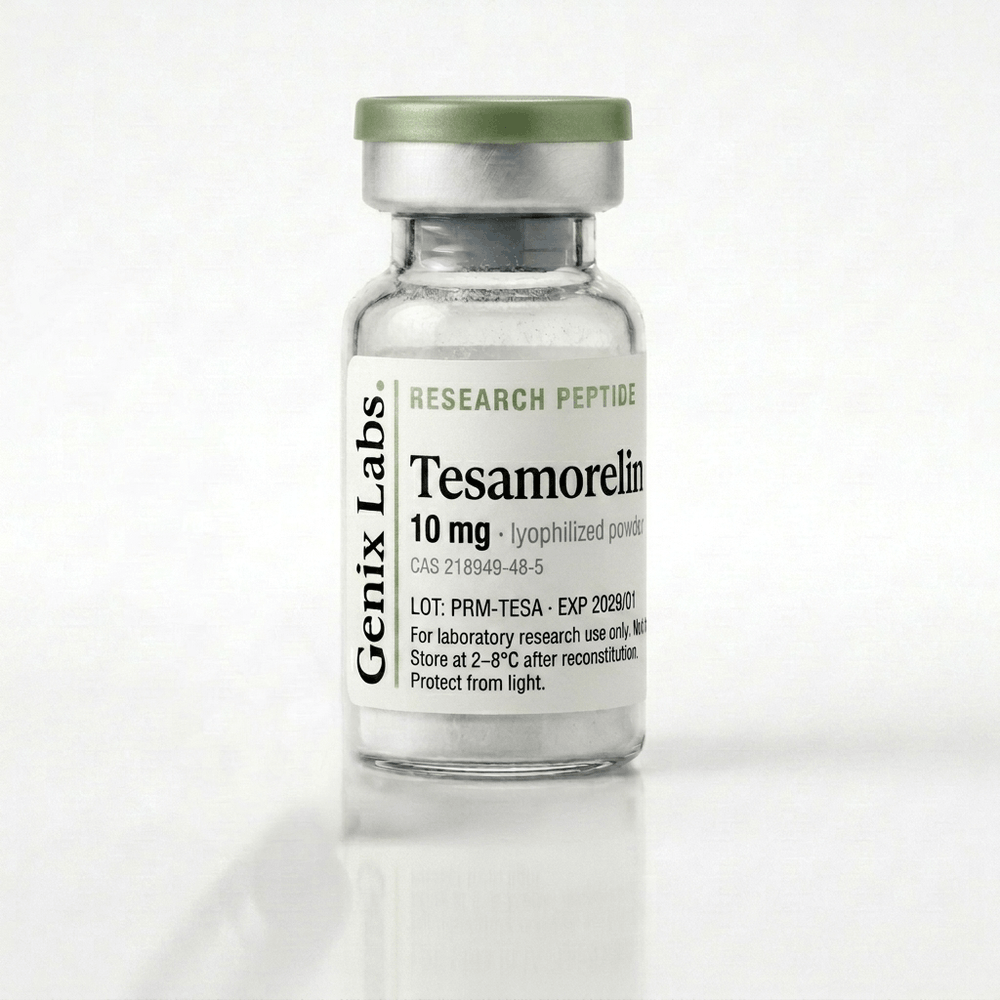
It is also the growth hormone axis compound we actually stock. Our tesamorelin research vial is a 10 mg presentation at $149, or IDR 2.450.000, supplied for laboratory research only. The deeper comparison sits in tesamorelin against sermorelin.
The GH peptides compared
| Compound | Receptor | Measured half life | Current FDA approval |
|---|---|---|---|
| Sermorelin, GHRH 1-29 | GHRH receptor | 4.3 min, intravenous, in men | None. Two approvals withdrawn 2009 |
| Tesamorelin | GHRH receptor | 8 min, subcutaneous, per label | Yes, for excess abdominal fat in HIV lipodystrophy |
| CJC-1295 with DAC | GHRH receptor | 5.8 to 8.1 days | None |
| CJC-1295 no DAC, modified GRF 1-29 | GHRH receptor | Minutes to hours | None |
| Ipamorelin | Ghrelin receptor | About 2 hours reported | None |
| Macimorelin | Ghrelin receptor | Oral, per label | Yes, for diagnosing adult GH deficiency |
What side effects were recorded?
The commonly recorded ones are local: pain, redness or swelling where the needle went in. Flushing, headache and dizziness were reported less often. In repeated dosing of a long acting GHRH in older adults, some impairment of glucose tolerance was measured, which is the signal worth watching in research.
For the class as a whole, the approved label is the better guide, because it carries findings from completed trials rather than from clinic experience. The tesamorelin label lists elevated IGF-1, fluid retention including swelling, joint pain and carpal tunnel syndrome, glucose intolerance, hypersensitivity reactions, and a caution about neoplasms.
- Local injection site reactions were the most frequently recorded effects for sermorelin itself.
- Flushing, headache and dizziness appear as less common effects.
- Impaired glucose tolerance was measured with repeated dosing of a long acting GHRH in older adults.
- The approved analogue's label adds fluid retention, joint pain, carpal tunnel and raised IGF-1.
- That label also carries a neoplasm caution, because growth hormone is a growth factor.
The glucose signal
Growth hormone opposes insulin. Push growth hormone up for long enough and blood sugar handling can get worse. This is not a fringe worry. It showed up in the repeated dosing arm of the long acting GHRH study in older adults, and the approved label in this family carries glucose intolerance as a named precaution with an instruction to check glucose before and during use.
For laboratory work, that makes glucose and insulin sensible measures to design into a protocol alongside IGF-1. A study that only reads IGF-1 will miss the counter effect that the completed human trials in this class found.
Does sermorelin cause cancer?
No sermorelin study shows that, and no regulator has said so. FDA looked for postmarketing adverse events on both Geref products in 2013 and concluded neither was withdrawn for safety reasons. What does exist is a mechanistic caution about the pathway, not a finding about this molecule.
The caution is on the approved label of the analogue. Growth hormone is a known growth factor, and raising IGF-1 for long periods has unknown effects, so the label advises against use in active malignancy and tells prescribers to monitor IGF-1. That is a careful warning about a pathway. It is not evidence that sermorelin causes cancer.
How long does it take to work?
Growth hormone moves within minutes. The visible outcome took far longer: in the one twelve month study, height velocity in short children rose from 4.8 to 7.2 cm per year over a year of twice daily injections. Nothing in the record supports a fast adult body composition result.
So two different clocks run at once. The hormone clock is minutes, and the stimulation test reads it inside an hour. The outcome clock in the only sustained dataset was months to a year. Pages promising a few weeks are quoting neither.
How would you know it is working?
In the published work, by measuring. The diagnostic protocol read serum growth hormone over the hour after a dose. The treatment studies read height velocity over months, with overnight growth hormone profiles and repeat GHRH tests alongside. IGF-1 is the standard downstream marker, and the approved label in this class says to monitor it.
Feelings were not an endpoint in any of it. Sleep quality, energy and recovery are what clinic pages offer as proof, and none of them appears as a measured outcome in the sermorelin literature.
What doses were studied?
Two regimens appear in the record. About 1 microgram per kilogram intravenously was the diagnostic dose. About 30 micrograms per kilogram subcutaneously at bedtime, once daily, was the treatment regimen described in the review, and the Kirk study used 20 micrograms per kilogram twice daily for a year.
Why was it given at night?
To ride the natural pulse. The largest growth hormone burst of the day comes shortly after deep sleep begins. A bedtime dose of a releasing peptide lands with that rhythm instead of against it. The approved pediatric regimen in the review was once daily at bedtime for that reason.
Can sermorelin be taken orally?
Not usefully as the molecule itself. A 29 residue peptide is digested in the gut like any other protein. Even under the skin, where nothing digests it, only around 4 percent reached the blood in the measured work. Swallowing it leaves far less than that.
An oral route does exist in this area, which is the instructive part. Macimorelin is taken by mouth and was approved in 2017 for the diagnostic job. It is a different molecule built for oral use, not sermorelin in a different wrapper.
Handling and storage
Sermorelin is supplied as a freeze dried powder. Sealed and cold, lyophilised peptides are stable for long periods. Once liquid, they are far more fragile. Heat, light and repeated freeze thaw cycles all degrade a peptide, and a degraded peptide gives a result that belongs to whatever it became.
Our standing guides cover the mechanics: how to reconstitute peptides and what bacteriostatic water is for. Every Genix shipment leaves cold packed and tracked, same day from Bali when ordered before 9 PM, with cash on delivery available on the island.
Is it banned in sport?
Yes. Growth hormone releasing factors and their analogues sit on the World Anti-Doping Agency prohibited list, in and out of competition. Sermorelin is covered as a GHRH analogue. The ban applies regardless of whether a product is approved, compounded or sold for research.
Is sermorelin legal?
It is not a controlled substance, and that is a different question from whether it may be sold for human use. There is no approved sermorelin drug in the United States, so no lawful marketed product exists for treating anyone. Research supply sits in a separate lane: the material is sold for laboratory use only, not for people or animals.
Rules differ by country, and Indonesia is stricter than most on importing anything presented as a medicine. Our guide on whether peptides are legal in Indonesia sets out how research supply works here.
Why identity matters on this one
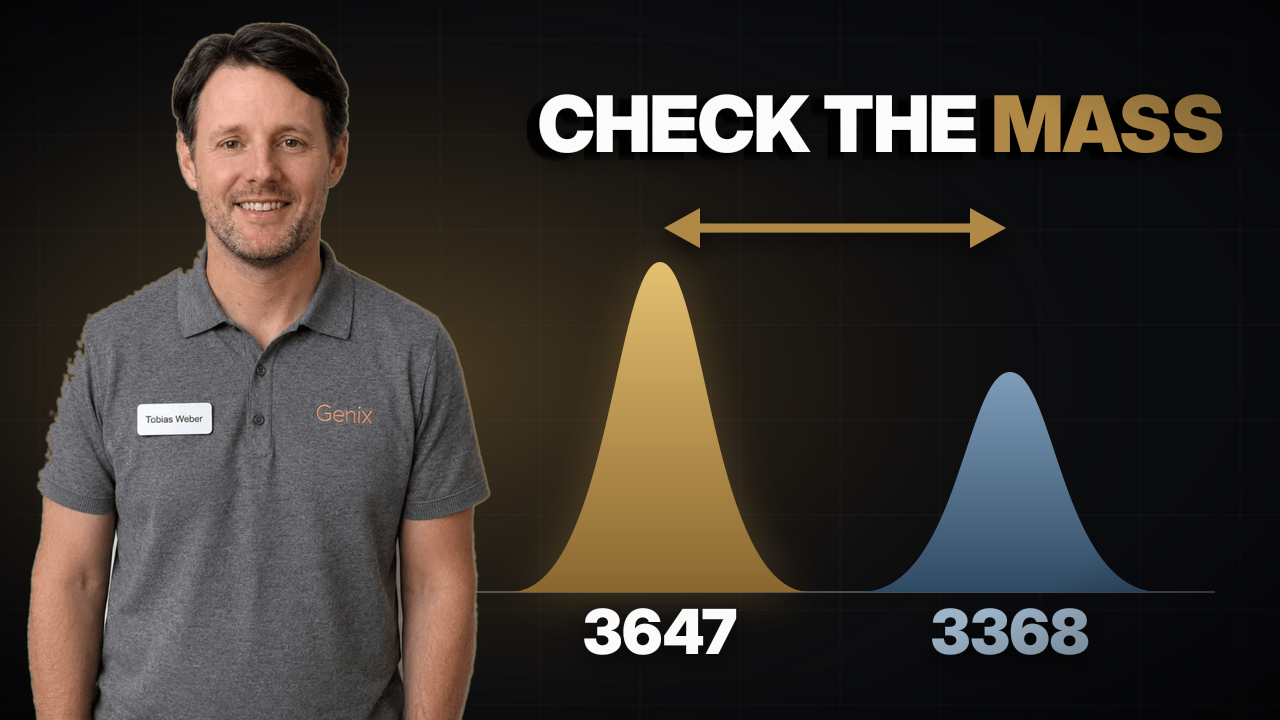
Sermorelin sits in a family of near neighbours. GHRH 1-29, the D-Ala2 modified version, modified GRF 1-29 and CJC-1295 with its drug affinity complex are all built on the same front end. Some differ by a single swapped residue. A purity number cannot tell them apart, because a sample can be 99 percent pure and still be the wrong peptide.
Only a mass check settles it. Mass spectrometry reads the molecular weight and compares it to the expected value, which is how a one residue swap becomes visible. Every Genix lot ships with HPLC area purity at or above 99 percent on tested lots plus LC-MS identity confirmation, run in an ISO 17025 accredited laboratory. Our tesamorelin lot 447106 report is published at HPLC area purity 98.20 percent with the observed mass printed, and that result applies to that lot only.
What to ask before sourcing
- Which molecule is it, exactly? GHRH 1-29 and its modified cousins are different compounds.
- Is there an observed mass on the report, not only a purity percentage?
- Does the lot number on the certificate match the lot printed on the vial?
- Who ran the test, and is that laboratory accredited?
- Is the claim being made about an approved product? For sermorelin, no approved product exists.
- Does the seller present it as research material, or as something for a person?
The background on reading these documents sits in peptides 101, and the catalog carries the GHRH analogue we stock with its published lot report.
Which peptide for which question?
| Research question | Where the evidence actually is | Why |
|---|---|---|
| Can this pituitary still release growth hormone? | Sermorelin, GHRH 1-29 | This was its approved job for eighteen years, with the best false positive record among provocative tests |
| Does a GHRH analogue reduce visceral fat in adults? | Tesamorelin | It finished adult phase 3 trials and holds the approval for excess abdominal fat in HIV lipodystrophy |
| What does a week long GHRH signal do? | CJC-1295 with DAC | It is the only member with multi-day human pharmacodynamic data |
| Does a ghrelin receptor agonist raise growth hormone selectively? | Ipamorelin | Different receptor, though it now sits in FDA 503B category 2 |
| Can scale weight be moved? | The GLP-1 family, not this one | The approved GHRH analogue label states a weight neutral effect |
For the wider map of this pillar, the hub page collects every guide in the set: weight and metabolism peptides.
Frequently asked questions
What is sermorelin used for?
In its approved life it was used for two things. One vial size tested whether a pituitary could still release growth hormone. The other treated children with idiopathic growth hormone deficiency and growth failure. Adult anti-aging, muscle and fat loss uses come from clinics, not from the approved labels.
Is sermorelin FDA approved?
Not today. Two sermorelin products were approved, in December 1990 and September 1997, both held by EMD Serono. FDA withdrew both approvals effective 18 June 2009 after the company asked it to. FDA's own drug database still lists no approved sermorelin product anywhere.
Why was sermorelin discontinued?
The maker discontinued it. EMD Serono told FDA in letters dated July and December 2008 that both Geref products were being discontinued, and asked for the applications to be withdrawn. In 2013 FDA ruled on the record that neither product was withdrawn for reasons of safety or effectiveness.
Is sermorelin the same as HGH?
No. Growth hormone is the hormone itself, injected directly. Sermorelin is a 29 amino acid fragment of the hormone that tells the pituitary to release its own. The ceiling is whatever that pituitary can still make, which is why the approved test used it to measure exactly that.
What are the side effects of sermorelin?
The commonly recorded ones are local: pain, redness or swelling where the needle went in. Flushing, headache and dizziness were reported less often. In repeated dosing of a long acting GHRH in older adults, some impairment of glucose tolerance was measured, which is the signal worth watching in research.
How long does sermorelin take to work?
Growth hormone moves within minutes. The visible outcome took far longer: in the one twelve month study, height velocity in short children rose from 4.8 to 7.2 cm per year over a year of twice daily injections. Nothing in the record supports a fast adult body composition result.
Takeaway
Sermorelin is the only growth hormone peptide on the research market with a complete FDA file, and the file says something quieter than the marketing. Two approvals, one for a test and one for children. A withdrawal the maker asked for. A determination that the withdrawal was never about safety. An open route to a generic that nobody walked down in thirteen years.
The pharmacology is equally plain. It clears in about four minutes, and roughly four percent of a subcutaneous dose reaches the blood. That did not stop the one analogue in this family that finished its adult trials, which is the real lesson: pharmacokinetics do not decide the question, trials do. Sermorelin has the trials for diagnosis and for children, and none for adults.
For a GHRH analogue with a finished adult evidence base, the compound to read about is tesamorelin, the GHRH analogue we supply for research, at $149 for a 10 mg vial with a published lot report. Everything Genix Labs sells is supplied strictly for in vitro laboratory research. It is not for human or veterinary use, and nothing here is medical advice.