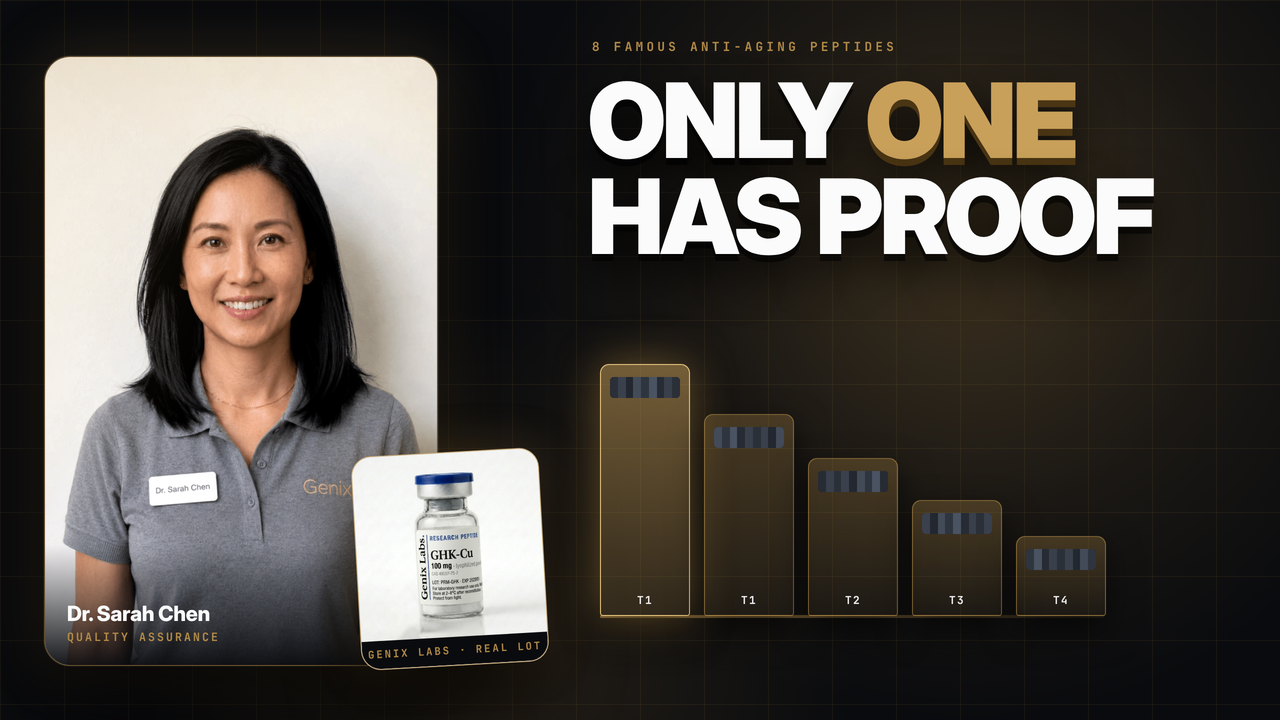
Search this phrase and you get a page of listicles that mostly agree. They rank the same six or seven peptides, in roughly the same order, with the same adjectives. What none of them does is tell you which rankings rest on a human trial and which rest on a pathway diagram. That gap is the whole article below.
What are the best peptides for anti aging?
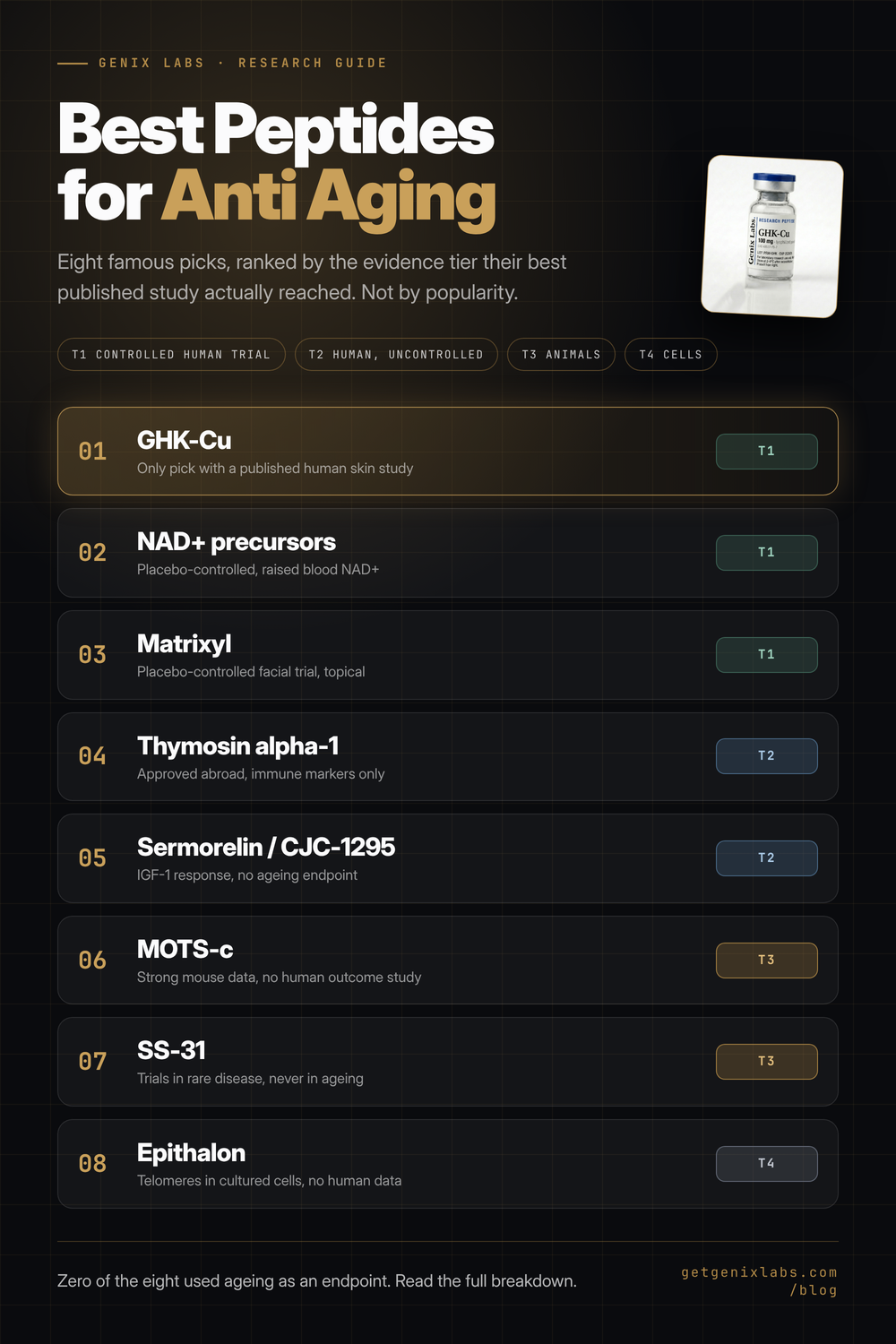
Graded by published evidence, GHK-Cu leads, because it is the only peptide here with a human skin study. NAD+ precursors come second, with placebo-controlled trials that raised blood NAD+ but measured no ageing outcome. MOTS-c, Epithalon, SS-31 and the growth hormone peptides sit lower. Their support is animal and cell work.
- One pick has a human skin trial. One has human blood-level trials. The rest do not have either.
- Nothing on this list has been shown to extend human lifespan or reverse ageing.
- The most-quoted longevity number in this category was measured on a gland extract, not a peptide.
- Mechanism is not evidence. It is a reason to run a study, not a result.
How do you grade the evidence?
With five rungs, and nothing else. A claim sits on the highest rung its best published study reached. That is the whole method. It is boring, it is reproducible, and it moves three famous picks down several places.
Two words do a lot of work here. A controlled study has a group that got nothing, so you can tell the compound from the calendar. An endpoint is the thing that was measured. If the endpoint was blood chemistry, the study tells you about blood chemistry. It does not tell you about wrinkles, energy or lifespan.
Which picks rank highest?
Here is the full field, in evidence order. The tier column is the ladder above. The last column is the honest one, because it says what the best study actually measured, not what the compound is sold for.
| Rank | Peptide | Tier | Best human data | What was measured |
|---|---|---|---|---|
| 1 | GHK-Cu (copper tripeptide) | T1 | Topical, laser-resurfaced skin, 2006 | Skin appearance and healing |
| 2 | NAD+ and its precursors | T1 | Placebo-controlled, older adults, 2018 | Whole blood NAD+ level |
| 3 | Matrixyl (palmitoyl pentapeptide-4) | T1 | Placebo-controlled facial trial, 2005 | Wrinkle depth, photo grading |
| 4 | Thymosin alpha-1 | T2 | Approved abroad for immune use | Immune markers, not ageing |
| 5 | Sermorelin and CJC-1295 | T2 | Human growth hormone response | IGF-1 and body composition |
| 6 | MOTS-c | T3 | None measuring an outcome | Mouse metabolism, human blood levels |
| 7 | SS-31 (elamipretide) | T3 | Trials in rare disease, not ageing | Muscle and mitochondrial function |
| 8 | Epithalon (tetrapeptide) | T4 | None | Telomere length in cultured cells |
Read the last column twice. Not one row says ageing. That is not a flaw in the table. It is the state of the field. For a fuller version of this problem on one compound, the Epithalon benefits breakdown grades every claim one by one.
Why does GHK-Cu rank first?
Because somebody put it on human faces and wrote down what happened. In 2006 a team published results in Archives of Facial Plastic Surgery. They applied a topical copper tripeptide complex to skin that had been resurfaced with a CO2 laser. That is a human study with a measured skin endpoint. Nothing else on this list has one.
The mechanism behind it is unusually well mapped. GHK is a three amino acid sequence, glycyl-histidyl-lysine, that binds copper. A 2018 review in the International Journal of Molecular Sciences walked through the gene expression data. GHK-Cu shifts the activity of a large number of human genes in culture, many tied to repair.
- Collagen and elastin genes get switched up in cultured skin cells.
- Wound closure speeds up in animal models, including a rabbit study.
- Antioxidant and anti-inflammatory gene panels shift in the same direction.
- Copper delivery is the point. The peptide is the carrier.
Two honest limits. First, the strongest data is topical, on skin. It does not transfer to a claim about your heart or your lifespan. Second, copper is a metal your body regulates tightly. More is not better, and copper accumulation is a real concern at high exposure. The GHK-Cu side effects guide covers that properly.
What about Matrixyl and Argireline?
These two are cosmetic peptides, and they are the quiet winners of this category. Matrixyl is palmitoyl pentapeptide-4. A 2005 placebo-controlled facial trial in the International Journal of Cosmetic Science reported improvement in photoaged skin. That is a top-rung study. It is also the least exciting entry on every listicle.
Argireline, acetyl hexapeptide-8, works differently. It interferes with the signal that makes a muscle contract. The idea is softer expression lines. Its published record is thinner than Matrixyl's and mostly comes from industry studies.
Neither is sold as a research vial, and neither is a Genix compound. They are in this guide because leaving them out would distort the ranking. If the question is which peptide has the best evidence for looking younger, the answer is a cream, not an injection.
Where do NAD+ and its precursors land?
Second, with a caveat that matters. NAD+ is a coenzyme, not a peptide, and it falls in most cells as people get older. That decline is well documented. The pathway is one of the strongest stories in ageing biology.
The human evidence is real and narrow. In 2018 a placebo-controlled trial in Nature Communications gave nicotinamide riboside to healthy middle-aged and older adults. It was well tolerated and it raised whole blood NAD+. That is a top-rung result. Note what was measured. A blood level went up.
- Raising a blood level is a confirmed result, not an ageing result.
- Most human trials used oral precursors, nicotinamide riboside or NMN, not NAD+ itself.
- Trials ran weeks to a few months. None ran long enough to look at ageing.
- Blood pressure and arterial stiffness moved in a small subgroup, which needs replication.
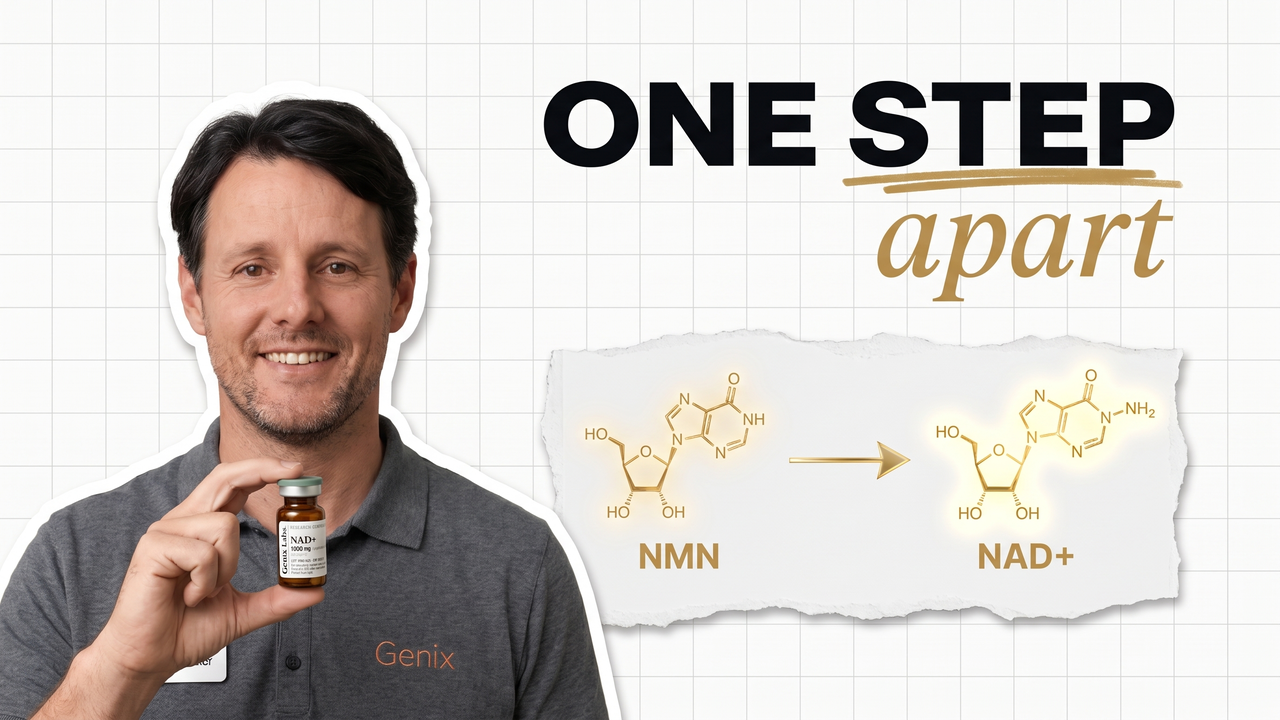
The precursor point trips up almost every ranking. A trial of nicotinamide riboside is evidence about nicotinamide riboside. It is suggestive for NAD+ itself and it is not the same study. NAD+ versus NMN sorts out which molecule each trial used, and the NAD+ benefits guide grades the energy claims.
Is MOTS-c worth studying?
As a research subject, yes. As a proven anti-aging compound, no. MOTS-c has the most interesting origin story here. It is encoded in mitochondrial DNA, not in the nucleus. Your mitochondria make it. That makes it a messenger between the cell's power plants and the rest of the body.
The founding paper came out in Cell Metabolism in 2015. In mice, MOTS-c improved metabolic measures and reduced diet-induced obesity and insulin resistance. That is a clean animal result with a plausible mechanism, which puts it on the third rung.
Human work so far measures MOTS-c as a marker, not as a treatment. Studies look at how blood MOTS-c changes with exercise or heat stress. That is useful physiology. It is not a trial of giving MOTS-c to people. The MOTS-c benefits guide separates those two literatures.
Does Epithalon belong on the list?
It belongs, near the bottom, and not where the other rankings put it. Epithalon is four amino acids, Ala-Glu-Asp-Gly. In cultured human cells it switches on telomerase and lengthens telomeres. A London lab reported that independently in 2025, which was the first replication outside the original group in over twenty years.
That is a genuine fourth-rung result and it got stronger recently. What has not changed is the top floor. No published study has measured telomere length, sleep or lifespan in a person given the tetrapeptide. Telomere length is testable from a blood draw, which makes the gap more striking, not less.
The same 2025 paper reported telomeres lengthening in two cancer cell lines, by a different route. An honest summary includes that line. Full detail sits in the Epithalon explainer and the side effects breakdown.
Which famous numbers belong to a different substance?
Three of them, and they account for most of the confusion in this category. The claims are not invented. They were measured. They were measured on something else.
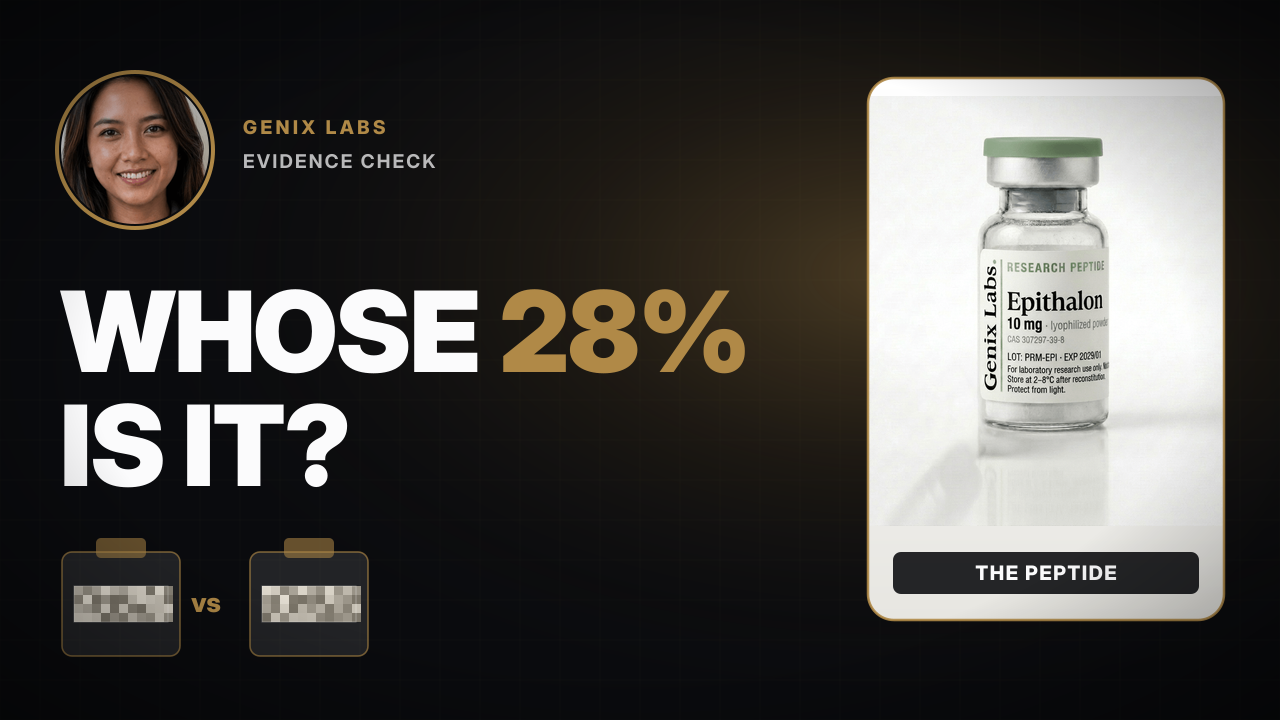
The Epithalon case is the worst. The famous figure, a 28 percent drop in deaths in an elderly cohort, came from Epithalamin. Epithalamin is ground-up bovine pineal gland. Its exact composition was never published. The vial sold today holds a synthetic four amino acid peptide. Different substance, same marketing page.
The NAD+ case is subtler. Trials used oral precursors. Vials hold NAD+. The copper peptide case is about route. The human data is a cream on skin, and the number gets quoted next to an injection. None of these three is a lie. All three are the wrong label on a real result.
What about thymosin alpha-1?
It is the one pick with genuine regulatory standing, for something other than ageing. Thymosin alpha-1 is approved in a number of countries as an immune modulator. It is used alongside treatment for certain infections and cancers. That is real medicine with real oversight.
The anti-aging pitch is a bridge. Immune function declines with age, a pattern called immunosenescence. Thymosin alpha-1 acts on immune cells. So the argument runs that acting on immune cells should slow immune ageing. The bridge is reasonable. No trial has walked across it.
That makes it second rung. Human exposure data exists, which is more than most picks can say. The endpoint in those studies was infection or immune markers, never age.
What about sermorelin and CJC-1295?
These are growth hormone secretagogues. They prompt your pituitary to release its own growth hormone, instead of injecting the hormone itself. Growth hormone output does drop with age, so the logic is replacement.
Human data exists and it is not ageing data. Studies measure the growth hormone response and IGF-1, a downstream marker. Some measure body composition. Those are second-rung endpoints. For a related compound in this family with real trial data, see tesamorelin versus sermorelin.
Do Semax and Selank slow brain aging?
No study has tested that. Semax is a short peptide related to a fragment of ACTH. Selank is related to a natural immune peptide. Both come out of Russian research and both have a mostly Russian-language literature on focus, stress and recovery.
Cognitive ageing was not the endpoint in that work. Attention, anxiety and stroke recovery were. Those are different questions. The two are on this list because competing rankings include them, and the honest grade is low. See Semax versus Selank for what each literature does cover.
What about SS-31 and elamipretide?
SS-31 is the most pharmacologically serious compound in this group. It is also called elamipretide. It targets cardiolipin, a lipid in the inner mitochondrial membrane, and helps keep that membrane organised. Poor mitochondrial function is central to ageing biology, so the target makes sense.
It has been through real human trials, in rare mitochondrial disease and in heart failure. Results have been mixed and the endpoints were disease endpoints. No trial studied ageing in healthy people. On the ladder that is third rung for ageing claims, even though the drug development programme is more advanced than anything else here.
Why is BPC-157 on other lists?
Because repair sounds like rejuvenation. BPC-157 is a recovery peptide with a large animal literature on tendon, gut and muscle healing. Healing faster is a good thing. It is not the same as ageing slower.
No published study measures BPC-157 against any ageing endpoint. Its place is the recovery cluster, not this one. The BPC-157 benefits guide grades what the animal work actually shows.
Do topical peptides actually absorb into the skin?
Some do, a little, and the detail decides the result. Skin is built to keep things out. The outer layer blocks most large molecules. Peptides are small compared with a protein, and the short ones used in cosmetics are small enough to get partway in.
Three things change how much gets through. Size matters, so a three or five amino acid peptide does better than a long one. A fatty tail helps, which is why Matrixyl carries a palmitoyl group. And carrying copper changes the behaviour of GHK entirely.
This is why route confusion is so costly here. The published skin results came from creams applied to skin. Quoting them for an injected vial changes the study without saying so.
What actually ages a cell?
Researchers group the damage into a short list, often called the hallmarks of ageing. Each pick on this page aims at one of them. Seeing which hallmark a compound targets explains why the rankings disagree so much.
| Hallmark | In plain words | Which pick aims here | Best tier reached |
|---|---|---|---|
| Telomere attrition | The caps on your DNA get shorter each division | Epithalon | T4, cells |
| Mitochondrial decline | The cell's power plants run worse | MOTS-c, SS-31, NAD+ | T1 for NAD+ blood levels |
| Loss of proteostasis | Damaged proteins pile up | No pick here targets this | None |
| Extracellular matrix wear | Collagen and elastin break down | GHK-Cu, Matrixyl | T1, human skin |
| Immunosenescence | The immune system gets slower | Thymosin alpha-1 | T2, immune markers |
| Hormonal decline | Signalling hormones drop off | Sermorelin, CJC-1295 | T2, IGF-1 |
One row is worth pausing on. The hallmark with the strongest human peptide evidence is the most superficial one, the matrix in your skin. The hallmarks closest to lifespan have the weakest peptide evidence. That inversion is the honest shape of this field.
What counts as an anti aging result?
A measurement that was taken before and after, in a defined group, against a control. That is it. Three things are often presented as results and are not.
- A marker moving in a dish. Real data, no body around it.
- A pathway being plausible. That is a hypothesis, not a finding.
- Someone feeling better after four weeks. No control group, no conclusion.
Apply that filter to the eight picks above and the list shortens fast. Three rows survive, and all three measured something narrow. A short honest list beats a long flattering one.
How long do anti aging peptides take to work?
It depends which pick, and for three of them there is no evidence-based answer. The published study windows are the only defensible timelines, so here they are.
| Pick | Study window | What was read at the end |
|---|---|---|
| GHK-Cu, topical | About 12 weeks | Skin appearance, healing after resurfacing |
| Matrixyl, topical | About 12 weeks | Wrinkle depth, photographic grading |
| NAD+ precursors, oral | Days to 6 weeks | Whole blood NAD+ by mass spectrometry |
| Thymosin alpha-1 | Weeks, per indication | Immune cell counts and markers |
| MOTS-c | No human outcome study | Nothing. Timelines online are practice, not data |
| Epithalon | No human outcome study | Nothing. Cycle lengths online are community practice |
Any page that gives you a confident week-by-week schedule for Epithalon or MOTS-c is reporting a forum consensus. That is worth knowing and it is not a study.
Can you stack anti aging peptides?
People do, and no published study has tested any of these combinations. That is the complete state of the evidence on stacking. The rest is reasoning.
The reasoning is not silly. Each pick hits a different hallmark, so overlap is low and interference is unlikely on paper. The practical cost is different. A stack makes the result unreadable. If three compounds go in and one marker moves, nothing tells you which one moved it.
- Write down which marker belongs to which compound before starting.
- Change one variable at a time, or accept that the result is uninterpretable.
- Keep the lot numbers. A result with no lot attached cannot be repeated.
- Copper plus more copper is the one real interaction risk in this group.
Which biomarkers are worth tracking?
The one the study measured. Pick anything else and there is nothing to compare against. That rules out most of what gets tracked in practice.
- Copper peptide work: skin biopsy collagen density and blind photographic grading.
- NAD+ work: whole blood NAD+ measured by mass spectrometry, not a wellness panel.
- Epithalon cell work: telomere length and telomerase activity.
- Growth hormone peptides: IGF-1, plus body composition by a consistent method.
Weight, mood, sleep scores and energy are not ageing markers. They are worth noting and they answer a different question. A wearable sleep score is a reasonable thing to watch and it has never been an endpoint in any study on this page.
Are longevity peptides safe for long-term use?
Unknown, for every systemic pick here, because the studies that would answer it do not exist. The longest human NAD+ precursor trials ran weeks to months. Ageing happens over decades. Nobody has run a decade-long trial of any of these compounds.
Two specific flags are worth naming. Copper accumulates, so copper peptide exposure has a real upper bound. And anything that raises telomerase activity raises a question about cell lines that already divide without limit. The 2025 Epithalon paper saw telomeres lengthen in two cancer lines, which is exactly the question that needs answering.
Are anti aging peptides FDA approved?
Not one of them, for ageing. The reason is structural. Ageing is not a recognised indication, so there is no label a drug could be approved for. A compound can only be approved for a disease.
Some picks do hold approvals elsewhere, for narrow uses. Thymosin alpha-1 is licensed in several countries as an immune modulator. Elamipretide has been through formal trials. Tesamorelin is approved for a specific metabolic indication. None of those approvals is an anti-aging approval, and the difference is not a technicality.
Do anti aging peptides need a prescription?
That depends entirely on the country and on what the compound is being supplied for. Research-use-only supply is a separate legal category from medicine. It means the material is sold for laboratory work, not for a person.
Everything Genix Labs supplies falls in that category. It is not for human or veterinary use. For how that works in this region specifically, read are peptides legal in Indonesia.
How do these differ from growth hormone?
Growth hormone is the hormone itself. The peptides in this group are much smaller molecules that either signal your body to make its own hormone, or act on a completely different pathway. Size and route are the simple difference.
The important difference is the evidence base. Growth hormone has decades of human trials, including the ageing trials, and those trials found real body composition changes along with real side effects. The secretagogue peptides have far less human data and a gentler signal. Less data is not the same as more safety.
Do anti aging peptides really work?
For narrow, measured things, two of them do. Copper peptides changed human skin in a published study. NAD+ precursors raised blood NAD+ in a placebo-controlled trial. Those are genuine results and both are small.
For the big claim, slowing or reversing human ageing, nothing here has been shown to do that. Not one study on this page used ageing as an endpoint. Anyone telling you otherwise is describing a mechanism and calling it a result.
How do you know the vial holds the peptide?
You read the lot document, and you check three specific things. This is the section no competing ranking includes, which is odd, because a ranked list of compounds is useless if the vial contains something else.
- HPLC area purity. A percentage for the named peptide, on the lot you were sent. Ours run 98 percent minimum by specification.
- LC-MS identity. Mass spectrometry confirming the molecule is the one on the label. Purity without identity proves nothing.
- An ISO 17025 accredited lab. Accreditation is what makes the number auditable instead of a claim.
- A lot number that matches your vial. A report for a different lot certifies a different vial.
Here is what our own published lot reports say for the longevity range. These are the documents, not marketing copy, and each one applies only to the printed lot and fill size.
| Compound | Tested size | Lot | HPLC area purity |
|---|---|---|---|
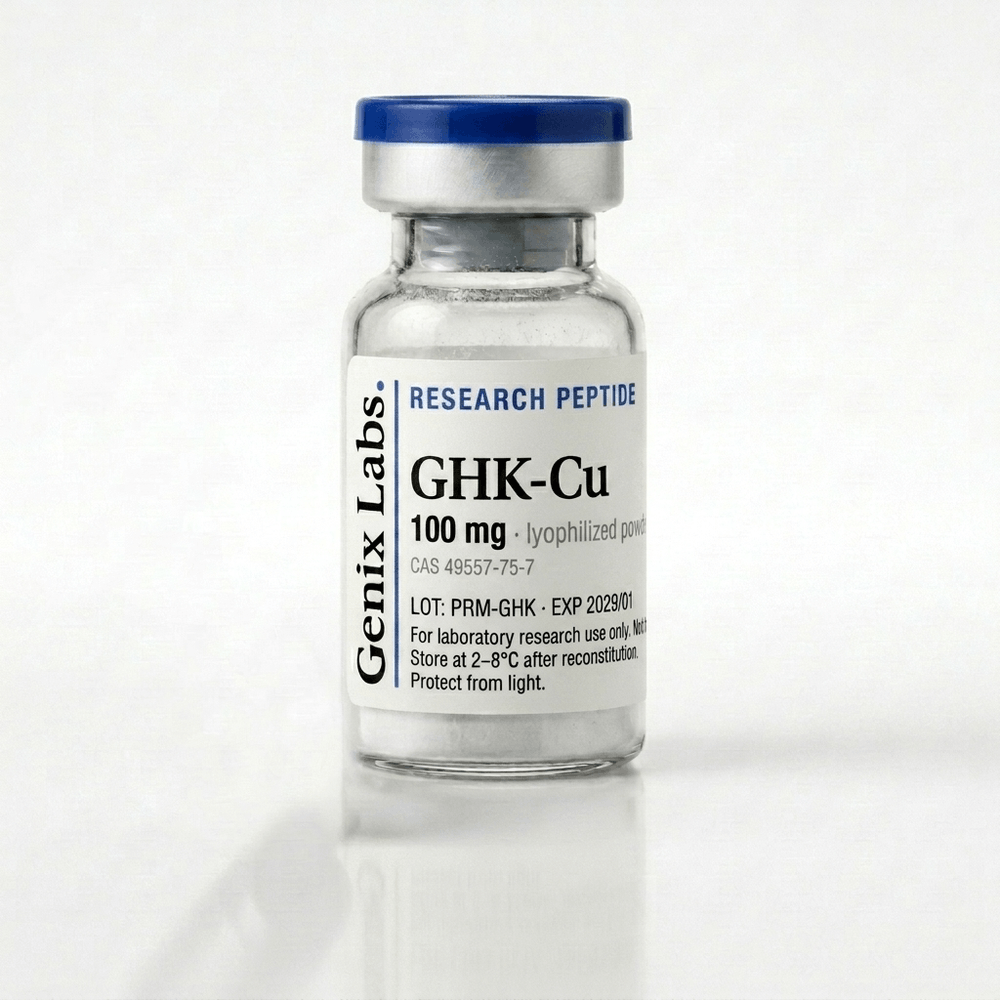
| GHK-Cu | 100 mg | 830472 | 99.10% |
| Epithalon | 10 mg | 489053 | 99.40% |
| MOTS-C | 10 mg | 559238 | 98.90% |
| NAD+ | 1000 mg | 158390 | 98.70% |
| Glutathione | 1000 mg | 264817 | 99.20% |
Why does handling decide the result?
Because a peptide that has warmed up and sat around is no longer the peptide on the certificate. Purity is measured at the lab, on that day. Everything after that is handling, and handling is where most of a result gets lost.
- Lyophilised powder is stable cold. Minus 20 degrees Celsius for long storage.
- Once reconstituted, 2 to 8 degrees Celsius, and a short working window.
- Light and repeated warming both degrade peptides. Freeze-thaw cycles are the worst case.
- Cold chain from the lab to the bench is what keeps the certificate meaningful.
We ship cold chain, same day inside Bali, with cash on delivery available. The practical detail is in how to store peptides in Bali and how to reconstitute peptides.
What does a year of research cost?
Nobody else prints this. Here are the real current prices, in USD and IDR, for the longevity range. Reconstitution needs bacteriostatic water, which is listed too.
| Compound | Vial | USD | IDR | Evidence tier |
|---|---|---|---|---|
| GHK-Cu | 100 mg | $69 | Rp 1.090.000 | T1, human skin |
| Epithalon | 10 mg | $49 | Rp 850.000 | T4, cells |
| MOTS-C | 10 mg | $79 | Rp 1.290.000 | T3, animals |
| NAD+ | 1000 mg | $125 | Rp 2.000.000 | T1, blood level |
| Glutathione | 1000 mg | $63 | Rp 1.000.000 | T2, human studies |
| KLOW blend | 80 mg | $179 | Rp 2.900.000 | Mixed, per component |
| Bacteriostatic water | 10 mL | $13 | Rp 200.000 | Solvent, not a compound |
One comparison stands out. The pick with the best human evidence, GHK-Cu, is also among the cheapest. The pick with the thinnest human record, Epithalon, is the cheapest of all. Price does not track evidence here in either direction, which is worth knowing before a ranking persuades you otherwise.
The GHK-Cu 100mg vial is the single best-evidenced starting point for anti-aging peptide research in this range. The KLOW anti-aging stack bundles GHK-Cu with KPV, BPC-157 and TB-500 at a discount to the vial sum, and KLOW versus GLOW explains what is in each.
What wastes a research cycle?
- Choosing the pick with the best story instead of the best study.
- Quoting a topical result for an injected route, or a precursor result for the parent molecule.
- Running three compounds at once and then asking which one worked.
- Tracking a marker no published study measured, so there is nothing to compare.
- Letting reconstituted material warm up, which quietly voids the certificate.
- Keeping no lot number, which makes the result impossible to repeat.
Who is each pick for?
Different research questions point at different compounds. Matching the compound to the question is most of the work.
| If the research question is | The pick that fits | Why |
|---|---|---|
| Skin matrix, collagen, wound repair | GHK-Cu | The only human skin study on the list |
| Cellular energy currency | NAD+ and precursors | Controlled human trials on blood NAD+ |
| Mitochondrial signalling | MOTS-c | Strong animal data, clean mechanism |
| Telomere biology | Epithalon | Replicated cell result, no human data |
| Oxidative load and detox pathways | Glutathione | Human exposure data, broad endpoints |
| Immune ageing | Thymosin alpha-1 | Real approvals, no ageing endpoint |
Which picks would we skip?
Three, for three different reasons. Saying so is the point of a ranking that is not a catalogue.
- BPC-157, for this question. Excellent recovery literature, no ageing endpoint anywhere.
- Sermorelin and CJC-1295, because the ageing biology argues against the goal itself.
- Argireline, because its record is thinner than Matrixyl's and aimed at a narrower effect.
Skipping is not a verdict on the compound. It is a verdict on the fit between the compound and the question on this page.
Frequently asked questions
Which anti-aging peptide has the most clinical evidence?
GHK-Cu, by a clear margin, and only for skin. A 2006 study in Archives of Facial Plastic Surgery tested a topical copper tripeptide on laser-resurfaced human faces. Nothing else on this list has a published human skin trial. The systemic longevity picks rest on cell and animal work.
Are anti-aging peptides FDA approved?
None is approved to slow ageing. Ageing is not a recognised indication, so no peptide could hold that label. Tesamorelin and thymosin alpha-1 are approved elsewhere for narrow medical uses. Everything in this guide is supplied for in-vitro laboratory research only, not for human or veterinary use.
Can you stack multiple anti-aging peptides together?
Stacking is common in protocols you read online, and no published study has tested any of these combinations. Each pick acts on a different pathway, so a combined effect is plausible on paper. Plausible is not measured. A stack also makes it impossible to tell which compound moved a marker.
How long do anti-aging peptides take to work?
The honest answer differs per pick. Skin studies of copper peptides ran about twelve weeks before measuring. NAD+ precursor trials measured blood levels inside two weeks. For Epithalon and MOTS-c no human study measured any outcome over time, so any timeline you read for those is community practice, not data.
Are longevity peptides safe for long-term use?
Nobody knows, because long-term human safety studies do not exist for the systemic picks. The longest human NAD+ precursor trials ran weeks to months, not years. Copper peptides carry a known risk of copper accumulation at high exposure. Absence of reported harm is not the same as demonstrated safety.
What biomarkers should you track when studying anti-aging peptides?
Pick the marker the published study measured, or you cannot compare. Copper peptide work used skin biopsy collagen and photographic grading. NAD+ trials used whole blood NAD+ by mass spectrometry. Epithalon cell work used telomere length and telomerase activity. Weight and energy are not ageing markers.
Takeaway
The honest ranking is short. GHK-Cu first, because somebody measured it on human skin and published the result. NAD+ precursors second, because a placebo-controlled trial raised blood NAD+ in older adults. Matrixyl third, for the same reason in a cream. After that the ladder drops to animals and cells.
Nothing on this list has been shown to slow human ageing. Not one study used ageing as an endpoint. The three most-quoted numbers in this category belong to a different substance, a different molecule, or a different route than the label they carry.
That leaves a usable rule. Pick the compound whose best study measured the thing you care about, verify the lot before anything else, and track the marker the study tracked. Start at the longevity and anti-aging peptide hub for the rest of this cluster, or read GHK-Cu benefits for the top pick in detail.
Genix Labs supplies all compounds strictly for in-vitro laboratory research. They are not for human or veterinary use, and nothing on this page is medical advice.